CTA’s Melissa Harrison on CES 2026, AI & the Future of Events
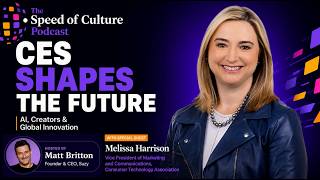
In this on‑location interview at CES 2026 in Las Vegas, host Matt Britton talks with Melissa Harrison, Vice President of Marketing Communications for the Consumer Technology Association (CTA). Harrison outlines her unconventional career path—from working on public policy in the Obama administration and the EPA to a stint at Ogilvy—leading to her current role shaping CTA’s narrative. She explains CTA’s broader mission beyond the trade show, including a 160‑person government‑affairs team, a research division, and an ANSI‑accredited standards group that influence everything from airplane mode to over‑the‑counter hearing aids. The conversation tracks CES’s evolution from a pure gadget expo to a cross‑industry platform that now attracts consumer brands, media, and the creator economy. Harrison details the massive logistics of staging the show—13 venues, a December build‑out, and Las Vegas’s unique capacity. She describes CES’s marketing strategy: deep audience segmentation, global outreach, personalization powered by AI, and the need to balance attendees and exhibitors in a two‑sided marketplace. The rise of creators is highlighted through the new Creator Space, its redesign based on feedback, and the shift from treating creators as media to offering them on‑floor, interactive experiences. AI’s role is examined, noting the transition from theoretical buzz to tangible demos such as digital twins, humanoids, and autonomous vehicles, with AI now a headline theme. Harrison also discusses strategic category moves, like co‑locating digital health with smart home to foster remote‑monitoring conversations. Looking ahead, she mentions the launch of CES Foundry (AI and quantum focus) and speculates on future expansion. The interview closes with Harrison’s personal mantras—always say “yes” to opportunities and a favorite Eleanor Roosevelt quote about believing in the beauty of one’s dreams—reflecting her outlook on career and the show’s future.
Chapters
We are live in Vegas here at the CES show, and today we are thrilled to welcome Melissa Harrison, the Vice President of Marketing Communications at the Consumer Technology Association. Melissa is a seasoned communications and marketing leader with deep experience shaping narratives at the intersection of technology, culture, and public policy. Melissa, thanks so much for joining today.
Oh my gosh, it's such a privilege to be here. Thank you for having me.
Absolutely. So we are here, CES week. We made it. Las Vegas 2026, and you were kind enough to lend us some of your time and what I'm sure is a very busy week for you. Tell me about the road you took in your career to lead you to your current role as VP of Marketing at CTA.
We could talk for hours about that, but I'll try to keep it as simple as possible. I think if you looked at my resume, you would probably say that doesn't make a lot of sense. But I spent some time in my early career working in public policy and really at the intersection of politics and policy. And what I've realized is that turnout for voters is just like getting people to show up at a trade show in January, right? There's So someday I'm going to write about this, but there's a real intersection between just politics and policy and the work that I'm doing now, which I find very interesting. But yeah, so I spent some time there. I worked in the Obama administration at US EPA, dealt with a number of fun issues while there, and then had the opportunity to go to Ogilvy and really understand how brands are made.
And it's a great place to cut your teeth, isn't it?
I jokingly said to them, if you're crazy enough to hire me, I'm crazy enough to hire it too. To actually say yes, because most people start their careers at an agency and then work the other way. I sort of did the opposite. I came out of the Obama administration and was really interested in what don't I know? What do I want to do next in my career? What can I learn? And that is really where I just started to understand the intersection between marketing and communications in a really fundamental way and started working more across the corporate sector. And so when CTA called, there was no way I was, I was going to say no. I've known about CES my whole career. And CTA is well known in the Washington area for the policy and advocacy work that they do for the industry. It's a really great place to work with really great people. And so, I had the opportunity and I jumped at it.
So, how much of your role is spending time on all the other stuff? Because, and maybe we could talk about those other things that CTA does. That's right. More than just the show.
That's right. Most people don't know that there's about 160 staff at CTA that do all of the things I'm going to say and the show on top of it. So, we actually have a full government affairs team. Teams, who are a huge policy advocacy organization working on behalf of the tech industry, not only in Washington, but across the states and across the globe. On top of that, we have a full research team. So we put out a ton of research, really setting the standards for the industry and helping people understand what's happening. And then on top of that, we also have a fully ANSI-accredited standards team. Every time you turn on airplane mode, CTA made that. Wow. So it's just a gentle reminder that—
These things don't just come out of nowhere, right?
That's right. They don't come from nowhere. You know, we recently, the standards team and the policy team worked together for over-the-counter hearing aids to make them more accessible for people. And so you just, none of this happens overnight, but that is, that's all happening at the same time that we're, you know, getting ready to put on the world's best tech show.
Yeah. And we're gonna get into that. I've actually worked with CTA for now nearly 25 years. I worked with them when they were CEA.
Yes.
And my former agency, MRY Create, the something called the TKO Thunderdorm Tour, which basically— Love it. It was like a technology-infused dorm room and we actually built it on the showroom floor. That's so awesome. To show like what the future dorm room would be. Yeah. It's crazy. Yeah. Because companies like NVIDIA, I worked with through CEA back then and they were just making Xbox accessories.
Right, right, right.
Who knew it would be where it was? And you know, over the last 25 years as I've continued to come back to the show, It's just expanded, right? And it used to just be about physical electronics, right? And then you start to, right? And then you start to see some of the broadcasters and media companies come. Now you have Procter Gamble here and PepsiCo and these companies come. So why has it expanded and why has this become really a tentpole in business across, you know, media, entertainment, technology, marketing, et cetera?
It is, it's super interesting cuz when I started, you know, I, I was going through the history of the show and there was a period of time where everybody wrote about the show and it was the gadget show. Yeah, right. And now we go out to do media interviews and they say, you haven't talked about any gadgets. Are the TVs still going to be there? And I'm like, there's still going to be amazing TVs, huge, amazing TVs. But the evolution of technology, I think, went from— we thought about them in individual devices and now we're wearing them, our car, is a device, right? Like everything that we touch, we always say that every company is a technology company, and that is proven true across CES because we touch every sector, every category, anything you can think about. It's, it's really here. And it's— I think this is where business gets done and people want to kick off their year. They want to be together. The partnerships— when you walk the show floor, you may be not in the mobility sector, but you walk through West Hall, you can be inspired by anything that you see there, right? And that can ignite another idea of how to parlay that into something else or to move it from, hey, this works really well in the car. What if we moved it to this? And I just— I think people want that excitement and that feeling at the beginning of the year. Everything's fresh and new. Let's get to the show. It sort of feels like a family reunion. People are hugging, saying hello to one another.
Right.
But I do think that ultimately we are a B2B show. Right. And you've just seen that grow over the years. The enterprise sector continues to grow. So much of what ends up being consumer technology really does start across enterprise. And so I just— you can't— you can't walk the show floor and not be inspired. And I think people want to be here for that. Yeah.
So what goes into putting on a show like this? I think I read there's over 150,000 people.
So, so last year we had 143,000 people. We are— I can never tell you how many people are going to come.
We can probably get into this because for those who have been at CES, there's a whole ecosystem around CES. Obviously the convention center is sort of like ground zero, to speak for the show. But then there's all these sort of pop-up and satellite events and it's sort of like it creates this huge—
Right. So we have, we have 13 total venues across Las Vegas. So people often ask us, Why Las Vegas? Why January? I'm going to give you those— that inside scoop. Okay. Why January? We start building the show in the middle of December. There's only one period of time across Las Vegas and the convention center that there is enough downtime to build out a show of our size. Wow. So it has to be that period.
So you start— everything loads in December. It takes 2, 3 weeks to put everything together.
Yes. The second is that we always are in Las Vegas because there is no other place in the world that has enough floor space or hotel rooms in the world.
Correct.
Wow. Correct. Las Vegas has 150,000 hotel rooms, which we need. Yeah.
I mean, Las Vegas can really digest it.
Yes, that's right.
That's right. But it doesn't get chaotic.
Yeah, yeah, yeah. Well, we do our best, right? We have a lot. Our operations team, who's phenomenal, does a lot to make sure that it doesn't feel overwhelming from the shuttles to everything else that we do to try to help people get around the town. But It's, it's pretty incredible. There's a— so you asked really, how do we do it? There's, there's a core leadership team across all of the priority issues that, you know, where you're thinking about. So we have marketing communications, we have operations, we have sales, we have, you know, just anything you can think of. There's someone who needs to be a lead for that. Yeah. What I love to think about is my first day here. I just take a moment to sort of look around. It takes millions of pieces to put the show together. And we have a finite amount of people who do it. And it's just nice to take that moment, take a deep breath and say, we made it.
And that's one of the great things about being in the event business, because if you're in a business that we create digital products, you don't— you can't really touch and feel it, right? The physicality, the enormity of walking to the show and knowing that you had— you played a role, right? Bring this to life, right?
Especially last year when we changed, we did a wholesale brand change. So new look, new feel, and to show up and see it for the first time in a very tangible way, right? The website looks great. Our business cards look great, right? All of the things that us as marketers look at to make sure that everything's right. But to actually see, you know, coming up the escalator in the Venetian Expo and seeing the entire logo of 12-foot letters, right? There's, there's really nothing better than that.
So, so obviously your role is marketing the show. What does that look like? Who are you marketing it to? What tactics are you using to make sure that, you know, it continues to be— because you can't take it for granted, right? There's other conferences, other places. You're at the top, but, you know, you don't want to lose that.
We never rest on our laurels and we make pretty audacious goals for ourselves. We like to bring new things to the table all the time.
And global audience too, right?
Exactly. And so we have to not only look at Who's our core audience? Who— that's who's been here before, right? We look at our— basically the last 3 years of like, who's been here, how are we talking to them? But we also have to go out and grow, right? That's on top of everything we're doing. And we have to do that across not just the US, but globally. This year has been particularly interesting from a marketing perspective globally, right, where we've been dealing with geopolitical issues. We've been dealing with terrorists, right? There's So also, you're a trade association, and many times in other countries, there's no separation between the government and a trade association. And so having to establish ourselves as we are, we are a separate organization, right? This is, this is what we stand for. This is who we are. We've been very, very vocal in our opposition to the tariffs. But all of that, as you know, starts to sort of commingle and you have to work through all of those nuances, which I will just say I think it really comes down to personalization. And this is something that AI has just accelerated for us, for us to be able to talk to hundreds of thousands of people to get to that number of the 143 who actually show up on site. We've really broken it down. We have to know our audience so well because we can't go and talk to you about mobility if that's not what you're actually interested in. It's not going to drive you to take any action. And so we've, we've worked really hard on our audience personas, really thinking through how does this speak to our customer and how are we like, what's going to drive them to make the decision to come to Las Vegas?
And your customer is a two-sided marketplace. So it's the attendee and the exhibitor.
That's exactly right. So we're— we, we don't just get the privilege of looking at the attendee, right, as a marketing communications team. We're also talking to the exhibitors. We're also thinking about who's going to be keynoting and what that's going to be looking like and how do we weave that into what we're what we're talking about. It's— there's just so many layers.
The media too is massive. Oh my gosh. Right.
So we had over 6,500 media and content creators on the ground last year. I think we're going to be bursting at the seams again this year, especially now with the creator economy.
Oh my gosh. So many YouTubers coming in that cover this stuff. I mean, my 18-year-old son is here and he's—
I love it.
He's a YouTuber and he's there. He's there at the showroom floor right now covering different things for all of his friends and his followers. And I think that's a very cool new wrinkle in all of this?
So I will say, I think one of the things that historically we sort of always did was lump them into media, right? That just assuming that they would sort of want the same services, the same like touchpoints. And we really took some time to step back and say, that's actually not how creators are— want, want to show up. And we did some very deep dives and conversations with creators to say, What is it that you want? Yeah, right. Let's like listen to what they actually want. They don't want to be in a media lounge. They want to be on the show floor, right? They want to be in the middle of action. And then watching the rate at which they are able to turn over content— it's crazy.
Well, if you think about the mind— boss, what it used to be, you had somebody there doing videography, photography, there's a different writer, there's an editor. Exactly. The creator's all in one with the phone doing it, right? Sometimes live.
So this— in 2025, we built the Creator Space for the first time. And I kind of joked, I was like, if we build it, will come, right? You dip your toe in the water. And we, we got feedback as we were building it. We really tried to work with the, with the creator, the creators that we work with to just really get insights of like, if we put a lounge, does that make sense to you? If there's a stage where you come and listen to other people, like, is that something that the community wants? And what we saw was that it was— it went gangbusters. Yeah. And so we actually, we had it in the central lobby and the feedback we got was it was so great, but can you put it on the floor? Because we want to be able to pop in and hear someone speaking for a couple of minutes and then we want to be able to get back out on the floor and produce content. And so we were like, we can absolutely do that. So we moved it into Central Hall this year. And the other thing is that we had it limited to just media badges so that the creators could get in. But then we were hearing from brands that they also wanted to be in there because they wanted to have conversations with other attendees.
Publishers too.
Absolutely. And so we said, said, you know what, this needs to be an open space for dialogue. That's, you know, we wanna be a true thought leader where we are a convener, where we allow people to have these conversations.
And that's how me— the media landscape has evolved. It used to be there's a select few that controlled the narrative and there are big media companies. Now we're all creators, we're all publishers, right? We all have this device that allows us to capture anything at any moment.
That's right. And it's really been interesting because we've also started to learn just the creator economy around our exhibitors as well and better understanding who they're bringing to the show and who they're working with. And then also for us, you know, creators are like, we're— it's great that we're coming to the show. We're having a lot of fun. We love putting out the content, but this is also our business, right? How do we get to know the exhibitors? Right. And so for us to better understand how do we— what's the role that we should play in that conversation, maybe a little bit of matchmaking and a little magic there. But it's, it's been really interesting and, and really evolving and it's been something that it has been a little, for me, outside of what I typically have done. And so I've loved getting to learn and understand and, and really listening to provide a product that they want.
Yeah. So as I mentioned, I've been coming for 25 years and every couple years is a new big theme. And I remember when it was the iPhone and then there was all these iPhone accessory companies and app companies, and then you had, uh, you know, the whole world of digital media and streaming, and then you had a lot of the broadcast networks coming. I remember at one point, one of the years was like 3D technology, 3D printing.
That's right.
3D TVs, all those things. And now this is the year, along with last year, but definitely this year of AI.
Absolutely.
At CES. How big is AI of the CES story and how do you see AI transforming the show itself?
I think what's really interesting is that if you look over the course of the last few years coming out of the pandemic, AI has clearly been a part of the conversation.
Would you guys cancel one year because of the pandemic, or did you run it?
We, uh, we actually did a digital show. Oh, it was right before I started.
That's 2020 or 2021?
'21.
Right.
Yeah. So '22 was the first year back.
Yeah.
You, you, you started to, like, the conversation was happening, but it felt like it, like the gasoline got poured on the fire after ChatGPT. Yeah. Right. So that became a, a word that even my mom in Ohio was like, what's this?
It's the AOL of the AI generation. AOL got everybody online. ChatGPT. 100%.
And then it just just felt like it ignited a larger conversation. And, and we kind of laughed because we're like, well, AI has actually been a part of the show for many, many years. If you used an Uber to get here, if you flew on a plane, right? AI has been a part of all of this. But I think it started once it kind of crossed over into that vernacular with like the, the normal, like, Joe on the street. Yeah, it just, it really took off. I think over the last 2 years what you've seen is a lot of talk about it. And everybody felt like it was like, I need, I need to have AI in whatever I'm talking about to figure it out. Right. I think what we're seeing this year in 2026, which is going to be the giant leap forward, and this is just from what I'm seeing and what I've seen on the floor, this is the actual— we went from theoretical to practical. You're going to see AI, you're going to see physical AI, you're going to see digital twins, you're going to see all the humanoids, right? Like this— I feel like this is the year that we take that giant leap forward where you start to see all the things that we've been talking about in theory.
And we're at the bleeding edge of it, right? Like companies that, right, are making these ground, you know, these breakthroughs, right? And, and they're, they're seeing, wow, this product can really— this technology could really do interesting things with our product or service people never dreamed of, right? The first place they're going to bring to the public is here.
That's right. That's right. And it's— it is a privilege for us that they choose to do that. Uh, we love that people come here to make news. It's an incredible ecosystem between our exhibitors making news and the media wanting to be here gobbling it up. Yeah. So it's really great that they want to start the year off here, and we've already had such incredible news. I mean, I just saw, um, on my way here, I was literally scrolling through, and Waymo had just gotten their approvals to start testing autonomous driving in Las Vegas, right? Zoox is already here. Yeah, they're both on the show floor in West Hall. I mean, it's, it's just, we've talked about these things and now they're really—
that the future is here, so to speak.
That's right. And I think it's the, you know, this is the window into tomorrow today. And so I, I think it's fun to be here and see all of these things and to also have seen the things over the last few years and say, I don't know if that's ever gonna actually, is that ever gonna really happen? And then you're like, nope, it's here.
It goes from concept to reality.
That's right. That's right.
So it's interesting 'cause you brought up the pandemic and obviously one thing the pandemic brought to society and especially the business world is this whole remote culture. Right. A lot of companies are remote.
Right.
A lot of people are using Zoom to communicate. But there is still such power in human connection convening. And I would just love to hear your thoughts on why you think this is a business and an event that will stand the test of time based upon that.
Thank you for saying that. I will tell you that for all of the running across halls that I've seen people doing when they see their friend that they haven't seen all year, but this is the one place where they see them or their, or their partner, you know, business partner, etc. You cannot replace the serendipity of bumping into someone on the show floor and having a conversation.
Or even the conversation you and I are having now. Like, we do a lot of these podcasts over Zoom, but you have a connection to the interview.
Right.
Better.
But you get—
you really feel like you know somebody.
That's right. Yeah. I mean, you're looking at 29 meetings on average that our exhibitors are having.
Wow.
Right. When you think about what it would take to fly all over the world to do all of those meetings, or all the time it would take on a, you know, on Zoom. Zoom is great. It's also a tiny little box. It's hard to tell if you're trying to make a business deal. It's hard to tell emotion. It's hard to understand. Is the other— is the other person still here? Is the dog barking? You know, did the mailman come? What's happening? I just— I just think you can't replace that human-to-human interaction. And CS brings all of that together. And we've really tried to build community, right? So we're— we're here at C Space, right? That's a community. But we also have the different categories across the show floor and people are able, you know, our digital health community continues to grow and grow and, and you come here and it's your one chance to catch up with, you know, the other doctor who lives across the country. Right, right. It's just you can't— you just can't replace that in person.
Yeah. And what you mentioned, I'm glad you brought up digital health because the power of AI is it's going to seep its way into every industry, every sector, which then brings those sectors, right? So we actually— construction, it doesn't really matter what it is, right?
So we, we made a strategic decision Last year we, we moved our whole health category to the Venetian because that's where the smart home category is, right? And there is a direct connection between digital health and monitoring and keeping people in the home longer. And interesting. And being in your home and remote monitoring to ensure that after you get out of the hospital that they can monitor you at home so that you don't have to stay in the hospital or go to some type of recovery center. And hopefully you stay well. And if they notice anything that's wrong, they can catch it before you have to go back to the hospital. So there's just direct connection between those. And so we were seeing that happening in real time in the industry and we said, okay, these need to be together. These, these two groups need to be— they need to know each other and have conversations.
It's fantastic. Yeah. So I would imagine that planning for 2027 CES ends the day 2026 ends.
I wish it were that easy. I was joking that half of my brain is 2026, but when I get here and the other half is 2027, 2027.
So what can we expect to see as the show evolves? Right. You know, let's say we're in the year 2030. What is CES going to be like? Do you see the show being in other venues as well globally? I know you have sort of like these pop-up side events that happen during the year, but yeah, what's the future in terms of the expansion of the show?
Oh, I think that's it. I think it's so interesting. I'm so bad at guessing the future, but I'm so proud of the work that our team does to ensure that the show is really great, that the show floor is really great, that we put a wonderful product forward for everyone who wants to be a part of CES. I'm excited because we just expanded to CES Foundry. So we're going to be at Fountain Blue this year. That's going to be on days 2 and 3. That's all AI and quantum. Wow.
I think I got to check that out.
You got to go see it. I mean, there's going to be actual quantum demos, and I would love to tell you that I can explain to you how quantum works. I cannot. That is— that's why— that's why I do marketing. Exactly. Yeah. But that's, you know, we're always looking at what's coming next. What categories should we be talking about? How do we put that forward in a meaningful way and how do we go to market with it? Not only to attendees, but exhibitors. And so we're, you know, we're excited that we continue to find new ways to expand and grow in Las Vegas. And I don't know, I think the future is really bright. So who knows where you're going to see us?
For sure. So, to wrap up here, we always ask our guests if there's a saying or mantra that comes to mind that defines their career journey, and I would love to know what comes to mind for you during this busy week here in Vegas.
Yeah, I mean, let me tell you, there are two things. So, one, I want to say, say yes. And that has a lot to do with my career, but also CES. I think you have to be open to the possibility, even if you don't think you're completely ready to step through that door, that the door has been opened, you need to say yes, like take the chance. Make a new partnership, take the new job, do the thing.
So that's something that—
go to that event, right? Like, even if you don't know anybody, I think that's— we've lost a little bit of that coming out of the pandemic. And so I just encourage everyone to say yes. The other is a quote from Eleanor Roosevelt. She said that the future belongs to those who believe in the beauty of their dreams. And I've really tried to— that's been a quote that I've kept near and dear to me my whole life. And I've really tried to impart upon the people that I work with that if you don't, if you don't believe in the beauty of your dreams in the future, how do you make them happen? How do you really— like, you've got to believe in yourself. You got to believe in the excitement and the beauty that you're building. And so I've always tried to just lean into that and then share that with the people that I work with.
It's amazing. Well, there's a lot of excitement and beauty in what we're seeing here at CES. That's right. So thankful for you to take the time during this busy week to, uh, share the incredible story behind CES with all of us.
Thank you so much for having me, and I hope you have a great show.
Oh, I will. Thanks so much. On behalf of Susie and Adweek team, thank you again to Melissa Harrison, Vice President of Marketing and Communications at the Consumer Technology Association, producers of the CES show, which we're here in Las Vegas to check out. Uh, be sure to subscribe, rate, and review the Speed of Culture podcast on your favorite podcast platform. We'll see you soon. Take care.
More from Matt




MikMak’s Rachel Tipograph on Consumer Spending, Retail Media & Holiday Shopping Trends



Jaguar Land Rover’s Charlotte Blank on Luxury, Purpose & Experiential Storytelling



