David Grutman on Hospitality, Social Media & Building a Miami Empire
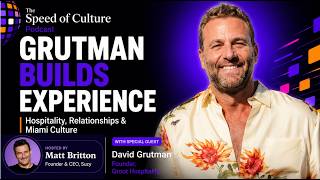
In this Speed of Culture episode, host Matt Britton interviews hospitality mogul David Grutman about his rise from early‑day flyer‑distribution to building a Miami nightlife empire that includes clubs like LIV, restaurants, and a growing portfolio of consumer‑brand investments. Grutman explains how branding has shifted from fax‑based invites to authentic, lifestyle‑driven social‑media content that he personally curates, and how he empowers his team to develop their own online personas to amplify the brand. He discusses the meticulous anatomy of a successful event, the importance of stamina and attention to detail, and his philosophy of treating every interaction as a win‑win, focusing on genuine relationships rather than opportunism. Grutman shares insights on networking with high‑profile figures such as Tom Brady, Bad Bunny, and Drake, and how those connections translate into collaborative ventures, from restaurant concepts to entertainment productions like a Netflix docuseries with Alex Earle. He outlines his investment strategy, partnering with distressed brands (e.g., Prince) and emerging consumer products (Olipop, Coconut Cult, NeuroGum), emphasizing advisory roles and mutual growth. The conversation also touches on his personal habits—abstaining from alcohol, daily tennis, family time—and how he balances a demanding schedule. Finally, Grutman talks about his new book, "Take It Personal," and a college course he teaches, framing his career as a blueprint for aspiring entrepreneurs, urging them to take ownership, act ethically, and prioritize long‑term relationships.
Chapters
Up today on the Speed of Culture podcast, I'm thrilled to be joined by David Grutman, one of America's most influential hospitality entrepreneurs and entrepreneurs overall. He's credited with transforming Miami to a world-class nightlife and dining destination. Dave, I'm so excited for this. Thanks so much for hosting us in your beautiful South Beach home.
Oh, thank you.
I'm so happy you're here. Absolutely. So let's start off with, you know, as I told you before we started,, I have a lot of background in nightlife. Uh, somebody who we both know, Jason Strauss, was my partner, uh, at Boston University. And we had a little—
but that's a little bit of a red flag.
Yeah.
I'm gonna be honest with you.
Um, and you know, we had a great partnership because he brought all like the New York kids. He went to a New York private school. I grew up in Philly, didn't really know anyone, and I brought the masses. And this is before social media. You know, I had teams of people handing out flyers for me. Faxes. Right, exactly. Different world. And he just had a network. And it was that combination that worked. But now we're in a completely different world and you've done such a great job at building your personal brand and the brands of all your venues using social media. And I guess my question for you as someone who's been in nightlife equally as long, how has it changed over the years in terms of building a brand specifically in the hospitality space?
Well, I mean, as you're building a brand, you always find what the best way to do it. Back then when Jason and I started, it was faxes, then it was e-vites, then it was flash e-vites with music and movement and all that. And then it, it was very event-driven and, and just mailed out invitations. Like, and then now with social media, it's a whole nother platform. So there's always been some sort of platform for us to find to try to magnify our message.
But I think you've particularly done a great job at just embracing social media and you seem really natural at it, whether you're talking about yourself, your ventures, uh, your, your vast network. Like what is your appro— what's been your approach to this?
So I do my own social media. You don't think I do it? No. So, That, let's start there. So it's, it's authentic. And I think I just like to show my lifestyle and hopefully you buy into like how I'm living my life and all the touching points about it. So that's kind of, social media's just been like, listen, I guess it's like having your own show, right? Right. Basically. So, so I kind of show my tennis, my, my meeting with people, my family, my, me going to the restaurants, other people's restaurants, consumer brand investments, how I use them, why I went with them. I just think it's important people get a glimpse of your life.
And part of what you do is seem like you just let— you're not afraid to let everyone in. No, of course. Because I think some people are private and you obviously live, you know, an amazing lifestyle just in terms of the way you spend your time and the network you have, but you're not afraid to share it with people. And, you know, my take from following you from afar is you love having people at your home.
Yeah.
Just like you love doing that. And have you always been that way?
Yeah, I've always— like, I love hospitality. Let's— at the end of the day, and I love hosting people. And you know, I've been doing it from so many years. I wanted to be that key holder. When you come to Miami, I, I really wanna be the person that you call and reach out to that makes sure that everything's perfect. And it started off just taking people to restaurants and yeah. And you know, then to my restaurants and then in my home and, and then hopefully party with them at nighttime at LIV. So it's been, it's been very cool to be that person.
So the first time I heard your name was in 2003 when someone who I know, you know, Ed Razak. Wow. I was launching Victoria's Secret Pink for Ed and Les, right? And we built this giant gift box in South Beach and basically opened up and we had a huge event. And that night Ed wanted us to take a bunch of people out and he's like, I'm going to call Dave Grutman. And I was like, who's that? And he told me about you and you came and you obviously, it was before you had this whole infrastructure here. Take us back to the early days when you came to South Beach and what were the path that got you to where you are today?
So I think when you talk about that part of my life, it was the VMAs and, and a lot of big marquee events were coming to Miami, but there was no real company or, or person for them to be able to communicate with. Like they were getting serviced in New York.
Who's the guy basically?
Right. Not only who's the guy, but also, uh, at that time I had a firm with a guy named Brian Gordon and Ryan Schimann.
And I know Ryan well.
And we used to, activate for the brands. And, you know, listen, New York and LA always got the bigger events and stuff like that. But then we grew the event business and being able to service them in a way that they needed to be serviced in a corporate way. 'Cause there's always that balancing act between, oh, let's throw a party and what's the corporation need to get out of it, right? Yeah. What's the branding? What, what's the message to get out? And at the end of the day, you know, what's the target to, to push the new brand they're launching or song or artist or who, whatever it is. I mean, they're all brands, right? So That was good. And then, you know, Ed Razek, when I got the deal at Live and I took him to the back of the Fountain Blue, it was dirt back there. And I go, Ed, I got this new club Live coming at this new Fountain Blue Resort. I think it's gonna change Miami. I need you to move the Victoria's Secret show from doing it in New York or LA, 'cause those were the only two places at the time. And I need you to do it for the grand opening of the Fountain Blue. And he looked around, then he looked at me and he goes, okay. And I'm like, okay.
He didn't need a place in Miami at the point, right?
He still has the same place at Il Villaggio. Yeah. Yeah. And, And Ed, to his credit, he's one of those vision makers. Yes. Yeah. So he was like, let's do it. And I remember it just really— there's moments in your life that you'll never forget. And that's definitely one of them. When I was able to call Jeff Stoffer, who owns the Fontainebleau, and say, Jeff, I got the VS show for us. And we'll do the afterparty at Live. But I think it's going to be a great thing for your resort. And Jeff right away is like, of course, let's go. And it was one of the most— in my life, one of those big blue checks that was just like—
I mean, Ed gave me my first big break too, so shout out Ed Rasek in advertising. Of course.
Best.
And there are people along the way who will just, you know, you probably think when you look back at your life of those moments.
Yeah. I mean, listen, Ed Rasek had Monica Mitra with him as well. And, and, you know, to Monica's credit, I really had to work Monica for many years saying, yeah, she's— and I love really strong women like that because And I've come across so many in my life where everyone else is like, oh, I hate that. And I'm like, no, these are the women that if you do what you say you're going to do, they do everything for you. And those are the ones I really focus on more than anything because they're the ones that change the world. So she's one. Amy Thompson was one that managed Swedish House Mafia and stuff like that. But to me, there's a couple of really strong women figures in my life that's helped me be better at what I do. Awesome. Yes, because they keep you in check. And, you know, I, I, I did a Super Bowl party for them right before that in Arizona, and I knocked that one outta the park. Like, for whatever reason, everything felt perfectly. They had a, a commercial in the Super Bowl that year, so they wanted to do an event afterwards for it. And from that, by knocking that outta the park, it gave me the leverage to say, I think this is gonna be something great for you as well. And he, everyone bought into it.
And to knock an event outta the park means a lot, right? You have to have the right people there, but that's only part of it. So what does it mean to knock an event out of the park, especially when you're on the road, so to speak? It's one thing if you're at your venue.
Yeah, the road, first of all, you're, you're kind of like, you know, you're not at the mercy, but you're like, thank, thank God I've built up enough, uh, name for myself that when I go to another venue or another city, they, they're not going to try to mess around, but they follow my direction. And my team is so good at making sure they know exactly what I'm looking for and what what's important to the brand because it's, it's subtle branding. It's making sure that people don't feel like they're walking into a commercial, but at the same time they know exactly why they're there.
Right. But you also have to think about the elements, like the anatomy of an event, right?
It's the music, it's the vibe, it's the performance, the, the pop-up performance, the one that no one knows about, the lighting, the music, the everything. It's all pieces of a puzzle to create something great.
Have you struggled throughout your career when you think about I've been at Live during Art Basel, like at the peak of an event like Calvin Harris there. And you see that every detail is perfect in terms of the lighting, the sound, the service, everything. To get there, have you struggled with, I guess, the dichotomy of allowing your team to do it, but you— but then at the same time, you looking at every single detail?
Yeah, I'm a, I'm a sick, sick human being where either my friends love going to dinner with me or hate going to dinner with me because I'm looking at all the different tables. Yeah. What's going on with the lighting and, and, table service. And if— is the plate dirty in front of the person? Is the— is our glasses empty? And I'm constantly looking. And I'm not one of these guys like some of my counterparts that will just write it down in an email and then they send it the next day. I, I correct it right on the spot. And that's not always the best way to do things, but it's the way I do things, right? Uh, and it's how I learn. I, I— otherwise I'll forget it and I won't— so yes, uh, but when everything's perfect like what you just said in, in an event and you just look around, you're like, it's the— it's the It's a, it's like this Stanford, it's like, it's like a perfect art piece to me. It is. Or like the wine. It's like, it's amazing. I just, I love it.
I do. I mean, I've produced some events in my life and when they go well and you look out there and people are having an amazing time and you knew that you put all the pieces together.
No, it's like the Catalina Wine Mixer. It's insane. It's perfection to me. I love when you see everything moving right.
Yeah. I think I have to check that out.
Never been. And right afterwards, uh, you high five with your, with your team. And this is where a lot of people in our business miss it is is you have an event that goes perfectly like that and they forget that there's tomorrow. And tomorrow we have to do it all over again. And being able to have that stamina for your, for you and your team to keep them focused on that, that's where the real power is. And that's how you keep building brands bigger and bigger and bigger. Yeah.
So like greatness is in the agency of others. And one thing I've noticed about you is that, you know, you have a squad, right? You have a team and people, and those people aren't just people that work for you. They're people that are kind of part of like your extended family and they've built their own social media brand as well. Of course. And, you know, I've known Purple for years and people like that who you've like, talk to me about how that comes about and how you're able to lead but still kind of make it seem like there's not like a hierarchy, but they're all just part extension of your network.
Yeah. Listen, because in, in our business, people wanna see certain faces around and I can't be everywhere. Yeah. At, at all times. So how great is it that I have a team that builds their own profile as well, right? And then integrates it into our places. Right. So at any time you could be one at one of our venues and see a familiar face that you might see on social or you might have a connections with or whatever it is. If it's just me, then I'm gonna be trapped and I'm never gonna be able to expand and grow my brands. Yeah. But if it's about all of us, then it's, it's way more powerful.
And I wanna move on to some of the other stuff that you're working on now. But the last question on the nightlife side is, you know, you're a family man now, right? You know, I read that you don't drink. Nope. And you know, it's one thing when you're getting high off your own supply. So just be like going out and partying when you're running a— I think that has a short— the most successful nightlife entrepreneurs don't party when they're out. I think you've kind of set the standard for that. But my question for you is, Is it harder to do what you do now that you're not really in the scene as much, even though you go there a lot? Like, how do you balance that?
So I think by not being super accessible is also okay too. Yeah, I, I, um, I don't find it an issue, to be honest with you at all, to not drink and be at my club. I like— I love it. I get to see more things going on and stuff like that. And you know what, uh, I don't know if everybody wants to be party with me. I'm an older man now, but it's cool, man. Listen, I think it's very powerful not to have to drink and not to do that.
And healthier too.
Healthier. And I don't think in today's society that's the part about going out anymore. I think people just like to gather and have fun and do whatever. Now listen, I sell alcohol for a living, so I hope lots of people drink.
How does that change your business?
No. So listen, I don't judge people for doing it. I mean, But of course I want people to party and have a good time and let their inhibitions go down. This is South Beach and this is Las Vegas. So if there's a place to do it, I want it to be done at my place.
Do you see the nightlife market changing with the private members clubs like Zerobahn and Cipriani? Like, do you— is that— and there's obviously ZZ's in a lot of places down here. Is that changing the nightlife game overall?
So Miami table market, you know, so Miami doesn't have that many members club like they do in New York and LA right now yet. Uh, but yeah, listen, um, I, I know in those markets, like, you know, all my friends are going to Crane Club or Zero Bond and stuff like that, but in Xe'Mar Go, but they're ex— they're just more nightlife extensions of people wanting to gather. Uh, for us in Miami, at the end of the day, people want a big club experience, they want a lounge experience, and they want to have a more festive time at dinner.
Yeah.
So it works.
It's interesting. A lot of people say, oh, consumers are never going to consume AI-generated content. And I actually wrote a post on LinkedIn the other day. If you go to EDC or, you know better than anyone, people gather around, listen to music that's not made by instruments and they don't care 'cause it's about how it makes them feel. They're musicians, but they don't use instruments. And to me, creative people can make AI content and I don't see the difference personally.
Okay. I mean, but people still want to experience.
No, my point.
Oh yeah.
That, my point is that a lot of people don't believe that AI content's gonna take off. And my proof is that. Essentially, it already has. Exactly. It already has. Exactly. Exactly. So let's move on to just network. Like you have built such a great network. If I look at your book, which we're gonna get into in a second, you have Tom Brady, David Beckham, Serena Williams on the back, superstars, right? Um, how have you been able to build this network over time? And it doesn't seem opportunistic to me. These people are truly your friends. Like what has your approach been?
Well, I don't try to take advantage of them obviously as well. And I think by just having great relationships and trying to add value to people's lives, they naturally naturally want to do great things for you. So it's not like, uh, I think when you go into something, opportunist people, you know, like anything else, you, you could feel when someone's trying to be opportunist with you or not, and if it's authentic or not.
100%. And was it— how did you get to be comfortable around the Tom Brays of the world? Like, it feels like you, you, you talk to them like you would talk to anybody else. Like, was that always in you, or is it something that you had to develop over time?
I think, uh, like anything else, I think by just talking to people all the time and tell— asking people their stories and stuff like that, and just having that interaction, being in the hospitality business kind of trains you to be able to talk to anybody anytime. And but if you just focus in on that one celebrity and not the other people around, that's when you lose, right? So I wouldn't be here today if I just focused on the Tom Bradys and not all the people around them, or all the people at the dinner that I'm with when there happens to be a celebrity or master of business or anything like that.
I mean, you're not chasing—
yeah, I just, I just— I'm here to have a conversation and entertain and, and just make people feel comfortable.
Yeah, awesome.
But not just the one person, the 10 people at the table, right?
That's important versus just zoning in on the most famous person.
Man, people do that, and I, I've been to dinners like that who, when they didn't know who I was, and I'm just like, oh God, right?
Because you really know what's behind that.
It's just like, yeah.
And that's probably why ultimately you've been able to build great relationships across the board. Yeah.
And I don't go into the relationship saying, what can I get out of?
Right, right, right. So I'm sure a lot of it is about value exchange and you're looking to—
and you know, a lot of people say, oh, I'm going to go to this networking event. I fucking hate that, man. I really think networking might be the worst thing I've ever heard before in my life. I really go to things trying to build authentic relationships with people.
Yeah.
And, you know, I'm not trying to hit 100 people. I'm trying to really build 1 or 2 really great relationships.
And speaking of spanning relationships, you've obviously done a lot outside the nightlife industry, and we're here in your office and seeing all these different brands that you've invested in. Yeah. How did that start, and talk to me about the process and, and how it's going and what you're getting out of that experience.
So it's been one of the most rewarding experiences, and, you know, as you get older, you want to keep, you know, pivoting and, and, and, and, or bringing other extensions of your ecosystem into your life. And, you know, I started making an ecosystem for me in the hospitality. I have like, you know, a restaurant and a nightclub and, you know, et cetera. So they all kind of feed each other. Now on the consumer brand side, I started doing it like right around COVID time. My first thing was I partnered with ABG and we took Prince out of bankruptcy and, and I be— and I did that and I saw that I had an effect on a clothing brand or lifestyle brand like that.
That was like— They were a distressed brand. Authentic Brands Group does that. You, they partner with you.
Yeah. It's, I mean, and they're, they're, by the way, they're the best partners. They're able to take a distressed or— They're fantastic. And, and work with you on building it and making it a great brand internationally. So that was great. But I really, where it really turned the needle for me is I met the co-founders, the founders of GoPuff. Yeah. Raph and Yak. And, uh, GoPuff, which is the most amazing delivery service. It's, they're incredible. Uh, we would talk to these young founders of consumer brand goods together. So you have me and the GoPuff founders on the Zoom with them. And it was, of course, you could see the, the, the person on the other line a little nervous, but I learned so much with them how, and also the way I live my life is I want it to be a win-win business. Now, the three of us together could really take advantage of an up-and-coming consumer brand. Instead, we never did stuff like that. We said, listen, let's do this. We want to not only invest, but we also want to advise and we want to build your brand together. And I think we, you're gonna get there no matter what, but with us, you're gonna get there quicker, better, faster. Right.
And just through the connections you have.
Yeah.
The whole thing.
Right. So to see the reward, you know, after you've done it a few times and to see founders just call you and go, I never imagined in my dreams this would happen. And that is the reward of all rewards. Forget about the money and all that. All that is just a utility of changing people's lives.
It's so true. If I look back on my career, the things, you know, once you make a certain amount of money, it's, you look for the intangibles and what gets you up. Exactly. To me, I look at people just how Ed Rezac gave you and I, sure, you know, an opportunity. There are people who, like, when you look back and you're like, wow, look what they're doing now. It's so rewarding.
And also people that, you know, I've, I've had my company for so many years to see that, you know, there has been people that have left me and started their own companies and they've been very successful. That, that makes me very happy too. Yeah. So that's great too. But I think as you work with these, with Skinny Dipped and Goodles and, and, and Coconut Cult and NeuroGum, and they're just exploding. Vacation is just at a crazy raise. It makes me so happy that I was a part of that.
Yeah. And I think the food and beverage space is changing so much. You look at GLP-1s and people want to live lives and you, the incumbents, the Coca-Colas and Mondelēzes, they're getting hurt by these new—
Olipop.
Yeah. Olipop's a great example. And Poppy, happy for your investment.
Yeah.
So, uh, I, we had, uh, David Lester on the podcast.
Great. Yeah.
Great guy.
Great guy.
Yeah.
Uh, I think Olipop is, is a disruptor of all disruptors. They are. I think. To me, Coconut Cult, now that they have these single serves that are out in—
what is Coconut Cult?
So it's a probiotic yogurt. There's 4— it's going to win the battle of gut health. As a Jewish boy, it's changed my life, that's for sure. And it's, uh, it's just one of these most— these very disruptive brands that you see come across your, your path. And so I'm so lucky to be able to invest in it. It's awesome.
And your latest venture is going into— you know, I was watching the Super Bowl a couple weeks ago.
You saw that?
And my, my wife's like, that's Dave Grubman. I'm like, what? No. And we rewound it and I was like, no way. And then it made sense because I know you have a relationship with Bad Bunny.
Yeah, yeah, for me.
Um, let's talk about, well, first of all, how did that come about?
It's so funny. Back in the day, uh, EDM was, as you know, was the most explosive music style there was. And we used to have a Thursday and a Saturday of EDM music. And then when EDM took a dip down, the Thursday was more the night that we incubated new DJ acts, and that had to go away. We could just focus on the Saturday. So we did a Latin on Thursday in Miami, and I was like, okay, let's do it. And I saw the reaction of people when this guy Bad Bunny would come and do the show, or come and, you know, host the night or whatever.
And this was before anyone knew him, as early—
I mean, listen, these are very early days, right? And I'm having dinner with Drake, and Drake goes, who's the hottest reggaetón guy right now? And I go, Oh yeah, Bad Bunny. He goes, he doesn't respond to my DMs. I'm like, are you sure you have the right DM? Right. That night I called him and his team and they didn't believe it. I said, Drake wants to record with you. He's recording a Scorpios album now. Scorpions album. And he'd like to see you tomorrow. And they go, we don't believe you. So I hand the phone to Drake. Drake goes, either you come to me or I'm going to come to you. They come the next day. They do Mia, one of the biggest hits, I think, in Bad Bunny's and Drake's. I mean, it was just a monster hit, and he never forgot it. And there's been other times along the way that we've been helping each other. And Live Nation buys 51% of my company, and Michael Rapinoe, who's the greatest partner, CEO, president—
right, better than your book—
he's just the greatest, goes, hey, I really want to do with Latin like I did with hip-hop with Jay-Z and Roc Nation. I want to do— I go, well, There's one guy to do that, and that's Noah Assad, who's Bad Bunny's manager. And when Bad Bunny went to do the stadium tour deal, he said, I have another condition. I want David Grutman to do a restaurant with him. Wow. So A, it makes me look great with my partners from Live Nation. First of all, the fact that he, he left this independent promoter that he was with for so long and go with Live Nation, um, and launch this tour. And then he goes, I want to do a restaurant with David Grutman. And we have Gecko. And Gecko's just been such a special place, not only just for the food in times and stuff we get to share there, but the fact that we did something special together.
Yeah. And he just said, I'm gonna be in the Super Bowl halftime show, why don't you come down?
Well, I went to the, I went to his residency, which there should be a case study from Harvard on because that's how impactful his residency in Puerto Rico was this summer. And he had something called Casita. So usually where the friends and family riser is, he built a Puerto Rican house. Oh, great. With satellite dish and couches and bar and every, and front porch and the whole thing. And I went to it this summer and I was in there. And I happened to be with him when he got the call that they got the deal for the Super Bowl. And I go, are we doing the Casita? 'Cause I want to do the Casita. I want to put the people in there. And it wasn't even a question. They were, they were all about it. And they're just great people. Noah Saad, his manager, Bunny and his whole team. And they've been with him for so long. There's special people out there and you just, you know, it's great to be a part of that team.
So speaking of entertainment, so I know that's your latest venture. Yeah, production or other production entertainment. So let's talk about it. I know you have a big show with Alex Earle. Yeah, coming out.
Finally got greenlit on something.
It's amazing.
Uh, and I'm currently— we're filming the Black Coffee documentary right now. Uh, but I've pitched a lot in the— so it's been— it's me and Evan Rosenfeld, and we just partnered now with Wheelhouse. Uh, so we're partners with Wheelhouse on the production company. But right before that, I had pitched a lot of shows, and a lot of shows, they were like, no, it's not right now. You want to get into it because Being in Miami, I come across so many amazing characters that I feel like their story needs to be told. And knowing Alex and Alex's world, it makes— for me, it makes all the sense in the world for great TV. And getting— convincing her and her entire family to want to do a reality show, or a docuseries, sorry, was not the easiest. I had to, like, FaceTime a couple of big friends of mine and have them convince them. Right. And then this— Ben Winston, who runs Falwell, who I just know does such a great job. Ben didn't know Alex at the time, and I just kept pushing Alex. I'm like, Ben, trust me, this is the one. And then as he did his research, he's like, she's the one. And finally, so we're partners on producing the show together. 3 different streaming services made offers on it, but we went with Netflix. And I'm so excited for the world to see the Earls. Yeah, because it's not just Alex, it's the whole family, and they're all such great characters.
So cool.
Yeah, first of all, she's— it's amazing what she's created, but you're— I think you're going to be equally amazed on what the rest of the family does.
And you know, Kim Kardashian obviously wrote the foreword to your book.
Of course.
You know, they kind of set the tone and the roadmap for reality TV and how it can help you branch big time into so many different ventures.
Of course. I mean, look, they've, uh, used that as a platform, and you know, there's so many superstars in that family that have gone on to grow their own Brands. Yeah, this is incredible.
Yep. Kylie and Ham Candle.
I got my Cloud Protein popcorn last week. It's like the— it's the best.
And, and when they— when something like that comes out, they know to send it to you, and you're always getting stuff in the mail here, and you're posting it. You're just building the net.
Well, it's about— it's about supporting your friends. So I think whether it's a post, whether it's even just calling them saying, I gotta tell you, it's what a great brand, telling other people about it, I think being Being people's cheerleader is the, is the greatest thing you could do in life. 100%.
So you got the entertainment venture, you have the restaurants, you have the nightclubs, you have, you know, all these ventures that you're doing. What's the pie chart of your day look like?
Uh, well, every morning from 8 to 9, I, I do tennis or I like every morning, every morning, or I like to call it fennis cuz I don't overhand serve.
Is that, was that hard for you to carve out given your family commitments, your work commitments to make sure that you do that every day? Cause a lot of people don't take the time to do that.
So it's very, it's, I think you know, what's important to you, you make time for. So that's by having a consistent time with that, that helps me kind of do the rest of my day. And I do meetings every half an hour to an hour, a lunch meeting. I do everything at my house, though, to be honest. Really? Yeah. So every— every meeting's here, lunch is here. And then my kids come home, like around between 4 and 5, and I take like an hour or two with them to try to be present. Have dinner with them, and then, uh, I do my second job of, you know, going to visit my restaurants and nightclubs.
Very cool. So to wrap up here, the book, um, Take It Personal, uh, what made you decide to write a book, and what do you hope readers will get out of it?
You know, I've been teaching a college course for the last 5 years at FIU Hospitality, The Dave Grutman Experience. The David Grutman Experience.
Yeah, very cool.
Uh, And the reason why I wanted to teach and the reason why I wanted to write a book is there was no blueprint for, for what I do back then. And I've been able to— there's a lot of stuff they don't teach you in college. And I think it's important that to, to be able to do what I do and where I'm at, there's certain things along the way that I, that I made a priority. And I put that all in the book because I want to be able to give the next generation a blueprint of stuff they may not learn in school, or just ethics and beliefs and relationships and how that really Over time, by playing the long game, works out great.
And it's not lost on me that you call the book Take It Personal because like you're inextricably linked to what you do professionally, right? And who you are as a person. Some people, they're a lawyer, no one wants to talk about how they're a lawyer during the day and they, they're a different person at night. But you are, it's all one. Is that a part of what, why you wrote the thesis of the book behind Take It Personal?
Well, I think because I take, I, I, I keep things so, uh, inside me that I take it personal. And one of the best ways that I've ever learned was when I, when I made mistakes, someone came pretty truthful and hard with me and I, it really resonated inside to me. I take things so personal that that's why I think I'm successful.
Yeah. I mean, speaking of which, there, we have a lot of younger listeners of the podcast and there's probably very few that wouldn't want to have the career trajectory and the life that you built for yourself. Mm-hmm. You know, you have a beautiful family and a great career and you're well-liked and you have incredible experiences. Is what piece of advice would you give to younger people starting off on their journey so they can essentially realize their potential in life like you have?
I think they'll go into every— I mean, I think for me, what's so— I go into every interaction as a win-win. And I just want to— when you just go into it like you're wanting to do good for somebody, it comes out great. And I always see, how do I, how do I make this—
not keeping score, not thinking what you're going to get back?
No, I keep score in tennis, that's for sure. There's a guy named Cedric Gervais that we're getting. Yeah, he's He's a terrible tennis player. But no, listen, I think when you go into something and your ethics and beliefs is something just for your self-gain and not for the other person, it pays off 10 times over just to do good for that person. And I think that's what's helped me so much in my life.
Amazing. So the wrap up here, we always ask our guests if there's a saying or mantra. I know you have your tennis thing. We make everyone else say a mantra, so I'm going to make you do it now. What's a saying or mantra that's encapsulated your career or professional journey today?
I mean, I really just wanna bring it back to the book. I wanna be like, to me, guys, taking, taking it personal is how you need to live, live your life. I mean, take everything super personal. Why that person's not in your restaurant, take it personal. Why things aren't going right, because you have to look at yourself when things aren't going exactly how it is. You need to change your, your tone.
Well, we're gonna leave it with that. Thank you so much for taking the time.
Man, this has been great.
To walk through your journey. It's inspiring as I knew it would be. I'm wishing you nothing but success with the book and everything else you have going on.
Moving forward.
Thank you. Awesome. On behalf of Suzy and every team, thank you again to the great David Grutman for joining us today live from South Florida. The King of South Beach is here, and he has his new book Take It Personal, which is available April 14th wherever books are sold. I'm going to pick up my copy. Make sure you pick up yours as well. Be sure to subscribe, bring me to speed, the culture podcast on your favorite podcast platform. Till next time, see you, everyone. Hey!
More from Matt




MikMak’s Rachel Tipograph on Consumer Spending, Retail Media & Holiday Shopping Trends



Jaguar Land Rover’s Charlotte Blank on Luxury, Purpose & Experiential Storytelling



