Deloitte’s Suzanne Kounkel on Brand, Curiosity & Marketing Transformation
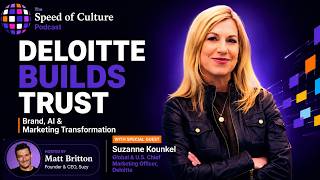
In this Speed of Culture podcast episode, host Matt Britton interviews Suzanne Kounkel, Global and US Chief Marketing Officer of Deloitte, about her three‑decade career, the evolution of Deloitte’s brand, and how the firm’s marketing organization has transformed. Kounkel explains why curiosity and long‑term network building kept her at Deloitte, how the firm balances heritage with modern relevance, and the shift from pure brand messaging to a demand‑generation, solution‑based approach. She highlights the importance of close collaboration with business‑unit leaders, data‑driven insights, and a mix of digital, social, and sponsorship channels (e.g., the WNBA campaign). The conversation moves to productizing consulting services, the growing role of AI/GenAI in accelerating delivery, and macro trends such as millennial‑driven C‑suite expectations. Kounkel also shares advice on career development, hiring for curiosity, and personal mantras that guide her leadership. The interview offers practical B2B marketing insights, strategic brand stewardship, and a forward‑looking view of Deloitte’s role in a complex, technology‑driven marketplace.
Chapters
Today we're excited to be joined by Suzanne Kunkel, the Global and US Chief Marketing Officer at Deloitte, where she's been for almost 30 years. She's future-focused and instills into all of Deloitte's brand marketing, strengthening connection between marketing and sales. And Suzanne, so great to see you today.
Thanks, Matt. It's great to see you and to be here.
Absolutely. So 30 years is, uh, no short and you're still going strong at Deloitte. You know, in this world, we see so many people kind of jumping around from role to role every couple years. What do you think is giving you such staying power at Deloitte?
Yeah, well, it's a good question, Matt. And I, you know, I wouldn't be, you know, part of my advice to people that are up and coming is to be curious. So I would, to be honest, I have often, you know, thought about where else should I be and whether Deloitte was the right place to be. And that would be— to anybody is to sort of always re-up your engagement and your commitment. But there were a number of reasons why I have stayed at Deloitte for so long. And it's been one of those things where I've sort of said, like, you know, I've had 7 major roles, and I don't believe that I would have been able to have those and the length of in that 30 years had I not stayed at Deloitte. Because part, if you think about what makes you successful in the work environment, right, a big part of it is your network, a big part of it is your reputation, and third, and probably in that is your skill level, right? So, because I stayed at Deloitte, I brought my reputation and my network with me, which allowed me to progress faster than I might have needed to do if I went from company to company. And Deloitte's a special place. Most big consulting firms are with respect to the ability to move to a variety of roles in a way that a lot of corporate environments don't allow you to. So I didn't need to go to a new place to get the next role.
Yeah. And obviously, you know, Deloitte is essentially an agency, and when you're working as part of an agency, you're not just focused on one category or sector. So you work with, I'm sure, a variety of clients across a variety of different industries, which also within itself, I assume, keeps it kind of fresh.
Yes, absolutely. And new team, new problem solving. So that's, that's what's kept me going.
Absolutely. So, take us back to the beginning when you first, you know, joined Deloitte. Did you think that you wanted to join a consulting organization out of college? Did you kind of just fall into it? And what type of changes have you seen to both your role and the company at large over the 3 decades that you've been at the company?
Yeah. So, I did join Deloitte after I got my master's, and I was pretty deliberate, as you might imagine, about where I wanted to be with respect to the type of environment. And probably it was the type of environment more than it was the actual skill set. I did look at a number of— I looked at PR agencies, I looked at insights and research, I looked at, you know, joining big brands that I had an appreciation for. And then last but not least, I looked at a variety of consulting firms. And again, as I, you know, said, I continue to kind of push on that decision all the time, which I think is an important part of the engagement process. But specifically, I picked Deloitte because, again, for reasons that you mentioned, I like that sort of evergreen notion of environments and different sets of problems and teamwork and really bringing multidisciplinary things together. Deloitte has always been really good at assembling very diverse teams, which was important to me. There is a critical notion of the team as a unifying, but it also allows like for a stronger voice when you're more junior than, you know, you don't have to wait to be senior to really have an impact on the work you're doing. That was very, very important to me. And just again, the problem solving and the always doing new things was of high interest to me. A little bit of your question was sort of what's changed over the years and what's particularly with the business. For sure, the big things that have changed are the complexity of the business and the breadth of the advice that we can bring to the table. That has changed demonstrably. The scale and scope of a lot of the projects we do has changed very significantly as well. When I first started, you could, you know, kind of rely on a small team to kind of work through problems. Today, we really, you know, we would always say it's people plus technology. We would always say, you know, it's worked with, with our clients, not for or to our clients. So some of those things have stayed the same, but really sort of the magnitude of the change and the impact that we can have on our clients has changed dramatically. That would be one. The second thing I think has changed very dramatically is we do believe as a brand that sort of the life's— life's biggest problems aren't solved by single actors. So you've seen us over time really have you know, co-creation with our clients, with third parties, whether that's alliance partners or, you know, government agencies or whatever the case may be, really solving problems across industries. So I would say that. And then, you know, we're no similar— we're no different than most big firms with respect to the global aspect of the problems presenting themselves. So I would say those three things are the big things that have changed.
Absolutely. Given all the change you've seen, I guess, And you talked about the different sorts of roles. How did you end up as CMO? Because it's, you know, and, and CMO of a, of a consulting company the size of Deloitte, which last time I checked has over 450,000 employees, you know, it's a major deal. It's a major role. And, and Deloitte does so many different things that the CMO role has to play at a pretty high altitude, I guess. How did you end up in that seat? And then we'll talk a little bit about, I guess, what your day-to-day looks like in, in bringing your initiatives forward.
Yeah, sure. So I often joke that my current role is penance because I spent about 20 years providing advice to CMOs and COOs.
You were delivering your services.
Right, right. So when I first started with the firm, I spent a good number of years providing sales and marketing and customer experience advice to primarily big hardware and software companies. That was the work I did. And so because of that, when I was offered my first role, which was as the CMO of the consulting part of our business. It was because of those things that they felt that, you know, we're, we're a complex organization. So they felt that somebody that knew the way the firm was wired was important. But they'd tried going that route exclusively that didn't have the depth with marketing, and that hadn't worked so well. They'd also tried with the marketing sort of prowess from outside. And because we're a very networked organization, that didn't work. So they had hoped with me that they would get the best of both worlds. And that connection with marketing and the customer experience was very, very important to them as well. So hopefully that's panned out. And then I assumed the— about 4 years ago, I became the US CMO, and then a year ago I became the global CMO as well.
Gotcha. So, so in the role of CMO, I would imagine one of the primary things you're focused on is just establishing what the brand Deloitte means. In an ever-changing world. Obviously, Deloitte has been around for so long, which provides you a lot of benefits because you have that trust, but you obviously wanna make sure that your customer base and, and prospect base knows that your company is evolving with new trends in the marketplace, like AI, for example, and globalization and everything that we're seeing in the world. When you look at the Deloitte brand, what's most important for you as CMO to get across to the marketplace? And how do you go about doing that?
Yeah, that's, well, it's well said. That's exactly what we as a brand are trying to do is really lean into the heritage and the trust and integrity that people know that they can trust with the DeWitt brand and the legacy of that, but also make sure that people, our clients, are always knowing the most current set of solutions that we can provide to the marketplace. So I am definitely always working on that. In that regard, I think there are a couple of things that we're doing that are, that are different than maybe other organizations, although I would, I would argue that we're all kind of in this together. But the first and foremost is that our people have to believe the promise of the brand. So, right, they are always going to be our strongest brand ambassadors. They will always spend a lot more time with their clients than any marketing organization. So that's, that's a big piece of, of who we are and what we're trying to do from a marketing perspective. The second thing is always to get the demand and the brand piece of it right. And, you know, obviously, I work very closely with the business units, the business units aren't going to allow you to do as much on the brand side if they don't think the demand and the growth side is being met. So that's always a balance. And then, you know, last but not least, is that our people and our clients are proud of their affiliation with Deloitte and believe that we have the best, you know, set of capabilities in the brand. And that really Matt, we, to your point, was we, or to your question, we really center that on 3 things. One, our brand purpose is an impact that matters to our people, our clients, our communities, and the planet. All of those constituencies are very important with respect to the way we think about the work. So that's a big part of, you know, we're not doing frivolous things. We're doing things that matter a lot.
That drive business results ultimately.
Exactly, exactly. And then there's this notion of, you know, progress and always modernizing what we're doing with the best set of capabilities and the best set of tools. But really, in uncertain times and challenging times like we see today, people do want advisors that they trust and that they believe have character and integrity and that they want by their side. And so we're always trying to pull the threads of those three things together with respect to the brand.
And in terms of bringing the work of the company to life because there's so much breadth and depth of work that Deloitte has across so many different industries. How do you go to market in, I guess, a more systematized way, if you will, for the brand? Because obviously you want to be able to speak to a multitude of industries and use cases, and at the same time, you don't want the work to be unwieldy or lack consistency. So I'd imagine you have to put some frameworks in place as you roll this out across such a large organization.
Yes, that is exactly the opportunity and the challenge for sure. Again, part of it is really making sure our people broadly understand enough about the way the brand needs to show up in what I call the little, the little lived moments of every day. That's really important. We've had to really sort of work hard. We have been the last couple of years undergoing a major marketing transformation. And it has been all about right-sizing the amount of work we do at the brand level with the amount of work we do at, you know, what we call the demand gen level and making sure that there were people. When I came into the role, I felt that at the brand level, we were talking too much about what we did and not enough about who we are and how we were different. And as you've mentioned a couple of times, our product set is too complex to really hook people in because of the specific sensors.
You could typecast yourself in a way if you talk about the brand level that might alienate certain opportunities.
Exactly. Exactly. And when we, when we do our best work, it is when we are solving bigger problems that require lots of, of, of combined sets of services, not just single services on their own.
Gotcha. So that's at the brand level. And then when you said demand gen level, that's probably where you look at the kind of use cases, more industry-specific, you know, stories. Yeah. So, so what's, what's worked for you? Like, I'm sure that a lot of what you do has a strong sort of measurement and analytics breadth behind it to make sure that you're putting your resources in the right place. When you look at the last couple years, especially in your role, what did you— what have you found has consistently worked at driving business as a result of your marketing activities?
Yeah. Well, the first thing, you know, I, I would say that most CMOs would say something similar, right? But the first thing that's really worked is having a much more collaborative approach with the businesses. So that means that I don't have to be omniscient with respect to what they're seeing in the marketplace. We can partner together to make some of those choices together. And that sounds easy, but it's actually pretty hard in practice.
So you mean the partners on your client?
And when you say collaboration, when I say partner, what I mean is the people that are running the business units, right? So the leaders of those business units, right?
Really working in close collaboration from a marketing perspective, understanding their needs, understanding what they're seeing, the opportunities, providing those, those things to help the customers believe.
Right, right, right. They're the front lines of the market, so they see things very differently. And then, and then combining our superpowers, right? Because they do certain things exceptionally well. We do certain things exceptionally well and pulling that together. You know, another thing that I would imagine every CMO should be saying is really leaning into insights and analytics to be able to drive the activity and see things holistically that they can't. That actually has been a huge unlock for us because it's allowed us to be more creative. Which you wouldn't naturally expect. We own a lot of the channels, so we can listen to clients in a different way than the business often does when they're, you know, delivering services. So that's been a big unlock for us. Certainly doing a big digital transformation and being able to do more activity at a lower price point has been an important part for us as well over the last couple of years.
And in terms of making stuff in the seat of a marketer that your customers and prospects want, you know, do you find the form factor has changed? Because ultimately a lot of what you're talking about is content, right? When you talk about insights and analytics, that boils up into not necessarily ads, but actual stories. And behind those stories are content that they're going to find value in. So have those form factors of content changed over time? And have you used channels like social media to kind of push those out and in what ways?
Yeah, we're always looking at the mix of those channels. And I would say that we're leaning in, you know, much more significantly now with, you know, with social and with digital than we did for sure, you know, 5, 6, 7 years ago. But I wouldn't say, you know, we do a lot with sponsorships because they're a great forum for us to really partner with the, you know, with the organization to do work for the organization as well as use that as an experience to host clients so they can see kind of the magic of who we are. As you mentioned, we do a lot of content marketing and that's an important thing. We also have been doing a lot more in the last couple of years around really showing again the personal side of what the brand looks like. If you haven't seen the WNBA campaign that we did in the WNBA Finals last year, that was a really fun way to lean into our brand purpose, which, you know, it was kind of under the notion of girls who play become women who lead. And this notion of that we've been cheering professional women on and off the court for a great many years. We've done some other, you know, so, so we're trying to do this mix of really showing the personality of who we are in addition to what we do and the results that we can have.
Yeah, I would imagine the level that the business leaders that you collaborate with play at being at some of these large events and actually bringing the brand to life, so to speak, through sponsorships. Provide you an added benefit because you're also relationship building along the way.
Yes, yes, absolutely.
Absolutely. And, and how would you say, because, you know, most of the CMOs that we talk to on the podcast are B2C marketers. I'm a B2B marketer. I've been a B2B marketer my whole career. And, you know, I believe there's a lot of overlap, but there's obviously nuances that go into B2B marketing. I guess what are some things that you've learned along the way about B2B marketing that you believe that maybe others don't believe, or just sort of like, I guess, tools of the trade that you've uncovered that you lean into in your role?
Yeah, well, you know, first and foremost, I do think about both of those mental paradigms, if you will. I think about B2C very significantly when it comes to engaging our people. Because that's a little bit more of a B2C motion. And then obviously, I think about B2B very significant with respect to our clients. I think, I think historically, there hasn't been enough sort of cross-referencing. So I would argue that B2B marketers should absolutely take a lesson from B2C with respect to, you know, engagement in analytics and insights. But I would say that B2C could learn a lot from B2B with respect to they've had to, you know, adjust quite a bit because the relationship part of a consumer experience has changed so dramatically over the last 5 years. And I think that B2B really has to get both sides right. They have to get, you know, digital engagement, but relationship and in-person things and that sort of thing. And so really pulling those things together, I think, is a big part of being successful.
Today. Yeah. And one of the benefits I imagine you have with partnering with the business leaders is just gain that sort of continual feedback loop back from your customers in terms of what they're looking at relative to Deloitte Services and where they're leaning in, because that would probably drive the things that you talk about. How does that work and how are you, I guess, facilitating that feedback loop so you can continually evolve for your customers?
Yeah, yeah. So, so, you know, one is, again, we can look across, you know, with a lot of the, the, the martech and the digital transformation that we did, we can look holistically across, we can also see things across categories of customers and categories of service that oftentimes the business may not be able to see as easily. So really partnering together on what that looks like and how we want to take a look at that. And then locking on what is the ideal outcome. And then that allows us to be more strategic and to be a little bit more playful, a little bit more creative with respect to the actual activation. And then again, doing that jointly with the things that the business is actually better at, which is a lot of the, you know, in-person delivery, you know, human touch, right, is, is what we're always trying to navigate towards.
Yeah. And, and when you, when you talk about the business in general, the business of consulting, what are some of the broader, I guess, macro trends in your industry where perhaps it will be a different Deloitte in 5 years from now than it is today? Like, what are some of those external factors that are driving some of the areas that, that you're playing in?
Yeah. So I think that, you know, the complexity of Deloitte would surprise most individuals. And so you will continue to see us really playing into the who we are and how we're different, what that actually looks like. What you will see is, and this exists today, but you'll see an increasing amount of solution-based, you know, kind of assets with respect to, you know, if you think about historically, it was, you know, if you were meeting with your auditor, it was meeting with a physical person and then, you know, right. Doing the audit results. The same thing was true with consulting. Now we have a lot more solutions that we embed in bigger—
like productizing your service offerings almost?
Productizing, yes. Right. And that allows speed to market, that allows for reduction of risk. But when you look at why somebody would go with a Deloitte, it's that they can get that plus the human, you know, judgment plus the technology prowess. Plus the cross-industry, plus the, you know, private and public partnerships, plus the third-party alliance relationships, like all of those sorts of things, I think you'll just see us do, you know, more and more of. And, you know, candidly, it's what our clients want, because that's really what progress means with respect to a lot of the fundamental challenges that they are seeing in the marketplace with growth and navigating an increasingly complex technology environment. And You know, again, you think about most of the big things again involve, you know, it involves multi-industries, multi, you know, governments, global, globally complex, you know, it's just sort of all of those things. And that's a perfect place for us to be. And you'll see that in increasing fashion.
Yeah. And, you know, pre-packaging solutions also allows you to optimize it over time. Where if you're building things bespoke for each customer, it's really hard to build technology and data-based solutions that can get better over time because you're always reinventing the wheel. So it also probably makes it easier for the business people to storytell around it because they're telling similar stories over and over again, which allows them by nature to get better at those things.
Right, right. And knowing where it matters, right? Because a lot of those assets are in places where the, the velocity is critical, right? There's a reduction of risk when they are road-tested to your point that when they're not starting fresh every year, but then also knowing where that, you know, it has to be a team that has the experience and the expertise and the judgment, you know, to make decisions and how and when to apply those things is what we are very good at.
Yeah. And where do you see AI playing a role with in your general industry and with Deloitte specifically in the years ahead, because there's been so much written about how AI is really going to disrupt and revolutionize the consulting industry. And I think that one thing many people don't realize is how slow to move a lot of these large organizations who you count as customers are, where just because they can do things that are more automated, don't— doesn't mean they will anytime soon. But at the same time, I think, you know, many of us believe that AI is going to have a massive impact in the way that these large organizations are serviced. So I guess what is your personal take on it and what are some of the things that, um, Deloitte is starting to do within the AI realm?
Yeah, I mean, I think it, it has and it will, right? And we, um, because it's unfolding so rapidly, um, you know, I think that's the, that, that's what's been so interesting, right? Is the rate of adoption.
Yeah, the speed for sure.
Right. Um, but we do believe in a world where it's always going to be, you know, people with You know, that's, that's a mantra that we have, right? People with GenAI, people with technology, people with AI in general. We are absolutely fundamentally thinking about it sort of through three lenses. The first lens is how do we do the work that we do with respect to like, if you think about the marketing organization, like what are the pieces where we really want to invoke GenAI and AI generally? We're certainly looking at it through the lens of how do we deliver services that take advantage of that? Again, we talked about, you know, speed to market and the, you know, how fast can you turn around advice that used to take a long time? That lens is really through the, what do we want? What do we want GenAI to do in areas where people aren't exceptionally good at it? You know, you think about looking through 100,000 contracts, right? Where, right, where people over time have done that, but we're not exceptionally good at doing that, right? So, So, by all means, infuse that to do those parts of things. And then, you know, last but not least, there's lots of things that will be big unlocks because, again, there were impediments because of the limitations of the technology that now we don't have. But again, we would see that, that, that is— there's an opportunity side of that and a huge risk side of that. So, having a partner by your side to help navigate that with respect to what you do with those technologies is critically important as we've all seen, um, great stories and, and challenging stories unfold.
Yeah, for sure. I mean, I think a big both challenge and opportunity that organizations like yours are gonna have is that the C-suite is now starting to be taken over with millennials who grew up with the internet in the household, right? So, you, you know, Deloitte obviously services the C-suite and Gen X didn't grow up with the internet in the household. So a lot of the processes and systems you had deployed may have been okay for them, but when millennials enter the C-suite and they're digital natives, so to speak, I think their expectations of how they're serviced and the type of tools that they have that are accessible within your service offering are gonna change. And that means that your brand's gonna have to change along with that customer base.
Yeah. Yeah. Absolutely. Spot on.
Yeah. So it'll be interesting. So let, let's shift gears a little bit as we wrap up, Suzanne, just to your career. So obviously You know, not everybody has the opportunity to oversee a brand with a company that has over 400,000 employees. I mean, it's, it's obviously a tall order. When, when you look back at your decisions you've made, obviously you decided to stay at Deloitte, which I think, you know, if you didn't stay there, you wouldn't have the opportunity to be their CMO. But besides that, you've probably made many decisions along the way that kind of put you in the position where you are today. When you look back at your career, what do you think some of those decisions or choices that you've made in terms of where to focus within your own professional development?
Yeah, sure. So the first one I would say is just always be really curious.
And you mentioned that earlier.
Yeah. And be curious around you, not specifically within your domain experience, right? So like, for example, I'm, you know, I've always been in marketing and sales. So supply chain is something that, you know, candidly was a little off-putting to me, right? So I spent time with my friends that were supply chain experts because that interplay is actually where a lot of the opportunities unlock. So that's one. I would say, you know, learn the business, right? If you really understand what the business needs, it makes your job as a marketer so much easier because you understand their perspective. You can speak their language. You can help, you know, you can bring the collective superpowers together. And then last but not least is I always talk with, you know, people that I mentor or whatever about kind of make, make your mark. Like if you're, you know, we all are very different with respect to what we can bring to the table. For me, that was always like the highest intersection between being strategic, creative, and getting things done. So what did that look like, right? And so that's how I was always wanting to change things.
That's a great intersection, by the way, a lot of people should focus on.
Of me being involved, right? What that is for another person, you know, would be different, right? But really knowing who you are and what you bring to the table and then making it different as a result of you being involved is the other thing that I've always tried to hold myself accountable to.
Right. Because for other people, it could be that they're very provocative or they're a thought leader or they're a great speaker or, you know, they have their finger on the pulse of what's next, whatever. That one skill set is, if you can lean into it to differentiate yourself, because many companies cast themselves like a Broadway play and they want different types of actors to be on stage at the same time in order to win.
Yeah, I love that play analogy because that is right. Every actor needs their own voice and together it tells the most compelling story.
Love that. Right. And, and, and I guess how would you suggest one go into this self-introspective process to identify where are the intersections that they should be playing in? Because I think with a little, I think self-awareness is a big issue with younger, especially younger people in their career where they may not know where they should lean into.
Yeah, I think, um, it's, it's a great question. I think that, um, you can find it in a lot of different ways. I mean, part is like your own personal interest. Part of it is taking an honest look at where you're having an impact. Part of it is asking people around you that you trust and know you well, like, you know, what are the differentiators or distinguishing characteristics? And then I think those are all important and those are what, you know, every individual should know is like, I bring this to the table. What I find sometimes people, particularly in today's world, don't think enough about is Okay, that's what I'm bringing to the table, but the table needs this. So where do those things meet? Where do those things come together? Because I often say to my team, right, you know what we want to say, but you don't always know what they can hear. And so really making sure that you're thinking about it from both sides is something I would really encourage people to spend some time on.
Yeah, and when you speak of your team, when you you decide to bring somebody onto your team, the interview process, like, what are you looking for? Because some of those things that we're talking about in terms of people finding the right intersection, so to speak, it takes a while for that to come out, especially in the context of a new organization. So what are some of those early signals that you look for where you're like, oh, this person, they're a great fit for what I'm trying to build?
Yeah, I do think, you know, I've said it a number of times, but I do think like innate curiosity, Right. Because that both allows you to—
We hear that so much, Suzanne. So you're not the only one who's saying it. It's probably one of the most common themes that we see and I see in talking to CMOs is they say the power of curiosity is just tremendous.
Yeah. And the curiosity is important because we— all we know is we aren't going to be doing things tomorrow that we're doing today. Right? And the— right? So that curiosity and that kind of evergreen learning and thinking what isn't there that could be there is really important. For sure, there's a general, like, you know, optimism, ability to work with people, kind of knowing that we're better together. That is a big piece of it. You know, increasingly, there's always going to be a component of, you know, technical expertise and skill sets and capabilities that you're bringing to the table. But again, we would want people to know that that's going to change pretty dramatically. Over time. But we do want to— you know, one of the things that has also kept me at Deloitte is that I always have said that these are the people that I not only want to solve really hard problems with during the day, but I want to go for a hike on the weekend, for a glass of wine.
And be likable.
It's that combination that's actually really important.
Absolutely. Because without that likability and without good chemistry of you working together, then it's going to be hard despite what talents people have to actually succeed and accomplish what we want to.
Yeah, absolutely. Bring in hard perspectives and, you know, have a voice, right? Like, that's really critical.
Yeah, I think a lot of people younger in their career, they find a hard time just having a voice because they just feel like they don't want to rock the boat. But I think what I'm hearing you say, and I agree 100% with our team, is the people that are most successful are the ones that conviction in something. They've done the work. They do have curiosity as I've sort of learned about these new things, and they're not afraid to speak up.
Yes, exactly. And that context is really important because I see it on both. One, either people are afraid to speak up because they're afraid of saying the wrong thing. There is no wrong thing. Everyone will tell you that. But on the other end, sort of coming in with conviction but not understanding context and not, you know, picking up on that is the other sort of end of the spectrum, but can be just as limiting.
Yeah, for sure. Absolutely. So it's been a great chat. So informative. I know we've covered a ton of different areas. Just if you had to sum up your career and the way that you look at your professional growth, professional life, is there a mantra or quote that you like to live by that you often find yourself saying?
Yes. Well, there are 3.
Okay.
The first one is Homer, and he said, the journey is the thing. So I think a lot about that. I love that notion. And I think it's particularly important for all of us to like be present in the moment, like look ahead, but really, but appreciate the journey. The second thing is Socrates said, be as you wish to seem. I think that's really important. I think about that all the time with respect to brands and, you know, because be as you wish to seem. And then last but not least is I'm a huge tennis fan, and Billie Jean King talks a lot about pressure as a privilege. And I think about that all the time and say that a lot to our teams, is that there's a lot expected of us, but that pressure is an absolute privilege.
Yeah, it's such a great way to look at things when you have tough situations or tough decisions to make, that it is a privilege to be in the position at a company like yours to be able to make those decisions, that you're empowered to do so.
Yeah.
Absolutely. Absolutely. Well, thanks again so much, Suzanne, for sharing a little bit about your journey and your role and where you see, uh, Deloitte at. It's been amazing. I can't wait for our audience to hear it.
Thanks so much, Matt.
Absolutely. On behalf of Susie and I, we keen. Thanks again to Suzanne Kunkel, CMO of Deloitte, for joining us today. Be sure to subscribe, rate, and review the Speed of Culture podcast on your favorite podcast platform. Till next time, see you soon, everyone. Take care.
More from Matt




MikMak’s Rachel Tipograph on Consumer Spending, Retail Media & Holiday Shopping Trends



Jaguar Land Rover’s Charlotte Blank on Luxury, Purpose & Experiential Storytelling



