Dentsu X’s Leah Meranus on Media Innovation, Attention & the Future of Ads
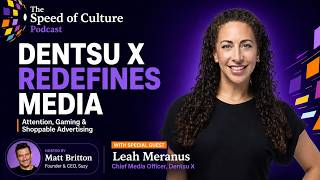
Leah Meranus, Chief Media Officer at Dentsu X, talks about the shift from impressions to attention as the metric that matters, the blurring line between creative and media work, and why brands need to balance experimental tech like metaverse and Web3 with measurable returns.
Chapters
Up today, we're gonna be speaking with Leah Moranis, Chief Media Officer for Dentsu X and 360i. Leah's worked for some of the biggest advertising agencies since the mid-2000s. So excited to have you on board the Speed of Culture today, Leah. Welcome.
Thanks so much, Matt. Great to be here.
Absolutely. So you're in a very cool role, Chief Media Officer for one of the most innovative agencies on the planet. 360i is an agency that we often went up against competitively when I was running my agency, MRY, and I always had a great deal of respect for both 360i and Dentsu. We'd love to hear about your career journey and the steps you took to lead you to where you are today.
I'm an accidental agency person. I started my career as a management consultant. After a few years of that, decided my passion was really in marketing. I decided to go back to business school with every ambition of becoming a brand manager at a CPG company. That led me accidentally to a an agency role at Omnicom. They did a wonderful rotational program. I had some wonderful mentors and coaches there, and I was hired into a media agency and never looked back. So the past 3 years at Dentsu have been wonderful. As you mentioned, I started at 360i. We've taken that brand and merged it with Dentsu X, where I am currently the chief media officer.
So one question I have to ask you based on your background is, was business school worth it? And what lessons did you learn in business school that you actually apply to your job today?
Yeah, so business school, I did it at the perfect time in my career. I think if you're going to go in there, you have to really invest and lean into it. It is an incredible opport— opportunity to reimmerse yourself in education, in thinking, and in networking. That's really the best part of business school. Do you need business school to do this job? I don't think so. I think we've gotten so evolved, and there's so many industry events and such great communities that it's not critical and essential. But at that turning point in my career, because I was what we called a career switcher, it, it was an incredible opportunity to skip a few steps along the way.
Right. Because, you know, I would imagine in business school they're not really thinking about the innovative go-to-market and media strategies that actually exist and what brands are asking for. So you're probably not learning a lot of the tactical things, but to your point, it's more the fundamentals and most importantly meeting the people. Is that fair?
That's exactly right. And it, it gives you a different frame of mind, right? It's about learning to ask questions, it's about challenging, and it's about having the frameworks and toolkits to challenge problems as you approach them in the real world. Not to mention being on the agency side, a lot of my clients happen to have MBAs, so it's a nice counterpart to them and understanding how they think. I think it gives me a nice advantage.
Yeah, totally makes sense. And kind of fast forward to where you are today.
Yeah.
Yeah, exactly.
Matt Britton.
You've been in the agency world for the better part of two decades. And you know, like myself— Are you aging me now? Yeah. Well, so have I.
Yeah.
And, uh, it's funny because that always comes up, but, um, we both have lived through a world where when we first went into the workforce, you know, the internet was first starting. A lot of people are comparing like the crypto crash of today to the dot-com crash of the early 2000s. We can get into that separately, but then we've lived through the advent of social media and the iPhone and the changes that have taken place as it impacts the consumer and the marketing advertising world are really unprecedented. In the last 20 years. How do you think that's impacted your role and really, you know, the role of the modern advertising agency?
The way that consumers interact and behave with our brands. I mean, it's fundamentally changing us. So what that means is you always need to be a moment ahead. And the irony and interest of me being on this talking about metaverses and multiverses is that's not my area of expertise. It's not my day-to-day, but all of us have to understand this stuff. All of us have to push ourselves to understand the impacts that technology are having on our consumers. Because if not, we're not going to know where and how to find them, engage with them, impact them, and connect them intimately to what we're providing as companies.
Yeah.
Yeah.
And you mentioned the metaverse. I mean, I have a feeling like, you know, I have no idea how to access the metaverse. Yeah, I'm the person, you know, I'm the CEO of a software company. I'm the person whose friends already call them to, help them set up their Apple TV, et cetera, and I have no idea how to access it. So there's no way the majority of consumers do. And I say that, um, in really setting up a question like, isn't there a difference between cutting edge and bleeding edge? Because what, what I found in running an agency for 15 years is often clients confuse the two and they want to be on the bleeding edge where there was really no ROI because they wanted, you know, a story in Adweek. And often that came at the expense of really focusing on the business results that matter. So I know media is where a lot of these innovations kind of come to bear. How do you— what's your thinking about that?
It depends the client and it depends the brand, right? Even if you don't have that quantifiable ROI, for some clients it is worth it at some point to start leaning and bleeding into those lines because it is representative of future consumers that they're trying to attract. It becomes aspirational or ambitions that they're trying to lean into. And the more you practice, the better you get and you become a step ahead. It's part of their DNA and fabric, right? Certain brands are always leaning in. That said, from our day to day, you know, I come from a portfolio of clients, it's quite retail-oriented. We have very strong business results that we need to deliver on a day-to-day and week-to-week ambition. So not everybody needs to be the leading edge. And I call it kind of like a spectrum of innovation, right? Innovation differs for different clients. For the last few years, it's been getting into CTV or connected television products. For others, it is— Yeah. Dabbling in a metaverse or Web3-like object.
Yeah.
So you really need to know what your ambitions are as a brand. You really need to know what you're trying to impact in your consumers and find the right time to test into those in organized and calculated ways.
Yeah, I mean, it's interesting with sort of media innovation because at first sort of like the medium is the idea. So when Facebook first came out, the big idea was let's get on Facebook or let's get on Twitter. That was the idea. But now in order for you to execute well in social media, it's not about the medium, it's about the message behind it. It's about the content and the creative behind it. So that's sort of the, the curve I often see is now the idea is the medium of the metaverse where ultimately it's gonna be about what, how do you add value? How do you activate on it? So the creative really has to pay off and deliver for the consumer. Not just, you know, you're not just gonna win just by being there.
Yeah. And it's the experience, right? So of course we talk about value exchanges. This notion of an experience is a value exchange. You can't just be there punting something at them because if they're not open, willing, wanting to receive it, it's not gonna do anything for that consumer. So this notion of building experiences is critically important. The reason that we're tapping into things like these multiverses and metaverses is because that's where consumers are going and the expectation or the crossing lines between digital, physical, and these, you know, multi-experience spaces, they're emerging. That's where people are having new experiences and we just need to be ready to experience with them in those places.
I've often found that it's been hard for agencies to really be able to differentiate, 'cause ultimately, you know, agencies are made up of people, and for a long time, the best people weren't even going to agencies, they were going to Google and Facebook, et cetera. Now agencies are obviously making a strong comeback, and some of the big tech companies are really struggling right now, as we've read about, while this year agencies are doing okay, at least the holding companies are. But given that we're all just made up of people as agencies, How do you find that you guys can differentiate? What makes you different than the, the company just down the street, Madison Avenue, when you're talking to these big clients?
Yeah, so I think it's about the culture and environment that you're setting forward and how people can build and elevate their careers and their own personal growth. What I love about the agency world is that we get exposed to so much, and I think that's always gonna be an advantage of, of the agency space. We're touching all the platforms, we're touching all, all the channels. We are exposed to—
All the industries.
The industries. That's exactly right.
Yeah.
And these are the areas that you don't get client, you don't get form side. And so I think that really creates an incredible opportunity to, to diversify, to be more horizontal. This, the program that I originally joined when I got into a holding company role was there was this notion that, that advertising people came in through one channel. You were a creative, you were a media person, you were a PR person.
Yeah.
And more and more those lines are blurring. And I think within the holding company space, you have the opportunity to stretch and flex across all of those, becoming more holistic marketers and partners to clients. So for those people who like to have variety, who like to test different things, who wanna be experts in multiple areas, agency really continues to provide the best feeding ground for that, in my opinion.
Yeah, it's interesting you talk about blurring the lines. I mean, I'm a huge fan of the show Mad Men, as many people in the industry, ad industry are. And you know, back then, creative and media were intricately tied together, and then for a while they broke apart and you had your hot creative agencies and you had large media buying agencies. And now we're starting to see it become cyclical again where they're coming back together, where creative and media has to be really tightly connected at the hip because data is such a big part of it. What are your thoughts on that culmination and how does that impact your role as a chief media officer?
Yeah, everything that's old is new again, right? Don't we kind of see that all the time? We see that in fashion.
For sure.
We see that in the agency world as well.
Yeah.
I do. They're coming together, but I think in interesting and in different ways. And I don't think it necessarily, it needs to be in one house like it used to be. At Dentsu, we talk about being the most integrated network in the world. You know, I know a lot of the agencies are talking about the same thing. That to us means finding the best and right people together with the right capabilities in the right moment. I don't even know if I would call it creative versus media in those biggest forms anymore. It's about delivering on client objectives and— Right. You know, how do you really define where gaming lives or where strategy lives? So we really pull from the best of everything in order to meet client needs. But yeah, the notion of coming back together is more important than ever, especially because we're so fragmented, right? And things are moving so quickly. Not everybody can be an expert in everything. And I do believe in this power in collective collaborative strength and thought to, to bring better offerings to bear for clients. You're not gonna get in one place.
Absolutely. Yep. And you're talking about differentiation, how competitive the space is. I was on the executive leadership team of, uh, Starcom MediaVest for several years, uh, after my agency was acquired. And one thing that struck me was just how much time and effort is spent on pitching new business and how it's such a big part of agency life. What have you seen be the consistent things that make the pitches you've been involved in that you won successful? Like, what are the commonalities when you're pre— and I don't want you to give away any trade secrets here, right? But like, what are some of the things where, where when you leave that room, you're like, we nailed that? What usually is the case when that happens?
I think it's, it's showing the client that you're in it with their business. There's definitely a level of chemistry, and chemistry comes across in a few different ways. One is the actual people in the room. Two is understanding what they're really looking for.
Right.
And the third is—
Listening.
Yeah, right? Like you've got to see it. Did you challenge the brief in the right ways? You know what I mean? Have you really dug and uncovered what the crux of the ask is? Not just reading the brief and delivering on those words on the paper. So I think that's really important. And the third one, I think there's authenticity that's really critically important. It's very difficult to recreate yourself every single time in a pitch and try to be something to those individual clients on a one-on-one basis. You have to know who you are. You have to know who the clients are that you want to go after because that's also going to make for the most fruitful relationships moving forward because you know who you are.
Yeah, absolutely. 100%. I found that as well. And I mean, do you also see in this new economic environment that clients are more focused now on hardcore business results than maybe they were 3, 4 years ago? They want to understand how you're going to move units or get them better, you know, retail shelf space or whatever it may be versus impressions and buzz. Has that— has the focus moved further down funnel in this environment?
Everyone wants everything. I do feel that lately there's been a rush to the bottom. You know, there, there has been a lot of that.
The bottom of the funnel. The bottom of the funnel. Focus on conversion.
Focus on conversion.
Pure ROI. Yeah.
Impressions and efficiencies, you know, all of those things.
Of course.
But every time we get down there, the smart marketers, the modern marketers, the marketers that we want to partner with are coming back and questioning that. They know that that's not the end game. Be all, and they know that that's not gonna be the future of their businesses and what's going to enable them to grow. So I appreciate and admire, we can have those bigger conversations. It's super important right now, right? Going into the R word, we, we know a recession's probably coming. We've, we're facing economic headwinds and, and how many times can we go back to empirical research that says continue to invest in your brand during these times? Don't go dark, don't bottom funnel. And those partners who we have, we're, we're trying to elevate that conversation and remind ourselves that there's more to it. It's a long game.
Yep, absolutely. And Lee, you've also spoken a lot about focusing on attention as a metric. So when you're kind of quantifying results, now often we're in a position where, you know, big CPGs, it's very hard for them to track directly the results of the advertising 'cause they're selling through Walmart or Target. So a lot of times companies can't even really drive a direct ROI correlation for a lot of the mediums, especially something like TV. But when you talk about the metrics that matter, why is attention so important and why have you gravitated towards that?
We have to push this conversation. The notion of, I mean, you talked about just we buy impressions and all these things. For an industry that is evolving so much and so quickly, there are so many things that have not changed, right?
Yeah.
We're still looking at GRPs, we're still looking at impressions, we're still looking at the same CPMs we always have. At some point we need to rally together and hold hands and know that we have to keep evolving the business. And you know what? It's hard and it's gonna take a lot of collaboration and coordination to get there. Attention is that next level. It shows us and proves to us that not all impressions are in fact created equal. And we know that because of research that we've been doing.
Yeah.
Dentsu's in its 5th year of the attention economy research. And we have, and we're looking at it not just on a channel basis, not just on a platform basis, but on an actual placement basis. Right? So there are differences in ways that we can create greater attention and get better return for the client's money based on this research and information. So attention is, you know, the next conversation that I think we need to tackle. I think we need to lean in for— we need to identify what attention means. That's one of the challenges is we all have different definitions of attention.
Is it mindshare? Is it like you have X amount of waking hours in a day and where the mindshare goes? Because Often your attention isn't on brands, isn't on advertising, it's on your kids or your diet or your job or whatever.
Yeah.
So there's only so much, I think, mindshare that's able to be even captured by an advertiser or a brand. And I think that's what we're starting to see now where clients are having to make hard decisions because people can only have so many streaming services. They can only have so many products in the home, especially again, in the wake of the economic downturn. That we're going to. So I do think attention's worthwhile. The question is how do you measure that and how do you ultimately measure that up to business results, right?
Yeah, you do research.
Yeah.
We have to come together as an industry. We have to share that research. We've been doing it in isolation. We've been doing it in pockets. How do we bring that together so that it does create a way forward? You know, I know the idea of a common currency around attention is, you know, there are polarizing sides on it. I wanna believe that we have to push towards something like that because there's no other way that we're going to actually change this industry if we don't push for something new. I think there's so much amazing things that are happening right now with the evolutions in our space. Let's talk about addressability. We can measure more things than ever before, right?
Yeah.
So it's the combination and kind of the force multiplier of all of these things coming together. The notion of identity and being able to find people, the notion of attention and the notion of context That's where we're looking at is Dentsu and how all of these things are coming together. That's really where we're seeing the what's next, thinking smarter about the investments through those lenses to change the game in media buying.
Yeah, and often a huge focus of media buying has been on television. Recently Nielsen announced that for the first time ever, more people are streaming than watching linear television, which is obviously a big moment because when you talk about addressability, and measurement, it all starts with streaming versus traditional linear TV. How do you see the evolution of TV impacting media buying as a whole? And are your clients still holding onto that old world, you know, upfronts buying CPMs, or are they really trying to shift to more CTV-based models when it comes to TV? And is TV any different than online video at this point?
Yeah, we think about it as video. So we talk about TV—
The device doesn't matter?
The device doesn't matter. It's long-form content in whatever form. I mean, you can watch it on your TV, on your desktop, on your— on the big screen in your living room. So we, we are seeing those come together more under this notion of video. And the more people are watching, quote unquote, television through their smart devices, the more addressable that medium is becoming as well. So we're— I mean, we can buy TV like we buy digital in a lot of cases, and that's really the direction that we're moving.
Yeah, I mean, we had a conversation with Google on this podcast a couple weeks ago, and what we found out was that more people are actually— the top 2 things that people watch on television are Netflix and then YouTube. Not YouTube TV, but actually YouTube, which actually shocked me because as of a couple years ago, when I would show friends YouTube on the big screen on the television, they'd say, "How did you get YouTube on this TV?" But now more and more televisions are coming out smart TVs. It's becoming more intuitive, and that's really changing the games. I think the evolution in the form factor of television itself, because that— they control the rails. Samsung controls the rails of most people have Samsung TVs. They're going to be the ones that actually— that shepherded that in, right? Because your Gen Xers, especially Boomers, it's not intuitive to them on how to access anything but the traditional TV stations.
Yeah, I mean, I have two kids under the age of 10, and they'll find YouTube on the quote-unquote television for you.
Of course, yeah.
So the way that, you're right, the form, the format, and the device itself is evolving as well. And the next generations of consumers are only gonna know that. So is TV dead, right? People ask that question. No, no, it's not.
No way.
No, it's not. And there's definitely a role still even for linear television, but it's changing all the time. You're seeing the day parts mix, you know, changing a little bit. You're seeing Prime and the value of Prime changing. We obviously have, supply, you know, constraints that have been happening in the industry. So as we're seeing ratings go down, so it's changing, but it's, it's evolving because of the digital streaming formats that complement the sort of long-form video.
Yeah, and we talk about supply. Now you have Netflix selling advertising, um, you know, so now all of a sudden they're going to take up so much more supply. The demand's certainly not going to go up in this market. A lot of companies are already starting to cut their media budgets, maybe not as, as big as the headlines might lead you to believe, but that's definitely gonna put a strain on the traditional networks, right? Because there's gonna be more supply out there. 'Cause all of a sudden you can shift your media dollars to something like TikTok, which is emerging, or something like Netflix, which up until now you haven't been able to buy media.
Yeah, I, I think it'll be really interesting to watch that space. We all talk about streaming fatigue or app fatigue or subscriber fatigue and, and overload, especially with the upcoming year that we have. How many services are our consumers actually going to support and be able to sustain. So it'll be interesting to see, one, does consolidation happen? Is that, is that a way forward? Yeah. So we know that that's coming. And the other one is you've even been seeing it in the recent upfronts is the, the bigger media companies proposing all of their offerings together. It is not in silo. They're selling all of their ecosystem. NBCU, it was all about Peacock. Yeah. Right, right. All about Peacock. So you're really seeing that.
So that's front and center versus saying buy a 30-second spot during— I don't even know what show runs on NBC anymore, which is kind of the point.
That's the point, right? You can see it anywhere.
And there— I was going to say Will and Grace, right? But I, I bet you can find it somewhere.
You can find it somewhere. Exactly right. But they're, they're sending you toward their streaming platforms because that's becoming the center. So, so we are seeing a bit of a shift in the center.
Well, they're also doing it because the model is, you know, they want a subscription-based model. They want the addressability, they want the data. There's a lot of reasons why. 1,000%.
And then they're leveraging that data. You know, we've partnered with NBC amongst others in order to have, you know, gain greater advantage, better targetability, as we mentioned before, better understanding of what our consumers are watching. It's very powerful to combine these datasets and, you know, gets back to that point of attention and addressability and context. That's a very powerful combination.
100%. The other powerful combination we heard in our conversations with Google, the, you know, how they're combining YouTube with Shopify, and now all of a sudden, you know, they really are creating the kind of convergence of content and commerce, right? So you can't really escape that in your world, right? It's not just about— not only is it not about impressions, you're talking about attention, but you have to go all the way down to the bottom of the funnel if it's possible to buy through these platforms, then all of a sudden you're in the commerce game.
One of the things I'm most excited about, I love this whole notion of, I'm gonna, I'm gonna make up a word, commercification, right? The shoppability of all of these platforms. We're making everything, everything shoppable and shoppable. Yeah. And, and what's really interesting and fascinating about that is to think about what that means for the funnel. I mean, we talked about the race to the bottom that implies a funnel. We are collapsing the funnel. We have smashed the funnel because anything that was a traditional brand driving medium, you can then click straight to purchase. What does what does that mean then? Is it a brand driving activity or a performance driver? So I think that's also going to fundamentally change the way we think about KPIs and what quote unquote matters to the advertisers as they're buying media.
Absolutely. Let's talk about Web3 a little bit. I was teaching a class at Columbia that I do once a semester and it was a business school class and a bunch of the students were asking, like about crypto and about the blockchain and is it dead? And I gave them the example dating myself to, you know, the dot-com crash and when Pets.com came and, you know, imploded. A lot of people saying, see, the web is not going to be what everyone says it's going to be. And it kind of went away and Amazon stock went from $100 to $3. And then the real work began. And now we have Amazon where it is today. Yeah. In so many other companies. Is that sort of the innovation curve that you see the blockchain and Web3 going down? Because I would imagine a lot of people, especially with recent news and what happened with FTX and the crypto crash, I mean, do you see the innovation curve kind of happening now where the real work begins once it's out of the headlines? And, and how are you advising your clients about Web3 and the blockchain?
Yeah, so a couple of questions there. I do think these innovation cycles happen. And I don't think the vision and the ultimate vision of Web3 is going away because of what's happening in crypto right now. It's not a matter of if, it's a matter of when. I mean, the direction of Web3 where we really have this interoperability, single decentralized identity, wallet, currency, whatever it is. I think that's where we're going to go. That vision's been put up there. It might just take a few iterations to get there.
Yeah, we need to build the applications, right? We're It's all about the applications of this technology in ways that are easily adoptable for consumers that aren't on the bleeding edge, right? That's ultimately what it has to be about.
You know, we equate this a lot to mobile, right? We talked about the year of mobile for how long? A decade? It was the decade of mobile. In order to get us there took so long. We were, you know, who, who would've imagined that when you were on your flip phone and even on your BlackBerry that you'd be watching Netflix on your phone taking off on an airplane? Crazy.
I still remember the first time I showed somebody a video on an iPhone, the first iPhone in 2009. They're like, no one's ever gonna— can you even see it with your eyes?
Right.
That's what people said. No one's ever gonna watch long form on this.
That's what people said. That's what people said. And the same way that you're like, I don't even know how to get into the metaverse. You know what? Eventually we will. Eventually we all will because we need to get the accessibility. We need to get the tech and the devices to all come in sync at the same time. And it will, it will happen. And we will go through these economic cycles.
It needs to meet consumers where they are, right?
That's exactly right.
Versus changing consumer behavior. That's ultimately, I think, what it's about.
That's exactly right.
So let's talk about another huge trend that has crossed over with advertising, which is gaming. Gaming's worth over $300 billion as an industry. Over 3 billion people are playing video games. It's interesting 'cause more people are talking about the metaverse than gaming, where Facebook is pouring billions of dollars into the metaverse to no avail and has has reportedly 50,000 users, but here you have 3 billion people on gaming and I don't hear enough about it. And I see that as such a massive entry point for brands to get to the younger consumer. What are your thoughts on gaming and how have you guys brought it to life for your agency?
Yeah, we're very bullish on gaming. We call gaming the gateway to Web3, the gateway to the metaverse. It is one of these multiverse, it is one of these entities where consumers are experiencing multiple realities in an immersive space. So it is.
Yeah.
It is. And what's amazing about gaming is that it's scaled. All of those numbers that you presented are very, very real and only getting bigger. So the opportunity is very real. We've leaned into in-game advertising. That market's growing. I've read statistics, over 15% growth year on year until 2025. So we have lots of eyes. And this is an area where we are specifically— this is cutting edge, bleeding edge, right? This is where we're leaning in for some of that innovation because we know We know that it's working, we know that it's scaled, and we know that there's opportunity to measure and grow. Two other areas that we've leaned into on gaming is attention. Going back to attention, we're partnering with companies like Twitch and Frameplay to understand attention metrics within the gaming universes. We're getting great response in those spaces. We're finding that there's great brand affinity, you know, the great connection for brand affinity and consideration in those spaces. And when it's done right, and it's not intrusive, it's adding value to the gaming experiences. So is it about giving an extra power or giving an extra point or give, you know, what are you give-getting in those universes that are endemic and inherent to the way people game and play?
So, so that's— Yeah, tapping into gamification, right? As a communication module.
Totally. The other thing we're thinking about is also understanding gamers better. So another thought leadership piece that we've done recently across Dentsu is partnering with GWI, which is a leading market research company. And what we've done is we've embedded their data on gamers into our panel, which we call CCS, in order to have a more robust, scaled view of gamers that we can then put through all of our planning tools.
Yeah, I can see why it's important, especially given how quickly gaming is evolved and the technology and how people use it, especially, you know, driven by the pandemic. So we're recording this today, second week of November, and by the time this comes out, maybe a month from now, I'm sure your answer may be looked at in a different context. But what are your thoughts on what's going on with Twitter? How are you advising your clients relative to everything that's happened since Elon Musk has taken over? And what is the role of an agency such as yours in kind of stepping in and having a strong point of view?
At the moment, we're, we're evaluating on a case-by-case basis with clients. I think agencies have an important role to play as partners to their clients. I think those conversations happen one-on-one, not in public forums. I think it's important to have that, that confidentiality and trust with clients, knowing their sensitivities, their risk tolerances. But first and foremost, our ambition is always to make sure that our clients are in brand suitable environments, that we are protecting the integrity of our clients' brands. And that goes both ways. That goes both ways. It's very difficult not to conflate politics with a lot of things that happen in these situations.
I think we wanna be very mindful of that. Yeah, it is. It crosses over, right?
It does indeed.
Absolutely. So let's look ahead to 2023. I was introduced last week to a tool called jasper.ai, which absolutely blew me away. It creates copywriting on demand and you can basically describe any picture and it'll make the picture for you., and I'm sitting here thinking like, this thing is like an ad agency, like, that's basically in your computer. And I'm starting to think about what are the implications for Madison Avenue, et cetera. So obviously AI is gonna change the world. A lot of people, it's one of those things where it was like, what's the application of it? And it was the first time that I actually saw the application of AI and like start to get it. Right. So including or besides AI, what are some of the trends that you have your eye on? Heading into 2023 that, that are emerging alongside with something like the metaverse?
Yeah. Is Jasper AI the one that has the blue jay on the rainbow macarons?
I think so.
Is that the one? I saw it too and I was like, that's awesome. Yeah. AI and automation I think are really interesting and powerful tools.
Mm-hmm.
And, and they might go, they might go in, in concert and in combination with each other. I think the more we evolve, the more we stretch the human capability. Right? We get to shed some of the mundane and repeatable tasks that we have.
Right.
And I would love to see us lean into technology in those areas, not as a threat, but as a push for us to be smarter, better, and more creative. Because ultimately, and at the end of the day, a machine will still be a machine. We did this research that I really loved. It's, we call it the Consumer 2030. And one of the trends is we call it the Synthetic Society, and the other one is called the Human Divide. These are 2 out of the 4 trends we we talk about. And I love thinking about these in concert because one of them is about more tech, more virtual, I mean, implanting chips in people's heads. Like, I mean, it's next level futuristic sort of stuff. And the other side is about humanity and the importance of human connection and the ability of humans to feel and emote. And I think AI automation—
Art and science, right?
It is art and science. And that's exactly where I think about these AI automation areas, we, we'd be silly not to lean into them.
Of course. We have no choice. It's won't, we're not going backwards.
We're not going backwards and it will enhance and evolve what we are able to deliver. But I think at the end of the day, we, and I hope that we continue to be humans. We are still emotive beings. We are irrational beings. That's what makes us people. And that's where the human ability will continue to stretch complement what tech can bring. So, so that's— Absolutely. Well said. Yeah, that's one big area.
Just— So let's wrap up. [FOREIGN LANGUAGE] So obviously very, very successful in a very competitive industry. What advice would you have? What advice would you have? Somebody starting advertising. Getting into the advertising industry. Might be one of our listeners. In terms of how to work your way up the corporate ladder. To get to where you are because— To get where you are because obviously it's competitive. [FOREIGN LANGUAGE] Always have your finger on the pulse of what's next. When you're working with these, you know, major demanding clients. So what was your major demanding client? What was your success? Come threads to your success throughout your career?
The success is around relationships. This continues to be a people business, and the way you get opportunities is by talking to people, understanding where there are gaps, learning about yourself, learning about how other people have grown, and then finding opportunities to zigzag, bounce, and find gaps for yourself. The kicker comes in today when it's a different world and we're not always in person. And I think we have a lot of conversations about what a future of work reality looks like, and especially new people coming into the advertising industry. They've never worked a 5-day week in an office, and it's glorious not to have to go into an office and to have the ultimate end-all be-all flexibility. So my answer has evolved a little bit in the past couple of years, and I'm going to say even more so in the last 6 to 12 months because I love not going into an office for a while. I would say remember that human contact really does matter, and in order to build those relationships, being in person makes a difference.
Mm-hmm.
And I learned— so going back to business school, one of the classes I took was Power and Politics, And one of the things we talked about is where you sit in an office makes a difference. If you're not in the office, you can't have that visibility. And if your boss is in the office, think about whether you should be there too.
That's a great point. Couldn't agree more. We just reopened an office. Our lease ended in May 2020. We didn't have an office for a couple years. We just opened up an office in New York, and it's been a game changer for us to be around people again, again, and still offering a certain degree of flexibility. Flexibility, but, you know, having a mixed world. Yeah, it is both. I agree. Totally agree more. So as a last question, Leah, obviously you must work very hard and you're always kind of thinking about what next and running around really fast in a demanding world. What do you feel is worth slowing down for you personally that gives you that yin and yang and allows you to get some sanity up, you know, in this world?
Family and friends. It's, it's probably cliché, but it doesn't matter if we're not able to share anything with those around us. Again, it goes back to humanity. I love talking about tech and I love talking. I mean, the fact that we're even living the lives that we are in this hybrid society is awesome to me, but spending it with people is, is really unparalleled. So I think it's really hard to say slow down when you work at an agency and have 2 kids under 10, but, but being present is critically important. It's presence versus speed. Or like even solitude or silence. So for me, it's enjoying the moments that you're in, even if it's like, you know, 30-minute conversation with us and not even looking at the phone, or, you know, maybe it's, um—
Even this podcast is an escape, right?
It's an escape, right? It's my Saturday morning ritual where my husband, you know, lets me sleep another hour and then I go work out on my own while he watches the kids. That's slowing down. And it's always accepting that invitation to have dinner with friends or take that trip up despite the other things that are going on.
Excellent. Well, fantastic advice. Thanks so much for that. And thanks so much, Leah. This has been an incredible conversation. I cannot wait for our listeners to hear it. On behalf of Suzy and the Adweek team, thanks again to Leah for joining us. Be sure to subscribe, rate, and review the Speed of Culture podcast on your favorite podcast platform. Until next time, see you soon, everyone. Take care.
Hey!
More from Matt




MikMak’s Rachel Tipograph on Consumer Spending, Retail Media & Holiday Shopping Trends



Jaguar Land Rover’s Charlotte Blank on Luxury, Purpose & Experiential Storytelling



