Disney’s Andrew Messina on Live Sports, Streaming & Personalized Advertising
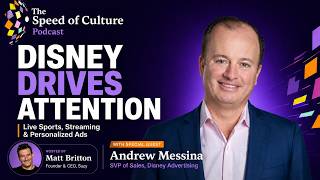
In a live CES interview, Disney Advertising SVP of Sales Andrew Messina discusses Disney’s extensive advertising inventory and strategy heading into 2025. He highlights live sports as a premium, real‑time platform—citing NFL games, college bowls, and the upcoming 2027 Super Bowl—emphasizing its second‑screen engagement and growing female viewership, including cultural boosts like the Taylor Swift effect. He contrasts this with streaming assets (Disney+, Hulu, ESPN) that enable addressable, data‑driven campaigns, noting Disney’s 1,800+ first‑party audience segments and Experian‑sourced targeting for upper‑ and lower‑funnel goals. Messina explains how Disney leverages social media and its leadership in women’s sports (Caitlin Clark, WNBA, volleyball, lacrosse) to extend reach. He shares advertiser sentiment about the economy, asserting that Disney’s stacked calendar of live events, award shows, and premium content provides confidence for brands. The conversation moves to custom brand activations, detailing successful integrations for Hyundai (Disney 100 Oscar spot, Ioniq 5 vehicle), Goodyear Cotton Bowl hospitality, Home Depot’s College GameDay partnership, and other on‑site experiences. Messina underscores the importance of relationship building—meeting CMOs, CFOs, and agencies in person, mentoring junior talent, and his “15‑minute” mantra. He offers hiring advice, valuing drive, punctuality, professionalism, and attention to detail. AI is mentioned as an emerging tool still in its infancy for sales efficiency. Finally, Messina reflects on his career trajectory from McCann Erickson to ABC, a pivotal move to Los Angeles during the dot‑com boom, and returning to New York as VP, illustrating how personal decisions shape professional growth.
Chapters
We're here live in Las Vegas at CES, and today we are thrilled to welcome Andrew Messina, the SVP of Sales of Disney Advertising. With years of experience driving innovation at one of the world's most iconic companies, Andrew has been instrumental at reshaping how brands connect with audiences through storytelling, data, and live events. Andrew, so great to see you.
Thanks for having me, really appreciate it.
Absolutely. So as somebody who sits on top of the advertising organization at Disney, you must have so many different things that you have to balance, um, just because the company has so many assets. And I'm sure that you guys work with the biggest advertisers that want to leverage those assets to drive their brand. Yeah. What are the top priorities for you heading into 2025 in terms of the assets that are most in demand by your advertising community?
I mean, for us primarily, we have, we have a lot of assets like you, you said, but we, it's really streaming and sports. But, you know, live sports is huge for us. We were talking earlier, you talk about the sports. We have the Orange Bowl tonight in Miami. Tomorrow night we have the Cotton Bowl. Monday we have the wildcard game in the NFL. So we have a ton of live sports that we can look at. And then, you know, coming up in March, we have the Oscars, but we also have a ton when it comes to streaming. When you look at Hulu, Disney+, there's a lot of hype behind that. We continue to invest in the content there, so we We just, we have a lot to offer our clients.
So sports and streaming kind of offer two different approaches for advertisers because of course sports is unlike almost anything else on television because it's live. It's one of the last bastions of live television along with live award shows, as you mentioned. And obviously the benefit of brands advertising during live sporting events is they really get, can tap into the second screen experience and community. And it's really of the moment where obviously streaming is time shifted. When you talk to brands about those two archetypes of assets, how do you position it to them differently based upon how they're each unique?
Well, I mean, first of all, live sports, when you just— let's just take Monday Night Football, for example. We've had a phenomenal season. We just signed another deal with them. We have a, we have a Super Bowl coming up in 2027 in LA. It's the first Super Bowl we're gonna have on ABC in, in 20 years. But we're, we're innovative on Monday. It's not just like we used to have Monday— ABC Monday Night Football. It— we have the Manning Kiss. On Monday Night Football.
I love that.
It's so cool. And so they bring, and you know, he brings in Bill Belichick and different, and different, uh, talent. So it's not just a regular Monday Night Football telecast with Joe Buck and, and Troy Aikman. We have to make sure that we're doing different things to re— really appeal to different audiences and younger audiences. So, you know, that's, that's the linear part of it. On the streaming side, you can also watch, we, we have, uh, as a tile, on Tye on Disney+. We announced on December 4th that ESPN is on there. So there's just a— it's not just the game, it's the game around the game. So you can constantly get highlights. And, you know, speaking of socially, right, which is a big buzzword, socially, you can watch, you can see, uh, there's a lot of social, um, buzz around Monday Night Football, not just during the game, before, after, and of course during.
Yeah, I mean, the NFL has continued to just maintain its role as like the driver of culture and live viewing in America amongst both males and female viewers. A lot of people don't realize how big the NFL is aggregating female eyeballs as well.
Correct. Yeah. Well, I mean, you bring that up and of course you can't bring up the NFL and females without the Taylor Swift effect, right? I mean, that's— I have, I have 4 kids, 3 of them are daughters, and my 16-year-old specifically watches. They're now watching a lot. They like the— they like football. I'm a Giants fan, so we're not that happy this year, but But Taylor Swift has really made a difference on the female base.
We had the chief marketing officer of the Kansas City Chiefs on the podcast a couple of months ago, and she was talking about, you know, how you balance that because obviously the Kansas City Chiefs are a professional football team and there's a lot of distraction. But at the same time, it's bringing so many new people into the fold. It's broadening the horizon of the NFL. And I think that's a great thing. It reminds me of Tim Tebow when he came in the NFL and he was a devout Christian. He brought a whole new community in. And it's great when you can, you know, expand an audience through different passion points.
Right. I mean, I think the best thing for the, the NFL and college football for us is the NFL and live sports specifically. Those two bring in huge, huge audiences. Yeah. But then when you marry that with streaming, you can actually target it. Yeah.
I was gonna ask you about that.
It, it's, it's more targeted.
Yeah. So, yeah. And that's changed because obviously advertising on television used to be cookie cutter, 18 to 49 demographics. And now we're in a world of addressability. So, right. What is Disney's offering when it comes to addressability, leveraging first-party data to be super targeted and ultimately drive better performance and ROI from advertising over streaming?
Right. I mean, so right now we feel like we're best in class. We just had our tech and data showcase. We're continually innovating. When you look at the segments, audience segments, we have over 1,800 audience segments that we can deliver. So if you need, if you need to deliver a specific person, an auto intender who's just getting, whose lease is just coming up, we can deliver that person through Experian data. So there's just a lot of different ways that we can reach your, the consumer for an auto or any category for that matter. But the most important thing for us is, you know, there's the upper funnel, which is obviously linear, and then there's the lower funnel, which is the targeting, which you were talking about. It's a good combination that you need. You can't just have one or the other because if you're just targeting, sometimes when you're on, when you're looking at addressable only, you're targeting the same person all the time. You need to make sure that you're targeting different people.
People. And speaking of talking to different people, and you briefly mentioned this earlier, but people are consuming sports, they're consuming entertainment differently, especially Gen Z. Yeah. You know, they're on their phone, they're consuming sports through highlights and, and quick form snackable content, et cetera. How are you leveraging your social media ecosystem to gain additional reach for advertisers?
Right. Well, most of our, most of our sports, they all have their own social handles. But you, you mentioned, we talked about women before, but when specifically women's sports, Disney advertising sales, we're the— and ESPN, we're the leader in delivering women's sports. And you couldn't last year look at any sports without talking about Caitlin Clark and what she did. Yeah, she was huge. In Iowa. I went to the final game with LSU. She was phenomenal. Then she goes into the WNBA. She has really taken the WNBA by storm. The WNBA is by no means new, but she's really taking it to another level. I went to a game here for a conference in the middle of July. Here in Las Vegas for the Aces, and they had 40— they have a 14,000-seat arena. It was completely full and very entertaining. So I think women's— this is— it's just not WNBA, by the way. Now we have all ACC, SEC college sports. So volleyball has taken off, lacrosse has taken off. So it gives it— it gives advertisers and our consumers an opportunity to reach some of those smaller people that they may not have reached. Because look, there's people that want to reach volleyball players or people that are watching volleyball or people who are watching softball people who are watching lacrosse.
Yeah, for sure. So we're heading into 2025. There is, depending upon who you talk to, you'll hear widely differentiated views of the economy, the state of, um, the markets overall. We have a new administration coming in. Um, on one hand, you see consumers that have rising debt and credit card load. The other, on the other hand, the stock market is at all-time highs. What are you hearing from advertisers heading into 2025 in terms of their confidence in the economy and their ability to continue to spend, um, on advertising at levels that we've seen over the last couple of years?
Well, from, from my perspective at Disney Advertising Sales, we, as we discussed before, we have a very good hand. When you talk about having ESPN, ABC, Hulu— Hulu's 15 years old, ABC's 73 years old. Then you have Freeform, FX, Nat Geo, all and everything in between. We feel like if a lot of our partners right now, they are looking for fewer fewer, bigger, better partnerships. So if you're going to look for fewer, bigger, better, really Disney Advertising Sales is the place you're going to go. Because if you're depending on what you're looking for, we have what you're looking for. If you're looking for live sports and you're looking to deliver there, we've got it. If you're looking for women's sports, we've got it. If you're looking for great content, because this is the other thing we have really, really— Bob Iger and team, they've made a significant investment on all of our entertainment programming. We just picked up another live event, uh, a couple months ago where we have the Grammys, uh, that starting in 2027. So now in first quarter of 2027, we're gonna have the national championship. We're going to have the Super Bowl in LA. We're gonna have the Grammys and we're gonna have the Oscars. So that's a pretty massive stacked, uh, first quarter. And then you look at fourth quarter of, of every year, we have, you know, Ryan Seacrest. Yeah. Leading on, which is the top entertainment show. Followed by, you know, massive college football ratings across the SEC and ACC. And then our Monday Night Football that is, you know, does very well as well. And then all of our primetime programming, just to mention a few, like Dancing with the Stars, you know, Bachelor, those type of things. So we feel like if you, if you're looking, if you need to reach consumers, we have the way you're going to be able to reach them.
Now, I imagine that when a brand comes to you, they're not just writing you a check and saying, get me X amount of impressions. They all want to do custom things that integrate their brand into your content. What are some of the interesting ways you've been able to activate on behalf of brands that go beyond them just doing a traditional media buy?
Okay. Yeah, no, I mean, we— that's the great thing about us. You know, I oversee, as we talked about, the entire brand sales team. So what our team does is we make sure we go in and my job is to go around the country and meet with CMOs and CEOs and even the CFOs, because the CFOs write the check.
Playing increasingly big role.
Exactly. The CFOs are more important is to sit there and not only, you know, hear what they have to say. It's really the agency. You come from an agency background. The agencies and I, my initial job out of college was from an agency. Agencies are still very pivotal in the organization, but it's more and more important. And I learned this when I was in LA, when I, for 5 years, because I've been at Disney for a while, when I was there for 5 years spending a lot of time with the clients that the relationships really, really matter. So you need to listen to what their, their needs are. So building the relationships is a key, key component for us at Disney and, and for our, for our team. And just as an example, you know, we have many, many successful examples of, of things that we've done. But obviously when you run a, when you have a successful campaign, it's like we did something for Hyundai for, and we launched their Tucson for them a handful of years ago. And we married some of our content with some of their, with their, with their creative. And we used ESPN, we used the Bachelor. We used GMA. We did all these things. They, they had record sales for the Tucson. What did that do for us? They came back the next year and said, okay, this was fantastic. What can you do next? We said, well, actually, Disney's turning 100, and we had D100. They were our main sponsor for Disney 100. They were— they, they came all in. They gave us a huge percentage of their budget, and we did something that's never been done before. You know, we, we married our content and their content in, uh, and, and their creative in the— in an Oscar spot that was a 60 that ran exclusively in the Oscars. And then we also created, with our imagine— with the Disney Imagineers, we, we created a Disney Platinum 100 vehicle Ioniq 5 with, uh, and we— and they sold those at different dealers by year leaders. And I can, I can pretty much confidently say that that'll be one of those things that might never be done before. Like, if you look in the wheels, there's a— there's a Hidden Mickey. In the interior, there's different things. And you can imagine at, at Disney, there's people that love, that kind of stuff. So it was just— and so Hyundai was thrilled to see, you know, this— those type of things to get approved, they need to go up through the CEO and CFO. So yeah, that's just one of the many examples that we have.
Yeah. So you'd mention how you spend your time traveling a lot, meeting with CMOs, etc. And I know— I believe sales is a lost art in a lot of ways, especially now in a world where, you know, we manage a fairly big sales team at Suzy, and when you sell software, a lot of times it can come down to just, I'm going to email people a million times. And when you're selling to big enterprises, you need to build relationships, you need to understand their business. What advice do you have for young or younger listeners that want to get into the world of sales in terms of some of the skills that they should be honing at the earlier stages of their career so they can one day end up in a seat like yours sitting on top of an advertising organization at Disney?
One of the most important things to me, and it kind of got a little— there was a little bit of a hiccup, uh, with, uh, the pandemic.
Yeah.
Is in-person. Yeah. Uh, I feel I feel like that is something that has, and I have 4 kids, like I said, 3 are out of college, and I said, get in front of people. Yes. Okay. Face-to-face is critical. It's very important for you to spend time with the people because that's how you develop a relationship. And also what I did is like, I had a few people, I'm sure you did as well in your career, who helped you along. I didn't, you know, kind of navigated my way. I mentioned that I was in LA for 5 years. LA kind of really changed my trajectory in my career because I spent so much, it was during the dot-com boom. I met so many clients. There are certain— there are certain things, forks in the road in your life where you realize, all right, this is going to change the trajectory. And I tell kids all the time, I'm— because one of my kids went to Tulane, one went to Boston College, one went to USC. I have so many people reaching out to me asking for advice. And what do I do? I try to meet with as many of them because— and I say to them all the time, I have 15 minutes for you. So here's what I need from you after this. I need you to give other people down the road 15 minutes. So I'm a big believer in paying it forward because when you meet with some of these younger people, it's real. You have no idea. I'm sure you do, but a lot of people don't realize how meaningful it is for that meeting that you're having with them because they, you know, every meeting that they're having is just their, their legs are moving and they're feeling better about potentially their, their career. And so I also do it selfishly because I want to make sure that we're building a better roster internally. Look, there's a lot of different industries. I've been very fortunate to be in this industry and feel like it's, you know, it's incumbent upon myself because people helped me along the way that I want to help people as well. Yeah.
I think one mistake I made earlier in my career is I'd be at a conference and if somebody didn't have like Nike or P&G on their badge, I'd like go sit at the next table. And the reality is it's a long road and you want to be building as many relationships with as many people as possible, especially when you're younger. Uh, you know, and I was talking to Harrison Silverstein, who's in the room, our executive producer, that like when you're younger in your career, you should be out every single night. You should be going to every single event you can, trying to meet as many people as possible. 'Cause as you know, as you get older, it, it sometimes you have family obligations. It gets a little bit harder for you to be able to do that.
Yeah.
And if you build that network right in the earliest stage of your career, you can mine that. Those people get older, more senior, and all of a sudden you have a great network and your network's everything.
You never know on a given day. Yeah. Who you are going to meet, whether it's on a plane, whether it's on a train, whether it's wherever it is here at CES. So I couldn't agree more with that. You have to make sure you put yourself out there. You, you can necessarily say, you know what, I'm tired, I'm going to go to bed tonight. You know, you might be missing— you, you never know who you're going to meet. It's, it's what we were talking about off camera before. It's not 6 degrees, it's 2 degrees. And that person that you meet one night could actually change the trajectory of your entire career.
It just takes one, right?
Yeah, all it takes is one.
And in between those meetings, do you have any tips in terms of how to keep the relationships warm as well? Whether it's like giving them content or just keeping in touch or is there anything that— any tricks that you've been able to over time amass that allow you to do that?
I really feel like it's really important to gain their trust. Yeah. You know, and so I'm a big person about just being real and genuinely friends. Yeah, you know, with people. So a lot of the senior leaders that I'm friends with, the CMOs at different organizations, I truly am, you know, if I, if I like somebody, you know, I'm going to invest the time. And I truly believe that, that the real— a real relationship, you cannot beat a real relationship. So to me, just be real, work hard. And I think it's work— working hard, not to sound on the older side, but working hard might be a little bit of a lost art. To a degree. And I, but I think we can get back there. I think there was a bit of a pandemic, uh, like I said, hiccup. Um, but just good old-fashioned working harder than others. When I was younger, you gotta, it's, it's cliché, but you gotta work harder than, you know, work harder than everybody else.
I, I agree 100%. So, you know, and I know that you kind of mentioned this, that all your assets come with these like amazing live events. You have award shows and you have these incredible, uh, sporting events. Are you leveraging those events, A, as part of your sales approach, like in terms of hospitality and things like that? And also, do you have on-site activations as part of what you're offering to advertisers?
Sure. Tomorrow I'm going to the Goodyear Cotton Bowl because obviously Goodyear is going to be there. But there's also a host of other clients that are going to be there. You know, Texas has a big following. Ohio State has a big following. So and there is nothing— if you, if you meet a CMO who went to Ohio State or Texas, they are going to do whatever it takes to come down to that game. Yeah. Okay. And then also Goodyear brings a ton of people. So it's very important for myself and some of my— some of the leadership team to make sure that we're down there, because if we're not down there, what is that showing that, you know, how important it is?
So it's not like it's a bad thing to go to a college football bowl game.
No, it's certainly not. So these are on a lot of people's bucket list.
Right.
But at the same time, it's work. But I think it's vital. The, the, and we're also very fortunate because when you are at an event like a Super Bowl or a college football championship or an Oscars, these are bucket list events for people. And so you have, they're a little bit at ease. You, and then that's where I think you are able to develop like a deeper relationship.
Yeah. They're attaching their relationship with you to this incredible experience.
Right. So I feel like personally myself, you give me 20 minutes, with a CMO and I'll have, I will have their cell phone number and we will be, you know, good fast friends. And it's not, you know, in a phony way. It's in a, I believe in really being real. And then the other thing really that comes down to is you can be friends with somebody and work with them, but at the end of the day, you need to make sure for these CMOs, because we all know how tough their jobs are.
And the pressure they have.
That you have to deliver. So if you're delivering, so that's the, at the end of the day for us at Disney Advertising Sales, it's all about delivery. If we are able to deliver, and delivery means driving sales for them, so it's, then it's a win, a win for us and a win for them. So for me, when we do the presale for people and we get them to buy something, it's not just about the presale, it's actually about the post-sale. If it delivers for them, if it delivers for Goodyear, if it delivers for Hyundai, if it delivers for, you know, X client, then they're gonna come back. They're gonna say, okay, you know what? That made a huge impact. On our sales. And so we've seen it. You know, another good example is, you know, College GameDay with Home Depot. They've been a partner for 21 years. It works really well and they are a good client. So it's also, you know, we work hard for them, but it's also really important that it goes both ways. Yeah. So it's for me, developing the relationships with the lead clients is critically important for myself and for the team.
Yeah, obviously a big buzzword here at CES is AI, and I know different brands that are playing in different ways. Does AI play a role at all in terms of your overall offerings? And just curiously, are you using AI with your department to make you guys more efficient, efficient in your sales outreach?
Yeah, I mean, I think we're using it a little bit. I think we're still in the infancy of it, and it seems like at CES this year and last year, it was, it was a big buzzword. I still, I still feel like everybody's still trying to figure it out. Yeah, of course. Including my, including myself. Um, but I think we're, I, I think it's gonna play a, a decent role in the next couple years.
Absolutely. So shifting gears, um, as we wrap up here, I'd love to just hear a little bit more about your career journey. So obviously you focused a lot on relationships. Um, when you look back at your career and the different moves that you've made, whether it's deciding to jump from one company to the next or, um, working for specific individuals that either mentored you, et cetera, what were some of the decisions that you think you made right in the rearview mirror that put you in a position that you're in today?
So I started in New York City right outta college at a McCann Erickson, worked on Coke. And then my dream job was to work at one of the networks. And I got a, I was able to— In sales? In sales. And I got a job at ABC and as a, as a sales planner. And then my dream, you know, you have dream, you go from one dream to the next. And then I became, my next dream was if I can become an account executive, then I've made it. And I— and so I was a director first, and then there was an opportunity in LA, and I'm from New York City, never— only been to LA once before in my life. And my wife and I were— she— my wife was pregnant with twins, and we made the decision. There was an account executive role for a great guy who was running the LA office, uh, John Sadler, to, to work with him. And I took— and I took that shot. That was probably a huge pivotal decision in my career. So to get out of your comfort zone and actually move across country when you're about to have you know, twins and change your entire life. It's, it's huge. And I mentioned before, it was during the dot-com boom. So that just all of a sudden we were inundated with just people coming to talk to you because I was not just selling, you know, primetime, I was selling sports, I was selling news. So we were selling everything and it just, it just ballooned into an unbelievable opportunity. And that opportunity, spending 5— I was going to spend 2 years in L.A. That was, you know, you have goals and then come back to New York. It ended up being 5 years. And then at 5 years they asked me to come back as a VP in New York and I'm like, I don't know if I wanna do this because we were so happy. And it, it ended up being the best decision we made to go back to, to New York. So, you know, you have to make these tough decisions. It's important for your personal. Yeah. Uh, cuz you know, it impacts your family, but these personal decisions, you know, make a, a huge impact on, uh, on business. So it was pro— that was probably the most pivotal moment. And, you know, I, I wanna mention also, cuz it's been terrible cuz I have one daughter in LA. Yeah. You know, I have my My in-laws are in LA. I have a lot of friends. It's been a tough, tough week in, in LA. So, you know, all, you know, my thoughts go out to all those people because it's been, you know, as you know, it's a, it's a great city. So all my, you know, thoughts and prayers go out to them.
Thanks for saying that. Yeah. When you look at young people that you're trying to hire, you know, and, and build your team, because obviously greatness is an agency of others, not gonna do it on their own. What are some of the traits when they walk in the room where you're like, think they're gonna make it, they're going to be good at what they do in the world of relationship building and sales?
I, I think for me it's a lot of it is because it's hard when you— when somebody— when, when a 22-year-old comes into your office, you know, and they're trying to pitch you on something. And I, I think to me there's a bit of a gut feeling with people. And by the way, sometimes you're going to be wrong, sometimes you're, you're going to be right. But first and foremost, I think it comes back to being driven. And I also think I've seen it before. It may sound a little trite, but, you know, dress, you know, if they come in, you know, sloppy and, you know, they got to be on time. There's little things to me that, that matter. But at the same time, I think the most important thing is just you can get a sense of their work ethic. Is—
yeah, I think the reason that I don't think dress sounds trite is because there's an old saying like, how you do one thing is how you do everything. Right. So if you're, if you're very detail-oriented in terms of how you take care of yourself, how you write emails, you're not putting typos, then you know you're going to be— you're probably diligent in everything else. So they're basically signals that spill over into all other aspects of your life, which is why it matters.
You know, and I think that's changed with a lot of executives just in general. A lot of people aren't wearing ties anymore. But I think to me, you're exactly right on the dress. But to me, you know, just showing up on time and you mentioned the resume, people, you'd be surprised. At like typos. Uh, and you know, a typo is a big deal because it's not that, you know, there's spell check, there's all these different things. So you should be able to figure that out.
Yeah, totally. Yeah. Well, it's been a great discussion. As somebody who spent his whole career in sales, I really have a lot of admiration for, uh, your career and what you've built. So thanks for taking time out of your busy schedule today. Um, to wrap up our podcast, we normally ask our guests if there is a mantra or saying that comes to mind that has defined their professional journey. Does anything come to mind for you?
I mean, I think for me is just show up and give somebody 15 minutes. I try to give everybody time because I think it's important because you could— we're giving somebody, like I said before, giving somebody 15 minutes could actually change their life. Yeah, I am just like a big, big believer in— don't tell everybody. Everybody's too busy. We're all too busy. We don't have any time. Give that person. And that's why I tell the young kids, you know, it's down the road, please give the time that I'm giving you to others down the road because it'll be more meaningful than you ever know.
You heard it here straight from Andrew, everyone. If you're a senior-level marketer and you are in a position of privilege and power, give that young aspiring person 15 minutes because they'll pay it forward to someone else one day. Andrew, thank you so much for joining. It's been a great discussion and wishing you nothing but success in 2025.
Same to you. Thank you very much.
Absolutely. On behalf of Suzy and I would team, thanks again to Andrew Messina, SVP of Disney Advertising, for joining us today. Be sure to subscribe, rate, and review the Speed of Culture podcast on your favorite podcast platform. We're here live at CES in Las Vegas. See you soon, everyone.
Bye-bye.
More from Matt




MikMak’s Rachel Tipograph on Consumer Spending, Retail Media & Holiday Shopping Trends



Jaguar Land Rover’s Charlotte Blank on Luxury, Purpose & Experiential Storytelling



