Domino’s Christopher Thomas Moore on Technology, Personalization & Customer
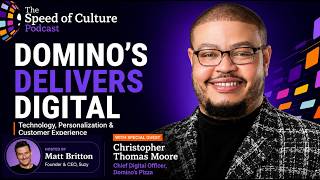
Domino's Chief Digital Officer Christopher Thomas Moore discusses how the pizza chain uses technology to drive sales and loyalty. The app now accounts for over 80% of sales, the company runs 100+ UX experiments annually, and a 2023 rewards overhaul focused on lower point thresholds and expanded redemption. Moore takes a cautious view of generative AI, prioritizing concrete use cases over hype.
Chapters
Today we're thrilled to be joined by Christopher Thomas Moore, the Chief Digital Officer for Domino's Pizza. With over 15 years of experience in e-commerce, digital marketing, and brand development, Christopher has been an innovator, a builder, and a forward thinker in the marketplace. Christopher, otherwise known as CTM, so great to see you.
Great to see you as well.
Thanks for having me. Yeah, absolutely. Thanks for taking the time during your busy CES schedule to be with us today. Talk to me about why somebody in your role comes to CES here in Vegas and what you hope to get out of it.
Yeah, I mean, there's just so much here. And, you know, CES is a hub of innovation, right? And it's really— I come here and actually the brand hasn't been here in a while. Yeah. And so this is the first year that we've had real representation here. But for me, it was important to be here to really understand kind of what's on this next frontier, right? The last time I was here, we saw folding phones, right? And we needed to understand what does that mean for our customer experiences, right? And so things like that are the next future innovations that you see when you come to an event like CES. And so I'm really excited to see what's next.
And what is next? Like, what are some things that you've seen here that are interesting to you that you're like, oh wow, this is interesting. We should think about this for our brand.
Yeah. '24. Honestly, I've not made it yet. Okay. Gotcha. So that's, that's my goal to, to get there this afternoon and tomorrow to really do a deep dive and see I can see.
Yeah, I'm sure AI is an area, just given the scale that you have, the interactions that customers have with your brand in a multitude of different ways, is something that you've been thinking about. What are your thoughts on the role of generative AI and other forms of AI for your go-to-market strategy moving forward?
You know, I think AI for me, um, sits in a spectrum of, um, you know, believability, but also I have a little bit of, you know, a pessimistic aspect and viewpoint as well. Um, in the sense of, I think that, um, when there's a lot of hype on the topic, but I don't feel as though there's still a lot of work that needs to be done to refine the space, right? From, you know, government and legislative concerns to really understanding how do we find true adoption in industry for this, right? Specific use cases that can be picked up and ran by organizations. You know, there's not— there are some of those that exist, but not fully replicatable across all industries. And so like, I feel like there's still a lot of refinement and learning that we have in the space of, you know, AI, generative AI, machine learning, you know, all of it buckled together. And so I'm interested to understand how we get there. Right. And it's going to take some time. And so I kind of believe some of the hype, but I have to see it to really believe.
Yeah, it makes sense. I mean, I think when it comes to things like customer service and chatbots, I mean, you're already starting to see some of the airlines and some of the financial service institutions integrate it. To me, that seems like a way where you can really provide personalization and service at scale.
Absolutely. When you have it sitting on like a language model datasets and specifically for like FAQ service-related items, it definitely helps take out some of the resourcing that would be needed to do that work, right? But as you start talking about consumer personalization and their experiences changing behaviors, like there's still a lot more to learn about this space. Of course.
And one thing I've experienced in the past year is that a lot of large enterprise brands are just— they talk about the promise of it, but when it comes to brass tacks and actually implementing it, the lawyers get involved and say, well, what about privacy, legal concerns, this and that? And it's just— it's going to be a very slow roll. It's not going to happen.
Right. And like content ownership, like who owns this content that's being created, you know? And so there's still a lot that we have to figure out. And so that's why I think for me, I want to learn, I want to lean in. Yeah, but I'm not putting all my eggs in the basket until it's really a little clearer.
Yeah. And social media was kind of the same way where when it first came out, brands were so scared. They were scared cared about losing ownership of their brand, what are consumers going to do with it? And it took some time for brands to really understand and it really shook out. And there's still a lot of controversy with social media as it relates to its impact on our culture and society.
Exactly. Or even voice. You know, I remember 2015, voice is the future.
Still never got there.
Yeah, it never did. Right. Hit a plateau. And so like I, so I'm watching, observing, testing, learning, but really interested to see where we go.
Yeah, I'm sure there are times at Domino's where you guys had conversations. Consumers are going to say, hey, Siri, order me a pizza.
Mm-hmm.
But I'm sure it doesn't really happen a lot right now.
So we do have those offerings under what we call our Anywhere offering, where you can tweet, you can send a text, you know, all these things. But you're right, it's a very infrequent—
okay. I think ultimately it's about what consumer problem are you solving? Exactly. And to cop on the Domino's app and order is so easy that doing it other ways and changing that behavior, it's not, it doesn't really solve a problem.
That's incredible.
No, marketers lose that a lot. Yeah. They get caught up on bleeding edge stuff. But now ultimately it's like, are you really solving a problem? Absolutely. That a consumer has.
And that's a big part of how we view where we have the biggest breakthrough is leaning in on those customer tensions, right? What are the tensions that exist that a brand action could alleviate that tension, right? And so it could be in the products that we offer, the messaging, you know, all of those kind of factor into where we find our biggest breakthrough. Yeah. And not just, not just the novelty of it.
Exactly. Exactly. A lot of I think a lot of marketers get caught up on really losing the vision of what's cutting edge, what's bleeding edge. And bleeding edge might get you into Adweek. Yes. Right. But ultimately, is it really going to drive an ROI? Completely. Is it going to make sense?
And that's— Completely. Yeah. Completely.
Yeah. It's like, are you, are you trying to create a press release or are you trying to create a business?
Yes, exactly. And sometimes you do a little bit of both. Yeah. Right. And so we have a view of what we call tech equity. And so there are certain investments that we make in technology that do drive equity for the overall brand but don't have the result of driving the revenue to the bottom line in the sense of people using that actual technology, right? Yeah. But it provides the halo that drives more customers to the brand because we're a smart tech-leaning brand, right?
It's part of building the brand.
Exactly. And so, but it's not everything, right? Yeah. Like you gotta have a balance there.
Yeah. So you joined Domino's, um, in 2018.
Mm-hmm.
Um, so you're entering, you know, year 6 and the change your industry has seen, like so many others, has been sort of mind-blowing because you had COVID where I'm sure you had just so many challenges and so many opportunities. 100%. Given— and now we're kind of post-COVID and we're trying to figure it out. Talk to me about your journey at Domino's and what have those changes been and what have they meant for your role and where your focus is?
Yeah, so I've had a number of hats that I've worn over the time at Domino's. Been really fortunate. You know, the brand and our culture inside the brand is one where they feel like smart people do smart work regardless of where they are. So I've been able to do a lot of different things. And so I started on the e-com, global e-com and digital marketing side. But then during the pandemic, I actually had responsibility for our menu. So all of the product. And so going and learning that process of building food and learning how to do that and do all of the qualitative research in the middle of a pandemic. Wow. Was really interesting. But so I've had a number of different, 4 different roles or so that I've had since I've been with the brand. And it's this constant evolution that I feel really privileged to have the opportunity to, you know, have TV media and digital media and product and all these other things that have refined my viewpoint and understanding of the brand, right? Having responsibility for product, I learned so much about our operations. I'm sure. In that process, you know, that it completely changed my perspective is now I have responsibility for the technology in the store. Having that strong understanding of both the product and the operations helps make that really possible for me to really help think through where some of those challenges and how we get through some of those challenges.
Yeah. I mean, so many people get dropped into digital roles or marketing roles and they don't really have an appreciation for how the sausage is made. 100%. And then their marketing doesn't really translate 'cause it doesn't fit with the, the inner workings of the business.
100%. So I feel very privileged to have a lens that's pretty broad of the organization, which I try to make sure that I apply to, you know, my role.
It's interesting 'cause your title of Chief Digital Officer, you know, now everything's digital. Yeah. Even TV. Yeah. Now we've spoken to a lot of executives in the TV world. TV shifting digital. So you're, you know, there's not much that you would do. It's not like you have people on the street corner handing out flyers, right? That isn't digital.
We still do a little wobble boarding every now and then.
How do you define the, the role of Chief Digital Officer at Domino's and what does success look like for you in 2024?
Yeah, it's one that helps drive and define, you know, our strategy as it relates to digital interactions and touchpoints with our customers as well as our team members in the store. So it's really thinking about experiences from different lenses depending on who that end user is. And so it's really kind of painting that vision, organizing the organization to really kind of approach those challenges that we have.
So one of the main pieces, I'm sure, is the app, because the app is a huge touchpoint.
It is.
I'm sure. I mean, I would imagine a very small percentage of customers are actually picking up the phone and ordering pizza anymore.
Yeah, there are some that still exist. Like, we have 5%. No, it's a little more than that. But we've tried really hard to ring and shift those over. But right now we're a little over 80% of our, our business is our sales are coming from digital.
I would think millennials is 95% plus.
Yeah, I would agree.
I mean, they hate talking on the phone to begin with. Exactly. Right. Even, even to their mom, they don't like talking on the phone. Whatever. So, um, so the, so when you think about the experience of the app. Yeah. Because that could make or break the business, obviously.
Mm-hmm.
Um, what, what does that look like? Like what works, um, you know, and what are your consumers asking for?
Yeah.
Um, when it comes to the app experience.
When we, when we think about e-com, you know, for the Domino's brand, And what's been very, very vital to our success is a test and learn strategy. So we run, you know, over 100 different tests a year to understand just the nuances of the experience. Like UX testing? UX and UI testing. Exactly. So from, you know, placement of content to colors to whole experience flows, right? We're constantly iterating on our experiences to understand where opportunities to alleviate those tension points to make a more fluid experience for our customers.
And what would make that change? Because ultimately you're still selling pizza. Like, why would it be different in 2024? 2020 than 2024 in terms of the UX? Is it based upon broader cultural changes that make consumers expect different things? Technological changes?
Yeah. I mean, like our, our customer expectations are predicated on all the experiences that they have, right? Not just the food experiences that they have. Right. And so some of it is understanding the current trends and expectations that exist. Some are, some is defining what those new trends and experiences should be. But, but we do see that even still with small changes could have really meaningful impact in the compounding effect of those small changes. Yeah, really drive the brand forward.
Yeah. I mean, with the amount of volume you have, you know, a couple of basis points of conversion.
Yeah.
Reducing breakage. Massive. Yeah. Because it's like, oh, screw it, I'm just going to go on Seamless. Exactly. It doesn't work. And that happens. It might not seem like a big deal, like in spots, but when you, when you actually add that up across all your markets, all your touchpoints.
It's huge, right?
And you probably have also just the checkout process, I would imagine, with Apple Pay, Venmo, PayPal, and making it easier for consumers to pay. How, how has that changed over the years?
Yeah, I mean, it's actually been evolving even in more recent terms. So we've launched Venmo, we have Apple Pay, and what it is, is that meeting the customer where they are, right? Providing optionality that's convenient for them versus what we want them to do. Exactly. And, and we find when we do that, regardless of where it is in the experience, payments, it could be signing, it could be whatever. However, it just alleviates some of that tension that helps drive it a cleaner conversion.
Yeah, it's all about convenience. I mean, you think about success of Uber, the one number one thing Uber did is it just saved people time.
Mm-hmm.
And they didn't even need to talk to the driver. It's like, it's just a seamless way that they can live. Yeah. They get into a car and they get out of a car. It's as seamless as possible. 100%. And I imagine saving time is a huge part of the overall—
It is. I mean, when we think about our brand, you know, our brand is a, a part of an individual's experience in life, you know, and if we could take something out of that, make your life a little easier, hey, that's a win for us.
Getting, getting something I want to eat in my house is it now is something that's easier, saves me time. It's a seamless experience. It makes my lives easier.
Put my energy somewhere else. Right. And so like, that's what our goal is when we think about our, our, the experiences that we're building is really how can we bring joy in the experience to the consumer. But then how can we, you know, again, just make it as simple as possible? Yeah.
You know, I know your Domino's Rewards program is a huge— and it makes sense. I mean, right now, all the things we're hearing are so consistent across category. You talk about the challenges with the cookie and, you know, privacy and the changes Google is doing. And we talk about with that the importance of first-party data. You, you guys are in the obvious position that you do serve the consumer direct. You do have our first-party data and the way that you— one way to leverage it is a loyalty program, right? Because it's a lot easier to grow an existing customer than find a new one. Yeah. Talk to us about the Domino's Rewards program and some of the innovations that you have your eye on this year.
Yeah. So, you know, '23, on September 12th, we relaunched our loyalty program under Domino's Rewards. And really it was about bringing more value for the customer. And so there were a few changes that we did. We lowered the minimum threshold to receive points and then we expanded our redemption menu, as well as added a lot of new perks and other benefits that our individuals get. And, you know, in an environment where you're finding a lot of loyalty programs moving in the opposite direction, taking value out, right?
Like, right, like the airlines did.
Exactly. Which I'm still mad about. Yeah. You know, I was really excited that we were able to infuse value, right? And it's paying off. You know, we're receiving such great feedback from our customers around the new program and providing the optionality that they've wanted for a long time, you know? So So we're really excited about Domino's Rewards and what it continues to do for the brand. Yeah.
And I'm sure another big piece that you're focused on in terms of just messaging, mediums, communication.
Mm-hmm.
Your business is a lot about context, right? Like if the football game, if everyone's watching the Super Bowl, everyone is gonna, everyone's a consideration set literally in America to buy a pizza.
Mm-hmm.
Where at, you know, at, at maybe 9:00 AM local time, not the case, right? Yeah.
That's an example.
Absolutely. A black and white example of context. Yes. Right.
So absolutely.
When you look at, you know, digital communication strategy, what has been working and, and, you know, what are some of the things that you're looking at maybe doing more of to make sure that you can actually deliver the right message to the right consumers at the right time?
Yeah, like right before the AI hype, the buzzword was personalization, right? And it still is and it's still so relevant. And it's relevant because of the fact that, you know, I view all of this as just relationship building, right? And it's just like scale. Any relationship that you have with someone, the more you know about that person, you kind of address them differently. You know, you have a different relationship as you kind of—
Next time I see you in person, I will have the benefit of this conversation.
Exactly.
I'll know what to say from what I just met you.
100%. And that's where personalization is important, right? And it's about building that tighter relationship and acknowledging the information and what you've learned about that individual, right? And if you can take that and then now make that individual's process, life, a little bit more simpler, then that's where that value exchange that happens from that data transfer becomes really valuable for the end user. Sure. Right. And so at the end of the day, I think that that from a digital communication standpoint has become and will continue to be very, very important in leveraging that information that our customers have provided so that we can make their lives such as what? So, you know, from, you know, from personalization experiences within, you know, the e-com experience, right? How am I, you know, bringing you through a flow that's leveraging information like the fact if you never eat meat on your pizza, why are we showing you that? You know, like things like that.
Or ordering history.
Exactly. That help, you know, drive, you know, a streamlined experience.
Payment method, all those kinds of things.
100%. 100%.
So in terms of some of the channels that you're using, you know, I know that you probably focus on a younger consumer, although you definitely have a broad audience, but how are you looking at things like social media, social commerce, TikTok's rising popularity as part of your overall strategy?
You know, social has been a big part of the brand for a number of years. You know, I've always felt like we've had a very different approach than some brands in the sense of we've always evaluated our— well, not always, but for a number of years have evaluated our media, specifically digital media, under a viewpoint of incremental return on ad spend. Right. And to get that, you really need lift studies. And so you need a lift platform in that publisher to be able to evaluate no impression versus impression and what's the true lift that you're receiving. Not all publishers had that.
You're saying you're doing attribution at the awareness level, not just at the performance level.
Completely. But it's all performance media, right? At the end of the day. And so because we're driving an IRO as that's driving to the bank. Right. And so, but we don't advertise with publishers that don't have platforms for us to evaluate the lift that we're getting. And so we've built that in concert with the number of publishers from the Facebooks to Snapchat to just recently TikTok, we've played a role in refinement and building out Lyft platforms so that we can evaluate the success or lack thereof of our media. And so TikTok is a space that we are growing. We're the number one pizza company on TikTok right now, but it's through a way of understanding really what's working and what's not working right. And, you know, our viewpoints have shifted over the years. 5 years ago, We really weren't leaning into influencers. We weren't finding incrementality in that space. Now it's very different. TikTok has a great platform to do that. And so, you know, we are evolving as, you know, society is evolving and thinking about ways that we can meet them where they are in really meaningful ways.
Yeah. And what types of content does Domino's see driving that lift on, on a platform like TikTok?
Like, you know, it's, it's different. It's not the same across platforms. Different platforms have kind of a different, um, core kind of voice and tonality. And so like TikTok has been really fun content and really scrappy content. Like it doesn't require a whole production studio and everything, you know, it's, it's a new version of UCG, I think, you know, and, and it's really great to see like how people are responding to it. So we've done some really fun things in that space.
Absolutely. And in terms of the category that you're in, are there changes that you're seeing with the consumer in terms of the things that they want to eat and what they are ordering more or less of right now that are driving the product and then as a result, marketing strategy.
Yeah, I mean, I think that at the end of the day, customers really just want, you know, hot and delicious food. Yeah. Right. And so it's our responsibility to make sure that we can effectively do that, you know, to the best of our ability. And so it's thinking about all of the considerations from like how long it takes you to actually order it to how long it takes you to actually receive it. Right. And so I think it's about the convenience, the, the time and effort it takes to order, which I think there's this expectation that it should be less and less, you know, as you kind of continue to build that relationship with customers.
And is pizza a category overall that is holding its own, decreasing or— because obviously you have like certain form factors like tacos, for example, really exploded. Yeah. You know, over maybe a 10-year period. Pizza's sort of been a main— at least American culture. Yeah. Is it, is it kind of keeping up? Are you seeing any pressure in the category overall?
Yeah. I mean, I think the pizza category is a fun category and it has weathered many, many storms. Right. And during the pandemic, it was an extremely important space because we were delivering, you know, in an environment where it was, you know, questionable and of going out into the wild and, you know, getting food other ways. And so, like, we, we, I think through the pandemic, played a really important role in getting, you know, safe, hot food to individuals. Right.
Just giving consumers a sense of normalcy.
Absolutely. Absolutely. And so, but, but through that, we had to like reinvent our brand. We never had contactless delivery before the pandemic, and we literally spun that up, I think, in 3 to 4 weeks, you know, as we saw what the world was changing.
Is that like, is that like knock, knock, zoom, zoom? Like you basically put the pizza and you knock on the door and you drive away?
So when we started, we had what we called the pizza pedestal, which was a cardboard like box that was hollow that we could put the pizza on because we didn't want to put it on the ground.
Right.
And, you know, new procedures that we wanted to step back and provide distance and make sure that that pizza was picked up.
Crazy, right? To come up with that on the fly.
Absolutely. And so it was a change to the digital experience, to the operational procedures, you know, and all of that had to happen really quickly. And so, but pizza has always been part of, you know, our lives in some form or fashion. And so to find a way that we could still do that in an environment where the world was changing really quickly was really exciting.
Yeah. So let's shift gears a little bit to you because you definitely strike me as somebody who's passionate, knowledgeable about the space, continually evolving. Um, how did you find your way, um, into this role? Did you always know that you wanted to be in the marketing space? No. Um, okay.
Not at all. Okay. So I, um, my career in, um, the marketing space started, um, I joined an agency out of, um, North Carolina called Pace Communications, and I joined as a temp in their call center because I needed a job while I was— to pay for school. And so I worked full-time while I was going to school. And, you know, very quickly I was assigned different projects from the leadership and eventually started helping build out brands for white labeling of e-commerce products for different publishers who didn't understand the space or wanted to expand.
Right.
And by the time I graduated college, I had, you know, 4 years of experience in building brands and e-commerce platforms. And so I had to make that decision what I wanted to do because I was pre-law, poli-sci major, took the LSAT, was ready to go to—
I took the LSATs too.
I was ready to go to law school. But, you know, there was just some level of passion that I had for this space. And what I've always said is why I think I've gravitated to digital is that I prefer to be the individual that tells you my performance versus you tell me my performance.
Performance.
Yeah. And the ability to track and understand the influence and impact is why I've always loved digital. Right. And so I've just kind of grown through the business from call center up. And, but it was never kind of my initial view of who I would be or the role that I would have in the future. But yeah, it is amazing.
It's crazy. A lot of people, a lot of young people, they're like, they want it now. Yeah. You know, they see other people flexing and they're like, oh, I want, And it's just not how it works. It's not at all. You know, you put in the time. No, you worked in the call center and here you are as Chief Digital Officer of one of the most prominent brands in the world. But I mean, so what steps did you take that maybe other people, younger people, would benefit from so they could have the same ascent?
You know, for me, I think it's always been a level of curiosity and willingness to feel comfortable in sharing my opinion and doing things based off of where I saw needs, right? So like with the agency I joined and there wasn't really a clean training program. And so 6 months after I joined, I built a training program.
You weren't asked to do it?
No. Initiative.
Initiative is worse than that.
Yeah. And so like I was like, someone needs to have a training program.
Some people are waiting for permission.
They are. And I, and I've always had, you know, felt comfortable just jumping out there. Why? And I don't know why, you know, it's a good question, but I, I've always felt it's— and maybe it's this desire to make things better for someone else. Yeah, right. Like, so someone doesn't have to go through the same struggles and challenges that I went through. But that initiative, I think, has provided opportunities that otherwise I wouldn't have received. And those opportunities have laddered me to where I am today.
And I mean, you know, it looks like, you know, then you went on to Extended Stay. It seems like, and literally every 2 years you just get promoted, 2 years, get promoted, 2 years, get promoted. Do you think you've gotten promoted through aptitude or by just asking? Like, you know, some people are great at their job, but they just keep their head down. Yeah. And other people, you know, maybe are slightly less great, but they just keep asking.
And some people are both.
Yeah. But, you know, how do you continue to evolve and go up the chain so quickly?
Yeah, you know, and I can honestly say that I've never received a promotion by way of asking for it.
I've always— It was given to you, right?
I've always tried at the end of the day just to show my contributions and impacts, right? Either directly or through the teams that I've had the opportunity to lead. And so for me, it's— that's where I've always anchored. I'm like, I don't care about all that other stuff, right? Like if I'm making impact, I'm learning, I'm growing, I'm happy, then I'm just gonna keep pushing, you know? And so I've been really blessed and fortunate that I've been in organizations that have acknowledged that and have given me new opportunities.
So, I mean, what's— where do you see yourself in 5 years? That's a good question. What's next for you? Yeah.
I don't know. There's, um, there's so much I'm super excited about what we're doing at Domino's. Yeah. Every year there's new excitement.
Yeah.
And like, I just, I learn new things and I'm continuing to grow as an individual. And so I'm just really excited about where we are and understanding that there's still a ton of runway in front of us. In front of us. So, but I, I'm not sure. Yeah. I don't know. I'm, I'm like kind of keeping it tight.
You probably didn't know 5 years ago that you'd be in this position. I didn't know. Right. And, and how you, this year, how are you planning on spending your time maybe a little differently to make sure that you keep growing and learning and selling?
You know, um, it's a good question. Like, I think that, you know, I wanna continue to challenge myself with understanding, you know, nuances of the industry where we're going. And so events like CES provide a platform for me to do that. I want to continue to expand my network to understand individuals. But, you know, I am really excited about just continuing to build up my team, you know, so that they are the future rock stars in which they already are.
Which is incredibly rewarding, I can tell you.
It really is. I mean, that, like, to me, that's the most rewarding thing to see that you maybe had a little bit, you know, and then they go on to do great things.
Exactly. Wow.
I had some type of role in that. Exactly. So I am really excited to see where this next generation goes and how I can be a part of that.
Awesome. So to wrap up here, Christopher, is there sort of a mantra that you like to live by? I mean, you seem really intentional about your career decisions. I'm just wondering, like, if you could sum it all up in some type of mantra.
You know, I do try to live in this world of work hard, play, play hard. Yeah, I feel as though, you know, we, we grind every day, you know, and we do our best to contribute, but we also have to make sure that we're enjoying this life that we have. Because I do not want to look back and feel like I didn't have a fun and exciting life because of the fact that I was just head down working. And so it's that balance that has been really important to me. And it's something I advocate for everyone within my organizations and anyone I know, that you have to find that balance because you work really hard, but you have to enjoy the life that your hard work has provided for you. And so I try to find that balance in my life.
And hopefully you'll have a chance to play hard here in Vegas as well. Yeah, it's not too hard.
I don't know. This schedule is a little crazy. Yeah, yeah, yeah.
Well, this has been awesome. I'm so happy we had the chance to catch up. You know, it's fascinating hearing about your career and the stuff you're working on. I have no doubt you continue to achieve great things at Domino's and wherever else.
Thank you, sir.
Thanks for having me. Absolutely. On behalf of Susan and the Adweek team, thanks again to Christopher Thomas Moore, Chief Digital Officer at Domino's Pizza, for joining us today. We're here live in Las Vegas at CES. And be sure to subscribe, rate, and review the Speed of Culture podcast on your favorite podcast platform. Till next time, see you soon, everyone. Take care.
More from Matt




MikMak’s Rachel Tipograph on Consumer Spending, Retail Media & Holiday Shopping Trends



Jaguar Land Rover’s Charlotte Blank on Luxury, Purpose & Experiential Storytelling



