DoorDash’s Kofi Amoo-Gottfried on Growth, Consumer Insights & Local Commerce
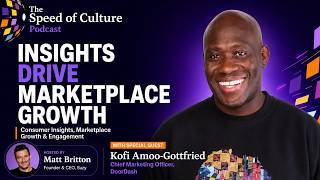
Kofi Amoo-Gottfried, DoorDash's CMO, talks about the company's pandemic pivot with the "Open for Delivery" campaign and its growth beyond food into groceries, alcohol, and retail. He explains how DoorDash uses first-party data and rapid testing to understand what consumers want next.
Chapters
Up today, we're gonna be speaking with Kofi Amoo-Gottfried, Chief Marketing Officer at DoorDash. Kofi was named one of the world's most innovative CMOs by Business Insider in 2022 and was just recently named to the 2023 Forbes Entrepreneurial CMO 50. Kofi, so great to see you. Thanks so much for joining today.
Thank you for having me. Pleasure to be here.
Absolutely. So, you know, I'm fascinated by your background and how you ended up here in the US and working for DoorDash. So at what point in your life, growing up in Ghana, I believe, did you know that you wanted to be in marketing?
I had no idea I wanted to be in marketing. I didn't know marketing even existed as a profession. I came to college, moved from Ghana to St. Paul, Minnesota when I was 17 to go to college, which I tell everyone, if you've never experienced culture shock, you should move from Ghana to Minnesota. It's like the perfect—
What was that like?
It was incredible. It was eye-opening. It was literally being in an entirely different world. Everything was different. The people, the weather. Having grown up in 80 degrees, 80 to 90 degrees all year round to go into -40, big change. And I was an econ major in college, so I thought I would go into finance or investment banking or consulting, something in that world. But my junior year, I did a— went to a job fair in Chicago for underrepresented students and ended up meeting the Leo Burnett recruiter completely by accident. Like in between my actual interviews, which were for like banks, I met this guy at a booth. We got along, I got an interview, uh, and, and ended up going to Burnett that summer for my internship and totally fell in love with this. I didn't even know it existed, but I found that like the parts of it that like appealed to like my econ brain was like, how do we drive a business? But then there was all of this other side, which is about creativity and psychology and human behavior. Which was super fascinating. So that's how I got started.
Yeah. And, and you know, we'll get to Leo Burnett in a second, but as you're talking, my mind is just running by like what it must be like to grow up in Ghana and then show up at a college campus not knowing anybody.
Correct.
Were you embraced? What was the experience like? And how did maybe that experience even shape you, the person that you'd become?
Yeah. I mean, McCallister is a very— the college I went to is a very unique place in the sense that their big value prop is around internationalism and multiculturalism. So my freshman class of 400 kids, there was about 110 of us that were fresh off the boat from something like 80 countries.
That's super helpful.
So yeah. So you came, you had a community, those kids from my high school in Ghana that were there ahead of me. So the people I actually knew, I didn't even know they were there, by the way, when I got there. I got there and I was like, oh, I know you. You were a few years ahead of me in high school in Ghana. So yeah.
Yeah. So you're at Leo Burnett and obviously, you know, you didn't grow up in America and Leo Burnett is marketing these American brands. 100%. Was there a learning curve just to even understand the consumer and just the brand architecture of America given that? And, and how did you kind of bridge that gap?
Yeah. So the consumer side of it came naturally to me for two reasons. One, I'd already gone through this like massive shift 4 years earlier where I'd had, where I'd had to figure out what, you know, I, I was gonna say America, but that's not even fair. What like Minnesota and St. Paul, and then specifically McAlister within that context, which wasn't even really like St. Paul, 'cause it was a very specific sort of bubble. But then I also grew up in a very large family. So I have like 84 first cousins. So I've always had to understand people. I've always had to figure out sort of how people are wired. And that has always come naturally to me as a result of my upbringing and sort of this very large family that I grew up in. Um, so that part was relatively straightforward 'cause it's really just like asking questions, digging into why people do the things they do. As an econ major, If you know econ, that's a big part of all of the hypothesis. So that part came easy, but understanding brands, understanding consumer culture, all of that I had to learn on the job.
Absolutely. And after a few years there and then a stint at Wieden Kennedy, you were hired by Publicis Group to basically go back to Africa and open up, uh, Publicis Ghana. So the first real agency of Publicis in, in Africa. What was that experience like and what made you want to go back to Africa?
So I had always thought that I would go back to Ghana at some point, right? So I, I, till today I still say like all roads lead to Africa for me. Like I'm proudly African, I'm from Ghana. These days I'm an American citizen, but I will always be first and foremost Ghanaian and African. And so I'd always thought that I would go back at some point, but I thought that might be like a retirement thing, you know, like later in life. And I was having an amazing time at Whiten, like, you know, the, I still say that's the most fun job I've ever had. Like being the head of strategic planning on Nike at Wieden and Kennedy, all I did was like spend time with athletes. It was just incredible.
Iconic agency.
Yeah. Iconic agency, iconic brand, iconic athletes. Right. So there was very few things that could have gotten me to leave that job. But when this call came and I was like, oh, I've always thought about going back home and here's actually an opportunity to do it much earlier than I thought. Um, but with the backing of the Publicis Group and Maurice Levy, with the opportunity to build the first majority-owned agency across all of the holding companies, not just Publicis, in Sub-Saharan Africa. And then just to— like, I felt that it was a small way for me to contribute to Ghana's story and also, like, learn. Because, you know, I'd never done that job before. I'd been a planner, I'd been an account guy, but I'd never run a business. And so this was being an entrepreneur, building it all from the ground up. In 3 years of doing that job, And I think it was like 15 years in experience in 3 years. So like, I wouldn't trade it for anything else. I'm sure.
And then you decided to go to the client side or kind of cross the chasm, so to speak, to go work at Bacardi. And so at that point, you had felt like whatever you wanted to achieve with that venture, it seems like you felt good about. And then you would end up heading back to the US, first at Bacardi and then the agency world, then at Facebook. So being at Facebook in 2015 to 2019, kind of like the height of their dominance. So to speak. So talk to us about that. Why did you go to Facebook and what did you hope to achieve when you were there?
Yeah, it's interesting. So when I left Ghana and went to Bacardi, as you said, that was my first time brand side. And what was fascinating about that was you got to— the canvas was just so much bigger, right? On the agency side, it was like, hey, you're making the campaigns. Here it was like, no, we have to figure out pricing and distribution and partnerships and innovation and packaging. And it was so fascinating to be able to like touch all of those things and lead that brand. Out of the UK on a global basis. And so then the work that we were creating was then strategy that was getting adopted across, you know, 100 markets. So that was like an amazing experience to be there and be, be there in a moment of transformation for that company. And then the, the shift to Facebook, you, you'll remember this in 2015, there was this sort of like slide going around the internet, which was like the large, the world's largest car company owns no cars, right? The world's largest hotel company. Owns no hotels. And it was this whole thing about like the sharing economy and all that. And so I was fascinated by technology. And at that point, I'd also gotten to the part of my career where I just realized that the most important thing to do was to keep building skill sets. And I, up until that point, I had been a pretty straight down the line, like brand marketer, ad guy. I had never worked in technology. I had never worked in a pure digital business. And so there was this really unique opportunity at Facebook where I went in to lead marketing for internet.org. That allowed me to bring a ton of my expertise because that was about expanding that brand, that product into emerging markets, specifically to people that did not have internet access. Because Facebook was so big that for Facebook to grow, it literally had to grow the internet.
Like, think about that.
Incredible. So they had a whole initiative about getting more people online so then you get them on Facebook. And so I went there.
And that was their mission, right? It was to connect the world.
Connect the world. Yeah. Right. And so I went there as the head of marketing for that initiative so I could bring all of my emerging markets, like, lived experience and expertise, but then also learn a ton about how a company like that builds digital products, gets them out to the masses, escalates growth. And so it was a fascinating first couple of years. Then they asked me to step into the role as the head of brand and consumer marketing there, which was also incredible. And I got to live Cambridge, fake news, Trump election, like, all of that. And so, like, again, being there and helping lead the company, like my team led the apology tour, right? Post Cambridge. Like we did Facebook's first ever like large-scale campaign in this country to talk about how we were making changes on the platform to like prevent things like fake news and hate speech and all of these things. Yeah.
So we haven't even gotten to your role at DoorDash now, uh, now, and already we've gone through more than many people's lifetimes of different experiences. You know, you strike me as somebody who can't stand complacency cuz you know, you've talked many times already about wanting to learn more, wanting to do more, et cetera. Where's that come from? Because I do feel like many people, maybe complacency is a wrong word, but they're comfortable somewhere, they're doing well and they don't wanna rock the boat. But you seem to be not afraid of risk, not afraid of new experiences. Why do you think that's important? Where do you think that comes from?
There's probably a couple of ways to answer this question. So one is that like, I'm an immigrant. Immigrants are sort of self-select, high-risk people that have a high tolerance for risk, right? Because anyone that leaves their country to go somewhere else to try to build a new life, that's a risky proposition. There's obviously opportunity there, but you don't know what's on the other side of it. So I think that's one. The other one, which is like a little bit more personal, is that I lost my mom when I was quite young. So I lost my mom when I was 10. And there's— I didn't think about this until much later, But like the worst thing that could have happened to me happened to me when I was 10. So like the things that I did later that would've felt like risk to other people have never really felt like risk to me. For me, it's always just been like—
'Cause it's all in perspective.
It's all perspective, right? So like, this is an opportunity to learn something new. And that's been true at every point. Like even going from Leo Burnett to Wieden, that wasn't obvious. Like I was on a really good path at Leo Burnett and I went to Wieden and took a totally different job. And my first 6 months there were super hard. Right? 'Cause I couldn't figure it out. And I was like, what have I done? Have I made a massive mistake? But you know, then you just go, no, you just have to figure it out. And so that, like, being able to make those transitions always give you, give me the confidence for the next one. Yeah. Yeah.
And in 2019, you went to the next one and you, uh, were, uh, took a role at DoorDash, you know, at first, um, VP of marketing and then ultimately where you are today as chief marketing officer. What strikes me in 2019 that you joined is then 2020 hit. The pandemic hit and all of a sudden everybody was ordering food. It's— so what was that experience like? And, you know, how did you end up making the leap from VP of marketing to chief marketing officer there?
Yeah, I mean, so DoorDash is a fascinating company. So I joined in 2019. I was really taken by the founder, his vision, uh, for the company, for the role of the company in the world. You know, Tony, I was really taken by him because he's an immigrant like me and he had come to the country as sort of as a 5-year-old from China.
As are many prolific entrepreneurs.
100%. You know, his parents had to rebuild their lives here. He had grown up in the restaurant industry 'cause his mom used to manage a restaurant. And so, you know, the notion that he wanted to build a business that would help small businesses compete was really interesting to me. And so I was like, okay, that's like something I can get behind. And the company was already growing super fast. DoorDash in '19 was probably going 200, 300% year over year, but off a small base. And then to your point, 2020 happens. And the first 2 weeks, like I remember on whenever it was, March 13th, um, you know, it was like Tom Hanks has COVID and then Rudy Gobert has COVID and then the NBA shuts down. And once the NBA shut down, all of us were like, oh, this is, this is a big deal. Um, but we actually didn't know what it was going to mean for the business. 'Cause if you remember at the time, it wasn't clear if restaurants were going to be open at all. It wasn't clear if you could deliver. It wasn't clear if it was safe. So all of us were like trying to get as much information as we, we could.
A lot of people also freaking about the economy and is it gonna be the next Great Depression? Correct.
Correct. And people are going to lose their jobs and all of these things. Yeah. Um, and so for us, once we got a sense, probably 2 or 3 days, let's call it around from the 14th, 15th, that we were still going to be able to, like, restaurants were going to be open. We then shifted our entire approach as a marketing organization and as a business to saying, our job now is to help restaurants through this crisis. So we shelved all of our plans, um, and we just said, we're gonna take all of our media and point it at this one thing. And we created a campaign in 7 days called Open for Delivery, which was just, we're gonna tell the world the restaurants are still open, order from them, uh, help keep them afloat. And then the business as well made like some choices that till today make me incredibly proud. Like we cut the commissions that we charge restaurants by 50%, and we're the only business in the space to do this. For what at the time was an unprofitable pre-public company to the tune of $120 million, and then ended up making a bunch of grants as well. But we just focused the entire business on like, how do we solve problems for people right now? And so that's what we did on the restaurant side. On the Dasher side, there was huge demand, to your point about employment. There's all these people now coming into the space looking for work. So it's like, okay, how do we ramp up really quickly to help them navigate?
We— Because that's another constituent, your Dasher.
Huge constituent, yeah. We became one of the largest procurers of PPE, and that was built by the marketing organization. Like, we built a PPE supply chain so that Dashers could get these resources and continue to work. We did things like we changed the schedule and what we paid them. So we built a product called Instant Pay, which meant they could cash out the day that they worked versus waiting a week. And then on the consumer side, we had to rebuild the entire product because if you remember, in those days, you had to meet your Dasher. So you had to rebuild the product in 2 weeks to say like contactless drop-off, all of these things, and then start to expand categories 'cause we're seeing demand for stuff beyond restaurants, which, which had always been the vision.
But that period brought all of that forward.
Accelerate it. And it was just like, you know, that, let's call that year and a half. I mean, was, was extraordinary in terms of watching the business respond in real time to customer needs and just be super focused on like, what is the next thing we can help solve for people?
It very much feels like it's also the culmination of all the experience that you've had to date. To think about understanding the consumer, brand building, leadership, you know, and now all of a sudden you're hands on keyboard, you know, getting very tactical about, okay, how are we gonna roll this campaign out? How are we gonna roll these payments products out, et cetera? So it must have been exciting and invigorating to go through for sure. And in an uncertain time.
It was amazing. And I, I've always believed as a person and saw this up close for the company that you find out who you are in a crisis. Yeah. 100%.
And, and I thought that— we experienced that as well.
Yeah. The way DoorDash responded in that crisis was extraordinary.
Absolutely. So fast forward today as CMO of DoorDash, what are the main things that you're focused on every day to help drive the business forward, which now is a publicly traded company and is a, is a significant business and really a market leader. What do you focus on to propel the business further?
There's a few things that we're focused on. So if you go back to 10 years ago when Tony and his co-founders did their submission into Y Combinator, their pitch was that they wanted to build a local FedEx. So the, they started with restaurants 'cause it's the largest category and it's the one that's most frequent, um, in terms of like how many times people eat. Sure. But the vision was always that we wanna help every small business on the street. So I'd say probably the first thing we're focused on is like, how do we expand into multiple categories? And so over the last few years we've expanded into groceries, into convenience, into alcohol, into flowers, into retail, like Sephora's on DoorDash, you know, like there's all of these things, which has been incredible. But that creates a bunch of challenges for the marketing organization because now these are— and for the business because these are new customers that we have to go understand, new behaviors we have to go understand, new moments we have to go understand.
New stories you have to tell.
New stories we have to tell, uh, new products you have to build because the same UI and the same product flow that works for restaurants doesn't work that well if you're going to go like buy makeup, right? So like rebuilding all of these things, uh, on the fly as we've gone. So new categories is a big one. International expansion is something we've been focused on. So we expanded a few years ago into Canada and then into Australia. And then about a year and a half ago, we acquired a Finnish food delivery company that operates in 23 markets called Wolt. And so we're also integrating that business and thinking about how do we build out the DoorDash platform and the Wolt platform internationally. And then the third one, which I'd say most people are, are not aware of, is what we call our platform services business, which is We took all the things that we've learned from building on our own platform, and then we white-labeled it on behalf of merchants. So today, if you go—
So they can do their own delivery.
Correct. So today, if you go to chipotle.com and you order a burrito directly from them, DoorDash handles the fulfillment, right? So like, how do we take our fleet? How do we take our logistics engine? How do we take our software prowess and how to deploy that on behalf? Because what we've learned over the past 3 years is that everyone is going to need a digital business.. It doesn't matter and doesn't have to be on our platform, doesn't have to be on DoorDash marketplace, but you are going to need logistics, you're going to need fulfillment, you're going to need software. So how do we start to build that out for our partners?
The rails for dis—
local distribution.
Exactly.
Yeah, exactly. So that's, that's a, uh, probably the third thing that we're focused on. And then much more recently, um, we've started to build an ads business on top of our—
I was gonna ask you about that—
on top of our platform. And what's been fascinating about that is like it's being built with the same mindset and ethos as the rest of the company, which is like, this has to be a service for small businesses. So that means we've made like really, um, unorthodox design choices. Like I think this might be the only ads platform that charges on conversion, not pay-per-click, not pay-per-impression. We only charge you as the merchant on our sponsored listing product. Bottom funnel. If someone goes on to purchase. And so like all of these, so we've got That's another big piece of what we're focused on. So there's, there's a ton going on.
I'm sure. So, and with all this going on, I imagine a big piece of what DoorDash wants to make sure of is you have your finger on the pulse of the consumer because, you know, we had COVID that hit and there's been so many changes since then. So some of the things that you're talking about right now, which seem very obvious to me, were sort of far-flung ideas pre-pandemic, even things like ordering makeup, like why would you go to the mall? We have work from home now. You know, distributed workforce. How do you keep your finger on the pulse of the consumer? What are the trends that you see evolving with the consumer that I guess give you more conviction to some of the areas that DoorDash is playing in?
Yeah, it's, it's a great question. So we, we do a number of things. So one is that like, we obviously have an enormous amount of first-party data. Yeah. That just informs—
which these days is everything.
Which is huge, right? 'Cause we see behaviors on the platform. We then follow up to try and understand why those behaviors are happening and then figure out if that is a viable path to proceed. So I'll give you a really tangible example. If you've used DoorDash in the last, let's call it a year, you've experienced a product called Double Dash, which says like you've made an order and you say, hey, if you wanna make another order in the next 10 minutes, we'll batch it with the same dasher 'cause we'll show you a collection of scores that are really close and the same dasher can do both deliveries and we'll bring you both. We'll bring you both in the same order. So now you can say, okay, I'm gonna get my meal from here, but I want a slice from the Cheesecake Factory and I'm gonna get both of those things together and it costs you the same amount as a customer from a delivery perspective. But that's 'cause we saw that behavior on the platform. We saw that people were making multiple orders within 10 minutes of each other and we're like, oh, why is that? And it's like, well, it turns out I want this and I want that, or I want this and someone else wants this other thing. And so like, like how do we build a product that—
You order pizza, you want beer.
Exactly. Both, right? Exactly. And so that, so one, one very tangible place is like looking at that data, understanding the data. We also do a ton of like consumer conversations, interviews, focus groups, um, because as, as you say, like we just find that this business, even beyond all the things that we are doing, is just incredibly dynamic because it's got seasonality, it's got like within the week different things happen. It's got like if there's a, um, last year when the government was doing like child tax credits, like it shows up in the business. So there's all of these things where you, You don't always know how the forecast is gonna play out. You have a forecast, but like, it's so dynamic that on a week-to-week basis, we find ourselves being like, hey, let's actually go check in with customers. Let's understand, like, there's a trend break here that we don't fully understand. Let's dig in. Let's talk to customers. Let's look at our data. Let's see if we can generate some hypotheses, um, and then find out what's going on. And then we try and act on it.
What do you think could go wrong with your business strategy? Like, what are some trends, I guess, you guys are worried about that could change the way consumers are, I guess, adopting the product, using it?
It's, it's a good question. Tony says this thing that I love, which is that like convenience only tends to go in one direction, right? Which is that like no one is looking for 2-week shipping. Yeah. Do you know what I mean?
That's easier.
There was a time, there was a time when 2-week shipping was the move, and we all thought it was like, this is great.
There's a time you had the helicopter too. Yeah, correct.
Right. But like convenience tends to be really sticky because like once you can actually meet people's needs and solve it for them, the business is tense. The way we tend to think about it— because the only thing we can't create more of is time.
That's ultimately what it comes down to.
This is exactly it. And so the way we tend to think about it is, is less external threats, but more a business is really composed of several inputs, right? So we think about selection. Do we have every possible thing you could want on our platform? And that goes from stores, you know, to things like Home Chefs. Which has been a really interesting trend over the past, let's call it, years, where people are cooking at home and selling it online, right, as individuals. And so home chefs is a booming category. There's products out. There's a product out there called Sheff, S-H-E-F-F.
I wasn't even aware of that.
Yeah, so like, and you can be like, and for me, someone who's from Ghana, like home chefs is my jam. You know what I mean? Like, I'm like, find me the Ghanaian auntie who's making the dope jollof. I will just be there. You know, like I know where she is. I got to drive to her house in Newark. It's far. Like, if somebody can get that to me, I'm all about it. So there's been things like that that we started to see come up. Um, but so it's like, solve the selection problem, solve the quality and logistics problem, which is like, if I say to you that you're gonna get this in 30 minutes and you're gonna get all the things you ordered, how do I make sure that that's true all the time? Solve the price problem. So like, how do I make the service more and more and more affordable over time? And then when we get things wrong, do we make them right? Which is the support and the customer service dimension. So in our view, if we can continue to do that, execute that well, and over time we want to bring down consumer fees, bring down cost to merchants, drive up earnings to Dashers, like we want to just keep doing, and we've done that. So like, how do we keep, if we keep doing that, we think that like we can continue to grow this business.
Yeah, totally makes sense. So shifting gears here as we wrap up, Kofi, I mean, you've had an incredible career, and I can just tell you by being here with you in person, you're a very inspiring person. I just feel inspired listening to your story, and it makes me wanna do better by my organization and, and continue to innovate. What are some, some of the things that you'd point to that you feel you did well, maybe for some of our younger listeners here at Speed of Culture that you'd like to impart on people? Because your road's been anything but easy and anything but the, the, the road, uh, most traveled, right? Sure. You've kind of bushwhacked through to all different sorts of places without fear, seemingly. You know, what's behind that and what could other people take away from your journey?
Yeah, I'd say there's probably 3 things. One is, for me, is curiosity. So I generally try to approach everything with a beginner's mind. I try to not assume that I know the answer, even in areas where I think I'm a domain expert, because the world's too dynamic. It's too complicated. The things you knew yesterday irrelevant today. You know, I joke with my team all the time that like, yo, when we're in high school, Pluto was a planet. You know what I mean? And that's like 400 years of physics. Like a lot of people worked on that and we've now decided it's not a planet anymore. You know what I mean? Like these things will change. And so don't hold to dogma. So the first thing is just staying curious. The second one is really around like, which is more of a personal thing, um, is kindness. Like I just believe that like the number one orientation that I try to have to the world and to other people is like, be kind. Like, shit's hard enough, you know what I mean? So like, how do we try and create space for others? How do we try to help others? I spend a bunch of my time mentoring for that reason because other people helped me get here. I did not get here by myself and no one gets anywhere alone, right? So trying to continue to do that. And then I'd say the third thing is probably just around like, there is— like, it's going to be challenging at times. And it's important in those moments of challenge to just understand that there will be light on the other side, right? Like when I got to Whiten, it was hard. When I went to Ghana, it was hard. But like having good mentors, having people you can call, having people that have been through the thing that you're going through that can give you perspective on it, um, and trusting that you'll navigate to the other side of it. And that even if you fail, it's a hugely valuable lesson. If when you do the thing that doesn't work out, it's just as valuable as doing the thing that did. So like those, those would be the things I would say.
I love that. Awesome. So to, to wrap all that up, is there a way to bottle that all up and maybe a mantra that you like to live by or a saying that kind of drives you? I know it's a tough one. Just pick the first thing that comes to mind.
So I've got a couple that are related to the, to what I just talked about. So one's like, be kind because everyone's fighting a battle, you know, the thing about, and the other one is like, It's not, uh, it's a Lena Horne quote, and it goes something like, "It's not the load that breaks you down, it's how you carry it." Which is that, like, none of us actually get to control anything that happens. We lie to ourselves that we do. But what we do control is how we respond. So just holding that and always being aware that, like, you know, difficult things will happen. Lots of difficult things have happened in my life, but I get to choose how I respond. And then the third one is from a much less lauded philosopher, Rocky Balboa.
I'm from Philly. Rocky's my jam. Which is that time is undefeated.
We have no time. So like, do the things that matter now. Yep.
Well, we're gonna leave it at that. Thank you so much for joining here in Miami, Kofi. It's been so great spending time with you and getting to meet you. And I have no doubt that under your leadership, DoorDash is gonna continue to achieve great things. So on behalf of Suzy and the Attaway team, thanks again to Kofi Amoo-Gottfried, Chief Marketing Officer at DoorDash, for joining us today. Be sure to subscribe, rate, and review the Speed of Culture podcast on your favorite podcast platform. Till next time, see you soon, everyone. Take care.
More from Matt




MikMak’s Rachel Tipograph on Consumer Spending, Retail Media & Holiday Shopping Trends



Jaguar Land Rover’s Charlotte Blank on Luxury, Purpose & Experiential Storytelling



