Doug Zarkin on Brand Relationships, Customer Experience & Marketing Strategy
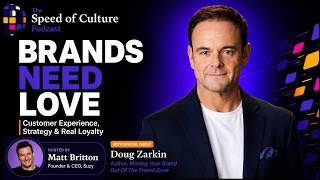
Doug Zarkin, author of Moving Your Brand Out of the Friend Zone, argues that brands overestimate how much customers care about them. He breaks down a brand-value equation (experience divided by price) using Delta, Marriott, and Starbucks as examples, and warns that big ad budgets can mask weak creative, as seen in many 2024 Super Bowl spots.
Chapters
Today we're back with a very special guest, actually a return guest, uh, the author of the recently published book Moving Your Brand Out of the Friend Zone, Doug Zarkin. Doug, great to see you again.
Great to see you, my friend. How you been?
I've been not too bad. You know, it's interesting, I wrote a book in the past. I'm always asked what was the experience like writing a book, and I'm just curious to hear from your mouth How was writing a book, I guess, what you expected, and in what ways did it throw some curveballs at you?
So I wrote the book in 16 weeks. I wrote the outline for the book in about 15 minutes. I had the chapter, I had the title of the book before I even started it. But for somebody who cannot spell and has, is a multiple-time assault victim of autocorrect, it was a terrifyingly exciting experience. To write it. There was moments of clarity and moments of what am I doing? I will share with you candidly that the day before I had to turn the book in for final, final, I was reading the book at the pool Labor Day weekend and I read the first 3 chapters and I thought they were dogshit. I said to my wife at like 2:00 in the afternoon, Honey, I gotta go home. And she goes, what are you doing? I go, I gotta just rewrite this. It's not what I wanna say. Right. And I rewrote 3 chapters in about 5 hours. And I'm glad I did because it's kind of like the opening lean in. But what a terrifying experience. But at the same time, I'm glad I did it. Don't have any plans to do another one, but I'm glad I did it.
What about the writing experience do you think led you to maybe make a misstep in how you opened the book? Is it because you rushed the beginning or is because you learned more about the concept as you wrote the whole book?
I think I got smarter as I went along. Yeah. When I wrote the beginning chapters, I didn't have the full narrative in mind. I was still kind of working on my writing style, trying to figure out, did I wanna write as I speak? You know, did I want it to be conversational? How formal did I want it to be? I was very self-conscious about my experience and, and making it all about what I've done versus what I've learned. And that's very different. And so I found the beginning of the book to be a little bit too self-serving. It was a little bit too narcissistic and it didn't welcome the reader in. It didn't give them that lean in that you and I both know in anything that you do, that, that moment of lean in factor to get somebody to want to pay attention is so important. Yeah, it didn't have it. But I had a moment of clarity when I was reading it at the pool, I, I started to see what I wanted to do. And I will tell you, to write 3 chapters in 4 or 5 hours, that's, that's the most I've ever done in the least amount of time, right? And, um, I'm really pleased with how it turned out.
Awesome. And, and just diving into the book, so just the title itself, Break Free from the, you know, the friend zone, it's— yeah, we've all kind of been there, know what it's like from relationship standpoint, terms of, you know, you have feelings for somebody but they they just want to be friends and you don't really know, and then you get disappointed in the end. What's the correlation between that and, and a brand and their customer? And what made you kind of create that analogy as a thesis for your book?
So, you know, as handsome as you are, my friend, you know, we have all experienced that, that moment of where our feelings aren't matched by the person, um, on the other end of the table. And for me, that analogy really materializes is when you look at Sales Plan and you find yourself, you know, missing revenue targets. Right. And part of the reason you miss revenue targets is because when you look at your appeal to people that aren't in a relationship with you, you overestimate it and you greatly overestimate your appeal with your existing customers to come back. And so the analogy of sort of feeling like you're in a deeper state of relationship commitment with somebody than you are, the analog of being in the friend zone to me just popped. And it was a way of really simplifying the complexity of that consumer-brand relationship that is so hard to figure out because you and I both know, and I think your listeners know, that marketing at its core is about motivating the consumer to do what you want them to do or what you're asking them to do when you want them to do it. Books, classes, seminars, Bottom line is marketing has got to get somebody to do what you want them to do when you want them to do it. To do that, you have to have such a blend of arrogance and humility, confidence and insecurity. And that's no different than when you go headfirst into a relationship in your personal life, right?
It's a, it's a fascinating correlation. And, you know, you also talk about kind of the importance of adopting a business mindset in brand success, and I've seen that You know, I spent 15 years in the agency world where you see so many concepts that get presented and they're like whiz-bang ideas, but there's never any thought given to how is this gonna impact the bottom line. And I think a lot of advertising has been disconnected from that. So is that kind of the way, cuz you have, you work for some of the biggest brands in the world leading their marketing. Is that the impetus behind kind of fo— focusing on that business mindset when it comes to brand building?
You know, FOMO is not a marketing strategy, and I talk about that in the book. And, and, you know, how many times have we sat in a boardroom where ideas are being thrown and everyone's like, oh, we got to do it, that's great, we got to do it, that's great. Yeah. And then you ask yourself, is it something that you must and need to do? Is it something that you should or could do? Or is it something that you want? And when in business you spend too much time on the wants and not enough focus on the must and the needs, that's when your business goes sideways. And for me, that mindset of building that marketing layer cake and really being disciplined is at the core of driving marketing effectiveness. Yeah, but for somebody who's young in their career, sitting in these meetings trying to make sense out of a brainstormed idea of how much time and energy to action against it, hopefully— and I call it a guide because I don't believe there's a right way or a wrong way. I believe there's just a way. Sure. And it's a journey. I hope this helps them.
Yeah. And you talk about— we talk about the layer cake. You also kind of go through like these high-performance habits that are essential for brand growth. Can you elaborate on like what some of those are and which ones maybe are the most underutilized in your experience?
So I think to me, any success I've had in my career, and I mean this sincerely, has been because I have surrounded myself with great people. Yeah. Building a high-performing team is a skill. And it's a skill that you gain proficiency in over time. But for me, there's sort of 3 core concepts in what I look for when I hire, when I build a high-performing team. First, I hire for passion. You can teach somebody a skill, you can't teach them the will. And the challenge is, is that if you have somebody who has a lot of passion but doesn't have a lot of skill, you have to work that hard, that much harder to try to get that greater balance.
And so I hire for the skill of what you're selling, right, Doug? Because like, if you're a toothpaste brand, people aren't necessarily passionate about toothpaste, but they're passionate about brand building and connecting with consumers and other parts about that.
Well, it, it, it bugs me that there are certain career jobs that I, let's say, would be dream jobs, but because I haven't worked necessarily in the vertical, your resume doesn't appear to the top. But if everybody who sells soft drinks worked for a soft drink company, you would never get innovation. And it takes a leader to recognize that there are translatable skills from other industries that you can bring in to help round you out. So starts with passion. The second thing is requiring purpose. I need people around me that go about their day with a set— with intent. You know, we never have the size of the teams that we need. Everything is always, I've got 20 minutes worth of work that I need to do in 10 minutes. You need people who are very purposeful in how they go about their lives, both outside and inside the office. And then it's about celebrating progress. Perfection is not attainable in marketing. It just isn't. There is no such thing as the perfect ad. You can get really close, but there's never such thing as perfection. So as a leader, if you're only focused on 100% results, you're going to miss the fact that it's if your sales target was +5 but you hit a +2, you still are up +2, right? Celebrate that progress with the team, then dig deep to figure out, all right, what did we need to do? Where, where didn't we perf— where didn't we perform? And but if you don't take the moment to celebrate, you're all about negativity. You're all about what you didn't do versus what you accomplished.
Yeah. So I'm curious, so I think I saw you on TV talking about Super Bowl spots. So, you know, and I know you're a football fan, just looking at the Lawrence Tara picture behind you. Um, I'm an Eagles fan but won't hold that against you.
We talked about that. It's okay, it's okay. We both had disappointing seasons.
Yeah, neither of us played, um, Super Bowl. What were your thoughts on— because, you know, it's interesting when you talk about brand building, we often, uh, you know, create an equivalent to TV advertising, and the way that we really see TV spots is during the Super Bowl. What was your take on the Super Bowl spots this year in 2024? And, you know, how does that kind of weigh against, I guess, your overall thesis in, in the book?
There were more misses than hits. Okay. I mean, there were some brands I just— I can't understand how this creative actually made it out of concept, right? Um, you know, there were— there was one brand in particular that ran multiple spots during the Super Bowl, probably spent $35 to $40 million, It was some of the worst creative I've ever seen.
And what made it bad?
I would say executionally, it, it was very sophomoric. You couldn't really dissect the strategy or what it did. It happened to be for a service and it didn't tell you anything about the service, right? It used a reverency in its illustrative style, not to give away who I'm talking about, but almost to the point of agnostic of a narrative. Right. And, you know, to create that critical thing, which is consumers make emotional decisions before they make rational choices, you still have to give them emotional decision about what.
Right.
And for some of these, I walked away saying, what the hell was that? Yeah, it didn't make me want to learn more. It actually made me angry that, you know, marketers never have enough money to do what we want them to do. How did somebody get this much money approved? With this story. I just didn't get it.
And do you think it's really a notion of, I guess, like some type of Stockholm syndrome that large brands have where they kind of create an echo chamber of feedback on something that's completely disconnected from the real world and what their consumer is looking for? Like, is that possibly how it gets out?
I mean, look, in society today, there is only one moment where you have appointment viewing for commercials, and that's the Super Bowl. Yeah. So much so that one of the big evolutions we saw this year was a lot more money and time spent on trailers for your Super Bowl ads than the ads themselves. It almost created a movie-like atmosphere where you went to the Super Bowl waiting for the debut of the spot because you had all the great teasers and some spots had better teasers than they did the spots themselves.
Right.
I think you can get lost in the allure of I'm on the Super Bowl and it's a, it's a, it's a badge of honor. Not realizing that if, that if you are mediocre, you lose. If you're bad, you really lose. That winning formula is so, so small a window that your chances of being successful, agnostic of testing and perfecting, I feel like is so slim.
Yeah, absolutely. So what are some success stories, you know, more broadly speaking, that you've seen brands execute where they've been able to successfully get out of the friend zone, you know, create that real winning relationship with consumers that has long-term commercial viability? And what are some of the tactics?
I'm going to, I'm going to give you, I'm going to give you two examples that I, that I, that I mentioned in the book. And it's because I think they, they practice both the arrogance and the humility. The first one is Delta. Yeah, I'm, I am a Delta loyalist. I will go out of my way to, to, to fly the airline. Hashtag not a sponsored ad because they make me feel valuable. And during the pandemic, when they could have really blanked out everybody's status, what did they do? They grandfathered your status. They made it actually easy for you to remember that as your life was getting back on track, that they were a valuable partner. They go out of their way to accommodate. And maybe that's because of the amount I fly, but I feel like when I travel with them, I always have somebody that's taking care of me. Right. Okay. And even though they've gotten a lot of negative press for some of the way they've done readjusting their loyalty programs, I actually think as, as far as an airline goes, they actually really do think human. They actually treat me as if I was their only flier. And some of the accommodations and some of the flexibilities and some of the, you know, we want to get you home to see your kids, so let me get you on this flight. Just the small moments of care and connection, not to mention the thank you note that comes on your chair when you, when you show up as a frequent flier. Those things mean a lot.
Absolutely.
Another one that I think has done a really good job of kind of moving itself out of the friend zone Similar in vein is Marriott. When Marriott expanded and created Bonvoy and brought in other hotels like W and Westin, there, there was a real fear that the volume was going to dilute the value of your patronage. And again, I think they do a really good job in small little touches— early check-in, late checkout, a couple of free bottles of water. Small things that don't necessarily create material value, but they create material love. Yeah. Why those brands come to mind is because they're in a service culture mindset.
Yeah.
Experience too, right?
Experience. Experience.
Yeah. The, the— my, my Pythagorean theorem in the book is the brand value equation. Brand value, which is whether you make $50,000 or $5 million, everybody wants it equals experience divided by price. If you deliver an amazing experience, you can charge a premium price and still have a positive brand value equation. They have realized, those brands, that they live in an experience economy. You know, I think a brand like Starbucks is a brand that forgot the notion of the experience economy and really lost the cachet of, I go to Starbucks and I feel really good about being there, not necessarily just because I'm drinking a good cup of coffee, but there's that neighborhood coffee feel vibe. I feel like I'm a— when I carry the cup, I'm showing a proud badge of honor. Starbucks, we all know, is called Five Bucks. Yeah. And Dunkin' sees the opportunity to sort of be the anti-Starbucks and be the everyman's coffee. And I mean, look, you wanna talk about Super Bowl success? What they did was just a stroke of genius. Absolute genius.
What— why do you say that? And what was the insight behind, um, they did?
They took a highly produced couple in Ben and Jen. Yeah. And gave you a peek under the hood of, do you think this really happens? Their use of cameos. I mean, the Matt Damon cameo when he utters the bastardized line from Good Will Hunting, you know, how about them donuts?
That was great.
Then you look over and you got Tom Brady. Then you listen to Ben, who dials up the Boston accent. Just the authenticity. Duncan really grew out of that New England culture. And they've owned it. They've not tried to be a foofy sheeshy brand. Right. They're really blue collar. Yeah, they're, they're a blue collar brand. They have a great sense of humor and irreverence about themselves. And I think consumers feel good that when they carry a Dunkin' cup of coffee, that that badge says something about who they are, that they're smart enough not to spend $5 on a, you know, double skim vanilla skim latte. And I'm just getting, you know, a good cup of coffee from Dunkin' and getting a bagel or getting a munchkin and feeling great about it.
What does— so, and I love that spot too. When you, when you talk about experience from Marriott and Delta, totally makes sense. But what does experience look like for a brand that sells shampoo or bottled water or something much more low-involvement category? How can they look at that experience brand equation that you laid out?
It's when you don't control your point of distribution, the experience that you cultivate has to be in the way in which you educate a consumer before or you romance a consumer after.
So content is a huge—
content is a big one. Advice and counsel. I would say honestly, your customer service. I had the privilege of spending a month in Japan learning the Japanese philosophy of customer service. And interesting, in Japan they look at customer service as an opportunity to strengthen the relationship, not triage a problem.
Yeah.
In the States, we look at it as an opportunity to, you know, triage.
Right.
If something breaks, if I have a problem and I call the customer service line, number one, do I get somebody live? Number two, do they speak the same language? Number three, do they stop reading from a script and listen to me? And one of the stories I tell in the book is something about a ceiling fan that I bought from Restoration Hardware, that was 2 years old that fell because the mount broke. And I was ready to buy a new one and I had called and said, "Listen, my ceiling fan, you know, broke. Can you tell me which one that I bought? I need to buy a new one." And the customer services person on the other end was like, "Oh my God, are you okay?" I said, "Yeah, it was in my master bedroom. My wife and I weren't in there." She's like, "You bought this 2 years ago." I said, "Yeah." I said, "Do you still sell it?" She said, "Yes." I said, "Can I buy it?" And she goes, "No." I go, "What do you mean no?" She goes, "It shouldn't fall off the mount. I'm sending you a new one." Didn't ask for a picture. Didn't ask for anything back. Just didn't want me to feel like I spent a lot of money on something and the quality wasn't there. And I will tell you, I will forever go back to Restoration Hardware because of the way they treated me.
Right. And they're a premium brand. So when you do your equation, you know, in order for it to play out, you're actually, you know, given the expectation you have for what you paid, the experience needs to be that much better.
Yeah. I mean, I had another story where I, you know, my son basically eats like 5 things and one of the things he eats is a particular peanut butter brand. And we opened the jar of peanut butter and we found a piece of plastic in the peanut butter. It clearly was from one of the, like, nozzles or something had sprayed off. And so it took me about 20 minutes to get the customer service number for that brand. I finally got the number, got somebody on the phone. They said, oh my God, this is terrible. Listen, will you— do you still have the container? I said yes. They said, would you mind FedExing it back to us? Said no, we'll send you a label. Great. I send a label. 3 months go by. I don't hear anything. So I call back and I said, listen, what happened? Yeah. And they're like, no one's ever gotten back to you. I'm like, no. And they're like, well, we're going to send you a bunch of coupons for free insert brand name peanut butter. And I was like, that's so lame. Like my son could have choked, you know, I didn't want to make a big deal about it. I just wanted them to know, but they didn't care, right?
They did not care.
That's what it came down to. You know, if my son wasn't such a picky eater, I wouldn't buy the brand of peanut butter anymore, right? But think about all the times that we've had bad experiences at a restaurant or have bought something that's broken or not lived up to our expectations. Does the customer service experience leave you feeling valued or valueless?
Yeah, yeah. I think it's so interesting and I love, you know, the whole take on if there's a problem, if something breaks in a relationship or in a customer business relationship, a lot of people look at it as, okay, we'll just put a Band-Aid on this thing when the reality is this is a chance to end up ahead of where you were before. Because if you overdeliver to a problem, you know, then the customer usually forgets about the problem and they're just focused on how you provide the solution. And it, it, it strengthens the brand to an entire new level. And that has a, a creative effect over time.
Yeah. It, it, it's a small moment of care and connection that could lead to big wins.
Yeah, absolutely. So looking for, you know, 2024, everyone's talking about AI and your ability to theoretically customize at scale. Obviously AI also presents, presents a risk of, you know, chatbots where there's no human in the loop and companies in their quest for efficiency being less personal and not even being a friend, but being sort of like a, you know, I guess a relationship between data and a human because they're relying so much. What are your, I guess, hopes and fears in terms of how brands can leverage AI in the context of the philosophies that you laid out in the book?
So I think marketers have to embrace AI.
Yeah.
Okay. Um, I think to ignore it is silly. I think for a marketer to embrace AI, you have to recognize that AI is not going to do your job for you. Okay. What it does is it allows you to iterate and see things from multiple angles. If you are skilled at AI, you can take a piece of content, put in a couple queries, and get 5 or 6 different versions of said content that play with certain emotions, certain focus to help to round out what you're doing. And I think for us, options are a good thing, but it also could torture you to death. Yeah. So you've got to be careful not to look at AI to be a problem solver, but to possibly be an assister. I happen to like AI a lot for helping to take an email where I want to convey something that potentially could be challenging to convey in email and optimize it for tone, content, professionalism. You know, we've all in our history have fired off angry emails and maybe we regret it. I know for me, being able to use AI to help take something that maybe is aggressive and still get the point across without possibly creating ill will is an incredible use of the tool.
Yeah, absolutely.
So I wish I could use it in my personal life. I know.
Yeah. Well, there actually are lots of ways to use it, but they're just slowly kind of coming on board. But I think we'll probably hear a lot more about that this year. So just shifting gears as we wrap up here, Doug, you know, the fact that, you know, you've had a great career, you know, in brand building and working for, as I mentioned earlier, really prolific brands. We first met when you were leading the Victoria's Secret Pink brand, decade— over a decade ago. Um, after all you've accomplished, kind of what gave you the ambition and motivation to do something like writing a book, putting yourself out there, going out and doing a media tour? A lot of people think about doing things like that but never kind of get through to the other side. So what is it about you, and I guess either the way you were raised or the way your career has formed, that kind of give— gives you the motivation and confidence to do that, that maybe we can impart on some of our younger listeners here so they can kind of put them— their best selves out there?
Yeah, um, Matt, such a great question. I think for me, to whatever degree of accomplishment I may have in my career, I hold equally to the— to the amazing leaders that I've worked for, and frankly, the really shitty bosses that I worked for. Yeah. And, um, I probably I can count on one hand, not using all my fingers, the people that I've worked for that I admire and that I would consider mentors. I can count on two hands the people I've worked for that are just people that I don't, never wanted to be, but learned so much from. If I can help somebody avoid mistakes that I've made in my career, not learning experiences, but mistakes, and they're different. A learning experience is when you do something wrong once. A mistake is when you do the same thing wrong multiple times. If I can help, if I can provide a little bit of a clear way to possibly frame an idea or solve a problem and help somebody to help somebody. I love teaching. I love lecturing. I've been very fortunate. I've taught everywhere from Ivy League to my daughter's high school class. And when you connect with somebody, wow, it's amazing. You know, best part of my job is leading a high-performing team, creating a team, high-performing, making them, and then really helping them grow and learn. The book for me was an opportunity to give a little bit back and maybe help. If I help somebody figure something out and avoid some of the pain that I've had in my career, then I'm doing something right and I can sleep well at night knowing that, you know, maybe I've given back. Absolutely.
Well, I definitely think you have. And I, you know, I really want to thank you for taking the time. To continue to share your learnings and wisdom here on the podcast once again. And hopefully we'll have you back yet again sometime in the future. So thanks again.
You guys are doing great work. You're, you're always at the center of what people think and how they think, and so much of our success collectively is in understanding the how, not just the what. So I appreciate the opportunity to be on with you today.
Absolutely. Everyone, please go and check out, uh, Doug's book Moving Your Brand Out of the Fred Zone, available on Amazon, everywhere books are sold. Be sure to check it out. So On behalf of Suzy and I, we team— thanks again to the great Doug Zarkin, marketer and author, for joining us once again here today. Be sure to subscribe, rate, and review the Speed of Culture podcast on your favorite podcast platform. Until next time, take care.
More from Matt




MikMak’s Rachel Tipograph on Consumer Spending, Retail Media & Holiday Shopping Trends



Jaguar Land Rover’s Charlotte Blank on Luxury, Purpose & Experiential Storytelling



