Dr. Eliza Filby on Gen Z, AI & the Future of Work
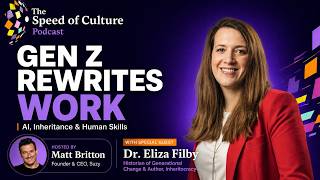
Dr. Eliza Filby, a historian of generational change, explains how Gen Z and Gen Alpha relate to technology differently than their parents, and why workplaces need to prioritize human skills like trust and empathy as AI advances. She warns of age bias against mid-career workers and notes a $120 trillion wealth transfer from Baby Boomers will reshape housing and careers.
Chapters
Up today on the Speed of Culture Podcast, we are thrilled to be joined by Dr. Eliza Filby, historian of generational change, bestselling author of Inheritocracy, and founder of the Generational Blueprint. Eliza is an expert in generational dynamics, helping organizations bridge the gap between different age groups to create more effective, inclusive work environments. So great to see you today. Thanks so much for joining.
Great to be with you, Matt.
So what got you into this particular topic?
I mean, I'm a millennial, I'm a geriatric millennial, and I'm really—
You and me both. Well, actually, I'm a geriatric Gen Xer, so you should feel good for yourself.
Right, okay. So you must share your wisdom with me. I'm a geriatric millennial, I'm a daughter of a boomer, I'm a mother to an alpha, and I'm also a historian by training, and I'm fascinated by the way in which these sort of generational categories tell a broader story of how society is changing. And there's all sorts of like problems with generational categories, right? But there's stereotypes, there's generalizations, it's an art, not a science. But ultimately what we're trying to do with these categories is understand how society is changing. And that's what I'm really passionate about.
So why are there kind of generational differences? What creates differences in, just say, within the workplace between one generation to the next?
Well, it's often perceived like, you know, there's a technological generational divide, there's an etiquette generational divide, there's a sort of difference in values. Do you know what, actually the generations have never been more similar. Like, actually, if you look at sort of how Millennials are getting on with their Baby Boomer parents, they get on hell a lot, a lot better today than say Baby Boomers got on with their parents, where the sort of tendency was to rebel against one's parents and in some ways have a much deeper values divide between the generations. So The first thing, as I would say, is that the generations actually have never been closer together. And number one reason for that is the sort of, as I talk about in my book, is that economic interdependency. Parents today in the US expect to be funding their kids up until the age of 29, right? And so the sense is we're living in a multi-generational workplace, we're living in a multi-generational increasingly family structure. Often home structure, and we're living in a multi-generational consumer space. And that's where I think, you know, the marketing sector and the advertising sector have really gotta get on board with dynasties is not just something for Beyoncé Knowles and Succession on TV, right? Dynasties is how families are thinking, multi-generational, building generational wealth, helping generations kind of, you know, achieve what they wanna achieve across generations, spending as a multi-generational family unit. And in the workplace, gosh, there's a generational gap, but it's in the age of AI, never been more important for those generations to work together. You need the disruptive spirit of youth and you need the wisdom that comes from experience.
Of course, technology is sometimes something that can bring people together, but I would imagine it can also create kind of gaps in kind of cultural norms because you have generations like the millennials who grew up with the internet and obviously you have baby boomers and Gen X who didn't. And then you have Gen Z that grew up with the iPhone. So they expect everything to be instant and mobile. And now you have Gen Alpha who's grown up with AI and, you know, doesn't that impact your worldview in terms of what you expect and kind of the baseline? And that isn't that kind of a, I, a big underlying cause of generational differences in the workplace?
Absolutely. And, and tech is a major, major problem. And, and, and to be more kind of even more drilled down on what you've just said, which is absolutely right. You know, millennials are the ones that grew up as analog and then matured into digital, right? They probably had landline phones, they probably had dial-up internet. They are the ones that probably can understand the analog to digital more than any other generation. But actually it was Gen X that was the first tech generation. The Sony Walkman, the Sony Walkman was the first piece of private technology, right? It was very unlike the jukebox or the record player, which was communal. And then they had the BlackBerry. The BlackBerry was the first piece of tech that enabled you to take your work home with you, right? Smartphone was the first piece of tech that enabled you to take yourself into work. Mm-hmm. 'thus the beginnings of the blurring of the boundaries between work and home life.' Now, you're spot on with Gen Z because the average Gen Z has had a smartphone in their pocket since they were 13. They're not the smartphone generation though, they are the social media generation. But what, what's critical to understanding this generation in the workplace is they had access to the world's information in their pocket since they were 13, which means they have, in many respects, very different views of, of, of knowledge and knowledge acquisition, right? If you have the world's information in your market, you're not impressed by your elders in the same way, right? Because you can find it out on Google and now ChatGPT, but also have the access to the world's marketplace. So that kind of entrepreneurial spirit of making money beyond in an infrastructure of a workplace comes naturally to a generation that's buying and selling trainers on eBay, creating content online and monetizing their skills in a very entrepreneurial way. And so what you've got is a generation now coming into the workplace that have done their studies on ChatGPT, right? So you've got a very different generation coming in with a very different relationship with tech, which is on demand and completely bespoke. It is learning who you are constantly and really kind of understanding even the language that you respond to best. And so that algorithmic generation coming through, which I suspect Gen Alpha will be become known as, is kind of this new tech frontier. And Gen Z will feel disorientated by Gen Alpha in the workplace, just as Millennials have with Gen Z.
Like history repeating itself, almost.
Right, but let's be clear, right? You know, there was a technological divide in the workplace when suddenly we went from having an army of female typists doing workplace communication to people actually using electronic devices and having to do their own email. You know, there's always been technological innovation in the workplace, there's always been a generational divide. But I think one of the most important things I'm with the workplaces I'm working with, I'm working from the legal sector, the hospitality sector. In the age of AI, one of the things that is guaranteed is this technological disruption, but also what is absolutely needed is for the generations to come together and learn from each other.
So how do, how do they do that? And how do employers bridge those gaps?
Right. You've gotta basically give time to things you can't count. And what I mean by that is we are so data-driven and productivity-driven in the workplace, But actually in the age of AI, what we need to be doing is enabling humans to do what they do best. What do humans do that AI doesn't? And I would say that's 3 things. Right, it's be human, right? Business is about trust, and trust can't be built on an LLM or a Zoom call, right? Fundamentally about that face-to-face, do I trust this person to deliver what they're gonna say they're gonna deliver? And so I think there's 3 areas that really human beings need to really zoom in on. And if you've got kids out there, you're worried about, you know, graduate unemployment or unemployment in the workplace for your future generations, get them doing 3 things. Learning how to communicate. And when I say communicate, I don't mean stand up and give a speech. I mean learning how to listen, learning how to be empathetic. Second is really learn how to teach someone, how to communicate something that you know about, but also how to learn, be self-taught. And thirdly, learn how to have empathy and care, deliver care. Now those 3 things, are about maintaining the humanity of the workplace in an age when productivity is gonna be supercharged by AI. And actually, that's where the older generations can really teach the younger generations, but it's also where the younger generations can really teach the older generations. My challenge to any business is, do you give people the time to do that? And do you give people the money to do that? Because in, with hybrid working, with, you know, greater, greater algorithmic workplace practices, actually, people don't have time to do that.
People don't see each other. It's becoming a lost art. And then what happens is culture can also erode as well, right? I mean, I think one thing a lot of young people will probably say is the mentorship that they've gotten from people with more experience and different experience is what molded them. And I do think you bring up a good point in terms of the remote workplace, where that's sort of an experience that a lot of younger people, unfortunately, are gonna be missing out on right now.
Right. Look, I learned what I needed to learn in the workplace in my 20s by observing, not always by doing, just watching people take a call, watching people give a presentation, watching people network, you know, gain opportunities. And I'm like, I wanna do that, I wanna learn how to do that. And I learned by first observing, then doing. And, you know, I work with big global companies, that infrastructure of learning is not happening to the same degree. Now I'm a mom, I work from home, I'm working from home right now. I am not against hybrid working, but I do think it's critical sort of critical sort of way of thinking about it is when we're in the office, when we're together, what are we doing together? Like, how are we maxing that kind of connection with each other? Are we learning from each other? Are we caring for each other? Are we communicating with each other?
Speaking of AI, I've been seeing a lot on LinkedIn lately, people in their late 40s, early 50s who may have just gotten laid off thinking that like, they are kind of being left out of this huge change that's going on. And I just want to get your thoughts on if you think that there is the kind of proliferation of age bias in the workforce and what both employers and individuals and employees should do about that.
Well, actually, do you know what I would say? The evidence suggests it's going against young people rather than, um, you know, I mean, you think about the graduate sort of unemployment crisis in the EU, in the UK, in the US, it's very much kind of, you know, partly a response for just a tightening labor market in the aftermath of the massive expansion post-COVID. But it's also because, you know, the evidence increasingly suggests because of AI. And actually much more in smaller businesses, medium businesses rather than big large businesses. It's most obvious because it's just more people that they're not employing in big businesses, but it's happening across the board, right? And across different sectors. What's interesting is actually if you look at the data on AI, the optimism around AI is in the mid, midlife, mid-career because they know that they have the critical evaluation skills, they have potentially the networks, they have the black book of contacts, they have those skills that have been nurtured in the workplace for 15 years, and then they're kind of bringing in AI to accelerate them to the next level. Now, however, However, and most of the jobs that AI is effective right now is those entry-level jobs. However, ageism in the workplace starts at 40 for women and 45 for men, right? Undeniable. So it's hitting millennials right now. And the challenge for that demographic is to, number one, recognize that they're not gonna be able to cruise to retirement. That thing that previous generations did post-40 is not gonna happen for millennials. They're going to have to upskill, they're going to have to remain agile, they're going to have to maybe even career swap, okay? And definitely realize that that cruise, career cruising that tends to happen in midlife, particularly when you've got young children, particularly maybe when you've reached a certain salary bracket, I don't think it's going to happen for millennials in the way that it did, frankly, for older generations. And I think secondly is that actually they have so much to offer. As the last of the analogs, right? And we talked about it earlier, is like those human skills, those connections, that ability to build trust, pitch, be creative without ChatGPT, that is something you need to learn how to sell in, in very, like, you've gotta, you've gotta, I mean, we've all gotta be like rampant pitchers of our own skillset, right? And, and I think as the workplace becomes frankly less secure, That is not going to come naturally to people in midlife because they're like, but I've worked hard for 15 years.
Yeah, I mean, all that happens. I hard, right? It's really hard to reskill or learn a different way of going through things after you've been doing the same thing for 2 decades or 3 decades.
And I'm going to, I'm going to say something that might sound a bit weird here, but I think women are more agile at doing that than men. And I think you look at the previous kind of deindustrialization in, in like the 1980s and 1990s, it affected midlife people more than it did young people because young people just naturally retrain, right? They move to where the jobs are, they upskill, they haven't got a kind of that stakehold in that career. The place where it really, really impacts people is not people in their 60s, it's people in their 40s. So we really have to make sure, particularly as I said, women do this naturally because biologically our bodies change and reform throughout life. I feel like we're just naturally a more agile gender, right? But I I think all of us are gonna have to really think about how do we upskill, how do we sell ourselves, and how do we remain agile?
Yeah, absolutely. And when you see, sort of, if you were to look ahead maybe 20 years from now and say you were giving advice to somebody who is a teenager and tried to give them advice in terms of like, what are the skill sets you need to develop to future-proof yourself for where the world is headed, for where the workplace is headed, given intergenerational dynamics and everything we've spoken about, what would that be?
So I think number one is learn how to market yourself. Like, I think—
What does that look like? What is marketing yourself?
It actually really is important building a personal brand, even if you do work in an existing company, being a great ambassador.
And that's uncomfortable for a lot of people, right?
It's uncomfortable. It's— for some people it comes natural. For a lot of people, it's quite awkward. Number one is actually learn how to sell, but learn how to also sell yourself. Number 2 is learn how to be a solopreneur, not necessarily an entrepreneur, very different things. A solopreneur, it's not about building a team, it's about building your multiple streams of revenue, okay? Number 3 is build your human skills, and that's not just being able to pitch and stand up and give a speech, it's being able to listen, it's being able to learn, it's being able to make eye contact, it's nurturing all those wonderful communication skills that keep us human. Number 4 is learn something that no one else knows. And the way that you do that is zoom in on something super niche, super, super niche. I did a PhD. It was so niche, no one cared about it, let alone tried to copy it. No one cared about it. But the key thing is, is that I went niche and then tried to expand on who I told about that story. So like really hone specialism because AI is the generalist. Not everyone's the generalist. AI is the generalist. So hone in on that niche and learn how to sell your expertise because we are, as I said, moving into a much more fluid marketplace here where we're going to have to think beyond just having that one career, beyond thinking even multiple careers with multiple firms, thinking, how do I be a solopreneur that has the right human networking skills and the right sales skills and has the ability to sell my expertise to the highest bidder?
It's interesting because building your personal brand is something that isn't really what most of us have been taught to do through, you know, our work, our career experience, right? We're asked to go into work and help the company and, you know, drive metrics and listen to what our boss says. And building a personal brand is like on you. You are basically a business of one building your personal brand.
Mm-hmm.
And you have to figure out what, you know, value you're bringing and how to build an audience and also have the courage to put something up there on social media and get no likes and be okay with putting something, something else. It really taps into so much of human dynamics.
Yeah, but you know what, Matt? Do you know I'm going to say something a bit controversial here? I don't think building a brand necessarily means being on social media. I think that's our more—
Interesting.
—interpretation.
I mean, you build a brand by not being on social media.
That's interesting you say that. You are, you're widening your, your audience pool by being on social media, but you could have a really specific niche. I was talking to a guy last, last week who made valves, valves, right? He doesn't wanna be on social media. He doesn't need to be on social media, but his niche on making those valves for hospitals, for test tube babies in hospitals, he had the most amazing ability to sell and to pitch the way he made valves better than anyone else in the UK. And I think this is where we get consumed by modern ways of doing things and thinking it will always be like that. I think the problem is, is that everyone that kind of chases the algorithm on LinkedIn or Instagram and tries to build a brand and all of that, actually, I don't think that's going to operate in the same way in 10 years' time, maybe even 5 years' time, frankly, because there's going to be so much AI slop. And I think the thing that I'm really, really keen on honing in here, Thing, is that LLMs are built on what's gone before, right? And it's all quite standardized, right? We know when we type into— It's an echo chamber, but it's also, you know, you type in a male graduate, they're often white, you type you know, a trad wife. It comes up with very stereotypical visions of human life, right? One of the things that Steve Jobs, I think, did brilliantly, brilliantly, is one of the best things I think he was sort of personified, personifies, is the meeting of weird worlds. And actually, you know, he brought together calligraphy, he brought together like, you know, human design, he brought together, you know, obviously, you know, tech, I think one of the great things about human beings is we bring weird shit together that often don't fit and shouldn't fit. So if I'm advising young people today, I'm like, bring worlds together that don't naturally fit and try and find some way of them making sense. So if you're a gamer, you know, go out in nature. If you're a historian, go into business. If you are— Yeah. And what I mean is you will subvert the LLM because you will be doing something different, unique to you.
Right, coloring outside the lines, so to speak.
Absolutely. And by the way, the education system actively dissuades you from doing that because it forces you to be subject-based, to be discipline-based, and to color within the lines.
Right, which is ultimately the one thing that AI can do well. Is color inside the lines.
Right, and I think your reference to the corporate ladder was such an important one because we are seeing the slow, not disintegration because there'll always be a corporate ladder, right? There'll always be a corporate world. But that idea, I work with a lot of law firms, they are slowly realizing the best lawyers aren't necessarily the ones that pass the, you know, do the, have the best grades in law school. You know, suddenly that kind of, that educational track leading to the corporate track and being really sort of, you know, a secure path as we know, is crumbling before our very eyes. And I think thinking outside the box, putting weird things together and subverting some of that conventional sort of way of doing things and way of thinking actually is something I'm trying to teach my kids and something I advise young people to do today.
I love that. So switching gears, we wrap up here, Dr. Philippi, you have a book out called Inheritocracy, which is a Sunday Times bestseller and is now available. So everyone go pick up a copy of that. Would love to hear about the process of writing a book and what the book is about and what do you hope people will take away from it?
Oh my God, I love this question because I mean, writing a book is hard, right? I mean, you've done it a lot. And my book is a memoir actually. I was unfortunate to give birth to my son, lose my father in very quick succession, and then my mother came to live with me. And the COVID lockdown happened. And I went through quite a tumultuous period in my life where frankly I grew up. I had to grow up and I had to go through a lot. And I had to go through a lot trying to also go from being quite dependent on my parents in various ways, financially being the obvious one, to them being dependent on me and me parenting my mother. Parenting the parents is something that inevitably happens to us all, right, if we take on that obligation. And so, I wanted to talk about this great wealth transfer that— financial services industry talks a lot about and gets very excited about. In the US, it's around $120 trillion, right? It used to be $80 trillion. It's gone up since the COVID pandemic. It's now $120 trillion that is transferring over the next 30 years from baby boomers down to Gen X, millennials, Gen Z, right? And that is, you know, it's already happening. And so you are really seeing, as I said, this birth of of this multi-generational contract that has always been there, right? There's always been inheritance, there's always been money flowing down to families, but there's such a considerable amount of money flowing down the family tree. And that's impacting everything from the fact that 1 in 4 Gen Zers now take a parent to a job interview. It's the fact that 1 in 4 Gen Zers in the US now gets a parent to help with their house deposit, help with that getting on the housing ladder. It's reflective of the fact that— Yeah. You know, more and more kids in their 20s are still living at home. It's reflected in the fact that college, the cost of college has gone up so much, parents are having to really sub that as well as any other entry points into adulthood. So this inheritance economy, this bank of mom and dad was something that I experienced and I wanted to write about. And I started it from my story, but it's a much bigger story of a generation of millennials and Gen Z. Yeah. Who are living in an inheritance economy where it's not what you're earning anymore, it's not what you're learning anymore. The rewards of education and work are dwindling just at the point when the rewards of having a, frankly, a wealthy mom and dad are becoming ever more determiner of opportunity, not just obviously in the UK where I'm from, but obviously increasingly in the US. Now, generational wealth is an aspirational phrase in American culture, and you are much better, I must say, as a society talking about money than we are in the UK. But it's still really important to understand what the shifting dynamics of the economics of the family are and how opportunity fits into that. And I wanted to write about that. And I think it has huge implications for marketing and advertising. I think it has huge implications for work and it has certainly huge implications for families.
Absolutely. Well, thanks for sharing that. So to wrap up here, we always ask our guests if there's a mantra or quote that helps encapsulate the professional journey. So just wondering what comes to mind for you.
Gosh, delegate, delegate, delegate.
Interesting. It's interesting. That's what came to mind for you.
You know, at 8 PM when I've just delegated the children's bedtime to my husband. Yes, I think as an entrepreneur, and I do see myself as an entrepreneur of a team of 5 that look after me, I don't look after them. One of the things that I've really realized is two things: is learn to listen rather than speak, and realize what you're not good at and delegate it.
Yeah, that's fantastic advice. Well, this has been a great conversation. You clearly, you know, have a very interesting and finite view on where the world's headed based upon generational change. And I hope that, and I know that all of our listeners are gonna get a ton of value from it based on all the changes we're seeing. So thanks so much. I'm wishing you best of luck with the book and everything else that you work on moving forward.
Thanks so much, Matt.
Absolutely. On behalf of Susan Iwikin, thanks again to Dr. Eliza Philby, historian of generational change and bestselling author of Inheritocracy, for joining us today. Be sure to subscribe, rate, and review the Speed of Culture podcast on your favorite podcast platform. Till next time, see you soon, everyone. Take care.
More from Matt




MikMak’s Rachel Tipograph on Consumer Spending, Retail Media & Holiday Shopping Trends



Jaguar Land Rover’s Charlotte Blank on Luxury, Purpose & Experiential Storytelling



