Dr. Marcus Collins on Culture, Consumer Behavior & Building Meaningful Brands
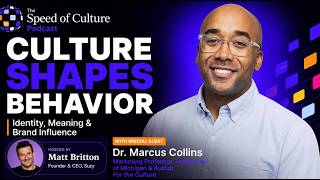
In this episode of the Speed of Culture podcast, host Matt Britton interviews Dr. Marcus Collins, Chief Strategy Officer at Wieden+Kennedy. Collins walks through his unconventional career path—from engineering to music production, an MBA, digital strategy for Beyoncé, and agency work building social practices—culminating in his current role shaping cultural strategy at W+K. He argues that culture is the most powerful driver of human behavior and that the best advertisers create cultural products rather than traditional ads. The conversation explores how music functions as a storytelling vehicle, the evolution of brands from legal marks to trust, love, and identity/tribal marks, and why brands must align with consumers’ cultural frames to become meaningful. Collins outlines the shift from a “Mad Men” USP‑focused model to a consumer‑first, culture‑first approach, emphasizing rigorous cultural research (ethnography, netnography) and the integration of academic sociology (Bourdieu, Durkheim, Weber) with practice. He discusses the role of creators and platforms like TikTok, the need for agencies to become cultural translators, and his parallel work as a professor and author, highlighting how teaching and scholarly work sharpen his strategic lens. The interview closes with personal reflections on work‑life balance and the importance of perspective‑shifting for both students and clients.
Chapters
Up today, we're gonna be speaking with a good friend, Dr. Marcus Collins, Chief Strategy Officer at Widen Kennedy. Marcus, great to see you today.
It's good to be here, Matt, man. How's it going?
Good, man. I, I've been so excited to have you on, uh, this podcast ever since frankly we launched because our podcast is called The Speed of Culture. And when I think about that title, there are very few people that I connect that with. Much in the industry as yourself. So really excited to jump in. We're going to get started by quickly getting a little bit to know about you and your real diverse background, which led you to where you are today. So why don't you jump into how you ended up at the— as the Chief Strategy Officer at Wyden Kennedy?
Oh man, that's a winding road, as one would say. I started off as an engineer, surprisingly, because I thought material science, uh, and polymers were interesting. So I realized probably not the best way to describe Material science and engineering. Interesting, yeah, but definitely not cool. So when I graduated from undergrad, I went into the music business, did a startup where I was writing, recording music for a living, realized the music industry sucks after a little bit of success, then went to get my MBA, then went into marketing. I found myself doing partner marketing at iTunes, end up meeting Matthew Knowles, who's Beyoncé's father. And he says, let me get this straight. You're an engineer, you start a music company, You have an MBA, you worked at iTunes and you're Black. Like, dude, you don't exist. You're not real. You're like, no, I'm real. Totally. He's like, well, you should come run digital strategy for Beyoncé. And I'm like, yeah, I should totally do that. So I moved to New York, ran digital strategy for Beyoncé before moving into the world of advertising, actually with our mutual friend Avi Savar at Big Fuel. Really learned sort of the ins and outs of social. What does it mean to be a social marketer? It was like boot camp for social in a lot of ways. While I was there, ended up meeting Steve Stout and Stout, a once music guy turned agency guy. Yeah. Kind of a hybrid of the two. It just kind of felt like it was the perfect intersection of the things that I'd always been excited about. And he offered me the opportunity to build the social practice of translation. So I went and did that. And during that time, you know, launched like the Made in America music festival for Budweiser, launched the Clif Bar campaign for State Farm, move the New Jersey Nets from New Jersey to Brooklyn and become the Brooklyn Nets. Just like some really cultural work. I started to really understand what it meant to impact culture. And then from there, I moved over to Donor, started working in the world of academia while also working at Donor in Detroit, my hometown, you know, getting a PhD, really marrying academia and practice, right? This academic gap trying to bridge. And now find myself here at Wieden running strategy here in the New York office. And it's been, it's been a blast.
Wow. What a journey. I know you're still very much in the middle of it. So you mentioned a couple of things that you mentioned that you were in the music business in the early 2000s. You know, you realized quickly that the music industry sucked. Why did it suck and what opportunities did you see there? And was it an easy decision to kind of move out of the music world to go into the agency side? Or was that something you struggle with?
No, it was really, it was a really difficult decision because I love music and I love what music does for people. I love the way that it connects people. You know, if you love Frank Ocean, like I love Frank Ocean, we're going to be best friends, right? We have so much to talk about. Or, you know, if a song resonates with me like it resonates with you, it brings us closer together. It fortifies these human connections, these bonds that we have. There's— I don't think there's much on the planet Earth that has that sort of catalyst to it. I really have a great affinity for music, being as a music— a producer of music, as well as one who put music, uh, who helped get music out into the world. But I just found that, like, where the opportunity existed for me, I felt like I was just better on the marketing side than I was on the, the production side, right? You know, I listen to Pharrell and Chad Hugo of the Neptunes, like, man, I— geez, these guys are making this kind of stuff. I don't know if I belong on this side of the world. And then once I was on the, the more the marketing communication side of the world, you know, work with Beyoncé, you you know, experience a lot of success because it's Beyoncé. But I asked myself, like, is this success because of me or because of her? Clearly it's because of her. I had to wonder, like, how good—
Don't sell yourself short, man.
It's Beyoncé. Let's be honest. So I'd ask myself, you know, was it because of her or was because of me? And when you look at the Beyoncé's in the world relative to the other artists that exist in the world, there's a huge differential, right? And because of that, it just felt like there wasn't a lot of opportunity for me to do the things that I was most excited about with the kind of artists that I was most excited about. And I feel like there's a great opportunity to do that through marketing communication. I mean, even if you think about this time, this is like 2010, 2011, marketers are doing a better job of breaking new artists and new music than the music industry was. Yeah. And I felt like, you know, these folks on the advertising side understand the vehicle of music and how to leverage it in a way that gets people to consume, to propagate, and to tell other people about it and that are like themselves than the music industry was. I felt like if I want to get better at that, I should probably do it with people who do it best.
Yeah. And I mean, you raise an interesting point. I think in the pre-digital world, the only music that was popular were the records that were getting heavy rotation. You know, on Hot 97 or Z100 or, you know, whatever the clear channel station might be in your market, it was controlled from the boardrooms. And now, like so many other industries, what goes hot is not controlled by the boardrooms anymore. It's driven from some of the sidewalks. And now the biggest arbiter of popular music is TikTok, right? And TikTok is generated by individuals and an algorithm. So it has switched over, and now the music industry is much more reflection, reflection of consumer culture as it is big business.
Exactly. So you give power to the cultural consumers, right? The people who give value to things, they become the arbiters of what is worth listening to, what is worth talking about. And I feel like that kind of meritocracy just didn't really exist in the music industry that, that I grew up in. And I just found— I felt that marketers, be it agencies, be it brands, or be it these artists themselves, these are the ones doing a better job of it than the institution that we know as the music industry.
And do you think there's a role for music with every brand?
I mean, any brand that wants to make an emotional connection, I don't think there's anything more powerful than music than that, right? Music is the perfect vehicle for storytelling. It is a great staple. We think about folklore within groups of people. You know, we have hymns, we have, you know, prayers. We have, you know, our, the gathering songs, the lullabies. These things become ways by which we socialize what people like us do. And it's no wonder why hip-hop music is the most consumed music genre in this country, right? It is a vehicle for expression of cultural facts of what people like us do. And as marketers, we know the power of stories. We know how important stories are. So, we understand how music plays as a vehicle to help tell these stories in meaningful ways.
Yeah. So you joined Wieden Kennedy a little over a year ago. For those in the audience who don't know what Wieden Kennedy is, they're one of the most iconic ad agencies really on the planet. And being Chief Strategy Officer is, you know, is no small job. And you have obviously a big challenge ahead of you in keeping the reputation of that agency with the work that it puts out. What drew you to Wieden Kennedy and describe what your role is there?
So for me, I came to the conclusion some years back, there's no— I didn't discover this. This wasn't discovery. It's just revelation on my part for myself is that there is no vehicle more influential on human behavior than culture, full stop. And the best marketers, the best advertisers in the world don't create ads. They create cultural product, cultural production. Like music, film, video, literature, podcasts, right? Comic books. These are things that we use to express our cultural subscription to help us navigate our day-to-day lives. And I felt that if I were going to work for an agency, I wanted to work for an agency that saw the world the way I did, that cultural production is really what we aim for. I think when you look at Wieden+Kennedy's 40-year body of work, the best work are all cultural production from everything Nike, you know, Just Do It, Dilly Dilly, most recently McDonald's and our fan truths. Like think about Famous Orders, for instance, right? These things are all means of cultural production. And I say like, these guys are actually doing what I teach about, what I read about, what I write about. And when I look at the work that I'm most proud of, are all demonstrative representations of that thinking. And so I figured this is my opportunity to kind of run with the '96 Bulls in a lot of ways. Run with the guys who are kind of doing the work that I aim to do as both a practitioner as well as an academic. So I come to the New York office to head up strategy in the New York office. We are an international organization, so we have 8 different offices. I run strategy in the New York office and my job is to to help provide a lens by which we can see the world through cultural frames, that we can understand the way people make meaning, how people translate the world so that the work that we put in the world is congruent with their worldview. And they can say, "Oh, that brand gets it. That brand sees the world the way I do." People use that brand to communicate their identity and socialize with people who are just like themselves. Yeah.
And the framework you're describing is, I think, a lot more challenging than the traditional Mad Men world of advertising where it's what was the unique selling proposition of a product, you know, that, you know, 350 horsepower, 20% more absorbent, and just push it out in an ad, right? That was kind of the pre-digital world. And, you know, in that clear channel world, in the ABC, NBC, CBS world where consumers didn't have a choice, you could take those ads and shove it down a consumer's throat until they would buy the products. But now consumers have choice. So I think what you're really talking about, the shifting, and it's been a shift that's going on for quite some time from advertising to content, right? Content is consumer first. Consumers identify themselves with culture, and that's a different approach. And it's an approach that many brands have tried and failed, and other brands like Nike have done a great job in doing. Where I've seen a lot of companies struggle, and I'd love to hear your thoughts on this, is that when you try to insert culture into a brand, right? Don't you have to strip down what that brand really means? Where they have a right to play and connect them together so it's not a total miss? Like, what is that process? Because I can imagine it's sort of risky business in some ways doing that.
I mean, 1,000%. I mean, you hit the nail right on the head. You said, what does the brand mean? Culture is the meaning-making system. Culture is the way by which we make meaning. And while the brand may intend to mean one thing, doesn't necessarily aligned to what it means in minds of people. So the brand may say, "We think we're cool, we're hip, we see the world this way." People go, "Uh-uh, we don't see you that way." And therefore, there's a great incongruence. So it's not enough for us to have a desired meaning. We have to understand what we mean in the eyes of people and then use our marketing communication to close the gap. So the notion of like inserting ourselves in culture, I don't know if that's the best verb to use. We insert ourselves in it. Instead, we ingratiate ourselves into it. And that is culture. It is the system by which people see the world and operate in the world. It's our governing operating system. So, the idea then is how does our brand become congruent with people's governing operating system? And that happens because they are congruent. The brand sees the world the way I do. And because the brand sees the world the way I do, I use the brand to express my identity. It's not about the brand. It's really about me. And when the brand and I are congruent, I go, oh man, that brand is for me because I see the world similarly. When I use that brand, I use it as a mark of identity. I mean, this is like interesting. Like if you look at like the history of brand, it's no surprise that we are here. Like the technology has helped ushered where we are, right? So if you go back to like the first time brands were sort of a thing, this is like the 1700s. Josiah Wedgwood, the first incorporated brand, late 1700s. You know, he made pottery and he bring his pottery to market with other people's pots or pottery. And he said, "I don't want people to mistake their pottery for mine." So, he put his name on it, right? As a mark of ownership, as a legal mark of ownership, right? And the idea then, if you were doing brand marketing is you put your label on things to say that it belonged to you, right? Right. You fast forward 2.5 centuries later, marketers start saying, "Oh, you know what? If we use psychology," then we can actually influence more people to consume. We started using value propositions, positioning statements, memory structures, associations, so that when people see the brand, all these things flood in their mind, and therefore, they have more trust, more credence in the brand. They're more likely to buy.
The brand equity pillars is really what you're describing, right?
Exactly. So, the brand moves from being a trust mark to a legal mark— I mean, from a legal mark to a trust mark. Right? Not just a mark of legality. It's like, I trust it because I know all these things about it. Come 1980s, marketers say, well, it's not enough people just to buy our stuff. We want people to love us. We want people to have relationships with us. So, marketers started telling really big anthemic stories where the brand was like a character inside the narrative. Right? You think of like—
Apple. Apple's 1984 spot. Michael Jackson and Pepsi.
Exactly. 1000%. And so, in this way, the brand moves from being a trust mark elevates from being a legal mark to being a love mark, right? Sachi Sachi said it right there, the love mark. Today, the most powerful brands have evolved from being a love mark to being an identity mark where culture is the driving vehicle by which people decide what I buy. I have a friend who has— her husband wears a Patagonia hat, a red Patagonia hat that he loved. He loves so much, he'd run with it all the time. But after 2016, he stopped wearing that red Patagonia hat. He sure did. Because he thought that people would see him and think that he subscribes to MAGA, right? Because of what that red hat means culturally, even though it wasn't that, I don't want to wear it. I'm not going to wear it because I don't want people to mistake my identity for that. Right. When identity is incongruent, we then eschew it. Which leads us to the future, right? So if today's most powerful brands we use as marks of identity, then what does it mean for the future of brand? That means if we are social animals by nature and the technology that we use helps fortify these social bonds through social networking platforms, through Web 3.0, all these ways by which networks are able to facilitate, then the future of brand will have to be brand as tribal marks, as community marks.
It's so interesting.
It's just like, identify by it who else out there sees the world the way I do.
Yep. I'm thinking about the brand Supreme and they were obviously scorching hot and then they were acquired by VF Corp. And, you know, VF Corp made, when they bought the company, they made the statement, this brand is going to continue to keep its identity, its cool factor, et cetera. And I asked my son the other day, you know, he's 15 years old, do any of your friends still wear Supreme? He's like, no, that's dead. And when he told me that, I was starting to think, well, is that because what made Supreme what it really was to begin with was so truly authentic? And the second they sold out, whether the acquirer knew it or not, they were essentially, you know, disintegrating everything that made Supreme special. And then it just became a legal mark.
Yeah, it's kind of antithetical to the street, the skater culture that birthed Supreme. Right? Right. When those things are no longer analogous, the meaning that was once associated with it becomes degraded and therefore you go, right, it's still as valuable.
Yeah. So what do you do with brands that aren't an Apple or a Patagonia or a Nike, like a, you know, laundry detergent or a feminine care product or a soap? Doesn't that become a lot more challenging to have as a type of mark that really allows people to identify with?
Well, I think that you have to transcend the category that it's in and think about the brand. I mean, the brand is a signifier that conjures up thoughts and feelings on behalf of a company, a product, institution, organization, or entity. A signifier. It has meaning. That meaning conjures up thoughts and feelings. So, we take a soap brand. It's like, well, how do I make a soap brand have— conjure up thoughts and feelings beyond the value propositions? Well, how does the brand see the world? I mean, like, as we talk about soap brands as a way to diminish what could be a culturally relevant brand, and we just point to Dove. I do believe, right?
Great example.
Uh, self-esteem, right?
Like, that's right.
Believe.
Just so happy it transcended the physical product.
Like, Nike sells a commodity, it sells sneakers, right? But Nike never talks about like where the leather is sourced or, you know, or how comfortable their shoelaces are, right? Never, right? Right. They talk about a point of view, a way of seeing the world, and people go, I see the world that way. Every human body is an athlete. I see the world that way, and wearing Nike allows me to project my identity.
Right. So Marcus, you're somebody who's not only incredibly book smart, you know, you're obviously incredibly street smart as well, and you get it from both ends, which really makes you a one of one, in my opinion. And I think that a lot of people who want to go into marketing, advertising, really any creative industry should strive to have that type of knowledge. Where do you get your information from? What do you feed your brain to get to where you are?
It's a really good point. I feel like it was that great— the poet, the Nigerian poet says, Too foreign for home, too foreign for here, never enough for both. I sort of feel like I'm like on this island, right? Where it's academic practitioner island where I'm taking things that we rigorously interrogate in academia and apply it to the work that we do, right? Because there's no point in having knowledge that we can't use, but it's also kind of fruitless to have all these skill sets but not a governing operating system or a way of seeing the world to help direct those skills. You know, I invest myself heavily in the academic literature 'cause these people have dedicated their entire lives to studying one small thing, right?
Such as what type of academic literature?
So I mean, I study a lot of my repertoire is in the world of sociology. So I read a lot of Pierre Bourdieu, I read a lot of Durkheim, a lot of Max Weber, a lot of Raymond Williams, like people who study culture. People who have interrogated culture at a massive level. Likewise, I still read things that are contemporary as well. I mean, I read the trades, right? I read the Ad Weeks of the world and contribute to the Ad Weeks of the world so that we can have understanding of how these things are applied today. It's really consuming from both ends of the well, the well, the W-E-L-L, well, and finding ways to converge the two. To think one without the other is looking at the world through a peephole. And I just found the biggest cheat code for me has been investing myself in the behavioral sciences, investing myself in the scholarship, and finding ways to apply it. You get more predictability in the outcomes than just throwing spaghetti at the wall to see what sticks.
Yeah. Well, you were able to create frameworks, I imagine, to it versus just being sort of scattershot with whatever the hottest new idea is.
And that's the hope, right? It's just adding just more rigor. To the work that we do. And the idea is to bring some of that thinking into what we do as an agency. So it's not just, "Hey, this would be cool," or, "What if?" just because it seems like it's interesting. But like, "Hey, this is what we know of humankind. This is what we've known for over a century about how people consume or how people operate. Let's use that to inform things that are also interesting." And you mentioned, you know, your work at an agency.
I mean, how has the role of an agency changed over time and how's that impact your day-to-day life at Wieden Kennedy?
I think that agencies have been forced to evolve because just like we talked about with the radio being the arbiters of what is worth our attention, agencies have felt the shift there too from a marketing perspective that people have decided what is worth our attention. So while we may intercept them and interrupt them in their news feeds and their programming through linear television or the case may be, though we may sort of try to co-opt their time and attention, where they put their attention and their social capital, what they decide to share with other people is up to them to decide. So therefore, we have to get better at understanding how they see the world, how they translate the world, and ultimately how they make meaning. And whether we do that through a very rigorous way, i.e., doing qualitative research, ethnographic, netnographic, anthropological research, Or whether we do that sort of serendipitously by kind of just kind of walking the streets of New York and kind of seeing what people are doing, or in some cases maybe a combination of the two, it's forced us to think more through the eyes of people than through the eyes of what we think are cool. Just like the program director can't say, I think this record is cool, so this is what we're playing and this is gonna be hot. Those things are not analogous.
So it sounds like what you're trying to accomplish is as much about understanding human behavior and as you talk about ingratiating into that culture, versus trying to change that human behavior, right? Like it's really seeing where the flow is and where you can drop into it versus, hey, you're doing this, but instead do that. Because that, I think that becomes a lot harder to do.
That's right. It's like getting beneath the surface of trends, what people are doing, what's cool right now, going one step beneath it to understand why are they doing it, what are the underlying physics of human behavior within this group of people, this subculture of people, this collective, this network of people and how they make meaning. What are the governing cultural characteristics that make them feel like this is the kind of thing that people like them do?
Yeah.
Because if we understand that, we're not chasing lightning in a bottle. We are following people with a great amount of intimacy. And that to me, I think is like one of the biggest, biggest misnomers when it comes to marketers in today's hyperconnected digital world. Is that we have more information than ever before, way more information, reams and reams of information. But while we have more information, we don't have greater intimacy and we mistake information for intimacy. That's right. Intimacy requires us getting really close, understanding the governing underlying physics on why we do what we do. The better we do that, the better we'll be able to ingratiate ourselves into people's cultural zeitgeist.
And when you talk about understanding consumer trends, like how does one go about doing that? This is where the street smarts come in, right? You talk about how you identify your your book smarts and your deep domain expertise in sociology. Now we're talking about street smarts and understanding consumer culture. How do you unpack that? How do you understand the why? What are the steps?
You gotta be a translator. Like you gotta go talk to people, you gotta observe people. You gotta, you have to implant yourself into their cultural context, right? You can't do this on a sideline. You have to like, you know, the best people at this are comedians. They are the absolute best.
Well, I always say Jerry Seinfeld would've been the best agency strategist ever. 'Cause every single episode was a deep consumer insight. Yeah, I know. So because that's understanding, right?
You just watch people, you just observe people, and you go, wow, that was interesting. Or better, we go, that was weird, that was unexpected, what just happened there? And they go, oh, right, he did it and he did it and they did. Okay, this is the thing. Why is this happening? Why? W-H-Y. Why is this happening? Then we go, okay, here's the theory that explains what we just observed. The cultural phenomenon that we've just observed. And then as comedians, they go, okay, how do I present this back to an audience? Emily Dickinson says it this way, that like, you tell all the truth, but tell it slant. And that's what comedians do. They observe cultural phenomenon, social phenomenon, they identify why it's happening, the theory, the underlying physics is why this thing is taking place, and they find a way to communicate it, 'cause people go, oh, that's just like me, I totally do that.
Well, the same thing with memes. People share memes on Instagram. This is so us, this is so, and all they're doing is uncovering a truth truth in a way that you've never been able to contextualize it. But the humor is in the truth, right? It's just uncovering what is real. You don't have to concoct something.
That's right. And what is contextualization? Meaning making. Meaning. Yeah, just understanding meaning. So we have to go out into the world and observe people. You got to go talk to people. You got to understand how they translate the world, right? That requires you— you got to be of the people. It's like investigative journalism. You got to go out there and understand how people are seeing things, how they are translating the world through their cultural frames, but requires understanding their beliefs, the artifacts that are meaningful, the behaviors that are normative, the language that they use. Those are the alchemy of what we consider people's culture. If we understand their cultural frames, we can understand how they see the world around them and ultimately then how we could communicate in such a way that what we intend to mean, what we actually mean are congruent.
That's right. And you talk about, you know, Seinfeld and comedians, and the new TV stars of our era are creators, right? And instead of them being on NBC on Thursday night, they're on TikTok. How much of Wieden Kennedy's strategy and your overall, you know, approach towards this is now integrating and communicating with these creators who seem to have their finger on the pulse of consumer culture in a way like none other?
For us, you know, we don't think about media in the traditional paid media real estate. We think of every cultural surface as a communicative object, right? That everything communicates and everything has meaning. And we can use these things to our advantage, to our disposal, to help signal intended meaning so that what we signal is congruent with the way people see the world. And they go, "Oh, that brand gets it. That brand gets me. Hey, Matt, come check this out. Isn't this just what we were talking about the other day?" And we share it and we propagate and it comes with a certain level of credence. That brands can't get on their own, right? So we look at the world as, as surface area, and everything communicates, everything signals, and we can use these things as a way to signal on behalf of our brand based on the meaning it intends to communicate.
And a big part of it, isn't it all about just being observant, just having wide eyes about the world around you, watching, listening, seeing? Everyone's so focused on what they're going to do next, what they're going to say next, but so much of it is about listening and hearing and seeing.
It's coming from a place of curiosity versus certainty. And I think that as marketers, particularly as advertisers, we've sort of like, we have established ourselves like we are experts when it comes to this and we kind of stand at a place of certainty. I think the idea here is like, no, if we come from a place of curiosity, a place of curiosity, then we go, oh, that's interesting. Let's go look into that. Right. Which is where I love so much about like my academic background. Because we always stand from a place of humility. There's so much that we don't know. We just focus on the things that we, you know, we can hone in on. Right. And if we take that level of humility, that is a level of curiosity, a way of seeing the world, that we can see the world through the eyes of other people in a much clearer fashion.
Let's dig into the academic world. You— I have a quote from you. My life's work is committed to helping people realize their full potential at the highest fidelity possible. I just so happen to speak, teach, and put ideas in the world, which I thought was a beautiful phrase. And it's probably something you just— knowing you— just spit off the top of your tongue without even thinking about it. But what draws you to the world of academia and what are your sort of current ambitions there alongside your agency career?
So I think my time at Translation was transformative in this way that I was running social there, building the social practice, and I realized I knew nothing about social. Why? Because social is people, right? Here I come from Big Fuel, pure play social agency, biggest social agency in the country at that time. And I knew a lot about the platforms and technology, but I didn't know a lot about people. So I started to invest myself in the social sciences, started reading Dan Ariely, Daniel Kahneman, Damon Watts. Like I started like reading these scholars to understand why we do what we do.. And the more I understood human behavior, the better the work got. And I go, oh, this is the biggest cheat code. Why isn't everyone doing this? If we learn the social sciences, then it's more predictability in the work. And I just, I found myself so excited about it that I wanna write about it and talk about it all the time. But you know, you pitching ideas to clients, you know, you can't spend 30 minutes talking about network theory. I was like, I need to go find another audience to talk this thing through to. So I started teaching. I was teaching at Miami Ad School, Wallach Translation. Teaching at Hyper Island while at Translation, teaching at NYU while at Translation. We moved to Michigan, started working at Donor, and I started teaching at University of Michigan, my alma mater, twice over. And I figured that this was going to be my lane. This academic practicing space is where I feel like I am operating at the highest, my highest fidelity possible. So I decided to get a PhD. So I started PhD at Temple studying consumer culture theory, really how brands propagate and how people make meaning. And as my world began to expand because of the academic pursuit, the world just got clearer and clearer and clearer, and the work got sharper and sharper and sharper. So for me, in my ambitions on this trajectory is to continue to marry the two. I do it here at Wieden, bring in more academic thinking into what we do. And in the classroom, I bring more practicing into what we do. And I just wrote a book that comes out May 2023 called For the Culture, which is a way to disseminate the knowledge both from a practicing perspective as well as academic perspective so that people can leverage this thinking into what they do as well, whether you're a marketer or an advertiser by label or you're anyone trying to get people to move because that's the core function of marketing.
And we'll certainly have to have you back on to talk about your book when it comes out later this year. Yeah. And what I'm sure you get a lot of joy just on teaching and both at the agency and, you know, in the classroom in terms of helping young people become the next Marcus or the next Matt or whoever it may be. Talk to me about that, how you like working with, with younger people and the next generation of, of business leaders.
The biggest intrinsic reward that I get is helping people see the world differently. Yeah, for me it's, I feel like I tell my students that the best gift I can give you is perspective. If you can see the world differently, then the world changes. Right? And here in the agency, and I tell my teammates as well in the department that seeing the world differently changes the world. So if you adopt new lenses, then the world will shift. It's like that scene from The Matrix when the kid bends the spoon. Neo goes, "How'd you do that?" The kid goes, "You don't bend the spoon. That's impossible. It's you who bends." Right? So for me, as a teacher in the classroom, as a leader in the organization or in the agency, It's really about providing new perspectives, even for my clients, providing new perspectives so that we might be able to operate at the highest fidelity possible. It's what worked for me and it's what's worked for, for people around me. So the goal is to continue to push that forward.
Yeah. And what's it— to elaborate on what I just said in terms of how you helped me see the world differently is, you know, I've always thought in my mind that when it comes to advertising and marketing, there's art and there's science, right? Science is the data, the metrics, the analytics. Art is the creative that brings it to life. But what you're talking about is really the thread that lives in between, right? People don't talk enough about strategy, don't talk enough about the consumer behavior, et cetera. And without that, then the art doesn't mean anything. And without that, then you can't do anything with the data. So I think that having that, I think anyone that wants to create great work, don't just think about the numbers, don't just think about the creative, but think about the consumer and the trends and the behaviors behind it because that's where the real insights live. That's where you really are able to, you know, really make a difference, right? Really move the needle in what you're trying to do.
I mean, this is exactly the same thing with music. Music is one part art and one part math. That's part of it. We were talking about the intervals between different notes and there's a mathematics, there's a physics to that, right? Yeah. Even though something may be technically wrong, it feels right, right? So you always think about what it makes, what the people feel when they hear it, when they hear a certain progression or a certain cadence or a certain rhythm, right? It's all about people. And this is the thing, this is like the biggest ta-da in everything we do as marketers, that our job is to get people to move. And if we don't understand people, we can't do our job, do our job well into a predictable fashion. And if we started understanding people, then the world begins to become a lot easier to navigate.
Absolutely. Well, we're going to wrap it up with that, Marcus. This has been a tremendous interview, and I just can't wait for our listeners to hear it. Before we go, you know, you obviously move really fast. What are some of the things that slows down Marcus Collins in the real world, that allows you to kind of take a step out of the craziness of New York City and agency life and really reflect personally?
It's my children. Um, I have two daughters, Georgia, 7, Ivy, 3, and they are they're everything to me. Yep. Right? And they keep me, they remind me on who are the most important people, right? Like I wanna help people be the best version of themselves, but I have responsibility to help them be the best version of themselves and paint the world around them. So while, you know, we may kind of freak out over a client deliverable or I may be, you know, upset about, you know, some students complaining about their grades, you know, what does it mean in the grand scheme of things when it comes to Ivy in Georgia? Those are things that— Right.
You can apply a lot of this to them, the most important audience you have, right? That's right. So, well, you're lucky to have them and they're lucky to have you. So thanks again for doing this. On behalf of Susan and Adewi team, thanks again to Marcus for joining us. We'll be sure to have him back later this year, or I guess it's next year, to talk about the book, because you said it's May. So 2023, we're going to drag Marcus back. And in the meantime, be sure to subscribe, rate, and review the Speed of Culture podcast on your favorite podcast platform. Thanks again. We'll see you next time, everyone. Take care.
More from Matt




MikMak’s Rachel Tipograph on Consumer Spending, Retail Media & Holiday Shopping Trends



Jaguar Land Rover’s Charlotte Blank on Luxury, Purpose & Experiential Storytelling



