e.l.f. Beauty’s Ekta Chopra on Digital Experience, Gen Z & Consumer Trend
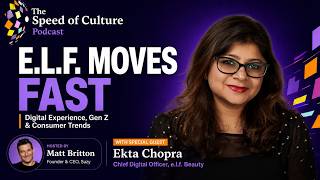
In this Speed of Culture podcast episode recorded at CES, host Matt Britton interviews Ekta Chopra, Chief Digital Officer of e.l.f. Beauty. Chopra outlines her unconventional career trajectory—from aerospace engineering to private‑equity technology leadership—to her current role overseeing digital commerce, technology, and customer experience for the e.l.f. portfolio (e.l.f. Cosmetics, Well People, Keys Soulcare, and e.l.f. Skin). She explains how the brand’s CMO‑centric structure enables a seamless connection between brand equity and the consumer journey, allowing rapid, culture‑aligned execution. The conversation delves into e.l.f.’s balance of data‑driven science and creative art, pioneering work on TikTok, BeReal, Twitch, and other emerging platforms, and a “test‑and‑learn” culture dubbed “elf speed.” Chopra highlights community‑driven product development, micro‑influencer authenticity, and unconventional collaborations such as the Chipotle avocado sponge and gaming partnership with top female streamer LuFu, which turned digital insights into physical products. She discusses the growing importance of OTT/CTV advertising, the challenges of creating platform‑specific content, and early adoption of AI tools (ChatGPT, DALL‑E, Jasper.ai) to scale content creation. Finally, she reflects on the brand’s experimentation with the metaverse/Web3, the need for integration across technologies, and future focus areas that include AI‑enabled content, metaverse monetization, and continued community‑centric innovation. The interview ends with Chopra’s personal mantra, “Anything is elf‑ing possible,” illustrating the brand’s optimistic, fast‑moving ethos.
Chapters
We're back with our next episode of season 2 of the Speed of Culture podcast. I'm thrilled today to be joined here in Las Vegas for CES with a special guest, Ekta Chopra. She is the Chief Digital Officer at e.l.f. Beauty. Thanks so much for joining.
Thank you for having me. I'm so excited, and what an exciting day today.
So great to be here. It's a very inspiring venue to talk about the future of digital and innovation and all the great things going on with Elf Beauty. I'd love to first start learning a little bit about your background and the road that you took to lead you to where you are today.
Yeah, so I— my career started in aerospace pretty much, and then from there on I joined a private equity, which I think gave me so much opportunity to dive into different types of brands and companies and so forth. But by— I was born a technologist. But now pivoted into a digital leader. I also oversee the business aspect of all our digital commerce at e.l.f. Beauty, as well as customer service and all things technology.
So let's talk about your time in the private equity world. So were you an analyst there and were you kind of looking at deals on behalf of the company?
I helped them every time like a company would come to them, but I was hired as their head of technology. So I would help them actually look at other companies, whether we needed to make an investment in the company, whether their goals were to go public, Or can we spin off something? Is there an IP opportunity? So I was there kind of an intruder to make sure technology was sane and it's not gonna require a lot of investment. And if so, is it gonna pay off?
So you are a real technology person. I'm like, well, a lot of people who know how to post on Instagram and say they're into tech, but that's kind of where your background is, which I think is really interesting. And you know, I'm just curious how that role led to you being at a beauty brand? Oh my gosh. It seems like such a jump. I mean, the leaps that you took from being in aerospace to being in private equity to now being in a beauty brand is just, it's very diverse and it is fascinating. Why do they hire somebody from private equity? It's just usually when you talk to somebody from a beauty brand who has a prominent position in digital or marketing, they're lifelong in the beauty industry or it's tangential, they're in apparel or something of that nature. So how did you even end up there and how did you get that role?
Uh, well, I think the CFO there got my reference from somebody because I, the investment group kind of knew me and then And the rest was kind of history from there. But I think, you know, when we are hiring, I think you always look for, hey, do they have this experience or that experience? I think diverse thinking is so important. Sometimes when you're going through either a transformation or you're going through like a rapid growth spurt, you need people who are just not thinking the way you are. And that's when disruption really happens.
And I think not every company thinks that way. A lot of companies are seen as sameness. They hire people that, you know, are only in their industry and then they basically look and act like everyone else. Exactly. So I think the best companies are ones that pick people from disparate backgrounds.
Exactly.
Uh, you know, that have differentiated points of view and that's how you really break new ground.
Right? Exactly.
So, so you said, you were saying that you joined e.l.f., you know, 9 months before it went public. Exactly. I guess maybe, so that must have been a wild ride. Let's just zoom out for a second. What is e.l.f. Beauty for those who don't know it?
Oh, come on, man. Everybody knows e.l.f. Beauty. Number one Gen Z brand.
Okay. Right.
We've experienced 15 15 straight growth quarters, which is incredible. And we are a house of 3 brands basically. e.l.f. Cosmetics, which is our OG brand. It's been around for 18 years. So that's where sort of it all started with selling $1 makeup online. And then we have Well People, which we acquired during the pandemic year. And then we actually built a brand during a pandemic year, which is Keys Soulcare with Alicia Keys. Oh wow. So we are a house of portfolio of those brands. And then we also started Elf Skin brand, which is now our fourth brand. So it's really not— I should have— how— it's not really three brands, it's actually four brands now.
And this Elf has his own— it has his own retail location?
Uh, no, we do not. So 80% of our business is distribution and 20% is direct international combination.
Gotcha. And then how much of the business is through your, I guess, brick-and-mortar partners versus direct-to-consumer online?
So 80% is distributed.
Okay, gotcha, gotcha.
So that would be—
okay, so as Chief Digital Officer, you're your main role, you talk about being one of the leading Gen Z brands. Is it about taking, I guess, the brand equity pillars that have been created by the CMO and then making sure that you bottle them up into assets and content you can push to consumer ultimately to drive sales? Is that the best way to describe your role?
Yeah, if I look at sort of our mission, e.l.f., we are a bold disruptor with a kind heart. And if you think about sort of bringing your consumer experience to life, I think having an empathetic lens, having a diverse lens, having a lens which is inclusive and, you know, really sort of moves at the speed of culture and so forth as well. I think it's really important that we sort of take into account there's the external consumer journey, there's the internal consumer journey. How are you going to make sure that behind the scenes, you know, when you're serving your consumer, everything is connected? And when you're selling online or anywhere else, everything is connected. Of course. And if I think about the uniqueness at e.l.f., almost 80% of the organization reports into the CMO. And there's a reason for that. Wow. Because if you think about from innovation all the way to the selling of this online, I think all of those aspects actually go through the CMO. So it really gives you a very connected lens, which then allows us to bring these things to life, you know, in the digital ecosystem in a very consistent way.
So how much of your role is focused on the art of marketing versus the science of marketing? Because given your background that you were in private equity and, you know, obviously you're a technologist by trade. Yeah. Are you focused much more on the data and the science behind it? And how much do you spend on the creative and the messaging?
I would say when I started, it was a lot about sort of the plumbing, right? Making sure the pipes are ready, things are going in and out and everything is, you know, and was a lot of that nascent when you joined? Yeah, there was nothing that existed. So I had to build all of that. But I think I find myself to be more on the artistic side now because, you know, if I think about TikTok, we were the first TikTok billionaire and our Eyes, Lips, Face campaign was the most viral campaign on TikTok. And one of the challenges that I gave myself then was, okay, how did it do that? How can I break the algorithm? Fast forward, it took me a year, but now I have 20,000 followers on TikTok because I love to understand what are people creating, how are they creating it, what's working, what's not working. The insights behind it. The insights behind it, right? So for me, I would say it's a balance and I've had to work really hard to find that balance, the art and the science of, you know, how do you leverage that data? How do you bring it to life with the creative? And then, you know, how do you always kind of challenge yourself to go to these new, you know, frontiers like BeReal? We were the first beauty brand there. Twitch, we were the first beauty brand there. How do you get to those places which are kind of uncharted territories, but then show up and show up big?
Not only uncharted territories, but in some ways intimidating. Exactly. I think a lot of brands, when they look at a platform like BeReal or even TikTok, they're— it's not as easy as it was, obviously, to run a banner ad or even to post something like Instagram.
Exactly.
Because a lot of it's video content. There's nuances with each of these platforms.
Yeah.
And since it's so intimidating, a lot of brands just keep doing what they're doing. They don't jump into new frontiers. Exactly. I think with Gen Z, and I would imagine this is a lot behind the growth of e.l.f. within the Gen Z population, they, they're always on to a new thing and you have to be there.
Exactly. I mean, one of the things that I love is, number one, I love our CMO. She's kind of crazy. She reads every single social post. Like, I get— not just myself, everyone on the team, the marketing leadership probably gets tons of texts from her all the time. What are we doing? Why? We need to do better for the consumer and so forth. So it starts with having a leader who is just really obsessed about— I couldn't agree more. So now that bleeds into us. Now we are all also sort of learning to do that. We have to act as a consumer. You know, we lead sessions where we're criticizing ourselves, like compare ourselves to this PDP or that PDP. How are we doing? Is it easy to shop? So I think that's what I love about our culture is we're a culture of really not just sitting there and not being okay with the mediocre. We challenge ourselves. Our community is very, very engaged. They're very authentic. They tell us when they don't like something. So listen to your community, be at these new frontiers, really keep your head in the stars, right? Listening to your community and moving at things with elf speed.
Yeah, you know, so I like that elf speed. Is it challenging to put yourself in the shoes of a Gen Z consumer if you're not Gen Z? And how do you go about doing that? How do you know what's actually going to work for them? Because I feel like their tastes are so discerning and changing. Yeah, every single day.
I don't think it is— it is challenging because, you know, one good example is they say they want— they care about, if you read any stat, Gen Z really cares about sustainability. Yeah. But when it comes time to pay for it, they don't want to pay for it. Yeah. You know, so I think it is a balance. So we do listen to our consumer, but I think it's also about we don't know everything, right? So listening to your community, surveying them, understanding them, what are they purchasing, what are their behaviors, and really understanding that aspect. But then there's surrounding yourself with partners that actually know how to operate in those channels. TikTok wasn't going to be successful for us if we thought we could do it all, right? No, what we did was we did a small campaign that told us, hey, there's an opportunity there. We leaned in and we partnered with someone who knew TikTok.
Yeah, and you guys have— and you guys have done partners all across the board. Exactly, exactly. A bunch of partnerships you guys have run because I'm really interested, uh, one of which is in the gaming space. That's right. About, you know, a beauty brand, they think female-centric. There's a misconception that gaming is male-centric, which it's not. And I think because of that, a lot of brands that target don't go near gaming.
Exactly.
You guys have dove in. Tell us about some of the work that you guys have done in the gaming space.
Yeah, I mean, I think whether it be any collaboration that we did or even gaming, we saw that on, especially on Twitch, we kept on seeing that there weren't a lot of female gamers or they were actually being abused in some ways, like, "You don't belong here," you know, and so forth. And we were listening to this and watching this trend and we said, "We are a brand that really helps, you know, sort of is centered around our purpose. You know, e.l.f. is for every eye, lip, and face, and furry paws. We don't leave them behind. So I think if I think about sort of our purpose and then being there and really going all in to support sort of the female gaming community, we partnered with the number 1 and number 2 female gamer called Lu Fu, essentially. And then the rest was history. And now we have— we were the first brand to like really go out there, create a community, and now we're expanding our tentacles in other places.
So when you say partnering, do you mean that you're hiring this individual and you guys are co-creating content? You're learning about the audience that she serves and you're facilitating the production of more content that— Exactly.
And you're putting payment behind it. Giving other female gamers a platform to come and actually talk about issues and talk about stuff or actually collaborate with them and do partnerships with them and giving them that opportunity that perhaps other brands haven't given them.
Now how do you tie that back to the product?
So I think it's no different than the challenge that we're trying to solve with metaverse and everything. How do you take this digital product and create a physical product, right?
Well, I actually haven't seen anyone do that.
Yeah, no, other than I think Nike and Adidas do a fairly decent job. But I would say that it's similar in the concept of, you know, if I take our LuFu partnership, for example, we actually created a gaming collaboration. GameUp, right? So that came out of us knowing about the gaming community, really learning about their likes, dislikes, and creating a product that spoke to that segment, essentially. So that's one way that we have brought that to life. Another way is really, you know, if you think about sort of that community, most of it is Gen Alpha. It's not even Gen Z. You're actually creating your audience for the future, right? So you're not going there to sell them stuff, you're also going there to understand them, who they are, be where they are, but use that information also to sort of build the future roadmap that we want to do either with gaming or metaverse or everything else, right? You know, so there's a lot of rich information and creating that engagement. And, you know, not every brand, every channel is for selling. Sometimes it's for engagement, sometimes it's it's there because you want to support that purpose and you're doing something to actually make a difference in people's lives.
It's all part of the story of the brand.
It's part of the story of the brand, right? So I think every channel has its uniqueness and you have to treat it like that.
Absolutely, that's a great point. I also saw that you did a partnership with Chipotle, which is interesting.
Yeah, I mean, if you look at, you know, everything that we do is always driven by an insight, and one of the key insights that people, when they walk into a Chipotle and they see that salad bar, it reminds them of an eye kit, like a makeup eyeshadow kit. And that was just, wow, that is so true. You know, the green lettuce and the red beans or whatever reminding you of a red rouge, you know, eyeshadow or anything like that. So I think, and even if you looked at from, we just admire Chipotle. We think we learned so much from Chipotle and it's a brand that, you know, truly inspires my CMO, myself, and our marketing teams. And when we looked at their brand values, we looked at our brand values, they were spot on. And that's when we knew that we had to work with them. And the rest was history. Once we connected with them, you know, came our first campaign, which sold out online, I think in less than 4 minutes.
And then— So you created a co-branded product.
Exactly, exactly. And then that led into our most viral product with the Chipotle collaboration, which was the avocado sponge. And basically it was the most talked about product on Reddit. Imagine Reddit, which is like not even— a beauty blog when you think about it. And they were talking about, oh my God, where do I get this Chipotle?
So does somebody from your team come to you as a CMO saying, let's partner with Chipotle? Like, where does that— where's that birth? Because it seems like such a far-out idea for a beauty brand. And a lot of beauty brands would say, oh, burritos, it doesn't really fit with beauty.
Like, it's just—
I've worked with a lot of beauty brands which are very pretentious, right? And that's probably why e.l.f. is so successful with the younger generation, because it's not The fact that you partner with Chipotle itself tells a story, probably why you're able to connect with the young audience, right?
Yeah. I mean, once again, your feet on the ground is one of the things that we focus on, which is listening to your community. Our community tells us, Elf Chipotle, Elf Chipotle kept on coming back.
They tell you where?
Yeah, on our social channels. Gotcha. Right? And even if I think about, we have a private Facebook group for our loyalty, our iconic loyalty members. And some of these people have been there since the inception.
So you have an active community of your most— Oh man, they're so active.
They call us out on stuff. Do you compensate that for them?
Not at all.
Not at all. This is all organic and we engage with them and we actually work with them to sort of improve ourselves, our product, our communications, our everything. And it's our loyalty members, you know, essentially. But then the social, if you're doing social listening right, you're not just doing it for the sake of it, right? You're doing it to find those nuggets that allow you to do something crazy that people people don't think is possible. And I think, you know, Chipotle and e.l.f., that was one byproduct of that. e.l.f. and Dunkin' was another byproduct of that, and many more to come. Wow.
You've talked about some of the work you've done with influencers in the gaming space. Is influencers also a big piece of the overall puzzle as you look to go to market with Gen Z?
Absolutely. I mean, influencers, 100%, but we don't believe in, you know, sort of having a lot of paid big influencers. For us, it's also about giving people an opportunity that don't really get an opportunity, you know, these smaller influencers. So I give kudos to our IMC, our integrated marketing, you know, team because they do such a brilliant job of having, you know, a pool of influencers that are very diverse and they always don't have like big followings, but they are authentic and they feel connected with our brand. Right, that's a big thing, right?
Especially Gen Z, the authenticity is huge.
It's huge.
Especially on platforms like TikTok and BeReal. Exactly. It's all about authenticity. Exactly.
And even if you think about content creator I mean, you just have to hone in on that even deeper and deeper.
So I mean, out of all the marketers I've spoken to on the Speed of Culture podcast, you definitely strike me and the brand as one of the most innovative, just in terms of not copying what other companies do, trying to be the first. I'm sure that, you know, there, there must be a culture within your organization where it's okay to break things. It's okay to fail. Cause I'm sure every partnership you've worked has not been a home run. And I think that that is definitely something that a lot of brands should strive to do is is don't be afraid and don't be afraid to break new ground because otherwise you're going to be stuck in the sea of sameness. There's so many brands out there, prolific large brands that, you know, are still marketing right now like it's 2015, right? And they haven't moved forward at all. So I think that, you know, it's definitely a great path forward. See, Esther, there's also, you know, buzz about some other, you know, topics that are definitely hot topics for CPG brands. I'm going to just quickfire them to you and get your thought on them. One is just the rise of OTT and connected television. It's obviously a different world now than it was 5, 10 years ago when brands were just spending money on the major networks or any upfront. What role do you see that playing as you build your brand moving forward?
I think it's a— it's already playing a big role. Like, if I think about sort of how we put our dollars and where we put them, OTT is a big part of that. So if I think about everything, you know, all the segments that we're going to get after and so forth and all the privacy changes. I think almost a, almost a year ago we made a conscious decision of starting to test and learn there and that testing and learning and now has sort of grown into making a conscious investment in really big dollars and that are paying off and the ROAS is great. So yeah.
And when you're in a world of OTT, is the, is the content different than it may have been several years ago when you're on a broadcast or cable?
Like, are you getting much more Exactly.
Focus.
Even if you look, look at sort of people's attention span. Yeah. You know, how long the video is gonna be and the type of content it needs to be, how relevant it needs to be. I think every channel is so unique that you cannot serve the same piece of content anywhere. Therein lies the challenge that the brands are facing.
Yep, absolutely. Unique content, they're not built for it.
It's not built for it. Yeah. So I think the challenge is not like like, hey, do we do this or not? Because if you do it right, I think it's paying off. I think the challenge is how do you have that much content that's so different for each platform? Yeah, yeah.
Another emerging hot topic is BeReal, which is a— you probably the fastest growing social platform of 2022. A lot of people who don't focus on Gen Z don't even know what it is, but it's obviously a fast-growing platform. And, and Elf happens to be, I the largest brand, first, first brand on BeReal. What are your thoughts on that platform and why has that been a successful channel for you?
I think, you know, for us it's too early to say how successful or how it's paying off for us. What I will say is that we were the first there, right? So obviously we learned a lot and it's a very authentic channel. It's not like your other, you know, where it's sort of channels where you have to tend to be—
yeah, somebody. For those who don't know, it pops up and say post now.
So you don't have time to— exactly, you have to post where you are. So it is about how are you gonna immerse, you know, sort of use that to, you know, incorporate your brand and show up authentically on that. So we're doing a lot of testing and learning, you know. We have a pool of sort of interns that are sort of on BeReal, and they'll post while they're in the office or go do something fun. So I do think it's about how you're going to be using it, but it's very early and we're still learning.
Yeah. And you talk about being first on BeReal. I mean, is it hard to be first? Like, you have to— is it about just making a decision quickly, acting fast? Because I would imagine for a lot, you know, the— for a company of your scale, being first is not easy because you have legal, you have all these decisions that need to be made, etc. It seems like your organization is unique and in one way, and that moves very fast.
We have no red tapes. When we decide and we see a signal and we saw that our community was BeReal, BeReal, we just dove right in.
And that's a competitive advantage, right?
Yeah, you dove right in. And I think that the beauty of e.l.f. is that we don't have those guardrails or those red tape. That's not to say that we don't do our diligence around what we should be very public company, of course, to be responsible. But I think it's just just being there first gives you this advantage that, you know, you learn a lot, a lot sooner, and then you activate.
Yeah. One of the last areas I'm going to get into, an area that everyone's talking about being first in right now, is in the world of AI. Yeah. You know, we've seen ChatGPT kind of explode. It's all anyone's talking about right now.
It's all over CES right now.
It's all over CES. It really is. What role do you think it has with, with your brand and brands in your industry as we head into 2023?
Yeah, I mean, I think ChatGPT, of course, just took off. Off, right? But then you also have Jasper.ai, you have DALL-E, you have all this other stuff that is solving for particular things for scale. So if my— for example, my brother is a voice artist, and he has spent the last 3 weeks doing nothing but just learning ChatGPT because it's going to take away his job in some ways, right? In, in some ways of like his he writes poetry, he does all of this stuff. And so he's trying to understand on how he can improve himself, up level, right? So I think it's not about replacing job, is that how do you leverage this technology to solve for issues? And I think with ChatGPT, DALL-E, Jasper.ai, you can really, really solve for the amount of content that you need as a brand, right?
You talk about OTT and how it's not just one and done, you have to have, right?
Constant modification of what's— and the amount of testing and learning that you need to have in your pipeline to like really be successful. So I think it's definitely something that's going to be, you know, evolving. I think there, there are security and other copywriting and other concerns that are not going to allow for you to use this as a mass— like, I'm going to solve for everything, right? But I think definitely you're gonna start seeing products that are gonna be leveraging this technology to either solve for the massive amount of content that you need or copywriting that you need or creative that you need.
Right, and ultimately I believe just like any other tool, the tool is only as good as the inputs or people that are using it. Exactly.
I mean, even if you think about, you know, of course like I am inherently curious, my brother is inherently curious, he saw this and he's like, how is this gonna impact my job? But so if I think about the creators, the creative team should be paying attention to this. Absolutely. They have to pay attention to this because if the young creators that are coming out don't know how to use this, they will not have a job in the future. Yeah. So I do think—
They'll get steamrolled by somebody who—
Exactly, who has figured out how to make this better and better than a human.
But you need to move fast, right? You talk about moving fast. I mean, our company is talking about it so many hours as well, because you don't want to be be a company that's no longer relevant because the things that you did 6 months ago, one day you're finding out, you know what, like that could just be done by somebody else by hitting a button.
Exactly right. Exactly.
And the pace of change is accelerating right now. Massive.
Yeah, massive. So I do think that this is going to require, you know, our education system, our, you know, sort of students that are coming up in, in sort of coming up, like how do you get quickly up to speed on this.
Not so much as writing their term papers, maybe though.
Exactly, exactly. That's right, that's right.
So we'll see how that plays out. Is there anything else as we, as we head into 2023 as it relates to the beauty industry that excites you, um, for next year that you guys might be focusing on?
Oh my God, there's so much. Like, of course, the AI, the ChatGPT, DALL-E, all— how do we leverage that to like solve for some of the massive amount of content that we That's number one. Number two is just this— it's become a buzzword, like the metaverse, the Web3, and sort of what is the real value, right? And then how do you bring it to life that can be monetized? Yeah, because we've done a lot of testing and learning, but what is the monetization work stream that we have to go at?
And a lot of that with the metaverse is it requires a change in, I think, consumer behavior. It does, which might not be there yet. We're like, when you look at like some of the tools we were just talking about on the AI front, it's the practicality of it's right in your face. You understand it. So I think that's the difference between those things. Exactly. Even the blockchain was something where a lot of people still don't really understand the practicality of it. Exactly. The promise of it was so huge, but it kind of never really did what everyone thought it would. We're not using Bitcoin to buy things. It's just, it's not there yet.
That has to do with the infrastructure of just America, right?
And the applications.
It's on top of the application itself. And the number one thing that people people need to solve for is sort of the integration.
Yeah, right.
So these things, if they don't talk to each other, right, and they don't work as an interconnected way, then you're not going to be able to—
and they have to be easy to use. They have— the reason that ChatGPT works, it's a, it's a chatbot just like texting. So, so anybody can use it, and that's why it's taking off, where a lot of people don't know how to mint an NFT or get in the metaverse or these things. And that takes time to change that type of behavior. And I think that's the biggest difference.
That is the biggest difference. I totally, totally agree. So I do think that these technologies are going to be sort of evolving. Yeah, I think the brands should be testing and learning. We have a few really interesting things that we're going to be doing in the next coming—
I can't wait to see.
I can't talk about it.
You've turned me into an instant fan.
Yeah, download our app.
I'm on it.
You'll see some new stuff coming there soon. But yes, for sure, like we always at the forefront, and testing and learning is in our DNA.
Is that why you're here at CES?
Because it's 100%. I mean, I'm like a kid in a candy shop. When I was looking at the menus, I want to go here, I want to go— oh my God, how many sessions can I attend, you know?
Yeah. And again, that even itself is a new thing because I've been coming to CES for well over a decade, and there was a time where it was only consumer electronics companies, and now you have beauty brands and, and all walks of life here.
I was checking in and the person who was giving me my things like, you're with a beauty brand, what are you doing here? Right. And I was like, what? Yeah, like, it's like, do you have any idea how many beauty brands are here? Like, Ulta's coming. I'm meeting with Ulta tomorrow here. I'm meeting with so many CPG heads and everything tomorrow. And I'm like, wow, like, this is— how do you take these technologies and actually monetize them? That's where brands and retailers—
yeah. We really are at CES here at the center of the universe of innovation and branding and content and digital. That's really what's become. It's exciting. So to wrap things up, is there one quote that you like to live by that you wake up every day and try to focus on?
Anything is elfing possible. I love that.
That's unique to Elf.
Yeah, it is very unique to Elf.
I mean, it sounds like it. You're paying that off.
Oh my God. Anything is elfing possible. I, when I first joined Elf, It was my week one. And I walked in, I was like, wow, this— everybody works here. Everybody's so excited to like make stuff happen. And since that day, and today's my 7-year anniversary. Oh wow.
Happy anniversary.
Anything is elfing possible. Definitely something that I live by.
I love that. Well, this has been amazing. I cannot wait for our audience to hear all the things that you guys are doing. And I just know that we could have talked probably for another 3 hours about all the things. You've got that energy that's very unique. And you know, that explains a lot about why why you've been so successful and obviously it's spilling over to the business health. So, um, thank you so much for joining. Enjoy the rest of your time here at CES. On behalf of the Suzy and Agni team, once again, thanks again, Ekta, for joining us. Uh, be sure to subscribe, rate, and review the Speed of Culture podcast on your favorite podcast platform. Until next time, see you soon, everyone. Take care.
More from Matt




MikMak’s Rachel Tipograph on Consumer Spending, Retail Media & Holiday Shopping Trends



Jaguar Land Rover’s Charlotte Blank on Luxury, Purpose & Experiential Storytelling



