e.l.f. Beauty’s Laurie Lam on Purpose, Culture & Community-Led Growth
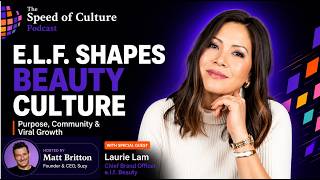
In this Speed of Culture episode, host Matt Britton interviews Laurie Lam (Chief Brand Officer of e.l.f. Beauty) about how the brand defines itself, builds community, and drives purpose‑driven growth. Laurie explains that e.l.f.’s brand is a multifaceted ecosystem rooted in a vision of "Every Eye, Lip, and Face" and a mission to make clean, cruelty‑free beauty accessible. She describes how the brand listens to its community, delivering products and experiences that reflect consumer values such as affordability, inclusivity, and positivity. The conversation covers e.l.f.’s bold forays into cultural spaces—Twitch, Roblox, NASCAR, TikTok, and partnerships like Chipotle—highlighting a process that prioritizes speed, cultural capital, and overlapping passion points. Laurie details the omnichannel strategy that blends e.l.f.’s digital‑first origins with physical retail expansion (Target, Sephora, Dollar General) and intentional global roll‑outs, using the Italy launch of Power Grip Primer as a case study of community‑driven insight leading to market success. She outlines the brand’s content and storytelling approach, emphasizing humor, emotional resonance, and rapid creative execution (e.g., Halo Glow campaign, Liquid Death collaboration, Super Bowl ad). The interview also delves into e.l.f.’s internal culture—high‑performance teamwork, healthy conflict, and a network of agency partners—and its commitment to authentic diversity, including board‑level initiatives to double women and people of color representation by 2027. Laurie offers career advice for women, urging fluid career paths, curiosity, and resilience, and shares her personal transition from a 20‑year L’Oréal career to e.l.f., driven by a desire for impact, legacy, and a supportive, purpose‑aligned environment. The episode closes with Laurie’s mantra, "Blessed are the curious, for they shall have adventures," encapsulating her philosophy of continual learning and bold exploration.
Chapters
Up today on the Speed of Culture podcast, we're thrilled to be joined by Laurie Lamb, the Chief Brand Officer at e.l.f. Beauty. With a bold focus on purpose-driven growth, cultural storytelling, and boundary-breaking innovation, Laurie is at the helm of e.l.f.'s campaigns, global expansion initiatives, from empowering women in sports to launching next-generation beauty brands like Rhode and major retailers like Sephora. Laurie, so great to see you today.
So wonderful to be here. Thank you, Matt.
Absolutely. You know, e.l.f. is such a great story and has really become one of the most culturally relevant brands in the beauty space. How do you define a brand today and how's that definition evolving with all the changes we've seen to the marketing and advertising landscape?
Yeah, the— well, the way that we view brands too is it's maybe a little bit different, but I really see it through our vision, right? And what we do at e.l.f. is we go and we seek building these powerhouse brands and this incredible portfolio that disrupt norms, shape culture, and connects communities. And I feel that starts with brand. And the way that we view that is through that lens, right? Everything we do starts with brand. And a brand has to be multifaceted to have all of those, the vision and, and then of course our mission, right? Make the best of beauty accessible to every eyelid and face starts with brand, right? You can't over, you can't kind of say, oh, that's a statement and we're gonna put it on the wall and that's it. You really have to live and breathe it.
Mm-hmm.
Also, when you think about our powerhouse innovation and every single insight-led social and TV campaign that you mentioned starts with brand. So we really see it as this ecosystem, if you will, of everything that we do is built around that and that brands can't really ignore a single facet of it because what powers it is all these elements together.
Yeah, especially more than ever before where the brand is really dictated and driven by the consumer. And you mentioned community and I know e.l.f. really prides itself on building and fostering communities. What's the brand philosophy behind that and what have been some of the tactics that you found effective at building a thriving brand community?
Yeah, our community that we serve is here because of the brand that we stand for, right? And my role is ensuring that we're listening to our community, delivering clean, cruelty-free beauty with positivity, inclusivity, accessibility. Our community, to put it in other words, is the foundation and they are a pipeline. They are pipeline for feeding what it is that this brand stands for. What do we care about? What do you care about? Like, what our community cares about is actually what we care about. What our community wants is what we actually put out there and serve them with. So they want value. They do want clean. They want cruelty-free. They want an alternative to some of the high-cost premium cosmetics that they see out there that they can't get in a brand that actually feels like we are bestie. And I think that's the perfect combination of it. When you're listening to your brands and you're building that relationship with your community through social or through an event, that's what makes a difference. And our community 100% is the reason where e.l.f. is today.
Yeah, I think another reason the brand also is where it is is that you're not afraid to make bold moves.
Yeah.
So e.l.f. has played in the gaming space, which is somewhat unexpected for a beauty brand. Obviously you have done a ton of work on TikTok and obviously you've had partnerships like the one you had with Chipotle.
Yeah.
What's the process for deciding kind which cultural spaces are worth entering for the brand that you feel is gonna just drive impact and ultimately ROI?
Mm, that's a great question. I, I, I love that because I, I think it's been evolving though. If you ask me this question 6 months later, it might not be the same, but that's okay. I, I think one of the facets is we move at the speed of community, right? Whether it's developing something like our viral Halo Gloss lip kits that we did for our community, by the way, was born out of our community to dropping a care package in the middle of the ocean for new sensation Oliver and his cat. e.l.f. is continuing to shape culture with our community by operating in real time. And another facet of that, and again, this might change in 6 months, is captivating new audiences. How do we decide where's the boldness coming from? It goes back to that principle of disrupting norms, right? And so we are the first, one of the first beauty brands that were on there to to go onto Twitch and do new platforms, not wait for these reports that tell you everyone's there already. As long as our community is there, we will go. And I think that's what took us from, when I talk about captivating new audiences, it's from disrupting norms as the first beauty brand to activate across NASCAR, Snapchat, Roblox, as you mentioned, right? Twitch, to open these new communication pathways for our brand, whether it's e.l.f. Skin, which is one of our namesake brands, bringing that onto Instagram and saying, we have a new pathway to build with this brand. We have to do it in record time because they're there, or it's where we continue to fuel fandom on our existing platforms while capturing new fans in new arenas by bringing in other things that they would say, I love Cars, but I also love Elf. Yeah.
I love watching the movie. You're, you're overlaying passion points, basically.
But I was like, exactly. You're finding a way to kind of overlap that Venn diagram. And I think another aspect of how we think what, what go, what to go after next, how to create this boldness or, or where that radiates is really around cultivating cultural capital. And what I mean by that is we live at the intersection of beauty, culture, and entertainment, just to bring that Venn diagram into play. And fueling new subcultures in a culturally relevant and emotional resonant way is where we found we win. Whether it's a collab, whether it's a launch that we're bringing that our community asked for, um, whether it's even partnering with someone like Project Hello Sunshine and bringing on Sunny and trying to really build another platform for us to build cultural capital, but also captivating new audience in the meantime.
Absolutely. I know that I would imagine being omnichannel also really helps, you know, having a, a real in-person presence allows you kind of, when you talk about community and understanding your consumer versus just being, you know, an e-commerce brand, talk to me about the omnichannel approach and how you're able to lean into a physical presence to also kind of, I guess, round out your overall touchpoint with the consumer.
Yeah, I think we do that very— with a lot of intention, I'll say that. Because when you think about it, e.l.f. was started as a brand that was actually digital first, right? It started— for those of you who don't— those of you who are listening who actually don't know, started as a brand, father-son duo that sold cosmetics over the internet for a dollar over 21 years ago. And a dollar, right? Like, Matt, a dollar. I don't know that even now that would work. You're like, oh, I don't know. I don't know if I want to take that gamble. But this was 21 years ahead of its time. And when it— When the founders did that, it was done with intentionality. It was, how do I create a sense of community and really allow a consumer low barrier for them to come into a cosmetic brand? And so we started digital first. So a lot of the principles that you see in terms of our digital disruption, the way that we listen to our community, they started with them, right? It was before ratings and reviews became a thing. And they were, you know, we have a dollar lip pencil. Sure, I'll give you some feedback, right? I wish it was creamier. Great. The founder's like, let's make the next formula creamier. And that That very essence of how the brand was founded is still in place today. So when I say we don't wanna forget our digital roots, it's actually who we are. It shapes our disruptive marketing engine, but we have matched that with, obviously there's been a lot of retailer, retailer interest to get us into stores. And so it's been a very intentional track, I would say, right? Going into Target, that was our first retailer, now our number one retailer, really proud of being there. Eventually building to the point where we're in multiple retailers, even last year going into Sephora Mexico because we know Mexico has high demand for our community. And I can go into that later in terms of where we've broken international global barriers really. And at the same time, we went into Dollar General because we realized there's beauty deserts and the people who have to, it's not as easy as finding a Sephora in your corner, and it's not as easy as driving to an Ulta that's maybe 5 blocks away or 10 minutes from your home. We are reaching every, and that's part of who we are as a brand. It's like when you stand for Every Eye, Lip, and Face, which is our acronym and our name, you really wanna make sure that's fully represented in every single way possible. And I talked about that earlier with accessibility, right? Positivity, inclusivity, and accessibility. Accessibility, that word has so many different meanings. Price accessibility, ability to get to it and find your products and not have to drive through 2 hours to find, a suitable SPF, for example.
Yeah. I mean, you must have read my mind because my next question was about global expansion, because obviously it's hard enough to understand the consumer with all the changes that are taking part in culture and society. But obviously when you layer on the cultural nuances of global expansion, it becomes even more complex. So what are the considerations before you go into a new market and how is marketing to consumers different on a, you know, on a market-by-market basis? And I guess what goes into executing upon that?
I'll start by saying that we are all one connected global community. If you hang out on our social or join a livestream from our team or our C-suite, you will see a tapestry of countries and different communities represented. It's beautiful. And e.l.f. today actually has less than 20% of its business outside the US, but the ripple effect of social has broken those barriers. At the end of 2024, we were in about 15 countries, all of them being driven by the community because I want you here, please e.l.f., I can't find you. And I think the way that we've gone through this is the same way that we've done our US expansion, intentionality. We've expanded our reach with our unique value proposition first and foremost, right? That doesn't change whether you're shopping in Italy or you're shopping in US, you're going to get that the very same things and the same principles of what e.l.f. does, right? You're going to find this product, it's going to be clean, it's going to be value-driven, you're going to see that. Uh, the powerhouse innovation, the disruptive marketing engine also resonates. And that growth that we've seen in non-US markets and that consumer demand is coming because of social. And what we do, and I think part of that strategy is that we engage with the community before entering that market. So we drive up that consumer demand and excitement.
You don't just launch and say, we're here, but you make sure that there's a groundswell interest on the brand. Yeah.
Exactly. Not just planting a flag, but really engaging with that community, finding that there is a demand for us, right? And then what we do is we partner with key retailers. We build strong connections with our local communities, and that's sort of how we go to market with it. A great example of where I think demand, when you talk about the cultural nuances, I think you were going in there, right? You gotta listen to grow, right? Expanding internationally is not just a revenue stream or a ticket to that. You have to really listen to what they're saying. And sometimes you also make the calls yourself. So I'll tell you a really good example. We launched in Italy in the end of 2023. 2023. The launch itself was a call from our community, to which my Italian husband found a lot of pride in, and whose family actually helped vet our tagline at the time. True story. And when you work at e.l.f., it's a family affair. But so what we found was that Italian women weren't using primer. So meaning they weren't applying Power Grip Primer to their face before their foundation to lock in that look. And we said, oh, but that's, that's, that's a, that's, you know, the team was like, they don't do it. It's not, it's not something that they do. We trusted our guts. We, we heard the community. We saw like on social, no way, because that demand is there. They're like, bring this here. I want this primer, make it in this color, make it in that. And so we took that gamble and we, and we placed the bets and we launched with Power Grip Primer actually being one of our key primary assets. And it became the number one product.
That's, that's a great story.
It took us to number one.
I mean, it just shows also just the power of a real consumer insight. You know, I think that word gets thrown around so much, but it's a great example of how it can truly unlock business and growth.
I love what you just said. It's an opportunity. It's a, it's an opportunity to learn, right? You have to learn new consumer behaviors and adapt products meaningfully. TikTok is TikTok, right? You know, social is social. And when you think about it too, what's interesting is we commit to traveling as a family. And, and what I find is even when you're abroad, whether it's Ulta here or Sephora abroad, teen behavior, Gen Z is Gen Z. They are still making values-driven choices. They're still reshaping their expectations based on transparency. Right, as a company, sustainability, your brand purpose, what do you stand for? Am I proud to have you in my bag?
Right, those are universal truths, if you will.
Exactly, they're universal truths. And I think that's one thing where I see social has broken down that, and we have a very global tapestry, and that's what's really driving our international strategy.
Yeah, that's great insight. So, you know, you mentioned social and how important it is even before your products are available in a market. Obviously social's rooted in community, which we've already touched on, but also content. What types of content and content applications, whether it's, you know, the, the form factor of the content or the channels you're leaning into, have you found to be really effective? And ultimately, what is your story— storytelling strategy for the brand?
Yeah, I love that question. I would say one of the, one of the, maybe it's a, not, maybe it's not a strategy, but I think it's a, it's a mode of operation, is moving at the speed of culture, right? Our brands create campaigns, right? That, that's a plug, right? I, I didn't, I didn't.
I'll take it.
You'll take it. Our, our brands create campaigns that are culturally relevant, but they're also emotionally resonant, right? So humor helps with recall first and foremost, right? Audiences are 80% more likely to retain something that's funny, surprising content, and we don't take ourselves too seriously. We take our innovation, our product safety, and our comments very seriously, but we don't take ourselves too seriously. I'll give you two examples of that. One where humor helps with recall, and we, we drove with that strategy. We had launched, um, our amazing Halo Glow Liquid Filter, right? And we, through our community, discovered it's not a one-trick pony. Some people thought it was just a concealer. Some people thought it was foundation. Some people use it as a highlighter. Some people use it as— it was so many different purposes. They were using so many different elfin ways. That we actually took it from a one-trick pony and talked about how it's not a one-trick pony and it's actually a multi-talented small bone horse. And that campaign was, I mean, it was talking horse, right? Like our creative team sat in a barn for like a week. So this was, this was name a team that would do that, right? Name a team that would use a horse as a spokesperson, so to speak. So, and we did because it weren't, you weren't applying it on, you know, there was no application even. So we break the traditional mold of how advertising is done in beauty in a way that it becomes Humor helps with recall. Another thing, another example I would say is, I don't know if you saw this, Matt, but our Liquid Death campaign.
Yeah, we actually had Dan Murphy from Liquid Death on the podcast recently.
We love Dan Murphy. And you know, actually speaking of Dan Murphy and his team, Liquid Death was one where it played up to humor helps with recall, but the creative trust that we had in our teams and Liquid Death team to come together and we dared each other to play a different game, right? We are not gonna do something like get ready with me. We're not gonna just launch a water here and, and go with it. We're gonna redefine a get ready with me. Me by going with corpse paint, right? Like, here, create your corpse paint look and just wear it and rock it like it's your everyday look. And we did it on a random Tuesday in March, the last Tuesday of March. This made us so uncomfortable— Dan Murphy, our teams— that it was a good thing for us to strive for every day. We didn't take ourselves too seriously. We went for the crazy and we went under that. The other things I would say, just as a nod, would be, I would say, creativity under pressure. You know, at e.l.f., we, we, have learned that from our Billie Jean King, pressure's a privilege. And the Super Bowl's a prime example. We went and we prepared a commercial ready to be primetime, big game ready in just 3 weeks. Otherwise, what would probably take companies 18 months. So, and when I talk about moving at the speed of culture, this is what I'm talking about. Creativity under pressure, humor helps with recall, uh, going after to help democratize access to dreams. And that's a, that's been a big one that we've been going after as well. And I would say overall human connection wins. Mm-hmm.
For sure. And, you know, obviously Liquid Death isn't going to partner with a brand unless they're willing to take risks and they're bold. So it's almost like a badge of authenticity for the brand, if you will. One question that's kind of brewing in my head as I hear you talk is you almost talk about these things like they're matter of fact, you know, and being someone who's worked with probably over 100 large Fortune 500 brands in my career is they often get in their own way. They often stumble. There's often bureaucracy that waters down ideas. And it just seems like e.l.f. does not have that dynamic. So talk to me about the internal culture, which can breed such a bold way of thinking and ultimately such differentiated creativity.
I love that you asked that. I, I think one of the very, I believe one of the things that differentiates e.l.f., not only because we strive to be a different kind of company, great work thrives for our marketers that actually practice a culture of what we call HPT internally. It's high performance teamwork. It's healthy conflicts, it's passionate relationships, it's mutual accountability. It means I got your back, you got my back, but I'm gonna hold you accountable to the work. And if something's not working, we're actually gonna talk it out. I'm gonna give you real-time feedback because the feedback is not to benefit me, it's to benefit you. So it's for the benefit of the team. And that's one thing that I feel companies have this in many different forms. Elf is one that practices this every single day. And our marketing engine, because we operate at such a speed, you can't have these things that would hold you back, you know, be barriers to actually getting great work done. And while our marketing engine, it's fueled by our community, we recognize that, it's fueled by our employees, and it's also fueled by an orbit of extended elves that don't receive a paycheck from Elf, meaning our agency partners. And you have to build an orbit around you that want to be part of your orbit because of what they're seeing. right? They see this passionate relationships, these real bonds and connections that when you're working in a pressure cooker, they— these are partners that live and breathe e.l.f. just as much as anybody at e.l.f. And part of our marketing engine is built this way because it's marketer to marketer, it's human to human. It's what creates culture and it's also what creates loyalty amongst the team.
So, Lori, many heritage brands, especially in the beauty space, talk about inclusivity, but e.l.f. really seems to live it. So how do you ensure authenticity and representation rather than just kind of box-checking, of which we see so much of in the advertising industry today?
Yeah, well, I think this actually goes back to the fact that purpose is a huge driver of what, of what we believe in, right? And e.l.f., we believe in showing up for our community no matter where they are. And for 21 years, we've been showing up in unexpected places to make the world a brighter place for every eye, lip, and face. And I pause there because I talked about being for every eye, lip, and face, you have a responsibility to ensure that your community is expressed in every eye, lip, and face. And that's an important part for us because we feel this is actually how we align our business decisions with meaningful causes that are not just because they're noble acts, but it's because it's the right thing to do. So one of the things that we've done as a company is really focusing on the fact that so many dicks talk about representation, right? And Why our, our company is taking a stance to increase or have the stance towards diverse representation in boardrooms is because we actually realize there are more men named Richard, Rick, or Dick on corporate boards than entire groups of underrepresented people. And the average US corporate boardroom is 88% white, but 27% women. And despite the fact that research shows that ethnically or gender diverse boards actually outperform, financially outperform those that don't have it. So when I think about what we commit to and how we really live our truth, this wasn't something that we just turned the switch on overnight. This is actually something that has been built by design from our CEO with our board that is diverse. And it shows that when we actually focus on this, our, the long-term goal of our campaign that some have seen is called So Many Decks, and it's to drive systemic change in corporate leadership. And Our goal is actually to commit to doubling the rate at which women and people of color are added to corporate boards by 2027. And that 3-year platform for us has started with NACD, where we've actually worked with them to prepare diverse candidates for board seats, working with nonprofits like 50/50 Women on Boards, uh, working with the Latino Corporate Directors Association, for example, and actually creating a coalition that drives towards one purpose, which is to see more diverse people in seats of decision-making power, right? These are, these are the people who are making decisions for your brand or your service.
So, I mean, and obviously that is the pinnacle of you sitting on a corporate board. We have so many younger listeners here.
Yeah.
On the podcast. And I was just wondering, given the success you've had in your career, what advice would you have specifically maybe to young women entering the workforce in terms of what are some of the skill sets that they need to acquire, and Aries need to lean in earlier in their career to end up in the C-suite like you have, or perhaps even on the corporate board one day so there won't be so many dicks.
Yeah.
In boardrooms.
I love this question. I know I've said that with every question, but I truly do love this one. If I was talking to someone who wanted to be in my seat one day, for example, I would say, don't tell yourself you have to be a certain age or you have to have hit all these steps in this type of succession. Before this X milestone, and after you achieve that, that something can happen before you get your goal. What I mean by this is you've gotta let your journey be fluid and you've gotta realize that you don't have to start after each stage gate. You can start now. Be curious about what it will take for you to get to your goal state. Allow that journey to be fluid. And probably the biggest thing that I learned in my career is setbacks are not a death sentence. It's actually a redirect for you to sharpen your lens and sharpen your strategy.
And it might not even be a setback. I think—
No.
To your point, a lot of people think that there's this kind of linear up into the right progression, both whether, whether it's the, the success of your company or whether it's the success of your career. And ultimately, sometimes you do have to take one step back to go two or three steps forward. And you might not see it at the time, but as long as I think you're staying true to yourself and you're leaning into what makes you truly unique, you're gonna end up on the right side of change.
100%.
Absolutely. I'd love to shift gears a little bit and talk about you and your career journey as we wrap up here, Laurie, because, you know, you spent quite a long amount of time, especially for today's standards, at L'Oréal before leaving ELF. I think you were there over 15 years. What goes into this?
20 years.
20 years. So that's obviously, you know, a very long time. And we've done a lot of work and continue to in L'Oréal. And so it's a great organization. What goes into a decision to leave a place like L'Oréal where you've continually elevated your, you know, your title and status and influence to jump to more of a startup relative to L'Oréal. How did you get the conviction to make the leap? And maybe what are some of the takeaways that some of our listeners can derive from change and actually leaping forward?
Here's the thing. There is a journey that is not something I would have seen, right? I have to say, there was— I love L'Oréal. I still have incredible mentors and mentees that are there. It's really an incredible 20 years that I had across continents, zones, roles that expanded beyond marketing that I really love. And for me, it was a very pivotal time in my life here. I was, it was about 2 years post-COVID and I had 2 young girls and I was really defining what I wanted to do and started thinking about like legacy. There were, it was post-COVID, so they were really, I was, having them and they were in the house with me and I really wanted them to see mom is doing something that she really finds to be impactful and filling my cup. And it was also a really personal time in my life because I had just lost my father. And I say this because I don't think people talk about this.
I went through the same thing recently. Yeah.
Yeah. I don't think people talk about grief.
It really changes you in a way that I think—
It does. It really does.
It changed me unlike anything else that's happened in my life. When you lose a parent, it really does reframe your, what's important to you. And you know, it really does change you forever.
It does. It, it makes you think a lot of things, right? Your legacy. What do you wanna stand for? Where do you want to live? And the year that I had joined e.l.f. was actually the year I had set out my own intention word, which was unleash. And I was ready to unleash my creative potential, unleash a different chapter of me that I did not see. And while I had an incredible journey at L'Oréal, when I met some folks at e.l.f., I actually saw a place that, you know, just to talk about the fact that they lead with diversity. And I was sitting down with our CFO, our CMO, and our CEO, and I actually realized these are leaders that actually walk the talk as well, right? They really, really stand by this. And it was an environment where I knew e.l.f. was at a stage where they were small enough to pivot, but they were big enough to do good things and great things. And that was really my entry point where I knew I would be able to come into a company that still very much feels that we're a startup. We still feel like the underdog. And I knew this was a place where I would be able to live out my intention word. And I think that goes back to what we said earlier. Your, your path is never going to be linear, right? It's gonna be messy and there are gonna be setbacks and there are gonna be things that you actually look back at and you're like, I'm really glad that happened to me because it made me stronger. It actually made me realize what I want even more, um, in my next chapter. And I think that's a really big part that you have to continuously doing is listen to yourself, listen to your gut, listen to what it's telling you and to find what it is that you want in your next chapter.— there was an incredible boss I had that said, you know, when you're leaving one place to get to the next, it's like you're holding onto one vine. And there is a point when you're leaping for the next vine where you are letting go of this one at the same time. And that's the part where you actually, I think, have the most clarity in terms of what is it that I want to do. So, it's like I would push everyone to reach for that line, that leap where you are in between vines. Yeah, and go for it.
Amazing advice. And obviously, you know, I'm sure you've learned a lot from all the ups and downs of your career. And I think other people having that perspective is super important. To wrap up here, we always ask our guests if there's a saying or a mantra that has helped define their professional journey to date. What comes to mind for you?
Ah, there's a fun one that I have.
Okay.
Blessed are the curious, for they shall have adventures.
And did you make that up or did you read that somewhere?
I don't know. No, no, no. That I, I've actually had that since I was a child. And, uh, I've kept that quote with me everywhere that I've went, everywhere that I've lived. Uh, it's a great one to kind of think about because it goes back to what I said, right, about being curious about what it is that you want.
Don't wait for it. Never stop learning, right?
Never stop learning. Yeah.
That's amazing.
The adventures will definitely come from it.
That's for sure. Well, I'm sure you're going to have nothing but continued great adventures in your endeavors at e.l.f. Beauty. And thanks so much for taking time out of your busy schedule. I'm a big fan of you and the brand, as you know. So it's a great thrill to have you here on the podcast.
Thank you, Matt. It was a pleasure.
Absolutely. On behalf of Suzy and I, we team. Thanks again to Lori Lamb, the Chief Brand Officer of e.l.f. Beauty, for joining us today. Be sure to subscribe, rate, and review the Speed of Culture podcast. On your favorite podcast platform. Till next time, see you soon, everyone. Take care.
Hey!
More from Matt




MikMak’s Rachel Tipograph on Consumer Spending, Retail Media & Holiday Shopping Trends



Jaguar Land Rover’s Charlotte Blank on Luxury, Purpose & Experiential Storytelling



