EA SPORTS’ Andrea Hopelain on Fandom, Gaming & the Future of Sports Interactivity
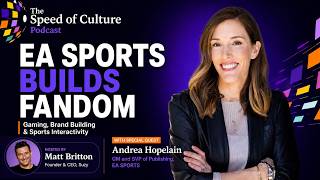
In this CES‑recorded interview, host Matt Britton talks with Andrea Hopeland, GM and SVP of EA Sports, about her 20‑year career that spans Disney, ESPN, Hasbro, and EA. Hopeland explains how early roles taught her brand storytelling, audience building, and product commercialization, and how those lessons informed her move into sports gaming. She discusses the core of her work—understanding fandom—and how that drives EA Sports’ strategy, from community‑focused, cross‑platform experiences to the massive rebrand from FIFA to EA Sports FC, emphasizing authenticity, innovation, and purpose. The conversation covers emerging trends such as AI‑driven player realism, in‑game commerce and partnerships (e.g., Nike Air Max, Ted Lasso), the shift toward digital distribution, and the importance of connectivity for fans. Hopeland closes with career advice for aspiring marketers, championing confidence, candor, and curiosity, and reflects on navigating male‑dominated industries as a woman. The interview offers insight into the business, marketing, and technological directions of modern sports gaming.
Chapters
Today we're thrilled to be joined by Andrea Hopeland, the GM and SVP for EA Sports. After a career spanning 20 years in media, kids TV, and video games, she's left a legacy that will forever pave the way for girls in marketing and sports. Andrea, so great to see you here at CES.
Thank you for having me. This is going to be fun.
Absolutely. Yeah, this is going to be fun, and thanks so much for joining. I was looking through your background, and you know, you've obviously cut your teeth in the entertainment space and came right out of the gate in your career working for Disney and ESPN. Was the entertainment world always a place that you wanted to kind of end up in?
You know, I've been really thrilled and honored and, you know, worked quite hard to build a career at the intersection of sports, entertainment, and technology. I've always loved the idea of and the motivations behind fans. I'm obsessed with the business of fandom. And so the career choices have been, you know, both intentional and opportunistic along the way, but super excited on the journey that it's taken me and the things that I've gotten to accomplish along the way.
Absolutely. And in terms of the intersection of that and marketing, why was that an area that you decided to specifically pursue within the world of entertainment?
I think it really goes back to really being that obsession with fandom and really trying to understand why people fall in love with what they fall in love with. Yeah. You know, we all either have a team or a show or a character or a world or a type of competition that we just love. And getting deep and really understanding those consumer-first motivations for why you love what you love really was at the heart of me becoming a marketer. But it's obviously transcended into very different spaces and allowed me to grow big businesses now.
Yeah, for sure.
And really lead with that consumer-first orientation.
Yeah. And, and it's not lost on me that you, You started your career off at Disney, and when I interview a lot of people on the podcast that are in CPG or food, a lot of them start at Procter Gamble. And because the discipline that they learn at a company like that, they're able to take for their careers. And I imagine you being in entertainment space is very similar with Disney because it's a world leader in entertainment. As you look back on your time at Disney, what are some of the main takeaways that you were able to, I guess, take with you for your other roles that you would then take part in?
I mean, I think that Disney was a masterclass in building a brand. Yeah. And building a brand that has deep storytelling at its core, but multidimensional entry points for consumers to come in and find their way and to express their personal fandom. And so, you know, whether you're a Star Wars fan or a, you know, a Marvel fan or a Mickey Mouse fan, like, you know, there's plenty of ways whether you come in through the parks, come through and through a comic book, come in through a t-shirt or a toy. Disney was a masterclass in building a brand and creating brand extensions that—
in multiple channels. Correct.
That tell the story in a variety of different ways and access points. I think, you know, to your point on consumer products, many people coming in from Procter Gamble, I was very lucky to have been able to go spend some time at Hasbro later in my career, in the middle of my career, where it really taught me the art of commercializing a brand through products. Product as well. And so I've kind of gotten both ends of those spectrum, those spectrum in my career.
Right. Because Disney, it was more of licensing agreements, right? When it came to the toy category.
Correct. Yeah. Disney for me was about building audiences and sharing our stories and, you know, driving eyeballs and managing the IP, I imagine as well. IP management. And then Hasbro in particular, I ran the girls business there and was responsible for the Disney Princess and Frozen business and commercializing that through play and through toy and product.
So let's talk about your stint at Hasbro, because obviously it is a much different role than working at Disney. You also have to think about the retail footprint and working with those channel partners. So I guess what were some of your focuses and takeaways there?
Hasbro was really the first opportunity for me to transition from driving audiences and driving fan growth into really commercializing a business. Yeah, I was responsible for a full P&L, responsible for a team that oversaw SKU development, product development, and the engineering of those products. And also the really, to your point, the sell-in and sell-through to retail and to e-commerce players. And so it really taught me the art of full business management, which was an exciting and totally eye-opening chapter of my career. I remember the first time I went to China and met with some of our manufacturers in China.
Probably pretty eye-opening, right?
Eye-opening.
Right.
Even just thinking about the things that as a consumer you don't think about, you know, as I mentioned, I ran the fashion doll business, princess business. And so the art of stitching the seams and that on the little tiny fabric dresses, and the art of rooting hair, and just the choices you have to make in terms of how do you make the right choices that ensure that the product, um, is exciting and delivers on the features and benefits that you're selling to the consumer, but also knowing how you make money as a business too.
Yeah, and also I would imagine has to be reliable in terms of the supply chain and making sure All of it. Manage the inventory and get to your retail partners.
All of it. And so it was like, you know, a marketer through and through, the learning the art of really owning and developing and leading a business through, you know, that consumer-first lens. It was a game-changing career opportunity for me that I think has been one of the most fundamental for me in terms of my— the future from that point.
And the other unique thing about Hasbro is, you know, when you're marketing a product that's consumed by children, the audience is obviously the parents as well, which is sort of an art form to marketing, which is unlike somebody who's marketing Coca-Cola as a person that drinks Coca-Cola. So talk to me about that approach and how you're able to refine that over time.
It's why the art of storytelling is so important across the board and why insights are really, you know, the driver of any great marketer's, you know, success. Yeah. I'll tell you a funny story. When I— so when I came to Hasbro, my first day on the job, my boss said to me, sort of, she gave me one of those surprise moments of welcome to the company and surprise and handed me an RFP from Disney. She said, you know, we know we just hired you and you've just worked at Disney, but guess what? Welcome back. And the RFP was for the Disney Princess and Frozen business.
So you were competing with other toy manufacturers to get the license so you could manufacture on that IP.
Correct. Correct. Thank you. And, and, you know, the Disney princess business had been going through a little bit of maybe a wane in perception from parents. I think parents were— parents saw the princesses as, you know, the beautiful, debonair, stereotypical, stereotypical, you know, just waiting to be kissed.
You know, lacked female empowerment.
Correct.
Correct. Which Disney then made up for in later films. But you're right.
But Right. it was really the start of the next chapter for Disney and the princess and Frozen business, which was really rooted in a core theme. It became a multidimensional theme called Dream Big Princess. And it was about celebrating the inner strengths of all the princesses. And so whether that was Tiana, who was an amazing cook, or Merida, who was an athlete, you know.
Or Moana comes to mind too.
Or Moana, exactly, Moana. And so it became really, it was a really fun challenge for me because I got to reinvent the product strategy for toy and play. In how we celebrated the inner strengths. And we built Rapunzel toys that had Rapunzel's long, flowing, beautiful hair become the paintbrush for the canvases of our art. And the pack-out, you know, we packed the toys out. So instead of having, you know, featuring their beautiful clothes, we put them in really strong, heroic poses inside the boxes. And it became a really fun marketing challenge for us to work with Disney to really celebrate the new theme of Dreaming Big and telling the parents the story as much as telling the young girls and boys who would buy our products.
Product. Yeah, it's interesting because Disney has these tales in some instances that there's all this time and they continue with that in the IP, but then the world changes around them and then they have to adapt. But it's easy if you are marketing sneakers and you could just change his design to make it more contemporary. But you talking about these stories, it, I would imagine, becomes a little bit more challenging.
Yes, characters, stories, and worlds. And you know, the good news is there's endless threads to pull. You just have to kind of dig a little deeper and find the insight. And I always feel like the insight leads to the innovation.
Yeah. And Disney, obviously, it's going to be interesting. You know, Bob Iger came back and they're trying to, you know, I think juggle a lot of challenges and opportunities in the space. Their theme park business seems to continue to do great. And then the streaming business is highly competitive. And it's just going to be interesting to see how they compete with the Netflixes of the world, even the Amazons of the world moving forward.
Yep, I'm rooting for them.
Yes. So you made the jump from Hasbro to EA to gaming. And obviously gaming is something different than your past roles that you had prior. You're marketing to largely a different audience. And it's obviously a space that moves a lot quicker than some of the IP we were talking about. What did you see in the opportunity at EA to make you jump? On that opportunity?
Yeah, for me, you know, I saw tremendous synergies from the things that I knew very well. Yeah. IP characters, worlds aren't much, aren't that different than athletes, teams, leagues, you know, and why people fall in love with those things aren't that different. It's fandom. It's fandom. Yeah. At the heart of it, it's fandom. And so I loved very much staying rooted in brands and that make emotional connections with audiences. I, I can tell you that Personally, I knew that my own career had a gap in it. I had not spent any time deeply in sort of digital or technology-led businesses, and I saw such an interesting opportunity at EA, Electronic Arts, to combine my strengths and the things and the power of play. I certainly knew play very well at that point from an analog play. Yeah, through toy. But to transition to an interactive space.
Far more immersive space.
Far more immersive and operating really at a much greater pace and speed.
Absolutely. And we're here at CES in Vegas, and there's so much innovation being discussed. What do you see in the gaming industry in the future? I had an interview with Shahar Scott from Meta Reality Labs talking about the things that they're doing with their VR lenses and how that's going to be a huge intersection with gaming. I imagine you have no shortage of conversations at EA about similar topics. Where do you see gaming headed?
I think for us, the future of sport and the future of gaming is truly interactive and connecting fans. We have one of the largest sport fan communities on the planet with, you know, hundreds of millions of people coming into our experiences on an annual basis. And not only do they love to play, but they love to connect.
It's a community.
They're connecting with a community of like-minded fans in a space where they can participate and play together. It's really powerful. And so you'll see, I think, The future is really rooted in harnessing the power of connectivity through interactive experiences and continuing to build onto that in ways that reduce friction, particularly for sports fans who are watching, are playing, are connecting, are creating around sport, and they also are participating.
I think that online betting is— I mean, that's driving even more engagement. You see it everywhere. I was at an NBA game last week and everyone around, for better or for worse, it is what it is. The leagues are embracing it. Yep. Everybody is putting $5 in a game or $100 on a game and to bring people closer closer to the sport, fantasy sports, all those things.
All of it. So there's an incredible opportunity to continue to lean into connecting fans across all of the dimensions of their sport fandom. And also, you know, an ability for us to keep leaning in. We have one of the youngest audiences in sports at EA Sports. If you think about the youngest generation's first form of entertainment now is gaming. And so the position we hold and are able to continue to drive forward in leading the future of sports sport in an interactive way.
I think we're really well positioned for that. Yeah, and two-way, because I think that as much as the NFL takes advantage of Madden, Madden kind of takes advantage of the NFL both ways. Younger kids, when they play Madden, it teaches them about the game, teaches them about the players. And then when they get older, they are more likely to take their kid to an NFL game because they've been engaged with the sport in a way they might otherwise not have.
Yeah, they, you know, the youngest generation is athlete first now. Yeah. Athlete first, then team, then league. Right.
And it's almost like music. They like the song versus the album. Correct. Yeah. And fantasy sports is a big reason why. Exactly.
For sure. And, you know, we inside of our games, you know, they're learning about sport, they're learning about team, they're learning athlete stats in ways that, you know, surprise and delight us. You know, they know more about, you know, the strength of the cornerback on this team, you know, ESPN might not be talking about it, but certainly they as fans now know about it through their exposure through our games. We've heard countless stories of youth who are growing up and learning about sport through EA Sports. And not only are they playing and engaging and becoming lifelong fans of sport, but they're also participating in sports. So, you know, you hear about— I heard one the other day, you know, someone was telling me about how their son played Madden and then decided to go try out for the high school football team. And it was through his— the fun he had playing and connecting with the sport through our game that led him to become an athlete as well.
That's awesome. There's also— there's other learning opportunities too with Madden because me and my son play all the time. He's older now, but I remember giving him like an allowance to buy the coins where you can buy players. And I remember he was probably 11 years old and he had to decide, am I going to get 2 good players or 1 great player? For the 50 coins I have. For those of you who don't know what I'm talking about, in Madden, you could build your own team and trade players with other people and try to build the ultimate team. You also buy players with coins. Correct. That's a whole new kind of gameplay modality that didn't exist 5, 10 years ago.
It's definitely one of the really fun ways and one of the most competitive ways of playing some of our sports games at EA Sports. And yes, exactly to your point, teaches a view about the strategy of sport and what it means to be a manager. Yep.
Absolutely.
A club manager or a GM of a team.
Yep. And we've talked about American football, but I know a huge title that you work on is what's more known as football around the world, which is soccer, we call soccer. And a big title that EA has in that area was FIFA, but is getting rebranded. Talk to me about that property overall and the— what the thinking behind rebranding it is.
So we rebranded FIFA to EA Sports FC this past year, which was arguably one of the largest entertainment rebrands in history.
Yeah, and probably not a decision you took— you guys took lightly.
We did not take it lightly. No, that was a bit of a hand-wringer for us. We've been in the business for a couple of decades now. And have amassed hundreds of millions of fans that come back annually to play our game. And we're incredibly proud of that. And to that insight, you know, of our fans being, you know, fans of athletes first, then teams, then clubs, you know, in addition to our partnership with FIFA, we've also had partnerships with over 300 different licenses underneath FIFA to deliver this really—
All the individual leagues.
Yeah, this really special game that we have. For us, you know, as we think about the future of sport and we think about the future of interactivity, we're really focused on a couple of components. Play certainly as a fundamental, but watch, create, connect, and participate. As we think about our own ambition spaces, it became a natural moment for us to start to push up, to push the boundaries and really start setting out onto our own. We knew that we had to do it right, though, and there were 3 components of doing it right. One was authenticity. And so the maintaining of the over 19,000 players, you know, 700 teams and clubs inside the game. Two was the innovation. You know, annually we're driving significant year-on-year innovation and making sure that we're delivering the best. Yeah.
Then it makes it worthwhile for somebody to upgrade this year's title.
100%. Yeah. And then purpose. Which was an opportunity for us to really start to own and to drive more reach and resonance for our own brand in the market. And so you've seen us, maybe seen us launch some initiatives like FC Futures where we're really investing in grassroots sport and really trying to lead our own brand forward.
Yeah. And, and the sport of soccer is obviously really taking hold in the US. When Leo Messi came to Miami this year, it was like the Beatles stepping foot in New York. So it was, it, it's, incredible to see how this is spreading. And with the Olympics and the World Cup, and I just feel like it continues to gain momentum as a sport.
The momentum is huge. We've seen a lot of growth in North America. The World Cup certainly helped Messi, as you're right. I would also say the NWSL and the acceleration of the NWSL here in North America has been a big driver for sport, particularly among youth.
Yeah, I mean, the Olympics has really, I think, drawn a lot of attention to women's soccer players. And, you know, they've been very competitive, certainly more competitive than the male US team. And I think that's driven a lot of popularity in US as well. So in terms of the, the business of video games, uh, you know, your business used to be you had to go into GameStop or whatever and buy the discs, and then it became basically all streaming now. I'd imagine most of your sales are streaming. So does that mean that you're just a direct-to-consumer company now? And how's that changed the way that you go to market? Because I would imagine retailers are for a small piece of pie.
Our business has definitely shifted over the last decade. We're seeing significantly more digital transaction. I would say without, you know, having a specific number, I would say the lion's share of our business is digital now. But we still have really important partners that help us deliver that business. So certainly we do have physical retailers and you will see us across all of them around the world and, you know, the big ones and the smaller ones around the world. But, you know, we have great partners, you know, partners like Microsoft, partners like Sony and Steam and others that are also helping us—
They're distribution partners.
—distribute our game through their consoles. And so they're an important partner of ours as we continue to deliver. And usually you find someone's like, oh, I play on Xbox and oh, I play— or I play on PlayStation. I think what's most important about the work we do is to reduce the barrier for fans between those platforms. And so really over the last couple of years, we've significantly increased the technology that allows cross-platform play. I was going to ask you about that. Yeah, so me to be able to find you on— PlayStation, on Xbox, right? Correct. And not letting that be a barrier for fans. Yeah, absolutely.
So as we look ahead to 2024 and beyond, and we're here at CES, what are some of the innovations that you're excited about, either relative to their impact on the gaming industry or otherwise, that in your role you have your eye on?
There's a couple. We've been working on a number of things that sort of start to push the bounds of who we are and what we represent. I mentioned to you that I'm really excited about the potential for EA Sports to be a leader in the future of sport, and that comes with sort of expanding ourselves into new categories and taking on new challenges. This past year, we partnered with Nike and we launched an Air Max 90 a custom Air Max 90 inside of Madden for Madden fans. And they were able to purchase it inside of our game and then also get a virtual pair of those Air Max 90s for their avatar. And so that's just— so they got the physical shoe and the virtual. And so, you know, that was an expansion of our capabilities in driving commerce. You're seeing us partner with traditional entertainment partners in new ways. We partnered with Ted Lasso inside of EA Sports FC last year and did, you know, a whole AFC Rix— AFC the SC Richmond experience, which was amazing. So I think you're going to continue to see us push the lines in those spaces. In-game advertising? I would have—
yeah, partnerships, deep partnerships. But you do in-game advertising as well, don't you?
Inside of our mobile games, in-game advertising is more, is more common.
Gotcha. Because I recall at one point seeing logos of brands inside your games. You're—
so core to who we are is to deliver the authenticity of sports. Got it. So I'm a, yeah, I'm a big F1 fan. And so, you know, as you're racing, you know, if you're on the Vegas Grand Prix circuit or the Miami circuit, you'll see a lot of the partners in sport, whether it's the DHL Bridge or—
or maybe— Just for realism. Because it's—
it supports the authenticity of delivering our games.
That's awesome. And what about AI? Do you think that— I mean, I would imagine that it's got to have a big impact moving forward in the world of gaming.
We've been, we've been really focused on motion graph— motion— what's the word, Claudia, I'm looking for? Motion— what's the— ML, machine learning. That's what I'm looking for. So let me read you this. Of course. Machine learning has been a really big driver of our ability to drive realism inside of our game.
And it's been incredible to see.
And it's massively, massively changed the way we're able already to drive very specific play styles for our players and to show the uniqueness of athletes and how they actually—
Their mannerisms. Their mannerisms, the way they dribble, the way the way they move their bodies.
And so that's been, you know, machine learning has been a big part of our development for some time and it will continue to be.
Yeah, it's fascinating. So zooming out, you know, as we wrap up here, Andrea, like you've had such a cool career working in companies like Disney and Hasbro and now EA. And, you know, a lot of people who go into marketing would love to have the career that you've had to date and to play in such a fun space as well as, you know, play at the highest level of business. What advice do you have for maybe younger people that are listening to the podcast that are at the beginning of their career that want to be able to pursue a similar path? What are some of the things that you think you did right to enable you to have these opportunities?
I have a personal mantra that I like to share a lot, which is really just the 3 C's. Okay. The first is confidence. You know, you've got to believe in yourself and you've got to have the confidence that it's okay to ask a question, it's okay to open a door, and that you, you know, you got to believe in yourself a little bit. The second is candor. You know, being able to spot the things and have a point of view.
That comes along with confidence.
It does come with confidence. Yeah, totally does. And the third is curiosity. And really, they're not in any order. Sure. But, you know, being curious, asking deep questions, I think all of those allow you to have really interesting conversations and open your mind to perspectives that you may not have considered. And actually, I find the curiosity to be one of the most interesting things when you have someone curious sitting by your side asking you lots of questions and really thinking thoughtfully about your business, those are the people that I want to hire. Those are the people that, that are showing me that they have the right brain space to, to push boundaries, to experiment, and to progress. And so curiosity, candor, confidence, those are probably three of the most important ingredients to drive a career forward.
And how do you think embracing those tenets have been different for you being a woman or young woman in business when you first got started? Because, you know, some industries are more male-dominated. And maybe there are some people who think that they don't have the license or permission to be candid, maybe as much as males do. And, you know, I'd love to hear your thoughts on that.
Look, imposter syndrome is real, male or female. Yeah. And I have worked in a lot of male-dominated spaces over the course of my career. I think, you know, really bolstering my own confidence, even if it meant faking it till I made it, I think that's been one of the more important things, but also being authentically me and showing up and, you know, keep trying.
Absolutely. Well, we're going to leave it with that. Thank you so much, Andrews. It's been awesome. Cannot wait to, uh, continue to see your success from afar, and, uh, can't wait to see the new games you guys are gonna have coming out in the next year. So it's gonna be awesome.
Yes, look forward to college football. Yeah, I'll give you a lot.
Oh, I was gonna ask you about that. Go Blue, by the way. Congrats on Michigan. Is college football coming out?
We are looking forward to an exciting summer for college football.
Okay, there you go. So there you have it, and we'll see what that means moving forward. So on behalf of Suzy and every team, thanks again to Andrea Hopeland, SVP of EA Sports, for joining us today. Be sure to subscribe, rate, and review the Speed of Culture podcast on your favorite podcast platform. Till next time, see you soon, everyone. Take care.
More from Matt




MikMak’s Rachel Tipograph on Consumer Spending, Retail Media & Holiday Shopping Trends



Jaguar Land Rover’s Charlotte Blank on Luxury, Purpose & Experiential Storytelling



