Entrepreneur Magazine w/ Matt Britton: How to Grow from Mktg Consultant to Successful Agency CEO:
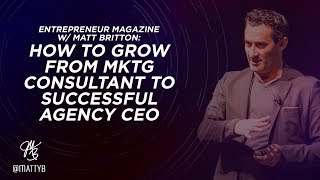
Interview (Pursuit series) with Matt Britton (founder/chairman of MRY; CEO of Summit Series) about his entrepreneurial journey and lessons learned scaling a marketing agency. Britton describes starting a college company (Magma Group), its failure after the 2000 dot-com crash, being supported by Ustream/Youthstream for two years, then founding Mr. Youth (later MRY) in 2002. He grew the firm from a solo bedroom operation (early clients: Red Bull, Valvoline, Intel, Microsoft, Coca-Cola, Visa) into an agency of roughly 500 employees and later spun out Crowdtap. Core advice covers reaching millennials (book: Youth Nation), the importance of mobile, data-driven and highly targeted campaigns, creating shareable experiences ("Did it for the Instagram" / "Dipty"), hiring and empowering talent, leveraging freelancers, finding mentors and peer forums (YPO), and a practical exercise: write a future press release as a daily decision guide.
Questions this video answers
2002
Two years
About 500 employees
21 years old
January 2017
Hi, I'm Kelsey Humphries and this is the Pursuit where I help you in your journey, your hustle and your climb to be your best self and put.
Out your best work.
After all, I'm still hustling for that too, guys.
So I sit down and interview today's most successful celebrities, executives and entrepreneurs and.
I break down success for the rest of us.
This is a Pursuit profile episode with Matt Britton. While you may not yet know his name, you need to hear his story. Matt Britton is the founder of New York based agency MRY and the co founder of Crowdtap. He is known throughout the advertising industry as an expert in social media marketing with a deep expertise in the millennial generation. Since founding the now award winning agency from his bedroom in 2002, Britain has worked with some of the world's leading brands like Microsoft, Coca Cola and Visa. He has also spoken at Industry Conferen World and has become a featured advertising expert for cnbc, Mashable, Forbes, the New York Times and the Wall Street Journal, among others. How did he go from solo consultant to over 500 employees and then a multi million dollar exit? That's what we discussed when I sat down with him recently in New York City.
Thank you for joining me for another episode of the Pursuit. I'm Kelsey Humphries here with Matt Britton, the founder and chairman of mry, an amazing agency here in New York, and now the CEO of Summit series, which is also very cool. And he has a lot to share with us about reaching millennials. And also just your entrepreneurial story I think is awesome. So thanks for stopping by today.
Thanks for having me. It's great to be here.
So let's go back to the beginning because you started a company in college and then never went into the workforce. I mean, you just started a company right after school. Tell us kind of how that all started.
Yeah, I mean I was very fortunate in that I was leaving college right at a time when the Internet was sort of becoming a mainstream media consumption habit amongst young people. And I immediately saw that as an opportunity really to bring that knowledge and expertise because I was an early adopter of the Internet to brands. So I started a business at a college called the Magma Group. Really was built to help Internet based companies target college students through a network of student ambassadors on college campuses to essentially drive registered users for early on sites like ebay and Yahoo and Lycos, right when they were starting really at the beginning of Web 1.0. Wow.
And so then you moved to New York and You got some really big clients like Red Bull pretty much right off the bat, solo operation. How did you do that?
Well, actually something happened before that that I think was a good lesson learned is that my first company, Magma Group, really kind of went under. What happened was all of our clients were Internet based companies. And then when the Internet bubble burst in 2000, we were left holding a ton of accounts receivables that were never paid and we couldn't make payroll. And we really were in a bad, bad situation. So we had a company in New York called Ustream Media bail out me and my business partner. And I was 21 years old at the time. I didn't really know what I was doing, but they actually covered all of our payables, stopped us from having to go bankrupt and really allowed us to kind of stay afloat. Got me to New York. I learned a lot from the company that acquired my initial company out of college. Mostly how to work with brick and mortar traditional companies like Procter and Gamma and Coca Cola, how those companies work, how they evaluate IT agencies, et cetera. And then after I felt like I had my legs under me, I left Youth street media to start Mr. Youth in 2002.
So wait, what do you think is a good sign you have your legs under you for someone watching who's like considering going out on their own?
Well, I mean, first of all, you have to be on a solid financial footing. You have to have enough savings where when the business starts, you can't make, you're not having any income, you can make rent, you can feed yourself. That's really important because if you're playing scared at the beginning, you're going to be making a lot of short term decisions. And make short term decisions, it's going to come back to haunt you later on. And secondly, you have to have a level of expertise and confidence in your craft that you can play at the highest level. And you know, I had the energy and ambition and passion from my first startup, but then having those institutional learnings from Ustream really gave me the tools I needed to begin Mr. Youth in 2002.
How many years were you at Ustream?
Two.
Yeah, not that long, not even a.
Year and a half.
Just absorbed as much as you could and then went out. Okay, so then at that point you're on your own, just you, by yourself. How did you get Red Bull to, you know, sign on the dotted line?
Red Bull. And I remember Valvoline and Intel were my first three clients. I can't specifically remember what order they were in and really was about relationships. Ultimately, when you're a startup, especially in the service business, the best way to get a disproportionate amount of business relative to the size of your of your organization is through relationships and trust. And I built relationships and trust with clients at those organizations. They knew me, they trusted me. They knew that I would run through a wall for them if I had to. And because of them, they were willing to take a chance on me working out of my bedroom in Manhattan to actually give me the business. And I knew that was the opportunity and I knew I had to over deliver. And I did over deliver for them, and then they became references for me. I made sure I publicized that in the industry trades. I was working with these companies and all of a sudden we became a legitimate organization. But if it weren't for those relationships and trust that I had built in my prior ventures, I don't think that would have been possible.
So let's talk about it. You get these giant clients. Did you immediately hire help?
Were you tell us relationships come in as well? I hired freelance account managers, project managers, creative people that I had been in touch with in the past to help me. Some of them were working at other companies full time and they were just moonlighting for me, but they helped me kind of put a patchwork organization together. I specifically remember answering the phone with the voice of someone else, you know, like you were calling Mr. Youth. Oh, is Matt Burton. Please hold. I did that. I mean, my bedroom was my, you know, was my office. It was everything. So I had. But I couldn't let my clients know that was the case. I had to, you know, kind of fake it to your make it mentality. My website, you wouldn't know if you looked at my website in the company that was doing $15 million a year that there was any difference. So when you're in their early stages, make sure that you kind of portray stability and portray a certain level of sophistication and prestige so clients can buy into it. But ultimately you have to deliver, otherwise you're going to get exposed and then you're going to blow your opportunity.
Tell us what the average day was like for you in those first few years.
You know, some days I woke up and I actually really didn't know what I should be doing, you know? Yeah, like when you wake up and you have a job every day, you have a boss that tells you what to do. When you're an entrepreneur and you first start a business you really don't like, if all the general tasks and checklists are done. So, like, your client's happy for that day. It's what then? What do you do? Do you pick up the phone and call? Well, who do you call? Do you go to a conference? Like, how do you actually spend your time? So in the very early stages, it's not like your calendar's filled. You have to fill up and understand what to do. And over time, I realized that I just had to figure out what the critical inch I needed to move my business forward that particular day, whatever that might be, and take steps in that direction. So I thank myself for whatever I did that day, you know, 30, 60, 90 days from that point. But it wasn't always easy knowing what to do. And I think that's interesting and something that was definitely a learning lesson for me.
Yeah. And something not very many people talk about. So I want to kind of transition to your book.
Yes.
Because there's a YouTube talk you did at Lincoln center last year, and I'm going to link it for you guys because everyone should watch it.
Talk.
Talking about just the changes in our world and the workplace. So someone out there who, you know, is trying to grow their business and reach millennials and work with millennials, why don't you just kind of talk about some of the realizations you had and what they should be doing?
Yeah. Well, the impetus behind my book, Youth Nation, was that, you know, I lived in the world for 14 years when I was running MRY, Ms. Youth became MRY, where I would deal with all these CMOs and people who are running marketing organizations at Fortune 500 companies that were Gen X or boomers. And they were completely disconnected from this huge groundswell of change that was happening right beneath their feet. They were making decisions from the boardroom, when in reality, the changes were being driven from the streets. They were telling me that Mark Zuckerberg, he knows what he's doing, but yet the 20 somethings in the organization were 7 floors below with no decision making power. That disconnect was really jarring to me. In fact, I remember being at a conference of 400 digital marketing experts, and I asked them at a show of hands how many people have heard of WeWork, which is the largest tenant of commercial real estate in New York City right now, and two people raised their hands. So that disconnect was so jarring, I knew that there was an opportunity to kind of create a roadmap or a bridge between the Gen X and boomers who were still in the driver's seat of making business Decisions and. And this whole millennial generation and all the changes it brings about and really try to get everybody to understand that we're living in a new world right now and the old rules do not apply anymore. And in kind of talking to both millennials who were on the receiving end, or actually rather on the driving end of this change and the other generations, it became clear that there were certain key points that really had shifted the way the world works. And that's really where I focused on the book.
So let's talk more. Maybe from a small business perspective. What mistakes do you see small businesses making with these changes and millennials?
Absolutely. I think for small businesses, the biggest misconception is your business cannot just be about the product or service that you're selling. And what I mean by that is that every car right now would be looked at as a marvel 15 years ago. You know, the Toyota Camry right now is technology 15 years ago would be looked at as, you know, an architectural marvel, but it exists right now. Every toothpaste is good. Every dry cleaner is good. The services in this day and age with the technology that's in place really surpasses the need that consumers have. The difference is in the ability for these businesses to be shareable and have a story behind that that people want to talk about. And too many businesses just stop at having a good service or product and think that that's enough. But it's really not. Everybody is finding out about products and services via word of mouth right now. They're hearing about things from other people. But word of mouth doesn't happen on its own. You have to go above and beyond in ways to give your customers the tools they need to become advocates. So that could be anything from if you're a dry cleaner, when you return clothes, give somebody a gift that they don't actually really know about, and they'll actually find it's the smallest, tiniest things, the smallest tiny investments that businesses do that make people say, wow, that's a great business. I need to tell everybody else about that. And that could be the difference between a thriving enterprise and a business that just kind of just hums along over time.
Right. I also liked in your talk, talking about experiences. Tell us what I think it did. Fee it.
Dipty.
Trying to think through the letters.
Explain that.
So Dipty stands for did it for the Instagram. And that is a premise that I learned through my research for the book, that this millennial generation is pursuing experiences not only for the ability to actually enjoy those experiences, but even More so in some cases to actually tell everybody else that they did it. So people will jump off cliffs, hike to the top of mountains, travel to far, remote places, sneak down courtside at an NBA game to get a selfie with a player or at a concert or with a dj so everyone else knows that they were there. And that need to share and validate oneself and one's personal brand through experiences is really, really strong. I gave an example of the book of a mountain that people climbed that now there's. There's complaints from local residences and there's pollution and there's lack of parking. All of a sudden in the last three years, it's just happened. Why? Because now people have the ability to share it. Before that, before Instagram was big, nobody really cared about hiking the mountain. So it's really changing the way tools like Instagram, the way that people are spending their time and their money in unprecedented ways. So what does that mean for our business? It means that you, your own business need to find ways to. That's going to become shareable. Friends of mine have a restaurant downtown, Lower east side, not too far from here, called Vandal. And it's all about sort of street art. And when you walk in, there's this incredible statue of a dancing pink elephant or actually rabbit, dancing pink rabbit. And everybody that comes into that restaurant takes a picture in front of that sculpture and they're sharing it because it's a cool place to take a picture. So for the consumer, they have a cool sort of shareable moment. But for Vandal, the restaurant, now they are carrying their brand across everybody who visits social networks. So it's the best form of advertising and the best form of word of mouth. So what is that sort of one cultural or shareable moment that you can have as part of your experience that you know people are going to want to share with others and that your brand and your business will go on for the ride. So that's how businesses can take advantage of diffty.
Let's talk specifically, because you're obviously sharing some marketing and advertising wisdom. I worked in an advertising agency because before switching to the other side of the camera, as I like to call it, what are mistakes that you see agencies making? Marketing and advertising agencies, or marketing and advertising consultants since there's more and more freelancers out there.
Yeah, I'd say a couple things. I think. Number one, the world has changed so dramatically even over the last two to three years. Right now, the fact is that if you cannot penetrate a consumer's mobile device, you're going to be largely irrelevant and largely invisible. Yet so many agencies are still coming to clients with mock ups and wireframes on desktop computers and that world is now gone. Everything should be centered on the mobile device. That's one, two. Everything needs to be data driven and personalized. We have the ability now, through platforms like Facebook and Instagram, to deliver consumers who are live within 50 miles of a Target and just bought a car in the last three years a message. And, you know, there could be, you know, a small subset of consumers for some brands, 10,000 consumers out there that can move the needle. So instead of trying to kill an ant with an elephant gun, how can you be very surgical with finding out who those consumers are and giving the right message at the right time? So it's really about being very data driven. And I think lastly, less is more. I think that there are so many different platforms out there that are shooting for our attention and consumers are kind of bombarded with more and more media message each day, that the ability for a brand to have ruthless simplicity and actually have a message that is so simple that you can understand it right away and is designed for the flick, so to speak, is really the game. And I think so many agencies are coming to their clients with these sophisticated, complex, you know, campaigns that a consumer will never understand, frankly, because they just don't have the time to understand it, no matter how clever it is. And there's a reason why, you know, Snapchat with a limited amount of time took off. There's a reason why, you know, Instagram, because you flick so quickly and its imagery has taken off, is because this new generation just needs to consume information so quickly and they just don't have time to dig in deeper. So short form is winning, simplicity is winning, Bing Micro Target is winning and mobile is winning. And those should be the areas where agencies should focus. And the reality is that we are still living in the TV industrial complex. So all these big brands are still putting a significant amount of dollars towards abc, NBC, cbs, Fox during the upfronts every year. But we are so close to that model breaking where once the computer and the TV merge and once the TV becomes a giant iPad hanging on your wall. I'm not going to tune into ABC or NBC to see a show. I'm going to push the Empire app or the Scandal app. I'm going to see the show directly. And then what role do television networks have and where do brands put their money? As long as agencies focus on the areas I spoke of, I think that they'll be set up for the future where a lot of agencies are still looking in the rearview mirror and they're operating in a 1995 or 2005 world. And those are the agencies that are certainly destined for hard times in.
Let's go back to your entrepreneurial journey because a lot of people will start as a consultant or start a marketing firm and they get to 20, 30 employees and that's a success. You had almost 500 employees, is that right? So how did you do that? What is your advice?
You need to find incredible people to scale a business. You need to find amazing people with heart and commitment. But more importantly than that, after you find those people, you need to trust and empower them and get out of their way. I think that the companies that are the ones that are unable to scale, no matter how smart the founders or the CEOs are, is because they hug their businesses so tight that they suffocate and paralyze them. Now, the risk of that, of empowerment, is you're going to have a lot of mistakes. You're putting your people out there to sink or swim, but it really is the only way. I hired a guy who was a brilliant product manager and came up with an idea for an entirely new software company and I stayed out of his way and it was so successful we actually spun it out and now it's called crowdtab. It's venture funded business and it's actually probably going to have a bigger exit than the agency did. And all the shareholders of the agency are going to be able to take part in that. And that never would have been the case if I would have micromanaged him because that really wasn't his job when I brought him on the business. So when you find people that you know are great again, empower them, give them tools they need to succeed and get out of their way. And what they will do is they're not going to come into work every day and wait for me to tell them what to do. They're going to come into work every day and do what they think is best for the business. And then your business grows in ways you never imagined, because it's not all being driven by one person. And I think that's, to me, the best. Now, how do you recruit those people? How do you find them? It's hard. And the way I did it is I made myself a personality in the industry. I put myself out there, I met as many people as possible and most importantly, I always treated my existing employees with respect. And I always made sure I invested in culture. So that created great word of mouth in the industry. And over time, the best people ended up coming to me versus me having to come and get them.
But then you talk about in your talk how many more people are just, especially millennials in the younger workforce are just going off on their own. How do you retain those people?
Well, right now, when I built my business, I built my business really from the year 2002 to 2012. So that was during a different decade, during the, I guess it's called the tens or the zeros. Now we're in the tens, right? Tens is a different, it's a whole different world right now. And what you're referring to is really this freelancer or free agent movement that's taking part. Where there's tools like upwork, where freelancers can go online and have over 2 million customers trying to leverage them for their own independent contractor freelancer services. It is increasingly challenging for businesses to compete with that. You know, even me in recent years trying to hire creative directors, I would offer them salaries of 2, $300,000, but they were making 5, $600,000 as freelancers. The way to retain those people is to embrace the fact that they have side hustles, that they have other things going on. Don't make them feel uncomfortable. If you happen to walk by the desk at the store, switch tabs from their Gmail to their work email, understand that that person is probably not going to be with your organization forever and embrace that and leverage them in ways that they can add value to your organization. But also know that they probably have other passions and pursuits that one day might bring them somewhere else because you really do not have a choice. At the same time, take advantage of this free agency or freelancer movement because you're running an organization, you can lower your fixed cost and you can take advantage of seasonality of a business where you can ramp up and ramp down easily. You have less cost when it comes to payroll taxes and healthcare and things like that. So if you know how to use freelancers as a powerful tool as a CEO, you actually can kind of counteract any negativity that comes from the fact that you won't have long term employees by being very surgical and using freelancer talent. But that movement is definitely here to stay. And I mentioned WeWork earlier in the interview. There's a reason that the WeWorks of the world are exploding. It's because there's so much opportunity right now in the freelancer world.
So you're Obviously a millennial expert. And you know, the young people. What mistakes do you see young entrepreneurs making most often?
They chase the money early. I think that's ultimately. And when I say they chase the money early, I guess the best way to put it is they lack patience. And that's a mistake I made. When you're at a conference and say you're in the marketing and advertising world, don't just look at the person with a Microsoft or Procter and Gamble badge and only give them your time. Because the reality is you never know where people are going to end up. And the more seeds you plant, it's better to talk to 20 people with badges of people who you've never heard of than the two people at the big brands, because those two people with the big brands probably have a million agencies and a million things going on. But if you invest in relationships today of people in the industry that you believe in, ultimately that's going to come back to help you. And I think too many entrepreneurs and young business people are thinking, how can I make money tomorrow? So I'm going to make decisions that are going to make me money tomorrow. But because they want that nice car or they want that nice apartment, because they're on Instagram, they're seeing all the ballers with the same thing. But that can be really a big detriment where you really have to think long term. And you can't chase the money tomorrow. You have to build something that you believe in and stay focused on the vision and the plan and know it's ultimately going to pay off. And the most successful entrepreneurs are ones that have done that. Yeah.
What about guidance? Did you have a mentor?
I did. I had a mentor, a gentleman who I met who ended up becoming the first investor in my agency. His name is Jordan Redner. And then what ended up happening? It's funny how things work out. I ended up hiring his son, Matt Redner, who. Who was incredibly successful for me. And then he started his own agency, which is incredibly successful. So it's funny how things pay forward, but yes. I mean, you need mentors. You need people in your life that you can bounce things off of during tough times and people who have been there before. And I would definitely advise any entrepreneur to find mentors out there that I get a lot of value from being a mentor to other people right now. It just. It's the most rewarding thing for me is to be able to help people and give back more so than anything. And I think a lot of people would say the Same thing.
You're also really passionate about ypo, Young Professionals Organization. How did that impact your journey?
I mean, YPO in the later years of my career has just been amazing for me because we all need sounding boards, and having a mentor is one thing, but you know that that mentor usually has their own and things going on. There's only so many times you can tap into it. YPO has been amazing for me, and the biggest reason YPO has been amazing for me has been form, which is basically every month I get together with another. A group of 10 of us from all different industries, manufacturing, real estate, finance, et cetera. But all that have achieved a similar level of success or stature in their industries. And we basically talk about what's going on in our lives and the challenges we're facing, not only from a business perspective perspective, but personally. And over time, my form through YPO has really become a rock for me and, you know, a group that I can lean into in the toughest of times and also, again, to be able to give back to the other people in my form. And I really don't know where I'd be without my forum and without, you know, ypo. As my business has grown, as my challenges have changed, I'm talking to people that have been there and done that, and that's been tremendously helpful for me.
Wow. Well, that's awesome. Awesome testimonial for them. So you've basically been an entrepreneur your entire life? Pretty much a few stints of being employed, sure. What do you think has been the best part and the worst part of the entrepreneur's journey?
I think the best part is just the feeling that ultimately you're controlling your own destiny. And seeing something that you build kind of grow in front of you is just an amazing thing. You know, starting with an idea, then every day, seeing that thing grow and get better. It's just a great feeling. And there's really nothing else like it besides the financial rewards and everything else. You know, I think being able to build is incredible. I think probably the worst thing about being an entrepreneur is just how consuming it is to your life. You know, I mean, I can't tell you how many vacations or, you know, times when I should be focused on my family or just it or watching a football game, be able to relax where everyone else around me is really in the moment of what's going on in front of them. And I'm looking at my phone or I'm pacing or I'm freaking out about things that are going on because if you're a real entrepreneur, it's consuming you and it's consuming you at all times. And as much as the blessing and a lot of times it can be a curse because we're on this earth to give back love, enjoy ourselves, etc. And be. Being an entrepreneur sometimes strips you of your ability to do that as hard as you try not to. Now, I am super neurotic and I can be a worrier and doesn't mean every entrepreneur is, but for me, that's definitely been my experience and it's just. But that's just who I am. So it's hard. I don't think I'd have it any other way.
Have you gotten better about coping with that?
Yes, I think. Well, I think over time there were times where I could. I remember in 2008, I had to put the company's payroll on my Amex and you know, and I had at that point almost 100 employees. And that was really scary, you know, and you know, mortgaging my future for betting on the business. You know, I've been through really stressful times where my entire financial future was a doubt. Now that I've had an exit and I've kind of achieved a certain level of success, I would say the lows are higher and the highs are lower. You know, it's not like, yes, it's like I can be a little bit more level A, because I've had the experience and B, because the stakes aren't as grave or drastic. I think over time they become, you know, it doesn't mean I care any less, but it just means, you know, I've grown and the stakes have changed a bit. And you know, hopefully over time I can figure out ways to even be more present, you know, in my daily life and not just continually focus only on business related things.
So that again, kind of goes back to the patience thing.
Yeah.
You know, it's not going to be that way forever.
Yeah.
So if you had one piece of advice to give to a beginning entrepreneur or someone who's just started their small business, what would it be?
I would say, you know what? I would write a press release of what you want your business to. If you had a dream press release for your business in 10 years from now, you know, that you pushed out, that you want an entrepreneur or a magazine or New York Times, Wall Street Journal to write about, what would that pressure release be? And then every day, whatever you're doing at that moment, and then hang that up on your wall laminated so it's there. And every day when you're doing things, ask yourself, is what I'm doing at this moment contributing to me being there? Yeah, you know, because I think that so many times it's not just, I mean, a lot of people aren't good with time management and they'll spend time, you know, on Facebook or whatever and that is not going to help you get to your path. So if you really want to get that, make that press release a reality. Every day when you're doing the daily tasks, you have to ask yourself, is this really going to help me? And I think that's a good guidepost to allow yourself to really, you know, kind of measure up against your goals and measure up against your ambitions and make sure that you're spending your time accordingly.
Wow, that is a great, unique answer. I love that man.
There is so much we can learn from that interview, but here are my keys to success from my interview with Matt Britton. First, learn as much as you can. After Britain's first business failed, he tried to absorb as much knowledge and wisdom as he could while he was employed at youthstream. He also thinks that there is a lot of value in finding a mentor and joining a mentorship organization. But number two, after you learn your lessons, don't play it too safe. He says it's important to build up a financial cushion for yourself, but that cushion should allow you to take risks. He says if you play scared at the beginning, you're going to make short term decisions which will haunt you later on. 3. Create a clear vision. I loved his practical exercise of writing a press release about your business 10 years from now and putting that press release up where you can see it to make sure that you're staying on track. Next, project that vision. I love that. Britton literally changed his voice to answer the phone so it would appear that there was an assistant with him in the room. He says when you're just getting started, it's important that you portray stability and sophistication so that your clients don't get nervous. But none of that matters if you don't do the next point, which is to cultivate trust. He says you can project all you want, but that only works if you can deliver on your promise and then try and over deliver if you can. He says that's how he got his first few really big clients, is that they knew even though he was a small shop, he would do whatever it took to get the job done for them. Next, you need to find amazing people and be willing to let them go. He says that scaling from 1 to 500 does not happen if you don't find and retain amazing people and the way to do that is to trust them and let them do their jobs. Number seven, you have to keep up the pace. Part of Britain's success is that he can talk big business in a boardroom, but then create a campaign that actually works with the everyday person on the street. He says that businesses and executives need to listen to the upcoming generation. Lastly, be patient. Britton says one of the biggest mistakes he sees young entrepreneurs making is that they go for the big money too early. Instead, he says, be patient, focus on your vision, build something you believe in and make long term decisions that will pay off.
Well, thank you so much. I'm Kelsey Humphries. This has been Matt Britton and you've been watching the Pursuit.
Don't forget guys, there are three ways to support the show. You can subscribe here on YouTube, you can leave a comment and you can go subscribe to the weekly emails to go behind the scenes and get extra info from each episode.
More from Matt




MikMak’s Rachel Tipograph on Consumer Spending, Retail Media & Holiday Shopping Trends



Jaguar Land Rover’s Charlotte Blank on Luxury, Purpose & Experiential Storytelling



