Fanatics Collectibles’ Ken Turner on Storytelling, Sports & CollectiblesDescription:
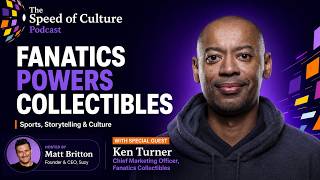
In this Speed of Culture podcast episode, host Matt Britton interviews Ken Turner, newly appointed CMO of Fanatics Collectibles and former CMO of Red Bull. Turner reflects on his career trajectory—from an MBA at Kellogg to roles at SC Johnson, Red Bull, and now Fanatics—highlighting the importance of process, consumer‑centric thinking, and the power of networks. He contrasts traditional CPG marketing foundations with Red Bull’s experiential, distinction‑focused approach, and explains how he leveraged those lessons to expand Fanatics’ collectibles business. The conversation covers the evolution of the collectibles market (physical cards, limited‑edition items, NFTs), Fanatics’ acquisition of Topps, and strategies for balancing scarcity, cultural relevance, and sport‑league partnerships. Turner also shares personal career advice, emphasizing integrity, clarity of purpose, and the impact of small, authentic interactions. The interview concludes with a mantra about the "power of one" and a story about a brief encounter with Derek Jeter, underscoring the value of genuine human connection in marketing.
Chapters
Today we're gonna be speaking with veteran marketing executive Ken Turner, who early this year was appointed Chief Marketing Officer at Fanatics Collectibles. He was previously the Executive Vice President and CMO at Red Bull, one of my favorite brands. And he was recently recognized by Savoy Magazine as one of the top most influential Black executives in corporate America for 2022. Ken, so looking forward to this. Great to see you today.
Great to see you as well. Thank you for having me.
This should be fun.
Absolutely.
So I was looking through your background as I always do in prepping for this podcast, and one question that came up off the bat is, you know, you graduated from Marquette and then you went into the workforce and then decided to go back and get your MBA in marketing. When you look back on that decision, was that the right decision? 'Cause there's a lot of discussion now is, is college worth it? Is getting your MBA worth it? What are your feelings on the topic?
You know, I actually get this question a lot and it really, It really depends on why you're going back. So, I was in a world that was finance-driven, a little bit of technology, and it wasn't what I really wanted to do. So, I went back to get an MBA to switch careers. It is difficult to switch careers or switch functions in your current organization if you are a specialist in something.
Right.
So, it was almost like a reset for me.
Right.
What I tell people is if you're going back to get an MBA to do the things that you're already currently doing, it's probably not a good idea to do it. —yeah. Even organizations recognize that it's probably not as necessary. I would tell you, like, some folks will say— I went to Northwestern. And Kellogg is recognized as one of the greatest marketing schools in the world.
Absolutely.
I didn't take many marketing classes. I took more organizational behavior and finance classes because all the marketers that I knew said, whenever you go to wherever organization you'll be, they'll teach you marketing. So it's not necessarily about the education. But if you want to switch careers, I'd say the other thing There's 3 things. The second thing is the network's phenomenal. I've met some of my closest friends by kind of doing the MBA and going back to school. And the third thing is the network continues to be amazing. So having kind of a Northwestern MBA or whatever it is network of folks you can tap into, not necessarily for work or jobs, but just to have an education or to talk to folks about things, it's pretty cool. If I had to do it again— someone asked me this before— I probably would I probably, knowing what I know now, I probably would've started in marketing and probably not done the finance.
But you didn't know what you know now and that's— Exactly.
That's the point in hindsight. Exactly. That's a great point.
Yeah. And what's interesting is when you were at Kellogg and you started there, it looks like in 2003, and it makes sense to me that you wouldn't learn marketing because I doubt the professors would've been able to prepare you for the change that was about to happen over the next 10 to 15 years in digital. I mean, in 2003, Facebook was barely invented. There was no YouTube, there was no iPhone, you know, all the things that shape modern culture and modern marketing didn't exist yet. So anything you would've been taught probably would've been dated by the time you got out and actually got into the real world, especially for brands like Red Bull, would you, would you, where you would later work, which is one of the most progressive marketers really in history.
Yeah, for sure. I mean, that was a, That's a long time ago. Thank you for reminding me, Kat.
Yeah, exactly. We're going way back, man. We're going way back in the future.
I would tell you though, sorry to interrupt you. I would tell you though, in 2000, 2003, if you remember, those were the years of consulting and investment bankers. Everyone wanted to be on the street. Everyone wanted to either be on the street or in consulting because that's where the opportunities— I mean, that was right before the the mid-2005, 2006 where all of a sudden the job market wasn't as good, but it was right before that. And so it was like one of those things where everyone was like, hey, let's do a little bit more of consulting and let's do a bit more of banking. And so no one was really talking about marketing in the way that we talk about it now. Experiential marketing that you see at Red Bull, that wasn't a thing. No one was really doing that. Yeah, it was about big budgets, big advertising budgets.
Well, because in the 14 years— And linear TV. As a mainstream consumption habit. So the only way brands could build their brand, they're running 30-second spots. So the notion of—
30-second spots?
Marketing didn't exist, you know?
And freestanding inserts, like you remember those, those promotional things? Yeah, of course. Yeah, right? And then the mailing, like, so you get the little things in the mail, snail mail.
Yeah.
Yep. So those, I mean, those were the marketing levers of the day back then.
Yeah. And so after Kellogg, you spent, I know I was thinking 10 years at SC Johnson, obviously one of the preeminent CPG companies in the world. And it definitely is a common theme at the Speed of Culture podcast where we speak to people who are in prominent positions like yourself, who cut their teeth, got their chops, so to speak, at a large CPG like Procter Gamble or SC Johnson or Unilever. Why is going that path sort of right out of getting your MBA right out of school a good one? What do you learn from working at a CPG that's applicable to other things you do?
Yeah, we talked about it a little bit earlier. You kind of learn what you don't know. Like, you don't know what you don't know. And going into a CPG organization that has some tradition, it helps you to understand that. There's probably 3 things I would say I learned from working at SC Johnson. One is process. I mean, SC Johnson is probably 150 years old right now. And you don't get to be a 5th or 6th generation organization without having some process and some clarity with respect to what it is you wanna do. So process isn't, it doesn't exist to slow you down, it's there to make you more efficient. So how do you get through things and do things with impact? Process kind of helps you that. So that's kind of one. The second is foundation for what's important with respect to marketing. And that is the consumer. It is consumer-centric marketing. It is a marketing-led organization. And there's nothing like being in a marketing-led organization because at the end of the day, We all know the consumer, the fan, the collector, whomever it may be, they decide. But being in an organization that thinks consumer first and then goes to product based on the consumer, it helps you to understand the importance of the consumer. And the third thing is I didn't realize, as I look back, I didn't realize how much I would actually like marketing. I actually thought I'd go to SC Johnson for a couple of years and then figure out how to get back to finance. Mm-hmm. Because I wanted to be a general marketer. And then it was the love of the consumer and the impact that those brands made on the consumers that, you know what, this is pretty cool. Like if you think about the role of marketing to motivate a consumer, a spectator, an audience to think, to feel, to do in a positive way, that was just kind of where I wanted to be. And it's like, this is really cool. I'm glad I did this.
Yeah, I mean, I'm always asked, why I love marketing so much. And I just love the notion that you could dictate another human's behavior through strategy and through delivering on their unmet needs. It's just a lifelong challenge to be a great marketer. You never fully succeed. There's always more to uncover, more insights to cover, more uncover, more consumers to learn about and impact.
Yeah. And it's, I always tell people there's so many different ways to get to a point in finance, which I mean, I still love Excel, there's an answer, right? It's, yeah, there's an R squared, there's a regression. And marketing, you have an opportunity to explore, to do something different, to reach the same point exactly as you said, to motivate a consumer's behavior, which is really, really cool.
Absolutely. And one company that has really been incredibly effective at motivating consumers' behavior is Red Bull, who really invented, in my mind, the energy drink category. When you joined Red Bull in 2015, they had already kind of rose to dominance and you joined as director of marketing and worked your way up to CMO. You know, when I think of Red Bull, I think of, you know, lifestyle marketing and I think of a company that really sort of embedded their entire strategy around the notion of extreme, right? And they just owned extreme across the board. When you joined, that strategy was kind of off the ground, but I imagine you were tasked over your career there as you progressed with kind of expanding that. Yeah. How were you able to do that and kind of what were the handprints that you left on Red Bull during your time there?
You know, Red Bull's a great organization. It's one of the best, if not the best, that I've ever been associated with. When the organization called me, I was working on Ziploc. I actually thought it was a mistake. Hey, you got the wrong person. But what they explained to me was, hey, we've got this great organization that's really known for marketing. Now we've introduced competition. Competition is there. We've got extreme athletes, they have extreme athletes. We've got experiences, they've got experiences. So they've blurred the lines of competition. And when you blur the lines of competition, consumers or shoppers are left to pick on the thing that they know, which is price.
Right.
And so the role or the expectation was, How do you come in and really set ourselves apart with some really strong brand foundation? So they were looking for someone with a foundation like an SC Johnson or a typical CPG to say, hey, let's figure out what we do in order to have some distinction, not differentiation. Differentiation is short-term. Distinction is long-term. How do we distinguish ourselves from the other brands? My response to Red Bull at the time was, [SPEAKING SPANISH]. Yeah. You're making a mistake. Don't hire anybody in traditional CPG because they're going to come in and they're going to do DRTV. They're going to try to do FSIs. They're going to try to do all the things that you don't do and your brand is amazing and special. And then the conversation turned because I was a big follower of Ripple Content. And I asked, hey, as a follower of content, you have some amazing things out there. How come you don't ever ask me to buy your product?
Right. Right.
And they said, "No." And now you know why we're talking to you. And so it was one of those things where you kind of come in, it's at the time Red Bull was a great organization, continues to be a great organization. It was from a household penetration, things have been flat. So the role and the conversation was how do we continue to grow the category, grow household penetration while elevating the brand and allowing ourselves to offer some distinction. So that's kind of what we did. Like when I started in Chicago, it was really more how do we test and learn some things that we may pilot for the future? As you mentioned, the, the brand was already strong, really based in, I would say, a couple of things, strong experiences from event marketing, a really strong sampling program, and a history of sports and extreme. And then also there was the other aspect of it, which from an on-premise standpoint, which is like the nightlife. So do you choose to embrace some of those things or you choose to move away.
Because that happened organically. The whole Rebels of Rocket craze was something that Rebel didn't push in the beginning. The on-premise business kind of just on its own just took off.
Yeah. And even to this day, Rebel doesn't push the on-premise, but it's just like you said, it happens organically. And so the question is of those levers, which do you keep? You still want to engage with consumers, with spectators, and audiences in real life. And so that remains the same. You still want to make sure that things that are happening organically continue to happen organically. Having a can in the hand from a sampling program, that makes sense.
Yeah.
So the opportunity became, how do you expand your brand outside of extreme sports? So how do you do things that are really more mainstream playgrounds?
Right.
How do you do things in basketball by signing an athlete or having a team deal? How do you do things in football? How do you do things in baseball? And so those are kind of the things that we kind of learned and tried and then we came up with a really cool strategy to kind of implement and execute. To get to the last point of your question, if I were to say one of the things that, maybe two things that we kind of did at Ripple that I'm proud of, the one is the introduction, I should say, of process and the introduction of marketing language.
Right.
Ideas of household penetration, buy rate, and requirements. Which you learn at the internship. Exactly, right? And those things become kind of— I mean, it's the way that the marketers talk now, which is really, really cool to kind of hear. Like, I'll have someone from Red Bull call me up and say, hey, someone just talked to us about marketing objectives, but we know those aren't marketing objectives. Like, oh, yeah, that's cool. We talk about marketing objectives. I guess that's the first one. The second one is diversity, equity, and inclusion. And so those are some of the things that not necessarily from an organization and a people standpoint, but really in the consumer-facing communication. So being able to kind of pilot and/or shepherd some of those things at an organization that is already an amazing organization like Ripple and kind of being afforded the opportunity to teach an organization to learn and grow in a different area was really cool.
Yeah, and what's interesting is you talked about you're working on Ziploc, which is like an incredibly low involvement category. You're talking about sandwich bags. And then you were at Red Bull and you talk about signing athletes and I see the Muhammad Ali poster behind you. And I would imagine this is pivoting to our next part of the discussion that you are a big fan of sports. And so was it, I imagine that like your passion meeting your work life when you joined Red Bull, was something that was new for you, certainly relative to SC Johnson. Did you find that that injected you with sort of more energy towards your career that you were able to actually work on something that interested you out of work?
Is this for Red Bull in particular?
Both. Yeah, for Red Bull and then, you know, currently at Fanatics, like, is working in sport much more like, you know, obviously you learned a lot at SC Johnson, but now you're at Red Bull, then you were into Red Bull and then Fanatics where you got to work on sports and as a sports fan, does that make work so much more fun? Does that make it you so much more passionate towards work?
Yeah, absolutely. It does. So a transition, I'll transition from SC Johnson to Red Bull and then Red Bull to Fanatics.
Please.
The one thing that I always tell people from going from SC Johnson to Red Bull, because I wasn't exactly sure if that was the right move. The last conversation I had, was with their current global CMO. He asked me one question, which was a bit of rhetoric. And he asked me, when's the last time you did something for the first time? It was a rhetorical question. He said, that's what Red Bull is about. We're in the business of doing things for the first time.
I love that.
I'm sold. Like at that point, you got me. Like if you can think about, and that's kind of not the downfall, but when you start to do things process, again, SC Johnson, it's not necessarily a downfall, but you kind of do things that are kind of proven. And Red Bull, they do things that are kind of proven, but they also want to be the first to do things sometimes.
Yeah.
Sometimes it's fast follow, especially in the area of sports. And so the other thing as we go from Red Bull to Fanatics where I started to enjoy is Red Bull started to expand culture marketing. So things in music and things in dance. And there's this intersection where sports meets technology meets media meets culture and fashion. Fashion where Red Bull was playing. I'm like, this is awesome. So as I transitioned to Fanatics, the question for me was, is there a place where I can do sports and culture and media and still sell a product and still be kind of the great person that I want to be and make an impact the way that I want to make an impact? And insert Fanatics, heavy in sports. And so Of course, I knew about Fanatics. I knew about some of the brands and started having conversations with the leaders there. And they talked about this idea of expanding categories, more specifically in the collectibles area.
Yeah.
And the ideas were really more, how do you take a great opportunity with some of the levers that we have? We have league partnerships and rights. Anything we have, anything you can think of, we have. Access to the athletes.
Yeah. And the—
You have access to the athletes.
Yeah.
Right. And you've got a leadership team that's willing to smartly invest for success. So you've got sports, which is amazing. We have opportunities with content. So there's an opportunity for content, especially as you start to think about original content that you can do with athletes or short-form content where you have an opportunity to leverage some of those social media things. So that checks the box. There's an opportunity, obviously, with trading cards, physical and digital. From a product standpoint. It's like, okay, that sounds really cool.
Oh yeah.
What about culture? It's like, all right, well, there is a place where sports— this is the words from the folks in Fanatics. There is a place where there's an intersection where sports meets culture meets fashion meets content meets technology.
Music.
Yeah, and that could be the future of Fanatics. This is perfect. So to be able to get into an organization like Fanatics at kind of what I'd say the ground floor in a business like collectibles, where we have an opportunity to have an intersection of all those things, as you mentioned, culture, meaning music, dance, entertainment, sport, fashion, as well as technology all wrapped up in a product. It's like it was one of those things that it's hard to pass up.
Yeah, I mean, it's an incredibly exciting opportunity. So you joined earlier this year. What was the most surprising, as CMO of Fanatics Collectibles, I should say, what was the most surprising thing you learned about the organization more broadly since you've been there where you didn't think it would be something that you'd be able to lever? And since you've been there, you're like, oh wow, this is actually here that you hadn't thought of.
The people, actually. It is like, I've heard two different analogies when you describe the leadership at Fanatics. Fanatics. Yesterday, someone called the leadership a Delta Force. The other analogy I've heard was it's like the Avengers. Seriously, walking through kind of the hallways, it's like a who's who in senior leadership.
Yeah.
Everyone's so humble. Everyone's done so many different things that it's an opportunity to really kind of learn and digest when you're a You're a CMO, what you're used to is being the one who kind of educates and teaches, and you've got some folks that you want to mentor. The peers, like, it's— there's a lot of big fish who are very humble.
Yeah.
And they know so many things. Some of them have been in sports, some of them have not been in sports. And so being able to kind of work with these folks from— and to assemble with these folks, if I can use an Avengers reference, it's been really, really cool. Something I actually didn't expect. I also didn't expect the humility that the organization has. The passion for sports and the ability to leverage sports was something I did expect. The one thing I was curious about is I love sports. I didn't want to get sports fatigue, and that has not happened at all. It's not even close. It's just really, really cool.
I don't think I could ever get sports fatigue. I don't know if that's even possible.
Yeah. Yeah, you know, you want to do something that you love, but if you do it too much, like, Like if I get, if I go on a mountain and I snowboard after a while, it's like, yeah, I don't really wanna do this anymore. Yeah. I agree. But I like it for the first couple of times. I was worried a little bit about the— but you're right. Like that, that hasn't happened. I don't foresee it happening.
Right. Not to mention, you mentioned this, Fanatics is so much now they're broadening the horizon beyond sports and it's a technology company. They're getting into gaming. We'll get into that. So let's start with the collectible space. So the collectible space obviously exploded during the pandemic.
Yeah.
You know, the Michael Jordan documentary. Really exploded the sports card industry. It boomed just like every other commodity-based industry. It kind of had a bust cycle as interest rates started to rise. But the rise in collectibles is certainly here to stay. I don't know if you were at the National or not, which is the annual—
I was.
I'm sure you were. The big sports card event, over 100,000 people showed up, which is, I think, their largest audience ever. And I really think it's signals that, you know, just the growing popularity of Fanatics really across all demographics is exploding. And now, you know, collectibles has gone from a cardboard, you know, card to going to where we went through an era where there was limited edition numbered collectibles, autograph, there's patches and cards. And now we're going to a world where things are becoming digitized. We have NFT-level collectibles. And as you mentioned earlier, Fanatics has kind of put together this incredible mix of assets, whether it be access to athletes, licensing, you know, the whole NFT platform that you have with Candy Digital. And it's really, I would think, a marketer's dream to take a category that has had some success, but really sort of a highly fragmented group of players that weren't well capitalized. And here comes Fanatics, where you have probably have an opportunity to really reinvent the category of collectibles for the new generation. So how are you looking at the opportunity at Fanatics and what are some of the things that you're working on right now to kind of move that vision forward?
Yeah, I share your enthusiasm and your excitement about the opportunity, especially as a marketer. One thing really quickly, we no longer have Candy Digital. So that was something that we kind of moved on from actually prior to my time.
You guys are moving so fast, I can't even keep up, to be honest. Yeah, right? Exactly.
Exactly. But from a collectible standpoint, if you know the history of, let's just start trading cards. Trading cards are over 150 years old, right? Like it was 155 years ago where that first trading card was inserted into a pack of cigarettes to keep the cigarettes fresh.
1909, 1909, you know, High Top card.
Yeah, exactly, exactly, exactly. And then if you think about the industry leader in trading cards, Topps, Topps is over 70 years old, right? And so it's a heritage brand. It's nostalgia. It's classic. And so what's interesting, the efforts and levels of marketing have mostly been organic. It's not a category that's been marketed heavily. There's a bit of a scarcity principle. From a trading card perspective, there are folks who collect it for the extrinsic value and investment purposes, and that's where a lot of the publicity. But most of the folks collect because they love the hobby.
Yeah.
If I use an analogy, sneakers. There are a lot of folks who collect sneakers with the intent to actually sell them. Sell them on the market. But if you go into my, yeah, if you go into my closet, I mean, you'll see a bunch of sneakers that I'll probably never wear.
Yeah.
And I'll never actually sell them because I just love the opportunity to collect. And that's what we have with respect to the collectibles business. So it gets back to the point we were talking about earlier, which is, How do you leverage the assets that you have at Athletes and access athletes and partnerships with the leagues to really, for a new consumer, expose that consumer and have them explore the art of collecting and enjoy the hobby?
Yeah.
And so it's one of the reasons why— there's 3 reasons ultimately why I ended up here at Collectibles, and that's kind of the first one. The first is, The job is to grow the number of collectors within the hobby while maintaining the value of the product and the service, which is an amazing challenge as a marketer. Like, you don't want to flood the market with cards because once you do that, then the value starts to diminish.
Of course.
You don't want to have people waiting around in lines because then the service is bad. So what's that balance, right? And so that's kind of like an amazing opportunity as a marketer. The second—
Scarcity and managing scarcity and access, basically.
Yes, exactly. With an amazing amount of assets to do so. So how do you pick and choose from basketball to football to baseball to combat via UFC or entertainment like WWE? How do you do some of those things in a way that actually makes sense? So that's one piece. The second piece, as we talked about, was an opportunity to be culturally relevant. And inspirational in your communication to the collectors, to the fans, to the community.
Yeah.
And so that's where the marketing comes in.
Leveraging that.
Yes. So now you have an opportunity to actually create the messaging based on a really strong brand like Topps with the backing of a brand that's growing like Fanatics. And so if you think about like just history, like Fanatics as an organization is really only about a decade old.
Yeah.
Now it's different from Topps, from 75 years. And I've seen the makeup of—
Fanatics, you should say Fanatics acquired Topps.—
Exactly.
Yeah.
Yeah. So Fanatics acquired Topps in 2022. So but Fanatics previous to that was a decade old. And even now versus 3 years ago, I mean, and I know we'll talk about it, there's 3, depending on who you ask, 3 to 5 different businesses within the Fanatics organization, which is all kind of built on this opportunity to focus on the passion of sports and telling stories that will allow us to understand kind of a collector, a fan, a consumer, a shopper. And then the last thing really quickly is world-class. So you have an opportunity to take a— what I would consider a senior leadership team that is world-class, uh, and make an entire marketing organization world-class, an entire product line world-class. And so all those things are just— you're right, it's a marketer's dream to be able to be in that situation.
Yeah, and I think what a lot of people who aren't in the hobby, you don't collect, understand is It's not about always the thing. It's about the story behind the thing. So if you talk to people, cuz right now all of our photos are in the cloud. So if you used to ask people, if your house was on fire, what would you grab? They'd say my old photos, but that's not really the case anymore. Now, if you asked a Yankees fan, what you grab and, you know, and, and he was around in the '50s and '60s, he'd say my signed Mickey Mantle ball, my signed Joe DiMaggio ball. And a lot of people who aren't collectors will say, well, it's just a baseball. Can't you replace it? But that guy might have gotten that signed ball with his dad who's no longer around. And that ball is really a memory of that moment. And I think, you know, I'm a collector and I go to shows with my son and it's not about the thing. It's about— it really is about the bond that has created with me and my son. And it really is— it transcends from a physical thing to an experience, which gives it sort of an emotional layer on top of the physical item that a collector collectible is, which I think is something that is so powerful in terms of the space that you play in.
Yeah, absolutely. I mean, you hit the nail on the head. It is a celebration of a moment. That thing does represent something that is greater. It's a memory. Like, you ask a collector about their favorite item, their favorite item, it's not necessarily about the item. It's what that item reminds them of. And in that, there are great stories and there's great history with it. And so what we'd like to say with the trading cards, especially with the ones that we offer now, is it's a celebration of those moments. Have your piece of history. On the Topps, we have a Topps NOW program, which—
Yeah.
You know, we try to capture moments, like things in the moment and celebrate them and say, "Hey, do you remember this moment?" And one of the ones I thought was really, really cool is You'll remember this on August 30th, Lincoln, Nebraska, over 90,000 in Memorial Stadium to watch a women's volleyball game. And so we created a Topps Now card to really— I mean, it's not to sell it to make money. It's really more to celebrate that moment and what it represents. For someone who's there, it's like, yeah, I can take my own picture, but I remember this moment. And to kind of have that in your history. Mm-hmm. As a moment to celebrate is really cool to me.
You own the moment.
Yeah, exactly.
It's a way for you to actually own a piece of the moment.
Exactly, for sure.
Yeah, another great thing that, and I could talk about this forever and we won't because I wanna respect your time, but you know, one of the activations you guys did with Major League Baseball where the rookie players wore a patch and then you're gonna put those patches actually, the actual patch that the rookie played in their first game into a card which you could get in the pack, which I just think it's like to be able to connect that moment with that player. It's a one-of-one moment and then you can own it. I just think that's just a tremendous idea. And that's a great example of Fanatics connecting, you know, the ability that since you create the jerseys and you have the trading card company, you can kind of connect those two, integrate those two assets into something powerful that's really never been done that way before.
For sure. And I think the other thing that's allowed us to do that is the, amazing partnerships that Fanatics has with the leagues. So with the relationship with Major League Baseball, the relationship with Major League Baseball Players Association allowed that to happen. I didn't realize how much of a, I'll say quote unquote controversy of what is the actual rookie card was until I joined Fanatics.
Yeah.
And then when we started to talk about putting this rookie debut pack kind of for the one time that that player makes it to the major leagues and they play in the game, it was kind of like overwhelming. The feedback is now we've ended the debate. It rises above all, right? Yeah. And so it's to see kind of the reaction of the industry, of the collectors, of the hobby, especially those in baseball, to say, wow, this is amazing. I gotta have that card. I gotta have that moment, especially for their players and the ones that they root for. It's been really cool to see that.
Yeah, and when you talk about the merging of Fanatics into culture, you know, there's also a kind of a rising sector of trading cards and collectibles for non-athletes, whether it be, you know, musicians or whether it be, you know, comedians, you name it. Is that an area that you guys see a lot of growth? Even entrepreneurs, do you guys see a lot of growth in that area moving forward? Is that an area you also have your eye on?
We do for sure. And so in one of the brands that we, Fanatics, did acquire was a brand called Zerocool. Zero Cool, yeah. And Zero Cool has been focused on kind of culture and entertainment. So there are things that are non-sports that we do right now, such as we'll do Star Wars. So Topps has Star Wars cards as well as, if you remember Garbage Pail Kids, those are still around.
Of course.
So we do those as well. But also there is a mixing of sport, culture, entertainment, music, and products that we have right now. So this week actually, we released this product called Allen Ginter. And Allen Ginter, kind of one of the older kind of brands that's out there. But it is a mix of baseball, music, entertainment. And so in that set, you'll see baseball players like a Mike Trout or Julio Rodriguez, but you'll also see a Kevin Hart. You'll see a Robert De Niro. You'll see a Lil Baby. Yeah, it is really cool to kind of have those.
You extend your market as well.
Yeah, for sure. I mean, and, and you've got autographs of those folks as well, which is like, all right, this is, I can get a Kevin Hart autograph Allen Ginter card. That's pretty cool.
That is, that's awesome. So shifting gears a little bit, um, as we wrap up, so the, this space is changing so much and the consumer's changing so much. What do you do personally to kind of keep your finger on the pulse of the consumer so you are able to jump on all, you know, any new emerging trend that pops up in such a dynamic business?
Like the next. Yeah. You know, I actually started, what I'm gonna tell you, I actually started this when I, in my time at SC Johnson, someone gave me the advice. You almost have to have your own selection of a focus group of folks you could tap into.
Yeah.
Because they will know things before you know things.
Yeah.
Because you spend all your day kind of doing the things that you do and they spend all the things, all their days doing the things that you want to motivate them to do. And so having kind of like that personal group, that personal focus groups, especially in collecting, allows me to kind of understand the collecting aspect of it. And then from a sports standpoint, there's no shortage of opportunities to learn a little bit about sports. You name it, there's an app for it. And so for me, it's really more about how do you set up and structure your team so that they actually have the opportunity to understand kind of the way that the wind will blow. Like, perfect example, I don't know, maybe you would've done it, Matt, but— Yeah. 2, 3 years ago, or not even 2, 3 years, 2, 3 months ago, would we have been able to predict what was going to happen in Boulder, Colorado with respect to the Buffaloes and Coach Prime?
We heard it.
Like, everyone was like, oh, they're going to go 1-11. They may win 2 games. I'll give them 3, maybe 3. And now, just at least as a marketer and watching from afar—
It's all anyone's talking about when it comes to college football.
It is. Yeah, exactly. It is amazing what has happened. And so having someone to be there on the pulse, and I remember I remember being in a meeting and someone was saying, "Hey, we should do something with Travis Hunter." And I think someone else said, "Wait, who is that?" That was like 4 weeks ago, right? It's like we kind of understand how things change so quickly, right? And so you just have to be on it.
Yeah, if you look at the story of Colorado, the reason I think it's hitting such a nerve with the consumer is it's about the underdog. You have Dionne, who obviously is an icon, You know, and then it's about family 'cause his kids are on the team. So it really just like hits on so many different points that kind of crosses over or transcends sports even into a broader story. And that's why I think it's drawing so many people in. It reminds me of almost like Tim Tebow, how, you know, he was religious and he brought in a whole different group of not casual fans into Florida football. It's sort of that, that's what it reminds me of.
Yeah, for sure. I would say like, I'm a fan of Coach Prime as a marketer. And what I always like to tell people is if you watch a Buffalo's game, look at the sideline and look at the number of folks who are capturing content, organic content.
Or how about the massive football—
Yeah, yeah, yeah. It's great. Unbelievable. Unbelievable. Like, that is a very great— it is a very good marketer.
So look out for a deal with Fanatics and Coach Prime moving forward. I'll keep an eye on that.
He's a hard one to get to.
I'm sure. I'm sure. So finally here, Ken, I mean, you've obviously had a great career and I, you know, it's not lost on me that you put in the work, whether it's getting your MBA, cutting your teeth at SC Johnson, that gave you sort of the blocking and tackling and fundamentals that allowed you to succeed at Red Bull and put you in a great position as CMO of Fanatics Collectibles to really be able to reinvent an incredibly exciting category. If you look back on your career, What are some of the things that you think you did right that maybe we can impart on some of our younger listeners here so they can one day end up with a career like yours and sit in the seat that you're in?
I'd say the most important thing, there's probably two things. One, you have to deliver results with integrity. Integrity meaning just do what you say you're gonna do. It's such an easy thing, but it is so hard to do sometimes because sometimes we don't realize we're outside of integrity. If you and I, Matt, say we're going to meet for lunch at noon and I show up at 12:05 and I don't acknowledge it, then I'm outside of integrity. And that's such a small thing, but it means so much with respect to others.
Yeah.
The second thing is having clarity on a couple of things. One, you have to have clarity on what it is that you want to do, not necessarily from a role perspective, but you have to put some thought into the things that you like to do, the things you don't like to do. For me, I've had a career journal for decades now where I'm still writing in there, hey, here are the things that I want to do. So you want to be able to have clarity on what it is you want to do. You want to be able to deliver results. And I would say, if there's one thing I wish I would have done earlier, it's the power of the network. And I don't think I actually started to—
Yeah, absolutely.
I don't think I started to build a network until someone asked me why I wasn't building a network. And this was after Kellogg. It's like, ah. I haven't really thought about it. What's that for? Being able to do those things early on, number one, it's lifelong friends that you have an opportunity because you're not actually talking to them because you want something. But being able to have kind of a group where you can reach into to get advice or thoughts or even pick their brain on some things, that's been kind of a game changer for me.
100%. I can't think of many things more important in your career than the power of network, especially at times where you're switching careers or you need help with something, that's who you lean into. And the network is also two ways. Like one thing I often find with our younger employees is they want me to call and ask for a favor of some exec I know. And my whole thing is, well, I wanna add value first. You can't just take, take, take. A network is two ways and yet you have to give over time as well and figure out how you can add value yourself for sure.
Great. Yeah. Yeah.
Well said. Well said. So, and finally here, is there a quote or mantra you like to live by? Is there something that comes that comes to mind if I ask that question?
Yeah, I used to, not used to, I still talk to folks about this idea of the power of one. So you never know the difference that the number one can make. It can be one team, one goal, one objective, one business, one conversation that you have with a stranger, one word, and that word can be hello. And the impact that you can make on someone's life is amazing. So I'll tell you a quick story from the Nationals.
Please.
Quick story. I am in the, there's, I mean, there's 100,000 people. It is like one of those things where it's like, at some point you're bumping into people. It's kind of tight and it's snug. And I remember I was in the bathroom and like, all right, this is a lot. This is my first national. I'm not sure if I'm getting out of it when I'm supposed to get out of it. And there's a guy behind me and he, we're washing our hands. The only thing he said was, "Hello, how you doing?" I looked to my right and it was Derek Jeter. And that's all he really said, but it was like, all right, this is worth it. Like if I can go to a bathroom and see the captain next to me and he didn't have to say anything at all, but the fact that he decided to say something and even ask, "How's it going?" It was like, It was one of those moments where it kind of brought me back to like, there's a, there's a power in just speaking and saying hello and putting down your phone on the elevator and trying to have a conversation.
Versus the opposite of one, which is zero, which is doing nothing where, yeah, you know, it's like you only make the— Wayne Gretzky said you only make the shots you take. I mean, if you're not taking a shot, you have no chance of anything coming out because there is no—
Absolutely right. Absolutely right.
Well, Ken, this has been amazing. Seriously, one of my favorite interviews on the podcast today, and we've had many. So thank you so much for joining. I can't wait for our listeners to hear this. It was awesome. And I wish you nothing but success in this exciting new role of yours.
Thank you for having me. It's been great.
Absolutely. On behalf of Suzy and Adwee team, thanks again to Ken Turner, CMO at Fanatics Collectibles, for joining us today. Be sure to subscribe, rate, and review the Speed of Culture podcast on your favorite podcast platform. Till next time, see you soon, everyone. Take care. Hey!
More from Matt




MikMak’s Rachel Tipograph on Consumer Spending, Retail Media & Holiday Shopping Trends



Jaguar Land Rover’s Charlotte Blank on Luxury, Purpose & Experiential Storytelling



