FCB New York’s Emma Armstrong on Agency Evolution & Creative Advantage
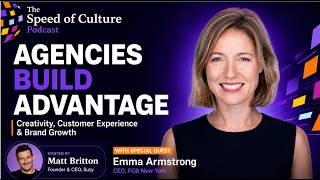
Emma Armstrong, president of FCB New York, has spent 25 years building expertise across digital, brand, and media. She credits creative work on GE and Pantene with driving both emotional engagement and measurable sales, and sees data platforms and behavioral science as the next growth frontier. Agencies need to move beyond traditional staffing models to compete with consulting firms and tech companies.
Chapters
Today we're going to be speaking with Emma Armstrong, who is the president of FCB New York. Emma, thanks so much for joining us today on The Speed of Culture.
Thank you, Matt. I'm delighted to be here.
We're going to start by getting to know a little bit about you. You went from working in digital and brand marketing director roles at iCrossing, Grey, and BBDO to now being president of FCB New York, really an iconic New York ad agency. Tell us a little bit about your journey that led you to where you are today.
Yep, so I started in digital. I spent 10 years working, um, for those of you who remember, at Agency.com, on and off and across different, different continents. Um, and, you know, we really— sounds a little crazy, but we really kind of built the internet. Um, you know, we created the first digital advertising. We set up all sorts of things for incredible, incredible brands who were just dipping their toe into digital. And what I learned from that was a real love of solving business problems. So, I came stateside, as you can hear a little bit, my accent is not fully American. I came stateside and what I realized was we were solving business problems, but back in the early days of digital, that was only going so far up the chain. And, you know, really unlocking business change was gonna require getting to the CEOs, the CMOs. A seat at the table. So, a seat at the table, the trusted advisor seat. So I moved to bigger, more traditional integrated agencies and ran big global brands for 10 years at BBDO and at Grey and really brought that love of digital solving business problems together with an understanding of brand and creating platforms that endure and really truly creating customer value across the entire chain. Then I felt as if I'd got a little bit far away from media. So I went to iCrossing for a bit and then I ended up at FCB, which really for me is kind of the merging of everything I learned in the last 25-odd years between digital brand and media, because I think that's where the future is going. And the future is now.
Yeah, of course. What's the one brand that you have the most heart for? I know it's like choosing between your children. Ah, what brand have you worked on throughout your career, whether it's early stages or when you finally hit scale and got on a big stage, so to speak, that you really have heart for?
That is a great question. And I'm going to dodge the question by saying two. So I know, I know, I'm sorry. It gives you an idea about how the rest of this podcast is going to go, Matt. So two very different brands, GE and Pantene. So GE, we did incredible work. The reason it has a special place in my heart is because it is, it was at the time, a juggernaut of a company that was very, very hard to understand. And I think we did a great job at truly emotionally engaging people in what traditionally was a very, very disengaged, don't really care until something goes wrong category. And then Pantene, because I went there deliberately to work with some incredible people and truly prove that creativity could drive business. And we did an amazing, amazing job. I'm so proud of the team and the work that we did, launching a global platform and really selling a lot of shampoo and conditioner along the way. Yeah.
And often, as you know, it's less about the actual brand, whether it's shampoo or toothpaste or deodorant. It's really about that time in your career, the team you work with, your relationship that you have with the clients. Totally. Really, really the feeling that you really made an impact. Because what I found on both sides of the coin when I was running an agency for 15 years is that sometimes we would have a very lucrative client, but I didn't really feel like our work was doing anything. I felt like we were making a lot of pretty PowerPoint decks that ended up on the cutting room floor. Where other times, whether you had that sort of visionary champion with inside the client organization, or you just work with a great team, you felt like that what you were doing actually ended up in front of the consumer, it's actually really impacting the business. And I'm sure you'll agree when you're an agency, that's what really gets you up in the morning.
I totally agree. I totally agree. I'm very bullish about the future of agencies. I think we have such an important role as a translator. We translate the outside world into a company. It's too easy, no matter how good you are, it's too easy to become a little focused on the company once you're within it. And then we take the company, the product, the brand, the service, and we translate it back out into the world. And that value exchange is essential. And to your point, you have to have a great team. You have to have a great team on the agency side. You have to have a great team on the client side. There really are no sides. It becomes one amazing team pulling in the same direction.
Yeah, I think when we look at the agency world, I think the two existential threats and they're both opportunities and threats at the same time. First and foremost is you have these management consulting firms, the Deloits and McKinseys of the world who have that ultimate seat at the table, right? Because their work's connected to not brand results, but business results. Now diving into this digital marketing set. And what's always struck me about the management consulting agencies is for some reason they're allowed to work on Coke and Pepsi, but the holding companies need to create two different agency brands to work on it. I just never really understood that, right? Because theoretically, they're touching much more sensitive data than even the ad agencies are.
I totally agree. I mean, what's the saying? It's two is a conflict, three is a specialty or an expertise.
Right, right. There you go. Well said. So, and it's crazy. And I think the other threat is just you look at agencies and they're competing now, whether it's the Googles or Salesforces or Oracles of the world. And most agencies don't have their own intellectual property. They don't have customer data. All they have is people. And in this world where everyone's fighting for talent, it's really hard to build sort of that differentiation. So when you look at FCB, what is your firm's differentiation?
But that was a sneaky add-in to the back of a question. I wanted to talk about white labeling and evolving business models.
Let's do that too. I would imagine white labeling is a competitive advantage if you're doing that.
Massively. And, you know, I'm coming up on 4 years, and I will get back to your question. I'm coming up on the start of my fourth year and the first year was kind of really getting the team in place. The second year, second and third year ended up being expanding the agency and surviving and thriving through the pandemic and helping the teams really, really survive. Year four is about evolving our business model for exactly the reason you're talking about, because we're stuck in this FTE world. And so we're looking at We've got to look at both top line and bottom line because if we don't fix our business model, we can't invest in the people. If we don't have the best people, then I can't fulfill my promise to—
That's right.
The client, which is bringing the best people, the sharpest minds, giving them the right environment to make the best work possible so we can grow our client's business. Because, you know, all we talk about is using creativity as an economic multiplier. The only way I can do that, and you asked about a competitive advantage, it really is the smart people that we have.
So we've—
it has to be. I mean, you know, that's what the— that's what consulting firms sell, and— but in— to externally, in reality, they sell the playbook. So we are— I, I always think creative agencies have the benefit of truly being out of the box, and such a trite thing to say, but truly being creative thinkers and coming at problems from a different way, creating bespoke solutions, which is the only way that you get a competitive advantage.
Yeah, innovate and change the story and ultimately build a brand. I mean, every brand is ultimately about story, right?
Exactly.
Where the stories come from. So, um, great. Well, super helpful. And I thought your answer was a great one and one I, well, I kind of agree with as well. Um, and I also would add that like the hard thing in being part of a holding company, and IPG I believe is, is one of the best, if not the best, is that, you know, they have pressures to Wall Street. Short-term pressures. They need to meet every quarter. So innovating often makes— means you need to take one step back to go two steps forward. But that's all well and good until you miss quarterly numbers. So it's basically that balancing act. And I've been in your shoes before. Once my agency was acquired by Klube Business Group. I understand. And I think ultimately it is about the people and it's about the relationship you have with your people and that they have with your clients that build great work and ultimately build a great business. So yeah, we're going to move on to the next section, which we call Culture Watch, where basically I asked you four core questions that really dive deeper into what's going on inside your brain. And I have a feeling that your brain is really jumbled all over the place because you seem like to be a very smart, creative person, eccentric, and you seem to have a lot of ideas like myself. So I'm really interested to dive a little bit deeper into it. And we're going to go into 4 questions. So the first and foremost is, what's the most important business decision you had to make quickly?
So it's not probably an original answer, and I'm sure everybody listening to this will be like, yeah, yeah, me too. But closing— deciding when to close the office, and then— oh my God, totally— when COVID hit, um, you know, there was a moment. We closed the office on a Thursday. On Wednesday, we found out that we had won our first big piece of new business, so we're all celebrating. Wednesday night at 10 o'clock, I read an article, um, and it was an anonymous doctor in Italy, and she said Watching the West right now is like watching a scary movie where the teenagers are going into the basement and you're screaming at the TV, don't go in the basement, you're going to die. And no one is listening. And I texted my boss, who is amazing, and I said, I'm sorry, IPG. I don't care. IPG can fire me, but I'm closing the office tomorrow because this is coming. And making that decision, sure enough, by the end of Thursday, they're like, do whatever you guys do, whatever you want. Figure it out. It felt as if it happened so quickly, um, and then suddenly we were at home. And I was incredibly grateful to— and it sounds really silly, but all of the technology that we'd set up already, like we're on Slack, we're on, you know, we're using Google Docs, and a lot of companies didn't have— no, and we had a massive advantage already, um, because it kept the culture going.
So absolutely. And how many people were in the office you were running at that time?
Um, so we have doubled in size in the last 3 years, so I think it was probably around 100.
Um, big shift, lots of communication, lots of change management through that.
Yeah. Okay, great. A lot of, a lot of— I'm sorry, a lot of human management as well. I mean, you know, everyone was scared. Like, I, it's— I think we forget, it's like childbirth, we kind of forget everyone was terrified. We were all terrified. And so managing through that and trying to keep our clients' businesses running was a challenge.
Absolutely. Um, the second question is, what do you think the fastest growing industry will be in the next few years?
So, um, I, I think the— and this is a bit of a cheaty answer— but I think the entire industry that enables better consumer experience. So everything from, you know, everything from your Adobe stack all the way through to, um, the the, the megalith that is becoming Salesforce, through to the behavioral scientists who are having their moment in the sun because they're figuring out how to take that data, make it into actionable insights, and then, you know, use it for competitive advantage. So the, the whole, the whole infrastructure and web that, that supports that, because I think customer experiences has changed, the expectation has changed, the adoption curve went rocket fuel in the last 2 years. And expectations are never going back.
They really are. Expectations are wildly different now. Yet, if you fly on an airline and you want to change the flight, it's still impossible. So when I think about customer experience, I think about why is it so hard to cancel my cable bill? Why is it so hard to change my flight? And I think the key about customer experience is landing that overall strategy in practical ways to touch the consumer, to really make their lives better. And I think that is ultimately companies that can do that are ones that are going to win, even in the smallest ways, um, that make consumer's life better. Totally.
Yes.
What do you think the fastest growing, uh, product category will be, um, in the, in the next few years?
So I'm fascinated by the revolution, and this kind of goes back to my GE days, uh, by the revolution that's happening in the energy sector. Overall. And I— it's such a great question. There are a million answers, but I do think that there will continue to be mass revolution in battery tech because that really is the thing. And charging and the infrastructure that brings electricity, you know, 10, 15 years ago, you had new forms of electricity being created and you couldn't move it efficiently across the country because systems were so old, not capable of handling it. So, you know, Everyone's a Tesla, everybody wants an electric vehicle. We've got to figure out a way of making that battery tech that supports that and then the charging network work to support it.
Absolutely. And what I think a lot of people overlook when they think about electric vehicles is that the raw materials needed to build the batteries have their own kind of issues with sustainability. It's not just, oh, we have a Tesla, we don't use gas anymore, that's it. It's, well, where are you going to find the lithium? Where are you going to find the raw materials to basically make the batteries themselves? It's a whole other— Yeah.
And you know where a lot of them are? In pristine, like, woodlands in the north of Canada or in tiny islands in the Pacific. And understanding that chain and making that as close to a closed loop of recycling as possible because those batteries, I mean, your car is obsolete. The battery in your car is obsolete after about 5 years. And also it can only go 300, 400 miles without a charge. Right. So, you know, they're incredible, but they're so nascent still.
Yeah, exactly. Definitely in the first inning there. And then lastly, you know, in terms of the consumer and their changing habits coming out of this pandemic, if we actually are out of it already or not, who knows, uh, changes every day, um, you know, what do you think the fastest growing trend will be, um, heading into 2023 with the consumer, whether it's an old trend being revived or a new one? In this new world that we're living in?
I think it's an old trend interrupted and now on steroids. So the, the experience economy, you know, travel experiences overall, it's no surprise to anyone. And I'm sure by the time this podcast airs, it won't have changed at all. The economy is incredibly volatile. It will continue to be incredibly volatile. And yet people have been deprived for so long. So, you know, my family's in England. There was a period of time where I couldn't get on a plane legally and go see them. That is an incredible constriction of our ability to make choices. So I think people are using this newfound freedom and ability to feel a bit safer as they go out and about to make good on a lot of what they've had to constrain themselves from doing over the last couple of years. So we were already moving towards sort of experience economy anyway, but I think this is just doubling down. And then you've got the interesting part, which is the demand is there. But there are no pilots there. I mean, you know, someone, a restaurateur told me it was going to take New York City 2 years to get back up to the quality of service because every— that we had pre-pandemic, because everybody left. They went to— they went off. They decided, you know, and it exposed—
or they got stimulus checks, which are still living on or whatever it may be.
It's all the things, all the things. So it's fascinating. And, you know, looping back around to consumer experience, there's this pent-up demand, there's an ability and desire to pay for that demand, and yet you go to a 5-star hotel and experience can be incredibly patchy, for example.
Absolutely. So did FCB reopen their office?
Yeah, we've been open. Look, Matt, they're all out there.
Um, wow.
We actually went— we, um, the management team came back probably May, June last year. We reopened the office for anybody who wants to come in. We've been back partially since September, um, and then Tuesday, Wednesday, Thursday this month. Um, so the vast majority of people have, have been here. And, you know, we're all like everybody, we're placing a bet on a form of hybrid. Um, and we'll— I, I believe it's a competitive advantage, and time will, will tell.
Would you say that the return to office has been like kind of flipping on the switch to 2019 all over again, or is it, is it markedly different? And if so, how?
Um, that is a great question. I, I think it will never be the same. Um, I think people have a new— what we're seeing is people have a newfound appreciation for the balance that they've been able to, to flex in the last couple of years, um, to the the benefit of being together when it matters and using that time together to truly appreciate being together and solving problems together, and then use time apart to do things that require more quiet time, require more thoughtfulness. So, yeah, I think it's a significant shift. I've always— particularly running global businesses, I've spent a lot of time traveling around, and so I always worked remotely. I have two not so small kids anymore, so I've always felt as if this industry is pretty flexible. But that was, I think, probably not felt by everybody through the ranks. So, you know, it's been interesting talking to people here and saying, look, you know, you always could stay home and get your fridge delivered and work from home, or, you know, if you have a sick kid, or if you have many, many, many reasons to go be quiet somewhere or do whatever you want. So it's reinforcing that We've always been flexible. You can continue to be flexible.
Yeah.
I have to plug my computer in.
I'm really sorry.
They left me without— give me one second.
Yeah, absolutely. Sorry. No worries. Um, okay. So I, I'm going to, well, I guess we'll continue the conversation. So how would you describe the other question I'd have coming out of all this is your relationship with your customers? Are they more reluctant to see you in person? Are you seeing them just as much? How has that changed?
That, yeah, that's a good question. It's, we've seen clients and partners kind of move into two very distinct camps. You have the ones that ran back. And then you have the ones that last year decided to let everybody do whatever they wanted. And then, you know, few in between, but it's very, it's actually very polarized. And one of the things we're talking about a lot at the agency is how you manage those two different groups. So, you know, how do you create, in the same way that we're trying to do within the agency, have kind of a structure and use time together for things that you want to use time together for, and then time apart for, for time apart. Creating the same relationship with clients and being more thoughtful about why you come together, what you do when you come together, maybe come together for a slightly longer period of time, knock off a lot of the big questions and then go away again. And it's It's, it's working pretty well. It's hardest, honestly, with fully remote, fully dispersed clients. So, right, you know, figuring out how, how that— and helping them in some cases how they come together and reminding them that they also need to come together and that, you know, maybe we should be there at the same time when they do— is— it's interesting. I think the next couple of years will be— I think we'll learn a lot over the last couple of years. I think I feel as if the next couple will be codifying that and truly studying it and then figuring out what works. Because what, you know, what works for one industry is not the same as what works for another industry. Um, you have, even within ours, you have, you have an agency in London going back 5 days a week, and you have agencies that are fully remote and everything in between.
So it's, it's one way, kind of just, um, you know, just figuring it out in the work in progress right now as we try to rebalance things. So I, you know, I was, I was really, um, excited about, you know, what you said about customer experience and how important it is. You know, the ad agency world has changed, advertising in general, where it used to be much about top of funnel brand building. Um, and now what we're finding is that instead of brands being built top down, meaning I'm going to run 30-second TV spots and I'm going to differentiate, why, like, you know, our Hershey's or Tide or Nike did in a world where we just watch linear TV. Now many great brands are being built bottoms up, meaning they're being built one great experience at a time. Yeah. And, you know, one customer has an incredible experience. They tell somebody else, they share on social media. We all know the story. So has that changed your business model and the way that you pitch brands and ultimately the role that you guys want to play overall? Because again, we used to just want that big Cannes Lion Award, that amazing TV spot. While TV still matters, it's certainly a different world now. And customer experience and your answer is customer experience. Really is emblematic of that.
Yeah, absolutely. And for us, it all starts with the audience and truly identifying the audience. So we start with behavioral psychology and we figure out really what the mindset of that audience is. You know, you think back to the days where you had an 8-person segmentation and you've got the busy, harried mom and the overworked father or whatever it is.
Cookie-cutter demographics.
Cookie-cutter demographics that are insulting to almost anyone that looks at them now. And, you know, don't truly represent the world that we live in. Didn't then and definitely don't now. And then you also look at how those segmentations were used. They were used to create generic insights that went into a TV spot, to your point, and then to say, oh, here are the big 5 TV networks that people are watching and off we go to the races. So, you know, we really have taken a step back. We start with the mindset that these people have that unites someone in a shared pursuit, in a shared belief, and whatever that is. And then we go straight into— so IPG's data spine is Axiom. We have software layers that sit on top that allow us to go in, analyze that data, pull it up, add it to syndicated data, and create an incredibly robust audience that takes that mindset and, you know, basically know everything about them. Um, and they're, they're— it's based on real humans rather than just extrapolation of, of tropes and, and clichés. Um, so not only can you then use that to create incredible experiences because you truly understand what is going to move their hearts and minds and, and wallets—
sure—
which is ultimately what we're trying to do. Um, but then you can buy against them, um, within the media profile. So, right, it's, it really I don't understand how people do business without doing that now, but otherwise it's just throwing darts at a dartboard. You know, it's never been scarier. I think it's never been scarier. And I say this every year, so it just progressively clearly gets scarier to be a client. If I was a client and, you know, our worlds are so much more porous, most of my friends are our clients. I would want as much surety as possible to make the bravest decision possible, of course, to move your business forward and compete, because it's it's a knife fight out there, no matter what you're doing and who, you know, who you are, even for the best brands. So why not use that data to understand the people and then create true value exchange?
Couldn't agree more. I mean, you know, at Suzy, our tagline is assume nothing, validate everything. It's basically the same thing. It needs to be rooted in data. You can build creativity on top of that. If you have the right data, you know who your audience is, which allows you to cover the right insights and also know where to reach them. It's, you think it seems so simple when we put it this way, but I think the advertising industrial complex is built in such a way where it's not always that simple when you're working, you know, in your organization, you're working with customer organizations and all the silos you're trying to break down. That's what becomes challenging.
Exactly. And I think, I think you're totally right. I think the thing that is holding companies, holding companies, agencies, independents, the entire, the entire world back are those silos. So whether it be, you know, I think back to my days 15 years ago, um, running FedEx, and it was siloed. The data was over here and the marketing team was over here. And, you know, they've done an amazing job, um, of pulling that together, but even then it should have been more closely knit together. Um, so I— on, on the client side of that, evolution needs to break down. On our side, you said it before, you know, who has that one seat at the table? There's always there are many seats, but there's always a first seat. We want to be that trusted business partner. And so, but so do a lot of other people. So how do you aggregate that, that knowledge? And really, I think the biggest differentiator for us now that we're seeing is having people who understand how to create collaborative teams and, and, you know, set a vision. And that team includes all the different people that you need to solve the complex business problems, including the clients. Set a vision and move everybody in that same direction. And it doesn't matter necessarily where some of that money flows. It matters if someone is leading the charge.
Yeah, couldn't agree more. I mean, and in that, it's just simplicity, doing one thing great, being known for that one thing is going to drive business results. That was great. This has been really fascinating just to, you know, see inside your world, literally, as you show me your office, which is great to see people back in. So in this crazy fast-moving world that we have right now, what's the one thing that you slow down for? You know, when do you finally get to take a deep breath and slow down personally?
I slow down for books and reading. Okay. I think one of the things that— one of my most annoying traits, and I like to think it's a nice trait, but I think it's probably annoying to most people around me, is I'm insatiably curious. And you can probably hear that in my career journey and sort of like what I poke away at. I just like to learn. I like to know. So nothing absorbs me better than a good book, whether it's fiction, nonfiction. And the annoying part of that is that I will read something and then press it on the next 5 people that come my way because I think it's so great and everyone should read it. What type of books do you like to read?
More business-oriented books versus fiction books.
So this is, this is not a business book, but have you read Being Mortal by Atul Gawande?
I have not.
No. So I will send you a copy as a thank you for doing this.
Oh, thank you. I will post it in the podcast notes as well.
And yeah, and everybody listening, it's, I think it should be required reading for being a human. So he's an incredibly gifted surgeon and also writer, and it's It sounds like a very depressing topic. It's about end-of-life care, but it is, you know, it's the one— death and taxes happens to us all. And it is an incredibly charming, uplifting, insightful book about something that we all go through with our loved ones at some point. We go through ourselves. And it's just— I think it would help anyone that reads it.
So read it. Yeah. It probably makes you so much more empathetic in your leadership. You know, it's so important to have that different perspective. You're in the weeds every day. You read a book like that, it zooms you out a little bit, and then you look at things a little different. I think we all need that. So thank you for that. Okay, so to wrap things up, in our last episode, we had Gail Troveman, the Chief Marketing Officer of iHeartMedia, and we asked Gail, if you had one question for our Suzy Market Research Network, what would it be? And she was really curious about why consumers listen to audio. Being in her position as head of iHeartMedia. And not surprisingly, we learned that while the majority listen for entertainment purposes, many people listen to not feel alone or to feel connected. You know, they have people feel a certain connection with their podcast host or radio host, which is really interesting to hear. So I guess to wrap up, and I'd love to know, is there any burning question you have for our Suzy Consumer Network that you'd like us to kind of dive deeper into, which we'll reveal the answer on during our next podcast?
So, as we started the podcast, I have two questions. Okay. Not one, sorry. And I did crowdsource in the spirit of Suzy. I did my own little mini Suzy version and crowdsourced this. So, this is sort of a question from the agency. One serious, one not so serious, but maybe it's deadly serious. One is how people's vision and expectations of leadership has changed. Over the last few years? And then two is how much fun is everybody having right now? So maybe not so serious, but maybe deadly serious. Did anyone have fun yesterday? Did they expect to have fun today? And are they going to have fun tomorrow?
Yeah, because there's so many reasons to have fun. You know, the world's opening up, yet there's lots of reasons, whether it's, you know, what's going on in the world more broadly with, you know, the political and social unrest that we're seeing or the financial turmoil, etc. There's a lot of reasons not to have fun, but hopefully people are finding the light, especially as we head towards the summer. So Emma, this has been a great conversation. The time flew by. I just want to thank you very much for taking time out of your busy schedule at SCB to talk with me today. And on behalf of everybody at Suzy, the team at Adweek, thanks so much for joining the Speed of Culture podcast. Until next time, take care, everyone.
Thank you, Matt.
More from Matt




MikMak’s Rachel Tipograph on Consumer Spending, Retail Media & Holiday Shopping Trends



Jaguar Land Rover’s Charlotte Blank on Luxury, Purpose & Experiential Storytelling



