General Catalyst’s Arielle Gross Samuels on AI, Brand & Building What’s Next
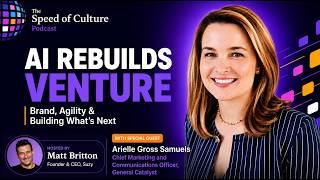
Arielle Gross-Samuels, Chief Marketing & Communications Officer at General Catalyst, explains the firm's three-pillar AI strategy: foundational models like Mistral and Anthropic, infrastructure plays embedding AI into legal and accounting, and workforce transformation. She discusses portfolio wins including Airbnb and Stripe, and how GC positions itself as the global authority on applied AI.
Chapters
Up today on the Speed of Culture podcast, we're here live in New York and we're thrilled to welcome Ariel Gross-Samuels, the Chief Marketing and Communications Officer, General Catalyst, a venture capital firm that partners with transformational companies shaping the future of industries like AI, healthcare, and fintech. Ariel, so great to see you today.
Thanks so much for having me, Matt.
Absolutely. So what got you into the world of venture capital?
So I am a builder at my core.
Okay.
I'm an engineer by training. I worked in technology for nearly a decade and then did a stint in private equity. So when I got the call from General Catalyst, it felt like this amazing opportunity to blend finance, marketing, engineering, technology all in one and to support founders pursuing their visions, which I was so excited about.
So what were you doing at the time when you got the call from General Catalyst?
I was running marketing at Blackstone.
Okay, so obviously Blackstone, a very prestigious private equity firm, one of the largest in the world.
Yeah.
What gave you the conviction to, I'm sure you were like on the fast track there, What gives you the conviction to make that jump and go somewhere else?
Yeah, it was really getting back to my roots in tech and the opportunity to build in the white space, which is something that's been true in my entire career, is coming to a place like General Catalyst, which we now call ourselves a global investment and transformation company. We've been around for 25 years, $32 billion of assets under management. So by all sort of measures, we're this very established, successful firm. And yet we're at this inflection point as a company where we're expanding the aperture of our business. We're expanding the client base of who we partner with. I thought, what an interesting time to jump on this rocket ship and see what I can build across marketing and communication. So everything from branding, creative, our events and experiential, MarTech and operations, and the whole communications remit. So it's been a really, really important opportunity and something that I, I've been super energized by.
So you're obviously leading the charge for the brand of General Catalyst. Who is your target audience? Who do you want to know about General Catalyst and what do you want them to know about the brand?
Yeah. So a few key audiences for us. First, our prospective entrepreneurs and founders, particularly in the US, Europe, and India. So this is anyone with a good idea.
Mm-hmm.
We want them to think of General Catalyst first. At what stage? Fundraising, really when it's still an idea.
Wow.
So the minute they have an idea, even before they start fundraising, before they bring it to life into market, we want them to think about GC as the person or the, or the firm that they wanna call. Second, I would say is sort of the business, financial, and political elite circles. These are organizations and leaders that are going to influence our brand and reputation and market. I want them to know who we are and what we stand for, which to get to your second question, we care about a few things. One is being the global authority on transformation and particularly within that applied AI and global resilience. So applied AI is really our focus on how do you bring the LLMs, the tools, the products, but integrate them into businesses at their core. I can talk more about that. Yeah, for sure. And then global resilience is really this idea that countries, particularly through the lens of geopolitical tectonic shifts, COVID, all of these supply chain disruptors are realizing that they need to modernize their critical industries across defense, healthcare, industrials. And so we have over 800 portfolio companies that can help with both. And so that's the real messaging that we want to convey is broader transformation around applied AI and global resilience.
Yeah. And essentially in the seat of the entrepreneur, you know, that they want to globalize, they want to take advantage of global opportunities. And obviously every entrepreneur is thinking right now, what is my AI story? Totally. How do I apply to my existing business, et cetera. Let's unpack that. Yeah. Because obviously I obviously spend a lot of time in AI as a venture-funded software CEO myself. Yourself and a company that's really focused on AI. I know that different companies are at different stages, and what using AI is, deploying AI is, means different things in different companies. How does General Catalyst look at the state of AI today and how it's being adopted maybe across both your portfolio, but then more broadly across maybe the customer you serve?
You know, it's such an exciting opportunity, and it's, it's pretty amazing the vantage point that we have just having 800+ portfolio companies, and also we've invested billions of dollars over the last 8 years in AI. So I'd answer this in a few ways. One is on the core sort of intelligence track. I think that's pillar one. What do we see as the future of intelligence when you think about LLMs focused on humanity and human-made decisions, data privacy? So we've invested in companies like Mistral and Anthropic, some of these leading LLMs.
That's the foundational level. Exactly.
Yeah. So there's, there's sort of that lens and you're seeing it also looking at the industry sector specificity where you bring an LLM, let's say, into biology with Modus AI or into physics and chemistry with PhysicsX. So interesting cuts of that. The second is the infrastructure layer. What needs to be true, both, you know, data centers and servers, but also this, I call it sort of the business scaffolding. How can businesses ingest AI? And this gets really interesting. We have a, a model called AI-enabled rollups. And the thinking here is that we can expand margins on legacy businesses, not necessarily software, but industries like legal, HOA management, accounting, so much opportunity, legacy businesses, workflow automation. Yeah, 100%. We have companies like Lean. So it's really interesting. How do you integrate AI into the guts of those businesses and help them really rethink the way their work operates and then help them scale that solution through M&A, which is where this gets into the the AI-enabled roll-up opportunity. And then the third is really workforce transformation, both, you know, the work itself is gonna change, the workforce around it is gonna change. What does it mean to have an agentic workforce? What does it mean to have a company worth $10 billion with 5 humans? How is that structured? And what is that sort of belief around AI-native companies going forward in the same way that people bet on SaaS and other key digital trends?
Well, that's unpacked though. I mean, first and foremost, your firm's role as this AI enabler, and obviously can take many different forms, both for tech-specific companies, tech-native companies, if you will, or like you said, going into other companies where you can use the power of AI and make them more efficient. But in either situation, your firm needs to be able to employ people and work with experts that really know what they're doing in AI. And one thing I've seen is Those people are far and few between. There's a lot of people that will speak buzzwords and, and throw this jargon around, but there's very few people that are actually doing the work, hands on keyboard, know how to build, know how to deploy it. Large companies are so scared, they're writing huge checks and a lot of times they're being told it takes 6 months and $60 million when the reality is it should take 6 days and $60,000, but they don't know the difference, right? So I think there's a lack of knowledge everywhere. So, but how do you, your firm, attract the right people that can help deliver that promise?
Well, you know, it's such an important question and it's interesting because, so you're, you're thinking about this through the lens of talent. How do you assess talent both for gaps, uh, in terms of, you know, what functionally needs to be true to build out these solutions, but also even going earlier than that, how do you train this in school? What needs to be true in terms of prompt engineering classes? What about AI accreditation? I was just at an event last week focused on AI in the boardroom. What does it mean to have governance and, and board directors that are sort of AI-enabled in how they think about, you know, leveraging all kinds of company data to make better decisions.
Maybe one day there'll be a bot that, or an agent that will be a member of the board. Literally. Yeah.
So I would say, I mean, look, we have an incredible executive talent team that recruits from all around the world. You know, we're lucky in that we have this massive network of not just founders and entrepreneurs, but also business leaders, partners across our portfolio companies, even policymakers. So we can sort of draw from a broad pool of candidates, but It is an important question, especially because the target keeps moving, right? So even you might think, you know, where the puck is going, but then that shifts.
It's quicker than what we've ever seen before.
Exactly. The velocity is just un—
un—
sort of paralleled. And so it, it creates a really interesting dynamic. I think what it teaches all of us, and particularly thinking about the marketers who are listening, you know, in today, you always have to be asking what's not there. You always have to sit on the edge of your seat and not rest on your laurels. Yeah. Always try to stay as, as sharp and educated as possible because this is such a rapidly evolving situation.
Yeah. But from an operational perspective, the challenges in that is that you don't wanna be reinventing your company or your strategy every single day. Correct. So you really need to rethink in terms of like what the goalpost is and where you think the world's gonna be going. And you have to have some conviction because you're right. It's like you could come up with a business model today and then tomorrow it could be rendered obsolete. And the question there is, well, maybe your business model wasn't really, um, forward thinking enough.
Well, and I think you're also touching on agility. Which is to be successful, particularly in 2025, you have to be able to rapidly pivot and ingest new data points to make better decisions. I think DeepSeq was such an interesting example of that. Oh yeah. Came out of nowhere. All of a sudden people were rethinking everything from the valuation of LLMs to how can they leverage this data that's so much more efficient, possibly over-pivoting. But even just the idea that, you know, the, the cost curve on AI is gonna asymptotically approach zero. So in the same way that we think about internet, I mean, it's literally gonna get cheaper and cheaper as a, as a currency. Yeah, exactly. And so, do all boats rise as a result of that? Is there, is there increased demand generation? Or does that, does that really throw a wrench into people's, you know, valuations of these companies? I think that's an interesting debate playing out. But regardless, it's an exciting space to be in. And I think, you know, what a, what a good time to be alive and to be building.
Oh, yeah. I mean, it calls into question where the value is going to be created, because you have the infrastructure, the chips, right at the bottom, then you have the foundational models, which we spoke of, then you have data, Right. And you've already seen companies leverage your data, not AI companies, companies like Reddit for selling their data, etc. And then you have the application layer, which some people write off as just, oh, it's a wrapper on an existing model. But the reality is, I would argue, your ability to package things, go to market, capture customer, you know, mindshare and drive a business is— has always been a really hard thing to do. And in tech, it's never necessarily been the best product wins. In some ways, who goes to market?
Yep.
What are your thoughts on where the value is being created in AI?
Well, you know, it's interesting. I think ultimately we're still going to see this trend towards hyper-customization, hyper-customization for consumers. I think the idea that, you know, particularly marketers and brand builders can spray and pray and just hope that what they build and throw over the fence is going to land is— we're, we're past those days right now because of the access to data, because of both algorithms and AI, particularly on the generative front. You can get super targeted and clear on who you're actually going after what they care about demographically, psychographically, what needs to be true for them to resonate with your business, your product, etc. And so I do think there's a really interesting inflection point for us in this industry to rethink even how we approach people so that they feel like they're getting value from every ad they see, from every piece of content they see, rather than something that they want to skip past.
Yeah, absolutely. So you mentioned earlier pivot and being able to kind of reinvent yourself. You know, our company, Susie, has 300 employees. It's a lot harder to pivot now than when it was when we had 25 employees. So what have you seen throughout the portfolio companies you work with and the entrepreneurs that you partner with that has been common across companies that have been able to effectively, I guess, change to the macro to take advantage and seize the moment?
That's such a great question. You know, and I even, I would, I would go back to even my days at, at Facebook, before it was called Meta, and even, you know, the way in which leaders would put a stake in the ground around trends that they believed with high conviction were true. This happened at Facebook, at Blackstone, that's certainly a general catalyst across our companies. I'd say a few things are true, right? One is pattern recognition. So you have to be able to ingest signal and data from different sources. And in our world, because we are inundated with stimuli, it's almost like, how do you parse the signal from the noise?, but really making sense of, of what, you know, what is the data that tells us one way or the other where trends are going, what themes are gonna play out? Does this align in our case to investment theories that we actually do believe in and have high conviction? And that's where we have a team of world-class investors writing checks towards founders that they believe in. So there's that. Second, it still comes down to people. And so ultimately in our business, you're, you're backing a founder. You're investing in a human. And certainly as marketers we think the same way. It's, it's about the person on the other side. Even business to business marketing, which I've now been playing in for, you know, a decade plus, it's still people on the other side.
Couldn't be more.
And so you still have to care about how you're—
that's why brand matters, by the way, as well. A lot of people in SaaS, I think, made the mistake of just looking at the bottom of the funnel, percentage performance. But the person buys software the same way that mom buys detergent at Walmart. They buy from the brands they trust. Totally. And if you're, you know, if you're building enough awareness and trust, versus a company they've never heard of before, they're going to want to choose, you know, a company they've heard of before. And that's why brand matters. It doesn't pay off right away, but over time it does become a defensible moat.
100%. I was going to say the same.
And be the big—
and you want that, you need that cushion. But also, again, you can't rest on your laurels. See, trust can also be lost so quickly. And so making sure that you're staying evergreen, consistent with your values, getting in front of consumers and enduring and sustainable way, I think is so important. And of course, the leaders of the businesses matter, you know. And so even as you think about the personalization of companies and how sort of these corporate ambassadors are representing, that matters. Yes, that's not going to change, especially just in— given the velocity of now social media and how even Gen Zers have higher bars, I think, for how they make decisions with their wallets.
So let's talk about some of the companies that General Mills has invested in and talk about maybe some of the lessons we can extract. So who would you think the 3 most prominent companies— if you're sitting at a dinner party, you're like, who tell me the general catalyst, obviously you're giving them proof points— who are some of those companies that come to mind?
I mean, you've got some of our incredible, you know, success companies. Okay. So Airbnb and Instacart and Stripe, you know, these, some of these really, um, successful companies. But then you've got, you know, I was sort of mentioning this AI-enabled roll-up strategy. I mean, you've got companies I'll take, um, Crescendo is a good one. This is a call center business where we're automating contact centers and you think, okay, most of us, we've gotten on a call with an agent.
It's painful. Yeah. Cable company, like utility company.
You're calling at your—
you're hitting zero a million times. Try to talk to somebody, right? Exactly.
Yeah. How do you make that a much smarter, faster, polite experience using AI and productizing that? And focusing on the outcome of that scenario, not just the inputs. And so that's where this business crescendo is really revitalizing the entire thinking around call centers, but also acquiring companies like PartnerHero most recently to scale their solutions broadly. So even something that historically has created consumer pain and has, by the way, very little to do with, you know, a Stripe or an Instacart, et cetera, is still, I think, super interesting part of our business. I'd also mention our General Catalyst Institute. Again, when you think about going from a venture capital firm to a global investment and transformation company, what does that mean? It means that we're doing incredible bets beyond venture check writing. And so this institute is our policy arm. It's how do we bridge federal government startups? How do we demystify on both sides? How do we help inform AI regulation, right? Which we know is coming and is actively being—
Do you think it's coming?
I do.
Especially with this administration, it seems so Wild West.
I think it's going to be light. Yeah, I think a light framework would be helpful. And I think we saw what happened with the internet, with social media. I ultimately need a little bit of guidance. It's not totally, you know, chaotic.
I mean, the good news is, you know, love him or hate him, but David Sachs was an entrepreneur and ran a company and understands AI. Totally. And most people that have been in the White House that have been in these positions in the past just are completely disconnected from technology. And I think that's actually a good thing. Yeah, yeah.
So I think I, I'm, I'm bullish on what's to come. Yeah, yeah. I do think that, you know, merging, merging on there on those fronts is going to be super important for us, particularly as we want to actually help entrepreneurs and founders build enduring businesses. That, that can only happen with this strong partnership between the public and the private sector.
So the call center, uh, you know, instance is obviously interesting for a lot of reasons. You know, we've heard Klarna say that they were able to essentially automate their call center. Now they're saying they're apparently they're recreating Salesforce and all these SaaS platforms as well because they know how to build so quickly. And we'll see if that becomes the case. But in the case of the call center, it did cost a lot of jobs. Yeah. And I'm sure that your company that's coming in is helping companies be more efficient, which ultimately does mean job loss. And it's going to happen everywhere, right? It's going to happen every corner. What, what, what do you think is going to happen with the job loss and resulting efficiency? What do those people do? What should they learn? How do they reskill?
Yeah, it's such an important question. You think about this even on a country-by-country basis. A lot of blue-collar jobs were offshored to, let's say, the Philippines.
Yeah, especially Costa Rica. Basically, that—
yeah, okay, you're, you're reentering the productivity but not the jobs. So what do you— I think governments have to take reskilling and upskilling really seriously. I think there has to be training programs. Ideally, you're redistributing talent towards problems that can be solved.
Assuming that you can learn the new skill sets.
I assume you can learn the new skill set, but it's a really— it's a point that I don't think enough of us are talking about because it's such an important implication economically for countries and for— I mean, for all of us. When you think about just what is the nature of industry, in, in 10 years with legal, with accounting, even with marketing and brand building. Of course. Like, what does this all look like? I mean, it's, it's, yeah, it's, you can either say it's unfathomable or you can just try to imagine it and yeah, build accordingly.
Yeah. After I get off stage where I speak around AI all around the world, people come up to me and they say, what does this mean for my son or daughter? What should they learn? What should they be focused on? Yeah. And it is just such a different world now. I mean, if you think about the education complex in America, it's largely based upon memorizing information and regurgitating it. So if you were a master at memorization and regurgitation, you would be able to, if you look back at your K through 12 or even higher ed, you'd be able to do pretty well. You'd ace every test. But now the notion of retaining knowledge is almost commoditized.
It's, I completely agree. Completely agree. And so I think I've observed a few things. One is there seems to be a self-selected disparity between sort of Luddites and early adopters. Yes. And that, that does seem to be psychological. You know, I still hear a lot of fear around AI adoption, but then I see other people who are running towards it. So I think that's a decision we all have to make when we get out of bed in the morning, is are we going to be scared?
I think it's a choice, right?
I agree with you. So I think there's, I think there's that on the, on the education front. I completely agree. There's going to have to be reform. You know, I remember some of my engineering classes in college, I would say to our professor, you know, these exams and these quizzes are so hard. I've never seen these questions before. Like, why do you make it so difficult? He said, that's real life. Yeah. I never see the same problem twice. We're teaching you the theorems. We're teaching you the, the way, the logic and the approach to problem solve, but then it's up to you to actually apply yourself. Exactly.
Like, that's hard. But that's also not taught.
How do you, how do you teach that? How do you scale that? How do you enforce that? What do you do with adults if they don't have that? I mean, it's, it's such an interesting question.
It shifts. I mean, my take on it is when you think about problem solving, creativity, critical thinking, that's what's going to matter more. And I think success in your career is much more about understanding and identifying the problems that need to be solved. Versus how to solve the problem. I agree. So if you think about how to solve the problem is a lot of where the knowledge comes in. And ultimately that's where AI I think is gonna do a lot of the work, but AI doesn't know what problem needs to be solved. Yeah. And I think if you, that's leveling up.
Yeah. Yeah. It's that orchestration, sort of view yourself as the train conductor looking around the curve. I agree with that. I also still think, especially in our industry, taste, understanding what humans need. Yeah, of course. You know, the creativity, a lot of this, quote unquote soft skills are still gonna be incredibly important. Yeah. And, and it's exactly to your point, how do you use the data, the analytics, the tooling to make better decisions and to inform business strategy versus relying on it to answer that.
And those that say like it's the end of the craze, it's a bad thing. Like Canva was already hugely popular before AI became a thing. And it's not like that's people being Picasso with their creative, they're using templates. So yeah, we were already looking for ways to be more efficient with creative even before before AI got widely adopted, and now it's just going to accelerate even further.
There's also, you know, I had this mentor who would always say, you don't have to be possessive when you're prolific. And I also think that's kind of an interesting mindset, interesting, where you can, because of generative AI especially, you can just churn out ideas, you can really test and learn and iterate at the scale that hasn't been seen before. And so that allows you to think more broadly and almost bigger picture about the future.
Yeah. A lot of large companies, even tech companies, are really struggling with this transformation. One thing I found at Suzy is that when, you know, AI first became widely accessible, I pushed it to my engineering team and I wasn't getting a lot back. And what I realized over time is it's not just like another feature build or even shifting from web to mobile. It— since it is about the problem that needs to be solved, it really is the CEO's job. To fully understand it and figure out how it's going to drive true inside-out transformation. And in order for the CEO to make that decision, what I've learned is I actually need to know everything about it. So I personally spend 80 to 90% of my time— I've canceled so many of my ongoing meetings— not only just knowing about it, I wrote a book about it, but I also built it. So now I can build almost anything in AI. I'm not a coder, but I've learned how. And now when I go into meetings, I know what's possible. So when it comes to larger builds, it's like, oh, I know you can do this. And if you don't, you should figure it out. And that's— it wasn't until I did that that I felt like things really started to move. I find that a lot of large companies, the CEO is either like on a golden package and just doesn't want to— publicly traded large companies doesn't want to risk it, right? Or they don't even know where to start. And because of it, you're going to see history repeat itself where a lot of large companies are going to be like, Why didn't we do this? You know, like you look at the Circuit Cities of the world, Toys 'R' Us that didn't get on e-commerce and you see that now they're bankrupt. I think the same thing is gonna happen with so many companies.
And, and that's exactly why the term we use is applied AI. Yeah. And we need to apply these. I like the operative word. 'Cause it's exactly that. It's how you can apply it into your business to actually make it stick. It's not gonna do itself.
Yeah. So your, your job, obviously if you do your job well, entrepreneurs are thinking about your firm when they wanna raise capital. And LPs are thinking about your firm when they want to deploy capital, right? And you're known as— KDP knows as a world-class brand. What works in terms of the tactics that you've been deploying to communicate your message to those constituents?
So I'm a big believer in highly coordinated omnichannel pushes. And what that means is when we know we have an announcement to make, something important to say, something important to say, How can we sort of galvanize the troops across all channels, across all stakeholders on the same day? Yeah. Like be highly coordinated.
I like that.
Frequency. To break through. And so that, you know, on the press side, that means, okay, maybe we have an exclusive, but also we, we know that after that exclusive goes live, we're gonna pitch extensively proactively. It means we have a full social amplification plan. It means we're publishing on our website. It means that we are engaging across email with, you know, with LPs, with founders, with, business partners. It means we're activating our internal employee base, like, and, and then we're measuring for, for share of voice, for breakthrough, for also sentiment of how is this landed.
So basically you're picking a day that you're gonna own because—
picking your spot. And if you can bolt it onto an event, that's the gravy, right? If you could activate it, connect to a conference or another moment where you have sort of that convening power, that's fantastic too. But I find that what a lot of people get wrong is they sort of dribble things out or in sporadic, or, and you just don't, you don't move the needle. And so you have to be, you have to reverse engineer it.
I've never thought about that, but it's so true. I mean, we have so much noise out there that if, and if you own a day, even if it's one day, you're getting the message across that day and people are gonna see it, hear it everywhere. Yeah. And then they'll get the message.
Well, and so I'll, I'll give you an example of this. Please. Um, we launched our new brand platform called Venture Beyond and the idea kind of in line with what I'm sharing, going from a venture capital firm to this global investment and transformation company, we needed the brand identity to reintroduce ourselves to the world after 25 years of what do we stand for? And so this brand identity across verbal and visual, this new website, social, the whole sort of reintroduction, we intentionally timed it along with the major fundraising announcement, which is that we were announcing Fund 12. All of this new capital was coming in and we knew that that news would break through, but then people would come to our website.
Right.
And people would come to our socials. So we wanted to be ready. At that same point. And so I do think that this is where, you know, it's important to sort of look at, look at the world as an editorial calendar and pick your spots to break in.
Yeah. Awesome. So let's shift gears a little bit as we wrap up. I mean, you obviously strike me as somebody who is so well-rounded in terms of their knowledge and commands the discipline that they're in. And you're obviously very passionate about all this, which I know is incredibly important. What do you do for inspiration and keep your finger on the pulse of where things are headed, especially topics like AI where things are changing so quickly? And more broadly, how do you spend your time in a given week? What's the pie chart of your week look like?
That's interesting. So I have this term, playing in traffic. I do like to speak with really interesting people on a diverse slate of people, meaning founders, entrepreneurs, business leaders, anything from Fortune 500 to early stage companies, policymakers, marketers. Like I like to, I like to intentionally have a well-rounded sort of cabinet on any given week. I do think it's really important to go to other people's events and hear how they frame their thought leadership, their programming intentionally, and sort of ingest that and take stock. Of course, reading the news, I have a number of favorites, which I'm happy to share. How I spend my time, I mean, it depends to some degree on where we are in our sort of cycles of marketing, but I would say 70 to 80% is focused on the core marketing and comms work. So how do we equip our portfolio companies if they're coming out of stealth, if we're announcing a big fundraise, if we're helping them through maybe an important either liquidity event, a merger and acquisition, some important milestone for them, um, telegraphing our own brand through our own launches and announcements. And we've been quite busy on that front. We just recently announced General Catalyst Wealth, which 2.5 billion of assets under management, a new wealth management arm for our clients, for example. People, hiring, training, continuing to broaden my organization, which I'm super excited about. And that's been giving me a lot of energy. And then I exercise. It's important. At the end of the day, 100%. I exercise. I try to get out in nature when I can, but it's a really sort of fast-paced, high-energy environment, and that's what I love about it.
When you look back on your career to date, and you're clearly just getting started with everything you're doing, what were some decisions you think you made right along the way? Um, whether it's what you focused on, yeah, or the companies you worked at, or the people that you got to know that put you in a position you are today.
I think there's a few things. One is I optimized for breadth over depth. That was intentional. So I thought early on, let me get exposure to different functions, to different facets of the business. I mean, even You know, Deloitte doing engineering consulting, working across different sectors from a consulting perspective at Facebook, you know, starting off in products, but working across consumer products on the operations side and then going into business marketing, like really trying to see how different businesses run and how leaders make decisions.
Yeah.
So getting that breadth rather than just going deep on any one domain, I thought that would be important to help me connect those dots later on. I think the second is. I did focus on building what wasn't there. And I think that's something that, you know, so many of us forget is that everything's made up around us.
I know. And no one knows anything, right? We're all just sort of like building.
Yeah. And so how can you go from zero to one? I was constantly writing proposals, even the pilots, whether it was a new project, a new business idea, and just anything. And the worst that can happen is someone saying that says no.
Exactly.
At least to be in that mindset of seeing what's not there and then building accordingly and at least pitching accordingly, I think is a, is a really important muscle. And of course, you know, your reputation is everything. It, it, it stays with you. And so acing your day job first, nailing your scope first before you expand and take on other things, being incredibly responsive and, and trusted as an employee regardless of a company, I think is incredibly important and not something that you can skip past.
Yeah, for sure. I love that. So, uh, we often wrap up our podcast by asking our guests if there's a saying or mantra that has driven their professional journey. I have a feeling you have a couple, but what comes to mind for you?
Something that my mom used to always say to me, which is, if not now, when? And if not me, who? And that inspired urgency in me and it inspired me to raise my hand and lean in.
That's just, that's great. I'm glad that you raised your hand at the other podcast today as well. Um, I, I often don't get a ton of ideas leaving a podcast, but I do today. So I want to thank you for that. You obviously have great energy and a ton of ideas, and it really inspired me. So thanks for joining.
Thank you.
It's so much fun. Absolutely. On behalf of Susan and I, we team. Thanks again to Ariel Gross-Samuels, the Chief Marketing Communications Officer at General Catalyst, for joining us today. Be sure to subscribe, rate, and review the Speed of Culture podcast on your favorite podcast platform. Till next time, see you soon, everyone. Take care.
More from Matt




MikMak’s Rachel Tipograph on Consumer Spending, Retail Media & Holiday Shopping Trends



Jaguar Land Rover’s Charlotte Blank on Luxury, Purpose & Experiential Storytelling



