General Motors’ Shenan Reed on AI, EVs & the Future of Media Strategy
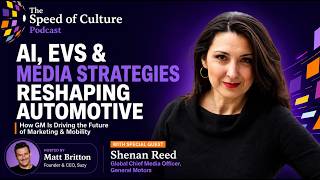
In this Speed of Culture podcast episode recorded at Media Week 2024, host Matt Britton interviews Shannon Reid, Global Chief Media Officer of General Motors. Reid discusses how AI is becoming a foundational layer across all marketing functions—measurement, optimization, planning, creative, and service—while warning against over‑reliance. She highlights the industry’s push for true cross‑media measurement, citing the ANA’s upcoming Aquila product pilot to better control reach and frequency. Reid explains how AI now makes hyper‑personalized CRM and email campaigns affordable at scale, moving beyond costly decision‑tree approaches. The conversation shifts to the fragmented media landscape, noting over 75,000 media placement permutations, the rise of the creator economy, and the need to target “passion points” rather than mass‑broadcast moments. Reid outlines the unique responsibilities of a Chief Media Officer at GM, emphasizing the massive media spend, integration with a vast dealer network, and the strategic role of media in driving business outcomes. She delves into GM’s EV narrative, describing growth trends, consumer education challenges such as range anxiety, and the importance of tailored messaging for different buyer segments. Reid also shares her career trajectory—from founding Morpheus Media in the early 2000s, early work with AltaVista and luxury brands, a stint leading L'Oréal’s media, to joining GM in 2024—highlighting the influence of her parents, especially her mother’s pioneering data‑driven work at Clairol. Throughout, she stresses curiosity, early adoption of new technologies, and a mantra of “good time, not a long time.”
Chapters
Up today on the Speed of Culture podcast, we're joined by Shannon Reid, the Global Chief Media Officer of General Motors. With decades of experience in the digital transformation and media strategy space, Shannon shares how GM is leading the charge in a rapidly evolving automotive industry from electric vehicles to innovative media approaches. Shannon, so great to see you.
Nice to see you as well.
How are you? Really good. Good. And we are here at Media Week in New York City. And as somebody who is the Chief Media Officer of General Motors, imagine this is an interesting place to be. How much time do you spend going to conferences like this on an annual basis?
Probably more than I should, to be honest. Okay. This year I've been to a good number of conferences. I sit on a few conference boards, so I sit on the board of the ANA, I sit on the board of the IAB, so I go out of my way to make sure that I attend those. And I think the ones that are specific to the industry are important. I think for this one, I don't get a lot of time to spend to stay here, unfortunately. I wish I could because I think the content's gonna be really great today. Yeah. It is something I'd love to send my team to, and I think these types of opportunities to get people in a like-minded field together and have conversations, not collusion, but conversations around what are we all trying to accomplish? How do we push the industry forward? How do we think of new ideas and new ways of approaching things? There's just so much richness that can happen in these moments and inspiration.
And at conferences like this, even though you can't necessarily stay for all the panels, I'm sure you have elevator conversations and the like. Of course. What are some of the trends that you hear people focused on media talking about here in 2024 that you think you need to pay particular attention to heading into 2025?
So you mean other than AI? Because I think it's gonna be the decade of AI. Yes. Like everybody wants to talk about it. Okay, so other than AI, I think—
Well, AI is kind of a layer also that touches everything.
It is. And it's going to touch measurement, it's going to touch optimization, it's going to touch planning, it's going to touch creative, it's going to touch everything we do in marketing from soup to nuts. Right. And I think it's exciting. I think it's an enablement tool if we get it right. And I think there's cautionary tales of how to make sure you don't overtrust it or overemphasize how you use it, but you make sure that you use it appropriately. That said, I think the things that are weighing on a lot of us is how do we get to making sure that we have really true cross-media measurement. And I think that's a continued push that we're all going to continue to fight for. You know the old adage, half of my advertising is wasted. I just don't know which half, right? Exactly. I want to make our— exactly. I want to be part of the generation that says we figured out which half was wasted and we don't do that anymore. That's what we want to be a part of. And I think the future of measurement and the future of what we can do in that space and the connectivity across our partners, there's some really great work coming out of the ANA by marketers for marketers with the Aquila product that we're super excited to see get into pilot stage next year. And I think that's going to be an opportunity for marketers marketers to really start to control their reach and frequency in ways we haven't been able to before.
For sure. And speaking of AI, I think one thing that's gonna be unlocking, it already is to some extent, is personalization. Absolutely. So we've been talking about it for so long, but you know, we've tried to do it for so long.
Exactly. But in really expensive and complicated ways.
Yes, exactly. Yeah. And I see a world where putting aside more traditional broadcast mediums, but say something like email marketing, mm-hmm, there's no reason why me and you should get the same exact email. From a company based on all the signals I've given, whether it's to the company or through third parties. And I think once you play that out in terms of a consumer journey, you can really do some amazing things if companies can really take the time to invest and unlock it.
I think on the CRM side and the email side, like we've had the ability to be able to do those things for a long time. It is the cost of doing it that has been prohibitive, right? Getting to the creative, getting the ability to do the segmentation, being able to send a single email as opposed to clusters of 100 or 500. If you're truly in an opted-in first-party relationship with somebody who you've given your email address to, you're not creeped out by them sending you an email that says, hey, I know you and I think this thing would be good for you, right? You're expecting that kind of service. That is truly service from a company that you've developed a relationship with. But the cost of a company to do that has been outrageous. That's where AI starts to really make this entire thing real and approachable. Won't cost us a gazillion dollars to get 1,500 different versions of a creative asset or even a single creative asset for everybody who's in your database.
Well, I think it's more the latter because I think, yeah, yes, when you could do personalization in the pre-AI world, maybe there's like modules and if this person equals this, they get this module versus that.
Yes, it's a decision tree.
Exactly. Where now you can actually have something custom bespoke created for each individual with prompts that are pulling certain points with about your product, your content. Totally crushing. Or in the case of your industry, when did you buy your last car and how many miles you have on? You buy an SUV or you into EVs? There's so many different levers you can pull.
It's simple things. It's due for an oil change. Exactly. Come on in.
Yes, right. Absolutely. And, you know, when you talk about like oil change as well, like, I think another thing that AI is definitely going to bring out with service-driven companies is just the ability to provide better service through AI, through chatbots and things of that nature. I know my hope for the consumer is in the next 12 to 18 months, you will no longer have to make a phone call, press 0 100 times to get to the operator. You will always be able to connect with something. It might not be a person, right? But some method that can help you get to what you want to from a service perspective.
Some kind of smart solution. Exactly right at the other end. Because you're right. How many of us are trying to hack what number to push to get to a live human? Yeah. And anytime we dial the phone, I love your example of pushing 0. Yeah. Do I push 0? Do I push pound? Do I push like, is there, it's gotta be a number that gets me to a person.
Yeah. And what's interesting about those experiences, they're usually with companies that are sort of monopolistic in some form. Cable company or the energy company that has no competition. So they don't need to do the thing about it where companies that do that, if they don't deliver great value, they're going to be out of business. Somehow they figure out a way to get these things going a lot more quickly.
Yeah, yeah, yeah.
So let's switch gears a little bit to you. So I see that you were the owner and founder of Morpheus Media, which was a media agency for, you know, over a decade from 2001 to 2014. Tell us about the experience of you starting and running a company and how maybe that's different than the role you're in today, which I know is probably vastly different.
Vastly and not so vastly. All right. So go back to March of 2001 when we founded Morpheus. I got into the digital media industry back in the early days of '99. Yeah.
At the dawn of the internet.
Yeah. I mean, look, the agency that I worked for called Mass Transit back then was actually founded in '94. So you want to talk about the early start of digital media, like they were on the cutting edge of it. It was super interesting to be in that space at that time because there was the question like, is this internet thing real, right? We need to be advertising on that. Like, keep in mind, Google wasn't taking advertising at this point, right? It was just, it was just a search engine for nerds, right? There was no advertising on that platform. And I think that's a super kind of interesting moment to be in. My first client, to give you an idea of this timing, was AltaVista.
I remember them well.
The search engine AltaVista. And my mission was to get them into the MediaMetrics top 10 by buying unique clicks only for $1 million a week. People would kill for a $52 million budget at this point today, right? 2024.
But this is like— The gold rush of the Internet boom.
Yeah, totally. Right. Every company was getting money out the wazoo and everybody was trying to win and da da da da. And then of course it all crashed around us. So we were in this moment, late 2000, early 2001, and myself and a couple of partners looked at each other and said, hey, what do we do? And we had this opportunity from the agency that we were working at to pick up a couple of clients because they were going to turn into a consultancy. And we still very much believed, even though all of this collapse was happening around us, that digital media was going to have a long-term future. We did not. And I love going to speak at classes on entrepreneurship because they're like, what was your business plan? Right, right.
You didn't have one.
I was like, no, I had, I was trying to just make the bill.
Let this be another day.
Yeah. So, right. Pay the bills. Yeah. Keep the lights running. Make sure you have water to drink and food to feed yourself. Exactly. And just keep going. So yeah, we kicked it off and we had the New York Times and Hertz Car Rental as our first two clients. And then the next thing we knew, we had Neiman Marcus and that led to more luxury fashion retail, et cetera. But think about those early days of digital media. I get so excited about this space. Like some of the problems that we were trying to solve for then created some of the problems that we have today, but also were the backbone of the solutions that we have today, right? Like, I feel bad that we were so dependent on cookies because cookies are delicious, but they've never been good for you. Um, and so like, we do have this moment where we need to kind of reset and say, okay, what is a world where we can actually get to these places? But we also got overly dependent on audiences and targeting. Like, I think audiences and targeting is great. I want to create a great consumer experience for you, but the world of contextual is still really important. Yeah, right. And being in the right place at the right moment. My grandmother used to tell me, show me who your friends are and I'll show you who you are.
Yeah. Psychographics versus traditional demographics.
And my mother was one of the people who actually invented and coined the term psychographics. So definitely an area that I'm super passionate about. Amazing. So I think there's this moment where we had this opportunity to kind of really invent how we were going to measure and monitor this space that we're in. And I think we did a really good job of it. And yet I think there's still opportunities to improve it. The really true value is at the end of the day, running Morpheus, we got to be about 200 people. It was an incredible business for search, social, programmatic analytics, SEO. We were a digital media shop, digital native kids, totally at the heart and soul of it. And then when I sold it and I moved over to one of the big holding companies, my first job at a big holding company was at MEC, which is now Wavemaker. And I remember the CEO, Marla Kaplowitz, who is currently the CEO of the Four A's, turned to me and she said, what does this job look like in 3 years? You're the president of digital for MEC. What does this job look like in 3 years? And my answer to her was it shouldn't exist. You shouldn't have a president of digital because it's all digital.
Yeah, exactly.
It's all going to be digital. And look at where we are today. The future of your media leadership is coming out of the people who have been your digital natives. Exactly. And I think that is the trajectory that we're going to continue to be on. And I think it's super exciting.
Yeah. I mean, it's interesting because some media planners today still bifurcate traditional media and digital media.
Right. And you can't.
You can't, right?
You can't. Also, we talk about like, well, we have brand media and performance media. No, it's all performance media. It may be performance to drive brand awareness, to drive brand lift, to drive brand consideration. But it's still— you've got to measure what you want out of things. And getting that measurement correct is huge.
Absolutely. So after your time in the agency space, you spent some time in the beauty space at L'Oréal. Yeah. And from looking at your background, that was kind of your first foray deep into the beauty space. How did that opportunity come about and what kind of gave you the confidence to jump into that role?
This is where my background's a bit misleading. So my mother was the manager of customer-specific data for Clairol. Oh, wow. So I was pretty close to the beauty space growing up and very much in love with that space. One of my first clients at Morpheus was 7 L'Oréal brands. We launched digital media for 7 of the L'Oréal brands.
Well aware of how they work.
Yeah. And then when I moved to Wavemaker, Wavemaker won the L'Oréal business in total, and I eventually became the president of the L'Oréal business at Wavemaker. Took a stint at Publicis for a couple of years to work on Verizon and GSK, and then got a phone call from L'Oréal asking me to come in-house and lead the media business in-house, which was an incredible opportunity. So I had been around beauty and specifically around L'Oréal for close to 20 years by the time I went in-house. It's an incredible business. Incredible business. And so exciting to be on the inside of a fast-moving consumer packaged goods company that's on the cutting edge of so much in digital and media. And really pushing the envelope and the opportunity to run it from the inside and make some of those decisions on let's trial, let's push, let's change, let's drive. It was an exciting place to be.
I'm sure. And of course you joined in 2020.
August of 2020.
August is when you joined. So you're in the heart of COVID And obviously I know the beauty business was impacted because people weren't going to work every day, although they needed like those Zoom-ready looks at the same time. What was it like being at the head of a media arm of L'Oréal during COVID and what were some of the lessons you took away from that?
So here's what's interesting. So yeah, I started in August of 2020 and we were back in the office at 25% capacity at that point. At that point. So it was kind of an interesting moment. Of course, they're down in the Hudson Yards building, which is just a peak of safety as far as filtration systems and outside air and all of that goes. It was a great place to be. You think about the beauty industry and the first thing that comes to mind is, you know, lipstick and eyeliner. And of course you want to be Zoom ready, sure, right? But skincare and self-care became so important during the height of the pandemic that the skincare businesses across the industry, the skincare businesses really took off. You have to keep in mind L'Oréal owns brands like CeraVe and the importance of people started washing their face more. They started moisturizing more. They started using their serums. Well, and also you're staring at yourself all day when we're in person. I'm looking at you, you're looking at me. I don't know the wrinkles.
Thank you.
So do you. But like, I don't notice the wrinkles I have right now. Now all of a sudden I'm staring at a camera at myself all day. I'm thinking about, oh my gosh, I really want to get rid of that dark spot, or how do I make my skin look more supple? How do I do that? And so it was an exciting time to watch the business go through an interesting shift.
So as a side note, I mean, you've mentioned your mother several times during this interview already and how her career and her learnings definitely rubbed off on you. Talk to me a little bit about that relationship and how you think it impacted the professional you are today.
Yeah, I mean, my mom was an interesting— and I just lost her on September 10th.
I'm so sorry to hear that.
Yeah, no, no, no. It's kind of a great moment to be able to celebrate her a little bit. So her career was super interesting. My mom, both my parents actually only had about 2 years of college before they dropped out and went to work on the family farm. And then a few years later had me and decided to move to Texas. My dad is the consummate salesman. Salesman. Like, he can sell ice to Eskimos and has— he's a master of many trades and super talented. My mom is a data nerd, like really, really deep data nerd, but didn't know she was a data nerd.
Kind of like art and science combined. Totally. You're the culmination, the culmination of all that.
So she had this moment working part-time at Clairol managing like small accounts in Houston. I grew up in Houston. She was managing these small accounts in Houston, making suggested orders, and she started getting their scanner data. So this is like the mid-'80s, right? And she's starting to get this scanner data in and she's trying to figure out how to read it and what to do with it. And she started creating all of her own reports for— we had a little Macintosh computer in the house. She's building all of her own spreadsheets and she's determining that in stores that have a heavy Hispanic population, she needs more facings of brown hair colors in the center and fewer facings of the blonde hair colors at the top and a few more facings of the reds at the bottom. And she just starts optimizing planograms. Clairol takes notice and they go, we need somebody who manages this consumer data. We don't know what to do with it. And she gets this job in New York. And so the whole family— I'm an only child, so all 3 of us, right, pick up and move to New York. And I'm now in my early 20s and my mother is working on Park Avenue for Clairol as the first ever manager of customer-specific data.
That's amazing.
They then get purchased by Bristol-Myers Squibb. She keeps that same role but expands across Excedrin and all of these other kind of amazing consumer products. And she's helping to drive their business in ways that I don't think any of us could have imagined using that type of scanner data along with Nielsen and IRI and Scarborough and Claritas. Like she's using all of the big data before there was big data, correct?
Yeah.
She literally had terminals in her office. So there was a terminal to Walmart and a terminal to Target. Wow. Data couldn't be commingled or managed. You couldn't log into it anywhere else. It was really cool stuff, but it was amazing to see what she could figure out about consumer patterns and consumer behaviors at the grocery store level, all the way down to like an area, a trading area for that grocery store. I remember learning about trading areas from my mom, right? Like, you're not going to cross— you can't draw a natural circle because a natural circle isn't a trading area. Because if there's a bridge, people don't cross the bridge to go to the grocery store. I live closer to New Jersey than I do to Long Island Sound, but I'll drive through Westchester than I will go over the bridge to New Jersey.
Right. Wow. I mean, there's a lot of takeaways there. We have a lot of younger listeners to the podcast just in terms of how to carve your niche and find your way. And I think what I take away from that story is you find the thing that you love the most in an organization where you think there's potential and you stick with it and that becomes your thing. And over time, if you believe in that thing and that thing, whether it's AI or big data or whatever it may be, there will be a role for that. And if you're known as the person for that thing, you can go along for the journey at the right organization.
I'll say for your younger listeners too, always learning, always learning. My mother took every Excel class ever offered. Now, I learned how to do pivot tables from my mom. I taught my mom how to do the concatenate formula. We were constantly tinkering with Excel data together. If one of us had a problem in how to do something in Excel, you can guarantee you we were on a call together trying to tinker it out. Right. And so she— we had these moments where we would go back and forth on all of the data. And I remember asking her, I was like, how do you keep up to date with this? She goes, I take every Excel 101 class that Bristol ever offers. And I was like, why?
That's you being a master of your craft, right?
You're an expert in Excel. Like you could teach the class. Yeah, but in those moments, like there's always that one case study that somebody is doing something differently. You've never had to do that thing before. You wouldn't have thought to do it that way. And sometimes those really one-on-one classes make a difference.
So I would imagine all that background in data, and obviously you're clearly articulate and you have the sales side to you as well. So you have the best of both your parents. I'm sure all that plays a role in your current role at General Motors. So you joined as Global Chief Media Officer at General Motors in January 2024. What was the impetus behind you making that shift? You were at L'Oréal where obviously you had a lot of history and passion for, and you got the call. Talk to us about that decision-making process to give you the conviction to make the jump.
Yeah, so it was an interesting call. So I spoke to Norm, who's the chief marketing officer. And interestingly enough, we had never come across each other in the industry before. Like, we had kind of been ships passing in the night. Lots of friends in common, right? And so somebody introduced us that said, hey, Norm's in the process of building this kind of marketing transformation over at General Motors. He's looking for people who know the media space because he's just curious how different companies are doing it. So I really just had a conversation with him about how we were doing at L'Oréal. It's not a competitive space, right? People in our industry talk to each other to help each other, right? I'll talk to somebody who's in a competitive space to get ideas and to build on each other.
And it's like this or wherever.
Absolutely. And so we just got on the phone to chat about it. And by the time we were done, I said, look, if I can ever be of help to however you build this organization, whoever ends up in all the different roles that you intend to build, please let me know. I grew up working on General Motors cars and I sent him a photograph of a '69 T-top 'Vette that my dad and I did a frame-off restoration on that drove me to my wedding because who You don't need the limousine when you have a red Corvette. Right.
And, uh, that's what she wanted to be worked on.
And I sent him a note and I was like, look, it's a '69 T-top 'Vette. It's got a '75 Chevy truck engine in it that's been bored and stroked to be a 383, and it's painted in, uh, Cadillac Firemist Red, which was a color in both '64 and '85. So I like cars. Right.
Clearly.
I know the simple answer. I still drive a '65 Pontiac Tempest. My dad still has a '68 Firebird, and we still have the '69 'Vette. Unfortunately, in this last hurricane, we lost a '68 Chevelle. Wow. Heartbreaking. But cars have been a heart and soul, a part of our family my entire life, specifically General Motors cars. So it was like, I just have a passion for your business. Yeah. Right? And I got a phone call back and said, hey, we're looking for a head of media and would love for you to consider it. And by the way, you can do this job remotely. I have a daughter who's in high school. New York is my home. Like, I'm not in the process of trying to find a new place. And so they made me a really interesting opportunity. And I was like, this is the chance. To take everything I love about media and marketing and advertising and what I do in the media space and pair it with a company that I'm super passionate about. Not that I wasn't passionate about L'Oréal.
Sure.
Still am. Support that company 110%. I'm so excited to see what their future is. But like, I had gotten to a place where the company was set up and ready to run. Yeah. And the team was on a tremendous path and I'm excited to continue to see them succeed. I get to build this one from scratch and that's fantastic.
So the chief media officer role is not one that exists at every company. True. What does the role entail and how are you spending your time and what does success look like?
Yeah, it's an interesting space. So when you think about the— and we were just talking about this on the panel here today, and it's, I think, one of the interesting conversations. You had 3 chief media officers on a panel today. You're right. We don't exist in every company. Why do we exist at all? And I think the reality is that for many companies, the dollars spent in media could be their second or third largest expense line item. Yeah. Right? The complications that exist in this space, in what we do, when you consider everything we just talked about and the explosion of digital, the future of AI, everything that's happening in the consolidation and fragmentation of media at the same time, like in any one place we're contracting and another, any other place we're expanding. And it changes every day, the tools that are offered, da da da. So I said on the panel today, if you look at the ways and places that we have to place media today, there are over 75,000 permutations of ways and places to place media.
Much different than the Mad Men era, right? Correct.
Yeah. Right. I would love to choose 3 television channels and run a 30-second spot and call it a day. Yeah, that would be lovely. Doesn't exist anymore. And it's only gonna continue to get more complicated. So as you think about who are the people you need to be in charge of this, and this is where I think that conversation I had with Marley years ago of, you know, you don't need a president of digital because it's all digital. The reality is it is all digital and it is all complicated and it is all measurable. So how do we get a team in place that can really manage the dollars, but also think strategically about all of the knobs and levers that we can pull to make it successful? Because at the end of the day, media's a business. Driver, not a business cost. And we need to make sure that we are using it to drive the business.
Yeah. I mean, I think a lot of people on the agency side sometimes lose that script.
Sure.
Because I've spent nearly 2 decades in the industry world where you're pitching your agency or advertising type metrics, but ultimately you and the chief marketing officer exist to drive volume.
Yep.
Because that's how they justify that massive expense.
Right.
And you need to be very closely correlated with those business metrics for everything you do. Right.
Right, exactly.
So a big innovation that's happening has been happening for quite some time is the way that people actually consume content. So Gen Z, which is the first generation to grow up with the iPhone in the household, which I'm sure you know. Yeah. Um, they are now 25, 26, 27 years old entering that head of household age. And since they grew up with no other world but the world with the iPhone, they're used to getting all their content on the small screen. And when they're on the small screen, they're usually scrolling and getting content from other people. Where the creator economy kind of comes in. I'm just curious, like, where you sit, how important is the creator economy and how do you look at that as part of your overall media planning strategy?
Yeah, I mean, we talk about the creator economy like it's something that's never existed before, and I think it's really interesting. I mean, wasn't Martha Stewart part of the creative economy? Wasn't Oprah Winfrey part of the creator economy? Like, you've got—
but they were distributed more over traditional mediums.
They were, but they expanded out into Magazines, podcasts, right? Like they went into all sorts of interesting places. And I think what you're seeing is like the acceleration of how to become a creator is different, right? So yeah, you started with a YouTube channel, you started with a podcast, you started with whatever.
Lower barriers to entry.
Lower barriers to entry. And, but the opportunity to be discovered, right? Like the opportunity to be seen and then the opportunity to turn yourself into a brand. And we're seeing it with MrBeast. We're seeing it with all of these like really interesting talent who are taking taking the kind of special sauce that they've created and expanded out to different channels and different platforms. MrBeast doesn't exist exclusively on YouTube anymore, right? Like, there's an Amazon thing. There's a— I mean, it's just— there's a chocolate bar. Exactly. It's going to be everywhere. So I think there's something really interesting about the creator economy is everything old is new again. Yeah. I think at the end of the day, creators are still a really important part of the media ecosystem as a whole. We're not doing a lot in General Motors of a direct relationship with creators. But that doesn't mean that I don't wanna advertise around the work that they do. Sure. And I think the opportunity for us to have more creators, more content, more creativity is super interesting. And we wanna continue to expand the marketplace that's available to all of us. The risk is that we also don't have consumers focused in the same places anymore. So what happened to the water cooler talk of, hey, we all just watched The Sopranos on Saturday night, right? Exactly.
Must've seen TV, Cheers, Friends, all that, right? Exactly.
We don't have those moments anymore. There's pockets of them. They pop up in little places. Like all of a sudden there's a group of high school kids talking about Friends and they're like obsessed with watching reruns of Friends. I'm like, hey, we did that already, but we all watched it together. Right now you're all in, like, it just seems weird. But I think that just, it's back to the knobs and levers that we have to pull as media planners. Now I have to be more strategic about making sure that I am in those places where the conversations are happening and that I'm reaching all of those people in their sub-pockets of places. There's fewer and fewer places where I can go to get a whole collection of people.
People at once.
Yeah, now in my world, right? And we were just talking about that on the panel, the Super Bowl. In my world, there is a conversation to be had about the fact that only 5% of the U.S. consumers buy a new car in any given year. So the people I need to talk to is a very small subset of the population, and I need to talk to them all the time, right? So actually being in these big temple moments is not always as valuable to me as being in moments where I can be in front of you on an ongoing basis with content that is of interest so that I can remind you that I exist. Because I don't know when you're going to be in the market to buy a new car. Now, you might have a lease expiring, in which case I do know when you're going to be in the market to buy a car. But other than moments that are really obvious like that, where you just had children or some other— you could have a partner that's pregnant that's going to have a kid that I don't know about, right? And I don't— don't tell me until you're ready to tell me, right? Right. Or you could have a bonus that you just got from your job or a promotion or a reason to move, etc. So there's all of these thousands of trigger moments that can happen that give you that new reason to buy a vehicle. Or you're passing your vehicle down to a kid that's going to college and you're going to go buy the new thing, My husband and I just did. He was really excited to, like, pass off something that had almost 100,000 miles on it and get into a new Cadillac.
Right. Super cool.
Yeah.
And when you mention, like, the area of passion points, right? And yes, there is much more fragmentation. I mean, so the Taylor Swifts of the world who can aggregate a lot of people at once or the Super Bowl. But yeah, you look on Spotify and there's a million different artists or Netflix with a million different shows. How does GM look at passion points and how this partnering with athletes and entertainers or the leagues or the record labels playing to overall strategy?
I mean, they're always something that we look at, but the reality is we want our cars to be the star of the show, right? Yeah. Our vehicles are the stars and they're worth it, right? They're worth being the stars. They have so many things that we can talk about. They have so many value propositions. They have so many exciting things that allow you to connect to things that matter. Like, that's our mission, right? We want to connect people to the things that matter, and we want to do that with zero crashes, zero emissions, zero congestion, right? Gotcha. We are on a mission as a company. And so, yes, we want to connect with authentic people who love our brands. And we do find those moments where we have a celebrity who authentically is in love with our brand, or there's a podcaster or a YouTuber or somebody who is truly authentically engaged. But at the end of the day, the vehicle deserves to be the star.
So you kind of mentioned some of my next question, but in terms of what is important, what makes a vehicle the star, and you're obviously talking about sustainability and efficiency and safety obviously is a huge part.
Safety is always paramount. Yeah. Absolutely.
How do you look at the shift to EVs in terms of telling that story for GM? Where is GM along that journey, and where do you see even things like autonomous driving playing a role into your overall strategy heading forward?
Yeah, so, I mean, look, the future of EVs is super exciting for all of us, and it's a place that we as a company have put a really strong bet on, and we're going to continue to put a bet on. We've had massive growth in the EV space. If you look at the trajectory of EV growth, not just for General Motors, but for the industry, it's been kind of this up and to the right trajectory, right? And so you'll get these news stories that say, EV growth is slowing. That's the key word. Maybe it's slowing, but it's still growing, right? And the public consciousness of EVs and the opportunity to have a conversation around an EV with everybody now, right? So people who wouldn't even know what an EV was a year or two ago are now at least having the conversation.
There's also hybrids that are part of that story too.
Of course. And will continue to be, right? But I think the opportunity for us to have a conversation, I'm talking to my almost 80-year-old father about EVs right now. He doesn't necessarily want one, right? That's okay. He doesn't necessarily need to have one. And for the type of driving that he's doing right now, he's still doing long-haul road trips. Yes, I know he's 80 years old and he's still doing long-haul road trips.
Good for him.
It's just who he is. So he's in a new GMC Sierra and he is loving being in a big truck and being able to haul back and forth to New York. I keep trying to tell him, you can do that trip to New York in an EV. And he's like, I'm not there yet. That's absolutely fine. But for the right consumers in the right moments and the people who are starting to make it part of consciousness, I think it is going to be an important piece of the puzzle. Now, what it means for me from from a media perspective, I have to think about why an EV might be important to you versus why an EV might be important to somebody else. And I have to bifurcate that message or trifurcate or multiple—
It might be range anxiety, and you have to address that through your—
Right. It might be because you don't want to ever have to stop at a gas station again. It might be because you're nervous about range. And so I need to tell you that, hey, this vehicle has 440 miles worth of range. That's Houston to Corpus Christi. Right. That's plenty of range. You're going to get there. It's not an issue, right? San Francisco to LA on one charge. Not a problem, right? So how do we start to tell those stories to make sure that the consumer understands kind of the realities of the EV ecosystem versus not?
Yeah, and sometimes with these things, you hear about a problem when it first comes out, like AI, everyone's worried about hallucinations, which are far less an issue now than it was when it first kind of came out to the mainstream. And 2 years from now, they'll probably be gone. A lot of times people hold on to that problem when it launched and kind of just write It's why you need a little bit of myth-busting around these things, right?
And you also need to continue to educate people on the evolution. So like the charging infrastructure was a scary thing. Now there's plenty of charging infrastructure out there. How long does it take to charge? It's getting faster and faster. Yeah, the world's changing. Do they work in the cold? Yes, they work in the cold. Is my car going to get frozen? Probably not, depending on the vehicle you have. And the newer ones are always going to be that much better. So I think there's tremendous opportunity in that space.
Yeah. Another unique part about the auto industry is just the dealer network and the importance of dealerships as the frontline to your brand, the service arm to your brand. How much do you collaborate with the dealer networks in terms of media and them co-opting on a local basis and how that whole, I guess, infrastructure work and impact your role?
Yeah, the dealers are amazing. I love working with our dealers. It's probably been one of the most exciting things about getting into this industry. I mean, I grew up, my dad sold nuts and bolts and fasteners for a company called Windsor when I was a kid, which meant we were in dealerships all the time. He also sold Hunter alignment systems. So if you wanted to align the tires on your vehicle for camber, caster, and toe,— everybody gets to Google what camper caster and tow is right now, you're welcome. You could buy a Hunter alignment system from my dad. The dealers still have Hunter alignment systems and some of them still have Windsor Reps. And I spent a good portion of my childhood going to visit different dealers and auto body shops with him, spending time with these small to medium-sized businesses, sometimes now really large businesses, right? Our dealer network's really impressive. They're also super savvy.
Yeah.
And they're not, not native to digital, right? They're very much into the digital ecosystem. They know what they need to do in the local market. They know that they want to be a part of certain events, certain certain moments. They want to be in certain parades. They want to be on certain television channels. They want to be in digital. They know they need to be doing search. So we've done a lot of work to try and make sure that we keep them connected with us so that we're not over-frequency consumers. We're not creating a terrible consumer experience with our media investment, but also making sure that they stay as educated as we do because we have these big partnerships with Google, with Meta, et cetera. We want to keep them as connected as we are and take the power of our collective buying together to get more powerful, more strategic together.
Absolutely. It's definitely a unique thing about the industry you're in, for sure.
But they're so great. So many incredible ideas come out of like that innovation that happens at a local level, right?
Well, they're hearing things and seeing things that you would never— Yeah. In your role.
Yeah, absolutely.
Exactly. So shifting gears and focusing on you as we wrap up here, Jen, it's been such a great conversation. I can't wait for our audience to hear it. You've obviously had a really exciting career and now you're working in an area that that you've had passion for since a child, and it comes out in everything you're saying and your deep domain expertise, all those things, which is so great to see. And I can only hope for anyone to be able to be in a role where they love it so much and they're being impactful, especially at a company like GM. What are the decisions that you think you made right along the way throughout your career journey that put you in a position that you're in today?
Oh, I love that question. So my career journey has not been a straight trajectory, obviously. It never is. It never is. And when I think back about what did I do right or what would I do differently, I think I think I was always curious. I always took every conversation. You never know who you're going to meet or where you're going to meet them or what you're going to learn from them. And it's not about just every, hey, we're looking to hire somebody, so please have a conversation with us about a job. But it's about getting to know the person that I run into here. Somebody who asks for a coffee, somebody who says, hey, I find you interesting or find the work you do interesting, or I have a product I want to show you. Media partners loved me, especially in the early days, because I would take every meeting with a new tech, a new piece of media, etc. And so as a result, I ended end up oftentimes the very first advertiser to try a tool, a tech, a something. I'll readily admit I was one of the first advertisers on Rocket Fuel. Okay, it went a different direction than we ultimately expected it to go, but fine. But we were also one of the first advertisers on PopSugar. We were one of the first advertisers on New York Magazine, which at the time was New York Metro. The opportunity to change these things— I actually convinced way back in the day the Washington Post to create a new channel on their website for Neiman Marcus to advertise on because they had a ton of fashion content, but they didn't have a place where they were actually covering fashion as a dedicated channel and so they created a lifestyle channel on the website so that Neiman Marcus had the opportunity to advertise on it. So I think the opportunity to have these conversations and just try to think outside of the box and connect dots in ways that aren't—
you could have like accepted that their publication was the way it was and you would just— it is what it is. But instead you said, yes, why not?
What if we do this? Exactly. What if? And I think the opportunities of curious questions and what-ifs and just keep trying to connect dots in new interesting ways. The more conversations you have with people, the more dots you can ultimately connect. But get out there and talk to people. It's not just about reading it, and honestly, it's not just about listening to the podcast about it. Absolutely. Go talk to people.
Yeah, that's great advice. And finally here, is there a quote or mantra you like to live by in your career that comes to mind? Something tells me you have a lot of them.
I do. I do. I mean, the one that I picked up from my dad, which is, "We're here for a good time, not a long time," which I do try to live by because, you know, you gotta make the most of every single moment you have. And I think with the recent loss of my mom, that's probably the one I'm gonna stick with today.
Yeah. Well, it's clear you're going in that direction. I just wanna thank you for taking the time today here at MediaWeek. It's been Fantastic conversation and fun.
Thank you.
Absolutely. On behalf of Susan and I, we team— thanks again to the great Shannon Reed, Global Chief Media Officer for General Motors, for joining us today. Be sure to subscribe, rate, and review Speed of Culture podcast on your favorite podcast platform. Till next time, see you soon. Take care.
More from Matt




MikMak’s Rachel Tipograph on Consumer Spending, Retail Media & Holiday Shopping Trends



Jaguar Land Rover’s Charlotte Blank on Luxury, Purpose & Experiential Storytelling



