GoDaddy’s Fara Howard on Customer-Led Storytelling & Entrepreneurial Growth
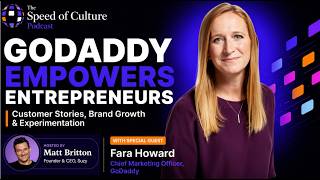
Farrah Howard, GoDaddy's CMO, built her career at Ben & Jerry's, Gatorade, Dell, Vans, and Amazon. She shifted GoDaddy from a domain registrar into a platform for entrepreneurs by using real customers instead of actors in ads, listening to thousands of customer guides, and repeating the message until it stuck: repetition is reputation.
Chapters
Up today, we're going to be speaking with Farrah Howard, Chief Marketing Officer at GoDaddy. Farrah, so, so great to see you, and thanks so much for joining today.
Thank you for having me.
Uh, you're welcome. We're gonna get started by just getting to know a little bit about you. You've had over 20 years of experience in marketing, raising from, uh, ranging from global brand management to creative campaign development for multi-billion dollar brands. And now you're at GoDaddy, obviously making a huge there. Tell us about your career journey that led to where you are today.
All right, I'm gonna take you all the way back.
Okay, let's do it.
I'm 14 years old working at Ben Jerry's, not as the world's youngest brand manager, just to be super clear. Okay, I was an ice cream scooper, but that first job really impacted me because I had an opportunity— although I didn't probably use the word brand at that time— but to work at a company that had a very powerful brand that was mission-based. Like even though I was scooping ice cream, I knew that I was affiliated with a company that had an aspiration of doing more for the world. And it was a really powerful feeling.
Did you know, how did you know they, at 14, that they had bigger ambitions than just selling ice cream?
I mean, everything that they did, right? Everything that they said, all of their, as an employee, I was exposed to a lot of internal marketing. And then a lot of the external marketing in the store, a lot of the ice creams and the donations from the, the brands, the sub-brands that they produced made me realize that this little company up in Vermont back in the day had an aspiration of selling more than just ice cream. And that was the power of both storytelling and brands. And so when I reflect back on that, in addition to probably eating far more calories in a given day than any human should ingest at 14 years old, I was exposed to the power of brands. And so you fast forward then greater than 10 years post, after graduate school, I had an opportunity to, to then pursue a career in brand management. So my first official job, although I could contest Ben Jerry's counted, was as a brand manager at Gatorade. And I started my career at Gatorade very intentionally. I felt like as a marketer, if I had a deep relationship with the product as a customer, I'd do a better job bringing it to market. I think that was completely true. But what I learned at that job and each job thereafter were some really important foundational skills. At Gatorade, I learned the power of really knowing your customer, watching them on the field, ingesting your product, seeing how it worked. I went from Gatorade to Dell, where we had an opportunity to partner back in the day. And at Dell, I had an opportunity to really get immersed in digital. It was 2004 and we were selling desktop computers on the internet. And fast forward 10 years later there, I was still learning a tremendous amount about digital advertising. I moved from Dell to Vans. And what Vans taught me is the power of a brand influencing lifestyle. Vans sell shoes and clothes, but ultimately they're about a lifestyle that is off the wall. And getting to tell that story. I was there for the 50th anniversary, so getting to tell that global story was a highlight in my career. I moved from Vans to Amazon Fashion, got exposed to rapid experimentation and innovation. And when I got a call now several years ago for an opportunity at GoDaddy, it almost brought me back full circle because GoDaddy is a mission-driven brand, right? They're about enabling and empowering entrepreneurs. And doing so digitally through the power of brand. So it really pulled from so many of my different experiences. And I've now been the CMO at GoDaddy for rounding the corner to 3.5 years.
I mean, those are all amazing brands that you worked at. I mean, Gatorade, I'm a huge sports fan and just what they've done to activate on sports and actually making you feel that when you're part of the Gatorade brand, you're part of a culture. Dell obviously broke around as being really one of the first direct-to-consumer brands. I mean, a story about me and Dell is I had a Dell and I went to pitch Best Buy, and at that point Best Buy was not selling Dell computers. And my client said, you cannot make this pitch, um, you know, on a Dell computer. So we went to Best Buy and bought an Apple, and at that point I'd never used an Apple, and I fumbled through the entire presentation. It was a disaster, but it was just It was crazy. It was actually going back to being true to your brand. It's almost like why would Best Buy wanted me to pretend like I knew how to use an Apple computer when I really use a Dell? Like it's just, that's how the agency world works sometimes. But then, and Vans obviously with the Vans Warped Tour and what they did to build their brand. Amazon's created a culture obviously within themselves and they're a force of nature. So I mean, you, you've been through all different types of companies. I mean, what an amazing career and, And now you're at GoDaddy, which is a company that, you know, it's interesting because GoDaddy is a company I think that probably needs to reinvent itself in this era. Talk to me about the work that you're doing at GoDaddy and what you see the opportunities are for that brand.
Absolutely. GoDaddy, like I mentioned earlier, is a mission-driven brand, right? Our ambition is to empower entrepreneurs everywhere and truly to make opportunity inclusive for everyone. And that means that we need to make it incredibly easy for entrepreneurs to bring their ideas to life digitally. Right. And by doing that through amazing products, commerce-enabled products, right. Just reflecting on what the past several years have asked of small businesses digitally, the world has been open and closed and open and closed. Yeah. And being able to do that for our customers with incredible— when I say support, I don't mean break-fix, I mean support like, hey, how do I do this next step in my entrepreneurial journey? And GoDaddy's customer care, we call them GoDaddy Guides, are second to none, best in the industry at really being able to help entrepreneurs bring their ideas to the world. Now, I would contest your point. The whole world doesn't know that vision of GoDaddy. And so, you know, as a marketer leading a marketing organization, that's a really powerful opportunity for us. And a challenge too, right? And a challenge, right? We have a brand that's incredibly well-known, very, very high awareness. They know us for domains. Great news. That's how a lot of entrepreneurs start their journey, right? You name your business, you plant that flag, and that first feels so awesome. And when you do that, you get exposed to all of the other capabilities that GoDaddy can help you with as an entrepreneur. And my job with my team is to tell more of those stories way upstream, right? Out in the world. So when people think about what it means to be an entrepreneur, they immediately think of GoDaddy. Those words are synonymous, entrepreneur and GoDaddy. So that's the journey that we're on.
I mean, it's crazy. I used GoDaddy way back in, I would probably say the year 1998 or '99. I registered lostandfound.com on GoDaddy and ended up selling the domain, but I probably have registered hundreds if not thousands of domains on GoDaddy throughout my career, but I've known it as that point solution to actually go register domain names. I did not know, frankly, about this new vision until, until recently. Frankly, I was doing research for this podcast. Some of the things that GoDaddy is doing now enter the area of Shopify and the area of Wix and Squarespace. And it makes sense because when you're on Squarespace, they're trying to get you to register a domain through them. And I actually, when I did that, was thinking, well, Why wouldn't GoDaddy just do the opposite? Because the domain's the first thing you do. So in terms of the customer journey, you own essentially the train station, so to speak, where you get on the train, right? The beginning of the rails. So there's no reason that you couldn't do these other things as well. And I imagine that was kind of behind the strategy.
It is, it is. And as customers' needs continue to change, you know, the train station's moving, right? And so it's really important for us that we, meet customers where they are with the products and technology that they need to power their business. So being an e-commerce player, being a payments player, having phenomenal website and digital marketing capabilities are all things that GoDaddy does for, for their customers around the world. And those are part of the stories that we tell both in advertising on godaddy.com and, you know, to our existing customers, to your point.
Yeah. And how does your company, I guess, keep its ear to the ground on what small business owners and entrepreneurs actually want in terms of the product roadmap and how you're positioning it, etc.?
So many different ways. One, we have thousands of GoDaddy Guides, care agents who talk to our customers millions of times a year, and we are constantly listening to what our customers are saying and feeding it back into our product development teams and into our marketing teams. That's one. Two, we do a huge amount of research, right? If I harken all the way back to my Gatorade days, you know how I learned about Gatorade? Watching athletes drink it on the field, seeing how much they drank, what flavor they grabbed when they were thirsty. We use that same analogy, right? You've got to be talking to your customers all the time, understanding what's working for them, what's not working, and build them products accordingly. And, you know, those two factors, listening and watching, ensures that you're able to serve them in different ways and serve them in better ways.
Yeah, I think it's super important and definitely something I think companies have put more to the forefront of their strategy is what's called customer centricity— is a word that's being thrown around. But I think for so long, big decisions were made in the boardrooms in terms of what's going to dictate the future of the brand. And obviously with the proliferation of social media, the future of brands isn't dictated in the boardroom, it's dictated on the sidewalks, it's dictated from the customer, from the consumer. So I think listening is more important than ever before, for sure. So we're gonna go into our next section called Culture Watch, and we're gonna go into 4 sections, Farah, that you've identified that you're passionate about and close to your business priorities to really help give our listeners some insights into your world. And one of the first areas that you talked about, and it's really a great segue from what we were just talking about, is the notion of customer-led storytelling. So talk to me about what customer-led storytelling is. And I imagine it all does start with listening.
It does. It does start with listening, but it also starts with truly putting your customers in the middle of the stories that you're telling. And I want to be super clear, stories aren't— they're not fables. They're actual real-life examples of your customer using your product to solve business problems. Right? So at GoDaddy, every single communication that you see from us features actual customers, right? They're not paid actors. They're people who are using our products and having amazing results as a result of using those products. So customer-led storytelling is— it takes a boldness, right? Because what you're doing is you're putting the keys to your brand in a customer's hands and saying, Talk to me about why you chose us, what it's like daily running your business, and oftentimes having them tell their story while you stand in the background, right? So GoDaddy is enabling customers to drive their first sale, to open their first retail store with point of sale. And the stories that we're telling are stories of Magpie, the vegan pie shop, not stories of GoDaddy Website Builder, right? GoDaddy Website Builder powers Magpie's Vegan Pie Shop. And so there's a patience and a boldness that is required when you actually let your customers do the talking for you.
Well, it's really the difference between advertising and content, right? I mean, advertising is about your unique selling proposition, your 350 horsepower, 30% more absorbency, whatever it may be. And you know, when you talk about the product functionality, I think that consumers will tune you out, right? Because it doesn't add value, it doesn't contextualize how your product can actually help them through stories that they can actually identify with. So when obviously if you're going through the lens of the consumer or the user, that's a whole different framework. But I imagine that also changes the way that you work with agencies, because a lot of the brands you've worked at in the past, I'm sure you've been on the other end of big glossy agency pitches where they come up with this big creative idea, but I would imagine this customer-led storytelling is a bit more gritty, right? And it's through there, right?
I love the use of the word gritty because you'll often hear me say, we need to go rub a little bit of dirt in this story, right? Because entrepreneurialism isn't perfect, right? Customers aren't perfect. And you want to tell real stories that actually generate an evocative response from your audience because they can feel that tension. They can feel that Wow, bringing your idea into the world is hard. It's not pretty.
It's not— authenticity, right? Isn't it? It's all about authenticity.
Yeah. And to the point of agencies, you know, I've worked with a lot of agencies throughout the year. I spend— or throughout my years, I should say, right? I've spent the majority of my career working largely with in-house agencies that then periodically will rely on external agencies to open their aperture. Because if you're actually letting your customers tell the story, You need a really great brief, really good direction, and a lot of patience and a willingness, like I said, to acquiesce control. Where traditional agency work back in the day, 15, 20 years ago, was very polished and very controlled. I can tell you stories of shipping a box of Vans outdoor apparel to two athletes with two iPhones and said, make me a commercial. Here's the brief. They brought back thousands of clips of content that we edited in post-production to tell a beautiful story of how that product performed out in the wild. Right. But it was, you know, it was a story that would have been, you know, years ago, quite uncomfortable for, you know, a traditional team.
Of course, because back then the way that those videos would get distributed was over television, which was all produced. So juxtaposed against a rom-com, right? Or against, you know, Seinfeld. It has to be well produced. But now your content is living obviously in linear media, but more so in places like TikTok where the content that consumers are going for is at its core authentic and has to be gritty and has to be believable. And it can't be too glossy or else it's gonna look too much like an ad. And that, and now consumers have the power to just flip right by it. So I mean, since you and I have both been in our journeys, like we've been through, I think the last 20 years, you think about the advent of the iPhone came in 2008, like, you know, social media, these massive things that have come on, you know, to society and culture where nothing like that had come on the 20 years prior. So like we've really lived through a lot in terms of navigating this world. It's been, it's been wild. It has. Especially at the brands you've been at. So, and I guess one of the questions, so you worked at Amazon and You know, Amazon is a company that is known for its culture, not always the best parts of its culture. I mean, obviously they're incredibly successful and people that have worked there have said, you know, that it's not necessarily a pleasant place to work because everything is on results. Everything is on maximizing every dollar in ROI. Like, was that your experience there? What was your experience working within a company like Amazon?
One of the things that I loved about Amazon is how disciplined The culture was, yeah, for anyone who's done any research on Amazon or has worked at Amazon in the past, you'll hear people talk about a document culture, right? If you have an idea, it needs to be written down. You need a really tight business case, a tremendous amount of data to attempt to prove what you want to build and why. And then, you're actually held to that as you start to build and deliver. And I personally, really enjoyed that part of Amazon. One story I'll often tell is when I walked in the door to Amazon Fashion, I was given a stack of documents, probably hundreds of pages of documents. And I've got to tell you, it was the fastest that I onboarded at any company because I was able to learn so much. The written word democratizes learning and makes it so easy.
Sure does.
I had to work a little bit harder to get close to customers. Just because the pace was so fast and was so digitally focused. But as a lifelong marketer, the team that I worked with there, you know, we were constantly out in the field. It's one of the benefits of selling a very tangible product like fashion. So we were able to, you know, to get to customers as well and really understand what was working for them and what wasn't.
And in terms of the power of the written word, I read once that one of the things that at least Jeff Bezos did is he told his executives to write a press release Uh, like years into the future. So if it was a success, what would the press release say? And then just work back to that press release, which I think is an amazing insight and something I've definitely embraced in my career.
I agree.
So we're gonna move on to using live events for strategy building. Now we were just on the call with Susie talking about live events and trade shows and how successful they've been in the first half of the year for us coming off of a 2-year period where you know, we didn't do much live event activations at all. How is GoDaddy looking at live events and more specifically things that you've done with organizations like South by Southwest?
Yeah, live events remain really important. They build communities, they connect customers, they connect customers to brands and customers to each other. So live events are a big part of how we go to market, whether that's showing up at WordCamp where we're engaging deeply with the developer community or running an event like GoDaddy Open, where we're engaging and launching new products with our customers. What we've learned in the past several years, and I think, you know, many who are listening to this podcast today can attest, what surprised us is you can build connection digitally too, but that doesn't supplant physical. So, our assertion is, as the world continues to open up more and more, we'll do both, right? What we also are learning is, regional events really matter, right? So being able to connect with communities of entrepreneurs and understand what their specific needs are in a region and being able to help train and support them, it can connect much deeper to that audience and build better bonds. You mentioned South by Southwest. As a fellow Austinite, you know, where I've spent nearly 12 years of my life prior, South by Southwest is such an amazing celebration of creativity and, and sometimes of brands if they're telling stories in really creative ways. So our involvement at South by Southwest was an opportunity to really celebrate our customers. So we participated this past year and we're lucky enough to have a documentary of one of our customers show up at South by Southwest. And we were just thrilled with the results.
I love that idea. Very cool. And of course, being an entrepreneur is all about experimentation. And I would imagine at GoDaddy, as well as some other places you've been in your career, you've had experiments. Sometimes they work, sometimes they don't. It sounds like GoDaddy is going through a period of rapid transformation now. What is— what do you see as kind of like the good part of experimentation that should be embraced in an organization? And how has that driven some of your recent work at GoDaddy?
Yeah, it may sound trite, but experimentation teaches you how to lose. And being able to learn from losing. I know those words sound hard, right? Folks are like, "Huh, losing?" But at least a third of experiments don't win and a third are neutral. And then a third, you win and you learn. And so, what experimentation does for a culture is it enables you to take risks, right? Because risks inherently have some, you know, pardon the pun, but some risk of loss. And so for us at GoDaddy, experimentation has been really important in propelling our business forward because with each loss we learn and with each win we learn. And so we have to celebrate both. And it makes us, makes us better at serving our customers. It makes us better marketers too, because it increases our risk tolerance.
Absolutely. And I think after I was talking with Gail Troberman, uh, who's the chief marketing officer for iHeartMedia during the last podcast episode, and we were talking about the fact that experimentation's great, but what companies don't do enough of is after they experiment with new ideas and after they find that one thing that works, instead of doing that one thing over and over and over again, right? And optimizing over time, they're onto the next thing. And I think, you know, we are in a world where the shiny object is so very appealing that sometimes companies never get that one thing great because they're afraid of the repetition and doing things over and over again. And you, you have this quote that I, I came up in during my research over and over that repetition is reputation. So when I read that, my mind immediately went to that, um, you know, conversation I had with Gail. So I mean, I guess what are your thoughts and what does repetition is reputation mean?
Yeah, I feel really strongly that brands are built through consistency over time. And I'll often say a brand is not that different than a person that you have a close relationship with. Yep. Right? Like, you know this brand, you know what you can depend on them for. You may know what they're going to say and how they're going to act and how it's going to be. Right.
Sometimes people say things and you're like, that was off brand for you to say. You even use that phraseology when you talk about people.
Right, right. And so being able to build on a foundation of trust and consistency comes from repetition. And with that repetition, you build a reputation. Now, that doesn't mean you sit completely still and you're stagnant. And actually, if we tie it back to experimentation and you really evaluate the scientific method, which is changing one variable slowly at a time to figure out what drove change. You can maintain a really strong foundation of a brand.
But you need patience, right? You need patience to do that.
You do.
Because it could be a couple basis points at a time, but over time you keep doing that and down the customer journey you're optimizing and next thing you know, you're 30% better. But it's not going to happen overnight.
Exactly. And in fact, you made that change in a way where you brought your customer along with you. So you're still recognizable. Despite the fact that you've made changes, right? We can think of so many examples in our life from a user experience standpoint where a product that you just knew how to use so well, you open up the application the next day, it feels totally different. That's an off-brand experience too. So small changes can make a big impact and enable you to be, to be repetitious in a way that actually bolsters your brand. And it's something we all have to remind ourselves of as marketers because we're so anxious to tell that next story. But I promise you, we fatigue of the stories that are in market long before our customers have even heard them. So we have to remember to continue to repeat so that you are known.
Yeah, totally aligned there. So lastly, I mean, it seems like everyone's calling themselves an entrepreneur right now and, you know, we'll see how that plays out into the future in this uncertain economic environment. Right. But You know, the identity of being an entrepreneur, like, how do you define that? And what does it mean to your audience? I mean, do you think anybody can be an entrepreneur? And is Goddard's definition of an entrepreneur just anybody who wants to do a side hustle? Or are you really, I guess, zoning in on people who really have that as the focus, core focus of their career?
It's a great question and a hard one to answer. So I'm going to pull it all the way back to the origin for every entrepreneur, right? Every entrepreneur was a solopreneur once, right? Yeah, every, every business started small. And so GoDaddy has the ability to support the solopreneur, the person with an amazing idea, like literally standing on their own, to a small business that's selling over $1 million of cheesecakes a year. Like, they all started from that same place. If we hearken back to We were talking about South by Southwest earlier, like Sherrilyn Yazzie, who runs Coffee Pot Farms. She's an entrepreneur. She is a farmer affiliated with Navajo Nation trying to help feed a broad population, right? That's an entrepreneurial concept that oftentimes people may say, well, is that a business? Yes, of course it's a business. It's a very different business than the Furlow sisters who are selling cheesecakes. But right, the same principles apply. Same principles, right? Same principles. They have an idea, they have gumption and ambition, and they need tools to bring their idea into the world. And that's what— that's who GoDaddy serves. And that's what wakes us up every day excited about what we're doing tomorrow.
Awesome. Well, it's definitely an exciting time, it sounds like, to be at GoDaddy just because, you know, I think the timing is right. I think the pandemic obviously accelerated a lot of these digital transformation trends, and it's made a lot of people think about their futures and, you know, has been quite empowering for a lot of people in terms of, you know, taking their future into their own hands. And it sounds like that's sort of the platform that you're trying to create again, moving from that point solution of domain registry to being a true platform, you know, for the entrepreneur, which I think is very exciting. So it's very cool. So as a closing question, you know, we obviously covered a lot of ground and obviously I just from hearing you, you obviously move so fast and you're thinking about a lot of data and optimizing, etc. But But from a personal basis, what slows you down in this fast-paced world? What do you do for any type of peace and relaxation?
I'll answer you succinctly and then I'll tell you how. My family slows me down in a great way. I have 3 boys. They're nearly ages 11, 12, and 13. And my husband and I spend a tremendous amount of time with them. And in terms of slowing down, Right? It's hard to slow down, particularly now, right? Our home lives and our work lives are intrinsically merged together in ways we would have never imagined 3 years ago and/or 2.5 years ago. And one of the principles that I use to slow down is called toggling, right? Like literally, like when we toggle at work, we toggle between applications and you can only work on Word and then you can only work on Excel. And that simple premise of only doing one thing at a time really helps me slow down. Like when I walk away at the end of the day to go shoot hoops very poorly because I'm 5'3" with my son, who's a phenomenal basketball player, I am only doing that. And, you know, at the end of the day, when I'm reading my 10-year-old a story at night because that's what he's wanted since he was a tiny, tiny kid, I don't have my phone in my pocket yelling at me. I'm wholly present for them. And I am going slower, but I'm actually getting more done because I'm only doing one thing at a time. And it truly, it, it makes me whole. It helps me at work. It helps me in life. And man, over the past several wild years that we've been on, it's helped me find some semblance of balance amidst all the crazy.
Well, it's definitely inspiration. I think it's, it's applicable not only to our personal lives, but also our business lives in terms of we can multitask and do all these things, maybe not as well as just focusing on that one critical task that you need to move your business forward. Absolutely. Great. Well, thank you so much for joining, uh, Farah, on behalf of the Suzy and Adweek team. This has been amazing, and I know that a lot of our listeners are getting a ton of value. Um, be sure to subscribe, rate, and review us on your favorite podcast platform. Uh, on behalf of myself, Matt Britton, and the Speed of Culture podcast, we'll see you soon. Thanks so much for joining. Take care, everyone.
More from Matt




MikMak’s Rachel Tipograph on Consumer Spending, Retail Media & Holiday Shopping Trends



Jaguar Land Rover’s Charlotte Blank on Luxury, Purpose & Experiential Storytelling



