H&R Block’s Jill Cress on AI, Digital Tax Filing & Brand Relevance
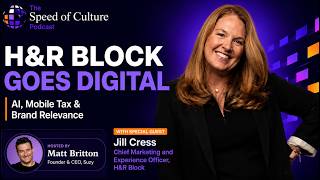
Jill Cress, H&R Block's chief marketing officer, left PayPal to tackle the company's "crisis of relevance" as a legacy brand. She's rolling out AI-powered tax filing, a mobile banking app, and a Gen Z reality show called "Responsibility Island" to transform H&R Block from a retail tax service into a year-round financial platform.
Chapters
Today we're thrilled to be joined by Jill Cress, a consumer marketing leader with 30 years of experience under her belt, including over 2 decades at MasterCard. Today Jill serves as Chief Marketing and Experience Officer at H&R Block, and we're thrilled to have her on the podcast. Jill, so great to see you.
Hi Matt, so great to be here. Thank you for having me.
Absolutely. So, you know, I was looking at your background and It's so interesting because you, you spent so much time at MasterCard kind of like early on in your career. And I would imagine just given the, the platform that MasterCard has in terms of its merchant network, its reliance on consumer data, that was just a such a great experience for you in terms of widening your palate in terms of knowledge as a marketer.
Absolutely. It was an incredible opportunity to grow as the industry was evolving and fintech was becoming what it is today. Yeah. In the 20-plus years I was at MasterCard, when I joined, it was a not-for-profit association.
Wow. That—
I didn't know that. Yeah. An association of bank issuers and merchant acquirers, and we were really connecting buyers and sellers through that network. We then became for-profit, and then we had the push towards a quite successful IPO and then had the time working there after the IPO where MasterCard really embraced the data and knowledge that it had on consumer behavior to diversify its business. And it was a, it was an amazing place to grow up as an executive and also as a human being. It really allowed me to to grow in so many ways.
Yeah, I find that so many younger employees just feel the need to jump around every 3 years or every 2 to 3 years. And I think, you know, I understand the value in that because I think a lot of younger people don't feel like they have the opportunities to advance. And the only way they could advance is by switching. And that's, I guess, a relatively new phenomenon. But at the same time, I just think there's such value at really sinking your teeth in a business and understanding various aspects building deeper relationships?
Yeah, again, I feel really fortunate in that Mastercard was a very supportive environment for me in the way that I thought about my development. And I think I was pretty intentional about wanting to continue to grow, to take on expanded roles. I did lots of zigging and zagging and taking, you know, moving horizontally across the company, moving geographically. And I think being clear on what it is that you're looking for, and if you're fortunate enough to work in a culture that is supportive of that growth and you can find ways to grow— Mastercard was a growing company. It was on the precipice of lots of new things over the course of my tenure there. I joined to launch debit cards, which were nascent at the time. I then was— actively involved in launching some of the very first co-branded cards in the world. I had an opportunity to move to Europe where I worked on mobile payments and leapfrogging the gap in technology that existed in Europe through telecom infrastructure. And so there was always something new and challenging, and that created a really interesting playground for me to take risks and to learn. So I feel fortunate that I was able to grow there. I had, in the 22+ years I was there, I think I had 13 roles— local roles, regional roles, global roles, strategy, product, marketing. So it was a really robust environment for me to grow and make an impact.
Yeah, it's interesting because the credit card space, you know, when Apple came out with Apple Pay, um, I remember was doing work with some of the large credit card companies. I remember thinking like, is anyone ever going to carry a physical credit card again? Because you're just going to use your phone. And we're, we're not there yet. I don't think the consumer behavior of just tapping your phone on everything has caught on quite the way we thought, but it's definitely heading that direction. Where do you see the future of the credit card industry, both in form factor and in consumer utility?
Yeah, well, I think it's really broader than, you know, we— it was credit card was the category. Right now it's payments and all, you know, the things that you reference, the, the form factors and the ways to pay. Interestingly, when Apple Pay launched, a big part of what fueled an Apple Pay transaction was Mastercard technology. I actually worked on some of that. And then, you know, while I detoured over to National Geographic, and we can talk about that, but then I was at PayPal where mobile apps and driving more engagement and payment through those apps was the value prop that we brought to the market. And You know, it was interesting. I think that there were a few things that were happening that were driving large-scale adoption of largely mobile to conduct transactions. The, the big one I think was what was happening in transit and in the UK, for example, when Oyster embraced mobile technology, you just saw a huge adoption of Apple Pay in the UK. I was, we lived in the UK for a while and I was spending a lot of time there and to see, you know, massive shift from what were prepaid Oyster cards to enable transit and entry into the tube to the proliferation of Apple Pay to, you know, be a streamlined, significantly less friction, how would you say, a frictionless experience. Yeah, and you know, similarly, I'm here in New York and you see it with, um, New York Transit here as well. And so I think as, as mobile payments can facilitate a more seamless experience for consumers, you see, you see much more adoption. And I think the, the beauty of being able to leave your home with just your phone, knowing that you have the ability to engage in commerce with it is a really exciting thing for a lot of consumers who just want to have the phone as their primary device. I mean, there's all sorts of crazy data, right? People would rather lose many things than, you know, versus their phone. Yeah.
I mean, you know, some would say their teenage daughter would rather lose the hand that's holding the phone than the body.
Very, very sad statement. But, you know, and I think that, yeah, the proliferation of phones At H&R Block, we have launched a mobile banking app that is working hard to serve our hardworking Americans who need a solution that is less expensive than traditional banking. And we see when we add more utility through, you know, savings tools and things like that, offers, discounts, we're really creating an experience that delights the consumer and creates a more sticky relationship with with our brand, which rides the— our card is— our payment— let's not say that. Let's do a re-record there. We enable payments through our mobile app through MasterCard. And it's just as consumers do more on their phones, they're going to use those to pay more. And I think that is really the form factor that is winning and will continue to win.
Absolutely. I mean, curiously, how much cash do you normally carry when you leave the house?
Yeah, very little.
I have zero. I have a few like crippled up $1 bills, but I really just don't carry it with me. Um, I'm afraid I'm gonna lose it. I usually leave it in my pants and it gets washed in the washing machine. I'm just not used to it. Like you have your keys, you have your wallet and your cell phone. A lot of people have their wallet connect to their phone and I think keys are gonna be gone one day too.
And your wallet.
Like there's no reason that you really need anything but your phone.
Absolutely. We just bought a Rivian. And there's no key in the Rivian. We have— we use our— you open it through the app. I suspect other electronic vehicles are the same. So yes, it is very interesting. I travel a lot. And so I often feel badly when I— engage with someone who needs a tip and I'm not able to tip them because I don't have cash. Actually, when I was at— we need a solution. Actually, when I was at PayPal, we, we worked on, um, a QR code solution to facilitate gratuities, which was, I think, an interesting use case. The other thing that I will say, and this was really indicative of the time that I spent at PayPal, was COVID really, really accelerated the comfort that more consumers across different demographics had with mobile and electric, uh, electronic payments. Um, you know, we saw explosive growth. Everything had to be done via e-commerce, and you had a whole new entrant of consumers who were embracing online shopping and learning how to use mobile banking apps and, and things like that.
Yeah, I mean, PayPal is interesting. I mean, I I was an early adopter of the internet because I came out of college in, you know, very late '90s, early 2000s. And that's when the internet was first becoming a thing, right?
Yeah. Yeah.
One of the first websites I used prolifically was eBay. I was just always fascinated with eBay. Oh, yeah. PayPal, I think, was acquired by eBay at one point and then spun back out, if I'm— if I'm not mistaken.
Yeah. And PayPal was the enabling payment technology to— right, that's right, to, you know, with the— they refer to it as the PayPal Mafia, you know, Peter Thiel and Elon Musk and others who built that technology. And yes, then it was spun off and there was a separate IPO for PayPal as a standalone company.
Yeah. So when I think about PayPal, I mean, they've been around almost as long as the internet itself has. When you joined in 2019 to head their consumer marketing. I guess given that it was a— it's not necessarily like a startup like Facebook that started in 2005, and this, you know, this is a company, um, that had been around for 20 years. So when you go there, I guess you don't expect it to have that like, you know, real startup vibe because it's a more mature organization. What surprised you about PayPal in terms of their innovation, and what do you think some of the opportunities they still have in the marketplace to still achieve?
It was a really exciting time to join PayPal as they were looking to do more than just facilitate commerce. And, you know, it did have a very— I guess I would say it was more of a tech-forward vibe, which I think felt startup-y to me. I mean, certainly based on the, you know, growing up at Mastercard, which while very, you know, technology-oriented, grew out of banking, and it felt a little bit more conservative from a culture standpoint. And then I was at National Geographic in the entertainment space. And when I landed at PayPal, I found the energy to feel similar to the tech companies that I had partnered with and having spent time at Facebook or Google or other tech-forward companies. And so, the energy was great. The then CEO, Dan Schulman, who took PayPal, led the PayPal IPO in separation from eBay, was, you know, he was not the founder, but he had a founder-like energy to him and really worked hard to rally the troops, to inspire culture. And that's what made it an exciting time to be there because we were really working to expand to do more jobs. We launched crypto while I was there. We launched installment products through our buy now, pay later.
And that's the COVID boom as well in terms of e-commerce.
Exactly. Yeah. And so, it was very much a aim for the fences culture rally technology resource and capacity around growth. And it was very, very energizing.
That's awesome. And then you made the decision in 2022, so a couple of years ago, to leave PayPal to join H&R Block. Why H&R Block? I guess what, what led you to make that decision? And tell me a little bit about your role there today as Chief Marketing and Experience Officer.
Yeah. So I received a call from a recruiter who had placed me before, and he said, I've got this great opportunity. You have to, you have to take a listen. And he said H&R Block. And I thought, huh, that's interesting. Taxes, Kansas City, I don't know. And he said, you know, it is a company that is very much in transformation, which is something I really enjoy. It was a big reason why I chose to leave MasterCard and go to National Geographic, which was a joint venture really going through a digital transformation. Anyway. I, I liked what the recruiter had to say. And so I met the CEO, Jeff Jones, who grew up as a, a very iconic marketer. He was the chief marketing and experience officer at Target. He worked at Gap. Coca-Cola had a short— very impressive, very impressive, and very consumer-centric. And the thing that was really exciting was the transformation, the focus the consumer, the focus on digital products and solutions, and diversifying our product experience to do more jobs for our tax clients so that we could be a year-round company. It was the Chief Marketing and Experience Officer role, which I had had experience roles. I'd had brand roles at PayPal. I learned growth marketing on an epic scale at one point in the, in the peak of our consumer growth there. We had 400 million consumer relationships around the world, and we're, we're really focusing on new client growth. So it was really this interesting opportunity to bring the things that I enjoyed doing— brand building, uh, growth, marketing, transformation, digital products, experience, uh, into a role that was designed to do just that for a chief marketing and experience officer that had a seat at the table reporting directly to the CEO, and I am having such a great time. I am, uh, feeling so fortunate to be in this role, to be, uh, empowered to swing for the fences there, to take some bold risks as we work to really address what is a bit of a crisis of relevancy, which I find to be a huge opportunity from a brand experience standpoint, understanding the, the tailwinds and headwinds on our brand reputation and how we can think about continuing to drive real transformation to, to win in this, in this space. We are— we really— H&R Block built the, the tax category, and we're here working to continue to energize it and revitalize our brand as the best way to facilitate that tax experience and, uh, do other things like provide those financial solutions through our mobile banking app and do more jobs for small businesses.
That's great. And when you talk about a crisis of relevancy, um, I guess, can you unpack that a little bit? And how do you believe that H&R Block got to this crisis? And I guess, how do you plan on, or how are you digging the brand out of that?
Yeah, absolutely. H&R Block is a nearly 70-year-old company. It was founded by two brothers, Henry and Richard, hence the H&R, Henry and Richard Block in Kansas City, who observed that the tax experience is intimidating and overwhelming and that they could take some of the, the pain out of that and provide more help through creating a network of experts who could, who could help to facilitate that. And we have really built our business around that purpose of providing help and inspiring confidence around this very challenging moment that, as we sit here on April 4th, we are, uh, knee-deep in pushing towards the tax deadline of April 15th. Exactly, exactly. And so we built that expertise and care through building that human relationship. H&R Block has around 9,000 locations that are open during tax season and close to 60,000 humans that are facilitating that experience between client and, and expert to facilitate the tax return. For most Americans, it is the most significant financial moment of the year. That's because 75% of Americans get a refund, and for many of them it is a critical influx of cash, or it can be a vehicle for creating savings for surprise and delight moments through the year. And our reputation was built on that human expertise in the retail experience. At the same time, as the world became more digital, and this really gets to the crisis of relevance, H&R Block launched really great digital tools. And you can work with H&R Block and get that same expertise and care without the need to work with a human, uh, in a, in a retail environment.
Perception of consumers is You have such a strong retail presence. Exactly. As, oh, this is the company that you go in and wander in their retail establishment on Main Street to get my taxes done when people use digital. And you're saying you do have that and there's just that lack of awareness or understanding.
Well said. Way to shortcut it. That's exactly it. So, you know, we've got 90+ awareness, 90+ percent scores in trust, but that is very much associated with that retail experience. And so You know, you can do the, the same thing with H&R Block as you can with our biggest competitor. You can do your taxes online and use, you know, virtual, virtual help and have access to a product we launched this year, an AI tax assist, which can bring that expertise. So we serve 20 million clients every year, and about half of those are through the traditional tax expert experience in either retail or virtually, as we're talking now through a virtual experience. And then we serve about 10 million through our digital product experience. And that is really the crisis of relevance, which is how can we continue to be known for more than just our legacy and really create awareness of the delightful digital experience that we can provide? And, you know, we really took the gloves off last year and just, you know, looked at how great challenger brands have challenged the category and really started to take, you know, take aim at the competition and actually use the equity that, that exists there in comprehension of what it means to do your taxes online in a trusted way. And, um, and we're starting to challenge the category.
Yeah, it's not unlike Walmart where, you know, they were late to get into the e-commerce game and now they're really stepping on the gas to get in the e-commerce. And most people know Walmart through their physical retail experience, and, you know, they have the right to play in the space and compete with Amazon. It's very much like the space the urine, right? Trusted brand, almost 100 years old. And, but you, you guys have the technology to go forward. So it's interesting because it's like, you know, once you were the institution and now you're almost trying to be the revolution, right? You're trying to fight against, um, I guess more established players in the digital side of tax prep space.
Yeah, you're exactly right. And Walmart is a great example, Matt. I look, look very closely at Walmart, what Walmart is doing. William White is Yeah, very inspiring. He's amazing. And another former, you know, Target exec. And, you know, I think their approach to Omni has been really inspiring. And I love and take a lot of inspiration from the way that they have told their digital story through content, the way that they bring their UI into that and show the simplicity of it. And, you know, we are looking at, at brands like Walmart and others who have gone through that transformation to help inspire how we tell our story, because that's really what it comes down to, which is really breaking down those barriers and perception and, and, and getting people to, to consider us. And so our, our campaign this year is all about switching, making the switch to H&R Block. We reference, you know, the places you can switch from, largely our competition, whether that be an independent tax preparer or TurboTax.
Yeah, we've had a lot of heritage brands on the podcast. We've had Cadillac and you know, Tropicana and these brands that have just been around for so long. And, you know, speaking to CMOs like yourself at those brands, it's just a really interesting challenge to try to contemporize the brand, hold on to the trust and equity on what got the brand there to begin with, but at the same time slowly change and alter the perception of the brand so you can actually modernize your, your business approach and take advantage of new opportunities.
For sure. Yes. And a lot of that really Oh, go ahead.
No, go on, please, please.
What I was going to say, a lot of that has really come down to the thing that drives, I think, great brand positioning and product development, which is what is the data telling us? And so really looking at, you know, who's using and really delighted by H&R Block, and, and where do we have an opportunity to grow? And so one of the things as we've been challenging the category and disrupting ourselves has been the effort that we have, uh, embarked on, which is to win disproportionately with new entrants into the category, which is Gen Z. And, you know, working to understand what are the headwinds that we have with that audience from a perception standpoint, and where, where do we need to meet them to introduce our brand in new, more relevant ways to get them to consider and, and choose us. And, you know, that has been rewarding in that we're moving the needle there, but it's also really inspiring our customer experience, marketing, and comms folks who sit within the, the world that I manage to, um, to try new things. And, and we've had some fun with that.
Yeah. And, and speaking of sort of innovation, um, I read a story, an interview of you recently in Wall Street Journal, and one of the things you mentioned in that interview, uh, was the AI tax assistant.
Yes.
And obviously You know, I'm surprised we've gone now almost 25 minutes of this podcast without mentioning other, um, it's almost like the drinking game where you take a shot every time that somebody says AI in, you know, in a business day. And soon I feel like it'll be so ubiquitous, it'll be almost like digital where you don't even need to differentiate it. But obviously we're in that disruptive phase of AI, and obviously your industry, I would imagine, has both, you know, tremendous threat and opportunity with the AI revolution. So I guess What is H&R Block's strategy in this space, and how do you see things unfolding over the next year?
Yeah, we are really excited about the momentum and the fact that we are really operating at scale with an AI solution at this point. So, we worked with, you know, let me start that over. We worked cross-functionally with our CIO and our product organization to look at, you know, what jobs could AI do for us, and at the same time, Microsoft and their Azure team were looking to partner with different, you know, different companies that they partner with to bring different use cases to life. So we were really delighted to be a part of a pilot program with Microsoft and to work with them and leveraging their technology and understanding of large language models to bring our AI TaxAssist to the market. And it was, you know, a consumer experience that was envisioned through the things that we know matter to consumers, which is, you know, providing that expertise and answering questions in an easy and efficient way. And, you know, essentially what we've done is taken that corpus of knowledge of, you know, 70, near 70 years of tax preparation and continuing to build and train the model to answer the most basic questions in a way that makes the process more efficient, makes it easier for consumers, you know, keeps them engaged in the product and doesn't take them out of the product once they're in a, you know, a chat experience and they need to, you know, to get more information. So we, we had a big sprint to launch AI Tax Assist. It was a huge cross-functional effort with our team of, you Yeah, designers, product, technology.
With data privacy and all those concerns that you have with financial information, I'm sure it was no small feat.
Absolutely. And navigating hallucinations and how important those questions are to consumers who are using it. And yeah, so it's launched. It's live. We have seen really good engagement with certain audiences, Gen Z being one who very much is embracing AI and using that to facilitate that that promise of our brand, which is we're bringing expertise and care to those clients in a way that is, you know, leveraging new technology to do that.
Yeah, it's really exciting. Another thing that you've been behind in the last, I guess, couple months was this reality show that you created called Responsibility Island, which like I have to say, when I first saw it, I had to— I did a double take and then I read into it. So much sense. Um, I'm sure you never thought when you joined H&R Block that you'd be behind the production of a fake reality show on a tropical island, but, uh, how did something like that come about? Um, you know, what's the process behind a campaign like that? And I guess what are some of your learnings now a couple months since it's been launched?
Yeah, I certainly never expected that. It was funny, the other day TMZ referenced Responsibility Island and close the segment saying it makes me want to do my taxes with H&R Block.
And I— that officially make you cool when he's referencing a campaign you built?
I think so. I mean, I certainly, you know, I shared with my team and with our CEO, you know, two references that, you know, I didn't expect to live together in a positive way were H&R Block and TMZ. But, you know, here's where we were again, starting with the data, knowing that we had to win with Gen Z. Last tax season, we created a lot of short-form content. We really embraced TikTok and we were able to meet that audience in ways that were, were fun, but also, you know, educational and, uh, and entertaining. And, you know, I think with so many things where we push boundaries as marketers, there is good fortune involved. And so fortuitously, the writers' strike served us really well. And that while writers were not able to write properly for entertainment, they could work for brands. And an old friend who I had been trying to work with for years said, hey, I've got a bunch of writers who, you know, wanna do some branded content while they can. Let's get in a writer's room and, you know, understand what your problems are and come back with some solutions. And that got us to Responsibility Island, which was again, a data-driven approach looking at what kind of content Gen Z and younger millennials consume. They're all about Love Island and Love Is Blind and other reality television. And the concept was, well, what if we can take some young people to an island under the guise that they're there to get lit and have a good time, but they're really there in a lesson in responsibility. And the only way they can get off the island is to do their taxes. And so it was a 4-part microseries, 4 5-minute episodes where we introduce a, uh, selection of, you know, young singles who are taking on some responsibility challenges like doing their own laundry. And kind of the, the, the penultimate of the experience that they have to do to get off the, the island is to do their own taxes. And so we introduce our online tax experience, we introduce AI Tax Assist, and, you know, it's been really fun. It's, it's done a lot of, uh, it's done a lot of jobs for us. Yeah, it's, we've, we've launched it on Roku, uh, YouTube and our own.com and we are seeing really high engagement with it and conversion into our DIY product. So that's great. But the other job that it's doing for us is helping us to learn how to test responsively, how to really look at an opportunity and challenge the status quo in the way that we've gotten at it and to embrace a learning journey. And, you know, to take some risks. One of our values is to, is just, you know, we've got enterprise values to, you know, stay curious and to be bold. And so, you know, doing these things within measure is teaching our organization that it's okay to experiment and we need to, we need to, you know, test and learn as best we can.
Absolutely. When you talk about crisis of relevance, I mean, obviously getting quoted in TMZ is a great step towards solving that, especially with a younger audience.
So.
You know, kudos to you for taking a brand like H&R Block and, and making it cool. And, you know, if you— I would definitely encourage our listeners to check it out because it's very well done and actually pretty quite funny. So, um, yeah, um, as we wrap up, Jill, um, you know, you've obviously had a great career and you've leaned much into the financial services industry. And I never even got to ask you, like, is that a place that you always thought you would be, or you kind of just stumbled into it?
Such a great question. What I've always been really curious about consumer behavior. My dad worked at Quaker Oats when I was quite young, and I was really fascinated by advertising and the way that they launched new products. And I dreamed of being a marketer. I was writing jingles since I could, could write. I studied, I studied marketing, and I, when I graduated, it was one of the previous recessions. I had a job with a CPG company in the beauty category. I was absolutely delighted. And that offer was rescinded. I was gutted. And I thought, here I am, a college grad. What will I do? And I actually started my career in banking. I worked at a regional bank in Chicago, which is where I am from. And I was learning commercial banking and making the best of it. And the CMO of the bank went on maternity leave, and we were launching a MasterCard product. And I raised my hand and said, can I work on that product while she is on maternity leave. And that was, you know, a real pivot for me in helping me to ultimately get to a role in marketing. I started working with MasterCard, and ultimately that was my entrée into working for them. And so it was not so much financial services as the thing I was passionate about. It was storytelling, value prop articulation, launching new products that really energized me. And I then just became really passionate about people's relationship with money and continue to choose places where I can bring that expertise that I have and continue to drive for differentiation and transformation.
Absolutely. So looking back on your career, Joan, and all the places you've been, we've talked about your stint at— longer than a stint, you know, so for some people, entire career at MasterCard. Um, you work at National Geographic and PayPal, now of course H&R Block. What are some of the things that you think you've done right along the way that has set yourself up to be in the CMO seat today? It's such an iconic American brand, um, and maybe that some advice that we can impart on some of our younger listeners here at the podcast.
Yeah, I love that question, Matt. I would say the first thing was consistently raising my hand. I do a lot of coaching and mentoring, uh, that is very much core to my purpose. And I always share the following, which is: understand what you're really great at from a competency standpoint, be clear about the things that you're passionate about, and understand how those play into what matters at the enterprise that you're at. And it kind of makes a really nice little intersecting three circles. And, and when something matters to the enterprise, you're good at it, and you have passion for it, raise your hand and lean in. And that was really, I think, the thing that I did with a lot of confidence at Mastercard to say, this is happening. You know, it started with asking if I could, you know, fill in when the CMO took a maternity leave. Raise your hand. It doesn't always happen, but—
Great advice.
And, you know, and I think if you do it through the lens of what matters to the enterprise and how you can bring value, you'll often get a fair hearing and create a path to doing a growth project or providing some sort of support in a task force, etc. So that would be the one thing. And then the other thing is, I know it, it sounds trite, but I took a lot of, a lot of lateral moves to learn new skills, uh, and to be really looking at what's coming at the thing that you're doing and, you know, learning how to be great at it. You know, when digital started to happen, I was, you know, saw what was going to be possible in the way I had no idea now in the way of consumer engagement and attention and consumption across new social channels. I was intimidated because I was not a digital marketer. I was more of a strategy strategist. I was, you know, really great at value prop articulation, but I really pushed myself to be uncomfortable to take on a digital marketing role. I worked on building priceless.com when I was at MasterCard, and I remember going to meetings with our agency and, you know, they said, okay, now we're going to look at wireframes. And I was like, oh my gosh, what's a wireframe? You know, so I think it's like being, you know, being vulnerable but clear about where you need to grow and, and what you need to, what you need to learn.
Absolutely. And with that, Jill, is there sort of a mantra or saying that you like to live by in business that you can think of?
Yes, I always say, let's start by starting, you know. And I think that's true of disruption or something like digital marketing. We may not have all the answers, but if we wait to have a perfect path we're gonna lose a lot of time. So let's start by starting. Let's learn, let's iterate, refine, and keep at it.
Yep. I can't tell you how many people I've seen throughout my career that are so great at writing decks or talking about what's gonna happen, but they never actually get the thing done. And ultimately that's what we're here as business people and as marketers is to focus on impact and to drive the business forward. And often it's easy to kind of get disconnected from that in a world of meetings and bureaucracy and, and PowerPoint decks and this and that. But that's what we're here to do, right?
Yeah, absolutely. We're charting our course for planning for next year. And I've got a one-pager that we're using, which is the role of a business is to acquire and retain customers. And, you know, that is, that is the work that we do at H&R Block to acquire customers, to give them a delightful experience so that we can retain them and drive advocacy and demonstrate that it's better with Block.
Absolutely. Well, we're going to leave it with that. It's been so great catching up with you today, Jill. It was awesome having you on the podcast, and I can't wait for our hearers to— our listeners to hear our, um, our talk today.
Thanks so much for having me, Matt. Great to see you.
Absolutely. On behalf of Suzy and Adweek team, thanks again to Jill Kress, Chief Marketing Experience Officer— on behalf of Suzy and Adweek team, thanks again to Jill Kress, Chief Marketing and Experience Officer at H&R Block, for joining us today. Be sure to subscribe, rate, and review the Speed of Culture podcast on your favorite podcast platform. Till next time, see you soon, everyone. Take care.
More from Matt




MikMak’s Rachel Tipograph on Consumer Spending, Retail Media & Holiday Shopping Trends



Jaguar Land Rover’s Charlotte Blank on Luxury, Purpose & Experiential Storytelling



