hiroki episode
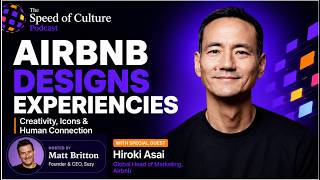
Hiroki Asai, Airbnb's Global Head of Marketing, talks about shifting the company's messaging during the pandemic and building features for group travel, which accounts for 81% of bookings. He discusses the Icons campaign, ultra-premium listings like the floating Up House and a Ferrari museum bedroom, and how AI and immersive tech will shape travel experiences.
Chapters
Up today, we're thrilled to be joined by Hiroki Asai, the Global Head of Marketing at Airbnb. Airbnb has obviously seen phenomenal growth over the last couple years. One of my favorite brands. I'm really looking forward to this. Hiroki, thanks so much for joining. Great to see you today.
Thanks for having me, Matt.
Happy to be here. Absolutely. So tell me a little bit about your background. Did it start on the marketing side, I mean, design side? Um, how did you enter the great world of marketing?
Yeah, it, um, funny, it's a long story. I started on the, uh, design side. I studied as a graphic designer and then graduated college and started to work at design studios. And then, you know, like most designers, went up the ranks and started to work on larger and larger projects. And then I think at some point in my career I realized that, um, I was okay as a graphic designer. I wasn't fantastic, and then maybe I should start taking a look at other avenues to take this. And so I think, you know, kind of naturally I segued into doing things more on the marketing side and much, much broader than graphic design.
Gotcha. And I mean, obviously where you have your background is where a lot of people normally have their heart. I mean, you clearly have— a lot of marketers don't really have an eye for design. They're more focused on the performance metrics or the actual tactics. I would imagine given that your background is in design, you know, you're acutely aware of the aspects of design, how it impacts any campaign that you bring to market.
Yeah, I, you know, what's interesting is I think my design background, you know, gave me the skills to understand form and typography and all those sorts of things and story. But I think more importantly, I think what it gave me is this understanding of the customer, an understanding of an audience, you know? And yeah, I think that's something that I really try and hold onto. Every, every day that we do things and every season where we go through a campaign is really, you know, understand the other person that's going to be at the other end of this. Because I think it's very easy for us to work and to design for ourselves and for what we think, for what we think is important versus what the person at the other end of it actually thinks is important. Yeah.
That being said, though, I do think there— and I'm sure you agree that there's general trends in design that happen over time. Like if you look at design from the '70s or '90s, like you, it obviously looks different from today. You know, I know you spent 16 years at Apple and you know what Apple's really known for, in my opinion, from a design standpoint is sort of like simplicity is the ultimate sophistication, right? Their use of white space and basically easy to read and easy to understand creative, I think, and obviously translate it all the way through their products. Like where does a movement like that kind of come from? And are we still in that movement when it comes to just overall design trends?
Yeah, I think it, it's probably less of a movement and a trend and more that it's a principle that we try and employ here at Airbnb also. Yeah. You know, the, the person at the other end of your work or your communication or the app, um, has a lot going on and they, yeah, you're, you're probably not the center of their universe. And so you're competing for attention, you're competing for headspace, and you're competing for ears. And so I think, you know, getting to the point, making it as elegant and simple as possible is a really good discipline in making sure that what you're trying to do cuts through.
Absolutely. Absolutely. And I, you know, we talk about being built for the flick, and especially when you look at younger consumers are spending all their time now not on the watching the television, but on their phone in social media feeds where you have a limited amount of time to gain their attention, right? And if you try to overcomplicate it, they're just gonna flick right by you.
Yeah.
Yeah.
I, I think there's this, you know, it's interesting. There's kind of this, it's human nature to try and add more to a story, to embellish it, make it bigger, try and bring someone in. And I think what happens to a lot of designers and marketers and storytellers is you start to add so much that you start to get ahead of who you're talking to, you know? Yeah. And, and the reality is, is, you know, like you said, people are swiping through pages and they've got 50 things going on at the same time. They have lives to lead, they have families, they have friends, they have a weekend plan that they're trying to figure out. And so you really need to show a lot of restraint and say it as simply and quickly as possible. And it's so difficult, you know?
Yeah.
It's so much harder than it sounds. Yeah.
Especially in an organization, you know, there's a very famous meme where they said, and I don't think this is the case of Microsoft at all anymore, but at one point it was like, this is how Apple would design a product, here's how Microsoft would. And it just showed how Microsoft was very feature-laden in their messaging and was just kind of too much. And Apple just said 2 or 3 words. And you know, I think at large companies there's often like multiple departments. Everybody wants to get their feature in, everybody wants to put in their 2 cents. At the end you have something that is all things to everyone and nothing to no one, right? So I think it's much harder, I would imagine it's much harder in a large organization to impose that discipline because you're fighting against internal forces. Yeah.
And I, I think that's what's unique about Airbnb these days. And what we're really lucky to have is we have founders that are creative. So we have founders that are— Yeah.
So let's get into that. Yeah. I mean, Airbnb's obviously an incredible generational company and one that, you know, you joined Airbnb in 2020, so we're talking about in the middle of the pandemic. Obviously there were certain points in 2020 where people thought Airbnb was going to be that not out of business, but obviously they went through a really distressed time where they had to raise money. And then, you know, towards the end of 2020, we started to see this trend where people wanted to get out of their homes and being in hotels wasn't safe and renting your own home on Airbnb was great. Talk to us about that journey when you first joined Airbnb. What surprised you when you first started working, I guess, remotely at that company and, and kind of the ups and downs of your first year there?
Yeah, it, it's funny, I was advising pre-pandemic actually, so I was there for about 6 months before the pandemic hit. And so, you know, it, and it was kind of fascinating. It was, it was great to witness a company that was under such hypergrowth and the expansion was just happening so quickly. It was a little overwhelming, you know, the speed of growth that they were experiencing. And then to see it all stop overnight was unbelievable, you know? And then, so then I came on shortly after the pandemic had started to help reorganize and reshape the marketing and the design teams and, and, and other things as well. But it was pretty amazing, you know, it was pretty remarkable to, to see, I mean, you know, who gets hard, who gets hit harder in a pandemic than a travel company?
Right.
When travel becomes, you know, to a, comes to a standstill basically.
So, and how do you look at marketing and communications during a period like that? Is it basically telling consumers we'll still hear when the dust settles? Like, how did— because it's such a, also a tenuous time in terms of marketing because you don't want to say the wrong thing either. So like, how, how did you approach that, I guess, when you first joined, when the pandemic did hit?
Yeah. And you know what's— this goes— this is kind of unique to Airbnb, and this is kind of interesting, is, you know, most companies are one product. For a million people. Airbnb is a million products for a million people, right? Because everyone and every home is different. Every experience is different. And so it's got unlimited variability, which means the way that that supply gets used could be unlimited as well, you know? Yeah. So in, in the pandemic, what's interesting about us is people tend to use Airbnbs in the way that they need based on what's happening. So the pandemic happens and we go from being vacation rentals to suddenly a way to get away as a family. Or to get out of the city or get to a larger place or work remotely. So I think, you know, your question was, what do you do as a marketer or a storyteller in that environment? And I think it's just really goes back to that basic principle of let's really understand what the customer is doing. You know, we all know the mindset, we all know the frame of mind, we all know the uncertainty and the terror that's happening, but then we can also see trends of how they're using us. And how they actually, and how we're transforming. And so I think we really need to be able to speak to that and, and talk to them and meet them where they're at, if that makes sense.
Absolutely. Makes complete sense. So fast forward to today, you know, 2024, and the brand has come out, you know, of what was a tenuous time, obviously really on fire and really is an iconic global brand that has really redefined travel. I stay in Airbnbs all the time. Love the brand, love the work that you guys are doing. What's your vision for the brand moving forward and what are some of the key tentpoles that you believe are, are core to the overall messaging and value that Airbnb provides?
Yeah, I think, you know, I guess the first part to that question is what we're really trying to do right now is to convince people that if you're going to travel, especially with a group, you know, some trips are always going to be better on an Airbnb. There's just some limits to the physical structure of a hotel and the physical location. Of a hotel, that's gonna limit your trip.
Right, right, right. Like the white, like you have to sleep in bed with your kids. That one is the, yeah, yeah. That's the perfect example. That was an awesome, awesome insight.
Yeah.
Yeah.
And there's these kind of like, you know, truths hiding in plain sight about traveling in a hotel versus an Airbnb now. But what's core to Airbnb is really about when you travel and it, if you get a great host, there is a sense of connection that happens. And there's also a sense of connection that happens when you use Airbnb because families are much closer together, friends get to share one space. And so, you know, the core of the experience that people have is a connected experience with us, a real human connection. Now, there's other ways that you can connect without staying in a place as well. And so we're really excited to start to lean into some of these other territories and offerings where we can offer, human connection.
Yeah. And I know that, you know, you had mentioned this earlier that different people look at Airbnb and use it for different things. Some people will now use it for ski trips, other people use it for family reunions, et cetera. I would imagine with all the advancements we've seen with AI and programmatic and the ability to sort of personalize at scale, that that provides a whole new realm of opportunities for you to really be contextually relevant for your different consumers that you're going out and, and messaging.
Yeah. Yeah, it does. And you know, it's, that's actually really exciting for us is the ability and the potential to employ AI in our, in our app and in a lot of our services. Because when you think about it, you know, everyone's ski trip is gonna be different. Everyone's family reunion is totally different, different needs, different locations, different sizes. Different things that they want to do. And so when it comes to matching and personalization and being able to design that kind of a trip, we think that there's a lot of potential in AI. It's very exciting.
Yeah, for sure. And just curiously, like, do you think the old way of advertising, like, you know, it used to be in the world of linear television, you would just hear about people's unique selling propositions, like, you know, 350 horsepower or 20% more absorbent because companies had the ability to cram those messages down consumers' throats because they were, they didn't have the ability to skip over it, right? And they could just write a big check. And now you don't really see that anymore because I think brands know they need to earn consumers' attention, especially in a social media context. And they are all shifting to storytelling. So in that regard, like, would Airbnb ever put out messaging about, I don't know, like how easy it is to pay or just things that are really functional on the product? Or do you think we're in a world as it relates to you and marketing in general, that's far more just exclusively in the storytelling realm?
I, I, I think it's a mix of all those things, to be honest. The, the way, the way we look at it, and it's a lot of, it's a lot about the way that we're designed as a company is, is we're very functionally organized, you know? And so, we have, we have a design group that's really focused on design, product group really focused on product, advertising, advertising, you know, marketing on marketing. And, you know, what that allows us to do is we can cross-pollinate and work cross-functionally to really think about the customer and how to talk to them when they're at specific points, you know? And, and I think at the highest level, we do— there is still a lot of people out there that don't really understand the benefits of traveling on an Airbnb versus a cruise or a hotel or staying in a hotel district. And so there's, there's kind of that job to do, and there's the right place and the right story to tell that. And then there's, you know, things like easy payment methods, you know, the ability to find something very, very quickly. And those are communicated through the experience of the product, you know?
Right.
Yeah. And so I think, you know, like, like humans, there's, there's certain things you're okay listening to and hearing, and there's certain things you kind of don't want to hear. And the best way to communicate it is just through experiencing it. And then there's all this stuff in between, I guess. Right. And so, right. When you can think about all those things at once and take a look at it from how is the customer watching TV, listening to the radio, listening to a podcast, picking up the app, opening it, getting an email, talking to someone else, you know, all how all of these things work together, I think is the way that we like to think. And yeah, we've purposefully designed our, our organization to be able to do that as well.
Absolutely. One interesting thing about Airbnbs is unlike when you like rent an apartment or even like at a hotel, like if you get a hotel room at like a Westin, you probably stayed in the Westin before, so you generally know what the rooms look like. People will book an Airbnb and rely on the pictures and, but they've never really been there. And for maybe a big choice, like a family reunion or a big birthday, like you want to be more sure. And now with like the Apple Vision Pro out and the ability to be immersed in these experiences, do you see that being a bigger part of your storytelling to allow, um, to kind of de-risk it for your customer?
Yeah, yeah. I, I think, you know, Airbnb was one of the first commerce sites to employ really rich full-screen photography of things. And so, you know, we've, we've always been at the forefront of embracing these kinds of technologies to basically, you know, manage the right expectations and let people know what they're going to get. So when it comes to technologies in showcasing homes or in the UI and the app itself, yeah, we're always looking towards new kinds of mediums and new technologies to do that. But I think the way we look at technology is it's always going to be in service of the connection. It's never going to replace the connection.
And so, right. And it's not really the idea. Technology is never really the idea. It's, it's a, it's a medium or a method to get whatever your core messaging is across.
Right, right. And for a brand like ours, which is all about, you know, human connection, we're, we're going to actively look at any kind of technology that's going to enable that to make it simpler and easier.
Yeah. So I know we talked about sort of the personalization, but I would also imagine at the same time Airbnb has kind of a distinct consumer segmentation in terms of different types of consumers that are, I guess, using your product in different ways. How do you look at that segmentation and, and how is that evolving over time given, I guess, more recent consumer trends in the marketplace?
Yeah, I, you know, Airbnb at its, at its core is great for group travel, and we always tend to attract the type of travelers that travel in groups. Now, luckily, that's across every generation. You know, when you're younger and you're taking a weekend ski trip with your buddies, you know, or your, your first weekend away with a partner, you're going to want to have all the benefits of what you would get, you know, in group travel as if you were a family or a group of friends that are older. And so when it comes to our segmentation, we, we definitely look at each emerging category of customer. And of guest, and we want to speak to them, you know, in our media and our tactics appropriately. But really the, the core thing that we're selling across all those segments and all the people is just this idea of traveling as a group, connectedness and togetherness on a trip.
Yeah. And that's where like memories are formed. Those are where the lifelong memories are formed, right? That those group travel, when you bring, family or friends together, when people look back at their lives, those are some of the moments that people will note as transformational in many ways. So I think Airbnb to play a role in that's really special.
Yeah. Yeah. Group travel for us is a really big deal. You know, we, um, it's become more and more clear that I think we're up to now 81% of the trips on Airbnb are group trips, you know, and it makes sense given the kind of supply that we have. And, you know, We've done a lot this year to design for group travel too. You know, we have a whole new way. We basically rewrote our messaging app in order to enable the group not only to travel as a group, but to be able to communicate as a group. So the host can talk to them immediately. All guests can talk back to the host. We've done a huge amount of work in making sure that once someone makes a booking, that an invitation gets sent out so everyone understands all the details and everyone could, you know, download all that information into their trips tab. And we've also done a lot of work in wishlists to make sure that groups can actually choose a home together and they can vote.
Very cool.
They can take notes, they can share the wishlist. So we're really, you know, investing heavily in this facilitating groups.
Right. So it goes beyond just booking the place. You're playing a role in deciding what place to book in and, you know, people collaborating over that decision and ultimately sharing and joining the experience.
Yeah. And facilitating that collaboration, you know, that, that's, that, that we know is already happening today.
Absolutely. So, I know that we're on the kind of peak of some big news for Airbnb, and I'd love you to share with us, you know, some of the big things that Airbnb has planned for the summer for our audience here at Speed of Culture.
Yeah. So we, we are getting ready to announce, maybe by the time this airs, we would've already announced, uh, Icons on Airbnb, which are super, super exciting. You know, it's, you know, when you tell the story of Icons, it's, it's kind of interesting cuz Airbnb started as this place where people can share their world, you know? Yeah. And it started with, um, tugboats and sometimes it's submarines and it graduated into houses. And then, uh, you know, houses of all shapes and sizes, but it's always been this platform where people share a little bit of their world to everyone else. Now, while we were growing, there's also been a lot of, uh, things that have been listed that have really taken off. Like the Barbie house got listed, the Shrek house got listed. That was awesome. The last Blockbuster got listed. And those things like really took off and they kind of captured people's imagination. Because I think people come to Airbnb with this idea of, you know, taking a window into a whole nother world. And so we've, we've pushed that really far this year with icons. And so we've basically gotten the 10— I'm sorry, the 11 most interesting icons and had them list and share either their experience or their world on the platform.
So can you give us some examples of some of those icons and some of the experiences that you guys are going to be offering?
Yeah, sure. Like one of the, one of the more exciting ones is, is the Up House. So we've actually created the Up House, uh, from scratch and built it and you can actually stay in it and the thing will actually lift, you know, 50, 60 feet off the ground. No way.
Now, like the whole thing was built in the sky.
Yeah. It's crazy. The whole thing was built, uh, you know, it's got tens of thousands of balloons on it. The thing actually lifts up off the ground. It's out in a, in the plains of New Mexico, and it's available for booking. It's unbelievable. So we've also, together with the Prince estate, rebuilt the Purple Rain house. Now, a couple years before Prince passed away, he had purchased the home in Minneapolis where the movie was shot. So we, together with them, recreated the whole Purple Rain house just like it showed up in the movie, and you could actually stay in it. And you can not only stay in it, but they also have unreleased recordings that he had made leading up to Purple Rain that you can actually listen to as well while you're there. It's pretty unbelievable.
We also work—
Wow. Yeah, it's amazing. We also work with Ferrari, and in their trophy room, we actually built out a bedroom so you can actually stay in the Ferrari museum amongst all the trophies and all the cars. And then at the same time, You can have one of their F1 drivers take you on a lap around the Ferrari track. And so we've built and we've created and worked with a lot of these icons to create these one-of-a-kind, unbelievable experiences. There's one more. I mean, this one's my favorite actually is, have you ever been to the Musée d'Orsay in Paris?
I have a long time ago.
Yeah. Yeah. You know, the beautiful museum with the two giant clock towers? On the other side of those clocks are just basically big empty rooms, right? And so in one of 'em, we built an entire apartment out designed by the designer that designed the Olympic torch. And so that's built this unbelievably beautiful hotel room out. And so you can stay in that, you can Airbnb it, you can stay on the other side of those clock faces in this gorgeous apartment. And you're also going to have a view to the opening ceremonies of the Olympics when they happen in Paris, as that whole thing happens on the Seine. Yeah, it's amaz— I mean, there's so— all of these icons are unbelievable. They're unbelievable.
So this is such a cool idea. And the question I have for you is, this obviously is a great marketing campaign and the buzz you're going to get from this is going to be unparalleled. But do you also see this as a new business opportunity, or is it just sort of like an ultra-premium experience that you're going to need to build and offer on the platform moving forward at the same time?
Well, what we want to do is we want to take people on a journey that Airbnb is more than just a stay, you know? And so a lot of these icons aren't just stays. They're actual experiences. You know, in the Up House, you'll be able to experience the entire recreation of the Up House, and the house itself will float. When you go to the Musée d'Orsay, you'll be able to see the opening ceremonies. We're working with Doja Cat, who's going to put on a living room concert for you, for her guests. And so these are all unbelievable experiences. And so what we want to do is, is really show people that this is the first step in thinking about Airbnb more than just stays, right?
As an experience. But I just wonder over the, over time, there won't be a filter where you have this ultra premium, you know, search filter where there's just 100 of these things all over the world that are just extra. You know, it, it's not a normal stay because, and, and because I just think people want experiences. We're in the experience economy. It's come roaring back. And you see that with things like F1, you see it with things like the Taylor Swift concert tour and all sorts of things where people are willing to overinvest in this. I just think this idea is right on the times in terms of where people want to invest their money and their time. And it really, I think, is going to be an amazing campaign just elevating how people view the brand.
Yeah, and what I love about experiences too is it really reinforces who we are. You know, it is about going to Airbnb and staying in a place or having an experience that really opens you up to someone else's world. And the great thing about these experiences is there's icons all over the world. You know, we're working with John B. Kapoor, who's— um, you know, part of the, probably like the most well-known Bollywood family in the history of Bollywood in India to open up her family estate for the first time and invite her fans in to be able to hang out with her and see this estate. And so, you know, it, it really plays to this idea, which I love, that Airbnb is really about these connections and these experiences, these real-life connections and experiences that you can have. Can have with people. You know, what we offer isn't something that you do on a screen. What we offer is connection and an experience that you can have in real life, which I love.
Well, very cool. Thanks for sharing that with us. I can't wait to see how this unfolds, um, this summer. Uh, it's going to be awesome to see. So shifting gears, Hiroki, as we wrap up here, um, you've had such a cool career and you're working, um, and heading marketing for such an iconic company. As you look back on your career and the journey that you've personally had, what are some of the things that, and decisions that you've made that you think were the right ones that set you up for where you are today?
Yeah, I, I, that's a really good question. I think when I look back at my career, the thing that's been consistent is I've always had this passion just for creativity and for design and for design thinking. And so every career decision that I've made has always been in pursuit of you know, working with great creative people, great creative teams, and great creative companies, you know, and, and I've always just kind of felt and trusted in myself that if you surround yourself with kind people and talented people and you feel like something exciting is going to happen, then you're on the right path. And so I think if there's any conscious decision I made, it was just to make sure that I was around the kind of people that I wanted to be around. Around other creative people and doing something that I felt was, you know, first and foremost kind of fulfilling and exciting for myself. Yeah.
And was there a point, you think, early in your career when you knew that you did know design? What gave you conviction that that was something that you were good at? Do you remember a moment, or was it just something that slowly happened over time where you became an expert in that area?
Yeah, I think, you know, it's That's funny. I, um, ever since I was 12 years old in 6th grade, I wanted to be a graphic designer and, you know, was really focused on it and like looked at all the design schools and stuff all the way through junior high school and high school. And, you know, ended up going to a non-art school because it's the only school that I could afford at the time. Right. But, um, but, uh, I think I always loved design and I always loved creativity, but I knew that as a graphic designer, my skills could only take me so far. Like I knew I was pretty good, but not great. And so I think there was, you know, the trend throughout my career for graphic designer into other things. I just realized that, hey, you know, maybe there's something more to creativity and design than actually typography and things on paper. And maybe that can apply, be applied to something else. And so I think that's, that's kind of how I, yeah, how my thinking evolved.
Absolutely. Well, it's been great to see, and obviously you are applying it to much bigger things, including the campaign that we just talked about. So really appreciative. Finally here, Hiroki, is there a quote or mantra that comes to mind that you like to live by? We, this is what we always ask our guests. To wrap up on the podcast?
Yeah, yeah, yeah. The thing, you know, I guess the mantra that I've always tried to live by is just this concept of beginner's mind, this idea of always trying to take a look at something as if you've never seen it before or you're seeing it for the first time. And I think when it comes to, especially for, you know, if you're doing something that you're, you're in a profession where you have to present something to someone else or there's a customer at the other end that has to try and understand what you're saying. Just this idea of looking at the world and looking at every day and the work you do outside of yourself with a beginner's mind, unencumbered by everything you know, stripped of all your own biases, and try to see it as fresh and cleanly as possible. Um, that's, that's always kind of helped me in all the projects that I've worked on.
So yeah, it's the curiosity too, right? Beginner's mind is you're curious and you're entering everything with kind of like this open-mindedness and imagination.
Yeah, yeah, yeah. And it's, you know, it's, it's like the simplest concept, but it's the hardest thing in the world to do. But I, I think that's been the one, the one thing that's probably stuck with me.
Awesome. Well, listen, thank you so much, Hiroki, for joining. I'm a huge fan of you and the Airbnb brand, and I'm excited to see you roll out, um, this next creative campaign and everything else that comes after it. So I really appreciate the time, and I can't wait for our listeners to hear about your journey.
Thanks, Matt. Thanks for having me.
Absolutely. On behalf of Susie and the Adweek team, thanks again to Hiroki Asai, the global head of marketing at Airbnb, for joining us today. Be sure to subscribe, rate, and review the Speed of Culture podcast on your favorite podcast platform. Till next time, see you soon.
Take care.
More from Matt




MikMak’s Rachel Tipograph on Consumer Spending, Retail Media & Holiday Shopping Trends



Jaguar Land Rover’s Charlotte Blank on Luxury, Purpose & Experiential Storytelling



