Hodinkee’s Ben Clymer on Watches, Collecting & the Future of Luxury
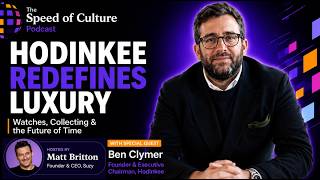
In this June 2026 interview, host Matt Britton talks with Ben Clymer, founder and executive chairman of Hodinkee, about his unconventional career path, the evolution of Hodinkee from a personal Tumblr blog to a leading content‑plus‑commerce platform, and the strategic choices that shaped the business. Clymer recounts leaving a junior investment‑banking role at UBS during the 2008 financial crisis to pursue journalism, eventually launching Hodinkee in 2008. He describes early frustrations with traditional media advertising, the decision to sell watch straps and accessories via Shopify in 2012, and later co‑designing limited‑edition pieces with luxury brands such as Hermès, Omega, Vacheron Constantin, and Leica. The conversation moves to fundraising: a seed round of roughly $5 million led by True Ventures and Google Ventures, followed by a $20 million Series B in 2020, and the impact of that capital on hiring and inventory. Clymer reflects on the resilience of the luxury watch market during economic downturns, noting a shift toward younger, affluent collectors and the growing role of watches as both fashion items and alternative investments. He highlights Hodinkee’s diverse, global audience, its strong community through comments and events, and the company’s ambition to reach ten million monthly users. The interview also touches on why Clymer stepped down as CEO in 2020 to focus on family and other ventures, while remaining deeply involved as chairman. He shares personal details about his newborn daughter, a side golf startup with Adam Scott, and his current watch—a 1967 Heuer Skipper. Throughout, Clymer emphasizes intentional entrepreneurship, the importance of owning the product experience over rental models, and a long‑term, multi‑generational vision for Hodinkee.
Chapters
Up today, we're going to be speaking with Ben Clymer, founder and executive chairman at Houdinkee. Ben, great to see you. Um, we're going to start by quickly getting to know a little bit about you. Tell us about your background in the industry and how you ended up where you are today.
Sure. So happy to be here, Matt. So my name is Ben Clymer. I'm the founder of a platform called Houdinkee, which began as a blog, a literal blog started by me about 13 years ago on, on Tumblr, of all places. I was working in finance at the time at a company called UBS, which I'm sure you're familiar with. Sure. And this was during the years of Lehman Brothers collapse, you know, kind of the first financial crisis of my adult life.
Yeah, me too.
You know, I grew up in upstate New York and I didn't really know what I wanted to do. I just knew that I wanted to be, you know, in business. And I'm giving the air quotes right now because I don't even know what that meant at the time. And so I went into consulting and finance and just because that's kind of what you did when you're from upstate New York. And you wanted to make a little bit of money. Realized really, really quickly it was not for me at all. And then in 2008, 2009, when the financial crisis hit, I said, you know what, I wanna make a hard pivot. I wanna be a writer, like a journalist. And my grandfather had given me one watch at the time, my maternal grandfather. He gave me an Omega Speedmaster right off of his wrist. And that got me really, really hooked on these mechanical things. And I just started writing about my grandfather's watch at first. And then, you know, say Paul Newman's watch or Mahatma Gandhi's watch, which is a thing. Um, and started blogging for fun. I mean, truly just to bide my time when I was at UBS. And then, uh, ended up leaving there and doing it full-time, becoming a journalist. I used to write for Financial Times How to Spend It. I wrote for, uh, Forbes.com. I wrote for GQ, places like that. And ended up going back to school for journalism and then kind of went off to the races on, on Hodinkee full-time writing about watches.
And that's obviously a big pivot. You know, you're working at UBS, going down the banker path, and all of a sudden you're a journalist, um, and obviously you're probably contemplating lifestyle changes for that. Um, you're into watches, but maybe you have to downgrade from a Rolex to a Seiko. Um, if you're going that bad, tell me about that, because that's about following your passion, which I think is a great thing to do. But I think many people in this sort of Instagram-driven, get rich quick world are kind of hesitant to do that.
Yeah, I mean, to be clear, so I was an investment banker. I was not making a, you know, a crazy amount of money. I mean, I was making a lot of money for what I thought, you know, I was a kid, I was 24. Of course. And certainly more money than I'd ever seen in my life. But I mean, not like, you know, it wasn't like, you know, Wolf of Wall Street type of thing or driving a Lamborghini. But still, I mean, it was the idea of taking something that was like a very clear and concise set forth path, which was like, if I stayed at UBS or some such large bank, I would continue to make, you know, decent money and have good health insurance and live a very kind of like probably consistent, if not a little bit boring life. But I mean, that is what most people tend to do. And I just said, you know, this is just not the life for me. I didn't know that watches and Hodinkee would be my future, but I did think that writing and journalism would be, whether it be photojournalism or video journalism or traditional written word, that's what I wanted to do. And I just, I had really kind of, I'd always kind of fancied myself creative in some way, even though I don't think anybody else did. And I said, you know what, it's kind of now or never. And this is the most opportune moment for me to make that jump and say, you know what, like forget the traditional path of kind of business and go out and do something different. And so I left UBS with, a little bit of severance, which was incredibly helpful at the time. And I basically just started blogging, you know, blogging for Hodinkee. As I mentioned, I wrote for Forbes.com and GQ and a few other places like that, kind of men's lifestyle publications. And then somehow, some way, I got into a master's program in journalism in New York and did that. And it was there that I met some people that are still with Hodinkee today. It was there that I wouldn't say Hodinkee was discovered, but some of my professors who are, you know, esteemed journalists, I would say, said, "Wait a minute, like, did I see you in the New York Times?" being written about, you know, talking about watches, or, well, you know, do you have a watch blog? And I said, yeah, actually, like, that watch blog is paying for this master's degree right now, right? Uh, and that was when I started to realize that I had something special. Um, and we started to get a lot of press in like 2010 to '12, which is when I was in journalism school. And then when all my classmates were looking for desk jobs at the New York Times or Hearst or Condé Nast, whatever, I realized that I already had a job. And it wasn't a super well-paying one, but it was mine, and I could kind of do what, what I wanted to do. And so when I left journalism school, I just decided to go with Hrdinky full-time. And then, you know, that was 10 years ago now and haven't looked back. I don't know.
And I think, you know, you raise an interesting point about kind of that fork in the road, so to speak, where, you know, you don't have a mortgage, you don't have a family, you can basically take a step back and say, what do I really want for my life? And I think that's an important point for some of our, you know, younger listeners is before you go down the path that you think you should be going down, is it really what you want? Because, you know, I look at somebody like yourself and so many other entrepreneurs I respect. And ultimately, whether they're a gazillionaire or not, they're happy because they're pursuing their passion and they're doing something that they truly love versus chasing the money.
Yeah, that's exactly it. And I think, look, I mean, there are certain folks out there and they're typically kind of like traditional investment bankers, which again, I was not. Like those guys, some of those guys really do love the art of the deal. They love the economics of it. They love the modeling. And that just wasn't me. And that's fine. There's no judgment there at all. It just wasn't me. I wanted to be kind of in control of my own destiny. And it didn't really matter how big it might become. And thankfully it became, it's really not big, but it became kind of a somewhat meaningful business. And I haven't looked back and I think even had Hodinkee not worked in any way, I still would be really proud of the effort that I gave it to really give it a go and to take the time to basically take a step backwards. And if there's one master's degree that really nobody needs, it would be a degree in journalism. And I said, you know what, I want to kind of do it because I went to school for basically finance, computer science, stuff like that. I wanted to take a step back and really learn how to write and be a journalist, and I want to do it the right way. And it, it thankfully paid off. Um, and you know, it's, it's been, it's been a great ride ever since.
So you leave, um, journalism school and you continue to write about your passion, which is watches, and here we are today and you're running, um, a, you know, full-out e-commerce platform. How does that transition work to go from content to commerce, which is something I think a lot of mainstream publishers have tried to attempt with varying degrees of success, but what was your path and how you got from, you know, just a content platform to a commerce platform?
Yeah, I mean, a lot of it is common sense, which is like the least kind of helpful advice I can give to any listener, but I think, you know, a lot of it for us was I grew frustrated when in, let's say, 2011, '12, I would get emails from readers saying, "Hey Ben, I read your story and I bought a $100,000 Rolex because of your story," or, "Hey Ben, I read this thing that so-and-so wrote and I bought a $300,000 Patek Philippe," and I'd say, "Oh my God, like, these are crazy," you know, way more money than I had. Like, you know, just crazy, crazy transactions taking place based on the content we were creating. And I would go to— excuse me— I would go to Brand X or Y or Z and say, hey, marketing person or CEO, like, check out this amazing email. This person literally said verbatim he or she bought this product because of our, because of our story. And they would say, oh my God, that's so neat. Like, would you like to come to dinner at Per Se? Or like, let us fly you business class to Geneva to see some watches? Sure. Like, in the beginning, that, that's neat, but it doesn't pay my rent. It certainly doesn't provide a life for me or any future employees. And I just realized really quickly that there was this like really unhealthy relationship between traditional lifestyle media and, and the brands that, that kind of support it and vice versa. And a lot of it was a lot of the marketing and a lot of the branding that, that went into, or from, from the brand side, they were paying it, they were, they were paying to be next to things. So like they wanted to be next to Vogue, they wanted to be next to the New York Times, right? Yeah, proximity. But they didn't necessarily, and I still think to this day, they don't necessarily believe that there's transactional benefits from working with these folks. You want to be in Vogue?
Of course.
Like, I would love to be in Vogue. I'm sure you would too. Like, that's a cool place to be. But like, it wasn't one of those things where they really felt— and I'm not disparaging Vogue in any way. Like, I actually do believe they could transact. But, you know, the relationship was rather unhealthy in that these brands believed that the publications were not actually driving sales. And I was like, no, no, no. Like, I'm like, here's verbatim proof. Like, this is firm. You can email the person yourself to see. They didn't even know this watch existed before we covered it, you know? And on top of that, they're transacting with somebody else. And so, you know, when I realized really quickly that like we were never going to grow this business in a meaningful way with the limited ad dollars. And to be clear, there were some, you know, meaningful for me ad dollar, uh, ad campaigns at the time. Not, not a ton, but some.
Did you have your own sales team selling direct premium display or just, it was just me? Yeah. So while you, in between you writing content, you were picking up the phone and calling agencies or brands directly and ask them to advertise?
100%. 100%. Yeah. Uh, and a lot of it was passive. I mean, I, I'm a pretty laid back guy. Like a lot of, a lot of the stuff that came in, maybe we could have built an ad business out of it, but I, I didn't I didn't really get aggressive about it. Um, but I just realized like, man, this audience is special. I could tell back then that like these guys and gals were really excited about this stuff and they wanted to spend. They actually wanted to spend if there was a great story there. And so really quickly I said, you know what, like we need to get into e-commerce. And Shopify was a thing, you know, 10 years ago, and as it is now, although much bigger thing now. And we decided to launch— I'm going to be clear, I had no money. I mean, living in like a studio apartment, like nothing. I just graduated We started to do e-commerce with straps first. In fact, straps like this. And so, you know, I found a manufacturer in Italy that was making straps for me as a watch guy and said, you know, instead of buying 2, let's buy 20 and then 200 and then 2,000. And we launched them in 2012 and— Selling directly? Selling directly. Yeah. Right, right off of our shop.hodinkee.com. It was a, you know, it was a Hodinkee Shopify page and it was covered by GQ and Esquire and all like the men's sites and all that. We sold out like that. I mean, And so then I was like, okay, let's keep pushing. So we started doing pouches and travel rolls and other little accessories to kind of continue to, to continue to go down the e-commerce path. And then eventually we said, you know what, like, let's do a watch, let's make a watch.
And so I was about to ask you, because I know like about MVMT, that company that, you know, like I was thinking if I were you, that would be the next thing I would do.
Yeah. So we didn't make our own watch. We work and we continue to work with limited edition brands right now. So we actually co-design products with anybody from like, we've worked with Hermès twice, we've worked with Omega, we work with Vacheron, like a camera with Leica. And so, you know, we put kind of the Hodinkee stamp of approval or the Hodinkee kind of, uh, look on or feel onto products that already exist, and we sell them directly to our audience at, you know, a wholesale margin. And then, you know, that, that was a huge step forward. But, you know, we sold half a million dollars in watches in one day on the internet in 2015, which is just bananas. I mean, that was like unheard of. Like, you know, the luxury industry and the web still have a tenuous relationship today, but back then it was adversarial, you know? Right. Um, and so, you know, we said, hey, we can do this thing, and we validated that our audience really was transactional. Then we worked with Vacheron, which is a very prestigious brand, Omega, which is a huge brand, and continue to do that. And now we sell 40 different brands as an authorized dealer on the internet, in addition to pre-owned watches and vintage watches and all the other accessories.
So, so you— along your path, this— as you built this business, and first you start to see you could sell your own products directly, and then you start to create Sounds like, you know, co-branded, you know, collaborations with these large brands. I guess somewhere along the line you decide that you need to raise venture capital and really try to scale the business. And as someone who has raised venture capital, sometimes successfully, other times in a very frustrating form, I know it's not easy. I know it's very time-consuming. Talk to me about that decision and that experience.
Yeah, I mean, it's, I mean, you, you, you've been there so you get it, but I mean, so venture capital and the idea of these were VCs was something that was totally foreign to me. Me, as it is to most. Like, unless you grow up in the Valley or have parents or friends in that world, I mean, it's really a totally foreign concept to me. So just by nature of me not understanding it, I didn't want to do it, you know. So for me, it was like, all right, I'm going to own this small little business, then I'm just going to sell it one day, and then we're going to be done. I don't want to deal with investors. And that, that changed markedly around 2014. I was approached to sell the business outright to a big company here in New York, and it was at that time that I'd become friends with a guy named Tony Fadell, um, who was one of the early iPod and iPhone guys at Apple, and then he created and sold Nest for like, I don't know, like $3 or $4 billion. And he had reached out to me a few years before on Twitter and was just like, hey man, like, I'm obsessed with your site, we should get together. We've become friendly. We did a video called Talking Watches together where I interviewed like celebrities about watches. Um, and he had just sold Nest and he was just like, man, like, I just think, I think Hodinkee is really special. Like, I see sites every single day and what you guys have is so different than everyone else. Like, you should think about not selling this thing. And, you know, to be clear, like, at that point, the offer on the table was like incredibly meaningful dollars for, for me at the time, for sure. Uh, and so I was just like, man, like, I don't know, like, I, you know, to walk away—
did you own 100% of the company at that time?
Yeah, I did. Yeah. So I mean, it was all going to me. It was, you know, it was a 3-person company, a single owner LLC, very simple. And it was really like, man, like, is, is this the right call? But he, he really was adamant that this thing could be something more. And so he helped me along with a guy named Tony Conrad from True Ventures, a guy named Kevin Rose, who's now at True Ventures. And we went out and raised like $5 million. And so, and that's between, you know, them and Google Ventures and John Mayer came in and like kind of friends of the show. So, but I mean, that was, that was a relatively low amount of money because we also hired a bunch of new people. We hired, we basically quadrupled in size almost overnight. With that, we went from basically 3 people to like 13 people. And so we raised, you know, low single-digit millions as our kind of like seed round and then kind of went off to the races. And then that's when we started doing more limited editions because we had the capital to buy the inventory. We started developing our own tech stack with the help of Kevin Rose. We started doing a lot more stuff that could kind of like allow us to scale in a meaningful way.
Right. Now, so, and how much has the company raised in total to date?
We have raised, I don't know the exact number, but the last round we did was a $20 million round. That was a Series B $20 million.
Got it. Got it. So, you know, you guys have raised sizable capital and right now, obviously, we're entering an economic downturn where, you know, the purchase of luxury goods is going to be something I think goes into question for a lot of consumers. How do you see the future of the business and how is the macro changing your strategy?
Yeah, I mean, look, I think, I think many of us would have thought the same thing in March 2020. And, you know, the collectibles market, not just the watch market, is just on fire and it remains on fire to this day. And we saw the biggest growth we've ever seen in the COVID era. And I think what we're seeing is when stocks and traditional equities investment vehicles are struggling, people are looking at alternative investments that are tangible, like the watch on my wrist or the watch maybe on yours.
Real estate, things like that.
Yeah, exactly. And so, you know, we are incredibly optimistic about what's going to happen over the next little bit. And we've seen it already. And the one thing I'll say also is there are several platforms and publications that have really benefited from the hype of these collectible assets, whether it is NFTs, cars, watches, wine, whatever. We are decidedly not one of them. We have benefited from the interest in it, but we were there long before these were popular.
Right. A company like StockX, which came out of nowhere in selling NFTs and sneakers. You guys have been there before collectibles were sort of a trendy thing.
Yeah, exactly that. And I think, you know, we will be here long. You know, if this market does go down, we will still be here. And I think like that, that's how we view this business is like, this is a multi-generational business. This is a— we're already 14 years old. This isn't a 3-year-old startup, you know. And so, you know, I think we look at what's happening with traditional equities today or not not actually today, but currently. And, you know, we've seen a major downturn this year, but watch sales are still up, you know, year over year. They're still doing exceptionally well. You know, everything peaked around the fall of last year, including traditional equities. Watches did as well. And, you know, we're down a little bit from there, but we're still up several times versus retail. We're still up several times where we were a year ago. It's still remarkable where things are headed. So we are, we are extremely optimistic about, about the future for sure.
And what are some of the trends in the watch industry that maybe somebody who's not as familiar with it should know? Are people kind of gravitating towards older models, um, you know, models from certain countries? What, you know, what are some of the more, you know, emerging trends you're seeing?
Yeah, the, the biggest— I mean, there's, there's two big things, and, and they're, you know, I would imagine that most people would respond to this question this way, but one is the consumer is dramatically younger than you would think. So the average consumer of a luxury watch now $30,000.
That was actually my next question. Wow. Has it— is it sort of aged down or aged up over time?
It's aged down considerably. We're seeing kind of like a— excuse me— like almost kind of like a generational shift where a lot of people on the pre-owned side are selling their watches in their 50s and the people buying them are in their 20s and 30s. So we're seeing them kind of like being passed down, which is kind of amazing.
As an investment vehicle or just to, you know, just as a fashion accessory? Both. What's the driver?
Yeah, both. I mean, look, there's no question that I think the investment idea in watches or any collectible is a thing today, but I think the majority of the people buying from Hodinkee are not thinking that way. They're thinking of it as like a talisman for their future child, excuse me, child, etc. So we're seeing a lot younger people, and then of course, you know, and we're in a great spot because of this, people going online, which is like, this is kind of like a no-duh moment, but at the same time, like the internet and luxury really, as I said, had a tenuous relationship even still. And so we we see a lot of brands and big retailers, our friends and competitors, trying to get online. And we said, man, like, we've been online. We've been online since 2008. We've been selling things online since 2012. So we've been doing this 10 years. So we know exactly how to, to speak to people in a way that is engaging in an e-commerce, in an e-commerce way.
Yep. Yeah, the notion of buying a luxury good without touching or feeling it, you know, just, I guess, 5 years ago would have been seen as very risky. And now you think—
go on. Yeah. And look, and to be clear, like, I think there's a certain, you know, certain class or small kind of a group of people that will always feel it's risky. But I think at scale, we're seeing a massive amount of transactions above $20,000, $30,000 on our platform every single day, every day. And by the way, like, you know, we look at— we benchmark ourselves versus the best in e-commerce. So like, think of Apple, think of Nike, you know, global, global brands. You know, if you buy a pair of Nikes and you don't like them, you can return them. Simple as that, right? No questions asked. You can do that with a watch as well. There's obviously, you know, there's also, there's guidelines there where like if you open it up and you wear it, like you obviously can't return it if you scratch it. But you know, Hodinkee is ultimately a 21st century e-commerce, you know, business that models itself after the very best and with the very best. And so the experience is akin to buying an iPhone on Apple or a pair of Air Maxes from Nike. And it is just that seamless. You can do it from your phone. You can insure your product, you know, right with the Hodinkee app. It's really, you know, a really kind of watches 360 program.
Have you ever considered, Ben, the whole sharing economy with the watch market and doing watch rentals, as I think some companies have tried? What are your thoughts on that?
Yeah, so, yeah, some, some, some friends have tried that in the past that, you know, to, to varying degrees of success. And I think for, for us, we always want to kind of remain true to kind of what Hodinkee stands for. And Hodinkee, for, for us, is, is not about the appreciation, like the financial appreciation of something, which I think a lot of the, you know, the shared economy stuff really is. We want people to experience the product. We want people to own the product. And like, so much of what Hodinkee is about is the understanding and collecting owning. And to, you know, to own a fractional piece of something but not even be able to touch it, it kind of runs counter to kind of who—
I was thinking that more like the Rent the Runway model for watches, where you can wear it and you have to return it.
Yeah, it's interesting. I mean, again, you know, there was a platform out there that did a pretty good job with it, and they struggled to kind of find a foothold in it. So I think, you know, if we had— if we were where we know we can be over the next 5 years and we said, hey, let's add on something else, sure, we would do that. But I think it's— I mean, you know how it is, like, you just need to prioritize what the next kind of few years look like. And that, that is, uh, I can say not, not on the priorities list right now.
Yeah. And when you think about growth, do you think about, um, going deeper with your existing audiences, finding new audiences to bring into the category? You know, how do you look at growth overall?
Yeah, I mean, Hodinkee is, is— I'm proud to say, absolutely the most culturally diverse, racially diverse, sexually diverse, you know, kind of group out, out there. No question about it. We, we made—
your audience, your audience, you're saying, or your employ—
Well, both really, but I mean, right now I'm speaking about the audience. We have made a conscious effort to really bring new people into this world. So, on the front page of the site, you could see a million-dollar Patek Philippe one day and then a $50 Casio G-Shock the next day. And I think, you know, we want this world, the watch world, to be as widely approachable as humanly possible. And I think, you know, our content does a good job with that. And so, our goal right now is simply to expand our reach to, you know, several million more than where we are right now. Across social platforms, we're about 3 million people a month. Um, you know, we want to get to 10 million, and I think it's completely possible. And I think when you look at how many people are interested in this space, there are— I mean, look, the, the, the watch industry is a $50 billion a year industry. It's just massive, you know. And so there, there are clearly that many people interested in it, and we just need to do a better job at reaching them and saying, hey, this, you know, whether you can afford it or not, you're interested, this is your home.
Absolutely. And when you talk about your diverse audience, I I would imagine that creating some type of community or connecting that audience together would be an opportunity to unlock even more growth. Have you played in anything like events or online forums to try to connect the audience together?
Yeah, no. So, I mean, Hodinkee, without taking too much credit for it, we are one of the early content community commerce companies. So, if you go on Hodinkee on every single post, and I mean every single one since the beginning of Hodinkee, going back 13 years, there's an active comment section. Section. And so if you go on there, people are engaging and responding, and people say, you know, and then we'll host an event, say, oh my God, I talk to you every day in the comment section, I just didn't even know your name. So, you know, community is core to what we do. It's also, frankly, the thing that I'm most proud of. You know, we have created meaningful relationships for people and meaningful, uh, you know, positive reinforcement for people socially via the watch world. And I think that is something that, that I'm, I'm just so grateful for and so proud of. So yeah, I mean, community is, is all that, that we do this thing for. And so when we do something great, our community is quick to let us know. When we do something stupid, our quick— our community's even quicker to let us know. And that's wonderful. It just shows that, that people really care. And I think like that's the best way to validate any media platform, any e-commerce platform, any platform really, is do people care enough to actually let you know how you're doing?
Yeah, absolutely. So I'm going to shift and kind of wrap this up with some questions about you. I saw that you guys raised your Series B. It was $40 million in December 2020. And with that Um, you stepped down as CEO, put in a different CEO, and now play the role of chairman. Um, what drove that decision, and has that changed kind of your day-to-day life?
Sure. I mean, I think for, for me, like, I think I, I am a builder. There's no question about it. I'm not an operator, and I think I'm the first person to admit that. Like, I, as you know, having done this, like, you know, you kind of— it's important to know your own limitations. And like, for me, you know, we scaled the company to, you know, now we're almost 200 people. We're at about 170, 180 people. Like, that is not the business that I necessarily want to do.
Whole different ballgame, right?
Yeah. Oh my God. I mean, it's a different planet. And I think I probably could do it, but I'm certainly not optimized for it. And I also just had to think of my own kind of mental wellbeing and physical wellbeing for that matter. Houdinki, like any startup, is so all-encompassing. It really becomes your child if you don't have a child. And that's exactly what happened to me. And I just said, you know what? I needed to kind of take take not a step back, but maybe a step to the side to say that, hey, there are other things that are important in life, such as family, friends, etc. And, you know, since I stepped down as, as CEO, I've gotten married, I had a child. I mean, things that are, you know, frankly more important than, than even watches and howdy. Um, and so it was one of those things where I just needed— I needed, uh, again, not a break, but I needed a change in my life after being the CEO for, for so long and working so hard. And I still work incredibly hard, and I'm still active every single day. I speak with our CEO, you know, chatting with him just before, every single day. Uh, and so, you know, I'm now just doing the things that, that I can do in a different way than most, having been here since day one, uh, but still as involved as ever.
Right, right. And does that open up the path for you to get into other ventures or do other things, or is Houdinki the majority of your focus right now?
Houdinki, well, is always the majority of my focus. I mean, I have a small startup, a golf startup actually, with Adam Scott, who's a professional golfer called Fairgame. And, you know, that, that's kind of a fun project for us. But, you know, right now Hodinkee is still very much at the forefront. Like, we're, you know, we're growing, we're in a good, good position, on a good path, but there's still a long way to go. And I think, like, ultimately we want this thing to be, as I said, a multi-generational business that, that really means something, that could stand the test of time. And I think we're getting there, you know, we're slowly getting there. But I think, you know, over the next few years we'll really solidify that, that plan.
So yeah, Hodinkee for, for sure is my And most importantly, what watch is on your wrist right now?
That's a good question. I'm wearing a— it's, it's a 1967 Heuer Skipper. So this is a really rare Heuer, so before it was Tag Heuer. And we actually did a tribute to this watch as one of our limited editions in 2017, and this is an original one from 1967. So kind of the holy grail of Heuers. I gotta get my watch game on.
I'm just wearing a simple Apple Watch, so don't judge me.
I have an Apple Watch on my desk desk. I, I, I love it. They're, they're great things for sure.
Panerai is my favorite brand, so that's the one I collect.
Um, super— that's a good one. Yeah.
So this is really great. We covered a lot of ground. It's clear that, you know, you're a very intentional entrepreneur and, you know, you've been through the journey that so many of us went through, and it sounds like you're at a really good place, and it's great to hear. Um, in such a crazy world, what's the one thing that, that slows you down? It sounds like you have a, a new— newly created family. So is, is that sort of the place where you can kind of zone out of business and kind of slow down?
Yeah, yeah, that's it. So I have a 6-month-old daughter named Georgie, uh, who was born, uh, December 28th. Uh, she was actually born, uh, almost 3 months, 2 and a half months premature. Uh, so that'll make you slow down real fast when, you know, something like that happens. And she's totally healthy, she's great and perfect and funny and, you know, like a crazy little girl. Um, but, you know, that is absolutely the thing that, that will slow me down. As I said, I'm, I'm, I'm getting deeply into golf, which is like another really dorky thing to be into, uh, but it's really a great kind of reprieve for me because I can go out there in nature on my own and just kind of be outside for 4 or 5 hours at a time. But those, you know, those would be the two things.
Super important, super important to have some things for yourself, super important to focus on family. So Ben, this has been great, um, really, um, fascinating to go through your journey, and I hope we can keep in touch over time. And, uh, Houdinki really helps me continue to up my watch game. So, um, on behalf of Suzy and the Adweek team, thanks to Ben for joining us. Uh, be sure to subscribe, rate, and review the Speed of Culture podcast on your favorite podcast platform. Until next time, see you everyone. Take care.
Cool.
Hey!
More from Matt




MikMak’s Rachel Tipograph on Consumer Spending, Retail Media & Holiday Shopping Trends



Jaguar Land Rover’s Charlotte Blank on Luxury, Purpose & Experiential Storytelling



