How AI Is Changing Everything In The Summer of 2025
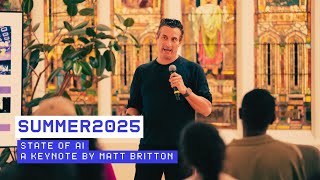
Matt Britton outlines how generative AI is reshaping business and society in 2025. His company automates customer-call transcripts into sentiment alerts and builds personalized healthbots from medical records. He argues non-technical people should learn AI by solving real problems, warns of massive workplace disruption, and says proprietary data and brand IP are now strategic assets.
Founder of Susie, Matt Britten. Thank you, Harrison. It's great to be here. I guess I have to take you all to AI Church today with this. I was prepping that for a little bit. It's great to be here. I have been in the advertising marketing space now for 25 years, and I've seen a lot of changes in my career, and it's always been about the new consumer. When I left college, I started a company called Mr. Youth. And the purpose of Mr. Youth was to help brands understand the digital generation at that point, called Millennials. I remember being in Pennsylvania at Hershey's offices when a brand manager said to me, we will never stoop the level of advertising on people's computers. And I went through a very long period of trying to get large brands to understand the. That this thing called the Internet had staying power and that one day people would actually buy on the Internet. In 2005, 2006, a lot of brands were talking about this thing called social media. I was working with Victoria's Secret Pink right when it first launched, and they ended up becoming the fastest brand ever in the history of apparel. And those, you know, Pink know that Pink targets young consumers. And they had heard about Facebook, but no one really knew how to advertise on Facebook. And I told Ed Raczak, at that point, the cmo, I'm going to figure out how to get us on Facebook. And they didn't even have a phone number on the site at that point. It was the Facebook. And a guy who worked for me who went to Columbia actually was a member. And that was a big deal because back then, you had to have a Edu email address actually to even sign up for it. And he gave me his login over the weekend, which is something that none of us would do right now, give people our Facebook logins or Instagram. But I. I was blown away. And I was convinced I had to get in touch with this company. And I went to their domain registry and I found a 617 number, and I dialed it, and a guy named Eduardo Savarin picked up. And I said, I run a company called Mr. Youth, and we work with a lot of the largest brands targeting young people. And I think I can get you some advertisers. And two weeks later, in an office that looked nothing like this because it was, like, very dirty and disgusting, Mark Zuckerberg and Wardro Saveren walked into my office with a very uninspiring presentation. But besides that point, ended up buying the first corporate ads ever on the Facebook and lived through an incredible era of a social media boom. Ended up rebranding my company to mri, which one day got acquired by the publicist group. But through that process, I had moments like registering Iza on Twitter and establishing what at that point was the first ever social media marketing agency. And my entire career has been about these moments. It's been about these new generations coming into society and redefining culture, redefining business in many ways, redefining the world, often propelled by new technology. And now we're in a completely new era, and we're in the AI era, and we all know it at this point. And the new generation that's bringing in AI is Gen Alpha. Gen Alpha right now is age 0 to 15. Gen Alpha will never know a world without AI. They will never know a world without having technology that you can speak to. And I can tell you as somebody who's been through this now two or three times in the past, because mobile was the other one I didn't mention with the iPhone in 2008, 2009, I've never seen anything like this. I've never seen a rate of change like this. I've never seen the potential for disruption of everything we know in terms of business, but also the way that we interact with, with each other as humans. As large of this. And really what blows me away is the arbitrage of opportunity right now. You know, I was hired to train a major tech company on how to use AI, but this is. This is actually one of the biggest tech companies in the world, actually developed an AI model, but their employees don't know how to use it because they're actually not able to use it because they're lawyers and data privacy people, Compliance people actually don't actually even allow them to use the tools. So if somebody at a huge tech company, an employee, can't use AI or don't know how to think about the rest of this country, think about the rest of this world. So right now we're at a period where 0.1% of people really get it right. Maybe 1% of people play around with it, and the other 99% of people really have no idea what's going on. And in a time like this, it creates massive opportunities for companies to get ahead, to leapfrog, to maybe make up for years of being stagnant with their business or their brand and move to the next level. So when I first hit and ChatGPT first became a thing in 2003, 2000, I'm sorry, 2023. 2024 and people were trying to figure out what to do. Obviously, as a CEO of a tech company, my first inclination was to give the notion of AI to my R and D team. And I did. And we really didn't get anywhere. And they really couldn't figure out how to easily and intuitively deploy AI to our product. SUZY and that was very much different than mobile. That was very much different than new technological evolutions of the past because it is a different realm of what technology means. So I actually made the decision to bring it back into my own hands. Now, I've never coded, I'm not an engineer, but I am fairly technical. I've always been buying ads on Facebook and Google. I know how to have hands on keyboard with tech, but I'm definitely not an engineer. And I started to really dive in. And with AI, the way I dove in was I first started with a problem. And with our company, the problem I was seeing and hearing is my salespeople were telling me they were not able to be efficient enough. They were spending too much of their time doing things that weren't them, being in front of the customer. Our company was, I won't say fortunate enough, but our company became remote during COVID and as a result we had to be in the cloud. Our entire company infrastructure was based on the cloud. And we deployed a tool called gong. Gong is a tool which many of you know, records and actually allows you to have transcripts of phone calls. But it was stuck within Gong. And I built an integration that essentially allowed and the way I built it is I just asked ChatGPT, how do I do this? And through trial and error figured out how to essentially hack my way to build an automation where after every call those transcripts were able to be fed into a model. And from that and from the 20,000 hours of previous GONG call transcripts, I was able to build a variety of different tools that transformed our business internally. So for example, after each customer call we have there's a sentiment score that's created. And if the sentiment score is under a certain number, the customer success person's boss is notified. Hey, maybe this customer's not happy. You should chime in. I created a publishing engine that takes the actual topics that are discussed with prospects and clients and automatically writes a redacted blog post and publishes it on an SEO optimized WordPress blog, which essentially has created now tens of thousands of new blog posts based upon the general topics that we're talking about with our customers. I created a separate tool that Outputs automatically Google search keywords that we should buy on and on and on and on. All from notion of these customer call transcripts. This is how you start to learn about AI. And it all started with a problem I knew I didn't want to solve. And I start to look at my personal life. What problem do I want to solve in my personal life? And I have young kids, I just turned 50. The problem I want to solve is I want to stay alive as long as possible. And I took that same mentality. I know what the problem is. What's the data? What is the customer call transcripts of my body, right? What's my body saying versus whatever customer's saying. And in the case of your body, it's MRIs and X rays, right? It's blood test information, it's notes from doctors. So I collected 20 years worth of that information and organized it and I created my own healthbot. I start to ask the questions like if I'm going to die in five years, what's the most likely cause? And when it told me, I'm like, holy shit, what can I do about it? A doctor usually wouldn't tell you that, but AI doesn't care about bedside matter. It's just going to tell you the truth. Can you just grab me some water by any chance? Cool. And that really opened up my eyes to what I think the path should be for all of us. Many of us work at large companies where we're not able to just use any tool that we want to use because we're part of a large enterprise and it gets in the way, etc. And if that's the case, then we have to look at our personal lives because I think what we saw with the iPhone, talking about like lessons of the past, is it took a very long time for iPhones to get into the enterprise. The reason why is it didn't want it. But over time with Instagram and all these apps, everyone had an iPhone, everyone. And then we saw the consumerization of the enterprise where it had to capitulate and now we have all of iPhones at work. I think you're going to see the same thing with AI. These large companies are purchasing these huge enterprise level agreements with these LLMs, but it's not really able to be adopted by us. We can't put all the data that we want. We are limited in terms of our ability to leverage it in the workplace. So I think what's going to start to happen is many of us are going to take the route not of What I did with the call transcripts, but what I did with my healthbot. People are going to figure out in their own lives, whether you're a parent, whether you have a side project actually how to leverage AI to make your life better and more efficient. And that's where you're going to create those skill sets that you're going to go into the workplace and truly future proof yourselves. So one piece of advice I would definitely give to everyone in this room who maybe feel stuck and wants to future proof themselves and doesn't want to get that call one day where you're getting laid off or someone you know is getting laid off because they haven't embraced AI, is if you feel like in your workplace you're not able to take control, figure out something on your own that you can do and leverage these tools because they're not expensive. And then through that, through that way of thinking, one day the world will catch up to you and you're going to be able to differentiate yourselves. But we all have to differentiate ourselves. Because I think what's going to start happening in the back half of the year is large companies are going to catch on to what big tech has done. So you've probably all seen Microsoft made an announcement last month that they cut 6,000 people. And they say the future's already here. It's just not evenly distributed. But where the future is distributed right now is these large tech companies. And what they're seeing is the impact of AI on automation and essentially cost cutting. And once that future gets distributed to the rest of the companies out there that employ middle America, Main Street America, you're going to find massive job loss, I believe, hitting society. I'm not saying it's a good thing, I'm just saying it's going to happen now over time. The hope is, as these companies cut costs, they're going to be way more profitable and, and they're gonna reinvest those dollars in innovation to create new jobs. But the new jobs are gonna require a completely different skillset. So I think I see too many people sleeping on actually how fast this is innovating. Cause it's really innovated faster than any other technology we've ever seen in history. So this is not a fear message, it's an empowerment message. Because in employing a company of 300 people and speaking around the world about AI, I find people are more often stuck than not. It's the 99 percenters I normally run into. And again, the crazy thing is many of those 99 percenters are companies that you would never think that they exist at. The largest, most prolific tech companies on earth are employing people that themselves don't even know what to do with AI, which is really fascinating. So I was so blown away with AI from the process of building, you know, my own tools, both personally and in business, that I decided 10 years after writing my first book, Youth Nation, which is about the millennial generation social media, to write a book about AI. Now, a book about AI is probably the last thing society needs right now. But I come at it from a different angle. I come at it from an entrepreneur. I come at it from a parent. I have four kids, right? Two are actually really young Gen Alpha. Two are in college. That's a whole different keynote. But I've learned through my older kids how the digital revolution, more specifically the iPhones, impact them. And I. I worry and I dream about the impact AI is going to have on my younger kids that are going to be growing up with it. And it was that inspiration and my inspiration as an entrepreneur that led me to write the book Generation AI, which is on the back table, which is really about the way I think AI is going to impact all corners of society. And what I want to do today with the rest of this presentation is walk you through the state of where things are right now. What I think is most important, especially to many of us in the room who are marketers, and hopefully allow you all to leave this room with a little bit of empowerment, a little bit of inspiration, and a knowledge of where things are. So I'm just going to grab a sip of water and I'm going to dive in. Thanks. And I hate not having a lavalier because I'm drinking super awkwardly, so bear with me. Okay, so why is AI taking off so fast? I think one of the biggest misperceptions, especially the older people, is that AI is a technology for the whiz kids. The great thing about AI is you do not need to be a technologist to use the technology. You just have to understand the problem you want to solve and communicate in any language. Unlike past technologies, there is not really a behavioral adoption curve. Right? You can get very far with AI just typing or talking. And it just astounds me that older consumers, baby boomers, aren't adopting this because they just have to interact with it. I built a chatbot for my mom who lives alone in Florida or where I told her, before you call me and ask to get Netflix on, I want you to ask the chatbot which has your password on Et cetera. And she loves it. So I think that's another huge opportunity is getting people who aren't that technically technologically savvy to really adopt this. I've heard so many times, oh, I tried that a couple months ago. It didn't work with AI and nothing gets me more upset because I think we need to look at it differently. We need to assume that. That by the time we get going on something, it's gonna be so much better than it is today versus not do something today because it didn't work three to four months ago. The rate of change is unlike anything we've seen in any technology before. AI right now is doubling in its potency every seven months, and it'll probably be doubling in its potency every three and a half months moving forward. It's so hard to keep track of everything that's coming out to the extent that conferences like this. I'm asked to give my deck a week in advance, and I say no, because it's going to be dated. Writing a book in that regard was a nightmare because a lot of the things I wrote about were a little bit dated by the time the book actually came out. Education is actually obviously a major issue. If you think about what makes somebody a good student, it's memorization and regurgitation. I was a terrible student, but I knew how to cram. The night before I crammed the Red Bull, I crammed the information. I regurgitated both the next day, and that actually made me a good student. But we're in a world right now where the knowledge economy is becoming commoditized. The ability to command and deploy knowledge in a specified way is no longer a differentiator because the large language models actually do it for you. So the education system is really in a tough spot, especially here in America. I spoke last year in front of 700 professors, higher education professors, at a conference for Pearson, and they're coming up to me saying, our textbooks were written in 2017. How are we supposed to train tomorrow's leaders based upon everything that's happening? China is teaching kids as young as age 6 how to use AI as part of their curriculum. And that worries me as we enter this kind of increasingly intense AI arms race on a global basis. But I think it needs to be really core. And at its core, it's no longer about memorization and regurgitation. It's about critical thinking. It's about problem solving, it's about creativity. But it's incredibly hard to teach people creativity. It's incredibly Hard to teach people how to be a problem solver. Which brings back my concerns about the upskilling. Right. It's not about getting somebody to do something a little bit better than doing today. It's about retraining a lot of brains that are out there. And how do you teach kids to be creative at young ages? Well, you don't focus on having them identify different types of leaves. You teach them how to have more experiential learning. But most schools, especially in the public sector, are nowhere near the point where they can evolve to do this. So I'm super focused on education is actually something I wrote about a lot in the book. I always try to oversimplify AI by coming up with this value chain because it's really just broken down the four areas. I'm going to quickly go over them, some quicker than others, talk to you about where things are out and where they're headed. At the bottom layer, it's the infrastructure. Now, most of us in this room don't really have to worry too much about AI infrastructure unless we're fortunate enough to invest in Nvidia. But AI infrastructure obviously is a booming business. The demand on compute, the demand on data centers and the power that runs it all is continuing to expand and grow to the point that Google and Amazon recently announced nuclear power capabilities that they're creating, investing in on their own as well as geothermal power to power the data centers that power these incredibly complex and sophisticated computing mechanisms that are powered by GPUs, which are the chips that Nvidia made. And many other companies are now trying to make that power. AI and GPUs. I worked with Nvidia in 2002 because they were selling video game components, because the chips that they ended up making were first made to power video games. The sound and complex graphics that came from video games. Right place, right time. But the demand for the chips continues to grow. And going back to my point earlier, what I'm seeing right now is CFOs are okaying massive POS for huge licenses, huge amounts of compute, but the teams, the rank and file of the employees, don't really know what to do with it. The Sturgis asking ChatGPT one off prompts because the infrastructure of that organization, whether it's it, whether it's management, whether it's the product strategy, are not able to digest the massive AI investment that these companies are making. The second part of the AI value chains, the large language models which many of us know, and chatgpt many thought maybe A couple months ago would go down as the AOL of the AI era. So America Online was the company that got us all online. Right. But they actually weren't eventual leader in in the digital world. Right. They were the crowbar that brought into society, but they didn't have staying power. Many thought when ChatGPT first came out, they were going to be looked at as kind of like a party joke. In the future they may have proven all this wrong in terms of the level of innovation and investment that's gone their company. But essentially OpenAI is the company behind ChatGPT, which is a large language model which very simply takes your language, whether it's typing or talking or imagery, and actually based on the prompt crawls trillions of different points of the Internet and comes back with a generative output, which could be an image, it could be text, it could be a graphic. That's why it's called Generative AI. LLMs have really stepped up their innovation pace. There's reasoning models which don't just give you an answer right away, but actually go through multiple steps of thinking. And this is for edge use cases where you have more complex problems. And the reasoning models have literally performed off the chart in IQ tests. You could see what the normal large language models performed 80 to 90 on IQ tests and what OpenAI's 01 performed. The test hasn't come out yet on 03 from OpenAI, but it's probably somewhere over here. So it's quickly becoming off the charts in terms of human intelligence, which is fascinating to think about. So 03 and 04, many are at a completely different level. Obviously not the case where it requires the type of use cases we have every single day. But the notion of reasoning is what pushes these models much further along. Many people, especially in the ad industry, are questioning Google and where Google is going to thrive and survive in this world. How many of you are using, you know, ChatGPT or tools like it instead of Google? Right. So there you go. And obviously I'm talking to New York City advertising digital marketers, so I'm not saying it's representative of society, but it's getting there, especially with younger consumers. And some say Google was late to the punch, but the reality is they had the classic innovators dilemma, as we all know. Right. But they are also not resting on their feet in terms of the innovation they are coming out with. And what companies like Google have the others is just incredible. Other sources of data that are proprietary to themselves, whether it's YouTube transcripts or your Gmail information or your historical search information, which gives them a leg up on other LLMs. Because the only difference between my use and your use of AI is data. And the only use only difference in Google's tool, their large language tool and OpenAI's is their access to data. Which is why the war for data is greater than ever, which we'll get into. A tool that many have the same name of they came out with is called Deep Research. I'm sure many of you know about it, which is a form of a reasoning model that also takes a lot longer, but is structured in a way where you can output McKinsey style research reports instantly. What does that mean for McKinsey? That's another keynote. But I think that the notion that you can actually get literally Deep Research on any topic, as somebody who's a CEO of a market research software company, is not lost on me in terms of what it means for the future of our industry. Now obviously, when you think about research, I believe that there will always be a role for human feedback, right? AI has never fallen in love, AI doesn't get jealous of their neighbor, AI has never broken their leg, A has never tasted a cheeseburger, right? So there's certain things in life. If you think about brands, why do people buy a $6,000 handbag? Would a large language model ever buy that? Probably not. We are by nature emotional, not rational beings. And if you rely just on AI for your research, I think over time you will probably lose the emotion which is inherent of why brands exist and probably why this agency on whose office I'm presenting at exists. So I think it needs to be a mix. And anyone who says you don't need to talk to humans anymore, and I know I'm probably biased because I run a market research company, I think is kind of lost the script if they also believe in the importance of brands. And obviously Meta is getting involved, et cetera, et cetera. What's interesting about Meta's llama model is they're open sourcing it and I think that's an interesting burn the bridges approach that we'll see. The third area and the area I spend probably the most amount of time on is data sets. We've been talking on stages like this for so long about data is the new oil. Data is so important, but the reality is we really couldn't do much with it. It if you had a 1 million line CSV file or Excel file, like who's going to sort through that shit? Who's going to Nobody, right, nobody knows what to do with it. Until now. Now, data, whether it's my call transcripts, my blood test, information, maybe information that's in that file cabinet over there, maybe information that's on a hard drive, can all be unlocked. And I think every company from law firms to accounting firms to advertising agencies to consulting firms should create a new department that generally doesn't exist, which essentially is in charge of aggregating and structuring and vectorizing, which is a fancy way of saying you're making data in a form that these large language models can read accessible, because that is going to be the differentiator and we're seeing it play out. Reddit just announced last week they're suing Anthropic. Who is behind the company? Claude. Claude is an incredible large language model. A I actually had Claude write the forward to my book, which was a crazy decision, but if you read it, you'll see why I did it. They are suing, they're getting sued by Reddit for essentially crawling data that Reddit didn't allow. Reddit, as you probably know, has millions of different posts on very niche topics and the ability for a large language model to see what French Bulldog owners in Minneapolis think allow it to be a much more powerful large language model. And you're going to see a lot of this. It reminds me a lot about what happened with Napster and using songs and then the itunes came on and kind of fixed that issue and it's not stopping. This actually just came out at 11:56am today. See me trying to be as, you know, timely as I can for you all, but this is a lawsuit where Disney and Universal are suing Midjourney, which is a photo generating tool for what they claim is copyright infringement. This is essentially just in their minds, theft of data and it's showing how important data actually is. Now, not all data has to be purchased. I have a lot of friends in real estate, most of which are both way dumber and way richer than me, and they don't really understand AI. It's one of many industries who don't. One of my friends runs a thriving brokerage firm here in New York City and I actually helped him tap into the NYC Open Data platform, which is a free API that publishes everything from traffic information to air quality to crime by city block, to publishing when new building permits get issued. This has been live for a very long time and you could see, you could just download the Excel file right here, which gets published weekly. But who's going to do that and crawl through it. But if you create an API which they have and you feed it into a model, you can be a commercial real estate broker on a street corner and and actually easily find out if that building has a new permit being issued or easily find out if that noise that maybe a potential tenant is hearing at the moment actually exists all the time because of the noise quality being published by New York City Open data. So this information is not fed into the traditional large language models, but it can into yours and it can easily be found. There's another tool called data.gov that publishes free open source information and you can almost look at data as the secret ingredients to whatever it is you're cooking. Anybody can make, I don't know why I keep thinking about cheeseburgers, but a cheeseburger. But there's a reason that somebody you know has Red Hook Tavern. If you've never been there, you got to go, they have a special ingredient and they're probably not sharing it, right? That's akin to data that you serve up in your dish of AI product. It's the little things that you sprinkle in like this that will unlock new use cases that you can't get with ChatGPT that other people won't be able to get. So obviously proprietary data is the best. First party data is the best. But not everyone's going to know about this, not everyone's going to tap into it. And it's that unique mix that will allow you to differentiate. And obviously the last piece of the value chain is applications. The application layer is where it all gets packaged up and delivered to us to use as consumers or as business people. And what's crazy about AI applications is if you think about the evolution of social media, it first started with text, right? Everyone's like, I'm having a cheeseburger for lunch, right? They would just post or they on Facebook or Twitter, it would be text. And then Instagram brought on the age of images and of course TikTok and Snapchat brought on the age of video. And there was kind of this long evolution of output modality, if you will, where with AI it's kind of all hitting us at once, right? Where AI in terms of the generative part isn't just text, it's video, it's image, it's voice, it's audio, it's data visualization, it's all at once. Many people don't realize this. They're saying give me the recipe for lasagna and is giving the information back. But what they don't understand is it could actually output anything you want in any modality. And it's getting better and better and better by the day. Case in point, this is Mid Journey. This is version 1. This is version 5.1. Anyone want to guess how long the delta or the gap was from V1 to V5 114 months. And look at this. Many people still think when you make images with AI, the person's gonna have seven fingers on each hand. But the reality is it's gonna look like this many people tried it. It would be like trying to stream a video on the Internet in 2001, and now refusing to use Netflix. That's basically what's happening here. Where's this going to be 14 months from now? Is it going to be me on stage, actually in the form of an avatar, maybe? Right. That's how fast it's all evolving. And this is just obviously in the image front. ChatGPT 4.0 image generation, for me was one of the biggest moments over the last couple years in terms of ability to create lifelike images. And when you talk about job displacement and what's going to happen with this in the past, and the guy on the left doesn't exist. He's not a real person. And there's that cat that's not a real cat. Right? It's just an amalgamation of trillions of other cats that pushed out this cat. And ultimately, if I want to ask the tool to swap out this beer can with a daikok can, it could do it. Or if I want the cat to eat a cheeseburger, it could do it. Right? I'm going to keep bringing that up. So ultimately, if you think about jobs, somebody in an ad agency or a designer is responsible for the lighting here and the shadow and making this look the right way. But if you as the creator could just say, I want this to have a sunset in the background, you can do it. You don't need to reshoot it. So the world, when you talk about creativity and this kind of goes into every industry, whether you're an accountant or you're a lawyer, right? Or you're a radiologist who's gotten paid to read X rays. Success is no longer about knowing how to solve the problem, but understanding the problem that needs to be solved. Because someone still has to come up with the idea to have this cat drink a can of beer. And if this doesn't look right, it's their sense of taste that's going to say, this should be a soda can or that cat should be black, right? But knowing how to solve the problem that is having to access the services of a graphic designer to do this is going to go away by the day. And if you're a graphic designer right now, you need to focus on shifting from knowing how to solve the problem to training your brain to focus on the problem that needs to be solved and then knowing what the tool is capable of. But being the best user of Photoshop is not going to be important. And Photoshop will even tell you that they are not putting knobs and dials on their tool anymore. They are just moving to a prompt based world. So that's not to say a graphic designer won't exist, but they're not going to be doing traditional graphic design anymore. And why would they? Why is it worth the cost? Are there edge use cases? Of course there are. Right? People still hire actual photographers, but 99.9% of pictures are taken on an iPhone where the person just has to know where to point the camera. They don't need you to need to know how to develop the film you see, know how to do F stop and ISO and all this shit they have no idea how to do. But I can now take a very good photo that's close, if not the same as professional photographer. They're still hired for weddings, but they're not used for much else. And I think it's going to happen in a lot of different use cases and that's just where it's all headed. So another tool, this is probably the second tool from a creative standpoint that blew my mind is Google VO3. Google VO3 essentially allows you to. Right now it's only 8 seconds. Output videos with sound of almost Hollywood quality. We have sound on this, right? I can roll this. Cool. So I'm going to show you some examples. Brand innovators just asked Matt to speak at this thing today. Is he even getting paid? There is no way a client will be able to produce a TV spot without us. So this, this type of imagery right now? Yeah, it's only eight seconds. We don't need to worry about Google v03. How long you think this is going to be? Six months from now? It'll be 45 seconds, then it'll be two minutes, then it'll be two hours. And when it's two hours, the prompt will be a movie that I had in my dream that I'm gonna be able to put in and I'm gonna get a movie. So if you produce content and TV spots, you no longer need. You're no longer limited by production capabilities. You're only limited by your imagination. Far less about how to solve the problem and for far more about the problems to be solved. Will there be incredibly produced movies by Martin Scorsese? Sure. It's not all going away, but the core use cases in content is going in this direction. Because if it's here now, where's it going to be a year or two from now? And when I show this sort of stuff, I got the sense that many of you weren't very impressed by this. But I can tell you, when I go to corporate America, across the country, they look at me like I'm Steve Jobs. I just put a prompt in here, right? And that's the reality. And that talks to the information arbitrage that we actually have right now. I'm also fascinated with the notion of digital twins. I think that. So one of these people is real, one isn't, and they're both blinking, so you really can't tell which one is and which one isn't. And the reality is, over time, you're going to see the Rock, you're going to see the Reese Witherspoon in movies that they didn't film in. I'm going to be watching a movie with a rock in it, and you are. And he's going to be saying different things based upon what whatever the system's delivering to me knows about me and my data, right? And some could say no one's ever going to watch a movie with a rock where he isn't in it. And I would tell you to go to the Electronic daisy carnival where 500,000 people go and watch Diplo push buttons with music that he didn't produce, right? And more people go to that than go watch real bands. And if I told you that 10 years ago, you, you would have said I was crazy too, right? So the reality is, if you have IP value like the Rock, or like Reese Witherspoon, pick your celebrity of choice, you're going to be able to 10x your value. But if you're an extra in a movie, good luck. And I actually think that analogy plays out for business in general. If you have IP value, if you're differentiated, you're going to 10x your value. But if you're an extra in a movie set or extra in an office, you're in trouble, right? Because those extras are what are going to be produced. IP matters more than ever before. Brand and brand love matters more than ever before. Because in a world where anybody can Create every everything, right? It's going to be brand and trust that's going to drive consumer choice more than ever before. Which is why I think that top celebrities, top brands, top creators, they're going to be able to just 10x their impact on a global basis. Because by the way, the Rock will be able to speak in 98 languages instantly as well. We have been playing around a lot at Suzy with Voice and we announced the launch of a product a couple months ago called Suzy Speaks. And what Suzy Speaks does is it uses an AI powered moderator to conduct interviews in any language instantly. I don't believe that consumers are going to be filling out surveys for much longer. We have clients that want consumers to fill out a 20 question survey about catch up and the people who are filling it out were the people that grew up scrolling on TikTok. It's just not going to happen anymore. If you ask me what my favorite restaurant is, I will tell you, but I'm not going to fill out a 20 question survey. That's how humans naturally give feedback and I think that's going to scale with AI. The reason this couldn't happen in the past is you had to schedule time with an interview, you had to schedule time with the respondent. This AI power moderator allows people to speak with an AI moderator that sounds almost exactly like a human and it will sound exactly like a human very soon. And they can pour their hearts out to them in any language instantly. And I think that at scale is the future of how research is going to be conducted, not people doing multiple choice questions. So this is an example of our industry, us trying to innovate very quickly and evolve. So AI voice climbing is obviously here. Another area that's really excelling in the world of AI is in the area of coding. And this is probably the area that really blows me away the most. Because the tried and true path to have a successful career around the world was going to Stanford, going to mit, learning how to be an engineer. And now these tools like Lovable and Cursor and one that OpenAI just rolled out called Codex are getting so good. And I can't tell you how many times engineers have told me, oh, it's not really good enough yet. And if they don't believe it's going to get good enough, they are just ignoring reality. They are just ignoring reality. And ultimately the notion of coding is going to be just as important as you knowing how to milk a cow for your coffee. You need to at once had to milk a cow if you wanted Milk. And you don't anymore, right? You need to know how to be a photographer to take pictures, and you don't anymore. And soon you, you're not going to need to know how to code the code. I actually don't even think the word code will exist anymore. You're just going to say what you want built from technology, and that technology is going to be built. It's not going to stop here. Anyone who believes it's going to stop here just doesn't want to accept reality. And I'm not speaking. The market is speaking, right? This is software development, job postings in the United States. And this is before some of these tools really rolled out. So the good news about that is if you know the problem you want to solve, that is you know that the tool that you want to create, you could create anything. But if you made your career on knowing how to solve that problem, that is code, you have to figure out how to reskill. Now, are there edge use cases for people who know how to code and engineer? Of course there are, but we're not living in the edge use cases. We're living on what this means for society and culture and specifically business. So to wrap up here, there's an adoption curve in AI and 90% of the people that use AI are in the realm of AI tools. AI tools is, yeah, I play around with ChatGPT, great. That's not a differentiating factor. That's quickly becoming, as evidenced by this presentation, the same thing as doing a Google search, right? So using AI tools, which you're putting something in and getting something back, like congratulations, but that's not going to differentiate you the next area. So when I talked earlier about using call transcripts and having an automation that built blog posts, et cetera, that is in the realm of automation. Automation is using AI to stitch multiple tools together to drive efficiency. That is incredibly powerful. And in the realm of AI, automation is the first area where we're seeing job loss. It's the first area we're seeing companies be able to do more with less. But the big Talk here in 2025 is in the world of agents. And the difference between automation and agents is automation stitches stuff together in a very deterministic way and gives you output. But agents actually can decide what to do next. They have autonomy, they have the ability to do things on your behalf, whether it's make a phone call, send an email, book your trip, whatever it may be. And the tools out there for AI agents are both easy to access and mind blowing. And in some ways where we might be going is we might not actually be using tools anymore. We actually might not even be using automation anymore. That actually may all get buried and everything might come down to an agent that will do anything for you and it will decide the tools that you use. And we actually will not be interfacing directly with the tools anymore. Just like we're not interacting with the knobs and dials of a camera, right. We're just picking the filters. It's all going to be built beneath the hood. So there's such a big push and some of these tools that I see get funded tens of millions of dollars. The VCs are going to get killed on it because they don't know what they're doing because they're not actually in AI, they're not building it, they just want to jump on the hot thing. When the reality is these tools are incredibly easy to create. Automation, automation is incredibly easy to do. Whoever has distribution is going to win the agent game. One of my biggest predictions with AI is the following. If you look at some of the best CPG brands and beauty brands and beverage brands in the last 10 years, what do they all have in common? Celebrities. Right. So whether it's Casamigos and George Clooney or you know, Kylie Jenner or, or Kim Kardashian skims, I mean the list goes on and on and on, right? In a world where it's easy over time to create CPG products, the differentiator was a celebrity who had distribution. I think the same thing is gonna happen with AI. I think these tools are gonna be so easy to create that the only differentiator is gonna be the celebrity or the brand voice behind it and cause they have the distribution. So Ryan Serhant, perfect example, real estate creator, he rolled out a software product that there's a thousand of them exactly like it. Why is he his taking off? Because he has relevance and distribution. So I think in the world of agents, I still think personal brands going to win, celebrity and creator are going to win because that's we buy from what we trust, right? And I think that's one thing that's never going to change throughout this. So obviously agents are getting big. One of the best case studies in the world, agents is Salesforce. If you think about what Salesforce does, you're a salesperson. You just had a great call with Procter and Gamble, you're going to log into their dashboard and say I just had a great call with Procter and Gamble. It was on this Date. This is the size of the opportunity. Right? And then their manager, Manager will log into Salesforce and say, tell me about the status of Proctor and Gamble and nine other accounts, and it's going to pull a report for you. Right. But in the future, that is now a salesperson doesn't need to log in their call of Procter and Gamble. The transcript's just gonna be, if I can build it, I promise you Salesforce can build it. You have a conversation, that transcript's gonna be dropped directly into Salesforce. And the manager is not gonna log in to pull a report. They're just gonna ask the Salesforce agent, that is Agent Force, tell me about the status of our top 10 accounts. And she's gonna talk right back to you. So Salesforce, which does, I think $40 billion of revenue, is saying, I don't wanna talk about Salesforce. Marc Benioff, who I think is one of the greatest entrepreneurs of our era, saying, I don't even want to talk about Salesforce anymore. It's a $40 billion company. I only want to talk about Agent Force. I'm going to rename everything about. Not many people have the cojones to do what Marc Benioff is doing, but that's what we all need to do. We all need to fast forward. Like, is our product even relevant anymore? And dashboards are just another extension of knobs and dials that won't be needed anymore. And. And they're diving. And the question is, is that gonna be enough for them? There's a really cool tool which, don't worry, I don't have it on me right now called bee. It costs $100. It's this little band that you wear on your wrist, and it records everything you say and anything anyone else says around you. I found it really impactful during the workday, and people find it really creepy after the workday. But what it will do is it will output to me everything I said during the day that. That I need to do and give me a perfect to do list. It allows me to go back to any single day in the past and understand what I need. And it has a chatbot that I can ask questions like, what did that person say that one day that they were gonna do that they weren't gonna do? And this cost $99. So when you talk about data, these things are really fascinating. OpenAI just recently bought Johnny I've's company who is designer behind the iPhone. They're gonna be creating something like this. Obviously, the big question is privacy. Is privacy even exist anymore? Is if everyone's gonna be recording everything. But listen, there was a time when people said people are never gonna post pictures of their kids in the bathtub. They're doing it. Why? They get a payoff from it. That's why we post on social media. Why are they gonna upload information and record everything? They get a payoff from it. I get asked about the Healthbot. Why did you upload your MRI next? Aren't you worried about privacy? I'm like, yeah, but I'd rather be alive. So in the end of the day, it's about that trade off of privacy. And with Gen Alpha, in this new world, it's gonna be an increasing issue. So the book is here, so you guys can grab a copy. As you can tell, I spent a ton of time on this. It's a brave new world. My advice to all of you guys, no surprise, just dive in. But dive in with a single problem that you want to solve, preferably in your personal lives, because it's going to be hard to do it in business. And go step by step. One thing I like to ask the LLMs like ChatGPT is give me step by step instructions on how to build something. But don't give me step two until step one is done. And by step 81, you're gonna be like, holy shit, I created this thing. I never thought I could, but there's literally nothing you can think of right now that you can't create if you just take the time. You're determined and you persevere. And then once you know how to do that, you start to see the world differently. And then you're gonna be in control of where the future is no other company will. So I hope you guys are left with that. If you want a copy of the deck, other information, take a picture of this QR code. And thank you guys all for hearing me talk today.
More from Matt




MikMak’s Rachel Tipograph on Consumer Spending, Retail Media & Holiday Shopping Trends



Jaguar Land Rover’s Charlotte Blank on Luxury, Purpose & Experiential Storytelling



