How AI Is Revolutionizing Real Estate
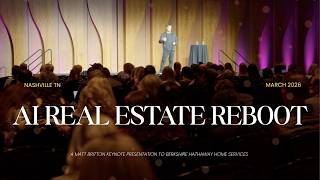
Matt Britton, CEO of Suzy, argues AI is more transformative than the internet or iPhone, reshaping real estate through mortgage underwriting, personalized market reports, and AI agents. The future workforce won't need coding skills but analytical thinking, creativity, and data literacy to direct AI toward valuable outcomes.
Chapters
All right, I'm back again. We are ready to get going with Mr. Matt Britton, and he's going to talk to you today about Navigating Tomorrow: Revolutionizing Real Estate with AI. And as we all know, as I said, so my name is David Beard. I'm general counsel for Berkshire Hathaway HomeServices. I keep reading how AI is going to replace me soon. Matt says no, but We'll see. Anyhow, it's not about me, it's about Matt. So I do have the pleasure of introducing Matt Britton to you. Matt is one of the leading voices in the world on artificial intelligence, on generational change, and on the future of work. He's the author of the New York Times bestseller Youth Nation and a 2025 national bestselling book called Generation AI, which explores— there we are, I'm sorry— which explores AI and how AI and Generation Alpha will reshape every corner of society. That's what I'm worried about. Matt is also a podcaster. He hosts the Speed of Culture podcast with Adweek. He's advised more than half of the Fortune 500 and shared insights with audiences around the world. In addition to all of that, Matt is also the founder and CEO of Suzy, which is a venture-based consumer intelligence platform which has been trusted by companies like Netflix, Procter Gamble, and Coca-Cola. Ladies and gentlemen, please welcome Matt Britton.
Change is here, no slowing down. New tools, new rules, new game to play. This is how you win today. Matt Britton stepping to the stage, turning insight into a new age. AI moving at lightning speed, giving every agent what they need. More deals, more time, more control, more clarity in every role. Berkshire Hathaway leading the way. Future of real estate starts today.
Pretty cool, right? Let's think about that for a second. If I want to create a custom song with a custom music video 5 years ago, I would have had to have hired a songwriter, a band, a music producer, a video editor, and a sound mixer. Instead, I met the video about 10:15 AM this morning at my hotel. That is how fast things are changing in AI. Things that would have seemed inconceivable just a couple of years ago are now part of my everyday life. They say the future is not— it is already here, but it's just not evenly distributed. Well, it is distributed to me. I spend all of my waking hours in the frontier AI models, and I'm seeing the change that's bringing the business, the culture, society. I'm seeing the change it's going to bring to your industry in a dramatic way. In fact, about 4 months ago, I keynoted the National Association of Realtors conference in Houston, and people there after I spoke looked like a ghost when I was done, when I told them things were happening. I hope I don't see as many ghosts today because things are moving so fast that people are every day understanding just how powerful this technology is. But some of you are on the earlier end of the AI adoption spectrum. Some of you might be in it every single day. Some of you might think that you're an AI expert, but maybe after what I show you today will open up your eyes to a whole new world. But what I want to impart everybody today is this is not like changes that we've seen in the past. It's not like the advent of the internet itself or social media or the iPhone. This is a completely new realm of how humans are interacting with technology and it's gonna change every single job. And I come to you not just as a thought leader, but as a CEO and entrepreneur who runs an AI-powered software company, as well as somebody who is a full-stack AI engineer. So I'm coming from a place of living in this, using these tools, and understanding just how big of an impact it's going to have on your industry. I spent my entire career helping big companies understand the new consumer. When I first started out in my career, the new consumer was the millennial generation. The digital natives, the first generation to grow up with the internet in the household. I am not on this chart. I'm a Gen Xer. I just missed millennials. And when I tell my kids that when I grew up there was no internet, they look at me the way I looked at my dad when he said he walked to school with no shoes on. But it's true, there was no internet when I was growing up. We actually had to pick up the phone and call people. If I was at the mall and I wanted my mom to pick me up and I had no change, I would do a collection I'd call, and instead of saying my name, I would say, "Pick me up in front of Burger King," or "Sam Goody," and then she would know— Sam Goody was an old record store for some of you younger people in the audience— she would know where to pick me up. We didn't have cell phones. It was a completely different realm. And then this thing called the internet was born, and there was a generation called the millennials that were the digital natives. They never knew a world without the internet and the power that it brought you. Then came a new generation about 15 years later, Gen Z. Gen Z will forever be known as the iPhone and social media generation, bringing the power of the internet in their pockets, forever changing the way that we communicate with one another, the way that we express ourselves. Think of the incredible businesses that were born because of the iPhone, companies like Uber, right, that allow you to push a button and get anywhere that you want to go to. And now there's a new generation that's coming to society, currently aged 0 to 15 years old, Gen Alpha. In fact, this is the last year a Gen Alpha is going to be born. Gen Beta is next, which gives me a whole other keynote to write. Gen Alpha is the AI generation. They will never know a world without AI. They will never know a world without a technology that you can communicate to the same way that you can communicate to other people. For parents of Gen Alpha kids, it's going to seem crazy to have kids in your household have intimate relationships with AI chatbots, sharing things with AI that you and I would never dream of sharing. You have to realize that they know no other way. Their worldview is different. Their brains are hardwired differently. And the incredible growing power of AI will make intuitive and natural behaviors from their everyday lives that we just won't be able to understand. The same way that many people didn't understand why people are looking down at their phones all day who grew up with the iPhone in the household. But this is so much bigger. So I recently wrote a book called Generation AI, and it's about the confluence of these two factors. It's about this incredible AI revolution and about this new generation's coming society that knows nothing but a world with AI and what it means for our future. So why is AI so very powerful? Why am I here telling all of you today on camera, on record, that AI is going to have a bigger impact on society than the internet itself? Well, there's a couple of reasons why. And I think first and foremost is just how easy it is to use AI. If you look at a lot of graphs and charts about AI usage and adoption, What you see is it veers towards younger consumers. But to me, that makes no sense because to use AI, you just need to know how to communicate in any language, in text or in voice, the same way that you communicate to a friend or a loved one. There's no learning curve with AI the way that many people think there is. The internet required you to understand www. The iPhone required you to understand how to type. on Glass. Right before that, there was the BlackBerry, and no one ever thought the BlackBerry would go away. But because there's no learning curve, I think slowly but surely everybody's going to be adopting this technology because it is built to humanize technology, removing that blocker, that friction that in the past has existed with new technologies. Not only is it easy to use, but it is improving at an unprecedented rate. We are seeing exponential growth of AI and its power. I cannot tell you how many times people told me, oh, I tried to use AI to make an image last year and it was terrible. And that would be like me telling you I tried to stream a movie on the internet in 2001 and it didn't work, so I refuse to watch Netflix today because the rate of change is that much greater. From iPhone 1 to iPhone 2, it took 18 months. To get the first version to the second with minimal change. AI is doubling in its power and potency every 7 months. So it's really incomparable to a technology we've seen in the past. When I speak at conferences like this, I often get asked to provide the deck a couple months in advance. I always tell them no, because it's going to be outdated. Everything I write is going to be rendered obsolete in 2 months. It's almost mind-blowing in terms of how quickly it's moving. And for a lot of people, that creates a lot of intimidation. And one thing I'm going to be talking about a lot today is about reframing how you look at AI. You don't want to look at the tools and the technology first. You want to look at your own life, your own career. What are the things that you want to solve for? Get really focused on that and then start to use AI to solve those problems. Where I think a lot of people first look at the tools, first look at AI, and try to basically have a nail looking for a hammer, right? And that is never a good way, especially when things are growing this very quickly. Got no 56 pass. I wasn't prepared to translate that as opposed to that little tease. That little mark with the A and then the ring around it.
At.
See, that's what I said. Kay said she thought it was about. Yeah. Oh. But I've never heard it. I've never heard it said. I know I see the mark, but never heard it said. And then it sounded stupid when I said it. Violence at NBC. Yeah, I see it around. Take that, Melissa Newsom. So you think there it is.
Violence at NBC, GE, Com.
I mean— Well, Allison should know. What is internet anyway? What is internet? Internet is, uh— That was on the Today Show in 1998. It seems laughable right now. I think we're in the "what is internet anyway" phase of AI still today. And the things that I'm going to be talking about today will be laughable a couple years from now. Back then, there was a technology called AOL, America Online, which was the crowbar technology that got Americans and the world at large online. It took the technology, the internet, which before AOL was used for government and military purposes, services and consumerized it. And for $20 a month and one of these CDs you got, all of a sudden everybody can get online. There's a lot of correlations with America Online in 1997, 1998 to a tool today called ChatGPT. AI has been around for a very long time and was around for a very long time before ChatGPT, used primarily for government and military and deep educational purposes and R&D. But it wasn't until ChatGPT came on board where everyone had access to the power of AI. And given its simplicity, given how easy it was to use right out of the box, it became the fastest growing technology in history. The question many are asking now is ChatGPT going to go the way of AOL? AOL ended up selling to Time Warner, and it ended up being one of the biggest disastrous mergers in history. And we don't know what's going to happen with ChatGPT, but there's already early signals that it's the pioneer that often ends up with the arrow in their back. And ChatGPT, while it's an incredible tool, there are so many other innovators in the AI space. But make no mistake, ChatGPT is an incredible tool. What it is, it's called a large language model. A large language model is an AI-powered application that takes inputs from consumers. That input could be voice, it could be text, it could be a picture. And then based upon whatever your query is, it goes through a knowledge base. In the case of ChatGPT, its knowledge base is the entire open internet, right? It's every Wikipedia article. It's everything that ChatGPT can crawl. And based upon your query and based upon the knowledge base, it will generate a response. A multimodal response, meaning if you want text, we'll give you text. If you want images, give you images, video, audio, like the song I just played for you, you name it. That's what a large language model does, and that's what ChatGPT does. And there are so many incredible large language models. There's an amazing tool I'll talk about later called Claude by a company called Anthropic. Google has a tremendous model, especially in the creative and art called Gemini. There's a tool called Llama that is from the people behind Facebook. And there's a lot of models that are coming out of China like Qwen, which are really powerful that many think are going to leapfrog the US models. All these large language models keep getting better and they keep leapfrogging each other. In fact, in just one year, the smartest large language model's IQ grew from 96 to 136. And talk about rate of change. Now it's at 144 since I've actually written this slide. Imagine your crazy Uncle Larry who couldn't piece two words together at Thanksgiving last year showing up as a Rhodes Scholar a year later. That's what's happened with large language models in the span only within a year. So let me walk you all through my experience with AI. Because I think my experience with AI might allow you to understand how you can go down a similar journey. I do not have an engineering background. I've never written a line of code. I've always been somewhat technical, but certainly nobody who would ever be able to tell you how all this technology works. I run a software company called Suzy. We've raised over $100 million. Uh, it's a consumer research software company that services brands like Netflix and Microsoft and MasterCard, etc. And when AI first came on board to society and tools like ChatGPT came accessible, I knew, just like so many others do, that this is— this means something. And as the CEO of a technology company, I had to do something about it. We had 85 engineers at that time, and I gave my head of engineering a mandate: figure out AI, figure out how to use AI, to reinvent our consumer research software product. And I waited and I waited and nothing really happened. And it dawned on me at that point that this is something that's different. This is not like HTML or a new sort of mobile framework. This is a new type of technology. And I made the decision at that point that I, as a CEO of the company, despite my lack of technical knowledge, was going to take AI back over myself. I'll take the reins away from my 80-person engineering team. And my experience in my life has been if you want to really figure something out, attach it to something that matters the most to you. So with that, I decided to first use AI to solve a problem personally before I was going to use AI to solve problems for my business. So I just turned 50 years old. I have 2 small children. I also have 2 kids in college. That's a whole other keynote. But the problem I really want to solve is I want to stay alive as long as possible. So I made the decision that I was going to use AI to figure out how to keep me alive longer. The other thing I had read through all my research about AI is that it's all about data. Data is what differentiates person A's use from AI from person B's use from AI. So I start to make the connection. What's the data that can help keep me alive? What's the data on my body? So I went through 25 years of personal health data to aggregate it and gather it. X-rays, MRIs, blood test information, notes from my doctors. I went through old filing cabinets and external hard drives to gather as much information I could, and I organized it into singular PDFs. Blood test PDF, MRI PDF, X-ray PDF. I've lived a relatively healthy life, but when you get blood tests, there's always things that are outside the balance, and those things mean something, but we don't really have the mental ability to actually compute and understand it. Frankly, neither do most of our doctors when they have 7 other patients in the waiting room, right? So with that information, I created my own personal health bot. After I gathered everything, I gave it a general prompt, and I created something called a custom GPT, which is just another version of a large language model, except Instead of this being trained on the entire internet, it's only trained on my health information, right? So it's using the power of that incredible tool, but it's pointed towards a very succinct piece of data, which is my health information. And my prompt was, act like a leading doctor from Johns Hopkins University with one sole purpose, to keep Matt Britton alive. So I built it and I was ready to ask it my first question, the same way that you would ask any question in ChatGPT. And my question was, if I'm gonna die in 5 years, what's the most likely cause? Now think about that for a second. This is something that is only trained on my information, right? If you go to WebMD, you should— we're all gonna die in 5 years, right? But this is something that's only trained on me, and it gave me an answer that obviously freaked me out, right? As it freaked anybody out. And I asked him, well, wait, what do you mean that? What can I do about it? Well, this marker, this family history, this, and it changed the way I look at everything about my life. And then I started to think, well, what about 10 years? Was that something different? And ever since then, if I go to an allergist, I'll have this health bot create a dossier, a 2-page report that I can give to my allergist before I show up. And she's like, how did you get this? Right? That is a great overall application of the power of AI and how it works. And it really can apply to everything you do in your personal life and in business. It started with one singular problem. I want to keep myself alive. Then it went to how can I aggregate the data that could help me solve that problem? And I just simply went to ChatGPT and said, I have this data. I want to use it to help me keep alive as long as possible. Give me step-by-step instructions on how to build an application that can help me solve my problem. And by the way, don't give me step 2 until I tell you step 1 is done, because if you give me 50 steps, I'm gonna get overwhelmed. I'm just gonna quit before I even start. And that's what it did. And I went step by step by step, and by step 27, I I look back and I was like, you know what? I can probably use this step for managing my finances. I can probably use this step for helping me understand the impact of my sales team at Suzy. And that's what happens when you start to build in AI. So many people who believe they're using AI well or the right way or they're advanced or an expert are using it the same way that you would have used Google, right? You're asking what's the best recipe for lasagna? And give you an answer. You're using it as a chatbot, which is great, right? And for many instances, it is better than what used to be a search engine like Google to accomplish those goals. But there's nothing like building an AI. Until you build an AI, until you've identified a problem and went through the process of building something, you cannot really understand what AI is capable of. And it's not really going to allow you to take full advantage of the incredible capabilities that it offers you in your job every day. And I'm going to unpack this for you now. I'm going to go through applications, especially for your industry, on things that you can think about building, things that you can think about applying. Because there's nothing worse than spending an hour hearing somebody like me on stage and walking out feeling inspired but not having any idea what to do about it. I'm not going to let that happen today. I'm going to make sure all of you walk out with specific ideas on what you can do about this incredible new opportunity that's presented to you. So one thing I think a lot about when it comes to AI is education, right? If you think about how people in this country and really around the world are educated, it's largely around this notion of memorization and regurgitation. I was a terrible student, but I knew how to cram. And the night before a test, I would cram as much information in my head, regurgitate it on my test the next day, and then I would never remember that information again. But that is how the education complex works, right? And it goes all the way up to college. If you're able to memorize a bunch of stuff for standardized testing, you're gonna get into a good college. And up until now, getting into a good college helped you get a good job. Afterwards. And a lot of this memorization and regurgitation was predicated on what was called the knowledge economy, which has really boomed for the last 25 years. If you had knowledge on how to write a contract and became a lawyer, if you had knowledge on how to read an X-ray and became a radiologist, if you had knowledge on how to write software and became an engineer, that was fine because if you maintain that knowledge and you can contextually deploy it in the knowledge economy, you were fine. Well, I will argue that the knowledge economy is coming to an end, and the notion of memorization and regurgitation is far less relevant. And people who spend their time memorizing stuff when they're young so they can complete tests will not have the skill sets needed to advance. There was a time where if you didn't know how to become a farmer, you would starve, right? Before that, if you didn't know how to hunt, you would starve, right? And over time, now I can just Uber Eats my Starbucks in the morning. It's all good. I don't have to worry about it. It wouldn't make sense for me to learn something that I don't need to anymore because technology has just intermediated that thing. This is that realm in a completely new level because the knowledge economy is day by day being chipped away at based upon AI's capabilities. So what is going to come in its place? The number one question I get after I speak at conventions like this is, what do I tell my kid to do? How are they going to get a job? What should they focus on if you're saying don't study for tests and do well anymore? Well, this is an amazing chart that came out of the World Economic Forum. And normally I don't show charts from 2 years ago, given how fast everything's changing, but this is actually one exception. It was a survey that asked 500 CEOs around the world, what are the most important skills in the workplace? And you can see here a lot of the skills that I exhibited in building my own health bot. Analytical thinking, I had to understand how to use data to give me the answer. Resilience, flexibility, and agility. I could have given up after step 8, but I didn't. I kept going. Creative thinking. I had the idea that this is a problem I want to solve, which was also about self-awareness, a certain amount of technological literacy, active listening, which you have to do to learn. You're all listening right now. These are soft skills. These are skills that will enable somebody in the workforce to see the power of this new technology and really have the wherewithal to understand where to point it to. The best example I like to give is a photographer. It used to be, in order for you to be a photographer in any way, shape, or form, you had to know how to develop film in the darkroom, you had to be able to afford or purchase a fancy DSLR camera, and you had to know a lot of the technical terms of the camera, right? F-stop and ISO, how to work all the knobs and dials. But here in 2026, 99.9% of pictures are taken with the iPhone, and all that functionality is now beneath the hood. And the people who are regarded as the best photographers are simply those that know where to point the camera to, right? That is how things are changing. Understanding where to point the proverbial camera of AI to, i.e., the problems they need to solve, is now so much more important than understanding how to solve the problem. Again, understanding the problems that need to be solved is now far more important than understanding how to solve the problem. I didn't know how to code, but I knew I wanted to solve the problem, keep myself alive, and I went through the process and I did a lot of copying and pasting. I didn't know what I was copying and pasting. But I persevered and I ended up building something. I spoke to somebody at my company because now I have been able to successfully integrate AI to my engineering team. And last week he told me something really profound. He said the people that grew up coding have a hard time letting AI code because they actually read all the AI-generated code before they actually deploy it. Well, I don't know how to read code, so I just have AI do it and then copy and paste it. And that lack of curse of knowledge is actually a big benefit because I'm not focused on how to solve the problem. I'm trusting AI to do so. And there are many engineers that said a couple of months ago, AI will never be able to write code. And it's the same engineers now that are saying, I'm just focused 100% on using Claude to build software. That's how quickly it's changed. So even for software engineers, who built their career around how to solve the problem, i.e., how to code. Now a lot of those skill sets are slowly being rendered obsolete, and what makes them a good engineer is just understanding the product that they want to build. That is for your job on an everyday basis. What's the problem that you want to solve? Are you trying to capture people's attention? Are you trying to get more listings? Are you trying to better track your agents in the field? Are you trying to better understand market data? Any of those things can very easily be built using AI in a way that's custom and bespoke for you. And you don't even really need to fully understand how to solve the problem, because if you're good enough at contextualizing that problem and you have the perseverance and a lot of skill sets that you see right now on the screen, my friends, you're going to be able to build and create things that you never thought was possible. Very few of you will leave this room and actually create something in AI. I know it because at every conference I say I want you to email me when you do, and I only usually get a handful from every conference. And those people come back to me 6 to 12 months later and all of a sudden have outsized returns in their career. They are the people that everyone goes to when they try to solve something in AI. They are not the people that at first had incredible technical skills. They just had analytical thinking. They just had resilience. They just had creative thinking. They had these soft skills. And I think that's what a lot of people miss. A lot of people believe that AI is for the whiz kids, is for the technical people, but it really isn't. It is just the people that find themselves becoming ultimate problem solvers. So In many ways, what is the new how? The problem you want to solve is so much more important than how to actually solve the problem. And if you can reframe your mind in that way, you look at the world in a completely different way because you spend time at an elevated plane of thinking. You don't get bogged down in those details anymore. You let AI handle the details, and guess what? Anything that AI can just do okay today in a world where it's doubling in power and potency every 7 months, it's going to be able to do that in an incredible way 2 years from now, right? It's going to be 3 times as good at doing whatever it can do today just 2 years from now. And every day it's going to get that much better. That whole dynamic is something that us as humans have a hard time comprehending because we've never engage or interact with technology quite like this before. So given that much of our workforce right now is knowledge economy workers, are predicated on how to solve the problem, we are seeing tremendous pressure in the labor force, something that I believe we are just at the very early stages of. I'm not saying I'm happy about it. I'm not saying it's a good thing. Obviously it's a bad thing. But it's here. There are so many people that come up to me after and say, AI is terrible, it takes away humanity, this and that. Well, when Socrates invented writing, a lot of people said it's terrible for humanity because no one needs to actually remember anything anymore, right? With every new technology, it was demonized. But guess what? We aren't going backwards. Corporate America is like, I say, you know what, you're right, we're shutting it all off. No, it's here stay and for us to understand how to future-proof ourselves. But as I mentioned earlier, the future is already here. It's just not evenly distributed, but it is distributed to people like Jack Dorsey, who is the founder of Twitter, who actually just cut 4,000 of his 10,000 employees because of AI. And I think it's very much the tip of the iceberg. And we are going to see a lot of pressure on the workforce as companies realize that so many jobs are predicated on how to solve problems that AI can do quicker, faster, and cheaper. A lot of people are questioning what does this mean for the housing market? Because we all know that given a range of factors, rising interest rates and inflation, that first-time homebuyers continue to get older. The notion of homeownership, which used to be the American dream, right, is kind of becoming something getting further and further away. First-time buyers in the US in 1991 were an average age of 28, and last year was 40. Repeat buyers in 1991 were 42, and last year it was 62. So what does that mean for your business? Well, there is a saving grace, and the saving grace is the great wealth transfer. We're over the next 20 years $84 trillion with a T is actually being passed down from baby boomers to Gen Alpha and Gen Z consumers. Because what baby boomers did is they treated their money nothing like the way the younger people do today. Let me give you an example. My father passed away 3 years ago. When he did, I was left in charge of his estate. And I was left in charge of his estate. I went through how much money he had saved. And my jaw dropped to the floor because it was nothing like the way he lived. He would circle around a city block for 2 hours to avoid spending $7 on a parking spot, right? Yet I saw how much he'd saved and I really had a hard time reconciling it. But the deeper I looked into it, I learned that he was a child of World War II and the Great Depression, and his relationship with money was one of scarcity. He didn't want to let that money go because when he grew up, He saw what happened when money wasn't as abundant. Now let's juxtapose that to the younger consumer, to Gen Z, when they were the beneficiary of fiscal stimulus during the pandemic. Was their relationship with money one of scarcity? Absolutely not. You're talking about GameStop, GameStops, NFTs, cryptocurrency, you name it. They couldn't spend fast enough. So what is going to happen when $84 trillion goes to a generation that doesn't want to spend money, to a generation that can't spend it fast enough. I think it's going to create a tremendous era of consumerism. And I think these people that inherit money are going to want to buy homes. And I think we are just starting to see this happen. Now, a lot of these people that inherit money aren't going to have any jobs, right? So hopefully they have really rich parents. But over time, I do believe I believe what's going to start to happen is I think in the next couple of years you're going to see a lot of layoffs. I think entry-level jobs are going to trickle down dramatically. But over time, what's going to start to happen is companies are going to become far more profitable. There's going to be new opportunities that will abound, and they will want to reinvest in innovation. And when they do, there's going to be a whole new wave of hiring. There's a stat that recently came out that 80% of the jobs that are going to be here in 2030 don't even exist today. But it's only 5 years from now. So I think we're going to go through a topsy-turvy time in the next couple of years. But I do think that there are a lot of tailwinds maybe between 5 and 10 years from now that are really going to resuscitate a lot of the housing market. And hopefully it starts to happen a lot sooner. And I think the great wealth transfer is going to be a big driver. The other thing I'm seeing in the economy before I jump specifically to real estate applications is this notion of the barbell economy. And this is really something that transcends industries. For example, The Gap used to be a great retailer, right? And they sold $100 jeans. But right now in 2026, there's a booming market of people that want to buy $20 jeans from Walmart. And there's a growing population of people that want to buy $225 jeans from a boutique downtown. But not a lot of people in the middle. And we're seeing that happen across real estate. We're seeing that happen across airlines, automobiles, you name the category. So in the short term, I think the barbell economy is the way you want to look at your jobs. Are you a value multifamily, you know, value side investor, or are you on the luxury side? Because you're starting to see that happen. It's happening in the— obviously in the office space market, and it's happening in the residential market slowly but surely as the middle class erodes and will continue to erode as a result of all this innovation that's occurring. So let's talk about your industry, real estate, which I like to call the world's most inefficient large asset class. Incredible market size, not a lot of efficiency, a lot of dated legacy systems. But the inflection point is now. The things that adopt today will enable you to future-proof yourselves 6 to 12 months from now because the change is already happening. It's just happening slowly beneath your feet. And I'm going to give you a lot of examples why AI is going to change the real estate industry and already is and what you can all do about it. Get a little bit specific. First area is in the realm of financing. We all know how painstaking it is to get to get a mortgage, right, for consumers. And it doesn't have to be that way because the underwriting process is just data analysis. And you know what AI does really well? Data analysis. If AI can analyze a 15-million-line spreadsheet, I think you can analyze my credit score and my personal balance sheet and weigh it against risk. And it's already starting to happen. So I think the application of AI in mortgage Main Street is going to be one of the first places that the consumer is going to start to see a lot of benefits. They're going to be able to get approved for a home nearly instantly, the same way that you get approved for a car loan. And obviously there's legacy systems and bureaucracy in the financial market that has to catch up. But this is an area where technology is so good, everything from intelligently processing documents to automated underwriting risk assessment to detecting fraud. This is, this is a technology that should superpower the mortgage application process. And essentially, if you are working with a customer who can't afford a home because they're not getting approved by a bank, wouldn't it help all of you to know in 2 minutes versus knowing in 3 weeks? Of course it would. And anything you can do to understand this, understand these vendors, push them, get to know them, it's going to allow you to much more likely be able to integrate this in your process sooner. I understand you can't just flip a switch, right? There's a lot of layers here. But know these companies, know what they're capable of, get to know some of these new startups, speak intelligently about it. This is going to be here before you know it. A huge change, I think the biggest change in business we're going to see in 2026 due to AI. Is that the internet is getting a new front door. By show of hands, how many people have used an AI search engine like ChatGPT in the place of something that you would have used Google for just a year ago? There you go. 80%. A year ago, it was 20%. I asked the same question, the same type of conference as a year ago. That is a massive shift. Google had a— that it arguably the most powerful, successful business model of the last couple of decades. It was— it is the verb, the place that people go to to find anything, whether it's a real estate broker that specializes in beachfront homes in Myrtle Beach, right? Or it's a lender that can give you a quicker answer on a mortgage. Whatever it is, they would go to Google for that. And they're not going to Google as much anymore. They are now going to ChatGPT. And because of that, we are seeing the front door of the internet changing. 50% of consumers already are using AI-powered search today, and up to 50% of traffic is now at risk, which is really interesting because for so many years, if you were listed first on Google for any search, you had it made. But that's no longer the case, which is creating a new industry called answer engine optimization, which is the new version of search engine optimization. This is a search where someone's asking for a South Beach apartment complex that they should look at. You can see it's giving you the listings and giving you a price comparison. If you want to ask if there's an agent or broker that can represent you, it'll recommend as well. Well, where are you guys recommended in your market? Is someone searching? Is someone searching for someone to sell their home? Where are you or your firm in that list? You should know, and you should know how or what to do about it, because that is going to be a make-or-break moment for so many of you. This year, 3/4 of my inbound search inquiries for speaking have actually come from AI. People are searching, I'm looking for a leading speaker on AI to speak at my conference, and my name pops up. And once they start After hearing this, I did a ton of research and figuring out what I can do about it. There's a lot of correlations to optimizing for Google. It's always about content, but it's about different types of content, specificity in content. Because when you are searching on a platform like ChatGPT, you're going a lot further down the funnel. You're not just asking what's the best pickleball racket. You are having a conversation. And by the time that ChatGPT is recommending a pickleball racket, it knows that you're searching for a pickleball racket for a 12-year-old girl. And if you're a vendor that sells pickleball rackets, you want to create content that's pickleball racket for 12-year-old girls, 13-year-old girls, etc. So that content's out there. So when ChatGPT is searching the internet, it's going to be able to confidently give your company as an answer. So how many different neighborhoods do you serve? How many different buildings do you serve? If you have a big building that you're representing, you need content out there that's showing that you are the person that can sell an apartment in that building or in that development and have as much content out there as possible, not just in Nashville, but in this subdivision of this development in Nashville. Push that content out there on YouTube, push that content out there on a blog. This is going to become more important than ever before because we're entering a world of agent-to-agent selling where you're just going to have to actually decide for you and ChatGPT is going to be reaching out to the broker. Sounds crazy. Trust me, it's going to happen. And your ability to be in that consideration set to these large language models like ChatGPT, like Gemini, like Claude is going to be make or break because You're not the only group of people where 80% of people are raising their hands saying they're not using Google anymore. Every conference I'm going to in every industry, people are saying that. And next year, it'll be 99% of people raising their hands. Another incredible opportunity with AI is in the realm of AI-powered creative. I mentioned earlier that some people say I tried to use AI to create images 6 months ago and it didn't look good. It's true. I mean, Midjourney, if you actually created an image— Midjourney is a text-to-image AI tool, right? We say make me an image of whatever. And version 1, I can tell you that guy had 6 fingers on one hand, 7 on the other. Wasn't very pretty. But look at version 5.1. And guess what? Midjourney is now working on version 8, right? So tell me, how are we going to be able to distinguish what's real and what's not? Obviously, lots of scary repercussions to that, right? But it's here, and for business, it allows you to create things that in the past you weren't able to create, like a picture of you in front of every single building or home that you want to represent without ever even having to be in front of that home, right? There are so many different ways that you can actually use this to have hyper-personalized content. The best image generation tool out there right now is called— funny name— Nano Banana. It's from Google, and it is incredible in the fidelity and way it's able to create imagery. I recently created a tool— I'll send you guys links to that— allow you to create branded market reports in seconds, where basically it's an automation that uses a tool called Perplexity that researches the market based upon a zip code and actually creates a branded report that's in your brand of your firm instantly. So there's— and this is a problem I want to solve for a couple of my friends in real estate. Another example, something I built, and I was able to actually build it, and now I productize this. So one of the main things I think that can really help you stand out in the selling process is in the area of listings. Real estate listings have gotten obviously very commoditized, and obviously a lot of people like spending their time on Zillow and dreaming of homes. They probably can't afford. But a lot of people also hear about properties when they're in social media, and social media is about entertainment, it's about standing out. So I started to spend some time thinking about— this is a couple months ago, right before the National Association of Realtors show— how can you use AI to create real estate listings that will really help you stand out? And I poked and prodded a couple different things. The first thing I created was what's called an AI avatar. Avatar, a person that looks like a human going through a listing. Welcome to your private retreat in Steeplechase, where modern updates meet backyard paradise. Step outside to the ultimate getaway, surrounded by lush tropical landscaping, a cascading waterfall canopy. So this was okay, right? I thought, okay, I think I can do better than this. And I should also say that it was for this listing. I was speaking at the time in Houston, and I want to basically pick a random listing and show you what could be done. And this was the first thing I created. But then I want to really up the ante. How can I create something that really had a lot of entertainment value, that really stands through in a world of social media? And this is what I came up with.
Welcome. Yard steals the day. Waterfall flowing, swim-up bar going, no rear neighbors in sight. The sunset keeps on showing, 4 beds waiting, style of bathing, new roof shingles.
How do you think your boring real estate listing is going to compare against that, right? So I'm going to show you guys the QR code at the end, and if you sign up, I'll send you guys instructions on how to get access to building stuff like this. But this is This is how you break through, right? It's creating entertainment content. It's pushing yourself out there because not only are more and more people obviously using tools like ChatGPT to search, but one thing's for sure, and this is especially true of the generation that grew up with the iPhone in the household, Gen Z, which, by the way, this year, for the first time ever, the average age of a first-time mother in the US is Gen Z. If she grew up looking at content, not through the television, but through her phone. And that consumer is very soon or later going to be coming, your core home buyer. And to break through on a mobile device where he or her are staring at all day, you need great content. And this is great content to get whatever you want to get accomplished. And it's a different way of building and thinking about AI. It's a lot different than asking ChatGPT for the lasagna recipe, right? This started with a problem I wanted to solve. I want to show the real estate industry a different way to create listings that's entertainment-driven. Started with that. Then I tried to figure out what is entertainment? Well, it's music. I'm going to pick a listing and I went step by step the same way I did with my health bot. And that's what I ended up with. I'm trying to show you the steps I went through to actually get there. And I'm not some incredible I'm a very technically talented MIT engineer. I just go at it from a very much a problem-solving, step-by-step, methodical approach to getting there. Data is another huge opportunity and unlocking the power of data. This is something called NYC Open Data. It is a free database that New York City publishes of all information that somebody in your industry would want to know about the real estate industry. It lists city traffic by city block, crime rates by city block, noise by city block. It lists an ongoing listing of new permit issuances for new buildings that are created. This has been alive for a very long time, but nobody had the ability to download a spreadsheet with 3 million lines on it and pour through it every single day. But with AI, now you can do it. This is what it used to be. In a pre-AI world what you'd have to go through. But this is what it is now. So I have a friend that's one of the largest real estate brokers in Brooklyn, and I connected a ChatGPT-like interface to this data. And now his agents in the field can ask, what's the name of the permit for the job located at 1 Madison Avenue? And it's going to give it to them right away. If someone wants to ask the closest local school to a certain listing, they don't have to find out they can do it while they're there in the field. You now have the ability of taking all the information that exists and being able to access it the same way you access any type of data in ChatGPT. This is slightly more advanced than building, but not even really much so. And this is something I was able to build for him that changed the way that his brokerage worked just by connecting AI to existing data. You could use this to go through your own data as well. You can take a massive spreadsheet of all your past listings, all your past information, and drop into a tool like Claude and talk to the data. Talking to data is an incredible application of AI. It takes a spreadsheet which I don't think anyone will ever pour through ever again. Starting in 2027, no one will ever open up a spreadsheet. The spreadsheet will be connected to AI and you'll interact with it. It's very deep beneath the hood. It's the milking the cow order of business, right? It's just going to be served to you, right? Unless you're a farmer and still does it, right? And this is basically how I think data is going to be used. Hyper-personalization is another huge unlock of AI. What you can do with hyper-personalization is really customize the content. One huge application that is a great example of something that was just okay maybe 6 months ago that's incredible right now is virtual visual staging and being able to take any picture of any property, understanding what your customer's style is. Like, if I was trying to sell a property, right, I would actually ask my customer— I would have a 10-minute phone call, I'd record it. I use a tool called Granola. I'm just coming up with this on the spot, by the way, but that's what I do. I would use a tool like Granola that records conversations and say, hey, customer Jane Doe, I just talk for 10 minutes or so about your style? She's like, sure. I'll say, well, first send me pictures of what your dream home would look like, and then let me ask you questions. I would record all this, and then I would take the pictures she sent me, and I would take the transcript from that conversation, and I put in the ChatGPT and say, give me a 3-paragraph overview of what this person's style is. And then I would have that 3-paragraph overview. And every time I show her a property, I would take pictures of the house in a before standpoint, and I would put in the ChatGPT and say, turn this picture into this style. I'm copying the 3-paragraph overview of what her style is. And now you don't need to have her envision what the home will look like. You're going to be able to actually show her the home in exactly her style. That is hyper-personalization. Getting as much information as you can from the seller, from the buyer, whoever it is that you're doing business with, and then using AI to hyper-personalize and not relying on them to envision it. You're just showing them what it is. There's an incredible tool that just came out called Claude Cowork, which allows you to do a lot of things I'm talking about today in a very seamless way. Claude, to me, is by far the best large language model in the market. If you're in business and you're not spending all your time in Claude, I believe you're doing it wrong. The way I'm using AI right now is I use Gemini for all images and videos, right? So if I'm doing like in-home staging, I'm always using Gemini, right? I'm using ChatGPT for for everyday stuff, but I don't really use it as much anymore. And then I'm using Claude for everything in business. Claude is beyond a chatbot though. Claude has two incredible tools that you can use. One is Claude Code, which is actually how you code and build things. But even something that's easier to access for all of you is something called Claude Cowork. This is something you can download, and Claude Cowork is essentially what's called an agent. So a lot of talk's been had about AI agents. And what is AI agents? Well, an AI chatbot, you're just asking the chatbot questions and it's giving you answers. What Claude Co-Work has the ability to do is essentially use other tools for you and work while you're speaking to get something done. So you can now plug Claude Co-Work to a variety of different tools. It could be a research tool like Perplexity, which I use to create the market listings. It could be a creative tool. It could be your data. And you're basically giving it very long lists of things to do and it'll do it for you. It sounds crazy, but you have to try it. This is a fantastic way for you to go into the building AI era that I think you all need to be going into, is using this tool called Claude Co-Work. The interface could not be easier. It looks a lot like a chatbot with the exception that you have the ability to connect to a bunch of things and it'll keep working. It's not meant to just give you a quick answer. It's meant to try to figure out through a variety of different paths how to get done whatever it is that you want to get done. And I think it's a big thing that I always say matter-of-factly that really is the most important thing that you need to do is when you get home tonight and you think about what would make this year professionally the best year of your lives and just write down what that is. And it's probably an outcome, right? 10x times the listings that you were able to part of the market, whatever it is. And then work yourself backwards. In order for me to get 10 times listings, what else would need to be true? Well, I need to speak to 10 times more people. Well, how do I need to speak to 10 times more people? Well, maybe I need to meet with 10 times more people, or email, or whatever it may be. And those are the sorts of problems that you can go into Cloud Cowork and actually have it solved for you, right? The outcome is 10 times more listings, but the The things you need to do to actually get there are things like having more content, emailing more people, being more personalized in your outreach. And these are very high-value initiatives that Claude and Cowork can actually help you accomplish. And I think if you just go into it with that mindset, I think you're going to find that you are able to really create some great things. So AI coding is kind of like the expert realm. Of where you can go to. And I think you need to move from chatbot to agent before you kind of get the coding, which is sort of— but it's here. Meaning, I woke up this morning and I just had this thought how crazy it is that I can dream of any technology product I want and without anybody's help, I can just create it. And it's not because I'm that talented or smart, just because I think in a time of knowing how this stuff works. That's where we are right now. Any technology product you want to create, whether it's a tool that allows me to stay alive or whether it's a tool that creates branded market listings, you can create. And it's tools like Cursor, which is an AI coding tool, and Claude has one as well, that enable you to use AI for the power of coding. And this is crazy. These are the software development job postings in the United States. You can see what's happened since ChatGPT. When GPT came out in terms of what it meant for engineering. Talk about the fall of the knowledge economy, right? Talk about the need to reinvent for AI engineers. This is the proof point that we are in a completely new realm. So to wrap up here today, you do not need to be an expert to do something great. I hope you all leave understanding that. You just have to have the motivation. The world's going to change. There's going to be a lot of job loss, a lot of change, but there's going to be So much opportunity and it's for the taking. But in order for you to future-proof yourself, you have to dive in. And in order for you to dive in, you have to know what you're diving in for. And that means the problem that you want to solve. It doesn't matter what age you are or your technical ability is. AI really has become the great equalizer for you to actually get there. There's 4 pillars I like to talk about, one being a problem solver. 2 L's in there for a reason. Large language models, how you do it. Focus on the problems you want to solve. Practice perseverance. Don't give up. I love the notion of give me step-by-step instructions. Don't give me step 2 till I tell you step 1 is done. It makes it easy to piece by piece to understand what you can actually create. Understand the power of data. Data is everything. You need to understand what data you have that can help you solve that problem. And most importantly, be action-oriented. Dive in and just try. Set aside time every single day to understand how these tools work and more importantly, have experience building in them because that will differentiate you and really put a force multiplier on what you can actually accomplish in your career. And you're all here today because you want to accomplish something big in your career. If you snap this code, this QR code, I'll send you a bunch of stuff, links to a bunch of stuff, a copy of the deck, a copy of the video, this presentation. And everything else. And I just wish all you guys lots of luck. Now I have to do this presentation all over again, so hopefully I'll be able to get just as much energy for round 2. But thanks so much for taking the time today. I really appreciate it. Thanks everyone. Great presentation. Thank you so much, Matt.
I hope everybody got all of that. It's pretty exciting. I mean, there's a whole new world out there there. Thank you all for your attendance, and please do grab your trash if you would on the way out the door, and we'll see you in the next session.
More from Matt




MikMak’s Rachel Tipograph on Consumer Spending, Retail Media & Holiday Shopping Trends



Jaguar Land Rover’s Charlotte Blank on Luxury, Purpose & Experiential Storytelling



