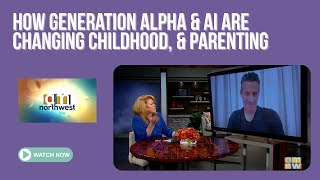
Matt Britton discusses how Generation Alpha, ages 0-15, will be the first to grow up with AI as native technology, forming intimate relationships with chatbots. He built a personal health bot using 20 years of medical data and warns parents that banning AI won't work; instead, kids need early training while parents manage risks like emotional attachment and treating AI as truth.
Welcome back to AIM Northwest. You know, when kids have a question, who do they ask? It's not their parents, not even Google. Instead, they're more likely to turn to TikTok and ChatGPT for answers. Here to share more, we welcome the author of Generation AI why Generation Alpha and the Age of AI Will Change Everything, Matt Britton. Matt, great to have you with us today.
Good to see you. Thanks for having me.
What inspired you to write this book?
You know, I run a software company for my day job and when I first came into the mainstream my initial inclination was to give it to my engineering team. And I quickly found that they had a hard time figuring it out and how to apply it to our product. So I took matters into my own hands and decided to figure out how to build an AI myself. And I made the decision that before I was going to build for my company, I was actually going to create tools that made my life better personally. And the first endeavor I took on was to build a personal health bot where I took 20 years worth of blood testing information, X rays, MRIs embedded into my own version of Chat CBT with the single goal of keeping me alive. And the first question I asked it was if I'm going to die in five years, what's the most likely cause? And the answer kind of blew me away. And since then I've been using that tool and many others I've created to really change my life. And I was so inspired by the process I made decision I need to share my learnings with the world in terms of just how drastic the changes I thought AI was going to impart on business, culture and society. And that's what caused me to write the book Generation AI.
I've got to ask you about this. I have a friend whose 20 something year old daughter had been having, I guess an ongoing relationship with ChatGPT, I don't know what to call it. And complained to her boyfriend that her boyfriend was not as nice to her as ChatGPT. In all seriousness, that she was thinking of leaving him because Chat GPT was a lot nicer to her. And I thought that's really. That. That says something because I keep reading in the news more and more couples are breaking up because one or the other is attached to a chatgpt which. Which sounds like a movie.
It does sound like movie. In fact there was a movie back in 2013 called her which yeah, was pressured on. On really predicting where this world was headed and it was actually quite accurate. If you go back and watch it, you Know Generation Alpha, which is currently 0 to 15, is going to be the first AI native population, the first population that grew up in a world with AI. And for them, developing intimate relationships with AI chat bots is going to become more the norm than something that seems strange. But for the first time ever, we are interacting with technology in a way that's very similar to the way that we interact with one another. And the more and more AI becomes real in terms of the way it, it writes, language speaks. Right now there's, you know, AI avatars that are becoming increasingly indistinguishable from real humans. The notion that people can gain intimate connections and attachments to AI chat bots is not really that far. And we're already starting to see the early inclinations of that.
Oh yeah, because we're hearing people call their chatbots a name. I'm talking to her, whatever the name is, or him, whatever.
Yeah.
What do you say?
It started with Siri and Alexa. Right? Right. To talk to Siri and Alexa. And now it just evolved.
Right. What are your suggestions for parents, especially of Alpha kids?
Well, I think the first thing is keeping AI away from your kids is not going to set them up for success in the future. Being someone who's very deeply immersed in the business world, I can tell you that many companies right now are reevaluating their workforces and you're just starting to see the very tip of what I think will be a mass wave of layoffs in corporate America as companies quickly realize that I can automate a lot of jobs that currently exist. So for kids to really future proof themselves, they really need to understand how to use AI at very early stages. At the same time, there's a lot of risk because of the dynamic that we just spoke about, the fact that kids are going to start to trust AI, you know, as kind of a source of truth. And AI isn't always a source of truth. So it really is going to be a balancing act. One of the challenges is that AI is evolving so quickly. It's really hard for parents to keep up and really understand where things are at in a world where for their kids it's going to be far more intuitive because again, it's the only world that they've ever known, it seems.
So it's so harsh in so many ways because a conversation that a 15 year old child may have had with their good friend or their mom or dad is now going to ChatGPT or to AI, and that ChatGPT knows that child so well, it will Give them the answer they want.
Yeah. And they feel like they can talk in confidence. You know, we're seeing a lot of applications right now in a world of mental health, you know, AI powered therapists, you know, there. And kind of the industry, and the health care industry in general is split on, on that topic, because on one hand, you can never replace the emotional connection you have with a real therapist, a real human being who you're talking to. On the other hand, therapists are very expensive. They're not available 24 7. They have many patients and don't really recall maybe something that you said three months ago. And for a lot of patients who don't want to share their most intimate years and life details with another human, AI allows them to do so in anonymity. So I think like everything else when it comes to AI, there are so many benefits and there's a lot of things to be concerned about and it's just the world of tradeoffs. But the one thing is for sure is we're not going backward. AI is just starting to impact every fabric of our culture, of our society. And as professionals, as parents, as students, you know, we really have to get our arms around it in order to be on the right side of all these changes.
This conversation is just beginning. We want to tell everyone. The book again is titled Generation AI. Why Generation Alpha and the Age of AI Will Change Everything. Matt Britton, thank you so much.