HP’s John Koller on Subscription Marketing, AI & Customer-Centric Growth
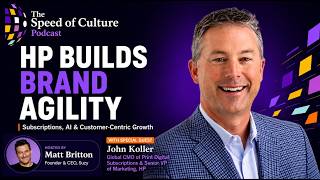
HP's global CMO John Koller spent two decades at PlayStation building online multiplayer and VR before moving to print subscriptions. He explains why first-party data is now gold, how subscription marketing differs from brand storytelling, and warns against chasing AI and VR hype without customer-centric purpose.
Chapters
Today we're gonna be joined by John Koller, current Global CMO of Print Digital Subscriptions and Senior VP of Marketing at HP. John's career has had him working for many huge names in the world of sports, beverage, and gaming, which we'll get into. And it's no surprise that John was recently named in Brand Innovator's Best 40 Marketers Under 40. John, it's so great to see you here at CES. Thanks for joining.
Yeah, of course. Glad to be here.
Amazing. So I'd love to hear a little bit about your background to take it way back. You know, you've had a great career and have worked for a lot of exciting brands. When you were in your college days, did you know what you wanted to be when you grew up one day?
So I did not. In fact, I had a professor in college at undergrad who said, never go into marketing. I don't like your test scores. So of course I did and took that challenge and I'm glad I did. I wanted to get into sports. I thought sports marketing was really the path that I was going to get into. Got some really good advice from a boss of mine with the 49ers that they pay the players, not the front office. And so maybe you should rethink. You know, if you want to get—
was football not an option at that point to actually be a player?
Well, I did. I did. I played through high school and then was, was offered a chance to play in college and decided just to do marketing work. Like I did internships and other things just to try and prepare myself just for the sports world. But yeah, they pay the players, not the people. So you start thinking like, well, what other places are there? And I jumped into gaming from there. And why?
Why gaming?
Well, same, same mentor, Rodney Knox, who ended up leading all marketing for Nike basketball actually over time. But he said, you know, there's this thing kind of starting to percolate a little bit. Like, you may want to think about, you know, the Segas of the world, Nintendo, PlayStation 1 had just come out. Maybe this is like mid-'90s. Maybe you should take a look at that. Like, it's really fun. I'm like, I play all the time. Yeah, this would be really good. So I said, all right. And he's all, here's, here's some names. Go, go talk to them.
And I saw you started at EA Sports, which obviously is famous for, among other titles, Madden. So being a football fan, I'm sure that didn't hurt in terms of gravitating you to EA. Yeah, yeah.
I mean, EA was great. That's a great company. And it was kind of still early days. Like, it's not the EA that we know today, which is a huge monstrosity and really big, but like they were still kind of growing too. And yeah, it was a good place to start. Like, I— some of the things that really struck me is, you know, in terms of— and I get this a lot from people asking like, why did you get into marketing? And I realized that for PR and comms, and I greatly respect the people in those, fields is, but a lot of that's behind the camera. I want to do a lot of the strategy work and things kind of in front of the camera. A little bit what we're doing today. Like, you want to be able to explain out, you know, why do things exist the way they do? Why are you, um, moving forward with the way that you are for this particular product or service? And, um, just enjoyed that. So that was kind of why I jumped into that in gaming.
And yeah, and you would end up spending 20 years at PlayStation. Um, obviously when you joined in 1998, the internet was first becoming kind of a mainstream consumption habit amongst consumers. And then fast forward 10 years later, and very few people are actually buying discs now. No one really does. Everyone's downloading. That's just one of the many changes that happened in the gaming industry. Talk to us about the evolution that you saw and had a front row for, um, at, at PlayStation and in gaming more broadly that you were able to experience.
Yeah, I mean, I think that actually, that what you just mentioned was probably the biggest shift. We realized pretty quickly when I started at PlayStation that the true way forward is for everyone to play together. We were starting to see that a little bit out of Japan where, um, they'd have a lot of local play. They'd play Monster Hunter, this game, and there'd be 8 people sitting in a circle in one room. And there was something there around like, all right, people like to do this together. What if you dispersed them and you were able to play online? And that was a whole thing, like in the early 2000s. What if we were able to pioneer that? And in many ways PlayStation did.
It was so choppy at the beginning. I remember, um, like you You'd be playing Madden or you'd be playing like a game and it was like you were waiting for the play to finish when you were doing it. Yeah. But it's almost like when you first started streaming videos on, on over the internet.
Yeah.
Right. And then over time it got better and better and now it's like you're, you're sitting next to somebody.
I, I tell my kids this now too. There used to be this thing called LAN parties and you'd bring, people would bring big TVs and they'd connect them with cables in one room and you'd have just gaming sessions, but it'd be all kind of localized, but you wouldn't talk to anybody. So it would be essentially online. And this was a thing until about '04, '05. And, um, now you're like, wait, what? Like you're bringing discs in and you're carrying like 400-pound CRT TVs. And yeah, we used to do that. And then, uh, realized that, you know, if you can play Madden or we had a great, um, game called SOCOM: U.S. Navy SEALs, which ended up being a big kind of online shooter game that I was a marketing manager for, you could end up playing with people from around the world in ways that you hadn't ever thought of before. And you did have some of the slowdown that you were mentioning. So you'd, Sometimes in a shooter game you'd get a shot off and you, the other side wouldn't realize they were dead and you were still shooting them and there'd just be this gap. Um, we had to fix some of those things, but like it turned into a community.
I was about to say, yeah, a really early iteration of social media in some ways, right? It's connecting people over shared interests and passions.
You know, we, we, you hear a lot from Meta about the metaverse and other things and Zuckerberg talks about this a lot, but I'm like, whoa, hold on. Like PlayStation and in many ways Xbox at that time really pioneered that. Like that whole idea of a, of a digital community that hung together in a different world. Like That was the idea, you know, 20 years before, um, you know, others started talking about it. So I, I credit the gaming industry for a lot of the things that we see today.
And, and what were some of the takeaways from working at PlayStation? When you joined, you know, you were a product marketing manager. When you left, um, you were basically heading marketing and you managed the launch of PS4, which was a major launch. Um, if you were to sum up your, your, your career there, it was 20 years, a long period of time. What were your main takeaways from your time at the company?
Yeah, I think the thing that I learned the most was that the more that you invest in the brand and in a brand, the better that you will be. And to do so in ways that differentiate and provide opportunities for people to get value in what you're doing, you have to be very customer-centric. I think we, we realized quickly, and I would tell you that one of the secrets to our success that Xbox did not have at the time was this idea that if you focus on the gamer and what he or she needs, you will ultimately be successful. And it sounds really strange, but others, and Microsoft in particular, fell prey to this. I think it was a lot of profit over people. Mm-hmm. And it was how, how much can we rack up, you know, subscription services on your back and add on a whole bunch of other layers and we're gonna put DRM restrictions on you and all these things back then. And it was like gamers said, I, I don't wanna do that. I just wanna play with my friends.
Right.
And so, um, you know, as I advanced in my career at PlayStation, I ended up at the end there as general manager of the business and we launched, uh, PlayStation VR and PlayStation 4 and, I did all the strategy work for PlayStation 5 and you end up seeing like the, the change that gamers, gamers are just asking for the opportunity to play and to have it as a seamless experience and be able to play with friends and just gimme some good games to play. Yeah. And so if you're able to get that and, and really kind of succeed there, you're gonna, you're gonna do just fine. And, and I think that's, we laid the groundwork for all, I think the success PlayStation has now. And now it's, you know, I think it's a top 10, uh, millennial, Gen Z and Gen Alpha brand. Like it's just, it's phenomenal.
It's amazing.
It's a force.
And you'd mentioned the metaverse, um, you know, and, and the work that Meta is doing. I'm just curious, what are your thoughts on the role of VR, um, and these new headsets that, you know, Apple has their new Vision Pro that they're all gonna be stepping on the gas on. What role do you think all that is gonna have in gaming? How's it gonna change moving forward?
I, I think first of all, we launched it in 2016 and we were really early. Yeah. Like, I mean, you could make a case. We're still early. We're still early. Yeah. We're still early. And even then we're like, gosh, do people want things on their head? Yeah. Like, I'm not sure. And even now, like. You can't really share it cuz of the, the health things and other things on people's body. So you've kind of got your own device. So there's not a lot of the sharing that we see in other parts of gaming. Um, I think there's a lot of opportunity for gaming. I think, um, Oculus done a good job and I think later iterations of PlayStation VR have done a pretty good job. But, um, it's still restrictive in some ways. You can only use it for 20 to 30 minutes medically, right? Like otherwise the brain starts becoming really fatigued.
You have to be very careful, especially with, with young You know, adolescents, you, you worry about how they're in their developmental years. You really want this. That's right.
The frontal lobe hasn't fully developed. We used to have a bunch of white papers we develop on this. We, you have to be very careful. All that said, I think it's, it's unbelievable when you, when you actually end up playing games in VR, it is a totally different experience. And it, if you can find a way, I think if developers can find a way for shorter, harder hitting gameplay experiences that get you in and out and then maybe take a break and then come back. It could be the way, but, um, I think we're still a little ways away. I'm excited for what Apple's coming out with. I think they'll maybe crack a few codes on that. Yeah.
People kind of gave 'em a hard time when they launched this $3,500 device outta the gate, but people don't remember how limited the original iPhone was.
Oh my gosh.
There was no app store or anything. You have to start somewhere, right? Yeah.
Yeah. You gotta start somewhere. And I, so, so VR, VR also has a lot of other, um, possibilities. Like we were looking at things like for people that were in, uh, medical situations and what if you actually put, or children, like children's hospital, you could put VR. Headsets on people as, as kids as they go through, and you're administering, you know, whatever kind of medication they need, but they're in a different world and not noticing. So the brain can be relocated in some ways to other places, and it really helps, I think, in some of these situations where maybe there's great pain. So VR's got, I think, a lot of applications that maybe haven't been fully tapped into.
There was recently a, a podcast interview with Lex Fridman and Mark Zuckerberg. I don't know if you had a chance to check it out, but they basically each went to this place in Carnegie Mellon where they for, I think it was like an hour, they scanned their face and their body where they had like every single, um, gesture that they would make. And then they were able to then take those renderings and bring them into a digital world. Yeah. So then they were, they were talking to each other across the country.
Ah, that's great.
But Lex Fridman was basically like, I, I'm emotionally moved. I feel like you're really here right now. Yes. So I think, and then you, you heard Mark Zuckerberg say things like, well, you know, we are trying to figure out how we can balance out between having not to have to send everyone to Carnegie Mellon because that's not really scalable. But how do we bring this experience and when's the right time to really push it? Right. It's going to be fascinating to see how this all accelerates over the next couple of years.
I mean, that. And so there's things like how do you bring families together and other things like that situation. And then there's the commercial side. Enterprise, for sure.
What if you—
what if— I mean, you could sell cars this way, really. Like we had car dealers asking us, I remember PlayStation, they're like, hey, what if we just put you in this horse dealership and let you kind of go off and then do you wanna buy now? And there's things like that that just maybe make things a lot easier than what we're used to where you have to go to a physical location. Can I have all your information and all these things? And so, uh, VR could really have a lot of application, but I think there's a lot of work still to be done. Yeah, absolutely.
So moving on, uh, John, to your time at HP, you joined HP in 2022, um, as global CMO of specifically their print, digital, and subscription business. Uh, talk to us about that role and, and what about HP that you found appealing to, to make the jump?
Yeah, I mean, HP is the original Silicon Valley brand and to me, I danced with them a number of years ago and I was thinking like maybe I should jump over. And at the time it didn't work out, but I always had this thought like HP's got so much kind of gravity within the, you know, the nexus of Silicon Valley. Maybe that and Stanford are the two areas that you could say like everything sprung up from. The garage is still there where Hewlett and Packard both developed, you know, all their products and So to me, it was a really interesting brand. The challenge is interesting too. Like there is, you know, in print we're looking at a secular decline in, in print overall. And, you know, and that's more on the consumer side. But are, are people going to continue to print? I was like, oh, this is a good marketing problem to solve. Like that's, you know, you're like a marketing exec. You look at those things, you're like, that'd be cool. Like, let's, let's see if we can tackle this together. And there's a lot of ways that we're doing that. So subscription business, same thing. Like You know, subscriptions have been a part of culture for a long time. Like, so how can we do things a little bit differently? Can we battle subscription fatigue that you see out there? Can we provide all that, you know, a customer may want? The, the tailwind of the brand right now for HP is very strong. So, you know, as I was looking at opportunities, that was number one. I was like, let's just make sure that I go to a place where the strength of the brand is such that it allows you to have that as, you know, a real weapon to use. And certainly that's the case for HP.
Yeah, I mean, it's such a strong brand. The question becomes, you know, because obviously printing isn't it is in decline just because, you know, as we know, people are using their iPads or other things. Yeah. But, you know, I'm staring at a piece of paper right now. So it's probably, as you know better than anyone, so many instances where you're printing more than you even know. It's just still a part of life that's not necessarily going away. But have you thought at all with your team about how to leverage the power of the HP brand to get into maybe some tangential areas where you could kind of still drive business, maybe in areas that are slightly connected to printing that aren't as much decline.
Yeah. I mean, and this is, this is some of the interesting things that I learned certainly. And now that, you know, I oversee certain parts of the marketing group that handles that, soda cans, digital, you know, billboards or outdoor billboards, you know, the printed materials you see, legal contracts, you know, art projects from a family, all these things are tied together with HP Print. So it's not just necessarily kind of, hey, can you print out your homework for tonight? You know, high school kid. It's a lot of the things that we use around us are printed with HP. And I, you know, I think that that is something that we need to tell that story. Like, that's something we've got to get out there and say, like, hey, all the things that you interact with, the printing on this water bottle here that we have in front of us, that's HP. So, you know, how do, how do we tell that story and really use the brand to be able to kind of facilitate that? And I think we have every permission to do so because HP's got a name not just, you know, in 1, 2, or 10 countries, but virtually every country in the world. And there's a real position of trust there.
Absolutely. And you mentioned subscriptions. I know it's a big part of your focus and HP's focus, the Instant Ink product I'm a subscriber of. Oh, thank you. Here you go. Thank you. But, you know, I imagine that when you're marketing a subscription product, you have to bring in a whole different set of considerations than just general brand building, right? You're collecting first-party data, you're creating kind of direct relationship with the consumer. What goes into that and where are your focuses within the subscription realm?
Yeah, subscriptions are fascinating. I think that is a completely different type of marketing, as you said. I think you start with your first-party loyalists. So, and you're, and you really, you know, there's that whole of like, how do you, who do you want to market to first? Is it net new or is it someone that you've done for years? In this case, generally it's someone that you've known for years. I think that's kind of a principle of many marketing departments, but particularly in this case. You start there and then how can we build something that the customer wants and can give them really ease of use and remove friction? I think subscriptions do best when you're taking friction away and you're giving them something that they particularly have asked for. And in this particular case, we're doing an all-in-one, which takes away a lot of the friction of things like support, like, will this printer work when I need it to? Because that's a problem in our category. Of course. You know, do we have the right product for me? Do I have the ink? Like, as you mentioned. So this all-in-one idea, I think, really gives ease of mind to the person that's coming into it. And, you know, for a low monthly— I think we've said like, hey, you can get a cup of coffee with what we're going to be providing this to you with, with the hardware. That's just an easy thing for many families to be able to jump into. So to me, okay, we've got the product. Then from a marketing standpoint, how do we go about doing it? As I mentioned, we go after those, I think, who we know well. And then I think, you know, you look at a performance marketing engine that you build and you really facilitate and give them, I think, the right levels and type of creative. And we know that world very well, right? You know how to do that. And, you know, I think we're going to have great success.
Yeah, I was thinking as you were talking about all the different use cases for printing and, you know, e-commerce is probably another one as well. Everyone's printing labels, return labels. And I was thinking about COVID and COVID created a huge e-commerce boom. Right. So What are some of the trends that you see in addition coming out of COVID with the consumer that you have your eye on that you're trying to leverage to drive the business forward?
Yeah, I mean, I think a lot of things have maintained since COVID So things like, you know, the art projects and the manuscript that you wrote for your book that, you know, you may be coming out with, but also some things have changed. I think a big one has been the home office. We talk a lot about this internally is how do you facilitate something that looks like it's going to stay like this idea of hybrid work, and those who have maybe a family need for a printer, which would be the consumer side. And then you have a home office where maybe that's where you're working 3 or 4 days a week and you need it for your business. Right. And, and so, you know, that's— that, that has, I think, changed the way we've looked at the customer. There's a bit of a merging of segments there, which I think is fascinating. So the old segmentations are kind of getting blown up. Yeah. And that's certainly a trend, but also when you look at how do you reach that person, that person's not always gonna be, I think, easily grabbed through the earlier means of like, hey, here's a printer for you and your family. You've actually gotta look at other use cases. And those other use cases, I think, are maybe even more permanent than the family need. You mentioned at the beginning, you know, with print kind of in that decline, you know, how do you arrest that? When in some ways, the way to do it is to look at that other use case and say like, hey, with your small business, you're going to be using this in ways you haven't thought of. And HP has a number of different ways to do that. I mentioned, you know, you can have everything from a soda can to outdoor billboard. You also have things like wine labels. You have things like, you know, all the different things that you may want to be able to print for your business HP can do. Right. So we need to be able to tell that story well, I think, on those other use cases. And that's certainly been a big trend.
Absolutely. And reaching consumers, you talk about reaching the right consumer contextually. A big topic here at CES is Google's deprecation of the cookie. Obviously, Apple made its huge changes with iOS 14, and now you have Google deprecating the cookie with Chrome. So it's going to be much harder to target consumers without first-party data. Of course, your subscription business gets you that first-party data, which I imagine helps you with your business overall. But what are your thoughts on, you know, reaching the consumer in 2024?
It's a great question. We, we were not surprised. Google did a good job of kind of taking us along for this ride. I think there are some, maybe some engineering challenges and things in terms of how and when they rolled it out. But to us, we knew, and it did, to your point, follow along the lines of what other browsers have done. Yeah. So to us, we looked at that and said, all right, we, we know this is coming, we better be ready. So I, I think in a lot of ways, you know, first of all, first-party data is everything. Yeah. Um, there's a good Salesforce, uh, ad right now about it being your, your gold. And I've been seeing that. I go, I absolutely agree with that. Like, you have to cultivate that in every way and own it and like put your arms around it and continue to have a relationship with your customers, your own customers and the ones who've been most loyal. But we've kind of gone back to the pre-cookie playbook. People forget about this, but you kind of actually have to have hard-hitting kind of direct ads that utilize and integrate your first-party data and get a measurement result out of it.
Good creative with real insights.
Good creative. Imagine that, like a really strong tight brief that allows, you know, the right hard-hitting. Type of result. Now, the area that's going to come up is measurement. And so that's the area that I think there's a little bit of squishiness here now without the cookie. And so I think what we're going to do and have been working on is a model that allows us to be able to kind of forecast what that result is. And I think many brands are going to have to do that too.
Absolutely. Absolutely. Yeah. I mean, I hadn't even thought so much about measurement, but you're right. I mean, we raced to a world of performance marketing. Yeah, almost to a fault because we saw these direct marketers doing so well and having such huge ROI. And now it's like in some ways it's like back to the future in some ways where you have to think about— and brand was always important. You talk about HP and the power of the brand is what allows you to be here today and talk about the business.
Yeah, yeah, yeah, for sure. And I think that's that, that there's a whole other thing in marketing that I love right now that you just brought up that goes, ties into that. And that is that battle between how much do you invest in brand and how much do you invest in the performance marketing side? And the cookie discussion kind of sits right in the middle of that because you've got to really figure out like, do I tell only narrative? Without the result at the end because I don't know what the model looks like? Or do you really just continue to rely on your playbook of performance, which people have been doing the last 5 years? I think it's a balance. Yeah, you've got to be able to— I always use this line a lot, but like, you can't, you know, if you lean too heavy on the performance, that's like saying let's get married without even going on a first date. And then if you have on the, on the brand side, you can have this narrative, but it doesn't land. You don't, you don't— stuck in the friend zone. You never even in the friend zone. You don't ever get to, you know, kind of complete the picture. So I think that there's this really interesting balance and I think a lot of brands are going to have to figure that out. You know, cookies are part of it, but just in general, like how do you capture a customer that's net new primarily with a balance between that top and mid to bottom funnel investment?
Yeah, absolutely. So we're here at CES. I'm sure you're no stranger to CES given your vast experience.
I love this show.
Yeah, you love the show, but you're tiny for an interview. In and out. Yeah, in and out. 24 hours in Vegas. In and out. Do it right. What are some things that you have your eyes on in terms of future trends in technology and media that you think are going to make a big impact both on your business and more broadly in 2024?
Yeah, I think, well, the discussion we just had around modeling and M&M and those things are a big one. I think the group that cracks that best is going to have an incredible future ahead of them. I'm, I'm not concerned. I think we have on HP side, we're in pretty good stead. But I think as a, as an industry, as kind of a broader view in terms of marketeers overall, we've got we got some work to do. We're gonna have to continue to figure this out because if you're a startup and don't have your own first-party data, then what? Then you're looking at a lot of the third-party data providers and you know, we've seen how that goes. Like that's not always the easiest thing to navigate. So I think, um, that's one thing I think, um, you know, I'm, I'm interested in a lot of the integration of some of these, um, kind of new technologies. We talked in the beginning about VR, but, um, you know, AR, VR, AI, obviously, and how you integrate these into your everyday work. And I worry sometimes because marketeers are very good at shiny object. Like if you go back in time, we had in the last 5 years we've had AR, VR, NFT, Web3.
Remember, remember 3D printing?
3D, 3D print, which we do. We do still do well.
But no, but people thought at this point everybody would be printing their own toothbrush.
Yeah, yeah, yeah, yeah. We— you could do some of that, but, but metaverse, AI, like you go down the list, right? Like there's a, that's the last 5 years, I think. Yeah. Right. And some of those have been disproven as like, I mean, I, I don't think anybody's like majoring in NFTs anymore.
Right, right, right. So that technology could come back one day and be huge. It could.
Right, right. And so it could, it could. So it's good to have the tech. Yeah. Is there the demand? I don't know. Right. So, so I'm, I always think that we always, we, we have to look in these a little bit deeper than sometimes the surface level. Yeah. We do. And you and I were talking before, I mean, there's a lot of conferences, we're both speaking in one later where I think there is a depth of, All right, let's really look at whether this will matter to everyone. I do think AI will matter. AI is one out of all that list that I just gave, maybe VR being the other, that really, really matters. And to me, the thing that I want to see is how can— I think there's a lot of like in the air around AI and creative and, you know, is our copywriters going to have employment and all these things, right?
New York Times lawsuit just came out.
New York Times lawsuit. It's fascinating.
Yeah.
And we have to see where that lands. Sure. But to me, I look at it and go, how can it help us be faster? Like, how can we be more agile? I think a lot of brands, and I will put us in that too, like we need to get faster, we need to be more agile, we need to be more responsive to the customer in real time. Like, we— can AI help us do that? I hope so. Like, that was— that is— that's my hope for it. Absolutely.
Yeah. So shifting gears, we wrap up here, Jon, you know, we talked at the onset about the early days in your career and working at the San Francisco 49ers. Good luck with the Niners, by the way. Yeah, thanks. Super Bowl run.
Coming back to Vegas.
By the time this comes out, right, then maybe they'll be Super Bowl champs. But let's know, what would you tell 20-year-old John just starting off in his career about some of the things that you knew later that maybe you wish you knew then that, you know, maybe allow the next generation to have a path to end up in a CMO seat as well one day?
Yeah, there's two things that come to mind when you ask that. The first is, so I teach at undergrad and grad schools now as kind of a side hustle, unpaid, but I like to give back. And one of the things that's come is to see how advanced the students are now compared to when I was—
unreal.
I mean, unbelievable.
I'm sure you have kids like it's probably the same thing.
It's like unbelievable. I was not doing what some of these kids are doing and they're phenomenal. So 20-year-old me or even anyone listening that's younger, start to think about things like business plans and opportunities in the market and where's their differentiation. I had a kid, he's 20. He came to me with a business plan. He's at Loyola about Loyola Marymount. About how we can have practice sessions for those who want to get into esports. And he started this whole business and he's a sophomore. And it's actually really interesting because people do want to get into esports and they want to become better players. So it's like a gym. It's called— it's a gym for esports. It's like, that's fascinating. Yeah, he had a thick document. He'll read this business plan. I'm like, okay, I mean, that's a, that's a great idea. So those kinds of things you say, let's, let's continue to further that. The other thing I would say is number 2 is really look for initiative when you find it in the work, work world.
I couldn't agree more. I said all the time, pick the fruit off the floor.
There's a lot that's fallen, right? You got it. I had a really notable time late in my late 20s at PlayStation. My boss was let go and her Vitaminwater was still on her desk. And I was like, something's weird about this situation. Let me go down to the VP and ask. And the VP then eventually went very, very high within Sony Corp. And I'm still— he's a key mentor of mine, but I went down to him. I said, I want— you don't have to give me her job, but give me her work. Like, I want to take on all that she was doing. I know you can't do it. Like, I want to take it. And I'm a marketing manager.
Yeah.
And he goes, great, do it. And I'm like, I don't want a raise. I don't want anything. I just want to do the work. And that is something I tell people all the time. Take the initiative because that allowed me to get later to become general manager and VP of the business and to be able to I launched 6 PlayStation platforms because of that moment. There you go.
And, uh, and initiatives come from opportunities and ultimately moments because you viscerally remembered the Vitaminwater.
Yeah.
Right. So you remembered that moment.
Yeah.
And a lot of people have those moments. You think it's, you're gonna have so many more of them, but you often don't. No. You, there's a handful of opportunities that you have in your career where you need to put yourself out there or take a job that maybe is not yours and run with it.
Yeah.
And if you don't, you don't know if that opportunity's gonna come again.
They don't come that often. Yeah. Take the initiative. And if you want to advance in your career, that's how you do it. It's less so of going into a performance review and asking for a raise or a promotion. It's more so, did I take the opportunity when it was in front of me?
Yeah. Yeah. Do it and then show what you've done versus what you're going to do. Right. Right.
Yeah.
So to close out here, John, is there a quote or mantra that you like to live by that maybe sums up your career to date?
I love this. I love this question. There's a few, but I like the one. I really, I really try to grind. So I like the line, it's been attributed to many people, but today I'll do what others won't 'cause tomorrow I can do what others can't. And it's like really, really good because you say, I'm gonna grind today for a future that I know is coming. You really have to like forecast yourself into something that is great.
And so I think patience is a big thing. I think you talk about the younger generation and, you know, a lot of our parents, the baby boomer generation, they kind of live the opposite that Gen Z lives where they basically didn't spend money. They saved up, they waited for a rainy day, etc. Now you have this new generation. They're on Instagram, they want to flex, they want to live beyond their means. But that's the opposite of patience, right? And I think there's a balancing act somewhere there. Yeah, I think what you're talking about is more about patience and putting in the work now for where you put in the work.
Yeah, put in the work. Find those opportunities that you mentioned to like find those, put in the work, great things will come.
Absolutely. Well, we're going to wrap with that. Thank you so much for joining us on behalf of Suzy and the Adweek team. Thanks again to John Kohler, Global CMO and VP of Marketing for HP. For joining us today. We're live here at CES in Las Vegas. Be sure to subscribe, rate, and review the Speed of Culture podcast on your favorite podcast platform. Till next time, see you soon, everyone. Take care.
Hey!
More from Matt




MikMak’s Rachel Tipograph on Consumer Spending, Retail Media & Holiday Shopping Trends



Jaguar Land Rover’s Charlotte Blank on Luxury, Purpose & Experiential Storytelling



