Indeed’s Jessica Jensen on AI, Hiring & the Future of Work
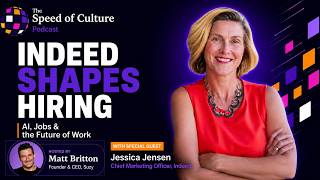
Jessica Jensen, CMO of Indeed, discusses her path through Yahoo, Apple, Facebook, and OpenTable before joining the hiring platform serving 350 million job seekers. She explains how Indeed uses AI for matching and content while stressing human judgment remains essential, and argues remote work flexibility especially benefits women and families.
Chapters
Up today, we're gonna be speaking with Jessica Jensen, Chief Marketing Officer at Indeed. Jessica, great to see you. Thanks so much for coming on today.
Matt, happy to be with ya.
We're gonna get started by just going a little bit into your background. What first drew you to the field of marketing? 'Cause we know that in doing our research on you, you had so much different areas of interest in your education, from political science to, Japanese and international relations. How did all those things lead to a career in marketing for you?
Well, I'm not sure we have time to follow the long, winding, strange road that I've taken. Uh, yeah, but I'm, I'm definitely, uh, a bit of a mutt on the educational and, and career background. I started, um, in— well, as you said, I studied Japanese for a long time. I lived and worked in Japan for 4 years. Um, also studied art history, so I'm truly a liberal arts, um, mashup. But my first real business job was Boston Consulting Group in LA in the '90s at the outset of the internet, the first boom and bust that very few people still remember. But I was one of those people. And then, you know, my career has followed really a winding road. I've done product development, business development, oversaw a lot of parts of B2B marketing for the Facebook companies for a while. And now, you know, and then CMO of OpenTable and now Indeed. So I would say I started as a strategy and business, you know, omnivore and then GM at Yahoo of some businesses, but realized over time that I love math and art in equal parts. And my dad was a creative director at an ad agency. My mom was a speech teacher. So we wrote copy at the dinner table., and worked on jingles together. So I think the pull back to marketing and creativity was inevitable in my DNA. Um, and fortunately now I get to do business strategy and marketing at the same time, which is the ultimate thrill.
It's cool that like growing up, it sounds like you thought what your dad did was cool. Oh yeah. And I think a lot of people don't like, so I, and he's actually talking about, and you're interested in it, I imagine. That had a lot to do with forming, you know, your interest in this creative field?
Oh yeah, for sure. I mean, I remember very clearly when I was in high school in San Diego, my dad was pitching the San Diego Zoo as a client. And so we literally worked on 3 different pitches for the zoo. Uh, and I got to work with, you know, I went into his office and worked with his creative team and his writers and Yeah, I mean, I just felt like how thrilling to be able to try to tell new exciting stories and drive business growth at the same time. So, yes, it's a very fond set of memories that, you know, fortunately I was able to come back to later in life.
Yeah. So, fast-forwarding a little bit, you mentioned this, but in 2009, you joined Yahoo and you spent some time there. And 2009 was an interesting period because it was right after the iPhone launch. Right after Facebook was getting major traction, and Yahoo was very much part of Web 1.0 versus Web 2.0. So when you were there, I imagine a lot of it was kind of like rearranging the chairs on the Titanic, so to speak. Did it feel that way, or was it quite not there at that point? And what was that experience like?
It was quite that dire, but I think your characterization is right. And I mean, listen, a lot of us really, really loved our time at Yahoo, and we got to reach hundreds of millions of people around the world and develop great content. But for sure, you know, in the history books, Yahoo missed the mobile development boat in a pretty substantial way, got very overextended on business lines and countries. So, I definitely got to witness the strategic swirl. Also was there under 4 CEOs. Wow. Not something that happens in a lot of businesses of that scale. So, I certainly would characterize it as fascinating and tumultuous.
Yeah, and then you went on to Apple and, um, you know, you were sitting on top of the iAd product, which Apple at one point had a big foray into advertising, has since really kind of backtracked on that.
And I don't think that's actually— it's— I don't agree with that statement.
Okay, maybe you should tell us since you're there.
Apple has a very robust advertising business. Um, it has morphed and changed. And so when, as you said, when I joined, the iAd, you know, in-app advertising platform was really the focus. And we tried to launch iTunes Radio as an ad-supported vehicle. Unfortunately, it turns out some people were better at music algorithms than, than they were. But, you know, I think Apple has really pivoted into other forms of advertising, search and a variety of things and are, you know, extremely, extremely successful in that arena.
Yeah, you're talking about the App Store advertising product. Yes, specifically, specifically. Yeah, yeah, yeah. I guess when I think of digital advertising, I think of the duopoly that is Google and Facebook, right? Uh, where so many dollars go. So, you know, Apple isn't, you know, routinely named in that duopoly, and every other place they play in, they're sort of like a monopoly, uh, or at least a duopoly. Yeah. Um, and 2013 you joined Facebook, and that was kind of, you know, at the peak of their, of their dominance. And you were, uh, at Facebook for many years, from 2013 to 2019, um, continuing to grow. What was that like?
Uh, when I joined Facebook, it was 4,000 people. When I left, it was 38,000 people.
Wow.
Um, so when I joined, actually, advertising was still nascent, and we were still trying to convince the market that Facebook was a legitimate advertising platform. Uh, you might recall, and some of your listeners might recall previously, Facebook was selling likes.
Yeah.
And when I certainly remember that, and when I was at Yahoo, I was buying likes. Yeah, we all did. Yeah, exactly. We all, we have all gotten older and wiser.
Yeah.
So, so yeah, I mean, I was there, you know, when I started, it was the Facebook blue app trying to convince people that, that, you know, we had the reach and the targeting and the ad products that were worth buying. Fortunately, we were able to drive those messages effectively. Then we bought Instagram, then we launched Messenger. Then we bought WhatsApp, then we locked— I mean, so by the time I left, my portfolio was 7 product lines. And, you know, the family of apps and services was robust and growing. I also got to live through the joy of Cambridge Analytica and all of the communications management around that, some successes and a whole lot of failures. So, I mean, my time at Facebook was exhilarating. Challenging, robust. I learned more than ever before. The people I worked with there were sterling, committed. You know, I just can't rave enough about the people. I know that Facebook has come to be viewed as the evil empire by many, and I always try to help people understand that we were trying legitimately to connect the world, to share their lives and their experiences.
Right. Not an easy task.
Not an easy task. And when you invite a billion people to a party, some real assholes show up. That's for sure. So, you know, I think, I think there's a very nuanced story to tell about the gestation of Facebook and that a lot of the tarnish of recent years has sadly overshadowed a lot of the awesome work that people did there.
Yeah. Although arguably, as of late, at least here in 2023, they've made a bit of a comeback.
Oh yeah, absolutely.
Maybe it's just juxtaposed against what's happening on Twitter, but it's, it's good to see them kind of get, uh, their feet under them again. And yeah, you know, I imagine— yeah, so, so when you're at a company that's basically 10— yeah, for sure. When you're at a company that basically 10Xs their, their staff from 4,000 to 38,000 in such a short period of time, one thing I would imagine would be a challenge is maintaining a certain level of quality and culture as you scale. And, you know, given, you know, the, the fuse of praise you have of your time there, I imagine that that's something that they were able to at least in part accomplish. How do you do that, and what was your takeaway from being in that organization during that time? Yeah, when it comes to talent, that is a great qu—
thank you for asking that. I would say of all the companies I've worked at, Facebook was the most intentional and invested in training and leadership development of anything I've ever seen. So, when you became a new director, there was a whole deep dive training, VPs training around building, nurturing, communicating culture. You know, we really felt that we had a special way of engaging and, you know, super focused on growth and mission. But also helping people mature and grow as workers and leaders. And I've tried to take those learnings from Facebook to other companies. But, you know, the care and feeding of that culture, which is driven by management and leadership, was a massive strength of Facebook's when I was there.
Yeah. And really, frankly, something that a lot of companies never figure out at far less than 4,000 people.
Sadly, sadly enough, that is true.
Yeah. I think it's really the paradox of focusing on things that are important versus urgent. You know, like if you're in an organization, you're always sort of putting out fires and being reactive. You're not thinking about things like training talent and developing talent. But those are things long-term that will really drive your success.
I couldn't agree more. And, you know, I would contrast that to Apple, you know, and I was there a long time ago, and I'm sure things have evolved a lot. But when I was there, the culture was, you're lucky to be here, work your ass off, you're on call 24 hours a day. Don't tell anyone what you're doing. And, you know, I think that the culture reflected that orientation. And it works for some people and there's a whole lot of organ rejection.
Yeah. Yeah. Interesting. Very interesting insight. So then you went on to Booking.com, where, as you mentioned earlier, oversaw the OpenTable product and obviously you joined in 2019. In 2020, the pandemic hit. I imagine that must have been a whirlwind for you based upon what was happening in the marketplace at that time. Talk to us about what was happening in a company like OpenTable when the pandemic hit in 2020 and how that kind of sharpened your leadership skills as a result of experiencing that.
Yeah. So, I was simultaneously running marketing for OpenTable and Kayak. And as you said, I joined 3 months before COVID And those are fantastic brands and wonderful set of companies at Booking. And I and many other people had never seen revenue drop to zero. Right.
I mean, most people haven't—
most people have not seen that, right? COVID comes to the dining industry and there's nothing to do. So we tried to support restaurants pivoting to delivery, takeout. I don't know if some people recall that restaurants were opening grocery stores and that people would line up outside of grocery stores, out of restaurants to get bread and milk and eggs. So it was utterly a scene of chaos. We were trying to keep our businesses going. We were trying to support the restaurants and the travel companies and the airlines that were our partners. And it was brutal. And we did layoffs and we did budget slashing. But I will say the level of innovation and creativity that came out of that crucible was amazing. And it made us closer to our business partners. We were in the trenches together trying to survive. And I was really, really proud of the creativity that people at OpenTable and Kayak showed in the face of great adversity.
It must have been an amazing experience. So, let's fast forward a little bit to your current role at Indeed because, you know, you joined Indeed.com in 2010. In 2021. And at that point, we were still in the midst of the pandemic. But, and soon after, the job market really started to recover. And fast forward to today, and the unemployment rate is basically where it was before the pandemic at 3.6%. So, you know, like many things, the, the unemployment rate kind of normalized. But, you know, that being said, the job market is still super hot in, in certain areas, I guess. Leading an organization, a marketing organization, through that time of such instability and not knowing what's happened quarter to quarter, I imagine just takes a lot of intuition and looking at data. But how did you look at when you joined in terms of what your role was, given the environment that kind of overshadowed that role?
Yeah, well, so Indeed is an extremely global company. So we operate, uh, we reach, um, around 350 million, uh, unique job seekers a month around the world. We have almost 4 million employers on the platform. So we are the largest hiring platform in the world. And yes, as you said, the complexity of Japan, Brazil, Mexico, France, Germany, Canada, US, all of the markets, all of the different industry segments, what's growing, what's constricting, are employers willing to invest in hiring? I mean, the chain— I've been here about 2 and a half years now. When I joined, we were, you know, the labor markets were on fire, you know, again, but pockets like, you know, hospitality and dining disaster, healthcare, trucking, e-commerce, logistics, bunch of industries just totally on fire. And now, interestingly, hospitality and dining having a real resurgence. Healthcare will stay hot for a very long time because everyone around around the world is getting too old and e-commerce continues. Tech way down. So like keeping on top of all of those changes globally is exciting to say the least. We have a group called the Hiring Lab, which are labor economists around the world who are tracking all of our data, all government data, and trying to make sense of labor markets. And they really, really help us to manage our business, but also help governments and policymakers all over the world and businesses with their labor planning. So, you know, we are a two-sided marketplace of job seekers and employers, and getting that matching flowing and right is a delicious, fascinating challenge and honor and requires incredible dynamism on the part of my team, our product teams, our sales teams. Um, but you know, our mission is to help people get jobs, so, uh, we're lucky to get to do that all the time.
Yeah. And as you mentioned, I mean, you oversee both B2B and B2C marketing, right? Your revenue generally comes from the enterprises that, that list jobs on your site, and then you need to make sure there's plenty of applicants for those jobs, right? How are the— how are those two functions similar, and how are they completely different in terms of how you look at building the brand?
Sorry, you mean B2B and B2C? Yes. Correct. Well, so, you know, it's all one big delightful circle. But, you know, at our scale, we are trying to be known as the best place for jobs for job seekers all over the world. And that can be truck drivers and lawyers and sales leaders and dishwashers. So, we are an incredibly democratic platform and broad in terms of our reach and the job seekers we serve. So we do major, you know, job seeker-focused brand investments in a number of companies around countries around the world, as well as a ton of performance marketing. So, you know, are you a nurse in Dallas looking for a job? You go to Google, you search, etc. So it's both that kind of brand awareness and halo as well as super targeted performance marketing on the job seeker side. And then similarly on the employer side, we have to convince Bob's Pizza Shop and Amazon and every company in between that we are the best matching and hiring platform in the world and that we have the job seekers they need, the quality matching they need, the ability to connect with job seekers easily, interview on our platform. So there's a lot of brand work and thought leadership work that goes into that. With employers as well as a ton of performance-based marketing directed at different segments of the employer market around the world.
And I would imagine with all the advances in AI here in 2023 and the fact that you play in the long tail and you did create content for the long tail, that those two things fit very well together for you in terms of a go-to-market strategy and how you're going to keep pumping out this content on a performance level.
Well, thank you for knowing that. That's very impressive and comforting. Yes. So we, you know, we do an enormous amount of content that largely lives in something we call Career Guide, which is interview prep, pay negotiation prep. What kind of jobs should I explore if I have these backgrounds? I mean, it's just an incredible repository of insights and learnings. We are definitely applying AI to content generation there very successfully. It saves us a ton of time and a ton of money. However, I want to say this very clearly. The humans are necessary. Human judgment and content.
Important to say that for sure.
It really is like, you know, I'm highly, highly conscious of both the incredible benefits that we are reaping from AI and the very, very real anxieties that people have about AI taking jobs, some of which are well-founded. But human judgment is here to stay. And actually, we are using AI to free up more time for better human judgment by our teams, which is wonderful. And we're going to— and we're using it throughout different parts of creative and content development. So that's super exciting for us. And we're learning every day. And then the foundation of Indeed's business for a long time has been AI and machine learning. I mean, we're matching millions, right?
You're a matchmaker, right?
We're matching millions of jobs to millions of job seekers across millions of segments all the time. So, you know, we've been soaking in the AI lake for, for a very long time, but working on a lot of innovation to take more of those AI insights and learnings and tools to our customers. And we'll have some very exciting, exciting announcements very soon.
Oh, I can't wait. So, and I imagine given the amount of job listings that are on the site, you're able to look at macro trends of the things that employers are looking for. And if that— and you're shaking your head yes. So if that's the case, are you seeing more employers requesting AI-based skills from potential applicants?
Yes, for sure. So yes, just as you said, we see so much data about behavior of employers and job seekers, and we publish a ton of that data on Hiring Lab. So if anybody wants to marinate in that data, go to hiringlab.org. So yeah, to answer your AI question, for sure, we're seeing increased job postings for, you know, AI content development, AI engineers. All kinds of things. Those areas are definitely rapidly increasing. And I read— and I don't know if you saw this— I read an interesting article that San Francisco real estate is now— commercial real estate has been in the toilet here and now coming back in certain areas.
Slowly, slowly.
No, no, no. I mean, I'm not— we're not out of the woods, but, but AI hiring is so significant that it's driving real estate lift.
I mean, it's a massive technological innovation.
Yeah, exactly.
Companies are going to need different skill sets.
For sure. So we are, we are an early indicator of that demand at Indeed.
Yeah.
And we will be reporting out more and more on that in the coming months.
Absolutely.
We have a big study coming out this fall on AI hiring.
Oh, I'll have to check that out because, you know, we get asked that a lot, both by employers and our customers. So yeah, please. So in terms of like your role, just to shift gears a little bit, how are you spending your time? What's the pie chart of your day look like? And how much time are you spending, you know, just keeping up with all these changes in the marketing industry, which I imagine is really incredibly important for your continued success?
Yeah, great question. So I oversee marketing as well as internal employee communications and external communications. So which is wonderful to have all of those things together because obviously all of the legs of the octopus reinforce each other. So I spend a great deal of time tracking, you know, media coverage of AI trends, labor trends, certainly marketing innovation, because I not only need to understand those things, but we are a contributor in those arenas and working to be a thought leader. So my being on top of all of, all of that content and information is really important. I obviously spend a great deal of time with our country teams. You know, we have large operations, Germany, UK, Japan, Canada, all over. So that's, you know, a great deal of my time. And then, you know, with my product leadership partners, my sales leadership partners, how are we coordinating around the story that we're telling in the market about our platform, our innovation, how we serve job seekers and employers simultaneously in a positively reinforcing way. So that takes a lot of care and feeding. Indeed is owned by a Japanese holding company called Recruit, which also owns Glassdoor and, and a large variety of other companies. And so I work with Recruit leadership a great deal on the coordination of our brand messages, go-to-market across company, across countries. And that is fascinating. And what I lived and worked in Japan before, so getting to work in a Japanese company again is a total thrill for me. And then I spend a great deal of time mentoring and coaching people across the organization, not only in marketing, but in sales, in product, in other areas. And I'm the executive sponsor of our Pride group at Indeed, which is a joy and an honor for me. So going to Pride in Austin next weekend, see you there. And, you know, getting to work with our LGBTQ+ crew at Indeed keeps me fired up.
Yeah, I think it's always important to, you know, be involved in initiatives that go beyond your, you know, your stated work or role. So you really feel the organization. Yeah. So speaking of, you know, the organization, organizational development, I'm curious just both from an industry perspective and a perspective of Indeed, what your thoughts are on work from home and how you think it both benefits employers and employees and maybe, you know, has some drawbacks. And where do you see us all headed? Because we talked about the unemployment rates normalizing post-pandemic. You know, the one thing— and you just mentioned the San Francisco commercial real estate, right? It's all connected to work from home is the one thing that hasn't normalized, you know, and it's— it— would you see that changing moving forward? And I just really curious to get your thoughts.
Yeah, um, I think it's an incredibly critical area of both work and human development. Uh, I, I always say there's, there's only two good things that came out of COVID First, children learned to wash their hands, And secondly, we have embraced flexibility in work. Indeed is hybrid, and people can go into offices if they want to. They don't have to. Our sales teams are coming in a couple of days a week because they need training and, and, and, you know, learning and collaboration around client issues. We think that our hybrid approach has been incredibly liberating for our staff, and we plan to continue to invest in that. I will say the people that are requiring people to come back to offices are largely white, entitled men who do not care for children or elderly parents. Women are the major beneficiaries of flexible work and remote work because we are the people who take care of families. Yeah, that's sadly still true in most cultures around the world. And I'll say for me as a working mother, not having to commute 10 hours a week has allowed me to spend more time with my child and exercise and frankly be more focused when I am working. So, right, I still think collaboration matters. We get together in the office, we bring people together, and we We dine and communicate and laugh, and that is super important. But if we lose the flexibility that we garnered from COVID shame on us.
Yeah, I agree with you. And we run our organization the same way as a hybrid, you know, solution. I would also add that I think younger people who, you know, might not have families yet that want the social camaraderie, the learning, for them, I think they could benefit from the office. And that we have heard from though, that constituent as well, like we want an office because at one point we thought maybe we don't even need one. So I think and I imagine when it comes going back to Indeed and recruiting, that's a big part of how people are searching for new jobs, right? Can I have the flexibility, which is a relatively new thing?
Absolutely. That is so true. Yes. And to your point, I like— I mean, I grew up in management consulting in my late 20s and the time that I spent with senior people there and clients in real life, learning and developing is probably the most formative part of my career development. So there is a role, absolutely a critical role for togetherness and learning in real life. But flexibility and not feeling tied to commuting is, I think, a universal benefit. Now, let's, let's also be honest that most jobs can't be remote. Right. Only 10% of jobs on Indeed have any remote or hybrid option. Truck drivers, dishwashers, teachers, nurses, retail, medical. Yeah, medical. Right. So it's really a knowledge worker phenomenon. And we need to also be really clear that, you know, the haves and have-nots here on, on the remote and hybrid work front. Require deep social consideration as well.
Yeah, it's a great point. Thank you for saying that. So, so wrapping up here, Jessica, would love to just focus on you and your journey. You've obviously have worked at some prolific companies and you're in a very exciting role now. When you look back on your career, what are some of the decisions that you think you made the right choices on that enabled you to end up where you are today? Because not everyone ends up as CMO who goes into the marketing field. You have, and you obviously, um, are taking commanding position there. What do you think some of the reasons for those successes are?
First, let me say there's been a lot of bumps along the way.
Yep, there always are, that's for sure.
I ran a startup that failed. I struggled with fertility for 4 years. Um, I think I was a pretty neglectful mom early on in my mom journey when I was on the road. So, I'm very, very conscious of the mistakes and failures that I have had that have hopefully made me better, stronger today. And so, I want to stress that point first.
Thank you for sharing that.
Choosing my husband is probably the most important decision I've ever made. We met at Boston Consulting Group. He is brilliant and kind and funny, and I knew that we would raise a child together with 50/50, sometimes 52, you know, flexing up and down. And he— we are celebrating 20 years of marriage this month.
Congratulations.
Thank you. And so he has been my partner and my enabler, and I thank my lucky stars for him every day. I would also say I have worked for a number of incredibly brilliant and strong women who have given me the confidence that I can do new and hard things and persist. Hillary Schneider was the head of the Americas for Yahoo, most recently CEO of Shutterfly. She has been a mentor and an inspiration to me. Sarah Personette was my boss at Facebook. She then went on to be chief commercial officer at Twitter. She is a shining light for leaders who have worked for her everywhere. So, I really think the role models and the support I have gotten from women leaders has been incredible. And then I would say I have a motto, which is try on lots of sweaters. I think that most people get in a job and a couple years in, they don't really like it, but they're there and they know, you know, the devil you know, and then and suddenly it's been 7 years and you don't really like it, but you're trudging ahead. I think that people need to try different industries, different roles, different companies, different bosses. And so I'm always trying to encourage people to get unstuck. And I think since— I mean, you could definitely describe my career path as varied and meandering.. But I think what I've been able to learn and experience along that journey has been magical. And, you know, I'm, I'm on a public board, I'm looking at more board opportunities, just trying to do as many different things and learn from them is, you know, I think the spice of life.
Absolutely. Try on many different sweaters. I love that, that phrase. I was gonna ask you what if you had a phrase or mantra, but you answered for me. So we're going to leave it with that. Thank you so much, Jessica, and thank you for your candor and honesty and walking you through the journey. It's been amazing.
It's been fun. Thank you, Matt. I'm glad we got to get back together.
On behalf of Susan and the Adweek team, thanks again to Jessica Jensen, Chief Marketing Officer at Indeed, for joining us. Be sure to subscribe, rate, and review the Speed of Culture podcast on your favorite podcast platform. Till next time, see you soon, everyone. Take care.
More from Matt




MikMak’s Rachel Tipograph on Consumer Spending, Retail Media & Holiday Shopping Trends



Jaguar Land Rover’s Charlotte Blank on Luxury, Purpose & Experiential Storytelling



