"Instagram Killed The Television Star" - Keynote By Matt Britton at Social Media Week
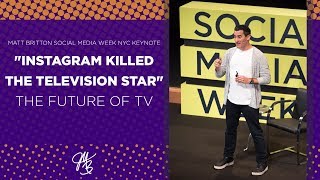
Matt Britton traces TV's evolution from Ed Sullivan to Instagram, showing how social platforms and mobile cameras created a new generation of stars like the Kardashians and Justin Bieber. Social media shifted power from networks to influencers and tech companies, fragmenting audiences into apps while live sports remain the last mass-audience draw.
Questions this video answers
74 million viewers.
125 million viewers in 1983.
86 million viewers.
845 million users.
500% growth.
This was a watershed moment in the history of America. The Beatles had just arrived from the UK and the first thing they did when they got to the US to build their popularity is they went on the Ed Sullivan Show. And at that time, if you wanted to be relevant, you went on the Ed Sullivan Show. That episode, watched by 74 million people at that time, was the most watched TV show of all time and really signified the beginning of the golden era of television. At that point, there was three or four networks. You could watch, see tv. There was no Internet, there was no cable. There was very little other things for families to do for entertainment. So they would sit around and watch TV. And that entire approach to media lasted for 35 years. For. For 35 years, advertisers had it easy. As long as they had a viable product and a checkbook, they could write a check, get on TV and aggregate eyeballs. And this period was a wonderful period in television. After Ed Sullivan, after the 60s, we went to the 70s where we had shows like MASH. Anybody remember MASH? MASH was about a team of doctors in South Korea during the Korean War. The final episode of MASH in 1983, generated 125 million viewers on television. OK, that was a staggering number. In fact, if you take out sports, the death of Princess Diana, the Grammys and Oscars, there was never a show that was watched that much ever again to this date. So we didn't know it back then, but we were already starting to see the demise of the traditional element of television. Who remembers the Cosby Show? The Cosby show went from 1984 to 1992, one of the most iconic shows ever to bring an African American family into the American household. Only 20 years removed from the civil rights era, this was a lovable family. It was also the beginning of a new form of TV called sitcoms. Short form to get a laugh. The episodic format of mash, where if you missed the last episode, the new episode will be less relevant, didn't exist in sitcoms like Cosby. You could tune in at any time and you would instantly love the characters, Dr. Huxtable included. And it was incredible to see that this show had such big cultural implications on society and the US public. And of course, my personal favorite, Seinfeld. I know a lot of you people in the audience saw Seinfeld. This is the final episode of Seinfeld. Look how awesome that TV is. I kind of miss it. The final episode of Seinfeld drew 86 million viewers. There has never been a Non sports, non live event that has garnered that many people since. And in my opinion and the opinion of many, this signified the end of the golden era of television. In fact, sitcoms at that time were all the rage. During when Seinfeld had its finale, 50% of all television programming was sitcoms. And just a couple Years later, in 2000, only 4% of television programming was sitcoms. Big change. What replaced sitcoms? What was the next phase? The next phase was reality TV, okay, which lasts from 2000 to 2008. Now, reality TV, in my opinion, was a genetic marker at that time that there was something big on the horizon because the viewers were voting with their eyeballs that people were far more interesting than scripted characters, that voyeurism mattered, and we wanted to look into the lives of people. And ironically, the first network that cracked reality TV wasn't a traditional broadcast network, but MTV with the Real World now, the Real World actually lasted. A lot of people were surprised. For 11 years from 1992 to 2013, take a lot of good looking people, all different races and ethnicities, put them in situations where fun, bad things could happen, see what happens, cajole them with a little scripted programming. And there you have the Real World at that point. I remember I did a promotion for VH1 and we hired a Real World season one star in season two for like $20,000 to hand out flyers in Times Square for like a week in the cold. So obviously the notion of influencers didn't exist back then because that wouldn't happen today. But back then, these people were trying to stretch out their 15 minutes of fame. And then MTV did something interesting because the Real World was so profitable for them. It was actually obviously a big shift away from music videos, which they were known for up until that point. They essentially took the scandalous extract that happened in Real World and bottled it up in pure concentrated form and they put it in a can and like Red Bull, let Gen Xers guzzle it down. Sex trade, Gen Xers. And you got the Jersey Shore, okay, so the Jersey Shore, three years, explosive ratings. Obviously it was short lived, but they want to stretch this Real World thing out as long as possible. I miss Snooki so much, I can't even explain it. Pauly D, still a great dj, check him out in Vegas. But the Jersey Shore was, you know, it signaled that this thing was real. And again, that people are so interesting. And it wasn't just to young people. Mark Burnett, who's one of the godfathers of reality tv, has a show Called Survivor, which is still on today. Shocking. And Survivor, unlike the Jersey shore, reached an 18 to 49 wide demographic on network television. Two groups of 12 people go to far away remote places, compete by eating bugs and crawling through crazy cold water and trying to win. Apparently somebody died, but then they said they didn't. Who really knows? But the Survivor was a very popular show. And Mark Burnett also created Big Brother and the Apprentice, which we all know right now was actually a very prophetic show in terms of the future of our country. So Mark Burnett, another huge influencer of reality tv, but without a doubt, the most successful reality TV show of all time was American Idol. American Idol. That's not American Idol. That's American Idol was created by Simon Cowell, who really came over from the UK and saw a similar show really take off. Ryan Seacrest actually ended up spinning this off and creating his own reality TV empire with the E. Network after this. What was really interesting and what really kind of drew the American public to American Idol was that it could actually cross the chasm from television into real life. So Kelly Clarkson, season one winner, and all of a sudden she has a number one hit with a moment like this. She sang it, you saw her parents crying, and then you heard it on Z100, right? So it's TV coming into real life. It's not just looking at real people on tv, it's actually looking at real people on tv, seeing their lives and actually seeing that transcend to the real world. And that was magical. And it was a magical breakthrough in reality TV. Reality TV had a huge run from 2002 to 2010. It made up for every single year, at least 50% of all broadcast. And during the 2007, 2008 season, the peak of reality TV, 78% of all programming. 77. I thought it was 78. Was reality TV so huge? Huge, Huge. And it would have went on forever. However, something even bigger was on the horizon, as we all know, because we're at Social Media Week. But looked at through history, it all makes sense right now when we look back. Oh, sure, that happens. But it's never as easy looking forward, is it? But in 2009-2013, we entered a time that I like to call the mobile state of social, mobile state of shock. Now, never before in history have so many things happened in a short period of time. And I call it the state of shock because I lived through it. I was running a prolific social media agency called MRY at the time and selling the craziest shit to clients and they would buy it all because they just wanted to figure out how to actually get into social media. We didn't really know what we were doing yet either. Everybody was actually figuring it out. And three things really drove this mobile state of shock. Obviously, Twitter. Twitter had started a couple years prior, was growing and growing, and then from 2009, 2011, it grew 500%. People thought Twitter was going to be the thing to take over the world. It connected everyone, it was one to many. And it gave everybody an individual voice at the same time. And I don't need to give you guys Facebook stats because the presentation that came before me did a great job at that. But Facebook obviously continued to grow its dominance, and by the end of 2011, 845 million users. And then a lot of people don't realize that the iPhone itself is still really in the first inning. So in 2011, it only had 30 million iPhones distributed across the U.S. but that was enough to change consumer habits. So you have Facebook, the iPhone, and Twitter happening in a short period of time, and all of a sudden, and all the young consumers are spending time and then it starts to transcend to other demographics. And advertisers really didn't know what to make of it. Case in point, the famous battle between Ashton Kutcher and cnn. I'm sure some of you guys remember this. CNN actually had a live ticker covering this. Who would be the first entity to a million followers? Now think about that for a second. 2009, at that point, nobody had a million followers on social media. Not one person. That was not that long ago. And Ashton just inched out CNN in a battle, the most irrelevant battle of all time, to get to 1 million followers. But Ashton was smart and he knew what he was doing because Ashton knew that he was a TV star and he knew that if he had reach on social media, it could prop his TV value. And lo and behold, two years later, the famous tiger blood meltdown of Charlie Sheen. And who comes in to take one of the biggest deals in TV history? Ashton Kutcher. And CBS gave him his deal. Many people suspect it because his social media presence would help boost ratings of the show. He was able to take a social media platform and presence and actually transcend it to boost ratings. Or at least that's what CBS thought when they wrote him an enormous check. And this was the start of a whole premise that I talk about in my book, Youth Nation called Brands are People, People are Brands. I first spoke about this actually on this very stage at another conference, probably back in 2006, 2007, saying that brands have to figure out how to turn themselves into people. CNN at that time, had to talk for the first time ever, not just through reporters, but the brand itself had to come to life. And Ashton Kutcher, the person, needed to know he had to become a brand himself, a brand that had value beyond just him as a human being. He was able to cash in the goodwill of his brand value with Two and a Half Men, and many other people obviously have since. But perhaps the biggest confusion that happened to during the state of mobile shock and all mobile social shock and all was during the Super bowl of 2013, when in Louisiana, all of a sudden, the lights went out during an amazing super bowl between the 49ers and the Ravens. And all of a sudden, an entrepreneurial agency called 360, I came up with the greatest clip art of all time. Now, great piece of work, timely piece of work, revolutionary piece of work. But it was clip art, right? But they created clip art. And advertisers thought that this was the greatest thing ever. I remember running my agency back then. Every client would say, we need newsrooms. We have to create newsrooms. This is the future of social media. News Jack. Cultural Jack. Take advantage of social moments and the Harvard Business Review, the esteemed Harvard Business Review, write the story. Advertisers need to act more like newsrooms. And then there was the ultimate advertising disaster, the Me Too disaster. Because during the Oscars, two weeks after the Harvard Business Review story, you had every brand out there trying to newsjack the Oscars with some of the worst content you'll ever see. 31 retweets. That's not probably going to move the needle for stella Artois or 15 retweets for new York Life. It didn't work. These brands didn't really understand how social and TV and social and live content connected. So they were just following the next thing, whatever happened. And. And then, lo and behold, my favorite publisher, Diljide, published the story, why Real Time Marketing sucks. In September. That became the end of real time marketing and really the end of the shock and all era of mobile and social. Because we were about to enter a new era and an era that really started to solidify social media's impact on television. And that's the selfie revolution. Okay, Selfie revolution obviously was developed by a couple things. Instagram. Instagram, in 2012, only two years after it found it, leapfrogged Twitter in usage and took off like a rocket ship, unlike anything we've ever Seen, we know the story created more value in two years than New York Times in a century, sold for a big amount of money to Facebook. And obviously, Facebook got an incredible deal with that because it continues to grow today. But Instagram signified that pictures really do speak a thousand words, that maybe tweets weren't enough. That Ashton Kutcher's race to get a million followers to see what he would write is nowhere near as powerful as the photography and the photographic element and the creative inputs it gives the consumer to be able to be their own star in their own right. Because the phones themselves had more than just the ability to dial and access the Internet. They had really powerful cameras. And that same year, to no surprise, Eastman Kodak, an institution in photography, was. Went out of business after over a century in business. So something was happening. Ellen, obviously, she nailed that moment in history. It did become the most retweeted photo of all time. And it was just another example how TV and social was getting more and more connectivity. That was a spur in a moment thing. It was an incredible integration by Samsung, obviously. And Ellen showed the world what could be done if you were creative in terms of crossing the chasm. But. But nobody, and I mean nobody was as creative in doing this than the crossover catalyst, Kardashians, who had just as big of an impact in the evolution of TV as the Beatles. There, I said it. Tweet that they started reality TV in 2007, right? So towards the end of the reality heyday, but they're still going and they're actually growing. Why are they growing? Well, they did the opposite of Ashton Kutcher. Ashton Kutcher took his social media presence to prop up his tv, where the Kardashians took their TV presence to feed their social media beast. And they were able to very essentially take the real life that they portrayed on TV and extend that. And social media became a pure voyeuristic, very natural extension to their TV presence, and people couldn't get enough of it. You talked about Instagram earlier. Well, the Kardashians had the most liked photo on Instagram in 2014 with Kim's marriage to Kanye. In 2015, with the amazing graduation of high school by Kylie Jenner, and my personal favorite, the laying down, staring into space picture from Kendall Jenner, which got 3.5 million likes. These guys understood how to build a brand, and they still do. Lay down. They are the penultimate kind of case study of how you can actually pull social media presence from broadcast. And they figured out how to monetize it with an ever assortment of tweets about tease and tummy tuck shakes and all sorts of things that they actually get people to buy. When they post things on Instagram for anywhere between 200,000 to $400,000, which they always do just to piss people off and in their pajamas. Okay, because we can make $400,000 before we get out of bed by going like this and holding a product up. The products actually sell. I've been involved in a couple of these activations, and the websites go down. Products sell. This is real influence. We throw that name around all over because people buy followers and they do this and they do that. But when you post something and shit sells, that's influence. And these guys, nobody can question the fact that, that they're selling products. And from their social media presence and because they sell products, they have built the Kardashian empire. In 2015, 2016 time period, they've made 110, $120 million. It's only going up. Every fashion, beauty, brand that wants to market to women who they call first. And with the Jenners, it was like the new offspring. So they got Kendall and Kylie, which now just gives them even more shelf life. And then when Northwest gets to be 18, there you go again. So these guys aren't going away anytime soon. They're going to have a bigger shelf life than the Beatles, because the Beatles did not reproduce like the Kardashians did. So these guys are going to be going on and on and on. I think it's great. But there was one last evolution to technology that really, to me, marked the signal that social media was going to basically drive the end of television as we know it. And when I say the end of television as we know it, a lot of people get confused because they're like, I love my flat screen. I. I love watching a game on the big screen. That's a display. To me, television is the operating model behind it. Where the content is fed, how it's bought, who are the players, where are the pipes? That's what television is. That display will always be there. Okay? And just like people say that desktops are going away, but people have big monitors in their office, that's just for visual display purposes. Couple things actually came about in the culture in the last two years which started this Instagram killed the television star phase. Catchy title, isn't it? Just came up with that one. Snapchat obviously came about. Now, the growth of Snapchat, nowhere near the explosive growth of Twitter and Facebook during the. Heyday, but what Snapchat did do, it was a predominantly mobile video platform. So Instagram was predominantly photo when we started. As we all know, Twitter is predominantly text. These guys came and video was really its core purpose from the beginning. A lot of people did and still do mistake it as one to one messaging, which has had a huge role on in taking the younger generation off of Facebook just for the purposes of messaging. Because if I hear one more time, advertisers say young people don't use Facebook, it's not true. The only thing. And Instagram's part of Facebook, so that's even more not true. The one thing they're not using as much for anymore is messaging. Because once their parents and grandparents got on the Facebook, they didn't want people to see what they were writing their bae at 2am so instead they used Snapchat because they felt a lot more comfortable. And that one thing was enough to give Snapchat a big ride. But really, Snapchat's bigger impact wasn't one to one messaging. It was one to many by way of their Snapchat stories where people would post videos that would go away in 24 hours. And since they go away in 24 hours, they could have a little bit more liberty of what they put out there, get it more close to voyeuristic life, to push it out there. And nobody has done this better than our friend DJ Khaled. And DJ Khaled, this is one of my favorites. It's a lot of people's favorites. He takes out his Jet Ski in Miami and he hits the open water. And along the way he stops and sees his boy Rick Ross for lunch. And as he's going on and on, it gets a little bit darker and a little bit darker. And at some point he's like, holy shit, I'm lost. But his phone somehow had Jack Bauer type battery status and didn't run out. This was before phones were waterproof. I don't know how this guy. If I took a phone on a Jet Ski, it would be gone instantly. But for some reason, this guy just his phone, I don't know what he puts on it, but he had this phone, he documented it. DJ Coward. How many of you guys follow DJ Coward on Snapchat? All right, respect so lion. So DJ Coward has his own language, and his language transcended pop culture. And people start to actually talk like him. And he showed, actually. So we talked about Ashton, an existing TV star, using social media as a prop. We talked about the Kardashians A TV star using TV to boost their social media. This guy was nothing. And used social media to become relevant, which is sort of the final stage, because a lot of people didn't know about him. I booked him as a DJ for an MRI party at CES for like, $20,000 two years before this. And now the guy won't get out of bed for a quarter mil, right? And it's all because he built his presence on Snapchat. So that was obviously a huge, huge, huge moment in terms of people building their own star power from this platform. And then November 2016, not too long ago, Instagram launched Instagram Live, which really, to me, is the biggest moment in terms of social media really becoming a new television, and social media truly killing the traditional television star. I don't know how many of you guys saw this. This was two weeks ago. But my boy J. Biebs again in his pajamas, okay? Without leaving bed. They always do that. Turned on his phone unannounced, okay. And turned on Instagram Live and just laid there and was like, I got this. Mmm. What do I say? I would turn on the sound, but this is the sound. He's actually not saying a lot. And as you can see in the upper right hand corner, look at the numbers go and go and go. How much do you think Coca Cola would have paid him at that moment to take a sip, a slow sip of a can? He could have probably made a quarter million just from that alone. And then maybe put on a Nike hat or who knows what else? He's not saying anything and doing anything. But the biggest point to me is this was completely unscripted and it was completely unannounced. He didn't take out taxi top billboards or run billboards in Times Square or run banner ads to actually say he's going to do it. He just decided to do it and he built an audience. I think it peaked at it. There's a puppy that peaked at 275,000 viewers. I think that was the number. And he's like, peace, I'm out. And he actually shut it down now. He didn't script it, and he doesn't care. But celebrities that want to monetize and celebrities actually want to optimize their audience. He could have promoted it. He was going to be on and he could actually figure out something to say and do that would be interesting. Obviously, the bar is fairly low in terms of what engages people, but what if he actually did something like semi cool and he promoted it? Then how many people would Actually watch it. It would actually be fascinating. Which got me started thinking, like, you know what? Celebrities actually probably are scripting their lies right now, the same way MTV told the Real World people to script their lies. And maybe that's why Kanye met with the President, because he actually wanted to say, you know what? This is a relevant stake for me. I'm going to meet with Trump because it's going to be talked about. That's why celebrities maybe do crazy things because they want to figure out ways where they can stay relevant. That's why maybe JLo was dating Drake. Maybe, for instance, she said, it's a way to put me back in. And that's not really a new concept in terms of celebrities doing things to stay relevant. But in this day and age, when they're scripting their lives and their lives actually is their monetization engine, it actually becomes more important than ever before. So managers of big celebrities in all areas of entertainment are trying to figure out things they can script into the lies. Because as these people share their lives, they need to make sure they remain relevant and interesting. And obviously, for somebody like Bieber, who's at the tops, tops, tops, he just really has to lay in bed and he's going to get a big enough audience. And that audience was way more engaged than probably 90% of the shows that every advertiser spends 80% of their budget advertising on every single year. That's the reality because it's engaged. People are looking at it. You saw the amount of hearts there. That was really shocking to me to see. So where are we headed? What does this all mean for the future of tv? So this is a topic that I have a lot of passion about. In fact, I remember being in an Apple Store here in New York probably about eight to nine years ago, and I saw the Apple TV in the corner and I bought it. Nobody had it. Still, a lot of my friends don't have the Apple tv. And I'm like, what? I don't understand. And I went on stage and I said, this is going to break TV one day. This is what's going to be the future. And Apple called it a hobby. And they don't make a lot of money from it. But slowly but surely, they're starting to do it, because I believe that the TV is going to very easily become a giant iPad hanging on your wall. Okay, I've seen kids 8, 9, 10 years old in Best Buy go out to the TV and try to swipe it right. They should be able to swipe the TV Why can't you? How bad is the process of going through the Time Warner Cable or file this remote to pick a show on cable? It's the worst user experience of all time. They still haven't cracked it. With my Apple tv, I'm like, siri put on House of Cards, boom. It's like, where's this been all my life? So this is gonna be. And what does that mean? A giant iPad hanging on your wall? It means that the TV and the computer will be won not through a component that you actually have to plug in and switch the source, which my parents can still not figure out how to do. Switching the source, but actually all one screen. And in a very easy way enable consumers to touch a network or touch a show and bring it up. So this is what Apple TV looks like today. And what Apple's been doing is they've been taking your logins from your. So if you're a DirecTV subscriber, or if you're a Time Warner subscriber, you actually get all these shows for free over your Apple tv. It logs you in. It comes with your subscription. So if you subscribe to hbo, you get hbo, go over Apple tv, and then you can watch it whenever you want. And really, a lot of consumers are gravitating towards that for On Demand. So you see a lot of networks here because it's just another distribution point. They do run ads, and you actually can't fast forward past the ads on. If you want to watch a show that was on NBC and you want to watch it, even if you pull it open here, you can't fast forward it. They still have their monetization. But see, I actually don't think this is the future of what an Apple TV interface is going to look like. I think it's going to look a lot more like this. And the biggest difference here is the only networks you see are sports leagues, because that's actually the only thing that a network really has value towards. It's actually the only thing that consumers are watching live. In 2005, 5% of live television was TV. In 2015, it was 94%. It's the only thing. And what are the other Grammys, Oscars, A few other things. And the NFL obviously dominates that. So I don't think TV networks have much of a shot moving forward, because to me, TV networks aggregate content, right? And one point where they curate content. When Seinfeld was on Must See TV Thursdays, there was an exec to NBC saying, this is what my audience wants to Watch Thursday night at 8 o' clock and we have the airwaves, so we're going to pick it and if it works, great. If not, we'll switch it with something else. Right. They're curating what you should watch. They're also distributing. Well, I don't need NBC to curate when I watch, when I can see what any of my friends are watching at any time. And I certainly don't need them to distribute the content. So I struggle to see the root value of a TV network moving forward. So what will the three elements be on this interface? First, I think individuals, okay, you look at YouTube stars and you look at how big they are in terms of their ability to get volume or celebrities, anybody with an audience, they should become their own network. And they will become their own network. And in some ways they already are their own network, but they'll get investors, they'll create their own content and there will be a DanTDM app or a Casey Neistat app on Apple TV which basically has all this content. Minecraft influencers are huge amongst young kids right now. That's what they always tune into. Kids don't even know what NBC or ABC is. They just don't. Why would they? It doesn't matter to them. So influencers and celebrities are going to have their own channels. They are going to be able to have their own monetization engine, which I'll get into, but they're going to go direct to consumer. That's the first entity. Second is shows themselves. So shows that aren't born by influencers. Traditional scripted television, because it's huge right now, there's great shows that are on Amazon and Netflix, like the House of Cards of the World or Billions on Showtime or so many other good ones. Scripted television isn't going away. I just don't think they need to be housed in a network anymore. I think Billions could be its own app. Highly interactive, you go to it because your favorite show and you watch it, and that's basically it. And then there's sports. And sports is going to continue to dominate television, especially the NFL, which is the most live program on television amongst both male and female viewers. And they really control the future of television. If the NFL were to do a deal with Apple, Google or Microsoft, as opposed to the $4 billion deals they have right now with DirecTV, Fox, NBC, ESPN, et cetera, by the way, Apple, Google, Microsoft have more money in their couch cushions than those companies, the big traditional networks have in general, then that would just drive core cutting en masse right away hasn't happened yet. And because of it, there's still sort of this wonky thing going on where you need your traditional cable so you can actually tune in to live, but the only thing you're actually really watching live is maybe a little bit of news and then obviously live sports. So I think that's what you're going to see and I think that's going to change everything. But the biggest thing that's going to change is going to be the monetization model, because at that point TV is going to become 100% addressable and it's about time that it does. Look at where we were during the TV golden era. What was the demographic you bought against 18 to 49. Maybe they're in there, maybe they're not. We're just going to reach it. We're going to reach 200 million 18 to 49 year olds. Who cares if they're male or female or if they like your product or or not, or if they're rich or they're poor. They live in New York or they live in la. That was traditional cookie cutter demographics that Nielsen gave to media buying agencies which they would sell against for years. And I actually think we're going to go from there, which a lot of advertisers are still buying against, to I want to reach Sally Smith, who likes Victoria's Secret, that lives within two miles of the mall. And that's the only person I want to target or I want to target people who look like her. The same way that you can buy ads on Facebook right now. And it all makes sense because I think Facebook is very close to being able to serve every ad on television because They've logged over 1 trillion posts from consumers. And if consumers are in a logged in state on the iPad, then there's actually really no reason why that type of addressability shouldn't exist. Let's go back to the NFL example. If NFL is the biggest watch program amongst male and female viewers, then why is every single ad I see these masculine ads like GMC trucks. Why don't I ever see an ad target towards females during the NFL? Because there's more males than females, but still the biggest opportunity to target females. So what if you could target females during the NFL? Isn't that a novel concept? Targetability and addressability could allow Joe's Pizza to advertise during the Super Bowl. I want to target every single person who lives within one mile of my location and all of a sudden Joe's Pizza is running during The super bowl, it's the same thing that's going on on Facebook right now. But the only difference is it's the future of tv. And I don't think it's that far away. I don't even think it's five years away. I think it's two or three. When Apple came out with the ipod, all of a sudden CDs went out, right? They were gone. When streaming happened, with Netflix, DVDs, which used to fill the racks when you walked into Walmart, were gone. It happened quickly. It happened in 12 to 18 months. And when it happens, what happens to Procter and Gamble and Nike and Microsoft and Coke when they want to write these gigantic checks that were normally reserved for NBC and CBS and ABC and fox? Where's the money going to go to? Because that's the arbitrage opportunity, $80 billion that's going to be coming into this industry so quickly. So that's why people are rushing into influencer marketing. That's why content is king, because it's about to get super, super fragmented and it will probably roll up at some point, but it's not going to roll up in a traditional television model. So who are the other winners? Besides Facebook, which I think is the clear winner because the data and targetability and addressability, it's hard to see how anyone is going to. They win no matter what. But three companies that are going to battle it out, who are all going to get their piece of the pie, are what I call the ecosystem players. Apple, Google and Microsoft. And what the ecosystem players. They all have a lot of these elements. Some have all. Some have a few. They have a mobile operating system. So iOS for Apple, Android for Google, Microsoft, Windows Phone didn't work. And if it worked, they would be really in the driver's seat. But they couldn't get it to work. They all have social platforms. So Microsoft bought LinkedIn, which a lot of people don't talk about. Obviously Google tried with Google, they never really did. And Apple tries to use itunes as a way to garner data. They all have ways to deliver entertainment into the household. Microsoft through Xbox, Google with YouTube, which they just had a huge announcement yesterday that we'll talk about, obviously Apple, itunes. So they have these ecosystems which actually can deliver the type of platforms we're talking about. In fact, just yesterday, and I love putting slides in the deck, that just happened yesterday, YouTube announced that they're launching YouTube TV to really facilitate this. $35 get a host of channels on TV. But oh, by the way, you can also look at all the YouTube content. They're mashing it together right now. This is actually. I was writing the deck when this happened. I was like, right on. Because it's actually what's going to happen and it's the direction it's going. So that's going to be interesting to see how big YouTube TV can really get, how quickly it's going to get there. Microsoft is definitely going to lean into Xbox. They should probably should have called the Windows Phone, the Xbox Phone, because that was a young entertainment brand. And I think that would have actually cemented their mobile legacy where Windows was a dying brand. But again, in a rearview mail, it always makes sense. But Xbox is definitely going to be their platform. And obviously itunes is a beast. And one other thing I left out from the ecosystem players is voice. So at CES this year, voice was all the rage because I got in an argument a couple years ago. I don't think kids should be taught handwriting anymore. Everyone's like, you're crazy. Well, I actually believe that because why would we teach kids handwriting when our global counterparts in Japan are learning algorithms at age 9? Like, we're just going to lose, right? I actually now don't think they should learn typing because voice recognition is getting better and better and better. And Microsoft has Cortana and Google has Google Home and Amazon has Alexa, and of course Apple has Siri. Voice is going to be the ultimate input to actually tell what we want, the content we want to watch, and a whole other host of applications. And that's why these big companies are investing there as well. TV networks, I think, really have a rough go. And a lot of the big ones got acquired already. So Comcast acquired NBC Universal. Really, anybody who is in the business of aggregating eyeballs, look at AOL and Yahoo getting bought by Verizon for pennies on the dollar. If you're in the business of aggregating eyeballs, you really don't have a great business because you don't have data, you don't have an ecosystem. You don't have a way to actually bring people in. So who are the other people? Time will tell. We have the pipes. So you have AT&T, Verizon and Comcast. They all have one thing in common. In the last 12 to 18 months, they've all bought content. Companies AT&T had a massive deal to buy DirecTV, Comcast bought NBCUniversal, and of course, Verizon bought Yahoo and AOL. They see that we have the pipes and we have content. Maybe we can Work our way in there. The problem these companies have is they don't have a mobile ecosystem so Apple can shut them out at any time. And also Google is building their own WI fi right now. They want to build their own pipes and they actually have the wherewithal to actually do it. So I think the companies with the pipes, because they have data, because they have the pipes and they're aggregating content, they can make a little bit of a run of it. They could end up just getting acquired by one of the big three, Amazon. A lot of people believe in Amazon. A big hit on Amazon for TV was the Amazon Fire not really being taking off. And the Kindle really is a secondary device. People thought it was going to be revolutionary, but the iPad kind of outweighed it. So because of that, I think Amazon's going to have a lot of problems in really owning tv. They're becoming a content house and they're creating obviously great content, but I don't know where they're going to work their way into the ecosystem. Commerce. They've obviously won it. And can they transcend their commerce base into content? We will see. But I think that them not hitting it with with Fire was really a big hit in terms of their future because these things that happen now, that's what's impacting the future. If Twitter would integrate it photos earlier, there might not have been an Instagram. Right. So sometimes the me too approach doesn't really work. And then Snapchat, you know, I would just ask to give a quote because they're going ipo. I still worry about their scalable revenue model as a business long term, you know that you can't click through this ephemeral base. They are aggregating eyeballs right now. That's really what they're doing. They have a strong utility in messaging. I just don't know. And I'm sure they are doing and working on a million things that I don't know about. So that's really the big question mark for me because they're such a nascent platform and I actually found it really curious that they decided to go public so early in their life cycle. So we're in a very exciting time right now and I think in the next one to two years so much is going to happen. You look at the pace of change, right? My first phase was 35 years. TV golden era. Reality was eight years, right? Then the confusion was three years. Selfie was two years. Now this is one and a half two years. It's going to I think voice is coming down the horizon. People talk about VR and AI. I don't know about that because the consumer applications are limited. But the rate of change through the story, which I think holds a lot of water, is happening quickly. And everybody in this room that's in this industry has an incredible opportunity to really innovate and take advantage of, again, of this massive arbitrage opportunity of dollars floating your way. So that is all I have for you guys. Thank you, Social Media Week for having me. Enjoy the rest of the.
More from Matt




MikMak’s Rachel Tipograph on Consumer Spending, Retail Media & Holiday Shopping Trends



Jaguar Land Rover’s Charlotte Blank on Luxury, Purpose & Experiential Storytelling



