Intuit’s Lara Balazs on Brand Power, Authenticity & Women in Leadership
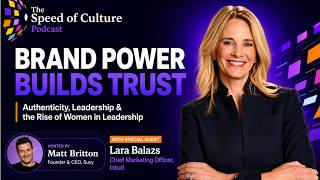
Lara Balazs, CMO of Intuit, talks about her path from pre-law to marketing, why brand matters in a performance-obsessed era, and Intuit's strategy of acquiring Credit Karma and Mailchimp while protecting first-party data. She also discusses mentorship, the CMO's evolving role, and what women leaders need to succeed.
Chapters
Up today, we're gonna be speaking with an old friend, Lara Balazs, Chief Marketing Officer, Intuit. Lara, so great to see you today.
Good to see you too, Matt.
So great to reconnect. We're gonna jump into all the things that you've been working on and, and you've really had such an exciting career, but I'd love to first start by getting to know a little bit more about your background and actually how you got into marketing, cuz I saw that you were pre-law major, um, which I can kind of see in you, but talking about your journey kind of going into school and, and when did you realize that marketing was sort of your path?
Yeah, I, well, I was a pre-law major and really I didn't know what I wanted to do, but at the time I, I was watching TV and there was a show called LA Law that, okay, so there was a woman who was an attorney and I thought there's a woman in a job that looks compelling. And so the— I'll just go to law school. So as a pre-law major, and what I realized when I was taking pre-law courses was I was totally fascinated by the sociology classes that you have to take, which are around why people— some people go to prison and some people don't, and why they behave differently. And that actually is marketing. How are you going to get someone from a current think and do to a future think and do and what really makes people tick. And so I graduated with a pre-law degree, decided not to go to law school, but of course I graduated into a recession, which I'm really good at. And because I graduated business school in recession too. But, you know, and I— so, you know, it was the idea, though, that, gosh, I want to motivate people to do things like buy products or do something that can make them better.
So yeah, I mean, it's interesting the correlation between law and marketing in terms of just changing consumer behavior and understanding that you can do something that changes somebody's course, whether what they buy, where they go, et cetera. So I can totally see how— I think it's just sort of like you put something in and you actually are able to see what comes out of it. Not a lot of careers are actually like that, and I think that's what makes it interesting.
Yeah, absolutely. And that was really the driver. And here I was, I wanted to do marketing and I had no experience.
So So, but despite the fact you went right into, uh, you know, the corporate world and worked with some really iconic brands, um, first at Gap and then at Nike, um, in more junior roles there, how do you think the experience— because those are both iconic brands. Gap at that point was still an iconic brand.
Nike still is today. Yeah.
How do you think your experience at those two companies helped shape you and prepare you from— for what would be your career moving forward?
Well, let me first say, I— when I graduated, it was a recession. I couldn't get a job. I was in Seattle and It was— there was a tiny little company called Microsoft that no one knew about, and it sounded really boring. So I was like, oh, I'm not going to look at that. Well, too bad. But I had to get marketing skills. And so there's an iconic tourist location, Pike Place Market. Have you— you've been there and, you know, throwing the fish. And because it was a recession, all the tourists had dropped off from going in there. And so I had this idea to bring in local consumers, and so So I pitched to them that I would work for free and develop, you know, to get people into the market and families. And so I created, you know, a whole program to do that. But just an example of—
yeah, and I think it's a good lesson to some of our younger listeners is sometimes if there's not an opportunity, create one.
Do something. Totally. Absolutely. And so I just say that because I didn't go right to Gap and Nike. I had to get some experience. And with That though, I started, you know, I had this really good experience in driving traffic to locations because at that time this is pre-e-commerce. Well, e-commerce is starting to take off and that's how I got hired at Gap. That experience. I'd also had my MBA at that point. And yeah, going to Gap and Nike, I mean, those are incredibly great iconic brands where you learn the power of brand, the power of positioning, the power of being in the fabric of culture. So they were very seminal experiences for me.
Absolutely. And it's interesting because there's been a lot of discussion about the power of brand. Let's go off on a tangent here because, you know, we're in a world now, another macroeconomic downturn, and a lot of companies are forcing sort of more of a bottom funnel focus.
For sure.
You know, everything we need, need to do has to have a certain amount of attribution and ROI attached to it. And does brand really matter anymore? And I happen to think that brand is more important now than ever before. And I know you do. I know you're a big champion of brands and we'll get into your Visa experience in a second. But how do you look at brand building right now and the importance of it?
Oh, I think it's absolutely important. And I, you know, I think performance marketing, I think bottom of the funnel marketing is absolutely critical, but it's, it's an end. If you are just doing performance marketing, eventually you're going to run out of the demand gen there. And, you know, the brands matter. Think of iconic brands. They have gone out and built themselves. Now, some of them don't build the brand necessarily by going and doing top of funnel, you know, TV, linear, nonlinear. But a Tesla is a great example of where they're not doing marketing, but they have built that brand and they've done it through brand versus, you know, hardcore acquisition performance marketing. Now, I'm a believer in the full funnel approach, full stop. I think you have to always be testing and learning and be instrumented to be able to understand your results, take them, and then, you know, take the results and then change them up and learn what's going to perform best. But it's a, it's an and. I mean, it's also what makes marketing incredibly exciting today is the amount of skills you need. Qualitative and quantitative, art and science is absolutely incredible.
From the Mad Men era where it used to just be, you know, how to buy a TV spot and have to have a little catchy tagline. That's all you really needed.
That's right.
So much more sophisticated. You need to know which, which, you know, going back to your Pike Place example, I think it's so relevant today because you look at all these new engaging tools like generative AI, and there's nothing stopping people from putting their hands on keyboard and trying those things out, especially earlier in your career. And that's the skill sets which often aren't taught in college.
Totally.
That I think employers are really looking for.
Yeah, I mean, one of the things that I always say is you have to know how to work in the gray. This stuff doesn't all have a playbook to it. Step back, you know, do the strategic work to say, what is the problem I'm trying to solve? And then work backward from that.
And going back to brand, you know, I know firsthand that Susie, like, we've invested in brand, and many people think B2B brand isn't as important, but I think people shop for brands for business services the same way they do at Walmart. They're going to buy from Brands they know. And I know at Visa, and we're going to get into that now, you know, you basically played both roles, right? Because Visa, many people don't understand, yes, they're a huge B2C, iconic B2C brand, but B2B is equally as important in terms of building their business. So what attracted you to Visa, and why do you think that was a role that really had such staying power with you in your career? Because you're there over a decade, um, and, and that's, that's sort of something that's really unique in this day and age where A lot of people are jumping around from opportunity to opportunity.
Yeah. Well, you're, and first of all, you're right. It's Visa is B2C, it's B2B, it's B2B2C. So you got just so many skills in that regard. And I do believe business people are human. So why do that classic, you know, Photoshop the woman pointing at the PowerPoint to, you know, sell your B2B products?
It's just, is, Some people will write an email to a friend and then write a business email and they'll have a different voice or—
Exactly.
Exactly. Or personal, but just be you.
And that's, by the way, that is why voice is part of your, you know, brand positioning and your brand identity. What is your voice is so important because it should be consistent, you know, whether you're doing B2B, B2C. Um, but yeah, Visa, incredibly, uh, wonderful experience, you know, I will tell you, I was there for over a decade because my roles were always changing. When I started, we were 6 disparate operating regions, and I helped bring those together to do an IPO. It was actually very thought— you know, everybody thought, oh, Visa's a publicly traded company. Well, back in, you know, 2008, it wasn't. So doing that and then taking on global roles, taking on strategy and planning And then the biggest shift I think that made that such a seminal job for me was going from what was a plastic rectangle form, you know, form factor to paying digitally. So, you know, this is during the time where we launched Apple Pay, Samsung Pay, Android Pay, and all of a sudden you're paying with your mobile device. And that shift to really a tech-driven, digital-driven world which, you know, is now very commonplace, actually, tap and go, is— it was phenomenal. And to drive that change and have different jobs along the way. And, you know, this is another thing that I'd suggest to everybody in their career is jungle gym around because that's how you get different experiences. And so that's what really the staying power was all about. And working for an iconic brand, you know, and working with people like you who are, you know, always bringing new ideas. And it was just an incredible experience.
Laura and I were very close together during her days at Visa. And I have to say, it was such a hotbed of talent. And so many people that were at Visa during your tenure have gone on to do such incredible things, including our mutual friend Antonio Luzio, who I think we both count as one of the most impactful mentors. In terms of mentorship, I know that you speak a lot, I follow you a lot. I'm really interested in what you talk about. I know you believe strongly in the power of mentorship. The power of networking, and you also had mentioned just double jamming and jumping around. To me, I would have to think they're both tightly correlated. Talk to me about mentorship and the power of a network and why that's been such an important driver in your career.
Yeah, I just— a huge, huge, huge proponent of mentorship sponsorship. So, when you get a chance to get advice from people, whether it's Antonio, who's, you know, been in the business forever, or even a, someone deeper into the organization who might be, you know, a Gen Z or a millennial who can reverse mentor you. That is absolutely incredible. You're giving something to them as they're trying to grow their career, and then you're learning from them on, okay, we got to get on TikTok. What is that? Yeah, what does it look like? Because I, you know, my sons may be on TikTok, but I didn't just show up there. I mean, I remember back at Visa, actually, when we were— Facebook was taking off and what was this thing? I mean, the reps didn't even know really how to describe it. And it was some of the younger folks in the organization that helped us get on Facebook and forced some of the older people, including myself, to try it out and get on it. And so that is the kind of stuff that I always recommend is not just finding that older mentor, but then the mentor underneath you that can reverse mentor you.
Absolutely. So it's obviously an amazing experience at Visa, and you're involved in so many exciting things, not just in the US but globally. And then eventually, after 11 years there, you decided to leave. What's that decision like? You know, you obviously were very happy there, you're on the fast track moving up. What, what precipitates the decision to say, you know what, I'm ready for what's next?
Yeah, I do think once you are repeating the same motions and you're not learning as much, it is really easy to stay. Yeah, it's really easy, you know, and be comfortable being comfortable. And I had the opportunity to go to Amazon and run Prime Marketing globally. And that's a pretty incredible opportunity. One is that, you know, Amazon does not take anything for granted. Measures everything. Ultimately, the idea that, you know, Prime could still grow internationally, but then was hitting household penetration levels in the US. So how do you keep growing something that's already, you know, incredibly loved, incredibly accepted in every household? So that was something that was a challenge to me that I felt like, you know what, I'm uncomfortable thinking about it, but that's exactly the reason to take it.
So after a year at Amazon, you decided to make the leap because you had this amazing experience at Intuit. Obviously, the CMO title is sort of the pinnacle of a career in marketing. Did you always think that you'd end up as a CMO? And when you did get that role, did you walk in the first day and were like, what do I do now? What does the CMO actually do?
Yeah, so of course, CMO title, um, you know, that was incredibly compelling to take on that lead role, work for the CEO. And for me, you know, it was really less about the title and more about just the incredible mission the company has to power prosperity around the world, how earnest the company is, true tech company, and making sure that, you know, at the time it was TurboTax and it was QuickBooks and Mint. As three incredibly financial, incredible financial tools. But knowing that a new CEO was coming in and we were really on a growth agenda, that was just incredibly compelling. And, you know, it was why I took the jump. And yes, I've been here. It's just over 4 and a half years. And, you know, every day is different and we continue to drive. We are so customer obsessed. We work customer back on everything. And just that incredible drive to meet all the customer needs is just really what fires me up.
Absolutely. So what does the first 100 days look like as a CMO? Are you just sort of immersing yourself with the team and understanding the business? And what do those steps look like?
Yeah. Um, and, and look, I have worked for great leaders. So Antonio Lucio, you learn what did they do, you know, and what are best practices. I took 90 days to do a listening tour and not only got internal insights from everybody within the company, you know, at a senior level, but also junior people. And then I went externally and talked to influencers and other marketing and, you know, just general manager experts out there and understood what was their perception of Intuit. And through that I was able to develop 5 priorities that would carry us forward and, you know, present those to the organization, ensure that my boss, the CEO, was 100% aligned because you want to make sure you're ticked and tied with what his expectations are and go from there.
Absolutely. And— understand adding to it, there were two huge acquisitions of Credit Karma and Mailchimp, which really turned into it from being sort of a product-based company to really what seems like more of a platform business and platform brand.
Yeah, absolutely. So, you know, we were historically a tax and bookkeeping software. Yeah. So, you know, small business owner, you may even have used QuickBooks and yeah, and it's incredible, but that's— it was like a backend sort of engine with Credit Karma, with Mailchimp, which we acquired because they solve our customer problems, you know, with Credit Karma. Karma, you can get better loans. You know your credit score. You can get insurance. And then with Mailchimp, the biggest challenge that small businesses have is getting new customers. Well, Mailchimp lets you do that. And so by adding them and then thinking about our platform holistically, which is AI-driven— we've been doing AI for over a decade— you really have a platform. And I really refer to us as a platform brand. And the amount of— we have over 100 million customers on the platform.
So when you have that data, of course you're using it with first-party data, which a lot of companies—
Completely. You have that data. You know, of course you're extremely careful with it. You respect privacy, all of those things. But you start to be able to do incredible work to support that customer, whether it's, you know, teeing up a benefit or feature that they didn't know that existed within the platform. And doing that through in-product discovery to, you know, ultimately offering up to somebody, you know, that's, you know, using TurboTax, they also happen to be a small business user, why won't you, you know, use QuickBooks? That's a zero CAC, you know, proposition, right? So you have an incredible value prop there just because you have this platform effect.
Absolutely. And when you look at acquisition, acquisitions like Credit Karma or Mailchimp, how are you thinking about the integration of the brand allowing— because, you know, like Mailchimp, incredible standalone brand that really is irreverent and you don't want to obviously dilute that or take away from that power, but you also need to integrate it and, and make sure 1 1 3. So what does that process look like in terms of ingesting and acquiring a brand?
Yeah. So first of all, on acquisitions, you know, they are, they can go really well or they can go not so well. And we have a very disciplined approach to acquisitions where, of course, we have to know that it's meeting a customer problem. It is absolutely, you know, part of the TAM, the total addressable market that we're trying to hit. Additionally, we want to know that the culture is symbiotic, and that's what Credit Karma and Mailchimp had, is cultures that mesh with our culture, which is, you know, we, we don't have jerks at the company. Like, we really care about helping customers. So that's number one. And then to your point, you've got this great company, you need to learn from them. And so what we always say is we don't integrate, we accelerate, we let them accelerate. And so it's a 1 1 11. In terms of the branding, we, you know, I— this has been a really thoughtful process of understanding and doing testing to say, okay, what are the equities of the Mailchimp brand? And it is, it's kind of quirky. It's got great, great creative that really symbolizes what it's all about. But what we want to do, as we've done testing, you know, what I've understood from testing is when you add Intuit to those brands, purchase intent goes up. So, you know, ranging from 9.2 to 19. It is. And so what we found is by adding Intuit in front of Mailchimp, in front of Credit Karma, in front of TurboTax, in front of QuickBooks, purchase intent goes up.
So, and talk about the power of brand.
I mean, look at that. Okay. So, you know, and so, and trust is so critical in the fintech space. It's, you know, I don't even have to explain it. It's just, you know that. So with all of that, we are moving to I call it a brand platform approach, but it is more of a toward a master brand, branded house for those of us in marketing, you know, who knows, know those classical terms, you know. So it is more akin to the Google model, the Amazon model, the Adobe model. And what we found is it's only accretive. Now we have to be careful about it. And what I, what I've made sure is that Mailchimp doesn't lose that relationship they have with that end consumer, and they still have a personality because like any household, you and I were just talking about our kids earlier. Everybody has a different personality, but it's birthed from the same place. So I can still have TurboTax have a really fun, you know, unique personality. Same with Mailchimp, Credit Karma, and QuickBooks. But I want to make sure that, hey, it's from the same family. And so that's what really this is looking like.
Absolutely. And those are really high-level business decisions, and ones I would always imagine are part and parcel with being a CMO. Besides large-scale branding decisions, which I imagine aren't ones you have to make every day, right? Because you're not acquiring companies of that scale every day. What else makes up the pie chart of your day as CMO of Bitdoit? Where are you spending your time? Is it reactive, or are you much more intentional about your schedule? I'm just more curious to peel back the layer Does that— what you do every day?
Yeah, we actually talk a lot about this at the leadership table because we did have a CEO, Brad Smith, before our current CEO, Sassan Ghadarzi, and they're both amazing. But we always talk about where you— if you have 100 points, where are you allocating your points and time? And I actually put that on paper and share it with my team and share it with my CEO. So that he can agree if I'm spending my time correctly. So not only do I have marketing and communications for the company, I have a strategic partner group that does deals with all of the financial institutions as well as the Googles and the Metas. And then I have corporate responsibility as well as a pro-tech software group. So we have a B2B software. So I have a P&L as well. So I have quite a large remit. And I have to divide my time. At the end of the day, in terms of things that move in real time and you want to be on top of it, I do spend most of my time on marketing and communications. And, you know, it varies from reviewing creative to a lot of work that is probably less fun when you— because when you go up in the chain, you end up doing a lot more, less less of the work itself. Your teams are doing it and you're enabling them. Exactly. And you're— so you're, you know, you're looking at the financials and you're understanding, you know, where, where are we seeing growth, where are we not, where's, where's all the opportunity. So that is actually the truth of one of the things that when you move up, you usually love— you know, the reason you got into it is not necessarily what you're doing, but you love what you're doing, so you, you know, stick with Absolutely.
Let's switch gears a little bit and talk a little bit about you and your journey, because we have a lot of younger listeners here at the "Beat of Culture" podcast that want to end up with a career like— like I was going to say you have, but you're having because you're clearly just getting started in what you're doing. What do you think the right decisions you made along the way that led you to where you are today? Where— and where do you think maybe you wish you would have maybe done something different along the way? Obviously, 20/20 hindsight, right? Yeah. It seems like you had more right decisions than wrong ones. I was wondering if things stood out to you.
Yeah. Number one is jungle gymming. I mean, I took different jobs in different spaces, and it made me so much better prepared for the job I have today, which is so diverse. One example was when I was at Visa, and, you know, people were thinking that that plastic card with the mag stripe was going to be around forever. That's the form factor. It's the mental model we all think about. And I did take this role to lead what we call the innovation marketing, which was launching these products and a product called Visa Checkout, which was kind of our version of PayPal at the time. And people were kind of whispering about me in the hallway. Why would she have taken that job? You know, what's going to happen? But it was—
risky, more speculative.
Yeah. Completely our kind of R&D space. And it was the game changer. So, you know, being brave, taking risks, jungle gymming so you get, get experience. Also not being afraid to go down to go up. I mean, I went from SVP of North American Marketing at Visa to Vice President of Global Prime Marketing at Amazon to you know, now I'm an executive vice president, into it. So there, you know, it wasn't a linear up and to the right, and don't be afraid of that. The other thing I would say is sometimes people get so obsessed with the promotion that they forget to focus on the job in front of them and knock that job out of the park. Because it's when you do that, that you get tapped for the promotion or tapped for that next job. It's when you start getting distracted, when am I going to get promoted? It's— that's where I see people go a little bit off the rails and they get in their heads and they can't, you know, really focus on the day-to-day work and make it best in class and be bar raisers.
Absolutely. How is being a woman in the executive world different in ways that a male like myself might not realize or understand? Because I know you're a big champion of women in business and you write about it. You're always sort of in the articles that talk about leading female CMOs and leading CMOs in general. But I would just love to hear your insight on that topic.
Yeah, well, first of all, I will say we've made huge progress. I am a huge advocate of women leading in general. When I started, I remember being one of the few women sitting around a table and being asked, oh, can you— you're taking notes in this meeting? You know, when I was— that was not my role in the meeting. I was actually one of the leaders. So The from to is incredible. I mean, that was many, many years ago. Now, for example, in our C-suite, it's 50% women. CFO is a woman. Chief Technology Officer is a woman. You know, the general counsel is a woman. It's incredible. So total sea change. Do we need to get better? And are we probably an anomaly still? Yes. But the change that we've all been part of, men included, standing each other up and recognizing that women have something to offer is incredible. I would also say, you know, there has been a shift toward authentic, empathetic leadership, and women tend to lead in that way often, you know, heart and head. And that has become important. I think COVID helped force that. When you have people going home and people are dying, a lot of women leaders stood up and were sort of stable forces during that. And so I, that I've been able to see that arc and I think it's an incredible progress we've made.
Absolutely. So to wrap up things here, we're here in 2023, it's already April. Can't believe it. This year's flying by. What are some things that you have your eye on in terms of innovation in the marketing space and things that you think are gonna be big hotbed topics in the years to come?
Yeah. Well, you know, I'm gonna say generative AI and you know, we have been using AI, you know, machine learning for many, many, many years. And it has been incredibly powerful. It makes everything so much more intuitive for our platform and for our customers. I do think generative AI is one of the biggest changes of our lifetime. I think it's in—
We've been through the iPhone being introduced. I don't know if you've worked for the iPhone introduced social media, like these huge—
Exactly. I mean, again, you know, thinking about Facebook, which you guys were involved at that time, we're like, you got to get on it. Well, really? Why? What's the right-hand rail? All those questions we had then. But it— I mean, we've— we're already using it. Mailchimp, we— of course, you can write with, you know, we have GenAI for Mailchimp. We have a tax offering that's GenAI related and more to come. I think it's incredibly important we're all trying this stuff. I know there's a lot that we need to get through.
So many tools, a new tool each day. The rate of change is unlike anything we've ever seen.
Yeah, I do think you need your foot in it. You know, I think we all thought, oh, cryptocurrency is going to be the next thing. I think TBD what happens with that. But blockchain, the idea behind cryptocurrency is really interesting, right? So all of those things, I believe you need a foot in it. So a foot in the metaverse, still a foot in, and then you're, you're ready to go when it takes off.
When the applications are ready for mainstream consumer adoption. Correct.
And they're safe. Of course, you know, we all believe in, you know, Gen AI is going to be powerful, but there's stuff we have to work through. It is not without its problems right now.
Right. And especially in the financial services space where people are super protective of data.
Yeah. And, you know, and it's another reason I love Intuit because we are so customer-backed. We know that trust matters. And we would never want to subject our customers to something that isn't safe.
Absolutely. What's going to be so interesting to see how this all plays out moving forward. So finally, Laura, I mean, obviously it's been such an amazing, I'd say, listening to your journey, and I'm sure it's been cool to you to go all the way back to the early days of the fish market and try to drive consumers. I think the one thing that stuck out to me was just initiative, taking risks. You know, diving in, and it's been inspiring to hear for sure. All that being said, is there sort of one phrase you like or mantra you like to live by that kind of drives you every day? Like, what would come to mind if I ask you that?
Yeah, I would say grit and resilience, without a doubt. I mean, in your job and any job, it's not all up and to the right, this wonderful linear experience, and you're going to fall on your face. So you got to get up, you know, as my mother-in-law used to say, get up and smile at the sun and go. You just have to realize to realize that there are days that are not going to be great and then there are days that are going to be wonderful and why you got into the job.
Absolutely. Absolutely. I think it's great advice because sometimes people can, you know, have a bad day and it can kind of spiral. And I think you have to really lean into the good stuff. So, Laura, thank you so much for joining your busy schedule. We're here in South Beach for the POSPO conference and great seeing you in person. These podcasts are always better in person, especially with an old friend I haven't seen in a while. On behalf of Suzy and the Adweek team, thanks again to Lara Bowers, Chief Marketing Officer at Intuit, for joining us today. Be sure to subscribe, rate, and review the Speed of Culture podcast on your favorite podcast platform. Thanks again. See you soon, everyone. Take care. Hey!
More from Matt




MikMak’s Rachel Tipograph on Consumer Spending, Retail Media & Holiday Shopping Trends



Jaguar Land Rover’s Charlotte Blank on Luxury, Purpose & Experiential Storytelling



