Kansas City Chiefs’ Lara Krug on Data, Community & Sports Marketing
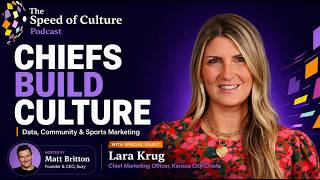
Laura Krug, the Kansas City Chiefs' first CMO, came from CPG marketing at L'Oréal and AB InBev. The Chiefs built a hybrid business combining media, events, ticketing, and partnerships, creating content in-house for speed. Krug uses first-party fan data to personalize experiences and help partners like Hy-Vee and Hallmark target specific segments.
Chapters
Up today on the Speed of Culture podcast, we're thrilled to be joined here in New York by Laura Kruve, the first ever Chief Marketing Officer of the Kansas City Chiefs. With over 15 years of experience spanning top brands like L'Oréal and AB InBev, Laura brings a unique consumer-centric approach to sports marketing, helping to position the Super Bowl champion Kansas City Chiefs as a powerful cultural brand. With, In, and Beyond the NFL. Laura, so great to see you today.
Nice to see you too. Thank you for having me.
Absolutely. So, you know, you are in a fascinating role and obviously the Chiefs are at the center of pop culture for so many reasons today, what we'll get into. But your career wasn't always in the world of sports. Walk us through kind of the twists and turns that you took in your career that landed you in the position you're in today.
Yeah, I, so obviously it's my first kind of core sports role with the Chiefs now, but I'd spent many years in different CPG organizations. L'Oréal, as you mentioned, and most recently AB InBev. Yeah. And at AB InBev, I was in both global and US roles, and beer and sports really go hand in hand. So I would say I was pretty adjacent to it for many years and both at a global and a local level. And so when this opportunity was presented, if you look at kind of my step-by-step career, people may say like, how does that all make sense? But I think that my industries that I've worked with, when and within, have always kind of been adjacent to sport and the culture of sport and the fandom of sport. And ultimately, a lot of my career was spent in media, you know, digital, social content, creative. And so all of those pieces have really kind of added up to work quite well with where the Chiefs are and certainly where we want to go.
Sure. Of course. One of the big differences between your role you're in now and some of your previous roles is essentially you were selling experience. Yeah. Right. And in the past you were selling physical products, beer, makeup, et cetera. There's been a lot of data coming out post-COVID that we're kind of in this experience resurgence. You know, revenge travel has been a word that's been thrown around a lot because for so long consumers weren't able to travel and now they are with abundance. How is it different marketing an experience brand versus a physical products brand when it comes to understanding the consumer?
You know, I think the first thing is really it allows us and makes us focus even more on who we are from a Chiefs perspective on a brand, right? Because you can't physically hold who we are and what we are. But in my past experience, and so from a brand lens first, I think it's really very focused on who we are and why are fans engaging with us every day, right, from the in-person experience. But what about who we are, our values, kind of the emotions that we bring that then transport when you're not physically at a game or at an experience? So that's been really important as a, as a focus. And that has obviously then said when we're trying to translate who we are to engage with either our existing fans or new fans, we've had to make sure that we know who we are, but we go to where they are. Yeah. Right. Because to your point, I think people are yearning for community. They're yearning for experiences, certainly in a post-COVID world. Of course. But I think pre-COVID, during COVID there was this sense of, I wanna be part of something bigger. And, and, and I'm sure, as you know, there's nothing better than a sports experience. Absolutely. That live kind of rush of emotion. And so we've had to experiment and innovate. How do we, make sure that experience is so good that people make Kansas City and the Chiefs a destination. But then how do we figure out what elements of that, who we are, what the brand stands for, that can translate all around the country and world through content, through relationships, through experiences, other things that may not be as physically, obviously, live.
Yeah. And you mentioned kind of the experience of being at a game. And, you know, one insight I have because I go to a lot of sporting events is—
Have you gone to a Chiefs game?
Well, I'm a Philadelphia Eagles fan. We're in a game today. We'll get into the holding call in 2022 later. But I've been to, I actually have been to one game at Arrowhead years ago. And, you know, I've been to many NFL stadiums and whether you're in an NFL stadium or an NBA event, what's striking is we are in such a polarized society right now. And when you go to a stadium, it's kind of like, oh wow, we can all be together again. It doesn't have to be so polarized. And I often say like demographics don't make as much sense anymore in terms of targeting like the 18 to 34-year-old. But if you get an 80-year-old Chiefs fan and an 11-year-old Chiefs fan, all of a sudden they have so much in common. It doesn't matter what their age or where they're from. So it kind of is the great equalizer and it brings people together.
It's so true. I think it, and, and I can speak certainly from the Chiefs perspective and if you've been there and, and we had a game obviously just a couple days ago. Yep. And, um, We, we had won against the Buccaneers and I was getting in the elevator and it was packed full as leaving and there was a handful of Buccaneers fans waiting and everyone who was a Chiefs fan in the elevator was like, come on, get in. Like there was, and, and the Bucs fan kind of looked at everyone and was like, man, you guys are so knuckies. And I, you know, one, I think that's a sense of who we are as Chiefs fans. And I think to your point, it applies to a lot of sports and a lot of different teams. There becomes a bit of this community escapism. You found a common purpose, right, in terms of what you believe in. But what we found is that that happens at a game, but that translates to the way that our Chiefs fans show up in other places. Sure. Talk a lot about this idea of everyone's welcome in Chiefs Kingdom, and it's kind of— Chiefs Kingdom is wherever you are. And so it's been a really exciting opportunity to find ways to make people feel that sense of family, right? So it was a family, community, escapism, right? I think that's what sport gives to a lot of people too. And I think you win, you lose, you win, you lose, it keeps going back and forth. And so I think people bond over happiness, they bond over trauma, right? They bond over all these emotions. And so yeah, I think it's a really unique thing in the world of brand in terms of fandom.
And to be clear, as of this taping date, the Chiefs don't win and lose. They actually just win because as of today they're undefeated. But for now, yeah, maybe when the time this podcast comes out, they won't be anymore. So, you know, it was notable when I was going through the intro that you are the first ever chief marketing officer of the Kansas City Chiefs. Congratulations for that, by the way. What was the impetus for the organization to create this role after all these years as a, as a football team?
Yeah, you know, I think there were a lot of things coming into play and in momentum as to why Clark Hunt, our chairman and CEO, and Mark Donovan, our president, who I report into, made the decision. As you just said, we are obviously in, in a glory moment for the Chiefs. And, and I've been there now just over 3 years. That started, you know, before my time, obviously. But it was really starting to accelerate, right? We have an award-winning coach. We have unbelievable players that are the face of, you know, the NFL. And I would argue sport at this point in many ways. We're built on authenticity in terms of the Hunts have, have been part of football from day one. And so all these ingredients were starting to ladder up, plus obviously winning on the field. But then I just think the, the expansion and the globalization of sport was happening. And so they really, I think, saw the opportunity and were one of the earlier adopters in the NFL and at the club level to, to establish a CMO role. It is still not consistent in every single club and certainly not in every sport that I've, I've certainly talked to different people on. And so I think they saw the opportunity and thought, let's do something now, right? Let's not wait until we're at the height or we've gone over, you know, the hump. And so it was, it was a pretty exciting call to get that first one to say that they were looking for their first ever CMO. And I think their investment in wanting to build the brand for the long term.
Yeah, I mean, in a lot of ways now is the time, you know, when you're winning Super Bowls, when you have the best player in the league to basically start to build that brand because it never lasts forever. You know, you see New England Patriots and they're in rebuilding mode and they had Tom Brady, which was, the Patrick Mahomes before there was Patrick Mahomes, right? And, but you know, they were able to take the momentum of those years and now they are brand, they, and they had, they're a much different fan base and they're in a much more valuable team and brand than they were before the Tom Brady era. And I think that sort of makes sense in terms of ride the momentum while you have it, 'cause nothing in sports lasts forever.
Correct. And I think that's what we've been starting to really focus on. And as you were mentioning about fandom and the humans in fans, right? Obviously winning helps. Sure. The conversation, it, it certainly makes— people ask me, is your job easier, harder now that you're winning? And I say it's probably a little bit of both, probably with the harder, cuz there is an expectation of what can we do on the business side to accelerate what the team is doing on the football side. But in that time, fans are fans oftentimes forever. Of course. And once they've come in, whether it's at the height or at the low or whenever it is, I think it's our job to keep them and find other ways to engage with them, even if winning isn't the only piece of the puzzle. And I think certainly in the last year, as we've all seen the stats and the numbers and the media of just the, the expansion of, of certainly NFL fandom, but the Chiefs fandom, we feel the responsibility now of how do we provide as many different ways to engage with that fan all season long and really all year long. And how do we find new business opportunities or new ways in the community that we can connect with them more often?
Yeah. And I think when you talk about like being a steward of the brand, I think what many people who probably aren't, you know, hardcore football fans or even people who don't really understand it is it's not even about wins and losses or stats. Like to me at least, football is about tradition, is about family. My dad passed my Eagles fandom down to me. Yeah. I passed it down to my son. I raised my son in New York, but he was able to hold on to that. And we go down to Philadelphia for games all the time. And, and I hope he's gonna do that with his son. Yeah. And it's a reason for people to come together. I know a lot of people are now traveling. So we had many leaders of hospitality companies, hotels and airlines on this podcast who've said that a big driver of growth is people traveling to road games with, with fans, whether it's college football. Exactly. So it's a catalyst for connections, a catalyst for memories. And the brand is kind of just like the, the glue that brings that together so much more than it is a bunch of people on a field throwing a ball around. Yeah.
And I think we see that when we even think through, obviously, obviously from a game day experience, right? And, and Kansas City really— Kansas City and the, and the Chiefs are so deeply linked. You can't separate the two. And not to say any other city is, is necessarily super different, but I do think there's something really unique about Kansas City and the Chiefs and, and, and the Midwest. I think there is a sense, an even deeper sense in some ways of, of community, of a sense of pride of, of where you come from. And so we see it though, even on, you know, weekend of a game, I'll I'll tell you, if we have a noon game, I mean, people are normally lining up to tailgate the night before. I mean, it is, and it's so much more than just the game, right? It's the experience before, it's going in together, it's the experience after. And you know, we have, we always talk about Kansas City, but we're seeing it across the board. You know, grocery stores are closing early to make sure that their employees can watch the games. Like, uh, kids at school on Friday are all wearing Tuskos. It really is the extension of it. Um, and I think we see that in a lot of our partnerships too, right? That's why certain partners have come to us and wanna work with us as a property because they're seeing the impact on their business, both local and now at a national level. Yeah.
So let's dive into the business side of what you do. So how would you describe, I guess, the core tenets of your job as CMO of the Cheese? Because again, it's not like a traditional packaged goods company there. It's a different type of business. So just curious from for our audience's sake to understand what does the CMO of the Kansas City Chiefs do all day?
Yeah, no, it's a great question. And, and no day looks the same. I sure can tell you that, like I'm sure many others. And I've, we've really begun to think of ourselves as media and marketing because we are at the core brand, right? And then one of our products is football and is the team, but we have all these other different parts of our business too. So from a media perspective, Right. Our reach on our social channels, on our website is significant in terms of volume, right, of people, but also engagement, which is a, a pretty unique thing in this world now when organically, right, you're still able to grow your brand on social channels and, and YouTube. So media is a big part of our organization and a big part of my day-to-day in terms of how are we evolving that, not just from a reach perspective, but how do we be innovative when we think of new ways to engage with fans through our IP, through content? Yeah. We have a huge events business, right? So even outside of game day, we have Arrowhead Events, which operates our stadium in terms of concerts, right? When Beyoncé comes, when Taylor Swift comes, to original experiences, we'll have something called Kingdom's Greeting again, which is a pop-up holiday bar that you get to overlook the field, right, for the month of December. We have, you know, obviously our ticketing business, our premium business, our community extensions. That's a part of my organization as well. And so it's wide, right? And no day looks looks the same, but we're a brand, we're media, we're a property. We oftentimes internally are a bit of an agency to our corporate partners who are looking to create custom content and looking to us to help give them that access. And then we ultimately obviously support our players in our core organization in every way that we can.
Sure. So let's double-click on some of those things. So you mentioned partners. So what you mean is brand partners, sponsors of the, of the Chiefs. So what does a great partnership look like? In terms of a brand partnering with the Chiefs, and how do you and your team support those partners to make sure that they're driving optimal business impact from that partnership?
It's a great question. We have a, we have so many really great partners who have been with us for a long time, and the best ones that I, I believe are the ones when we really think about it as a partnership, right? In terms of is the, the partner that we're working with getting something out of it as much as we are? And I think sponsorship plays a huge role in every sports organization, but when you get to the partnership level, that's when both kind of the magic really starts to happen. So some of the examples that I love to use, Hy-Vee, which is our grocery store partner, is an amazing one if you think about that extension into, you know, the tailgate experience at home and how does that come through in terms of adding value to consumers and buyers at that point. We have great partners with Coke. We have great partners now with Hallmark who has just come on with us and has a movie coming out with us in just a few weeks here. So we're really seeing partners seek different types of value over time. It's about the stadium, it's about the signage, it's about the exposure. But I think that the great partners and really the progressive partners are thinking about it as the extension beyond that and really seeing the value and what the Chiefs can provide to their fans, shoppers, buyers, whatever it may be on a day-to-day basis.
And as an extension of your partner offerings, you mentioned community and media. Yeah. And media. So basically they, they go hand in hand. So you have this growing community that craves Chiefs Chiefs content, you're pushing it out. How much of a piece of your overall strategy is first-party data, which I'm sure you have from your ticket holders and all sorts of things to allow your partners to be able to target Chiefs fans everywhere really? 'Cause you see companies like Walmart. Yep. Retail media is huge right now. It's, you kind of have the ability to, to I guess bestow the same model.
Yeah. I mean, data is, is a huge part. Yeah. As you can imagine of our ticketing business, right? Making sure that we're providing like delivering the best experience, the most personalized messaging to not only just our fans, but in partnership with our partners. And so even thinking through examples of that, so GHA, which is our field partner, obviously is a big one. Their real focus is, you know, military and federal employees. Imagine the synergies there where we can work through our data to figure out who are exactly people for them to potentially target with their offerings or, you know, other ones that are more conversion-based to Sleep Number, for example, right? People that are within a certain demographic. But also I think going beyond just the age demographic, as you mentioned before, it's so much more about, you know, it's a, you know, 25-year-old fan that comes one time. We're able to know so much more about our fans. And that's been hugely valuable to our partners coming in. And what we're starting to see now is, you know, the assets coming in terms of content too, right? How are we able to create content with that data to provide to our partners so that it's as efficient and effective, frankly, as it can be?
Yeah. And in terms of the fans and how they interact with cheese content, you know, one trend we've seen in sports consumption over time is highlight reel, short-form, built-for-TikTok-type content. Younger people do not watch traditional television as much. They probably tune in for the games, but in terms of their daily interactions, It's less SportsCenter, it's more TikTok. So how does that impact your overall content creation strategy and what has been most effective in terms of making sure that your fans, you are reaching your fans where they are?
So it's interesting. So we follow suit, as you can imagine, with most of the data and trends that show the, you know, rise of short-form content. Sure. TikTok, right? We're the number one NFL team on TikTok and we were an early adopter and moved—
What works on TikTok, by the way?
Highlights obviously work really well, right? But what we've found is it's, it's the casual type of content where it's the mini mics, it's the locker room content that nobody else has access to. Access is, I think, one of our unique selling points, right? What can you get from us that no other outlet can give you? And we always talk, while we say we're a media, you know, brand at this point, what we also are not is breaking news. Our job is not to break news about what's going on with the team. There are a million other sources that do that, and that's their role. Our role is about breaking the media and news around who they are with their helmets off, right?
And inside out, basically.
Exactly. And that's, that's been hugely successful. But to, to counter one point is we've actually, we have found that specifically on, on YouTube, and we're now number one on YouTube, um, as well in the NFL, which is awesome, is we do have long format content that performs really well.
Yeah, that doesn't surprise me.
And to your point, it's the, it's, it's the storytelling that fans in general want to see. Um, and so we have a, a series called The Franchise. Um, I, I, I'm obviously biased, but that you guys, yes, that my internal production team produces films, edits, everything, posts, everything that, that goes on, we do in-house. And that's an amazing piece of content that has really core football, right? They're showing what happened in the game a couple weeks before with access that you haven't seen, but they're complementing it with the lifestyle story. Right. And both from a football perspective, but also from the rest of the franchise, right? What's going on in the community? What is our, you know, CEO and Chairman Clark Hunt, what is he doing with his family, right, as the season kicks off? What's going on with our cheerleaders or our mascots? All these other parts of the brand that I think reach a very very interesting fan, and I think people are wanting more of that. So we have that complement of long-form content performing really well still, and certainly the ongoing continued rise of shorter the better, quicker, as quickly as you can scroll.
Yeah, I mean, it almost goes to my original question, which is like, why would the Chiefs want a CMO? And the reality is long-form content's hard. Correct. And if you don't have a CMO and you just have a bunch of people throwing clips together, you're not necessarily gonna be able to engage people with long-form content.
Yeah. And that's been a really, it's a great, Great point. And that's been a really interesting one for us, which is sports fandom. I think there was such a thought for so long that it was really just what was happening on the field and it was, you know, kind of narrow in the mind of, of who these fans are. And I think what we've tried to do with our team and, and, and what I've tried to push our organization on and, and we're seeing it work is fans want so much more than that. And for even the really avid season ticket member fan, right, who will consume everything and anything about the Chiefs, they are also willing to increase their frequency, right? If you wanna say of how they consume content, how they excuse it, consume other pieces of the Chiefs if you provide it to them. And we're constantly looking at the data to figure out what works or not. But having everything in-house also allows us to move with unbelievable speed. And I do think that's a real unique advantage that sports teams have and certainly the Chiefs have. And I think I think that's, that's a learning for other industries just in terms of that, that pace of, of content and what's needed and also able to optimize so quickly.
Yeah. So I talk often about like the barbell economy, which means that there's tremendous value on the value side of the equation and then a lot of, a lot of room to grow on the luxury side of the consumer. When you talk about access, you see companies like Disney World. Yeah. Offer like these premium ticket plans where you skip the line and you get to meet the characters, et cetera. And they're charging ungodly amounts of money, but they're able to sell it because there is a luxury segment that's growing. How do you look at that? Because in some ways I look at that as kind of like a dichotomy to the brand where it's about community and homegrown, et cetera. Yet you're also charged with driving revenue and there's probably no shortage of people from all over the world that would pay to be in the tunnel when the players are running out. What's your thought and what are the Chiefs' plans in that realm?
Yeah, it's a balance, right? Yeah. But I think it goes back to one of the points you were making around data. We know more now about our fans than we ever have before, and we're able to now provide products based on what they're asking for and what they need, but with the balance of what is right for our brand. Yeah. And I, and I think there is, the beauty of sport, to your point, is it is meant to be inclusive. And specifically at the Chiefs, we want it to be that way. We want as many people as possible as a destination to come to Kansas City or from the Kansas City area to come and enjoy a game. But there is the opportunity of there is only so many seats and space at Goed Stadium. And so I think that's really where myself, our head of, of ticketing, our head of events, head of operations, head of partnerships, we work really closely together to figure out what are new opportunities, whether that's in new experiences, right? Even within the stadium, but also like I mentioned, whether it's a holiday pop-up bar, that might be an interesting way for a more casual fan to experience something even locally, right? To experience something at the stadium that may give them such an amazing experience that they may now be willing to convert to a ticket at some point. Yeah. Or maybe it starts again, now that we know more with the data and, and the NFL has done, um, a huge project over the last few years of really helping all the clubs clean up their data and, and share the data so that it's in the right places with the right teams is also figuring out from merch right, to an experience, to a ticket, to going over to Germany, right, with a, a more luxury experience and all-inclusive when we played abroad. Those are ways that we can keep building on those, call it segments of fans and really trying to tailor our offering to them.
Yeah. So you'd mentioned the players and kind of bringing the players to life and obviously, you know, each player has the ability to build their own audience and their own personal brand, but at the same time you have your brand. How do, how are you guys working with the players to make sure that they're on brand, that you're on brand, that you're leveraging them, that they're leveraging you, you know, in a cohesive way?
Yeah. And I would say, I think that's probably been the biggest opportunity, probably the biggest evolution over the past couple of years as well as we all know how quickly athletes are their own brands. I think it starts, well, even before, uh, it's just such a different landscape. Sure. Um, our focus and our kind of belief is that from Achieve's perspective, we want to try to find the Venn diagram. We're very clear on what's important to us. We want to figure out what's important to them and then figure out where the areas of overlap are. So for example, um, 2 years ago, So, you know, merch is obviously a huge opportunity for fans, huge opportunity for the club, for the league, for everyone. And fashion is such a key kind of passion point in the world of sport. Travis Kelce has his own clothing line called True Colors. We knew that was really important to him, and we have the opportunity to do these local collabs, as they're called. We wanted to do one. We wanted to do one that was unique for the playoffs and for last season., and he has something that he's really passionate about from a fashion perspective. So we found a synergy there, right? He has his completely own other opportunities and, and focus, but that's a good one where there's value to both him and his, um, desire for his brand to grow and for our consumer that we could find those synergies. Other ones that are great examples, even on community pieces, right? So Trent McDuffie, um, is one of our players, is passionate about the community, is passionate about helping, um, you, the youth in, in the community. So Ronald McDonald and McDonald's McDonald's is a partner of ours for Red Friday, right? When we kick off the season, we always do something where we sell flags in the market, all the money goes to the Ronald McDonald's House. When we do kind of that giving of the check, when we're driving that experience, that's something that's passionate to Trent, and so he's involved in that activation. So whether it's, let's call it revenue creative driving, or if it's community impact, we try to find the synergies that make sense for both parties because is it just is so much more authentic. Absolutely. And everyone wins. I'm sure we could come up with a million examples of when it doesn't work, but I think that's something that all parts of our organization have tried to be really thoughtful around because if we can both help each other, really everyone, everyone grows.
Yeah. So I, you know, a conversation about your players wouldn't be complete unless we talk about Patrick Mahomes, who is, you know, the star of the league and the MVP and You know, he obviously has a great persona, a great reputation. How in your role do you leverage kind of a superstar like that to put him out front, but without him, which I know he doesn't want to do from at least what I read, what I've read and seen, he doesn't want to overshadow his teammates, but he is the man. Everyone's wearing his jersey. So how do you balance that? And how do you work with somebody like him who I'm sure he has this whole other team himself who is bad?
Yeah. Yeah. And, and, and He is brilliant and his team is brilliant in terms of what they're building for, for him and his areas of focus. I think one of the things the day you start at the Chiefs, or certainly when I did, but it's, it's from, from everyone, there is the very clear understanding that we are a team. Yeah. And we are very thoughtful and on even every single social post, right, of how are we balancing making sure that we're showing offense, defense, special team, right? How do we balance making sure that all the coaches are seen.
And that's what he wants.
I'm sure that's what he wants. And that's why it's a thoughtfulness, but it's also so baked within our culture that it would be strange if you've seen it any other way. Yep. I think for him, similar to the other examples I've given, there are certainly areas that he's incredibly passionate about. Community, right? 15 and Homies, which is his foundation, that we can be huge supporters with him and of that, whether or not So that's finding, you know, existing local partners that he would want to work with, highlighting what he's doing. Last year, he was nominated for the Walter Payton Man of the Year Award. So those are ways that we want to know what's important to him and we amplify that. But certainly, where there's crossover, where he's partners with T-Mobile, for example, they're a partner of ours, that also works incredibly well when that triangle is connected.
Awesome. So before we wrap up in here, just a little bit more about your career journey and where it's heading. Obviously a huge development in Chiefs Kingdom of the last couple years is Taylor Swift's relationship with Travis Kelce. Obviously as big of a star as Patrick Mahomes is, I would argue Taylor Swift is even bigger, right? And she's the biggest pop star that we've seen in quite some time. And all of a sudden when you're watching Chiefs games, you're seeing cutaways of of Taylor and she's talking about the Chiefs on stage and Travis was even on stage with her this summer. How do you as a CMO manage what must be a crazy onslaught of attention and opportunity and frankly distraction that has come with the Travis Kelce Taylor Swift relationship?
So I think, uh, it is unimaginable to, to even think through.
Are you wearing your friendship bracelet?
I, I, it is. It is not from her. I will say that. But yes, it is part of, it is part of my arm stack right now. Well, you know, I think we have been incredibly intentional about how we support Travis in terms of who he is as a player and his impact in, on the Chiefs and Chiefs Kingdom and sport in general. We want to make sure that quite frankly, for the fans that have been brought in because of the highlight that has happened over, over the last year or so. Our goal and my job is to make sure that those fans feel like they can connect with the Chiefs from day one all the way to the very end. Right. And so we would be naive to not obviously look at the opportunity in terms of just the sheer eyes, the— SRL, SRL and exposure. And I think it goes back to my point on media., and reach and content and connecting all those dots. Um, but I think it's really intentional. Again, going back to focus on the fan.
Yeah.
It's the fan who has now come into Chiefs Kingdom that is my responsibility, my team's responsibility to support while staying really true to who we are. And it goes back to that team aspect. So, um, we love, we love all the fans that are now with us. Exactly. And, and it does become a filter for creative and new ideas. It's, it's why the Hallmark movie, right? I'm sure is, has gotten as big as it has is because we're tapping into something that is about emotional connections and relationships. Going back to the beginning of the conversation, people wanna be part of something. People wanna feel something. And I think, um, with the Chiefs, they can do that.
Yeah. I mean, when Tim Tebow came to the NFL and a devout Christian, like he brought in so many other people. Into the fan base because they believed in what he believed in. Right. So sometimes you have these common, you know, passions or interests and it brings more people in the fold and you wanna try to connect the dots and make sure it's something that snowballs and continues to build the brand.
Yeah. And I think it's recognition of those fans. I think certainly before I joined Sport, I feel like fan, and, or at least my perception of the word fan felt very generalized, right? There was, kind of the surface-level understanding of a fan. And my husband is born and raised in Kansas City and a huge Chiefs fan from day one, and I feel like there was this perception of who it was that was the fan. I think what the last year has taught us, and I think where an experience from marketers coming from outside of sport have certainly, I think, accelerated, is the deeper knowledge of who the fan is. There's so much more than that kind surface-level description. Yeah. And I think we're able now with data, I think with the channels from social and digital that are existing now with the just connection, right? With the, with our, even our Christmas game on Netflix like that, all of those things are creating a whole new understanding of who these fans are. And I think it's really the responsibility of, of CMOs, but of sports organizations to go beyond the surface of who that fan is and connect with them to hopefully make it generational, right? And people like to see with them.
Totally makes sense. So shifting gears as we wrap up here, in 2025, obviously we're in a— going to be a completely different landscape based upon, you know, the political landscape, but more— but I would say equally as important, what's happening with AI in the marketing world. How do you, as CMO in Chief, look at AI as an opportunity to be more efficient and I guess drive more innovation and ultimately deeper fan engagement?
It's a great— we were— it's a great question and we were just talking about it, especially when we think through the creative versioning of all of the content that we have. And I will tell you something, it is something right now that we are not doing. It's something that I think from a league perspective, everyone is very conscious and very aware of what is the right way to use those types of technologies, especially when it comes to players, right? Or, and I like send it to them like this, but I've, and my creative team has certainly begun to think about it more from scale, right? So when you think about all the data, when you think about personalization and when you think about, so we have about 28, call it channels to manage. So we have our core obviously channels on Instagram and Facebook and X, but then we have a lot, we have GHA Fields accounts, we have all these other accounts. When you think about that scale and you think about also how lean many sports organizations are internally, AI and technology becomes very interesting on how did we do it and how do we do it right? And, and I really see probably in the next year or so that that will become something that we really try to figure out.
I would imagine so, for sure. So finally here, I mean, you obviously are in an amazingly exciting role. Yeah. And you wouldn't have gotten there without Mei Geng. Making the right, a lot of the right decisions along the way. Just like a player on the field, you make mistakes from time to time. Even Patrick Mahomes throws interceptions from time to time. But overall, you've made more right decisions than wrong ones. What were some of those decisions that you think you made on your proverbial field throughout your career that put you in a position that you are today?
You know, I think one of the ones would be that I've always been willing to, push myself outside of kind of comfort zone of what I know, taking roles that stretched me. You know, when I joined Anheuser-Busch InBev, I joined in a media and digital role, but after about 2 years or so, I was moved into a global experiential role, one of which I remember thinking as I was offered the job, I've never done a contract. Whoop-ass sports league in my life, so how am I going to be prepared to do that? But ABI is an amazing organization. They really stretch people. They see, you know, the value in the core of what I could deliver and put me in positions to then succeed, but also learn. And I think that desire for learn— learning has been something that has helped set me up for where I am now. I had never been a CMO before, right? The exact example of Well, why not? Here are all the things that I have that I believe can be value to the table, but I'm going to have to stretch myself and be willing to listen and learn to those around me and from outside to help me grow. So, I would say that was probably the biggest one that never really being satisfied and constantly trying to kind of grow my skills.
Sure. And what are some of the ways that you actively try to, you know, learn new things? I'm sure you're very much still in touch with people you've worked with in the past that are in other industries, et cetera. But what are some other ways that you lean in and try to make sure you have your finger on the pulse of where are the ever-changing world of marketing headed?
I, I, there's a lot of reading, there's a lot of, um, scrolling for work, as we say, just in terms of trying to consume not just what's happening in sport, but I think to your point, in every industry. And I think that has been something that's been really important to me is one of the reasons why I believe I was chosen was because of my non-sports experience. The other one too is raising my hands internally, right? I always, I still want to learn too. And a couple weeks ago, I was able to join a session with some other NFL female leaders at UCLA at their executive program, and I immersed myself, right? Everything that I can learn from people in the industry and outside the industry, I've raised my hand for, and I do think that is just so important for all stages stages, yeah, of your career. Because I think once you start feeling like you don't need to learn anymore is when things probably are not in a good spot, especially in the world that we— I mean, it's just moving so quickly and every day. And, and I have two little kids, and I, I will say, um, I'm not sure they're giving me work advice, but they are certainly showing me as a 5- and 7-year-old to consume media and sport and culture.
Just getting started too.
I mean, they— even when I think they're like our youth programming things that now that I have kids and I'm a mom and I'm trying to make sure that they're a part of sports, little things of even like, wow, that's so complicated, that signup process. Wow. I didn't even know, you know, a couple years ago that flag football was an option for my daughter to play. Like, those are things that I can now bring back to work and try to apply personal experiences to, to hopefully evolve our programs.
Totally makes sense. So finally here, Laura, is there a, a quote or a mantra you like to live by that kind of guides your professional journey?
It is always one that I say probably a ridiculous amount, which is believe in best intent. That's a work one. I think in the world we live in, things are moving very quickly, especially in sport. So, believe in best intent is one that I have used from the beginning of my career, but I use it a lot now. 'Cause, you know, not everything on an email is exactly what people intended or wanted.
Yeah. Everyone's dealing with their own struggles and problems here in this world. So give them the benefit of the doubt as well. Correct.
Awesome.
Yeah. Well, it's been such a great discussion today. I want to thank you for taking time out of your busy schedule to join us here in New York to tell us about everything that's going on with the Chiefs. Wishing you guys the best of luck, although I don't know if you need it, for the rest of the season and beyond. And, you know, really excited for our audience to hear here.
Thank you for having me, Hubs. You're welcome back, uh, uh, and to Kansas City anytime.
Oh, I might take you up on that. On behalf of Susie and Adweek Keene, thanks again to Laura Krug, the CMO of the Kansas City Chiefs, for joining us today. Be sure to subscribe, rate, and review the Speed of Culture podcast on your favorite podcast platform. Till next time, see you soon, everyone. Take care.
More from Matt




MikMak’s Rachel Tipograph on Consumer Spending, Retail Media & Holiday Shopping Trends



Jaguar Land Rover’s Charlotte Blank on Luxury, Purpose & Experiential Storytelling



