Kellanova’s Julie Bowerman on Snacking, Personalization & Cultural Agility
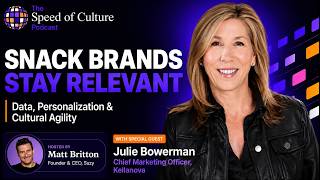
Julie Bowerman, CMO of Kellanov (Pringles, Cheez-It, Pop-Tart), discusses how the $13 billion snacking company shifted to omnichannel after COVID and built a loyalty database of 45 million consumers. She explains retail-media partnerships with Walmart and Amazon for personalized marketing, and why cultural collaborations like Crocs matter for brand trust.
Chapters
We are here live at the POSSiBLE conference in Miami, and today I'm thrilled to be joined by a very special guest, Julie Bauermann, who's the CMO of Kellanova. Julie leads marketing for some of the world's most iconic snack brands, driving growth through data, creativity, and culture while helping Kellanova stay deeply connected to the evolving consumer. Julie, so great to see you today.
Yeah, you too. Thanks for the nice introduction.
Yeah, yeah, absolutely. I know it's a busy time, especially being at a conference like this. For those in the audience who don't know what Kellanova is, because I know it sort of the output of some recent M&A activity.
Yeah.
Would you mind just explaining about the business?
Yeah, sure. So think of us as kind of otherwise known as Kellogg. Yeah. We were originally Kellogg and we spun off about a year and a half ago, maybe almost 2 years now, our US cereal business and created that carve-out as a standalone public company called WKKC. And then the remaining business is a global snacking business. We're about a $13 billion business. Some of the most amazing brands that you probably grew up with: Cheez-It, Pringles, Rice Krispie Treat, Pop-Tart, Eggo, Morningstar Farms, RXBAR, and a great snacking business that we have around the world.
Yeah. Now the snacking category has obviously had tectonic shifts over the last 5 years, largely accelerated through COVID. I mean, there were so many households who never bought food and groceries online, and then when left with no choice, they adopted it. And now we really have sort of an omnichannel market in the snacking category where in the past it was largely just in-store. How has that impacted your overall strategy in driving your brands forward?
Yeah, I mean, dramatically. You know, I'd say we saw the trends of online grocery, you know, and the way that consumers were shopping kind of starting to shift pre-COVID. And we were fortunate enough because was actually in the Chief Global Digital Officer role at the time. And we were fortunate to really kind of see the trends. And our CEO said, let's make a big investment here. This is going to be a growth driver for the business. And so we spent 2019 kind of unknown to what was going to come, making a lot of investments in omnichannel capabilities. And so we really accelerated through that, through that time. But what I'll tell you is it's changed kind of much more broadly how we think about not just the shopping part of our business, but the marketing, you know, how we engage consumers. And so a big shift of our marketing strategy is towards full-funnel marketing, and it's connecting our investments that are, you know, the big reach and scale all the way through kind of the transaction. And so we've made a lot of changes and investments and pilots and being able to do so.
So a big part of full-funnel marketing is obviously data. Yeah, and having data in, you know, unlike the big box retailers who sell through and other companies, it's not like you collect first-party data from everybody who sell directly to because you are relying on selling through the, the retailers. What does that mean? Because as data becomes more important, how do you look at getting your hands on first-party data, either through partnerships or direct, so you can be more precise in your go-to-market strategy?
Yeah, well, a good— I mean, also I think this is probably one of the areas where we actually are very advanced in the CPG industry. We have a first-party database of about 45 million records. Wow.
We started— That's unique.
Yeah, it is. That comes from years ago, we started Kellogg Family Rewards. It was a loyalty program that you started to engage with us through our packaging and buying our products. And at the time it was just collect points, but we had this vision of collecting data around our consumers. That now, fast forward today, has become such a competitive advantage for us. So we've got through our partnership with Publicis and Epsilon, a big database of our consumers. But then we marry it with the benefits that Epsilon brings and create their third party. And then we take that with to retail partners or media partners. And we've been able to do a lot with that in terms of audience segmentation, you know, insights, performance, just intelligence about our consumers.
Yeah, to decode that for the audience, basically what that means is if you know, Julie Smith from Minnesota is signing up for—
Julie Smith is my maiden name, by the way.
Wow. Okay. There you go.
Did you know that?
I did not know that. Okay. I probably took Julie because that's her first name and I used a very common last name. So let's just say Julie Sanders, to remove any coincidence, signs up for the Kellogg Rewards program and she lives in Minnesota and there's other attributes. There are companies out there that can match that information. Yeah. With other databases so you can learn more about Julie in terms of what are her other interests, what her income bracket, etc. And that can allow you to kind of create a profile of who your customer is for that brand and then model and lookalike that to reach the right audience, right?
And it allows you to take— because a lot of brands, particularly brands that are in the B2B2C space, right, we don't sell direct to consumers for the most part. A lot of brands don't have you know, the benefit of a large first-party data capability. So that lookalike modeling allows you to get scale, and so you can still have the benefits of precision, right, and segmentation, but still have reach.
And that's, that's because you need reach. You're selling to every American household. Yeah, yeah. And I think where the world is changing right now is, A, you're going to see a lot of personalization. So I think consumers are going to increasingly expect and demand. Like, you think about Gen Alpha, age 0 to 15, they are the AI generations where I just wrote my book about. They're going to know no other world but a world with AI. So when 10 years from now, when the 15-year-old's 25 years old and they start to become the head of their household and they're deciding what snack brands and cereals to bring in the house, the way they're going to be reached has to be completely personalized to them. And in order for you to personalize, you actually have to know who they are.
Yeah.
So I think over time it's going to be a mandate for brands to do the sorts of things that you're doing. Otherwise, they're going to be spoken to in a way that other brands aren't, and they're going to be left behind.
Yeah, for sure. And I think it, it does become kind of the, the standard now versus a test and pilot, because there's so many media partners. I mean, look at the world of retail media. Yeah, like, that is such a wonderful source of understanding about shoppers, consumers, households, that you can market to them in ways— like, you know, most brands, particularly in snacking, have a recruitment goal or objective. And so you can look at, you can use, you know, databases like a Walmart or an Amazon or a Kroger and really understand like who has not bought your product or if they have and maybe only bought it once or twice, what's the composition of their household? What's their buying frequency? What else is in their basket? And that really just starts to give you kind of intelligence that allows you, I think, to even be wiser even outside their ecosystem and how you target.
Yeah, I mean, the market's changing so much. You have Walmart saying we have, you know, tens of millions or hundreds of millions of consumer profiles 'cause they are selling direct to the consumer. They're allowing brands that you oversee to leverage that data, not just in store, not just on walmart.com, but throughout the whole web because they're essentially creating a strategy where they're finding their customers who buy your products everywhere around the web. It's incredibly powerful.
It is. And I mean, they don't think about them as, you know, we're using Walmart as an example, but a lot of retailers are like this way. You know, they're not just the lower funnel, like they've gone out and aggregated partnerships with networks that give them that reach to bring them into the funnel all the way down to purchase.
So yeah, Kroger, Albertsons, Target. Yeah, they're all doing it. And you're— it's on live display here at this conference. It begs the question, because in addition, it's not only them. Chase now has a retail network because they have spending information. PayPal rolled one out. So these companies that were traditionally advertisers are now selling advertising services. And if I'm a publisher, right, who just pushes out content, I don't have any of that shopping data. I don't have any of that spending data, which is, and that's why, you know, Amazon has Prime. They're kind of connecting the entertainment aspect with data to piece it all together. And I just wonder over time if you're gonna see the Walmarts and Targets of the world start to acquire content companies like Paramount, et cetera, to connect it. Because obviously you need to garner the eyeballs, right? And Walmart does it because they obviously, people are going to their stores. But Amazon has the added benefit of having Prime. And I think over time you're also going to start to see products in shows because it's all about attention when it comes down to it.
Yeah, I mean, certainly I think that's, that's very realistic. I mean, because if you think like Walmart wants to compete with Amazon, right? The billions of investment they've made in terms of, you know, their omnichannel, um, and their online capabilities. Yeah, they're going to have to, to compete. I would agree.
Yeah. And the other piece that's interesting is Walmart acquired Vizio. Which makes TVs. And I was always in shock that companies like Netflix or even Apple didn't roll out their own physical television because just like how Apple has so much benefit with the phone because it's the last mile and you have the device in people's hands.
Yeah.
The TV is, is in the home. It's the biggest, most important piece of real estate for brands in the home. And to be able to control the screensaver on the TV, the buttons that are actually on the remote control, it really allows you to dictate a lot of behavior.
Yeah. And TVs have become a low margin business. Business.
And ultimately, it could be a loss leader, almost like the razor, razor blade model, right, for these companies. I think Walmart, it's probably where they're going to start to take things. It'll be interesting to see where it all goes. Yeah, yeah, yeah.
I think that's, that's very, uh, that's very smart to think that way. Yeah, I think it's possible.
Yeah, I mean, the world has changed a lot, right? Like, you look at your time at Coca-Cola, you spent over 2 decades there, and when you were there, marketing was so different.
Yeah.
Than it is today. What are some of the biggest ways you think it's changed from earlier in your career to being a CMO today?
Yeah, I mean, when I started off in marketing with just, you know, creative was everything and creating a 30-second spot or a great billboard creative piece of creative was, you know, kind of the, the silver bullet to great marketing. And now it's so much more complex, fragmented. I think the, the, the, the skills of a CMO have to be more technical as well. You know, I've learned a lot about data technology, how it works. Then you've got multiple platforms in which you're putting your content and your media assets into that have different benefits. And so you have to tailor almost to— you have to really have to tailor to the, to the platform. Yeah. And so that just creates just a vast amount of fragmentation and complexity. And so it's really about kind of how do you prioritize, how do you manage through that complexity, how do you keep your skills fresh, how do you develop your team so that they're able to compete and understand how this works? It's a much different role as a CMO today, for sure.
Yeah. And, you know, I would argue not everyone believes believes this, but I certainly believe this— brand is just as important today as it's ever been, right? Because it's a marker of trust, and consumers don't love choice. They want things brought to them, and what removes choice is trust, and that ultimately comes from brand. Um, and a big part of brand is culture. I know a lot of your brands have really leaned in the culture, one of which is Pringles. Um, lots of great work in terms of collaboration with Crocs as well as their recent Super Bowl campaign. Talk to me about what culture means and maybe let's talk about some of the examples that have worked in injecting culture into or leveraging culture on behalf of your brands.
Yeah, I mean, culture is like broad, a broad term, right? And what it really for us means, like, how do you stay relevant with consumers? And so for us, you know, this started several years ago of really thinking about what— how do we do that? Like what, you know, what are the capabilities we need? What's the intelligence and data we need? What's the right agency partners? What are the right the right team members. And we just started to make really, I'd say, a lot of investments around building our ability to understand how our brands are going to be able to maintain relevancy. And then the second thing we've really done is then how do you operationalize that? And that is all about removing all of the barriers so that you can move quick. When it happens, you respond or take advantage of the opportunity. So it's, it's some of the weedy things and not the, not the interesting things to deal with, like legal and process and approvals, you know, all of that stuff has to be able to be done really quickly without multiple decision makers and enabling it to happen really quickly. And so I think we've done a great job making those investments and those changes. And it's paid off in, I mean, not just what you've seen in Pringles, but in, you know, look at Cheez-It. Cheez-It's been named Ad Age Brand of the Year. It was in the top 10 of the only non— the only non-food brand or the only food brand of non— other non-foods that was named, you know, kind of popular brand of the year. And it's just done it well, so well, because it's done big things like the Cheez-It Bowl and really tied into sports. But it's also done these kind of small moments. We've taken advantage of the kind of the food scene online where everybody's talking about food and recipes. We've unlocked that and made Cheez-It part of an ingredient, right, and helped enable recipes. Or we've done really cool things like our latest collab with Jimmy Butler and just really made the brand cool and hip and relevant. But we've done it in a way that's enabled that kind of all of that wiring underneath has enabled us to take advantage of it.
Yeah, you mentioned Jimmy Butler and we actually yesterday had Tim Ellis, who's the chief marketing officer of the NFL here. Obviously the NFL is remains to be so important in U.S. and increasingly global culture and like 90% plus of the top 100 shows watched live on television every year are NFL games, showing their power. And obviously, you mentioned earlier Pringles, uh, took place in the Super Bowl, and I know you've done a lot of work with brands in Super Bowl in the past. How important is something like sports for your brand in terms of garnering eyeballs and continuing to activate? Because I know it's a big investment.
Yeah, it's huge for us. Um, I think first of all, it starts with kind of understanding what your consumers care about, um, what their passion points are. Sports is right in our sweet spot. I think more importantly, sports enables though the— it can consumption occasion of our brands, you know. So both whether you're at the venue or you're at home, you're gathering with friends, you're watching it by yourself, like you're snacking during those moments of sports viewing. And so it becomes kind of a really relevant, you know, way in which we market of bringing our brands to life, keeping the relevancy, differentiating them, but also really tying into the appropriate consumption occasion. And so, you know, everything we've done, you know, Cheese It Bowl or all of our bowl game activations, Super Bowl, basketball, We've tied a little bit into women's sports, um, and we've got a few other things in the mix coming, uh, next year that you'll hear about.
Can't wait to see. Yeah, awesome. Um, obviously AI is a huge topic here, um, and it's impacting not only the way that you do business but also your consumer. You know, your consumers, their lifestyle is going to change. The way their, their daily habits and rituals over time will change as well. So seeing from where you sit, you have to think about how does your business leverage AI in going to market as well as what does it mean for your consumer? How are you thinking about AI here in 2025 in terms of your role overall and your approach to driving and continuing to build the brands you oversee?
Yeah, I mean, I'd say we're, we're at the, the nascent stage of this, right?
As are most companies.
Yeah. I mean, we're, we're not doing anything that would be kind of earthbreaking that you probably haven't heard of. But I think what's important is that we're keeping a really close pulse of it. In fact, I have a marketing town hall next Tuesday and we're bringing in a couple of AI experts in just to educate the marketing organization of, you know, how does AI work? Not the what are the marketing use cases, but like what's the kind of the way in which it works? How is it powered? What are the different agents and platforms and how does the data come together? You know, what are use cases as an individual versus not just a marketer? And so it's just that, I think, constant kind of understanding kind of for us, you know, to have the knowledge. But we're doing a lot. We're doing some in the digital shelf space around content optimization and content development. I'd say that's the most common use case. Sure. I do think though, as we get more advanced in what we were just talking about earlier in terms of audience segmentation and lookalike matching, that's going to all happen.
Leveraging data.
That's going to happen all automated. And I think that's where the real benefit is going to come over time and the optimization of that and to be able in a real-time nature is all going to be enabled. By, you know, AI and machine learning. So, so I think it's important that we stay close to it, but the scale is not quite there yet for us to fully leverage.
Yeah, I mean, even you think about your 45 million data points, your ability to crawl through that data and extract meaningful insights.
Definitely. Yeah, for sure.
Yeah.
Yeah.
Which in the past might have taken far longer.
Yeah, for sure. Yeah, absolutely.
Absolutely. I'm just curious, this is like a side question, but you're a CMO and the CMO is on a pedestal in the advertising industry, right? And there's like probably like 15 CMOs and 5,000 people here, right? And everyone's like, I want to meet with the CMO and it must be maddening. You probably get solicited all the time. And I get solicited and I run a small software company, so can't imagine what you must get. My question for you is, if you're a partner that wants to do business with Kellan Nova, what does it take to break through to get somebody like your attention?
Yeah. And you're right, we do get a lot of solicitations being a big brand. Yeah. Yeah. And it is hard as a CMO to say, gosh, who should I talk to? I really make an effort to make sure I'm kind of reading the reach out to understand, like, is that something that should be relevant to us? Should I understand that? But I think more importantly is that the partner has to understand what we're trying to do as a business. I think oftentimes they can get caught up in, she's a CMO or find and replace. They're a Fortune 500 company. Like, we have to talk to them. And I think understanding really what the needs are of our business. And so the ones that break through to me are the ones that understand that and they position themselves in a way that I think, you know, I've got to talk to them because I need to understand that capability. And like a good example would be, I'd say 2 years ago, there's a, there's a company called Fetch. Do you know Fetch?
Of course. Yeah.
Small, right? Not as meaningful as they certainly are. They've grown very fast and kind of had that, you know, hey, you were— we understand the importance of loyalty. They knew about our first-party database. They understood that we were kind of in that model, but we're trying to get out of it and replace it with, you know, more types of data and intelligence in a way to do our full-funnel marketing strategy. And they approached us and they just kind of in that manner of saying, hey, we've heard you talk about this, here's our capabilities. And it really opened the door for, through, for a pilot and a lot that we've done with them. And they've been a very meaningful partner. Yeah.
Yeah, I think you're right. A lot— what a lot of people who are new business try to do is they just find and replace. I'm going to have a list of Fortune 500 companies. Julie, Jeff, Joe, John, it doesn't matter. I just want to go. And that's what doesn't work. You have to put in the work. To understand and really have a vested interest in wanting to build your partner's business, not just close a deal.
Yeah, definitely. I think the retail media networks have done a better job with this over time. A few years ago, it used to be like, hey, you put our product— your products on our shelves, we need you to invest, we need brand money. It was a little bit more of a strong-arm approach. I think now they understand that they have to position themselves as a media partner and say Okay, you are about penetration, for example, or reach and scale. Like, how do we solve the needs of your brand and understand the needs of your brand, not just create leverage because we're also your retail partner where you sell, right? And they've done a much better job, I think, of kind of changing the way in which they position us or come to us with ideas or partnership mentality around kind of here's what we're trying to do to help you solve your problems of your business.
Of course, competition helps as well. Like, when Walmart is the only strong retail media network in town, yeah, it's one thing, but now Target is building and Kroger is building, so now you have more choices to make. So they have to up their game as well, just like any other market.
Yeah, for sure. They've all been great partners.
So sure. Yeah. Um, let's zoom out a little bit in terms of just the trends you're seeing with the consumer in the snacking category. Obviously GLP-1s has a major impact. Consumers' tastes are changing. Coming out of COVID we saw health become far more important. Yeah. How is that impacting the way that you look at your products, your packaging, and the way that you go to market for your brands?
Yeah, I mean, dramatically, right? The, the, the needs, the kind of the need states and occasions of which consumers are using snacks has changed dramatically. You know, kind of used to be an after-school, late evening thing. Now it's, you know, all throughout the day. It's meal replacement. It's a late morning snack. It's after my gym workout. I need to get protein into my system, you know, because that's what, you know, now I've been educated to know that's important to refuel my body.
Right.
And so kind of just that expansion of the needs and occasions of consumers. And so for us, it's really about having a really close pulse of that and then building our innovation strategy around it. Absolutely.
You know, the GLP-1 trends are important.
They're coming, they're coming even fast. Health and wellness broadly is coming very fast. And so it is, I, for us, about how do we take the brands in our portfolio and meet those needs, right? So it could be pack form, it could be formulation or ingredient additions or new ingredients, it could be, you know, portion sizes. There's a lot of ways in which we're looking at doing that. You know, so that we have the spectrum of, you know, the indulgent to the, you know, kind of the more health version of snacking. And so that for us is kind of how we look at it broadly. And we watch every single trend, but we don't just jump on a trend and— You can't. Yes, exactly. Exactly.
Because you have a, you know, you're not a company that can necessarily— yes, you can change your messaging very quickly, but in terms of changing what's on shelf, Yes, there's a process in doing that, right? So you have to be pretty measured in the decisions you make.
100%.
Every inch of shelf space matters. You need to make sure you're setting yourself up for success.
Yeah, 100%. Yeah, definitely.
And when you look at something like Instacart or Amazon or other places where people are buying groceries online, does that change also just merchandising? Because obviously if you're at a CVS, you can have your snacks at checkout, you can grab one, but that doesn't really exist the same way online. So how does that change in terms of your merchandising strategy as consumers are buying online? Do you have to have different packaging and products online versus in-store?
Yeah, I mean, not— you, you can, right? But the reality is the majority of the online shopping is coming from in-store, just the way that the retailers are fulfilling it, right? And so that pack variation, I think early in the days of online buying, that what seemed like a logical strategy. And the reality is it kind of only serves the Amazon model of, you know, shipping to your home. But there are complements of that checkout kind of behavior online. You know, there's add to carts, you know, add through the checkout process. So you're, you're doing the same, you're thinking about the same shopping behaviors, but you're using more media and data and targeting to, to get that because you can in the digital environment.
Exactly.
Yeah.
Awesome. Shifting gears a little bit as we wrap up here, would love to, because you obviously have worked with some of the most prestigious brands and obviously companies like Coca-Cola and Calanova, they hold high standards. You can't just go walk off the street and get a job, you know, overseeing one of these brands. And I'd love to know from you, throughout your career, what have been the hallmarks of like a great rising talent? When you look at attributes where you see somebody early in your career and you're like, they're going to make it one day. What has, I guess, been true more often than not?
Yeah, yeah. Great question. One of the things I think for sure is curiosity. Not a sense of I know the answer, I want to learn the answer. I think curiosity is a big part of it. I love to use this word scrappiness. I love when people are, they figure things out. And if you empower them as a leader and you help them kind of remove their barriers, but they run with it, they figure it out.
Resourceful.
Very resourceful. I think that becomes kind of a, a marker of a future talent as well. And then I think that the other part of a young talent is someone who's really keen to take advantage of getting experiences and not just chasing titles, and really looking at the opportunity to say, let me learn a lot of different things so that later on it'll benefit me, but I'm not worried about later on right now. I just want to get those breadth of experiences. And I think all of those kind of things make up, you know, someone who probably later on will be pretty successful.
So in terms of taking experiences throughout your career, you know, you spent over 2 decades at Coca-Cola. Yeah. What are some of the biggest takeaways you had from that organization that you still think remain with you today? Yeah.
Um, you know, that is where I learned the fundamentals of brand marketing, um, and just how important a brand and building a brand's emotion with a consumer really is. So that I think has stayed with me kind of throughout my career. But the— but one of the things I got at Coke was a lot of breadth. Just as I talked about, I was in digital, I was in media, I did shopper, I did e-commerce. I had a whole breadth of experiences pretty early in my career. And that really translated to me kind of later on. I worked in the US a good bit, but I worked around the world. And so I just kind of opened my mind to a lot of great opportunity and Coke enabled that for me. But, you know, there's other great companies just like a Coca-Cola. But I think part of, you know, is not only just the, the learning and the capabilities they have, but the people and the network that you build from that, that then translates later on as well.
Yeah, for sure.
It's a massive network.
Yeah. And finally, Joe, I mean, obviously you wouldn't be in this position if you didn't make a lot of right decisions along the way. I'm sure not all your decisions in the rearview mirror were right. No one's are. Yeah. But as you look back on your career and all the different roles you've had, what are some of the right decisions you've made to put you in the CMO seat today, whether it's relationships, skill sets, or just things that you focused on that allowed you to take this path?
Yeah, I was— I had been pretty, pretty, you know, pretty much embedded in marketing at Coke. I'd done multiple marketing roles I was talking about, and the organization came to me and said, hey, there's this thing called e-commerce that's getting ready to happen. Amazon's knocking on our door. They want to start up a grocery business. You've done brand, you've done sales, you know digital marketing. Would you go? You know, how about if we put you in this incubator role? You're going to go work for our chief strategy officer. We'll give you a couple of headcount, but can you go figure it out? And at the time, I had I was running digital marketing. I had a pretty big team, pretty big budget responsibility. And I was like, hmm. But I did it. And it became, I think for me, something that just unlocked so much more in terms of it forced me to build a business inside of a company. So I had to think, you know, end to end. I had to think, how do we make money? How do we manufacture and supply? How do we negotiate the deal with retail customers like Amazon? How do we convince the bottlers that we need to operate? How do we build the marketing capabilities? So it was really truly a GM role, but it was starting a business. It was very much an entrepreneurial kind of role. And I had to be scrappy like we talked about, and I had to figure things out. And no one in the organization knew, but I also had to influence the organization around this was important. Why it was important. Here's the future of what this means for us in our business. Here's how we're going to create value. And that gave me so much more confidence, skills, capability that I think that leapfrogged for me in a lot of ways that grew my career from there. And a lot of people would have looked at that as kind of, why is she doing something? No one— e-commerce is nothing, right? CPG. It's not even, you know, there's no sales associated with it. And then I got to go do it globally for Coke as well. And that just really opened a door for me that differentiated me and my profile and the skills that I had that I think that without that, I wouldn't have become a CMO.
It also takes a lot of courage and conviction to do that, to dive in, because it's not like you had all the answers either. You were kind of figuring out as you went along.
Definitely. Yeah, definitely. And I worked for an amazing leader, a woman who who's still my dear friend and probably number one mentor, who really pushed me and pushed me, challenged me, and I had to kind of rise up to that. Again, very uncomfortable throughout the process. Many times thought, why did I do this? But it turned out to be an amazing experience.
Yeah, I think that's a perfect example of just going outside your comfort zone. Yeah. Taking a leap and owning something. I think in times of change like now, Everyone just wants someone to lead, take their hand, and show them the way. Yeah. And even if the person that's showing them the way doesn't know all the answers, it's better than just sitting and waiting for change to happen to you.
Absolutely. I mean, particularly earlier in your career, I mean, I think you don't realize until you reflect back. I mean, you probably can look at this yourself, Stewie. Well, you've done some really bold moves in your career, right? But like when you look back, you're like, gosh. It's okay to fail. It's okay to make some bad decisions. You learn so much from those, those points that you become better as a result of it. You almost want to go look for those kinds of opportunities that might be, might be a bad mistake because you grow from it. And so, yeah, I think taking some courage and being— taking a bold move is really important.
I think it's important to say because the difference now is when we grew up, there was no Instagram. Right. Yeah. Now kids growing up see everybody, quote unquote, killing it. They don't have patience. They want to make it right away. And they also feel like they can't fail in private. They're failing in public. Yeah. And I think what that does to a lot of younger people is it makes them very risk-averse.
Yeah.
And I think over time that will be to their detriment. Well, we didn't have that growing up.
Yeah. So true. Yeah. Such a great point.
Yeah. Yeah. Awesome. Well, this has been an amazing talk. I'm so thankful you took the time. We always ask our guests to wrap up if there's a saying or mantra that has guided their professional journey? Just wondering what comes to mind for you.
I don't— I wouldn't say I'm the same person, but I had a father. I have a father who was a very successful senior leader in business, and his style of leadership was to touch everyone in the organization, the most junior people all the way up to his direct reports. He knew them personally. He talked to them. He made an effort to be engaged. Get to know them personal, be vulnerable and transparent. And that has instilled in me what I believe and want my leadership style to be like. While I'm very accountable, I have a boss and feel very accountable to my boss, I feel much more accountable to the people that work for me. And I think my father is really the one that gave me that value.
It's clear he has a strong influence on you. Yeah, definitely. So congrats on your success and wishing you nothing but the best of luck this year as you continue to drive this journey forward.
Thank you.
Nice to meet you. Likewise.
For the invite.
Absolutely. On behalf of Susan and Adwee team, thanks again to Julie Bauermann, the CMO of Kellanova, for joining us today live at the POSSIBLE conference here in South Beach. Be sure to subscribe, rate, and review the Speed of Culture podcast on your favorite podcast platform. Till next time, see you soon, everyone.
Take care.
More from Matt




MikMak’s Rachel Tipograph on Consumer Spending, Retail Media & Holiday Shopping Trends



Jaguar Land Rover’s Charlotte Blank on Luxury, Purpose & Experiential Storytelling



