Klarna’s David Sandstrom on eCommerce, AI & the Future of Payments
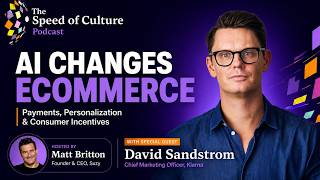
Klarna's CMO David Sandstrom talks about building BNPL into a win-win for shoppers and merchants, the shift from credit cards to alternative payments, and AI's role in shopping. He partnered with OpenAI on a ChatGPT shopping plugin and believes quantity leads to quality.
Chapters
Up today, we're gonna be speaking with David Sandstrom, CMO at Klarna. For almost 7 years, David has been instrumental in transforming the online payment brand to a huge international business named Europe's most valuable private tech company in 2021. David, so glad to have you on today. Great to see you.
Thanks for having me.
Absolutely. So let's start with your background. Um, I know that you spent a lot of time in the agency world. In the Nordics. Um, I'd love to hear first and foremost what that experience gave you in terms of preparing you to be a CMO of such a major brand today. Um, as well as how the environment in the Nordics when it comes to technology and advertising you think is maybe a little different, uh, than the US and some of the other Western markets.
Yeah, I mean, let's start with the obvious. I've had the, um, the, the opportunity to work at some of the biggest agencies here in the Nordics. Um, I started out as a as an analyst, really trying to understand what makes people tick, why people choose one thing over another. I'm deeply, deeply interested in consumer behavior and I got to apply myself to a lot of different businesses. I think in general, starting out at agencies, starting out as a consultant makes a lot of sense. Yeah. You get unique insight into like how different business models work, how different industries work. You get to dip your toe in so many different things. And I got to do that. I worked with everything ranging from the Swedish Armed Forces to the McDonald's franchise in Europe, right? So I saw a lot of different things. And I think, I mean, creativity, as we know, is a lot about, you know, putting different pieces together. And I think what I'm doing now, I think what I'm doing now at least is really trying to put together all the learnings I've had from all of these different industries again, McDonald's, Volkswagen, Swedish Armed Forces, like all of these different ones into like what makes sense and what works and see if there are learnings in between. So I've worked at a media agency, I was the CEO of a big ad agency, DDB, and yeah, that's pretty much the background. And I transitioned, I think, I'm not sure if this holds true or if I was particularly cocky when I was younger, but I often had the sense at the agency that, hey, is the CMO job really that tough? I think I can do that better, right? I think there are a lot of smartasses. Is that the right word?
Yeah.
At agencies, I at least, but I can talk about myself. I felt that I knew so much, right? I came into an industry, I saw a business, within 10 minutes I had figured it out. Like, why wouldn't they do this? Or what? Why didn't they operate like that?
And we call that Monday morning quarterbacking. For the football that we follow here in the States, it's, you know, everyone kind of second-guessing stuff from afar saying you should do this or that without really understanding the intricacies of the business.
Yeah, exactly. And at some point in time I just wanted to put myself to the test. Like, yeah, is it really easier on the, um, you know, on the brand side, on the client side, right? Which is, it's obviously not, right? But at some point in time, I think you are not mature enough, but you've done enough consulting and agency work that you want to go deep. Yeah.
Right?
You want to go deep at some point in time. And I probably want to go back at some point in time as well. But, but, uh, 7 years ago I decided to go deep and I went deep with Klarna, which is, which has been a fantastic experience.
That's it. And before we jump into Klarna, just, you know, I alluded to this at the onset, but when you work on a brand like McDonald's, and you're in the Nordics and you have to translate that brand, because I spent a lot of time in the Nordics and as you know, the culture is so different than it is in America. And I would imagine that is exemplified no more than it is on a brand like McDonald's, where a lot of things that, you know, I think people associate with McDonald's is not what they would associate with the Nordics. So you have to translate that brand to your culture. What is that process like and how would you say the cultures are different?
I mean, you're spot on. The culture is extremely different. And to some extent, McDonald's represents like America, something like, you know, the core of America. For better and for worse, right? Exactly. It's burgers. It's a founder story. It's franchise. It's global dominance. It's everything, right? It's setting the tone for culture. So McDonald's is very much American and the Nordics isn't, right? So what we had to do was to understand what core parts of the brand can we take and make it resonate with the Nordics. And one of the biggest things, and I worked with this for 5 years, was the insight that, you know, at the core McDonald's is a family restaurant, right? And the big insight here in the Nordics was that people or parents saw themselves as bad parents when and if they took their kids to McDonald's. Right. Not because McDonald's is a bad place, but also McDonald's represents, I don't wanna say McDonald's represents obesity because that is also like, that is a too harsh of a statement. But you know, it's burgers, it's fries, it's milkshake. It's, it's, you know, maybe not the kind of thing that, you know, you want to give your kids on a daily basis at least. Of course. So we worked a lot with, okay, how can we keep the core of McDonald's being a family restaurant, but transform that into, okay, how can it be a family restaurant in the Nordics? So we were very early with exchanging fries for carrot sticks. We were very early with, you know, going from sodas to, we drink milk here. You probably drink milk in the US as well, but you know, milk with hamburgers wasn't as usual. Instead of toys and the Happy Meal, we had books, right? So all of that progress was made due to the fact that we want to keep something that's core to McDonald's, which is family friendliness, but we needed to transcend that into something that was viable here in the Nordics. So it'd be extremely interesting process.
Yeah, and to your point earlier, I'm sure experiences like that definitely broaden your horizon and very much prepare you for the role you're in now, which is at Klarna as CMO. When you joined Klarna, in 2017, which was 6+ years ago. The world has changed so much since 2017. I mean, you think about 2017, no one really— TikTok didn't exist, for example, way before the global pandemic. You know, we were in a very much a different world. Even things like mobile commerce were still sort of early on in 2017, where now everyone's buying everything on their phones. Talk to us about the transformation you've seen at Karna, because not many people will have the experience of joining a startup at the size in which Klarna was when you joined to seeing the stratospheric growth that you witnessed with a courtside seat, it must have been an incredible experience and still is today.
I mean, it truly is. And as you probably know and hear, I'm from Stockholm. In Stockholm, there aren't many, although we have quite a lot of companies like digital companies here, big companies like back then when I joined, it was really a choice between Spotify and Klarna. Yeah. Like those were the two companies that were growing at the time. And many people, when I chose, when I then chose to, to join Klarna, asked me like, why wouldn't you join Spotify? You know, you have music, you have Jay-Z, you have like, you know, all of that, right? Why would you join a, a payments company? Right.
And, and to me it was much less sexy, so to speak, than a music.
Exactly. But, but also the challenge, right? I, I, constantly say it's so much easier to make Klarna sexy than to make Nike sexy, right? Nike is already at the peak, right? How would you evolve that? I wouldn't know, right? But taking Klarna, something that is— now bear in mind, we're operating in the most distrusted industry in the world, right? More distrusted than media, more distrusted than politicians. It is an industry that people, you know, I wouldn't say hate, but the relationship people hold to financial institutions is It's very particular, right? Sure. Taking a brand there and, you know, breaking it loose from that stigma around financial companies, trying to treat the brand and the company differently, seeing like, okay, what can we actually do with the power of marketing, go-to-market, branding in that environment? That inspired me so much more and still does to this day. So it's, it's been an absolutely amazing journey taking Klarna from a, I mean, a fairly small Nordic tech company that was very male, very blue, very transactional in many ways. In all fairness, like we were a service but not a brand, right? And that was the challenge to me. Spotify was way more of a brand back then. Of course. And maybe still is, but The challenge was basically, can you take a transactional service and turn it into a beloved brand? And this is what we're still working on, right? And that is what got me going with Klarna and to this date still is the thing that motivates me.
And for those who don't know what Klarna is, how would you describe it to somebody at a cocktail party? And then how would you also describe what your role is there and what you're trying to accomplish on a day-to-day basis?
So at the core, what we do is we offer what we call alternative payment methods, right? So a smarter, better way of paying for things online. We have a variety of ways to do so. We're mostly famous for what is called Buy Now Pay Later, which is basically taking a payment, splitting it in 4 parts, spreading the cost and paying no interest. So at the core, like if I would put it very simply, depending on how deep into the cocktail party we are, I would just say that we're a much, much better alternative to credit, much more consumer-friendly, better for society, better for merchants, better for consumers, right? On top of that, we've built loads of shopping services due to our personal popularity, but I wouldn't go into those, right? But we have an app in which you can shop, you can track your packages, you have all your digital receipts, you can stay on top of your spending, smart budgeting tools, all of that. But at the core, I would say we're a payments company. That's the easiest way to—
Yeah. And when you mentioned that, it's much better for society and for the consumer than credit cards. What's the basis for that stance?
I mean, the basis for that stance is that the credit card industry in the US is an $8 trillion industry, and those $8 trillion comes from the fact that people can't repay their debt.
Right.
Right. It's as simple as that. And what we offer is an alternative to that where we say, hey, don't pick up the interest bill as a consumer, but pass that on to the big merchants, right? The big merchants have more money than you and they want to see you as a happy customer, right? So again, what we offer to consumers is the ability to split the purchase and spread it out over time, just like credit. But the tab basically is picked up by the merchant. And we feel that that is fair.
The tab of the—
The tab of the interest, right? The tab of the interest. So you do this without any interest.
So the risk is shifted from the consumer to the merchant, basically.
Exactly. And I do think what we're trying to achieve, which is— it's fairly cheesy to talk about, right? But I think we're aiming for a win-win-win situation here, right? We have the consumers that are obviously better off because they don't have any interest, no fees. We have a merchant who is better off because they get a more loyal, a happier consumer, and we have Klarna that is better off, right?
Right.
I think the big difference between modern companies in general, not only Klarna, but modern companies in general, digital companies in general, they have aligned incentives with their customer base, right? If you look at credit card customers or the credit card business model is, you know, the credit card companies are happy when you're not repaying, right? That is how they make their money because people start revolving on their credit and that is how they pay fees. So basically they're happy when the consumer's unhappy and when the consumer is happy, they're unhappy because they're not making any money. The incentives are misaligned, right? And I do think the vast majority of successful digital companies have fully aligned incentives with their consumers and their customers, right? We like when consumers repay us because it's the merchant who is actually paying for it, right? So we want them to repay and continue shopping with us because they appreciate the service. So we have fully aligned incentives with our consumers, if that makes sense.
Yeah, absolutely. And how is— now obviously Klarna has grown dramatically. How has the buy now, pay later model evolved and I guess caught on with consumers? And what are some of the categories that you find the most amount of volume and success with?
I mean, it's taking the— I mean, we're seeing huge traction everywhere. I think that's the start. And the reason for that is, I think, I don't know, I would label it as, you know, as always, part luck, part skill, right? The skill part, we can talk about that later on. But the luck part is basically we're seeing a huge macro shift from credit cards to alternative payment methods. And the reason for that is because I do think that we're seeing a generation now that has been almost screwed over by credit card companies. When you survey people, credit card debt and student debt are the two most anxiety-driving things you have in your life. And not only a younger generation, but a more modern generation, like everyone in more modern times, are avoiding credit cards, right? And the move is to this new alternative. I don't even want to call it alternative anymore, but a new, better way of using credit, right? So we're seeing traction in general because it's just a smarter, better, more consumer-friendly way to pay for things. So we're lucky on that end, right? And we see traction everywhere. We started out in fashion partly because, you know, fashion is fast-paced. It has an order value that suits us fairly well between $100 and $200. The target audience is digitally savvy. Um, you know, they are open to new, you know, new technology, new inventions, right?
So, um, so millennials and Gen Z, or, or you take—
exactly. There you go. Right. What we saw during the pandemic was though that this opened up to almost all different target audiences. Right? My mother started buying groceries online because she had to. She had to pay for them in a smarter way. More also, it's not only smart, like we're obviously mobile optimized, digitally optimized in a completely different way than, than, you know, an old Mastercard experience, right? So now it's opening up completely. We integrated with Airbnb post-summer now, which is obviously a smart way of doing things. I mean, You're renting a house. Why not spread that cost at no fee, no interest, right? So we're seeing traction being picked up almost everywhere, I would say.
Yeah.
Again, part skill because it's smart, but also part luck. People truly want to avoid credit card debt.
Yeah, and speaking about like luck with timing, obviously Klarna and other companies in your space benefited from, you know, the massive economic boom we saw from the fiscal stimulus around the world. During and after COVID. Now that's clearly running out. We're entering a different economic environment. In many markets, consumers have rising debt. Their savings are lower. How do you see Klarna performing going into 2024 in a slightly different macroeconomic environment? Do you think your model, you know, can stand, I guess, withstand that based upon all the benefits you talked about? Are you changing your marketing strategies as a result of this? How are you looking at the future?
Now, I mean, I truly believe that, you know, the industry as a whole, but also us as a brand, we are growing up and we're maturing, right? So we've moved from being this almost, you know, aggressive challenger that wants to take down the credit card companies. And we're, you know, back then, at least 5 years ago, maybe we were attracting, as you said, mostly millennials and Gen Zs. What we're seeing now, especially with the cost of living, I don't want to say crisis, or maybe I should say crisis, to be honest, right?
For some people, it's crisis for sure.
What we're seeing is that the entire industry is moving from being this challenger industry into becoming a true utility, right? A true utility in terms of it's a smarter way to spread your cost. You have no interest, no fees. We do underwriting on a transactional level, which means you don't— on a credit card, you accumulate debt on that card. And then at the end of the month, you get hit with the entire bill saying, oh, fuck, what's this?
Right?
Right. We do this on a transactional level, on an item-by-item, right? So you always stay on top of your spending. All of this, in my opinion, is a true utility for a recession if we're now in a recession, right? People are more mindful what kind of fees and how much money they're spending. They want to be smarter with budgeting. They want to find a way to spread the cost, right? I don't think that 2024 is a year where consumers want to give more away to banks and credit card companies, but rather less, right? Yeah. And I think that our position is fantastic when it comes to that.
Absolutely. And in terms of your product specifically, I read a story that you wrote earlier this year called Ecommerce 3.0, which I really thought was great. I mean, Harrison Silverstein, our executive producer, always gives me, you know, articles to read in advance, and sometimes I skim through it, but this is actually one I really dug a lot. I really understood where you were coming from just in terms of the evolution of ecommerce, where at the beginning it was about consumers searching for stuff, and then we had a period where the the goods were searching for consumers and you had a lot of direct-to-consumer companies that were driving, you know, a lot of, you know, paid media very successfully. Companies like Warby Parker, you know, pushing out this direct-to-consumer model. And now we're in a model where you talk about hyper-personalization. I would love to hear from you what your vision is for that and, and why you think that's the direction that we are all heading to when it comes to e-commerce.
I mean, to me, there are a lot of things happening here. What one thing is obviously what is happening in Asia and, and you might make a case that what we're seeing there is a couple of years ahead of what's happening here in the Western world. But I do think the development we're seeing within e-commerce is through these three phases, right? The shift in, you know, people, you know, having an intrinsic need and wanting to find that product in the first phase of e-commerce, you know, the reason why Google is huge, right? You and I need something, we Google it or we go to Amazon and we, Amazon, right? But you search, right? And the second phase we saw all of these DTC companies, as you said, like the DTC companies actually creating that need for the consumer, the product generating, generating demand, basically. Exactly. Generating demand. What I do think we're gonna see, um, especially with the introduction of AI as well, is the ability to match products and consumers in a very, very automated and highly personalized way. And we're seeing that already happening in China where the vast majority of products being sold aren't sold with a search but are sold with a recommendation engine, right? And I mean, we see that on TikTok. They do that masterfully, recommendations, right? You get stuck for hours watching stuff you didn't even know you wanted to watch. And I do think— Or Spotify. Yeah, exactly. Or Spotify. You get stuck listening, right? Because they can, in a very smart way predict the next move based on a lot of different things, usually based on a lot of data, right? And we're gonna see that. And I do think the big tech companies, fortunately or unfortunately, have a head start there because based on all of the data that we have, I do think that they will be able to predict and, you know, connect you with products in a completely different way, right? They will know when your shampoo is about to run out. They will be able to present you with products you didn't know you needed because, you know, they know you're refurbishing something, right? So what we're gonna see is the move from, you know, me trying to find something to companies knowing I need something and platforms knowing I need something and map me to that product before that happens and before my need arises. And we're seeing that already in China where the shift from search has just, or search has just plummeted and things are just, you know, happening to you. And I do think it's extremely interesting. Right.
I mean, going back to McDonald's, I mean, the original, I guess, recommendation engine was the person at McDonald's saying, do you want fries with that shake?
Right?
'Cause you bought a milkshake. Yeah. Yeah. Do you want fries with it? Right? So now that they knew that the person just bought fries and they're standing in front of them and you say, well, do you want a shake or vice versa? And now we're in a world where it's like, how can that be scaled to, to billions of people based on all these different signals, uh, uh, you know, of human interaction with brands, with searching, et cetera. And to your point, just knowing what you're gonna need before you know it. I actually read an article that Amazon knows a woman is pregnant sometimes before they even know they're pregnant, uh, based upon the things that they're searching for. And I think what I hear you saying is that's gonna be much more, I guess, um, regimented and scaled for the companies that are in the e-commerce space.
Exactly. And for the platforms where people spend a lot of time and a lot of engagement and action, they have enough data to predict this with a very high certainty, right? So mapping like the big, the, the holy grail is obviously mapping that behavioral data with the product data and the product graph or the, the product database, right? Yeah. To understand like what behavior triggers what product. Amazon started that, you know, 10 years ago saying, hey, people who bought this book like that book as well. Like, that was the first baseline. Now we know so much more, like search terms, clicks, time spent, like, previously bought products. And these algorithms become, they become so advanced so that I actually don't think that the DTC brands are gonna, you know, they're not gonna flourish to the same extent anymore because the algorithm—
and we've already seen that in the venture markets, et cetera. A lot of them struggling. And I think one of the, I think that what's gonna add gasoline to the fire you're speaking about is AI. And you mentioned AI. Carn is one of the first countries in the, excuse me, European Union to partner with OpenAI for a ChatGPT shopping plugin. Would love to hear about that. Your thoughts on AI overall, your work with OpenAI and, I guess, your plans in this realm in the future?
Yeah, I mean, um, AI is just one of those, like, maybe it's almost too late to talk about, but about this insight, but when we first encountered AI, it was like almost an internet moment, right? You used it, you tried it, you were instinctively and instantly struck by the fact that there's magic going on here, right? For many years we've been asked like, why don't you do crypto? Why don't you do Bitcoin? Stuff like that. I think at the core of it is because we don't fully understand how that works. Like as a company, people out there probably do, but us as a company, we didn't really, you know, feel that magic connection. But when we tried AI and OpenAI and what you could do with the GPTs, we felt the, you know, instant connection to that. And since that day we've started to build everything from internal services to external services around these LLMs, right? Not only OpenAI, although they are our biggest partner. So one of the first things we've built together with what AI can do in a magical way is process a lot of data and give, you know, ordinary people like you and me the ability to talk to big datasets. Yeah. Like 2 years ago you had to be a data scientist or an engineer or something like that, right? Now you and I can actually talk in, in human words to big datasets. And our plugin is basically that. We have a huge product database, a huge merchant database, and we give our consumers with the help of that plugin the ability to talk to all of these products and the big merchant database, right? So if you're, whatever it is, if you're looking for some Christmas gifting here and you know you want a drone, but you know nothing about drones, that plugin is fantastic to start, you know, working with that because it's almost like talking to, to a human that knows everything about drones. You would say—
it's incredible—
what you like, what is being used for, the price range. You would actually have a conversation with it, and it is the next, next frontier of Google. Like, I could search for drones on Google as well, but I couldn't have a conversation with Google. Right? But I would, you know, would probably need to start to search for reviews and take those review results and go deeper and deeper. This really allows you to have a conversation with products and that is fantastic.
Absolutely. I mean, you talk about like personalized shopping assistance and this brings it to scale where if you're trying to find an outfit for a family event or a wedding, it knows, you know, what your styles are generally. It can probably direct you to where to buy stuff, for example. So, you know, you can, it makes it much easier That combined with what you're talking about in terms of recommendation engines, I think that definitely both stand to change the future of what we know as e-commerce.
Yeah, no, I agree. And, you know, what we're really looking into, I mean, we're doing all of the obvious things with AI. So customer support, translation, content creation, all of the basics are really up and running here in a fascinating way. I do think the next big thing that will be launched by multiple companies obviously, are the assistants. Yeah. Right? Having a personal assistant, having a financial assistant, having a shopping assistant that not only understands that space but truly understands you based on the data you want to share with it. Like I think we're obviously moving into a future where everyone has an amazing personal assistant in their pocket. Like not like Siri or Alexa kind of things, right? But a real one.
Agreed. And I think the, I think the technology behind it isn't just gonna be text, it's gonna be voice and video moving forward. Yeah. I mean, I don't know if you've seen some of these technologies like Runway, which is text to video. It's just incredible. And with the processing power, quantum computing, you know, supporting that, that's sort of like what a lot of people aren't talking about is you have these tailwinds of quantum computing and, and these, the processing speeds are getting faster and faster. So instead of things taking a couple minutes to render, it's gonna happen instantly. You can instantly create text to video. It's, it's gonna be fascinating to see where it evolves to.
Absolutely crazy. Absolutely crazy.
So, so as we wrap up here, uh, David, I'd love to just talk a little bit about you and your career. You've obviously, um, you know, built a great career and, and, and a very exciting one. Uh, in terms of your role as a CMO, How do you divide your time? Because working at a startup, it, and it is still a startup, versus like, you know, a more established, um, Fortune 500 company, just based on how young the company is and, and how nascent the, the category you play is, how do you spend your time? I would imagine no two weeks are the same, but are there core pillars in the way that you look at your job?
Yeah, I mean, depending on what phase we're in, right? But I think at a company like Klarna, it is important that the senior, like, what we don't like and what I don't like are middle managers that don't do anything, that just tell others what to do, right? So I think at a startup, especially, especially at a tech company that is fast growing, I set the tone with the work that I do, right? So I try to delegate as little as possible. That doesn't mean I go in and micromanage, but I do think I select 3 to 4 key projects that we need to achieve within the next quarter or next half year. And I work intensely with them, right? Intensely. I sit with the team and work. I produce, I shape myself.
Hands on keyboard, not just sending it, holding meetings and giving people directives, but you're actually doing the work.
No, exactly. Because I do think one thing that creates low quality with other companies is the, you know, that people delegate too much. So the CMO delegates to the VP of brand, the VP of brand doesn't have any time, delegates to The head of brand, the head of brand thinks, oh, I'm too senior to do this kind of stuff. And all of a sudden, a very important task that should have sat with me now sits with an individual contributor in a team in Germany, right? So I need to select the things that really set the tone for Klarna, and I need to do them myself. So if you would look at my calendar, I'm very, very, very hands-on, right? We set the strategy once, maybe twice a year. And then we execute. And I'm very executionally focused. So that's, I think that differs. Like if you look at a PepsiCo kind of CMO, I think it's a different role, right?
I just think it's very much a startup mentality that, you know, the longer you hold onto that, I think the more successful you'll be. 'Cause you're right, many big companies just have layers and layers of people that are just pushing paper down from one person to the next. And that's what slows companies down. That's what opens up the possibility for a new startup to nip at their heels and one day, you know, become them. And I think it's great to hear that your size, that you're really still embracing that. So wrapping up here, David, like if you look back at your career and, and point to some of the things that you think you did right that set you up to be in a position you are today, maybe for some of our younger listeners at the podcast, what would they be? What are some of the things that you, that you think that you really got right along your journey?
I'm not sure I'm in a position to hand out, you know, tips on that. But I do think one thing that has been important to me, at least in the beginning of my career, I have been very, very focused on what I get to do rather than titles, salary, what company I'm at. Great insight. And usually when I say this, people tell me like, oh, you only say this because you're the CMO. But I truly believe that if you focus too much on, you know, bureaucracy, titles, levels, salary. Like, the salary when you're 25 or 35, like, it doesn't matter. Like, that's not the time to, you know, you should obviously get a decent salary and a decent title, but I have unfortunately people also here at Toronto, they focus too much on that. Like, they focus too much at that And then they don't focus on what they get to do, what they get to be part of. Like, I would rather have a fantastic project that is going to give me all of the experience needed and a lower salary than the other way around. But that's one thing I would tell people. No, I love that. Focus on what you get to do, what you're allowed to do, the, you know, what kind of accountability you get in the organization.
Yeah, I mean, we definitely see that in America where, you know, in this Instagram culture, I think with younger people, there's just a lack of patience. So they want that, that title, that salary now. And sometimes, to your point, they look past what's most important when you're younger, which is, I think, the power of relationships, the power of experience that really make you well-rounded and set you up to be in a position of like the CMO one day.
Yeah.
And finally here, Dave, is there a mantra or saying that you like to live by? That if you had to pin to yourself, maybe something that you have on your wall at your office that, that motivates you every day?
Um, well, maybe from a professional perspective, I constantly tell my teams that quantity leads to quality, right? We usually talk about— and, and there are a million ways to say that, you know, get to that statement, but usually we, we debate whether we go for quality or quantity, right? But I constantly push my teams towards the fact that we need to do things in order to get to quality. Regardless if we're talking about creative ideas or go-to-market ideas or crafting the perfect email, we need to craft 1,000 before we get to a good one. So, quantity leads to quality is something I push because I also want an action-based culture. So, that's really a mantra that stays with me here at Klarna, at least.
Fantastic. Makes a ton of sense. Well, listen, thank you so much for taking time out of your busy schedule, um, and congrats on all your success at Klarna, and can't wait to see what's in store for you guys in 2024. That's been great having you.
Fantastic. Thanks for having me.
On behalf of Suzy and the Adweek team, thanks again to David Sandstrom, CMO of Klarna, for joining us today. Be sure to subscribe, rate, and review the Speed of Culture podcast on your favorite podcast platform. Till next time, see you soon.
More from Matt




MikMak’s Rachel Tipograph on Consumer Spending, Retail Media & Holiday Shopping Trends



Jaguar Land Rover’s Charlotte Blank on Luxury, Purpose & Experiential Storytelling



