Kraft Heinz’s Todd Kaplan on Iconic Brands, the NFL & AI’s Role in Marketing
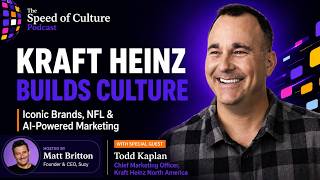
Todd Kaplan, CMO of PepsiCo, spent 16 years rotating through roles at the company, from Mountain Dew to sports marketing. He explains how marketing shifted from TV-focused campaigns to digital-first, creator-driven content, and walks through launching Pepsi Zero Sugar with a Super Bowl sampling push. On AI, he sees value in optimization and brainstorming but warns against replacing agencies.
Chapters
Up today, we're going to be speaking with Todd Kaplan, Chief Marketing Officer of Pepsi. Todd was recently named one of Business Insider's top 25 most innovative CMOs in the world. Todd, great to see you. How you doing today?
Doing alright. Good to see you too.
I was just commiserating about the Super Bowl, and by the time this podcast is out, the Super Bowl will probably be old news, but it's good to see I'm on with a fellow sports fan. Would love to hear from you, Todd, about your career journey. You know, you now sit as the CMO of Pepsi. It's one of the most prominent seats in marketing. I know you've spent quite a long period of your career at Pepsi. Can you tell us a little bit about that journey?
PepsiCo is just a great place to work, great company overall. And one of the great things is they really invest in their talent and rotating people across new critical experiences, as we call it, to try and grow and stretch and learn new things over the years. And so I've been here for about 16 years, which sounds crazy saying that out loud, but that's not— and that was not by design, to be clear, but it's one of those things you kind of blink and you're like, wow, you know, because you keep trying new things. I've changed my role every, you know, 2 to 3 years with new things, doing everything from running our, you know, things in our Mountain Dew business, starting our energy business, food service marketing, sports marketing. I mean, you name it at Mountain Dew, across the board. I led our water portfolio for a number of years, creating a couple brands, Bubbly Sparkling Water, LifeWater, and then for the last almost 5 years now, I've been running the Pepsi brand and it's been a blast and it's a really great place to work. So I'm very fortunate.
Yeah, and we live in a world, Todd, where so many people in the marketing world, it's almost like in the sports world, jumping around from team to team, from company to company every 2 to 3 years. And it's definitely more rare to see somebody have the tenure that you've had. What do you attribute that to and what do you think the benefits are today sitting in the CMO seat of having that sort of historical context?
I think it's more of a nod to the great way that PepsiCo does talent development, as they, you know, and especially for someone like me who needs to be intellectually stimulated and challenged. And, you know, it's— I feel like there's been such a big, broad company, right? I mean, we represent so many brands in so many different areas and, and functions even within the marketing function, from innovation to commercial marketing to brand communications, creative, everything in between. I really haven't I haven't felt bored at all. I've been very excited and stimulated, and so I think it's been great. And so I feel like I've changed jobs every handful of years just for something new and a new experience where they get you out of your comfort zone, which has been great. And like I said, I've been here, and what's been great is I've built a lot of great relationships over that time with people in the company and know the way kind of we work internally and all that, which has been great as well. So it's been a great place.
Awesome. And I saw the one common thread of your career at Pepsi is you've always been in marketing. Growing up, did you always think you wanted to be a marketer, and what kind of thing led you into that position?
It's a great question, and it's, you know, growing up, you know, I mean, like every kid, you're a baseball player, basketball player, something crazy, you know, like whatever, and then you get a sense of reality. And so, but no, I think I've always been interested in this idea of, I remember back in, I'm gonna date myself now, but back in the '80s, there was this movie, Secret of My Success, with Michael J. Fox. I don't know if you remember that movie. Of course, running around. All I remember is he's just running around in a suit carrying a briefcase, you know, going from the mailroom to the boardroom. Very classic kind of cheesy '80s movie or whatever. And I was like, oh, there's something interesting about business. And, you know, my, my parents weren't coming from business. My dad's a pediatrician, my mom's a teacher, so different professions. I said, I want to get into business. But as I started getting into it, I realized that as somebody with more of a creative disposition, musician and really enjoyed creative creativity, I discovered the field of marketing and just thought it was really interesting. And specifically sports marketing is where my background really started when I was in college, you know, started really getting more exposure to that. I interned at the U.S. Olympic Committee and Fox Sports Net Chicago when I was doing my undergrad at Northwestern and, and really got my feet wet and learned there's a lot of really fun areas to it and can kind of grew from there.
Absolutely. And you've been there now at PepsiCo for 16, 17 years. Obviously, the world of marketing has been through such tremendous change since then, which you've had a front row seat to witness. What are some of the things that stick out to you in terms of how the role of a marketer, especially at a CPG company, has changed?
It's so funny when you put it kind of bookend to bookend like that. And it's, uh, if I remember, like, when I first started, and again, I just sound so old saying all this stuff.
We came out at the same time, my friend, so it's all right. Good.
All right. But, uh, you know, when I first started, I remember, uh, you know, I was a young kid kind of starting this new integrated marketing role that I was between our media and our, our media team and our digital team, kind of helping everything from like brand, you know, product placement, brand integrations. That was like a new thought of how you would integrate into media and all that. And at the time, as this like young kid, I remember I was kind of the, uh the Web 2.0 whisperer internally, where it was like, you know, YouTube and Facebook and all the kind of stuff, like all that stuff was out there, but it was just, it was really tipping that much more. And I remember I did a whole education session for a whole leadership team at that point, really helping them understand how to use these platforms. Everyone set up a MySpace account, if you can believe that, you know, and we did all sorts of fun things like that. And that, and now fast forwarding to what's changed now, the Web 3.0 revolution is just getting underway, and I find myself in a similar boat, albeit with a little less hair and grayer hair and all that kind of stuff, but just trying to really educate people on what it is and where that's all going. And when you look at kind of the world that marketing, you know, when I was first starting, there was such a focus on the TV spot and the national campaign and the big, the big bet and all that. And there still is a lot of big prominence for that in the industry that we play in, given top-of-mind awareness and a lot of the big push to retailers and stuff we do for our marketing. But really, you know, our mix has shifted so much more to digital and so much more to kind of how not just what we tell to consumers, but how we interact with them and engage with them on a deeper level and build kind of that brand love on a two-way street is something that I think more and more we've done as we've gotten into more content creation, we've gotten into more, you know, two-way platform building and other things like that that have have really, uh, manifested over time.
Yeah, I mean, I'm glad you brought up content creation because back in the day, and as I mentioned, we both kind of came out into the marketing world around the same time, it was about advertising, meaning like, what's my unique selling proposition? Like, I have this sort of interruptive medium called television that I could just cram my message over and over again. But in the world of content, you're starting with the consumer and what their needs are, and then you kind of have to work your way backwards. So I know a big part of what Pepsi does is really focus on content marketing and understanding the consumer. How are you able to see, as CMO, to keep your finger on the pulse of your consumer as it changes so quickly?
Yeah, I mean, it's— well, there's so many tools now today, from social listening to more traditional insights tools and all that. And it really— everything we do at Pepsi starts with a cultural insight, a consumer insight, and then where those connect with your, your product and brand trunks is as well. And that's where all the great ideas come from. But back to just what you're saying about content is, um, you know, historically there's this point of view that marketing is this very linear kind of hunting and gathering exercise from the brand. Exactly. Brand X, I'm targeting consumer Y. I'm gonna like, I use this analogy of throwing my little darts. Once I find them, I'm gonna hit them with my message. I'm gonna hit you here with my message and here with my— and that just seems super old school and interruptive and just not how it's done, you know, and rather than chasing consumers with your message, rather, why don't you come up with a message that is relevant to your brand, that is relevant to certain areas of culture, that, and shine it out and have the consumers come to you. And that is a very different frame around how we've done things like some of the content creation, whether we've created TV shows and series, we've done full-length documentaries, we've done primetime, you know, game shows, reality shows. Things we've built like just real hardcore content from Pepsi all the way to just digital videos that again have high pass-along value and are just engaging content more than an ad, you know, whether it was the trailer we built for the halftime show a couple years ago called The Call that had all of Dr. Dre bringing all the halftime performers together all the way to music videos we've made to everything in between. It really comes to Why would a consumer want to engage with this content? And is it organically something that's interesting and relatable to them? And if not, you know, then it's just advertising and there's a role for advertising too, but that, that shouldn't be all of it. That should be just a part of your, your whole mix. Absolutely.
And one of the biggest roles for advertising is actually obviously during the Super Bowl. I know you recently had a big launch of Pepsi Zero Sugar that you've been working on. So I'd love to kind of zoom out and talk about What is a product launch like for Pepsi and what is your role in that product launch? How early are you involved? How are you taking— how are you giving direction from the product development, you know, stage all the way through? I'd love to hear about that.
Yeah, we do everything. We call it AOP. It's our annual operating plan where we come up with each year, you know, what is our big bets for the year for each brand and our whole portfolio and what are we trying to do? What's our strategic growth? You know, coming from over the 3 to 5 years and all that stuff. And so zero sugar obviously is one of the biggest, uh, subcategories that are growing in our space today and an area where we really need to double down. And, um, yeah, you know, I'd say a couple years ago— I mean, we've been focused on this for, for years.
I remember Pepsi Max years ago.
Yeah, Pepsi Max. We've launched it for— I mean, it's been out there for years trying to figure it out and get it right. And one of the things we noticed is we had to get our proposition right in in terms of the formula of the product itself. And so very early on, I, I sat with our team and our R&D team as well, and we looked at our product and we said, you know what, this product formula was actually made back from when it was Pepsi MAX, back years ago when they launched it. They launched it with a different caffeine level and a different sweetener blend and different— and I said, why don't we take another crack? You know, it's always a little risky when you want to reformulate a product. You want to make sure you're doing it for the right reasons and have the consumer at the forefront and it's an advantage. Our R&D team did an amazing job and developed an advantaged product that we know actually beats the competition on just about every metric, which is amazing. And so we said, let's, let's roll this out in a big way. And so we started rolling it out January this year and it's out in the marketplace now. And we launched it on the Super Bowl with this really compelling proposition, just trying to get people to try it. You know, I don't know if you saw our campaign or not. We partnered with Steve Steve Martin and Ben Stiller and had a very just different take of the fact that there's this back to this cultural insight around the Super Bowl of everybody is being sold to on steroids on the Super Bowl of like, who has the biggest celebrity, who's saying what? And there's this general insight around, there's a distrust of advertising. They're like, well, you just paid that person to say some stuff to me. Like, why should I believe that? And what's most important to us is if we want people to try our new formula or new product, Of course we can tell them as Pepsi how great it is, but they're gonna be like, well, you're Pepsi, you're saying that. And so we thought that was a fun way to kind of push off that leveraging the idea of what's acting and what's real, saying, you know what, everything you're looking at on air, you don't know what's real and what's acting. The only way to really know is to try it yourself. And so we're gonna give out 10 million free samples of this new product so you can try it for yourself as well. And so that, that was our whole campaign.
Yeah, I saw that was— I love the fact that you're focusing on sampling. That's where I got my start. I do believe getting the product in people's hands is ultimately the best way to get them to buy into it. So, but there's a lot in between, Todd, when you launch Pepsi Zero Sugar during the Super Bowl and when your R&D team first comes up with the, you know, the, the mix and the ingredients that I imagine you play a role in, in terms of like naming the product, the packaging, you know, the messaging. Like, so are you involved at every step along that product development lifecycle?
Yes. There's a, there's a whole lot. And this was one that was more of a, a relaunch or or, you know, of an existing product that, yeah, of course we got to figure out what's the call-out on pack? How do we work with our SRA, our science regulatory people, our legal team, our R&D? I mean, there's so many packagings.
Retail merchandising.
Our Walmart folks, getting everyone going along the way. You do that. Now, you know, going back to where you're saying, you know, when I was starting a new brand, like Bubbly Sparkling Water years ago on the water team, you know, that's everything from initial inception insights, naming, packaging, design, product formulation, R&D, legal, you know, all the economics of the cost of ingredient. I mean, you get, you go to all of that and then what's the marketing plan surrounding it. And so that's probably the most full soup to nuts kind of you can go to is creating a new brand and launching a new brand. In a place like PepsiCo, we obviously have lots of layers, lots of people, lots of stakeholders to involve in those things along the way.
Yeah. Because often a lot of people just celebrate the launch. But the reality is all the work that— and they look at, you know, your role as very sexy in terms of like, you know, you're at these big events, you're at the Super Bowl. But the real work I would imagine that you do on a day-to-day basis is the real grind of figuring out some of these things, right?
Yeah. A lot of people, a lot of misnomers of marketing is all we do is the big shiny brand communication, right? Media. And it's like we do that, but we also like, you know, we have to create the innovation, we create the calendar, we build the strategy. We partner with our consumer insights team. We pull them through to the commercial side of our business, working with Walmart, 7-Eleven, Taco Bell, and food service. Like, you know, all the different layers that come into how are you going to grow a business over time. And that's what we're really trying to do. And the great thing on a brand like Pepsi is I remember about 5 years ago when I came in here, you know, this business was in a bit of a decline for over a decade. And we've now, you know, had about 15 consecutive quarters of straight growth since that time, positive sales growth. Our equity is up, our business is up. We're feeling great.
So— and you attribute that, I guess, change in fortunes to innovation and pushing out different products, understanding your consumer better.
Yeah, there's a whole host of things that go into it. I'd say it really started when we repositioned the brand and really started the master brand, the master brand of what Pepsi stand for and what do we exist, how do we want to show up in the marketplace, you know, in a bit of a different vibe and energy. But then in addition to that, having very choiceful and thoughtful plans around when we're focusing on our core, when we're bringing in new innovation, whether it's around zero sugar, whether it's new products like Nitro Pepsi, uh, that bring in incremental users, flavors, things like that over time. And just having the right programming, um, throughout to keep the brand top of mind, the category growing, uh, as well as the role that we play within.
Absolutely. And we're here in 2023, obviously uncertain macroeconomic environment, not the heyday that we saw as recently as 2 years ago. Has that changed your role as a CMO and how is it impacting the way that Pepsi is going to market this year?
Yeah, I mean, you always got to be looking at the macro environment on these things to see how to best relate to consumers. And, you know, again, I think today back to you talked about the what are one of the biggest changes over that, you know, your span of my career or whatever with PepsiCo, I'd say is the You need to make sure just the different macro environment context matters more now than ever. Right. Right. If before it used to be I could reach everyone through a TV or a radio or an out-of-home billboard, now it's in your pocket. It's your frickin' phone. It's wherever you are. It's how you're looking at stuff. You can go two ways with it. Right. And so context is critically important for every message to land. And the context of the macro environment, whether there's political strife, whether there's global warming, whether there's an economic, you know, you know, crisis happening. All those things are relevant at different levels to different people, uh, for certain things. So obviously the macroeconomic environment, you know, with— as we think about pricing, as we think about the role people— what they decide to buy and their shopping cart and all that, it all definitely factors in.
Absolutely. The context matters so much. And a lot— I see a lot of marketers still marketing now like we're in the year 2021, and it's a different world. You have to continually evolve. So you strike me as someone who, you know, through following you in through the trades and social media, etc., you really understand where marketing is headed and you've never been afraid to kind of grab on to the new things in ways that really are relevant and drive business. There are a bunch of trends that I've been tracking that I know are probably top of mind on your list. I'm just going to run through a bunch of them with you and see what your thoughts are in terms of where you think things are going. First and foremost is retail media. So obviously you have these big box retailers really pushing these sort of retail media channels to varying degrees of success with, you know, with, with their partners. What is your take on retail media and how important is that as part of your overall media planning?
Yeah, obviously it's, we call it the moment of choice, which is when the consumer's in the store and looking at kind of the product and where and how they're going to engage. And obviously there's a lot you can do in those final minutes or the decision process, at least for our line of business. You know, just to, for context for a lot of the listeners out there, we don't have the same degree of, uh, I'd say lower funnel, you know, possibilities as a lot of direct-to-consumer brands do where you can drive conversion through click here and that, you know, if they click on this ad, that's going to be 12 times more likely to buy X and Y on the website. Here, our hope is we get you into the store and then when you get into the store, that we have the right bucket in your brain to get it, we have the right point of sale, the right display activity, pricing, all those things. And so those in-store moments are really important for us, and so that's what this in-store media network says. The stores and our customers have more, um, you know, media that they can, uh, engage with. Obviously it's important for us to participate in and, uh, and see how we can drive that final conversion at that moment of choice.
Have you generally found those channels to be effective? To the extent that you can measure them?
Yeah, within differing— I mean, again, it all depends on the specific execution, the time. Like, are you promoting it when your product is out on display and what's the creative? And it's a full, fully integrated thing that we need to probably talk through a little bit more. But yeah, it's definitely something that customer to customer probably varies.
That's very helpful. Let's talk about TV. So I was at CES this year and I met with Samsung, Roku, Comcast. You know, Google, all these big players that are really reshaping the television industry. And Pepsi's been a brand that, to your point, although doesn't solely focus on TV, it's been a big part of its heritage and history. Yeah. As TV becomes more addressable and connected, and with the growth of streaming, how does that impact the way that you're looking at TV as a channel and, and some creative executions you might be focused on given this rise of CTV?
Yeah, like TV, I mean, TV is mass Right? Every, every home has a— the TV is the centerpiece of your living room. So it's still like culturally our lives revolve around it. You set up your couch so it faces—
yeah, the form factor of TV is not going anywhere, right?
Form factor, it's, it's the screen to get the stuff. Now what you do once you turn it on is a little different. So rather than maybe scroll through your guide or whatever, you go on demand, you watch Netflix. And what I would say is right now, um, I still don't think the consumer experience is that great when you look at the connected TV, because right now, I mean, we all— I went through it this weekend. We want to watch a movie as a family.
You have no idea where it is, right?
Google, I gotta look, I gotta check 50 things. It's like, there's got to be a better way until that universal remote kind of comes to bring it all together, you know, or that whatever that right solution is. And again, and it's going to all happen, and consolidation will happen over time as it is. But what's great about it is there's, um, obviously so many different content that is out there today that we can, uh, we can watch and engage with. So there's something out there literally for everyone, but there's also the con of that is there's something out there for everyone is there's so much out there. It's like very easy to get lost, to just throw some stuff against the wind and all that. And so I think, you know, I go back to the idea of, um, there's two ways you can approach it. Uh, there's the advertising kind of way, which is yes, in some platforms like Hulu and Netflix is testing ads and Yeah, you can throw an ad in a pre-roll and it's accepted in here and there. I'm not loving— while there's good reach, I don't love the idea of interrupting someone from what they want, right?
With something kind of going backwards in a lot of—
a little bit going backwards. And it's kind of not the right engagement that you would think. But then on the flip side, the content itself, you know, like I said, we've created documentaries on Showtime. We've done things where if you can become the content and people are interested in watching it and things like that will be helpful as well. But I think it's an area we're going to keep a keep an eye on. You see the whole connected TV thing with, um, you saw the Tubi spot over, uh, yeah, that was awesome. Such a great execution that they did and really clever. So, and there's going to be a lot to come there, and we'll see how the tools and as marketers how that all condenses. But I think it's going to be less TV-specific and more content-specific because it's less about the fact that you're watching it through the box in your living room and more about what you're watching.
Yeah. Yeah. And speaking of content and sort of like the longer tail. I know that PepsiCo's done a lot of work in the influencer and creator space. How do you see that evolving in importance in 2023 for your brands?
Well, that's the other thing too, is I think as you look at this, and so as you look at the connected TV, you know, here's an interesting thing is I have two young kids, two boys, and all they watch is these gamers on YouTube. Yeah. It's like, you know, and it's, you know, no matter what's, what game is on, no matter what movie we can watch. Like I said, you have access to more content at your fingertips on demand than you ever have before, yet a lot of this is coming, these kind of bite-sized pieces of YouTube and these creators. And I think, um, the creator economy is real where I think, um, you know, the more you can connect in the most authentic ways with some of these people, the more you can figure out what's right for your brand and how to do so. I think it's, um, where a lot of the stuff is going. Now, have big brands caught up with how to do that? Have the creators understood how to do it authentically? Absolutely not. Because it's, uh, you still see these very forced integrations where it's hard if I'm a creator and someone's offering me millions of dollars to insert their brand, it's hard to say no from an authenticity standpoint because it's real money and they gotta pay their rent and do stuff. And then on the other side, as a brand, you don't want to completely, you know, give the guardrails and say, hey, do what you will, say what you will, be authentic. A lot of brands get very heavy-handed and say, "Must say it this way," and then it doesn't feel right. And so the balance in that is finding the right partners, the right creators, having the right authenticity, giving them the full degrees of control since they know their audience in the right ways to do it in their way, and then partnering, you know, being more choiceful with who and how you partner.
Yeah, and being able to execute at scale, right? Because, you know, you guys are a global brand that you need to be able to execute everywhere. So how do you do that in a very scalable way that, you know, is driving business results?
It's real tricky. It's real tricky. So I think there again, that's another area that I'd say to watch that's going to evolve over time as tools and how to engage comes a little bit easier.
And the last piece that is obviously something that every marketer is talking about right now is the role of these AI tools. You know, and here in 2023, it's just incredible how much momentum they've gotten, at least in the trades, at least from buzzwords. Do you see applicability with those tools to your business in the near term, or do you think it's something a little bit further out?
Yes. Yes and no. I think there's a good role for AI as you look at a lot of that lower funnel stuff, optimizing digital units. And we already do a lot of that stuff where it's like, hey, you throw up a couple of units, which one does better? Like that stuff all day, every day. Easy, right? Get into the creative element of it, of saying, hey, you know, just for fun, as ChatGPT has come out and all that stuff, you know, could say, you know, I'm sure you've played around with it just like most people have. And you can, I mean, You could say, hey, write me a Super Bowl ad for Pepsi, and it actually does. Or you could say, hey, tell me how to— what should I do, you know, next month? Like, it's really an amazingly phenomenal tool and scarily smart how it works and how a lot of that stuff happens. That being said, I don't think there's any need for replacing the role of agencies or the role that people will play moving forward with it. I do think there are probably some helpful shortcut kind of moments as in, as far as a creative process, right? So if I'm trying to brainstorm, like, hey, what do I want to name? What are some fun names for this product? What are some scenarios I could, like, you could potentially use tools and things like that to help inform? Yeah, I'd say where it is right now, it's definitely a space to watch, but, um, I think it's getting a lot of press and a lot of discussion right now because it's so, you know, game-changing in how smart the technology is. But I don't, I don't think right now today day, it's going to replace anything in the process.
Yeah, I agree. I mean, it is reminiscent a lot of like, you know, blockchain entering 2021 where everyone was talking about it. And then, you know, it kind of— there was a boom and then the price of crypto dropped and then everyone sort of went away except for the people who are doing the real work. And I think one day, 2 or 3 years from now, brands are going to have these applications which make sense for the consumer. And everyone's like, why didn't I do that all along? And I think That's generally what happens is the media stops paying attention as soon as the real work begins.
It's, it's the same thing. Like right now it's a bit of a, of a novel. It's like when, uh, when Alexa and all that starts. Exactly. And it's like, it's like a bit of a novelty. Like, look, it hears my voice and like people put 'em in their house and their kids just ask it to play stupid songs all day. Right. Like it's, you know, the amount of people who connect it to every single element. There are people of course who are the early adopters who make it turn on their lights and their car. I get all that, but at the end of the day, just because the technology is there, I think, is the big headline. But then when it adopts to the masses, I think that's still going to be a handful of years away before we really embrace the true benefit of a lot of these things like the blockchain.
I agree 100%. I heard a Steve Jobs, you know, clip the other day where he's talking about, we don't want to take great technology and figure out how to get consumers to use it. We want to understand what consumers' needs are and figure out if we have the technology to deliver on it. That's right. I think a lot of companies are trying to, at least in the last couple of years, take some of these innovative new technologies and cram it down consumers' general behaviors. And that's just not how it works. They're not going to change behaviors like that.
Correct. Correct. I don't think you can chase these things with the, uh, what I call shiny penny syndrome.
So, absolutely. So as we wrap up here, Todd, uh, just, you know, let's zoom out to you and your role. You're obviously, um, have an incredible role and one that many people in the marketing and advertising industry and undoubtedly just fascinated with in terms of what does your day-to-day look like? So what is the pie chart of a day of Todd Kaplan? Is it the same every day? Does it change? Tell us a little bit about, about that.
Every day is different. I spend a lot of time with my team talking through, you know, our plans. And a lot depends on the time of year you're talking about. Also, we have like the AOP planning for their annual plan when we're ramping up for next year's plans. There's sometimes when we're just launching. Like Super Bowl, we've been neck deep doing all this stuff for Super Bowl, and right now our summer programming that we're working on and stuff from the fall. We have some really, really big stuff planned for the back half of the year. And so, but like I said, it just really depends on, on the day that there are sometimes we do everything from a product tasting all the way to, uh, you know, a brief or we're reviewing creative to, you know, we're going through our scorecard and our performance operating view and just looking at how the business is doing and what's working, what's not. And so it's really a full, full boat of the full marketing experience that we get to do here, which is great.
Gotcha. Awesome. And if you were to give one piece of advice to somebody to end up in your seat one day, in the CMO seat, what would that be? What path did you take, do you think, was most helpful?
I don't think there's a specific path or anything. And like I said, I don't think I've been on even any path. I think it's more of a matter of just, and I've said this to people giving career advice as well, it's that you make the role, the role doesn't make you. I like that concept, and it's one of those things that a lot of people look at a job description on paper when they're starting a new thing, and by concept, whenever you start a new role, there's usually a boss and there's maybe a predecessor who did the role before you a certain way. And so when you get in there, there's already a bit level of bias as to like The boss sees the role as X and Y, and you need to look at it this way, and here's your core objectives, which you have to, of course, listen to. They're your boss, and you need to deliver those objectives. The person before you may have done great, or may have done okay with it. It depends on, you know, what the context is in leaving, and said, hey, this is what they thought was important, or this is where they were focused on, keep doing this, don't do that. But you're gonna lose sight of some of those horizontal, kind of beyond the kind of tunnel vision of that focus of the role. Like, of course, once you get that focus kind of really going, you might be able to see other opportunities, right? You know, where you can take initiative and actually make it work. So I've always found, even when I was very junior, starting from my very first role in that branded entertainment, branded content thing I told you, that digital immersion I led, that was not something that was asked of me. That was something I provocatively did there. Each role, as you take it, you you can kind of create opportunity and say, hey.
That's fantastic advice.
I'm sitting in this little seat right here, and I get that they've defined it as this, but if I can see where the organization needs something that could relate to this, maybe I can add on this area or bring in this area to really, you know, proactively drive some new thinking and bring some new enterprising.
Right, 'cause when you're getting reviewed, no one's gonna go back to the initial job description and say, yep, you did that, you did that, you did that, great, we're gonna promote you. That's not generally how it works in this competitive environment.
Right, well, and it does mean you do need to still deliver your core account. Check the box, sure. Not trying to ignore what your boss needs or anything, that's not the context either, right? You have to do what you need to do, but once you can kind of get that going and figure out kind of how to do your day job, how do you kind of figure out, are there other areas that as I look at the broader organization and the role that I sit, that this role can help better serve the organization and maybe I can help my boss see things that they're not seeing or help my peers in another group see what they're— So that's part of it is just whatever role you're in. You know, I've been in roles that people say, "Oh, I wouldn't want that role," or, "Oh, why do you wanna go work over there?" And then you see the opportunity and you build it into something cooler than when you started. So that's the opportunity to say every role I've been in, I've taken that perspective and so far seems to be going okay.
Awesome. And finally, Todd, with that, is there one quote or mantra that you like to live by that sort of drives it? You've mentioned a couple throughout this, but does something come to mind?
Oh my goodness, there's so many. I wouldn't say there's one, One thing I've said quite a bit with my team internally is I say take no as a request for more information. Right. Because a lot of times we hear a lot of nos from our internal stakeholders and trying to push things around and trying to kind of be agile and flex with it. The other one I'd say is probably this idea of, there's another just more career advice I would say, and it gets back to this concept of going big or going home kind of thing of, you know, I say write your resume in reverse. And by that I mean is when you start a new role, say, hey, here's the 3 or 4 things I want to make sure we did in this role. I grew the brand from X to Y. I launched this thing. I did this whatever. And then put that up, you know, on your, your wall, on your screen, on whatever. And just make sure you spend like 70-something percent of your time on those things and focus on the big things rather than all the little things. And that's where the real impact can be felt. You know, when you go back and you talk to someone like me or other people, you talked about their career stories, they'll tell you every freaking meeting they had and every, you know, thing they've done. They tell you the big things. Hey, I did this, I launched this, I did that. So try when you're starting a new role to think about what are those things 3+ years from now you want to say you did in this role. And damn, focus your time.
Yeah, they talk about the— they talk about like things that are important or urgent, and I think a lot of times people jump towards what's urgent, which is sort of like the fire of the day, right? But the things that are important would be the thing on that.
Totally. It's a time management thing. And listen, I get sucked into the urgent thing just like anybody else does, and internal stuff. And, but you get, you gotta just try to gut check yourself and every so often to say, hey, are these the things I really want to do here? Is this what I'm, am I doing? Am I a victim of someone else's calendar? Am I doing what I want to really achieve out of this job?
Awesome. Well, thanks so much. We're going to leave it with that, Todd. On behalf of Suzy and the IWe team, thanks again to Todd Kaplan, CMO of Pepsi, for joining us. It was an amazing interview. I can't wait for our audience to hear it. Be sure to subscribe, rate, and review the Speed of Culture podcast on your favorite podcast platform. Until next time, we'll see you soon, everyone. Take care.
Bye-bye.
More from Matt




MikMak’s Rachel Tipograph on Consumer Spending, Retail Media & Holiday Shopping Trends



Jaguar Land Rover’s Charlotte Blank on Luxury, Purpose & Experiential Storytelling



