Lagunitas’ Hannah Dray on Beer, Gen Z & the Future of Social Drinking
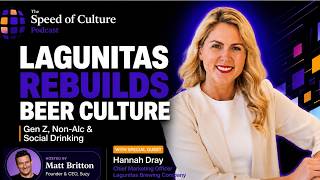
In this Speed of Culture podcast episode, host Matt Britton interviews Hannah Dray, Chief Marketing Officer of Lagunitas Brewing Company, about how the craft‑beer brand is reinventing itself within the Heineken portfolio. Dray explains the challenge of reviving Lagunitas’ challenger‑brand DNA—through iconic packaging, bold IPA branding, and the pin‑up “Little Something” mascot—while using low‑budget PR stunts like the “American Party Legend” search and “Wedding Crashers” to punch above their weight. She details the shift in consumer behavior, especially among Gen Z, toward less alcohol, health‑focused and functional drinks, and outlines Lagunitas’ product innovations: the first craft non‑alcoholic IPA (IPNA), the Hoppy Refresher (zero‑calorie, zero‑alcohol), a hazy IPNA, and a new hazy IPA launched on‑premise. Dray discusses broader health trends such as functional beverages, cannabis, and GLP‑1 medications, emphasizing the need to stay ahead of wellness‑driven demand. The conversation moves to channel strategy, contrasting on‑premise (bars, nightclubs) where optics and sessionability matter with off‑premise (retail) where price‑per‑unit and packaging design dominate, and how Lagunitas tailors product formats for each. They explore storytelling in a crowded digital landscape, the limits and efficiencies of AI, and the importance of authenticity—showcasing employees and real consumers rather than AI‑generated content. Influencer and music partnerships (local California creators, national acts, NPR Tiny Desk, the Ampitheater series) are highlighted as extensions of the brand’s bold, disruptive personality. Finally, Dray reflects on the evolving CMO role—balancing strategic work, team building, cross‑functional alignment, and rapid pivots across categories like cannabis and non‑alcoholic drinks—while sharing personal career lessons about embracing discomfort, taking unconventional opportunities, and believing in oneself.
Chapters
Up today on the Speed of Culture podcast, we're thrilled to be joined by Hannah Dray, Chief Marketing Officer at Lagunitas Brewing Company. With a career that spans Heineken to Lagunitas, Hannah has led brands through some of the most significant shifts in consumer culture. From embracing nostalgia-driven branding to leading the charge in non-alcoholic and functional beverages, she's steering Lagunitas through a rapidly evolving market. Thanks so much for joining, Hannah.
Thank you so much for having me. It's awesome to be on your podcast for the very first time.
Absolutely. So we just had a funny kind of banter before we started recording because I didn't actually know how to pronounce the brand. I thought it was Lagunitas and it's Lagunitas. And I imagine when you are rolling out a brand that doesn't have the unaided awareness of a Heineken or a Budweiser, that in itself presents some branding challenges. So Talk to me about the brand itself. I know it's part of Heineken, if I'm not mistaken. So, you know, how do you, you know, build the challenger brand within a large incumbent and even start to build enough awareness so people know how to pronounce the name?
Yeah, certainly not an easy task to do at all. I think first and foremost, so Lagunitas is a craft beer brand. It was established here in Petaluma, in 1993. So we've actually been around for over 30 years now. And to your point that you just mentioned, one of the biggest challenges over the last 2 years since I've been coming in on the brand is really around how do we re-establish this brand. Actually, during the time that it was first starting out, because of its challenger approach, because of its kind of irreverent personality and going against the grain of what the norm of the beer industry was, it was able to shout above its weight and to really drive its awareness through a lot of kind of the differing behavior that it had. One of the things that we've been super focused on in the last year, year and a half or so is looking backwards and really thinking about, okay, what worked for us back then and how do we bring that back? So one of my biggest challenges as I look towards the future years is how do I get this brand back to growth? And we've really dug deep into what were those iconic elements that people loved about this brand and how do we bring that back. So really specifically, the bold IPA branding, when you see that in store, people instantly associate it with the Laganitas brand. In the last year, we've brought that back onto our packaging and really executed across every single touchpoint and, and seeing consumers really gravitate towards it. And likewise with our Little Something brand, for example, with the iconic iconic pinup lady. She has been slightly adapted, but we brought her back this year onto the packaging. Standout naming and font that's really driven an increased rate of sale, which has been awesome. I think the other aspect that we have to lean into as challenger brands is we have to think differently. So especially here in the US, a big, big media market where huge budgets are required to really— oh, previously have been required to really play in the game. I think here what we've started to lean into is actually how do we use PR opportunities and amplification stunts to really punch above our weight. Just recently, actually, we took some consumer insights which showcased that Americans are really not partying anymore. In fact, only 4% of Americans are actually socializing on the weekend, which is horrifying. And we took the opportunity to create a nationwide search for America's first party legend and dubbed it kind of the American Party Crisis. But for us, it was about, okay, how do you bring an unconventional spin to that? How do you make it different? Because that's quite a generic insight that a lot of brands could lean into. So for us, it was, if you are the party legend, we're gonna crown you with a gold statue. That you get one for yourself and that we'd put in the, in the brewery as well. We'd give you $5,000 to be able to continue your partying. And it was all about how do you create social connection? And they would get to come and have a beer named after them as well. So it's really about how do we offer unique opportunities for consumers to connect with our brand so that we create more noise than potentially just spending on digital or on social media might do for us. Yeah.
And as much as obviously you want to lean into the heritage of the brand and the packaging and the story, as you kind of alluded to, the consumers change, right? It's no secret that Gen Z just doesn't doesn't pursue alcohol, whether they're partying or not, the way that they used to. And so there's tremendous shift in tastes and preferences, especially coming out of COVID How are you as a CMO of a company that sells beer responding to that?
Yeah, I think that's a really interesting question. I think consumers definitely have changed. What's been fascinating for us and really important over the past year as we've looked at the changes in the category is actually making sure it becomes an and and not an or. So actually what we've seen is that foundational brands, the major brands, whether it like, like our IPA or like our little something something, deliver the foundational volume for our business. However, yes, it is with those changing consumer behaviors that we see the need for innovation, and continual innovation is where we there drive growth. Um, for us, we were the first craft beer to introduce a non-alc product, so our IPNA, And then kind of 5 years ago introduced the first hot water, so Hoppy Refresher. That continues to be the market leader within that category, has the highest rate of sale and the highest distribution. And just this year we introduced a hazy IPNA as well. So recognizing that even consumers' taste profiles, so they're not drinking as much, but also their taste profiles are shifting. They're looking for something that is slightly more accessible, slightly fruitier versus potentially that hoppy bitterness that we will have delivered in, or that we do deliver within the IPNA product. So we, we're making sure that we are offering them choice. And likewise with that Hoppy Refresher, I think what we've seen in the alcohol category is that non-alc beer is really thriving and that's where you are seeing a tonne of growth. But ultimately consumers are looking for choice. And so for us, the Hoppy Refresher, which is zero calories, zero carbs, and zero alcohol offers consumers an alternative taste profile, something different that they're still able to be part of those social occasions, um, and, and deliver them.
Curiously, I mean, you talk about like only 4% of Americans went out to party, and now we're saying they're drinking less alcohol. Like, and obviously there's so many other stats are just about how people are pushing off marriage and this and that. And it seems that just like social media and the iPhone, and now probably AI as well, is just making people— maybe they feel so much more connected, but they're so much more insular. I mean, what do you think the implications of this are more broadly just for like Gen Z as they age up? Because a lot of people thought— think Gen Z still is like a young consumer, but this year for the first time ever, the average age of a first-time mom in the US is Gen Z. Yep. So now this completely new framework is entering the household and household decision purchasing as well. Like, what are some of the longer-term trends that you have your eye on with this demographic in ways that will continue to impact your brand?
Yeah. So for me, health and wellness and like functional best benefits are 100% where we need to be playing and where we need to focus our time. I think, you know, just earlier this year you saw PepsiCo buy the Poppi brand for $2 billion. That for me is just the start of where we see this trend moving. I think more and more you're seeing consumers and not even just Gen Z, right? If you look at what's happening in the Midwest with like Delta 9, for example, that is an older millennial female consumer that is now able to shop and find buzz without the booze.
Or look at GLP-1s, Hannah, and what that's doing to impact people's tastes.
Yeah. And so I think for us, you mentioned this earlier, but moving with that trend is exceptionally important. If we choose not to move with that trend, we will get left behind. And I think for us, Laganitas is a brand where innovation is in the heart of our DNA. And in fact, you know, pioneering brewing, let's call it, has always been what we are about. And we're able to create incredible liquids. We're very fortunate to have 3 very talented innovation brewers here locally. And so for me, that is gonna be super important as we look forward. How do we continue to expand without losing the DNA of the brand as well? So how do we maintain that relevance of being alcohol adjacent, um, but offering consumers more variety, um, and allowing them to, as I say, still socialize, um, but in the way that they now wanna socialize and being part of that occasion with them.
And with the changing consumer and some of the behaviors that we've discussed, is there a shift in terms of on-premise versus off-premise consumption? And does that change the way that you, obviously if someone's buying a beer at a bar or a nightclub, it's going to be packaged and merchandised differently than if they're getting it at Walmart. Yeah. Does that shift make you impact your product mix and your packaging and even the way that you storytell?
Yeah. So I think launching products and being channel-specific has been at the heart of kind of how we've been transitioning this business. I think very much so. You see a heavier shift in terms of scale with the off-premise, particularly I think now with financial pressures starting to come in, consumers are able to get more bang for their buck. Um, when it is in the off-premise, it's all about how does this look and what does this say about me. Um, and that's where, you know, the Laganese brand personality has been super important to bring back to the forefront of our new packaging and our new visual identity. Um, we're fortunate and, and very objective about the fact that we have a product for everybody, no matter which occasion or which personality you're wanting to be. And so each and every single one of our products, um, aims to really showcase our consumers different personalities no matter where they find themselves. And I think, you know, where we've started to lean is we've got 3 very clear buckets within our portfolio. One that is very much around our core, it's very much for our, like our main consumers who've been with us all these years. We've then got products where we see higher alk and flavour really come into the forefront. I think if you think about those consumers that are shopping within convenience stores, They're looking for smaller-scale pack formats. They're looking for bang for their buck. So you get that higher ABV, higher octane taste profile, very hoppy, really leading the way. And then you've got this non-alc space. In contrast, what I would say is in the on-premise, and we fundamentally believe that the on-premise is super important to our category. We particularly believe, as I mentioned about social connection here about Laganitas, it's about getting together, with good friends, a good beer, and of course your dog. So for us, it's like, how can we move with the trend? People are looking for more sessionable products. They're looking for slightly easier drinking. And so this year we launched our Hazy IPA brand, which is a 5.5%, juicier, slightly citrusy driven, coming from kind of the Nelson and Crush hops in the on-premise. And we have seen phenomenal performance of that. So for us, this was something that we deliberately chose to launch in the on-premise first. We knew that we're a brand that we're the number one craft beer brand within the on-premise. It's our heartland, it's where we kind of established ourselves. And so we really wanted to, again, look back at what had worked for us. How do we re-establish those consumer connections within real time and real moments and use that brand to start there? And we will look to transition that into the off-premise nationally in the right way. But first and foremost, it was all about how do we, how do we bring that to life in the on-premise where consumers are likely to be wanting more than one or two beers, but still want something that is, is, is easier drinking.
Yeah, it's interesting. And it's an insight that I guess seems obvious when you think about it. I just haven't had the chance to think about it like you have, because this is what you do all day. Um, but just the notion that when you're buying a beer at a bar or a nightclub, the optics matter. Right? And if you're buying a beer at a, a store, beer liquor store or big box retailer, the optics of the packaging matter, but then the product almost has to, you know, it has to deliver because when you're home and you're consuming it, there are no optics. You're just with your family and it, it has to taste. And I know taste matters and you know, the, the product has to perform regardless, but the consumer journey's different and the way that you think about what products might thrive in an on-premise versus off-premise environment is such an interesting nuance to your role and something I really hadn't thought of.
Yeah, and even to build on that, if you think about in the on-premise, the simplicity, um, I think one of the benefits we have been synonymous with the IPA category and having established the IPA category is the bar call when anyone goes into, into a bar is, I'll have the, the IPA, or I'll have the hazy. So for us, when we were creating that brand, it was a no-brainer, and we have never expanded off of our flagship because it is the crown jewel. But for us, it was a no-brainer to make sure that this Barcall was simple and very clear to consumers what they were getting. As you say, where we're on the shop shelf, we've potentially got a little bit more time with that shopper to have a bit more fun and be a bit more playful with the naming conventions. Yeah.
So obviously as a, as a marketer, you have to get the brand and the product and the overall strategic pillars, right? But then you obviously have to reach people in an increasingly crowded world and landscape. And you did mention the concept of storytelling, which is obviously of paramount importance, right? And that every marketer, how do you approach storytelling? How do you approach the ever-evolving world of social media and people consuming on their mobile devices and everything that AI is bringing to the market in terms of hyper-personalization, this new realm of expectations that we're undoubtedly going to be seeing from consumers?
Yeah, great question. I think it's definitely challenging for us. I think it's been super important to put the consumer at the heart of it. We really like to lean on what are consumers talking about, what are they saying to us, and how can we bring that into what we choose to execute, for example, and alongside kind of the Party Legends campaign that I was just talking to you about. We have seen numerous consumers really ask us, can you bring back brown sugar? Can you bring back brown sugar? Bring back Sugar's original recipe. And so later this year, to consumers' delight and those fan favorites, they will be getting Sugar coming to life in October through to the end of the year as a seasonal. But for us, it's all about how do we make sure that our real consumers are put at the heart of what we're doing. I think AI is super interesting, especially from a broader business perspective. I think there is a ton of opportunity from an efficiency, from a kind of supporting with especially some of the more administrative aspects of our roles. I will say though, for Lagonitis as a brand that again, really heroes those real connections and has authenticity at the heart of it, really encouraging consumers to be themselves, I think it is going to be exceptionally challenging for us to be able to leverage it from a creativity and storytelling perspective.
Even companies that want to do it are finding it challenging right now. Yeah, exactly. The way it differentiates.
Yeah. And you know, for us, there's some super simple things like if you look on our social media platforms, more often than not, the majority of the people being showcased are my marketing department or our employees here. It's about showcasing the real heart of the business. Likewise, we really connect with consumers. We've just had, at the back end of last year, we executed a social stunt called Wedding Crashers, where consumers have all been sending us their invites. I'm sure they send many big businesses invites to their weddings, really looking for free items. But Laganitis being an irreverent brand and being a brand that does things in the unconventional and different way, um, actually decided to show up unannounced to their wedding because we were in fact invited. Um, of course we took them personalized beers and we bought a great party and, and a ton of energy with our Laganators. Um, but again, putting those consumers at the heart of what we are doing and showcasing reality, um, versus looking for something that can be created through AI is, is always gonna be at the forefront of what we're doing.
And how big of a role do kind of creators and influencers play? I know that that may veer away from the authenticity of showing people in your office. But obviously, you know, they have scale and reach and influence that others don't. I was wondering where that fits into your overall mix.
Yeah, absolutely. It's something this year that we've really started to bring to the heart of the brand plans. And I think again, what's been super important, we've made it a very clear priority to look at who are those influencers that are already connecting with us. I think as brands, you have to be very careful to make sure that whoever you choose to partner with, they really share your values, they really bring to life what you represent as a brand. And so again, thinking about the fact that Lagonitis leans on unconventionality, it leans on being bold, it leans on being disruptive. For us, it isn't about necessarily just getting any influencer that can talk about our product. It's really about bringing the brand personality to life. And we've made a conscious effort as well to find the balance between local influences here in California, which is our heartland, but also making sure that we have influences that have that national relevance too. And I'd also mention, I'm not sure if you're aware, we have an Ampitheater series, which is kind of our music platform, and we have partnerships with the likes of NPR, Tiny Desk too. And those are key aspects where we have artists that come to our amphitheatre here in Petrópolis that also operate as influencers. Just a few weeks ago, we had Morgan Jay, the comedian who mixes comedy and music. Super unique. Yeah, he's, he was awesome. We just had him on board and he's done a load of content integrating Lagonitas, but also one of our local influencers into his content as well, which was super cool. So really looking at the different ways that we can lean into the different pillars of the brand as well. So not just unconventional, but the role of music to help with that. That scale.
Excellent. So I'd love to shift gears and talk about you and your role as, as we wrap up here, Hannah. Obviously, the role of the CMO has changed so dramatically over the last decade and arguably over the last year even. And we've talked about a lot of things today from your product roadmap to positioning and storytelling to retail and of course your channel strategy. How does a normal pie chart of your week play out? I mean, is it every week and every day completely different? And how do you know where to prioritize your time in the role of the CMO here in 2025?
Oof, yeah, definitely. There's definitely been a big transition there, I think. There is, especially at Laganitis, there is no one day that is consistent. I think that is one of the things that I love about this role, the dynamism, the variety that you get to work on. On one day, I can be talking about cannabis and THC products. On the next day, I can be talking about non-alc. So very different ends of the scale. Generally, I try to focus my time more specifically on either strategic work and of course building and developing the team within my department. But I think one of the other fundamental aspects is having that connection across the business. I fundamentally believe that marketing is really the heart of any business, and I think having that connection with your supply chain, with your sales team, with your finance team, to make sure we are all in lockstep is, is super important.
Absolutely. And, and, you know, just looking at your history and your career prior to joining Laguñés, you were part of the, their parent company, Heineken. Obviously the, you know, the powers that be at Heineken putting you in charge of this sort of emerging brand and, and, and portfolio of products was not a decision that was taken lightly. What, what are some of the attributes that you think you've built professionally over time that has put you in a position to, to the seat that you're in today and ultimately the seat that so many of our listeners want to get into, which is that of the CMO.
Yeah. So I think, you know, one of the big attributes of myself that has probably put me in a very good position to take on this role is really getting uncomfortable with doing things that make me extremely uncomfortable. And I think that's— I mean that in the best way. I think it really means stepping into the unknown. Doing things that other people haven't necessarily forged the path on just yet. I think if I look back to even the start of my career, I remember going for my first brand manager job, which was the brand manager of the Heineken sub. And I will tell you now, not a single other person applied for this role because it was a weird new product that needed a completely different marketing plan. It was all an e-commerce and online-focused strategy, essentially. That I, by the way, had no experience in. And for me it was like, well, this is new. I'm gonna learn a ton more and I'm super curious to see where this can take us. It's talking with completely different customers to what we'd be talking with on the kind of some of the other brands. And I think I've brought that spirit through everything that I've done and all the roles that I've taken. Just before coming to Lagonitis, I was working on the Dos Equis brand where I introduced the first tequila-based product. I mean, just working with the CRT, um, integrating a spirits-based product into a beer business, um, was all a huge learning curve.
Yeah, we're shift.
Um, and, and it's, and something we had not done as a business. But I think having that courage to be able to, um, step outside of your comfort zone, um, not, not be reckless, but, but think about, okay, um, how do I do this? And, and I think at times also, um, drinking a little bit of the, the Kool-Aid and, and believing that, okay, I don't have all the answers, but, um, I think we'll But nobody does, Hannah, right?
And especially in a time when things are changing as rapidly as they are with your category and the consumer, arguably the biggest risk is not taking one, right? And, and staying in place. And, you know, it seems like you're somebody who's willing to run into the fire when others aren't. And I think it's a good lesson for all the listeners is, you know, things are gonna change whether you like it or not, whether you think it's right or wrong. That's, that's sort of the, the, the way the world goes, especially the business world in 2025. And if you're willing to dive in and admit that you don't know everything, but you're willing to learn, it's going to put you in a really top position in whatever organization you're trying to have an influence at.
Yeah, absolutely. I think, um, I know you kind of, uh, spoken with a few different guests and a lot of them have always spoken about, um, kind of the, the path not being linear in terms of their mantras. Um, I think for me, definitely, uh, taking that leap and enjoying the ride, again, sometimes difficult to do when you're in the thick of it, um, and, and kind of not being able to see a way out, but really just taking on those opportunities. It's not always the plan that you've written, but I think you are always learning even when you're not winning. And so for me, throughout my career, I have often looked back and kind of felt, okay, that may have not been the easiest path, but I have learned a ton in doing so.
Yeah, and it always seems obvious in the rearview mirror, right? Of course. But it just never, you're never able to see that at the time, how it's likely to hold up. So we often ask our guests to wrap up the podcast if there's a saying or mantra that kind of encapsulates the professional journey to date. Just wanna know what comes to mind for you.
Yeah, so, um, as I just mentioned, I think, um, for me it's all about taking that leap and enjoying the journey. Um, I think I have not really left any opportunity, um, unturned, or I've never said no to an opportunity. Um, I don't believe that should contradict your values. Um, however, I, I never planned to live in California. I never stayed— planned to stay in the US for 8 years, and here we are. And, you know, um, my my career continues to go from strength to strength. And I think alongside that, Ted Lasso has obviously become famous for his yellow sign that has 'believe' on it. And I think especially as a female in the industry and as somebody young in the industry as well, believing— there are days you have to kind of just put on your big girl pants and go out there. And I think that is super important to anybody taking a risk and doing something that's uncomfortable. Is really about believing in yourself on those days that it may fall tough.
That's fantastic. I think it's fantastic advice, especially for women in business that want to kind of claw their way to the CMO role as you have. So congrats on your success and, you know, thank you not only for telling me how to pronounce your brand, but also on how to navigate, you know, an ever-changing consumer and industry. And I'll continue to root for you from afar. So thanks for joining today.
Thank you for having me.
Absolutely. On behalf of Suzy and Edward Keene, thanks again to Hannah Dray, Chief Marketing Officer at Lagunitas Brewing Company, for joining us today. Be sure subscribe, rate, and review the Speed of Culture podcast on your favorite podcast platform. Till next time, see you, everyone. Take care.
Hey!
More from Matt




MikMak’s Rachel Tipograph on Consumer Spending, Retail Media & Holiday Shopping Trends



Jaguar Land Rover’s Charlotte Blank on Luxury, Purpose & Experiential Storytelling



