LEGO’s Tom Donaldson on SmartPlay, AI & the Future of Play
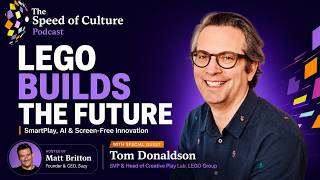
In a live Speed of Culture podcast recorded at CES 2026 in Las Vegas, host Matt Britton interviews Tom Donaldson, Senior Vice President and Head of Creative Play Lab at the LEGO Group. The conversation opens with the announcement of LEGO Smart Play, a new interactive 2x4 brick equipped with sensors, audio, lights, tags, and minifigure detection that can generate real‑time sounds and respond to movement, color, and configuration, turning static builds into responsive creatures or vehicles. Donaldson explains that Smart Play is not a pivot away from LEGO’s core brick‑building ethos but an added dimension that gives models agency, social interaction, and a sense of change over time, aligning with kids’ desire for creativity and social play. He describes a multi‑year R&D process involving weekly prototyping, extensive user testing in homes, and senior leadership demos to build conviction, emphasizing the need for both technological feasibility and business viability. The interview touches on the growing adult consumer segment, the role of AI in creativity—viewed as a collective human intelligence that augments rather than replaces human imagination—and the importance of fostering creativity in education, where memorization dominates. Donaldson shares his leadership philosophy, highlighting curiosity (especially beyond one’s domain), resilience, and values as hallmarks of future leaders, and recounts his own career path from a 1990s AI startup and consumer‑electronics R&D to LEGO. The discussion also covers the strategic partnership with Star Wars, which serves as a launchpad for Smart Play, and Donaldson’s excitement about emerging technologies like quantum physics and physical robotics as future opportunities for LEGO. He concludes with his mantra, “magic works in lo‑fi,” emphasizing early vision, lo‑fi prototyping, and perseverance as keys to innovation.
Chapters
We're here live in Las Vegas and Up Today. We are thrilled to welcome Tom Donaldson, the Senior Vice President and Head of Creative Play Lab at the LEGO Group. Tom is a global leader in innovation overseeing the company's product development and R&D efforts. He's led the charge on groundbreaking initiatives like LEGO Smart Play and is driving the future of LEGO play experiences. Tom, so great to see you today. Thanks for joining.
It's really great to be here. Thanks for taking the time. Absolutely.
You know, when you think about CES, LEGO traditionally has not been a brand that comes to mind. You know, they're analog physical toys that you, that kids play with, but the world is changing so fast. And I know LEGO made a big announcement here at CES. We'd love to start off by just hearing about it.
Yes, we're announcing something called LEGO Smart Play. And the reason we're announcing it at CES is it's bigger than just a product drop. We're announcing what we call a new dimension in LEGO System in Play. So we're bringing interactive physical play to the entire, you know, Lego brick world. It's a Lego brick that is really responsive to how kids play, but builds into existing Lego models, extends the building play that we know and love to be much more interactive and physically responsive for kids.
So what does that mean? Like, how does it work?
I mean, ultimately it's a 2x4 brick that has a ton of sensors in. It also has some audio and some lights, and it also, it comes with some tags and some minifigures that it kind of can detect and respond to. So you build models, you put the brick in, you also put these tags and minifigures around a model. And depending on how you move your models, depending what the models do between each other, what the colors are of the bricks around them, and also the tags and the minifigures that interacts with, it responds, you know, becoming a creature, you know, becoming a vehicle. It sounds— it makes sounds. Absolutely. And lights. And, you know, those sounds could be anything. They could be an elephant's trumpet noise. They could be an airplane engine noise. Uh, it's a synthesizer in there, so they're not just prerecorded sounds, it's actually generating new sounds in response to how kids are playing. Um, and the space of possibilities is absolutely huge.
So if you put one of these smart bricks in a car that you're building, it could have a horn honking.
It can have a horn. What we showed was, uh, yeah, some, some key click noises for the unlocking. We can have a siren, it can have, uh, an engine that the faster you move the car, the faster the engine revs. If you skid around the corner, it skids. I mean, that's a huge innovation. It's, it's huge.
It's, well, we bring it to life really.
That, that's the entire plan. The entire plan is to take all of the different Lego models, uh, uh, you know, and at least potentially let them come to life, uh, but come to life in a way that enhances kids' imaginative play, right? So not doing the stuff for the kids, but actually letting the kids, you know, play, get feedback, try stuff out, be surprised by the way it responds, um, and just really enjoy themselves, to be quite frank.
So what goes behind an idea like that at LEGO? Because obviously you have a brand that has a lot of nostalgia, huge heritage, right? Globally. And now you're making a little bit of a pivot, not a pivot, 'cause you're not going to a different business, but the way that kids, I imagine, look at LEGO and interact with them after this soon may become successful, will really never be the same. So like, what goes behind the decision to go in this direction? And then what's the R&D process look like?
Uh, well, to those two questions, that, that's quite, I mean, in, in terms of the decision, we really think of it as a new dimension. What we've really tried to say is we're not in any way doing less of the Lego, you know, bricks and Lego models and Lego play that, you know, today. But we are adding a dimension. We are adding this fact that your model changes, the fact that if you do something, it responds, uh, and the fact that it can be more social because the models can kind of work together. So we think of it as a, as a deeper layer that sits on the existing. LEGO models rather than a pivot into a kind of alternative way of things. I think ultimately, um, there's a few things behind that kind of decision. Uh, it is driven by the opportunity. We do spend a lot of time listening very carefully to kids and, and understanding the opportunity. And we know that kids wanna be more and more social all the time. Yeah. We know that kids love that, the sense that, you know, when you play with something and come back to it a day later, it's changed. There's something new to see. Um, and we love the fact that they really want some agency, that when they do something, it matters, uh, and something changes. And, and so we really saw saw that opportunity to, to layer that in. The way we think about, you know, the type of change is a little bit like the minifigure. If you have a LEGO minifigure, it, it doesn't make the bricks any different. It's a layer of additional play that you can bring, the role play, the characters that you can bring on top of the models. But it, it, it's not a— when we had minifigures, we weren't pivoting away from brick build. We were just adding a layer of play. And we see this about adding a new layer. So it's really driven by what we see as a, tremendous opportunity, particularly an opportunity in physical play and in making physical play kind of even more exciting in some kind of new ways.
And to give the company conviction to go in this direction, what does testing look like? And were there some things that you learned along the way in terms of the use cases that maybe you didn't expect?
I mean, this has been a very long program. We've been running for many, many years. And so conviction building has been in a number of different areas. Even some of the technology we've put in our really, you know, were they possible at all? But as you say, you know, exactly how do we know that this is exactly what kids want? So we've done a ton of testing all the way along from week by week, little moments, testing ideas with kids to putting, uh, our sets in kids' homes for 4 months at a time unsupervised and just seeing what the response was. Um, and conviction is built, you know, brick by brick, if I'm really honest, in the early days. Yeah. Right. Uh, in the early days, you know, it's, it's, it's senior leadership selling a dream. And, you know, I'm a big believer in demo and prototype to just kind of capture the magic. You have to be able to show that there's some little bit of magic there that if we could just pour a little bit of organizational fuel on it, it would grow. But ultimately, yeah, there's a lot of conviction building from the technology, from working with kids, and also from the business perspective, really understanding this might be great, but it also has to be a good business at the end of the day.
Absolutely. One data point that kind of surprised me is that one of the fastest growing consumer segments of LEGO is grownups. It's not kids. Why do you think that is? And what does that say about today's consumer that they would gravitate towards something like LEGO?
If I'm really honest, I think there's always been that opportunity, right? You know, I think we're just as a business, we're finding new opportunities and new spaces to grow into. I think probably there was quite a lot of latent desire for LEGO products, not just from those who have had them as kids and grown up. But that way of, you know, that way of relaxing, that way of enjoying yourself very physically, we feel has been out there for quite a while and we are just finding new ways to tap into new audiences with ultimately the same proposition that we've had for many years.
Yeah. So I talk a lot all around the world about, you know, AI's impact on the consumer and the workforce, et cetera. And obviously one element I believe that's gonna become increasingly important in the age of AI is creativity. And would just love to hear from you With all the changes we're seeing in the professional landscape.
Yeah.
With AI, what role does creativity play moving forward and, and how do you think it's gonna evolve a, as this technology continues to grow in its potency?
Yeah. And I think this is something that everybody needs to spend some time thinking about. From my, my side of things is, you know, the human is at the heart. I don't really see AI as really an intelligence. I see it as a sort of collective human consciousness in, in some sense, because we are just taking data from loads of humans and,, you know, providing access to it. Yeah. And I see it from that perspective. It's very powerful access. You could do some very cool things, but ultimately it's the human that has the values, that human that has the curiosity, the human that knows what they want at the end of the day as the output. Um, and yes, I think creativity is a, is a massive part of that because at the end of the day, things that are quite predictable go down in value as, as AI can do things, things that are not yet predictable, right? Because you are creative, because you've got a spark of imagination, aren't. Um, and so I do see the importance of creativity thriving with AI. I also see AI supporting creativity, and I think that's something that, that, that I would love to see a bit more of is, you know, rather than AI being seen as sort of replacement, how is it, uh, an intellectual superpower? Um, how is it something that really helps people be even more creative? Um, and we see that in the sort of manifestation loop. If you could make, if you could have an idea and actually make it, then your ideas get better quicker.
Right.
Um, and that's how, you know, I would love to begin to see, uh, AI being used more broadly. Yeah. As driving human creativity.
It's interesting because, you know, you have a lot of people that are in, you know, the ad agency world, for example, that pride themselves as artists that make great creative work, whether it's TV spots or billboards, what have you. And the reality is over time, I think AI is going to become increasingly adept at creative output. Meaning like if I say I want to have, you know, a video of a child pulling a red wagon down a street in London, I can create that. Yes. And I can continue to optimize it until I have the exact right shot I want. And the fidelity's only gonna grow of that. The, the notion of creating that scene, pick, you know, finding, going to do the site location and all that used to be a lot of what it took. Yeah. To be someone successful. Now I think, and it's more true every day, that's less important. But to your point, you still have to have the actual idea of I want to have the little boy pulling a wagon down the street, but that is a different side of creative cuz it's more about knowing the problem you want to solve versus knowing how to solve the problem, if that makes sense.
It, it makes a lot of sense. I still think, you know, to, to come up with great problems to solve, you, you as humans also need some idea of what it takes to solve it. So I think we will still see scientists who can, you know, look at a, an AI-generated proof and say, hang on. That's not quite right. In the same way, we'll see creatives who look at output and say, right, you're nearly there, but actually let's tweak this pixel and tweak that pixel. I don't personally think it just becomes sort of writing the brief, you know, creativity doesn't become writing the brief, it becomes attention to detail. But I think for me it's more like everybody becomes a creative director.
But can everybody become a creative director is the question.
Yes. I mean, I think that's an open question for anyone. My, my belief is yes. My belief is the more you give people access to tools and the learning for those tools, the more creative they become. I know that sometimes we think about, yes, there's a few brilliant creatives and everybody else, but I would like to think that creativity is something we can teach or at least help people learn for themselves.
Yeah.
And I think that's very true to the LEGO brand that, you know, it's about unleashing creative potential for sure. So, you know, certainly that's how I think about things, that it's about giving people the ability to be even more creative than they have before.
Yeah. What's interesting is like, if you look at education and how kids are taught to date, a lot of education has been around memorization and regurgitation, right? Like cram as much information and then participate in the test. Just prove that you memorized it. But that isn't creativity. So I think in order for people to become more creative, they have to, it starts at early ages. And obviously LEGO is, and we could talk about Does Lego, should Lego have a bigger role in schools? But I think the reality is that needs to change because I think the way that kids are taught isn't really congruent with where the world is headed.
I, I think it's a great hypothesis. It's not an area of my expertise. Sure. Um, I mean, broadly speaking, I think that again, the human element in how you grow and how you inspire kids and how you give them curiosity, I think there's still an incredible role for great teachers. But I also know that, you know, from, from my own family that sometimes producing lesson plans that, and some of these sorts of things is time-consuming and takes away from great teaching. And I also know that, you know, becoming a kid or an adult with a growth mindset where you care about your own learning is also a super important part of being highly creative. And I think, you know, AI can help everybody have a growth mindset. 'Cause if you're minded to learn, it's increasingly easy to learn stuff through videos, through, you know, all the access to stuff. And I think hopefully it will also enable, you know, educators of all forms to, you know, to do what they do best and, you know, and optimize their own kind of creative influence on creative folks. So that would be my, you know, personal view. I'm very optimistic about this, but there's a way to go.
Yeah, for sure. I mean, let's talk about your path because obviously you are in a creative role. How did you end up where you are today and what do you think some of the key, I guess, milestones or even focus areas that you've dove into along your career journey that put you in the seat that you're in today?
I mean, that's one of those ones I don't know if I'll ever have a good answer for. My career's been quite meandering. I did a lot of kind of startup work in the tech industry. I actually come from quite an engineering and sort of deep tech kind of background. I had an AI startup back in the late '90s, for example. Before it was Core. Before, yeah, it's been through a few winters, but Uh, you know, I, I come from that, that, and, you know, up until about 10 years ago, I was working in the tech industry doing consumer electronics products, uh, more from the research and development end. Uh, uh, the journey into the LEGO Group was a fascinating one. It was one where I really saw the purpose of the brand, the values of the brand, and, and the people, uh, and the opportunity to make a, a really positive impact, uh, as, as something that was part of my personal growth journey. Um, uh, and perhaps, you know, not just about deepening technology, but also broadening my understanding of things like leadership, of things like creativity. So, you know, that's my sort of very rough journey into it. Maybe a slightly different path. I'd like to think I've always been creative, usually from the more tech technology-led creativity, sort of inventiveness.
Sure.
Those types of things, patent writing, you know, coming up with those types of ideas. And obviously within the LEGO Group, I've, you know, learned to broaden that beyond the pure technology kind of creativity.
And what is your role in Teladai? What, what takes up the pie chart of your day, so to speak? And what do you hope to accomplish? With the brand here in 2026?
I mean, the pie chart of my day is leadership. It's building culture. And you know what I really love about the LEGO Group that is slightly different than maybe the way technology industries work is, you know, when you work for something like the LEGO Group, there's no right answer. It's not that this toy works or this doesn't work or this play experience works. It's either great and people love it or it's not quite so great and they only sort of love it, right? You know, and that's actually a different type of outcome than, you know, uh, this rocket got off the ground or this rocket didn't get off the ground.
Uh, much more binary.
Yeah, much more open-ended. And that means that actually how you stimulate individuals' creativity and how you— the importance you lend to individuals and team creativity becomes ever more important because that's how you get to those types of really brilliant results. So most of my time is figuring out, um, some mentoring, which I absolutely love doing one-on-one mentoring, but more How we build teams that can take risk, how we create a culture that can take risk, that can do the unknown, you know, think about the impossible and supporting that. And then obviously funding the, or securing the organizational support for activities that, you know, are ambitious and deciding when to do that. So that really is the bulk of my day one way or the other. I love to tinker, but it's not something I do so much in the day job.
And when you are building your teams, what are some of the hallmarks of a great future? We have younger listeners here on the podcast. What are some of the hallmarks of a great future leader where you see someone and you're like, I need to invest in this person, I need to mentor them because I think they have what it takes to become a leader themselves one day?
Super question. I mean, I think curiosity is, you know, and curiosity for others. I see some of the best teams doing the most challenging work. Where they struggle is if I'm a super expert in my area and you're a super expert in your area, I can sometimes imagine that I know, I can be over sort of overconfident about my knowledge beyond my area. And you can be overconfident about your knowledge beyond your area. And you sometimes get friction in the middle where people who are very, very talented, their own area, the gap between them can become a source of of team dynamics, let's put it that way. And I think for me, curiosity, not just about your own field, but curiosity about other people's fields is a superpower for, for growth. Um, if, if you're a, an artist, be, you know, being curious, even if you don't understand the quantum physics or whatever it is, you know, asking questions and genuinely being curious in a way that allows you to connect with other people. Because I think going forwards, collaboration is where creative creativity is gonna come from. And we've seen these in the sciences for years. It's not just the physicist, it's when a physicist gets together with a biologist or the sociologist with the, you know, what have you, that you start to see some really interesting kind of collaborations come together. So I think curiosity and in particular curiosity for people outside your domain and topics outside your domain is really important. Resilience is really important. Nothing Nothing that got done that was worth doing was easy. And, you know, it's easy to say resilience is, you know, we all need resilience, but resilience is something that takes a lot of hard work to build. Honestly, you know, doing something knowing that there's a good chance that 6, 9, 12 months of your work will be completely wasted and doing that with relish is a superpower. And it's something that I always also look for. And I think values are super important, if I'm honest. I want people that have a sense of what it means to be positive in the world. And we can all take our own views about that. But I think, you know, being values-driven and, you know, wanting to see outcomes that you believe in and wanting to put your work towards outcomes that you really believe in and find folks to work with who share those beliefs, at least to some extent. I think that's also something I like to It's interesting about resilience.
So I have a 2 and 4-year-old at home. My 4-year-old built these incredible Lego creations and then my 2-year-old will come and knock it down. Yeah. He'll just come and swat it and I'll say, okay, we'll just build it back up again. Yeah. But don't go in your room and pout. Yeah. This is what's gonna happen in life too. And I think that is almost a microcosm of being resilient at younger ages. And I think that involves creativity. Yeah. Okay, this happened. I have to be resilient and how can I be creative and maybe take what I learned in the first castle I built and make the second castle better? 'Cause I have a chance to start over again with those learnings.
Yes. And, and you know, sometimes the, what you see as a mistake or a problem is the, is the source of the next solution. Yeah. We know this in the art world. We know this in the science world, right? Yeah. That actually, you know, not everything that looks like a problem at first blush is, you know, is a problem at the end of the day. Sometimes it's the insight that gives you, yeah, an entire—
Never feels that way, but in the rearview mirror you always see it. Exactly. Yeah, I think it's interesting cuz right now you have, unlike you and I, you know, you have kids that are growing up in the social media era and they're staring at their phones and seeing all these other people quote unquote killing it and doing so well. And you only see their highlight reels. Yeah. And I think that does take away a lot of younger people's patience and resilience because they just want to get it now. Yeah. And you and I both know that just not how life works, but I think Growing up in this era is hard for younger people to really have that wherewithal to understand that it's gonna be a long journey, a bunch, bunch of ups and downs, and it's never just up and to the right.
Yeah, I, I think that's true. You know, when I grew up, my creative superpower was boredom. You know, if I really, wow. If I really wanted to be creative, I just stopped doing anything and that's great. And when I got really, really bored enough, I put it in different ways. Sometimes I talk about, you know, the creative inner voice and you just have to sort of, for me personally, quieten the influence of the world around you so you can hear your creative voice.
That's why people get great ideas in the shower, right? Because they're not on their phones or the TikTok walks.
Exactly. Right. And so for me, honestly, bored, you know, deliberately becoming bored has been part of my creative process. Right. Because I know that if I just hang on long enough, the ideas will start flowing. But that's mine. And I think the reality is everybody has their own creative process and finding what yours is versus somebody else's. But yes, I don't think you can take an off-the-shelf set of stimuli and set of things from Instagram or wherever it happens to be and immediately that's creative. I think you have to find your own way of listening to the world and your own way of seeing it before you will start to create material that is different than what you've seen. But you're right, also, you also know what you need to know, what you want, and when what you want— when you— what you want is defined by other folks, that can, you know, create challenges of its own for sure.
So shifting gears as we wrap up here, I want to just talk a little bit more about the business. I know on top of the innovation that you've been working on, uh, with LEGO Smart Play, um, you've also worked on LEGO Star Wars, which is a new innovation. Would love to talk about the importance of partnering with intellectual property like Star Wars and how that comes to life for the brand.
So, and the first point about the partnering is, is it's the companies that you partner with are super important in the same way with Teamworks. And I think, you know, the partnership with the Star Wars brand and the folks there is one of a real mutual mindset of, of a joy of innovation, you know, a real desire to do great storytelling, to really, you know, give the kids and the fans a truly incredible high-quality experience and to be brave about, you know, what it takes to go there and push there. And I think that's the heart of any great collaboration is, you know, a mutual desire to do something special. And I think we've seen that in the 25 years that we've been working with, you know, with Star Wars in LEGO Star Wars, that that's a great collaboration. LEGO Star Wars is where we're launching LEGO SmartPlay. It's the first outcome of that. And it's been a tremendous collaboration working with the team there to bring to life in physical sets the galaxy. That's been really fun and really creative journey there.
Absolutely. So wrapping up here, CES, obviously, a really great way to start off the year. And there's so many incredible innovations. Is there anything outside of LEGO here that is really capturing your attention that you wanna learn more about just based upon all the incredible evolutions we're seeing across the technological landscape?
Yeah. Um, there, there's a lot. I haven't had time for it yet. Uh, I think there's a quantum physics stream here for the first time ever, so I'm super excited to see, uh, you know, what's happening in that side of things, the, the geeky side of things.
Yeah.
Uh, and you know, we've talked a lot about sort of software AI for many years, but I, I suspect that CS this year we're gonna see quite a lot of sort of physical robotics, physical robotics. And I think there's some fascinating opportunities both in terms of technology, but also in terms of, you know, industrial or home or, you know, all the different ways that robotics can, you know, begin to be a fantastic influence. I'm really excited to see what people are thinking about that.
You think we're in our lifetime, we're gonna see a world where, you know, somebody can build a Lego creature and that, and then talk to it because AI is in it. And like, is this the start? Is LEGO SmartPlay the start of a robotics stream? Because, you know, when you put the brain of AI inside the body of anything, whether it's, you know, a cardboard box or a LEGO-like design, it could come to life.
I mean, I, we believe in things coming to life and I think that over time, you know, it'll become richer and richer about how they come to life, whether that's AI or whether that's just designers doing a really good job. Uh, I think is, is an open question. And also whether it's AI or designers doing a good job is the why and the how of the product is also super important. We would want the kid interacting with that creature coming to life to be an incredibly big part of that play experience and not feel that they were just given a creature and there you go, but that they are engaging. So I, I, I'm sure something like that will come to pass in, in in the medium or far future. Exactly what the technology is, I don't know whether it's AI or not. And I think that ultimately, you know, the key thing is why are we doing it? What are we doing it for? And is it about imagination, creativity, and deepening, you know, the human aspects of life? That's what I would love to see.
Yeah. So finally, Tom, here we ask our guests to wrap up the pod. If there's a saying or mantra that comes to mind, that helps kind of encapsulate the career journey? What comes to mind for you?
The one that I like to use is magic works in lo-fi, by which I mean, you know, we can get very, very sort of caught up in, you know, the, you have to do the incredible amount of work before it's worth doing. But when you see something special very early on, when you just make it out of Post-it notes and cardboard, or if you are, you know, if it's a story, it's, It's a few bullet points. You, you see the magic very early in the journey.
Not everybody else does, but you do.
You do. Uh, exactly. And, and I, I personally feel, you know, finding the magic early, it, that's the trick. Uh, find something that you really believe, you know, even when it's, it's, it's barely started. I can see it. I can feel the magic. Yeah. That's what carries you through difficult programs.
I've had a lot of experiences like that and I think that's a lot of things we talked about today and it's been such a great discussion come into play because you need to have resilience, you need to have conviction. Because when it's lo-fi, other people aren't gonna get it. They're not gonna see your vision, whether you're a 4-year-old that's building a castle or whether you're building a software product that's right outta college. And you ju— if you believe it and you feel the magic, you just have to go. Yeah. And lean into your intuition that, cuz that's how you're gonna get there.
Yeah. But the programs where people, ah, they don't really see the magic, but let's just, you know, pour on the resources and see if it comes. They can sometimes be the ones that people look back and think, ah, You know, I, I wish we'd got done something different a little bit earlier.
Right. Absolutely. Well, thanks again for joining us. It's been a fantastic discussion here at CES in Vegas. I'm wishing you nothing but a successful 2026, uh, with LEGO.
Thank you so much. Been a great discussion.
On behalf of Suzy and every team, thanks again to Tom Donaldson, Senior Vice President and Head of Creative Play Lab at LEGO Group, for joining us today. Be sure to subscribe, rate, and review the Speed of Culture podcast on your favorite podcast platform. See you soon, everyone. Take care.
More from Matt




MikMak’s Rachel Tipograph on Consumer Spending, Retail Media & Holiday Shopping Trends



Jaguar Land Rover’s Charlotte Blank on Luxury, Purpose & Experiential Storytelling



