Lenovo’s Emily Ketchen on AI, Gen Z & Smarter Technology for All
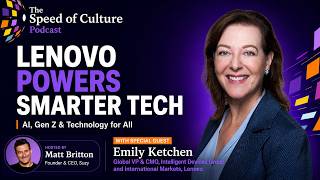
In this interview, host Matt Britton talks with Emily Ketchen, Global VP and CMO of Lenovo’s Intelligent Devices Group and International Markets. Emily shares how her early agency experience at Grey, Publicis, and McCann Erickson shaped her strategic, creative, and client‑service mindset, emphasizing the value of listening, chemistry, and partnership in agency pitches. She discusses the generational shift from Gen X/Boomer decision‑makers to Gen Z consumers, noting Gen Z’s demand for brand inclusion, digital‑native expectations, and the opportunity for technology companies like Lenovo. Emily outlines Lenovo’s brand vision of "smarter technology for all," highlighting key pillars such as democratization of tech, the strength of legacy brands (ThinkPad, Yoga, Legion, Motorola) and recent brand extensions like the ThinkPhone. She describes a marketing transformation at Lenovo built around Centers of Excellence for insights, media, and ROI, and shares a campaign that leveraged insights about women’s under‑representation in gaming to position the Legion brand. The conversation moves to the evolving omnichannel retail landscape, balancing online research with tactile in‑store experiences. Emily reflects on AI’s role in marketing, viewing it as an additive, long‑term tool that requires thoughtful, secure experimentation. The interview concludes with her advocacy for women and diversity in tech, practical advice on mentoring versus sponsoring, and personal career reflections on taking risks, global mobility, and the importance of making deliberate choices. Throughout, Emily’s tone is conversational, enthusiastic, and reflective, offering concrete examples and actionable insights for marketers.
Chapters
Today we're gonna be speaking with Emily Ketchum, who's the Global VP and CMO of Intelligent Devices Group and International Markets at Lenovo. Emily is listed in Brand Innovators' Top 100 Women in Marketing. She's a Forbes Communication Council member and DEI advocate. Emily, so great to see you. Thanks so much for joining today.
Thank you so much for having me. It is great to be here.
Absolutely. So I was looking over your background and all the various places. You've been leading up to your current role at Lenovo, and it looks like you spent a good deal of time in the agency world prior to working on the brand side. What were some of the takeaways that you had from working at large agencies like Grey and Publicis and McCann Erickson, from what you can remember?
Definitely. So I actually had the good fortune of working for somebody on the brand side early in my career, and she made the move from the brand side back to the agency side and said to me, I really want you to think about a career in marketing, and that career her mind could not be fulfilled without proper agency experience. And she said, "I'm now at this agency way back in the day, Poppy Tyson. The client was Toshiba, so it was, you know, my first foray into technology." And she, you know, convinced me that the right thing to do would be to take a tour in the agency world. And it's one of the best decisions I've ever made. I think it's really hard to understand what happens inside an agency unless you get to experience it.
Yeah.
So, I have a strong bias for that. It was fascinating from a strategic perspective to an account management perspective to a creative perspective. And the fact that when you're on the account side, which I was at all 3 of those agencies that you referenced and in technology, the opportunity is to, you know, use multiple sides of your brain, right? The business side is like the clients and the account. You're actually responsible for revenue and you're driving business. I had a P&L in those organizations. Organizations, but at the same time, you're using all of your creative skills to be able to craft and mine for those insights and come together with an incredible strategy that lends itself to great work.
Yeah.
And you are the holder of blame of the brand and of the creative expression of that brand. And it's such a hugely valuable experience to be able to spend time on the agency side and to know what clients are looking for from that seat. Yeah. As you then pivot into the client side, and I've been agency side, publisher side, client side, and I think it just helps you to be a little bit better rounded. Yeah. More empathetic, maybe more thoughtful about inputs to agencies. Sometimes you'll encounter people who are like, well, you know, call the agency, they can help us to solve it. And I remember getting those calls.
Yes. Presumably you would never ghost an agency when they submit a proposal because you know what it's like to be on the other side. Totally. Exactly right.
Yeah.
And the other great thing about agencies is you you get to work on various different types of businesses as well. And even if you're in the same category, you're going from one technology company to the other, they have different cultures and you get to see the inner workings, the different phraseologies, the metrics those companies use. And I imagine that also makes you more well-rounded in preparation.
You're 100% right. And you're never bored. Like you're stimulated all the time because the other responsibility that a lot of account directors have in agencies is to be able to lend a hand on new business.
Yeah.
And so, your brain gets fired up because you're working on a new category or something you haven't done. Like I led the technology practice, but I got to work on a pitch for a financial company that was dealing with ETFs, and I, I didn't even know what they were really as a financial instrument. We also worked on an airline. So fun, different things that you get to experience. And you're right, the cultures of all of those companies are different. But here's the crux of what's great about the agency side, and that is that there's a very common sense of purpose.
Yeah.
In account teams, creative teams, and strategy teams, you're all pulling for the client, which is so rewarding. And it really, it helps develop that culture of What are we going to go do for this client? So I find that to be super fun and super rewarding. It was a lot of fun. I spent a lot of time in agencies for sure.
So, and being someone who's been on both sides of the table now, you'd mentioned pitches. What do you think makes a great pitch in agency world? What sticks out to you as the things that are, I guess, common when you walk away and say, we really nailed that, or they, meaning the agency, really nailed that?
Yeah, I think a lot of it starts with an agency who really listens. Sometimes agencies, lean into their own bias and their own thought process.
Sure.
And my own experience tells me if you listen really carefully to the assignment, that is really helpful. And come in with a fresh perspective on how a client is looking to solve that problem, right? Clients generally go to pitch when they either have something big that they want to do, they want to create a new campaign to launch a new product, or frankly speaking, they're looking to solve maybe an age-old problem and they're looking for a fresh perspective.
Yeah.
So, the first thing I would say is great listening. The second thing I would say is don't underestimate the value of chemistry. You're going to spend a lot of time together, right? You're going to meet, you're going to spend time, and then you actually step into a relationship with an agency that in my mind is 100% a partnership. It is not, um, it's never gonna work if it isn't that. And so you have to respect each other. You have to be able to have a great relationship. I think the chemistry piece is borne out by then two supporting pieces. One is communication. It's the basis is for any great relationship. I have to be able to tell you what's working, what's not. Honestly, this is a brand problem we have. Honestly, how would you help us to solve that? Or here's a brand opportunity that we have and how can we make the most of that? And the second piece is collaboration, rolling up your sleeves and being super honest about what needs to get done and in how much time. Because oftentimes you want very good, you want very fast, and you want not so expensive. And we always said in the agency business—
I want all three.
Pick two.
Yeah, you cannot. But the client would say, I want all three.
Oh, I want all three. So I think having That level of honesty is really important. And I think at Lenovo in particular, we really value the commitment to honesty and to partnership with our agencies and take that very seriously.
Yeah, a big part of partnership too, 'cause I ran that agency for 15 years and where we had the best success with clients is when the strategists and the people on the agency side felt like they had a license to push back and ask hard questions and not just be a yes man or a yes woman. And basically, you know, we use this phrase at Suzy all the time, the HIPPO, the highest paid person's opinion. And a lot of companies operate that way where everyone's at the table and they're looking at the most senior decision maker in the room and they let them decide. And that's not where great ideas or innovations come from. You talk about listening. Listening has to come not just from agencies, it has to come from brands, right? They need to listen to their partners and they ultimately need to listen to the consumer.
Yeah, I would say perfectly said. And I'd be willing to bet that your agency was very successful because you don't want to come in— it's exactly what I said. You don't want to come in with that bias. And HIPPO is a great way to frame it, right? It's the most important person in the room. And, you know, often they're wrong. Wrong. They're not right, especially as you look at the influence of different audiences and who companies are talking to. So, I think you're spot on and you have to be able to push back. I think the other thing is great relationships, and I always felt this in my own experience, was when we were considered an extension of our client's team and vice versa. I look at our agency partners as an extension of our team. So, we're in it together and that makes a huge difference. It's not, "Ooh, we're the agency," or Oh, we're the client and we expect you to solve the problem. It all comes from that fundamental partnership and that desire to get to the best outcome for both.
Yep. And I think a big divide that's happened, at least for the past decade, is you had mostly Gen Xers, in some cases Boomers, who are in the C-suite. And those people did not grow up with the internet in the household. And then they're targeting a consumer base, much as Lenovo, of Millennials and Gen Z consumers who grew up You know, millennials grew up with the internet household. Gen Z grew up with the iPhone or the mobile device as an appendage to their body, right? It's a completely different consumer. And a lot of times the myopic thinking of people whose brains, frankly, are wired differently is where a lot of the disconnect happen with their communication strategy, the marketing strategy, etc.
Yeah, I could not agree with you more. I mean, Gen Z in particular have a whole different set of requirements and expectations of brands and marketers. And maybe to your point, those generations that came before are a little bit about message out, whereas I think that what defines millennials and Gen Z is this notion of far more porous brands. They want to be heard. They want to be seen. They want to be part of the brand and not certainly somebody who you're speaking at, right? That's a surefire way to not succeed with Gen Z.
Yeah.
No question about it. So I think you're absolutely right. And you would hope that folks could take the time to be curious and use insights to learn about audiences. So if not, that's a problem. But I totally agree with you. You have to know this is Gen Z in particular is the very first generation ever to grow up as that digital native, right? They're, you know, cybrids. They don't know what it means to be without technology, which I think actually for us at Lenovo is a huge opportunity because we are a technology company and it's very natural for us to put technology at the center of that conversation. So I think you're spot on.
100%. I mean, I just moved my daughter into college, which was a crazy moment, but one thing that struck me is none of of the dorm rooms had a TV in them. None. They all had laptops, 2 laptops in every dorm room with 1 for each student, right? That's a big shift. And that's where a company like Lenovo, you talk about the Gen Z consumer, these are the future operators of businesses and they're not even thinking about bringing a TV into a dorm room.
Could not agree more. You and I share that in common. What a, what a moment of kismet. I was moving my daughter back into college last weekend.
Oh, that's great.
So we share that. And you're absolutely right. They can consume everything off of their devices, which is All the more responsibility and opportunity for those of us who are in technology to create devices that fully surround you with everything that it is that you need, whether in the case of Gen Z, is it that they're gaming? Is it that they're studying? Is it that they're consuming their programs and listening to music? It's all of the above.
Yeah.
So I think you're absolutely right. It was very funny. We went downstairs in this house that my daughter has moved into, and there was a TV room, and she just looked at me like, I was like, hmm, that should be interesting. And there was no TV, to your point, in the TV room. It must have been an old sign. But I agree with you. And they are the future. And so we need to make sure that everything that we do, the way that we speak to them, the way that we create devices for them, the way that we think about how they consume technology needs to be super thoughtful.
100%. So before joining Lenovo in 2021, you had— or 2020, you had spent 9 years at Hewlett-Packard. Which is a company that's obviously iconic, one of the, I guess, innovators in Silicon Valley, and obviously has had its challenges as of late just based upon how quickly the technological space is moving. Talk to us about your experience at HP, what you were able to take away from your time there that prepped you for where you are today.
Yeah, I mean, I think reaching back into my own background, I've been in technology since '96. And so I've been around it for a very long time. And I think each of the different companies I've had the opportunity to work with have brought something different to my own set of experiences. And so I think specific to that story, you know, tons of different opportunities to work on the consumer side, the business side. I had worldwide roles and geo roles. Our family moved to Singapore for 2 years and I ran the Asia Pacific region, which I think was really a fantastic opportunity, came back.
Was that a hard decision, by the way, taking your family to Singapore?
It was not a hard decision. Here's, here's how that went. Um, I am actually a, a child of what I call the third culture. So I grew up the child of an expat, and I had lived in 7 countries by the time that I was 13.
Wow.
So I really wanted to share this experience with my family, and my husband is a stay-at-home dad. And so my kids were gonna be in school, I was gonna have this amazing opportunity, and my husband and the dog were gonna like I'd be home in Singapore, right? So he was the first stop in terms of, is this something that you think would work for our family? And I spent a lot of time talking to him about that opportunity and just wanted him to really be sure that it would work for us and for our family. Our children were 5 and 10, which is like the perfect age to move kids around the world.
Yeah.
And he said yes. And I said, well, I'm going to go for it. Like, it's the only job I want. And so I threw myself into that and got the job. Now, Now, it's fair to say from San Francisco to Singapore, you really can't go anywhere further in the world. It's a very long way. And we did it. And I think the incredible benefit was actually not something we thought about before we left, which was how close that brought our family together. Because here we were, 4 Americans living in Singapore and living the third culture. You're neither Singaporean and nor, nor are you an American in America. And on top of that, my kids were in a French school. And on top of that, I was in a brand new role. So if you manage, you know, all of those dynamics together, I think we expected to have a good experience. We didn't expect to become so much closer as a family because of all the things that we experienced together.
Exactly.
So it was great and it was an easy decision to make. And then I had the opportunity to come back and do the same thing for the Americas. And so I think it's been a great setup for the role that I have today at Lenovo, where I get to actually now lead the marketing for the entire division of intelligent devices, which actually happens to also include Motorola. So it's been super, super fun.
Yeah, let's dive into that. So you joined Lenovo still at the heart, in the heart of the pandemic, September 2020. I know there's lots of supply chain issues and lots of considerations at that time. How was it diving into a company like Lenovo in such a prominent role in the midst of the pandemic? And I guess, what have you been working on since that point?
Yeah, it's a great question. And it's a little daunting to step step into an organization that you're not super familiar with in a role where the expectations are very high in a place that you can't leave, which was my office in my home. Now, the beautiful part of the story is technology actually was at the center of my onboarding, and I was able to, with, you know, all the technology that we have, be at my desk, be on camera, and get to know people really deeply, actually, over the 9 months. I mean, I joined in September of 2020, and we were locked in until like the summer of '21, right? It took a long time for people to break out. One thing that I did was I was super conscious about taking every single meeting that I possibly could on camera. Just get to know people, see the facial expression, relate. And it's actually—
That can be exhausting, though, can it?
It can be super, super, super tiring. And I had to find ways to regenerate. In fact, I wrote a little bit about that when I started the role. I had this kind of golden hour in the afternoons because the company being based on the East Coast, it would be an early start in the morning. And And then things would taper off around 3 or 4 on the West Coast and then kick back in again when Asia woke up in the evening. And so in those hours in between, I would walk the dog, get out in the sun, get out in the fresh air and regenerate. But what was so great about it was the ability to truly connect with people one-on-one. The one piece that I underestimated, and this is super, super interesting, is when you're on whatever your company uses, Teams, Zooms, whatever it may be, you can't read the dynamic in the room. Mm-hmm.
Room.
And how important is that when you're in a seminal leadership role? Like, who's paying attention? Who's looking at their device?
100%.
Who's like—
Couldn't agree more.
—winking at the other person across the room? And you can't read those dynamics. So what I will tell you is the second that we opened up the ability to travel, I went— first thing I did was go to Raleigh. And I literally said to my husband, I'm gonna go for 2 weeks and over the weekend, I'm gonna meet people, I'm gonna dig in, we're gonna eat, we're gonna break bread, we're gonna spend time. And I did that for 6 months. I think I went to Raleigh maybe 8 or 9 times in 6 months. I went every opportunity that I could get to go spend time and build relationships. And then slowly but surely over time, things began to loosen up and I could get overseas. And again, my first summer post-pandemic, I think it was the summer of '22, I was in Europe for 5 weeks. I happen to have family there. My husband and my kids joined on vacation. But what I did was I spent time with the Lenovo team in— In Italy. In Italy and in Milan, which is a big center for us, in the United Kingdom, in France, really digging into the agenda that we had, which I think was also part of your question. We can certainly talk about that, but it was all about creation of a reputation. It's wonderful when you start with a new company because you get to start over in some ways. Obviously, you have your reputation built. I've been doing this for 30, 35 years. Folks know me a little bit, but what a great opportunity to go in and define what I wanted to do both for the brand and for the marketing organization. And so, it's been fantastic. And what a great company to join in a time like that when technology is at the center. And then just how I was, you know, welcomed and treated and, you know, sort of conducted this major transformation of the organization, never leaving my home.
Yeah.
It's kind of a fascinating story.
Absolutely. So, let's talk about the Lenovo brand because obviously you're in a highly competitive space. You have companies like, you know, Apple and Microsoft and HP, who were formerly at, and many others playing in that space. How does Lenovo differentiate itself? What are some of the things on the brand side and the key brand pillars you're leaning into as you continue to build the brand here in the United States? Which is— I look at Lenovo still as somewhat as an emerging brand in the US compared to some of the companies I mentioned. So what are some of the key things you're focused on?
Yeah, that's fair to say. And I— that is exactly our opportunity, right? So I think that's exactly right. What attracted me the most about the company was the vision, which is really about smarter technology for all and this notion that at the heart of who we are and what we stand for in our vision, it's all around providing technology for everyone, which is very different than some of the competition if you think about it.
Yes.
So democratization of technology and this extraordinary ability to build products and services and solutions that are at a tremendously high quality. If you think about some of the brands that we have inside of our portfolio, ThinkPad is legendary and known worldwide for a a lot of the equity that it brings. Yoga, this extraordinary form factor and category creation that we put together and put into the market. Motorola. So a lot of, of those things really attracted me and the whole idea and the whole role was really anchored to how do we elevate the brand in and of itself and compete against all of those very worthy competitors that you talked about. And at the same time, really focus on a marketing transformation inside the organization. and I led that by starting with setting up several centers of excellence, one all about insights because, as you know, that's so, so important to great marketing.
Absolutely.
I put together a media COE because I felt that it was very important for us to have a hybrid strategy, what's in-house and out-of-house, and so a transformation there, a lot of work around ROI. There was a huge opportunity to be able to share a little bit about how I think about ROI and connect it back to insights in the context of what is it that you want to do with the brand. And so when you think about our a gaming brand, for example, Legion, mining deeply into insights. There, we were able to uncover that women feel very underrepresented and underserved in the world of gaming. And this was some work that we recently did because I think the insights told us that they don't feel like they're treated fairly, right? A lot— you know, 49% is the statistic that comes to mind of women who are in gaming have been approached or, you know, you know, "Oh, your cute outfit." Marginalized in some way, yeah. Yeah, exactly. That's a great word for it, marginalized, and just in an underrepresented space. And so, we actually put together a campaign that elevated women, featured only women, and featured them being able to go sort of from the boardroom into the game because the other insight that we found was actually gaming hones your skills and makes you better at what you do. So, when you combine that fact with the fact that women are underserved and marginalized, a lot of women won't use a name that is female even. They'll use a neutral name because they want to be able to compete fair and square. So, being able to to take on that story and tell it in a unique and compelling way that, again, is very authentic to Gen Z, is very authentic to millennials, I think was a huge opportunity for us. And it served us super well. It's been a campaign that has continued to propel Legion to great places. So that's a great example of how you take those insights, you mine them, you tell a, a creative story for the brand, and you continue to advance the agenda. So that's a lot of the work that I'm thinking about. The other thing is maybe how do you consider the value of these different brands together? And I don't think I don't think that's been contemplated before. So are there ways in which ThinkPad can extend itself? And one of the things that we've done there is crossing over with our Motorola brand. We've recently launched a ThinkPhone. How amazing, right? A phone that is designed just for business that carries a number of the features that you need to be—
Yeah, first-rate security, I'm sure.
Exactly. Exactly right. So it carries the ThinkShield brand, which is our security brand. And so that's been really a wonderful journey in helping as a marketer to be able to tell sell and evaluate the promise of those two brands together in the brand extension.
And how is the retail landscape changing in your category? Obviously, you have some companies in your space that just go direct or have their own, you know, store. And I'm sure you partner with a lot of various retailers and have a strong e-commerce strategy. Where's that all kind of shaking out?
Yeah, I think everything that we've learned from deep studying around the customer journey is that there isn't one or the other methodology that is right. What we find is that when people are making a really considered purchase, like a laptop or a phone that is expensive, they will want to spend time touching and feeling and interacting with that particular technology, right? Think about the story you told me about moving into college, right? Tell me that that particular device is not at the center of your daughter's life, right? She wanted to touch it. She wanted to feel it. She's got it under her arm going into class. It's a part of who she is. And And so for us, it's about having that right balance of I can find it online. All searches start online, right? It's really important to have the right set of reviews so that people understand what are people saying about your products? How is the technology stacking up? And then in my experience, they want to go touch it and feel it. How heavy is it really? What does that cover feel like? How do those keyboard, you know, how does that feel? We have legendary keyboard status and a lot of that is just based on work that we've done, but it feels great. They're going to test, they're going to feel, they're going to want to know what that is like. That to be a really important part of the customer journey, again, based on insights. So I think it's about balancing that go-to-market strategy and having availability online and being able to do that with your partners in retail or in your own e-commerce vein, and then being present where people shop.
That's the definition of omnichannel, ultimately, as we're just throwing around.
Absolutely.
Another buzzword is obviously being thrown around, especially here at the Brand Week conference in Miami where this interview is taking place, is AI, especially here in 2023. How are you looking at AI as an important, I guess, ingredient to your overall marketing mix to use it across various different applications.
Yeah, absolutely. We, like everybody, are super excited about AI. We're thinking deeply about what it means for us, how it will actually improve marketing. I'm very optimistic about that. And it's super interesting that you raised AI because there have been a number of hype cycles. I rewind back to things that we talked about 2 or 3 years ago. We were all convinced—
3D printing. I mean, we can go on forever.
We were convinced that these things were here to stay forever. I think that AI definitely is, and I actually think that—
AI is what?
Is here to stay. Yeah, without a doubt. Oh, without a doubt. Sorry. Yeah, it's not part of the hype cycle. It's here to stay, and I think it will actually really, really help us. It will help marketers come up with new ideas, I think. If you think about generative AI and the queries that you can make, for example, today into ChatGPT, it's fascinating the ideas that you get back and the concepts that you get back. And so I see it as additive, not as a replacement, and not as something that will not matter. It's right there in the middle. It takes me back to 20, 25 years ago when people said, "The internet is going to replace our lives." I was there too.
I was there too.
No, the internet did not replace your life. So yes, has it changed things? Definitely. Are there good and bad? Yes, there are for sure. I think what's important is incumbent upon us as marketers, so often the definers of the future in terms of communications, to really be thoughtful about how we use and how we think about AI. That's the only watch out that I would give us. And you might say, well, what do you What do you mean, Emily? What I mean there is, first of all, you've got to know how to use the tools, and that means you have to experiment.
Yeah, experiment.
And that means you have to do it safely. Exactly right. So, you want to make sure you're doing it in the right way because there's a lot of security concerns in terms of people not really realizing what they're putting into, you know, a ChatGPT algorithm. It is, it's an algorithm. It's just that, you know, AI fundamentally is pattern recognition. And so, it can't tell you whether it's right or wrong. It can just tell you that it's there. So, I think that's something we have to be thoughtful about in the context of making making sure that we understand as companies what are our policies, we communicate those policies, people feel included. And then I think we experiment, right? And we see what it does for us. You can imagine in the world of translation, it could have profound impact. You know, there's all kinds of conversations about visuals and how it will impact those. So I think it's a bit of an experiment and wait and see, but like all technology, my own own thought process is to lean into it and to embrace it. So that's where we are. I'll just share one more—
Please.
—little anecdote with you. When I arrived here in Miami, I was on my way and I was in a taxi and super nice taxi driver chit-chatting. And he said, "I mean, I think that AI is gonna replace, you know, all of our jobs." And I said, "No, no, I don't think that it is." You know, it just happened to be a topic of conversation. You hear that all the time. Right? All the time. And I wanted to try to be, uplifting about AI, I think, is going to help us and not replace all of our jobs.
Absolutely. So let's shift gears here as we wrap up and talk about some of the things that you're passionate about, one of which I know is about women and diversity in the workplace, especially in the technology field. Why is that something that is so— other than the fact that you are a woman— is so important to you and something that you really kind of plant your flag on as a leader?
I think it has a lot to do with the fact that I'm a woman, right? I mean, I think it very much is anchored to that. I—
But not every woman speaks as passionately about it as you do.
That's true. That's fair. I think for me, there are so many examples of women, you know, put into situations that they shouldn't be in. The key is, how do you advocate your way out of that? And so I'm all about trying to share anecdotes and stories and ways in which women can actually advance themselves. And so I talk a lot about the difference between mentoring between coaching and between sponsoring. I had a fascinating conversation with a woman last week who wanted to share with me that she felt like there were times when she wasn't taken seriously in a global role based on where she lived. And it was causing her a lot of issues in meetings. And I just gently suggested that, never in public, but after the meeting is over, that she call the person who was challenging her and just ask, "Why were you challenging me?" Right. You know, I'm in the role. I find oftentimes women have to be more skilled to get the roles, especially at the senior level. And so, how do you create a safe space for them to have that conversation, to actually call somebody on something that they're doing that isn't right for them to do in a constructive and meaningful and good way, but just to check that a little bit? Because I think it's really important. And I think the other thing is women have a real responsibility to lift women. I'm all about that. I think that there's so many opportunities to— Non-binary. To do that. And my favorite quote from Madeleine Albright is that there is a special place in hell for women who don't support women. And she said that, and she meant it in her own special way. The third pillar is all about pipelining female talent. And so, as much as I can challenge women and try to make them better at their jobs and create a safe space for them and elevate them, I will on every single level. The last thing I'll say is I'm often the only woman in the room, and I might be the only I'm the only senior leader who's a female on the staff. It's all the more important to represent women in the right way, to tell the stories, to show up, to be prepared, to deliver. So that's just pressure I put on myself. And the last anecdote to all of it is I'm a mom to two girls and I want them to see that—
That's fantastic.
It's possible for them to do anything that they want to do.
Yeah, that's amazing. Well, thanks for sharing that.
Yeah.
So finally here, You've had an amazing career, and you're clearly somebody who has their finger on the pulse of business and culture and society and your consumer and very worldly, given your experience. As you look back on your career, what are some of the things that you think you did right, that the decisions that you made along the way, forks in the road that you're like, I'm glad I made that, which put you in the position that you are today?
I took a lot of risks. You know, I put myself— and I was having this conversation with somebody last night— I put myself in jobs that I really wasn't necessarily qualified for, and I figured it out. And that's not so risky. Risky when you're 20, 22, 25, and you work for somebody. I worked for a woman who was incredibly strong. I worked for her 3 different times. I referenced it earlier in the context of the agency experience.
Mm-hmm.
And she believed in me. Now, that translated to a ton of pressure, but I just figured it out. You know, I owned when I didn't know something. I asked questions. I wasn't afraid to ask questions. And I dug in and I did the heavy lifting. And I'm really glad that I did that. I could have gone a safer route. I could have just— made incremental steps in my career, but I was willing to make major changes. I went from, you know, a very quarterly profit-driven home building company in Southern California to a nonprofit for the country of Spain. That's a big change. And like, on what basis did you have those skills 2 years out of college?
Right.
I didn't. I went for it. And then I went to work for an airline. Well, interestingly, that really played in when you heard me talk about us in the agency world working for an airline. I had insights there that just based on my experience, I was able to lend. So I would say at my age today, it's easy to look over my shoulder and see how the threads all come together in the tapestry of what is my career.
Right, in the rearview mirror.
But like in the moment, it was scary as all get out. And it was me and a cat. And so off we went. Yeah, I think that's what I'm most proud of in hindsight was the willingness to try new things.
That's awesome. So to wrap up, is there a quote or a mantra that you live by that kind of embodies your career, even your personal in life that you find yourself saying a lot?
Yeah, I think, you know, one of the ones that is closest to me is really the importance of making choices. And so choice and not chance is what defines our future. I believe it anchors back to something Aristotle said, which sounds very lofty and erudite. I don't mean it to, but I'm a huge believer in the empowerment anchor to making choices. And then guess what? You live with those outcomes, but that's okay 'cause you made the choice. And I find that a lot of times, people believe things happen to them. And that's true. I don't underestimate that. And everyone's circumstances are different. But I'm a huge believer in the power of making a choice.
I love that. Well, we're going to wrap it up there. Thank you so much for joining us. This is an awesome interview. I cannot wait for our audience to hear it. So on behalf of Suzy and the Adweek team, thanks so much to Emily Ketchum of Lenovo for joining us today. Be sure to subscribe, rate, and review the Speed of Culture on your favorite podcast platform. Until next time, see you soon, everyone. Take care. Hey!
More from Matt




MikMak’s Rachel Tipograph on Consumer Spending, Retail Media & Holiday Shopping Trends



Jaguar Land Rover’s Charlotte Blank on Luxury, Purpose & Experiential Storytelling



