Lenovo’s Milo Speranzo on AI PCs, CES 2026 & the Future of Hardware
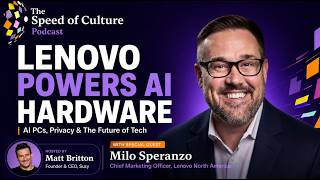
In a live Speed of Culture podcast recorded at CES 2026, host Matt Britton interviews Milo Speranzo, Chief Marketing Officer for Lenovo North America. The conversation covers Lenovo’s massive CES showcase at the Las Vegas Sphere, the strategic reasoning behind the event, and the complex production involving partners such as Microsoft, Intel, NVIDIA, and Jensen Huang. Speranzo highlights Lenovo’s AI‑centric product roadmap: the Kira AI agent that orchestrates AI tools across devices, next‑generation AI PCs and ThinkSystem servers that set new inference benchmarks, and wearables—including a prototype pendant—designed for edge AI and privacy‑first data capture. The discussion delves into the shift toward edge computing, the emergence of a new buying cycle for AI‑enabled hardware, and the company’s view of data as the new oil, turning Lenovo from a component seller into a data‑driven service provider. Speranzo also explains Lenovo’s partnership with the 2026 FIFA World Cup, where AI‑stabilized referee cameras and democratized football analytics will showcase the ecosystem. The interview wraps with reflections on his career path—from the U.S. Air Force to marketing leadership—emphasizing authenticity, relationship‑building, and his “be a goldfish” mantra for resilience and rapid iteration. Throughout, the dialogue balances product announcements, market trends, and personal leadership philosophy.
Chapters
We are here live in Vegas at the Speed of Culture podcast, and today we are thrilled to be joined by Milo Speranzo, the Chief Marketing Officer for Lenovo North America. With a career that spans the US Air Force to entrepreneurship and now leading Lenovo's marketing efforts, Milo has been instrumental in driving Lenovo's brand relevance in high-growth sectors like sports, tech, gaming, and AI-powered innovation. Milo, so great to see you today and welcome to the show.
Thank you so much for having me.
Absolutely.
I need an intro like that everywhere I go. Take me everywhere you go.
Yeah, love this. Yeah. You know, we're here at CES and yesterday I had the privilege of attending an incredible presentation that Lenovo put on at the Sphere. Yes. And I would love to just talk a little bit about that to kick off. First and foremost, what gave you guys the conviction to dive forward with such a big presentation and do it at the Sphere?
Yeah, multiple factors. The platform of the Sphere is, you know, obviously world-renowned and to be a part of that and to be a part of CES is, absolutely amazing. But frankly, last year when we were here, we did a pivot with CTA and, and worked a little bit more B2B and less consumer at the event. And we didn't know how it would go. So we had some amazing results and customers that wanted to attend that were maybe nontraditional CES attendees. They were very much small and medium businesses that wanted to see what the next gen of tech was. And we saw some of our large global accounts even want to attend and be a part of, you know, if it's just the atmosphere or Vegas in general. But we had a really good showing last year from a, from a commercial perspective outside of consumer. So we started to ideate after that and said, you know, we typically have our, our, our annual event in North America in October. And it's very much, it's very much what you saw at the Sphere minus the giant globe with amazing visuals. But it's, it's a hybrid consumer commercial event. And after, once again, after the event last year, we started to think, why don't we just do it all here? Why don't we do it all at the Sphere during CES? And slowly, with conversations happening with the Sphere and with CTA, it all came to fruition in the summer of this year and we, we made it happen. So very excited to do it. And the turnout was Honestly, beyond—
it felt like it was a concert. It was completely sold out.
Yes, it was. It was completely sold out. Yeah, we had, we had over 14,000 in the Sphere. And what was even more interesting was we had Gwen Stefani afterwards, which was an amazing concert, by the way. And, uh, and we had a lot of folks— well, not a lot, but we had some leave, circulate out. And it was— they were there really to see the Lenovo launches and releases, which it was. Yeah, we didn't want to see anybody leave. We would stay for Gwen and we did. Right. It was amazing. But, but we did take that as a wow, they really did come.
Yeah, our stuff does.
It was matters too.
Yeah, it was nice. And of course it wasn't just like a keynote, it was a full-scale production. And you had your partners from Microsoft to Intel and NVIDIA. You had Jensen Huang, who's one of the most important people in the world right now in the business world, let alone the tech world. Yeah. What goes into a production like that to kind of go through step by step all the talking points? Obviously the production side coordinating with the partners. And what was that? What's that been like over the last 6 months?
Yeah, I mean, it's, it's as you can imagine, it's a mind-numbing amount of emails. Yeah. One, a lot of communication and overcommunication. But as the other marketers who might be listening will know, it is even beyond the production. There is paying for it and the sponsorships and the politics of who's on stage and when and, you know, and how we— how we actually deliver the visual of the show. And, and all of those complexities were, one, I think, very expertly handled by, by the team. I could not be more proud of not just marketing, but Lenovo holistically. So as we pulled it together, marketing took the lead in a lot of the areas, but we really relied on some of the, you know, let's call it the adjacent organizations. Sales. We needed sales to drive the attendance. That 14,000 people, you know, we did email blasts and we did all—
nothing works great than performing to an empty room.
Yeah, yeah, yeah.
The room's a sphere.
Yes. And when it's that big of a production, the traditional, you know, let's call it marketing strategies around, you know, digital and advertising, You're not super confident that that will fill all 40,000 seats.
And there's so much competition at CES.
Oh my God. It's—
yeah.
Again, everybody—
Gold Sphere, a little bit off the beaten path of the CES trail.
It is.
And to spend 2 to 3 hours, it's— that's no easy feat with everything else that's going on in Vegas right now.
Yes, you're absolutely right. So it was sales took the lead on, let's call it, audience acquisition. And marketing played a role in all of that. Our corporate marketing team and comms team took the lead on developing the production piece. Our alliance Matt's team took the lead on interacting with Jensen and Lisa and Chris.
You met, he was a good friend. He was there.
Yeah, it's amazing. Microsoft was a big player. They're a big player in that and also a big player in some of our announcements. So we all took— we bifurcated the responsibilities a bit and then had a central, let's call it, ownership team. We had one person and three people working with that person to orchestrate really what was Everybody in Lenovo working to deliver what you saw at the Sphere. It was a company-wide effort.
I'm sure. So let's shift gears a little bit to what you actually revealed and talked about. I'll let you do the honors in terms of what was announced yesterday and why you were so excited about it as the CMO of Lenovo of America.
Yeah. So we, one, I'm obviously a big homer here and I'm gonna give you the Lenovo speak, but I am honestly very, very proud of what we, what we've done and the risks that we're willing to take and how we lean forward. And there's items, for instance, the wearables that we are very much involved in. We have, you know, late-stage concepts. We're ready to go to market. And there was a discussion of, you know, hey, do we want to talk wearables? Absolutely, we want to talk wearables. Do we want to talk, you know, then Kira, the announcement for our AI agent that is really an orchestrator that orchestrates all of the AI tools across all devices. And Kira is amazing. Our new ThinkSystem servers that inference, which you need for all, you know, all enterprise-level AI, are just killing the benchmarks. I think we had— I forget the number of world records.
I love the healthcare example that you gave of your hospital, the MRI data and how important that is.
Yeah. And it's securing on-prem the data as well as reading that MRI. So it— that's amazing. All the way to Moto, where you got the Fold, the new Razr Fold, which is personally, I think the most elegant, sleekest designs that we've, we've delivered via the Moto line in a long time. So it's, it's exciting. I think what's the most exciting is we're the only ones that are actually delivering that end-to-end.
Yeah, there are other companies in your space that have ecosystems. Sure, sure. That we don't need to mention, but yeah, that have not done it yet.
No, no, no desire to do it, right? And we— and that's that risk-taking. And yeah, it's almost adventure. Is adventurism even a word? I don't know. Is that—
it is now.
If it's not, let's—
let's— that should be your new, you know, tagline for 2026.
Lenovo adventurism. Uh, so with the R&D and the resources we have, there is nothing stopping us from making those leaps. And also what we already have in-house. So we have obviously Pocket. Everybody says pocket to cloud. That's a thing these days. The marketers that are listening will know they've heard the word pocket to cloud. Realistically, nobody has phones, wearables, PCs, servers, storage all in one portfolio. The competitors will say that they, oh, you know, they work well with this other device provider or— but in real life, we actually have the ecosystem which enables us a pretty big differentiator in AI, especially when it comes to Kira, for instance, to be able to really navigate your day, build that personal AI twin that's gonna give you one, more efficiency.
Yeah, superpower you.
Yeah, it's really gonna superpower you. That's a great way to put it. Yeah.
So, you know, there's a lot of themes that I kind of extracted from the story that Lenovo told yesterday. First of all, it was on kind of the edge computing, aspect where the demands of AI are only going to continue to grow. And if you're relying on the cloud to deliver, you know, it's going to take more time. And there's a lot of use cases where you want that compute to happen on the device itself. Yeah. You know, whether that's your laptop, your phone, et cetera, that will give you, you know, you had mentioned the privacy aspect, but the speed, et cetera. Do you see that kind of driving a completely new buying cycle for the hardware that you guys sell?
So Yes, I, I see the evolution of AI driving an accelerated buying cycle. So we're starting— AI is, you know, in its infancy, not in first inning. We're in first inning. First inning, I believe. Yes, I, I agree with you. Um, and Jensen explained it really well yesterday as far as how it's a platform, it's the new platform. But as we, we evolve from an AI perspective, we're starting to see these new let's call it consumer demands. And one of the consumer demands is, is privacy. So last year, privacy was kind of talked about in the periphery and, you know, and it was one of those. Yeah. And the, the environment is another one, right? Is really coming. Yeah. To the forefront. It's becoming mandatory now. Whereas so we're allowing AI to be done at the edge, at the PC without even being connected to the internet.
Right.
And we think that's going to be a demand.
I agree. Even I was on a flight out here to Vegas and the Wi-Fi was choppy. I was saying, I just wish I had an LLM that could run fully on my device.
That's it. That's it. So, so we've, so we've pivoted to one, our, our customer demand and what they have told us they want now and what they want in the near, you know, and then far future. But one of those non-negotiables is, is certainly privacy. And you heard that in our, in our, uh, we might have said it too much, but you heard it in our presentation last night where it was with your permission.
Yeah, we said it a lot because we, because everyone's thinking about that and they really, because it's almost, we're almost in a dystopian world right now where this technology is so powerful and everyone's always thinking like, well, what's the downsides of it? You know, how can I control it? You have this kind of counter-narrative of AI and the way that I think you hit that is the way that Lenovo did yesterday. You hit it head on. It's, you can share as much as little as you want. We have this powerful equal ecosystem, put it to work for you the way that you think is best for you.
That's it. Yeah, that's it. And, and then functionality-wise, it actually functions better. So when you talk buying cycle, having that LLM kind of on— when we say on-prem, it's usually an enterprise discussion, right?
But having it on—
consumer at the edge somewhere, you know, where you can leverage it on a plane or even in the middle of Vegas, but privately. Yeah. So we, we do think that that is, um, we, we do think that's gonna spark a, a bit of a consumer, that new consumer buying cycle. Uh, from an enterprise perspective and B2B, which we also hit on deeply here, like we talked about, uh, that buying cycle for AI PCs is already— Oh, it's crazy.
Demand is nuts right now. So, yeah, because like laptops had a moment during COVID where it's like, it was all about mobile. And then once COVID hit, everyone was buying new laptops and, and even desktop devices and cameras, everything, huge boom, and then it kind of went away as, as, as you know, the pandemic kind of willed down. And now you see this other boom coming where you probably do want to upgrade your device if you want to take advantage of this technology the best possible way.
That's it. And, and if you look at the install base of what was sold during COVID the majority are not— I mean, obviously I don't think any of them during COVID are AI PCs, right? Or capable of really leveraging the LLMs and all these new tools like, you know, Canva, everything that's coming out that's just amazing. Sora. And so having that is gonna be a, I, I wanna say almost a necessity even on the consumer side to interact with maybe the games that are coming out, you know, in the gaming environment and the R&D perspective. We see a lot of architectural and engineering firms they cannot buy anything but an AI PC now because they're drafting and what they're using in their own in-house.
Yeah, rendering.
So yeah, it's so demanding. So, you know, and that's a flow that we've seen forever. The highly technical B2B, the highly technical consumer, the engineers, the tip of the sphere, and then it leaks into everything else. So we're seeing that rapidly get adopted this year. So we do think that that great refresh cycle is, is, uh, is happening, and AI PC is definitely the anchor.
Yeah, there was a device that was also shown on stage that was a pendant. Yeah, the pendant you can wear that will be way more fashionable, right? Right. Yes, that's, uh, but I understand it was in that early prototype phase. Let's talk about that because that's a big consumer shift. I've played around with some of the existing ones that are in the marketplace, and, um, I remember being at a dinner with a CNBC reporter and I told her about it. I'm like, but it's not on. And she was like, you know, is this like, am I being recorded right now? And there's like the trade-off with AI, and I get it all the time once I, after I talk about AI on stage, is because I talk about a health bot that I built where I took 25 years of personal health information, load it into a model, and it helps me make health decisions. And one of the questions I always— yeah, it's cool. But one of the questions I always get is, aren't you worried about just all the privacy implications. And my answer is always the same. I'd rather not drop dead on stage and risk that ChatGPT knows my cholesterol score. Yeah. Like, in other words, like, it's a trade-off.
Yeah.
We make trades on social media. People post pictures of their family on vacation. Maybe their house will get robbed, but like, they, to them, it, they feel safe and it's a trade-off and they wanted to show people the, the life that they're having and their kids. Everything in, in use of technology is a trade-off. In the case of the device that you're— the pendant that you're wearing.
Yeah.
How do you think that trade-off's gonna play off with the consumer? Because I see the benefit of capturing everything. Yeah. And I'm probably gonna be the first one to adopt it.
I know.
But a lot of people might even be freaked out about it.
People around you, not people wearing it. Exactly. People that you interact with.
Especially if it's a camera on it too.
Yeah. We're very, very sensitive.
Yeah.
And, and you know, at the beginning when you have the, when you start to go into the R&D process, you say, well, everybody's carrying a camera anyways. All we're doing is just holding it up so it could see the thing.
But it's on an alt spot. Instead of it being— yeah. That's the difference. Right. So.
So then that always-on function and then the listening and then whatever other capabilities that end up growing into these, we have to be very, very sensitive, not just with the user privacy, but with the privacy of, of, you know, holistically what you're capturing.
Right. If it's on, there should be ideally a light that's showing it's on. And if it's off, somebody could use it and not— which, right.
Which there is. But, but I think that's, you know, that's kind of table stakes. We have a, We have a committee at Lenovo that focuses on privacy and consumer advocacy. And so internally we look at it, but then, you know, you don't want to write your own report cards, right? So externally we bring in external companies, either governmental agencies or just third parties that come in and give us a, hey, here's your— so we have a risk with— not a risk, but we looked at homes on Zillow now or whatever the app is, Google Earth, I don't know. You can zoom in and see a house. Well, now you can opt out and your house—
Yeah, I read that blurred.
Yeah. So, you know, so they can't— you can see your house. We need to cross-reference all those and we are cross-referencing all those privacy capabilities and say, hey, listen, if, if let's leverage what's already out there, if Google Earth is not allowing these houses, then we need to on our wearables. Interesting. Make sure that that is right. Excluded. You know, so, so we have a— which is honestly The tech is there. Yeah, 1,000%. We have the tech for it. We have fancy versions. We have ones that, you know, designers can make. But the reason it's not mass production is because we have to make sure it's—
it's early days. We don't know.
Yeah, it has to be ready.
I mean, the question is like, younger consumers, look at Gen Alpha, who—
everybody, I don't know that they're even going to care.
I know they're just— or, or yeah, or even Gen Z.
I mean, and I don't know that that's Great.
What is good or bad anyway? I know there's some people thought electricity wasn't good when it was invented. It's like every time there's evolution, there's people who kind of want to hearken back to the way it was. Yeah. But the reality is there could be tremendous benefit of capturing anything. You're creating a second brain that can remember every— and it could advance humanity. It could allow us to focus on what's really important. You don't need to take notes anymore. You don't need to— it's all kind of done for you.
Yeah. And and it really— that personal AI twin is really the beachhead into what AI will be in your life. So you have robotics. I mean, we've seen it. CES, everywhere, right? Ridiculous. Yeah. So, so, you know, you're going to have LG just released the robot that I watched it yesterday. Fold clothes very slow. I got to go very slow, but I loved it. Like I said, they're going to speed that up.
That's because I hate folding clothes. I hate it. I got to pick that one of those up.
But your, your personal— that AI twin is going to be the interface between, hey, we know that you need this for this meeting that you have tomorrow. It's going to orchestrate daily chores and life, but then also the enterprise AI twin. When you go to work, if your enterprise or your work is enabled with AI, it's also going to help you when you walk in the door and you're a quality inspector and the robot dog has found 19 different, you know, potential issues throughout the night. Your AI twin is going to interact with the enterprise AI, which is what we call hybrid AI, and it's gonna say, hey, here's your, here's what you need to do immediately this morning. So there is no checking emails and— Right. It's go, you have a leak on pump 4, you need to go, that's your first priority today. Yeah. So harmonizing that AI is gonna be, I think, the next wave. And, and, and a lot of it's agentic, you know, we hear the word agentic a lot and that's what it is.
Often misused, but in this case it really is agentic.
Often, often misused. Often generative AI, it's another one, often misused. A lot of it's just predictive right now, but Um, but that orchestration between the agents is going to be just absolutely— whoever does that wins. Whoever can do that the best. And we think that's what Kira— yeah, that's what— that's—
and of course, if you couple in like the wearables and you're getting data on your body, you can really paint a whole picture of your life, your life's dashboard, what's important to you, what this AI agent is seeing and hearing. And I love the device integration. I mean, we've seen companies really take advantage of having that last mile, meaning like when you have the physical device in a consumer's home or in a consumer's hand. What, and what's starting to happen with companies like Lenovo and others in the category is used to just sell components. Yeah. Low margin components. Yeah. And now you're really a data company. Right. And, and, and these components are really just a conduit to collect data, use the power of AI to make consumers' lives easier, which I would imagine makes your job as a marketer and a CMO completely different than what it would have been 5 years ago if you were CMO of Lenovo.
Completely different. And you're, and you're right, it all, it all stems from data. So yeah, I, I don't know when it was, maybe 4 or 5 years ago, 6, 7, who knows at this point? All these years run together.
Yeah.
But, uh, but there was a lot of discussion around the, the most valuable commodity in the world is data. And everybody said it and it was a big thing and it was, but nobody could actually figure out how, how—
They would say data is the new oil.
The new oil. That's it.
Yeah.
Data is the new oil. It's more valuable than water. Well, there's a lot of companies that store— there's distributors that have infinite amounts of data. Now all of a sudden that data is actually becoming valuable and useful. So in a personalized way, it's almost like, yeah, it's almost like cryptocurrency, like it's kind of in the ether and then all of a sudden now you can use it for things. Right. And that's the— so, so that's really the pivot that we're seeing. And in marketing it's the same way. So it has changed. How we do analytics, and you're very aware of, you know, brand studies, how we engage consumer engagement. There's all these external data pools that are now available to us that show we've had major insights like ITDMs, IT decision makers are not the ITDMs we think all the time. Yeah. You know, it's especially in the AI world, we're seeing chief financial officers drive the IT evolution inside a company faster than a CIO because they're like, hey, we need this AI tool so we can reconcile at the end of the month so we can do the shareholder thing. But you don't have servers that can handle that. And they're pushing the CIOs. So now we're marketing to these, let's call it nontraditional ITDMs. So data is very much to your point, changing the way we do marketing, for lack of a better term. Absolutely.
Yeah. So moving forward here in 2026, it's another big year. Not only did you have this incredible presentation to Sphere yesterday, but you are a major sponsor of FIFA World Cup.
We are. We are so excited.
And it's here in the US. Yes. It'll probably be one of the largest sporting events ever. It better be. Let's talk about why the FIFA World Cup is important to Lenovo and what are some of your plans to activate it. I did love one concept, I need to say, where you have— and this, I think I interpreted this the right way— you have cameras on the refs on the field. And if you have a Lenovo device, You can see the feet. We had Tim Ellis, the CMO of the National Football League, on the podcast previously, and I actually brought up that exact idea to him that referees on the field, that even the helmets on the NFL should have hammers in them. And here you guys are doing it, which is an amazing idea. I just had to tell you.
Yeah, that— well, thank you. So it's— there has been, and I don't know if you remember, years ago, I forget the American football sport, it was the USFL or maybe Arena Football.
Yeah, it was.
They attempted tempted to do the cameras in the ref's hat and the cameras in the— but it never— you couldn't do it. You couldn't stabilize it.
It wasn't ready yet.
It wasn't right.
And then 5G, exactly.
Yeah. And then a couple years ago they said, okay, connectivity is there, let's try it again. And they did. They tried it again in a couple— I, you know, I think in some cricket matches and, and I think even in some football a little bit. It still wasn't ready. Now with FIFA and using AI stabilization, it's all a— that broadcast, the broadcast center will, will own that feed from the refs and fully powered by Lenovo. Lenovo's AI. AI is the critical function for making that commercially viable.
Yeah.
So it's a product that will not be viable.
First it was data, then it was the hardware, and now it's AI.
Now it's AI. Yeah. So, so AI stabilizing that and, and FIFA as a whole is Well, I mean, very, very exciting for us. We— I can't say how excited I am to go and actually see some World Cup matches in the States and be a part of it. But FIFA's mission really aligns with what we wanted to do from a small and medium business. We want to leverage AI to democratize essentially their ability to compete. For small, you know, somebody that starts an Etsy business or somebody that has a small dental practice, that maybe in the past couldn't compete with bigger franchises or chains. And AI is that level setter. So AI allows them to punch way above their weight, and we want to deliver that to our small and medium business customers and allow them to compete at a level they never could, which will create jobs. And it's a great story. FIFA wants to do that with the countries. They want Tanzania to be able to use the analytics that England could only afford to crunch data-wise. And so with, with Football AI, which is what we developed in conjunction with FIFA, we're doing that. We're doing that same thing. We're democratizing the analytics. Every country, the smallest countries to, you know, the biggest, will all have the same ability to parse the data. You know, when Messi comes in and he does this, there's an 80% chance he's going to pass, right? We, we're giving that data and allowing these smaller countries to punch way above their weight. So yeah, it's really exciting. So when we started working with FIFA, we had a lot of, let's call them marketing meetings, where we said, what are your goals? What are your— let's see where we can work together. And it has been seamless throughout the past year since we inked the deal. And then you'll see on the stage, automated AI offsides that we're going to have the VAR with our—
with our— you're putting your technology to work in ways that allow people to see its power.
Yes. Yes. So we think it's going to be a showcase for one, world's most popular sport, but also the Lenovo ecosystem. So, so exciting.
So shifting gears as we wrap up here, and this is such a great discussion, I can't wait for our audience to hear it. Would love to talk about you and your leadership style as CMO. Yeah. And first and foremost, like, what do you think you did right along the way in your career and professional journey to put you in a position that you're in today?
I don't know. I don't know. But I know what I did wrong. Okay. So I think— I think that might be— I think that might be what I did right. It's, it's recognizing the things that you could have done better. So, so I, I, you know, there's key mentoring moments in my career as I pivoted from— I was in the military. I had no real transitional skills into the private sector.
And then what happened?
And then I just— I got out. I knew some IT. I was passionate about something. So I went into the IT field and I started working for some government contractors because that's what I knew. I came from, you know, the military, the DOD side of the house. And as I started doing sales, it was started at sales and I said, okay. And I looked at the environment and I said, you know, marketing, That might be more me. That seems fun. So made the pivot slowly through networking and engagement inside of the companies I worked doing sales. And then I made a transitional pivot and it was a sales and marketing role and then it was just a marketing role. But, you know, throughout the entire process, authenticity, I can't— and I know everybody says that being your authentic self, your true self. Yeah.
And not being work Milo and home Milo, but just being Milo.
Yeah, right. Yeah. And having those conversations openly and building those, building trust with one, the company, but also the people around you. People got me to where I am. I, you know, it was, there was a lot of things that I didn't know and a lot of false starts, but a lot of people that I was authentic with and opened up to that really, you know, I would say were much more willing to mentor and guide me and say, oh no, no, no, no, don't do that. Focus here. This is where you want to— you want marketing. Don't think of marketing as PR. Think of it as, you know, and they rein you back in. So I really do think authenticity, relationship building, trust, and sometimes you get burned on trust. Sure. I got to be honest. I mean, there's been times in my career where I've really trusted somebody or something, a process, and the process did not work right or the person was not there necessarily to mentor, but to, you know, maybe get themselves ahead and you just move past it. You got to have, you know, be a goldfish in a lot of ways, you know, forget the things that, that, you know, maybe were outliers that, you know, I have 10 amazing relationships with trust and authenticity and one real shitty— like, yeah, yeah, yeah. So that, that one you got to just forget and you got to move on with those other 9 and 90% is a heck of a ratio. So it's authenticity, learning, trust, relationship building, networking. Once you get in, it's going to get you wherever you want to go. And yes, that's been my—
awesome.
That's been my philosophy.
So with that, to wrap up here, we always ask our guests if there's a saying or mantra to help encapsulate their professional journey.
Oh my God. You know, everything that I do is going to be— it's like Ted Lasso sayings. So I feel, you know, one, I feel like I'm cheating it, but it's— but it's to be a goldfish, you know. So, but, but also, but also learn. Yeah. And we're doing that with the Sphere. The Sphere was amazing. What we did at the Sphere was— I'm so, so proud of it. There's 10 things that I want to fix for the next Sphere, you know, event. So don't rest on your laurels. Focus, double down, do it better next time. But also be a goldfish. Forget about that outlier. Fail fast and be a goldfish. That's what I'll say. I'll combine two.
You heard it here from Milo, everyone. Be a goldfish in 2026. That's it. Focus on the positives. And I just want to thank you for a great talk. And I know you're really busy here this week, and it was really inspiring being at the event yesterday, and wish you nothing but success and hat tricks at the FIFA World Cup 2026.
I love it. Thank you so much.
On behalf of Susan and we team, thanks again to Milo Speranzo, the Chief Marketing Officer for Lenovo North America, for joining us here live at CES. Be sure to subscribe, rate, and view the Speed of Culture podcast on your favorite podcast platform. Till next time, see you soon, everyone. Take care. Bye-bye.
More from Matt




MikMak’s Rachel Tipograph on Consumer Spending, Retail Media & Holiday Shopping Trends



Jaguar Land Rover’s Charlotte Blank on Luxury, Purpose & Experiential Storytelling



