LG Ad Solutions’ Tony Marlow on Connected TV & the Future of Advertising
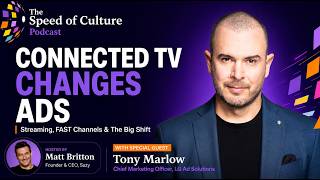
Tony Marlow, CMO of LG Ads, traces how TV shifted from linear to ad-supported streaming during and after the pandemic. LG uses its own 350+ channel lineup and privacy-friendly technology to put shoppable ads directly on TVs, turning hardware into an advertising platform like phones and Kindles.
Chapters
In Las Vegas at CES, I'm really excited today to introduce today's guest, Tony Marlow, who is the Chief Marketing Officer at LG Ads. Tony, thanks so much for joining us today.
Yeah, thank you so much for having me.
Before we get started and dive deeper into connected TV and LG Ads and all the exciting things happening here at CES, we'd love to hear a little bit about you and your career background.
Yeah, I mean, I think for me, I'm considered by many to just be a pure marketing nerd. Like, I'm the guy at the Super Bowl party that cares more about the ads than the actual gameplay itself. For me, it really goes back to my origins. I started my career in the data and insights space, really doing a lot of thought leadership. When I was still based in Australia, we were working with a lot of brands to measure the impact of their online advertising, working with brands to understand how they can make connections with their respective audiences. And so for me, I started off, I really started my digital career at Nielsen Online. It was a company called NetRatings, which was acquired by Nielsen.
Sure.
And I was doing a lot of these thought leadership projects to really help the world understand how to leverage digital at the time. In a really roundabout way, which is maybe a story for another time, essentially my team and I, we, we invented a new way to measure the impact of online advertising. So I was traveling back and forth to the US to Nielsen's headquarters, really trying to help demonstrate how this product could unify the way we look at advertising globally. Because at the time, everyone was doing it differently on a regional basis. So in a really roundabout way, on one of those trips, I met this guy at Yahoo. We had a coffee. A mutual friend said, hey, you're both marketing nerds, go have a coffee. I had the coffee. 5 weeks later, I was living in New York working for Yahoo. So I spent the better part of a decade there. I entered doing the thought leadership stuff and When I left Yahoo, I was running the, the B2B marketing practice, essentially the CMO of the B2B side of the business, right? From there, I had a quick stint at DataAxle. So we, we rebranded from what was previously known as Infogroup, the US-based data company, into what is now DataAxle. Really exciting stuff. That's actually a really cool company to this day. From there, I joined Integral Ad Science. I was part of the executive team that we took the company public. So I was CMO in that role. And now, as you said, I'm Chief Marketing Officer at LG Ads. And I think CTV is just the hottest space that exists right now. So yeah, really excited to talk about that.
Yeah, they talk about the art and science of advertising. And what I'm finding increasingly here at CES is many people in prominent positions in advertising come from the science side, come from the side of data. Why do you think that is? And do you think that creativity is more commoditized right now? Or I mean, obviously your answer is probably going to be they're both equally as important, but What, why do you think such a big focus right now on the data side of things?
Well, I think at a macro level, I think you used to, as a marketer, you used to have to choose, are you a performance marketer? Yeah. For your brand, for your category, for what you're trying to achieve, or are you a brand marketer? But I think we're seeing a new breed of marketer where you can be what I like to call a performance storyteller, because all marketing at its core is, we kind of mentioned it a little bit earlier, is trying to make a connection with a human, right? Like, that is what marketing is— trying to convey a message, drive awareness, trying to just make that connection. And now, especially with the rise of connected television, new media, there's the ability to be highly immersive, be, you know, biggest screen in the home, really super rich creative executions are available, and you can understand what outcomes did this drive, right? And so because we can do both of those things now, the importance of having that, as you say, science element helps drive the creative element. So I don't think we're in a situation where you need to choose anymore. In fact, you could argue that you need both to be successful.
Yeah, they're no longer disconnected. You know, you look at something like, you know, the Cannes Advertising Festival, the Cannes Lions, and for so many years the awards were based upon these very cool creative ads, but there was never real any business data connected to it because it's very hard to do. You know, there's not a call to action behind it. So it's just like, oh, that was a cool ad. But I have a feeling those days are sort of in the past now.
Yeah, I think, I think it needs to be cool and needs to resonate with its audience and it needs to work. So the effectiveness piece of it is very much in the mix right now.
The TV space has always fascinated me. And, you know, as a kid who grew up in the '80s, you know, I still remember where there was 5 channels to choose from and we had to walk up and change the channels and the remote control was a big deal. And then cable TV TV was a big deal, and then TiVo was this huge thing, and there was all these evolutions that happened, but I always thought the big evolution was gonna happen was when the TV became sort of a giant iPad hanging on your wall, where it truly became interactive, just like, you know, the iPad, it knows who you are, and it knows, you know, what you like, and there's applications that sit on top of it, and there's ads that serve you to meet your needs, and it seems like we are very much getting there, and we spoke to the people at Roku, and they announced that they're launching their own television, obviously, talk about what LG is doing and Samsung, obviously, of Apple and Amazon and Google's YouTube. Everyone's in the mix right now. So everyone sees this opportunity. What excites you most about the TV space and why did that lead you to your current role at LG?
I mean, very topical question for this moment in time. I view it— I think the last 2 years have really been the tip of the spear in terms of the CTV journey. So essentially with with the onset of the pandemic, we saw over a, over a 3-month period, we maybe saw 3+ years worth of behavioral change. So you had stay-at-home guidance, people were at home, they were watching more television, consuming more content generally. And what we saw was eyeballs shifted from traditional linear to connected TV. Now, back then in 2020, that was really underpinned by subscription content. So think, I've got my Netflix, I'm paying X dollars a month, and I'm good, there's no ads in, in this sort of scenario. But over the ensuing 2 years, what's happened is people are adding these subscriptions to their repertoire. It's now a cable-esque expense every month for your 5, 6, 7+ different apps. And so, and we call this the big shift at LG Ads. So the first phase of the big shift was the shift to connected television, really coinciding with the pandemic. And right now we're in the middle of the second phase of the big shift, which is the shift from these subscription models towards ad-supported models. And just to be clear, I'm not saying necessarily shifting away from subscription, of course, although there is a little bit of that happening. It's more people are embracing ad-supported models. And we did a study that showed in the US, 70% of connected TV viewers prefer ad-supported models. 2020, if you had asked that, that number would have been close to zero. Now people actually want these ad experiences They want content and they want it to be free. So in the context of your question, I think that the coolest space right now is ad-supported content on the biggest screen in the home.
Yeah, I have two things about that. I mean, in one way it's like everything old is new again, because at one point, at one point, the TV, you'd have your linear, you know, network channels that were ad-supported, but then people would subscribe to a Showtime or HBO, so they'd have both as part of it. And then we had a shift where everyone was subscribing, but then they hit a tipping point where to your point, it became— it's becoming almost too expensive. And consumers saying, you know, I don't want to pay this, especially in the wake of an economic downturn. I don't want to pay as much. I want some ad-supported programming so I can get all the programming I need, but I don't have to pay more than I used to pay.
Completely. And I mean, it kind of leads us to think about, you know, the concept of a bundle. When you're talking about television, it's hard to not tackle bundles. I think we're in the midst of a reinvention of what that even means. So For example, you can create video content hubs on a TV. Say it's Pride Month. You could have Pride content brought to you by your favorite insurer, or it's holiday season, holiday content, movies, TV shows. It's contextual. It's easy to find the stuff you want for a moment in time. And so the notion of aggregating content in new ways, making it easily accessible and making it free, it's really appealing.
So couldn't agree more. I think two things. First of all, in an all subscription world, one thing that was definitely becoming the case is you didn't reach mainstream America, you know, so you're just reaching people on the coast, so you didn't get the scale, which is an interesting point. When it comes to making things easy to find, I've always thought the one thing that's been holding it up was the form factor, meaning you had to switch to a different input, you had to plug a dongle in, and I always thought, just like how Apple has this vertically integrated solution where they have the software and the content, but they also own the device, and that's what makes it so easy that a 2-year-old, as me and you both know, can play with a phone at a young age. The thing that was holding it up from most people understanding it was the form factor because there were different companies. You had a different company making the television that, and then a different company that maybe making was the, the operating system, and then a different company creating the apps that you saw the content on. Mm-hmm. And that created a very clunky experience. Totally. What fascinates me about LG getting into a space like this is that you actually control the rails, right? If you can get your television device into people's homes, you can control the experience. Traditionally though, companies like LG, and I've never spent a lot, I haven't spent a lot of time with LG's operating system, but other companies in your space, let's put it that way, haven't created, let's just say, the most user-friendly, because they're not software companies, experiences. They're focused on making components. So what's the opportunity with you guys creating this vertically integrated solution to make it easy and accessible for consumers?
I mean, there's so much in what you just said. I mean, firstly, well, with regard to the UI, I think the LG, we need to get you, we need to get you some experience with the LG UI. Okay, great. You should send me Biggest we can. I'm sure we can figure something out. But what's really unique about it is the navigability, right? Like, because you're talking about, you know, phase one of the big shift was subscription, but you're talking about an underpinning, I guess, subtext, which is death of the dongles. Yeah. I used to need to plug something into my TV.
Multiple remote controls even, right?
Oh my God. What household even has that anymore? It's not a thing. But the death of the dongles has meant that people are going direct to glass, as we like to say, directly to the OEM TV to have their experiences. And so then you talk about the content experiences, but also the advertising experiences. And the really unique thing about not having this dongle intermediary— and you mentioned one of those dongle players announced they're getting into the TV space. I mean, that's existential because everyone is unplugging the dongles. If that doesn't work out for them, Right. You know, who knows what's next?
I'm surprised Apple hasn't made a TV.
It's, you know, there were always rumors that they were, they were considering doing that. And I think right now at LG, we're seeing the benefit of going direct. So for us, our ACR, for the uninitiated, that's the automatic content recognition. Essentially, we're able to understand in a very privacy-friendly way what kinds of content does a particular television or household understand. So Are you movie enthusiasts? Are you news buffs? What is the nature of the content? And that ACR extends to linear. So if you're watching sports on linear, we can have that understanding shape your advertising experiences within connected television as well. So going direct-to-glass helps marketers have a more complete picture to make those marketing connections, and they can do it in a very privacy-friendly way because I don't need to know anything about you to know, oh, you're a sports enthusiast. Let's give you those creative executions that make sense. We can know, for example, are you a Super Bowl viewing household? For brands, that creates a bunch of either sort of frequency addition of a campaign if you're already involved, or maybe conquering campaigns. And so it becomes really interesting from a marketing perspective when you're going direct to glass.
Yeah. So, you know, when you talk about being interesting from a marketing perspective, obviously the monetization opportunity is through advertisers. So how does LG work with advertisers? And what are you offering advertisers that other companies can't? Yeah, in 2023.
Yeah. So, and we've got a few ways in which we monetize, but really the tip of the spear for us is LG Channel. So if you're, if you're on an LG TV, you have this thing called LG Channels, which is essentially a cable-esque experience, 350+ channels. It's free, it's ad supported. We sell the ads on those. And in fact, yesterday we had a really cool announcement. So LG and Paramount announced that they're adding a whole slate of content from the Pluto side of things, Paramount being, being a parent of that. And so the addition of all of this content is where those ad experiences are. Now that's cool, but what I think is really cool, and native is maybe not the best description, but there, there are a bunch of home screen and other screen executions that are unique, very rich, and very relevant to the experience. So for example, if you're in the media and entertainment space, maybe there's a new movie that's being released and you're trying to promote it. You can literally promote it within the UI as people are browsing content. Yeah, you can download it, or maybe, maybe you're an app and you want people to download this content app to your TV. It's just integrated into the experience. And so that's one of the reasons we're seeing just this explosion.
You know, people are going to turn on their TV every day and there you are right there. You know who they are and you can serve it to them on the big screen.
Totally. And, and there's some research that indicates it can take people up to 7 minutes to decide what they're going to watch after they turn it on. Sure. Which is, which is pretty interesting. So If you're natively integrated into those areas where people are trying to decide what comes next, that's a connection moment and it's, it's really cool. And that, that's before you even talk about these enhanced ads that can kind of bring the co-viewing experience to life. So we know that most people are on their phone while they're watching TV now. Being able to have ad experiences that are both on the big screen but also on the screen in your hand, yeah, extending that reach is something that we get into as well. So within an LG TV household we can help extend the campaign footprint to the other devices in the household. So it's on your LG TV and it's on your iPhone.
So are you working with advertisers as the CMO of LG Ads to help them understand the story? Because it's a new world, right? And so many buyers are still thinking, oh, upfronts are going to put my money there and I'm going to buy the 30-second spots. This is a new world in at the same time a modality that has been the core for every media buying campaign for the last century. So you have two things kind of playing against each other. Are you basically leaning into their comfort with the in-home television screen and say, listen, you, you're already sold on the eyeballs for television. Here's a different way of doing things. Like, how are you going about that story?
That's exactly what we're doing. So what we're observing is some of the best marketers on earth are saying, look, we know we need to do this CTV thing. What we want help with is doing it well.
Right.
And we're talking about the best of the best are still navigating what is the best approach to most effectively connecting getting efficiencies out of CTV. And so that's where we're at right now. And I don't mind saying this publicly, my rally cry for the marketing unit of LG Ads and for the company is I want us to win the thought leadership war. I want us by the time December 31 ticks over this year to have helped the industry figure out how to do this better.
And that's why you're on the Speed of Culture podcast.
Oh, it's— I mean, everyone wants it. We have insight to help them do it better. You know, hopefully along the way they choose to work with us. But even if we don't, we're helping the industry. We're helping everyone do this better.
And so you're crushing tides, raise all boats, right?
Absolutely. But your question is just a bullseye because that is the moment we're in where everyone just wants to do it better. And I think we can help them do it.
So making televisions, component devices is a low margin business, right? And if you look at the most valuable companies in the world, most of them aren't making it on maybe with the exception of Apple, the actual— and even Apple, most of their revenue growth now is on services, not on devices, which begs the question, is there a world moving forward where televisions are given away at cost or even for free where the— because it's low margin, not recurring, and then the revenue is made on the advertising and the eyeballs, which is recurring, which is higher margin? Is that discussions over time?
I mean, I think of this as you need to have a TV for everyone. Yeah, right. Like, you're going to have demand for the 100+ inch OLED on, you know, the big beautiful top line— top of the line, excuse me— TV. Yeah. But also there's a budget-conscious consumer as well, increasingly. And so as you, as you've got the full spectrum there, I think there's a section of the market where maybe you do go down the path that you're talking about, where maybe these TVs are either directly or indirectly but essentially subsidized by the fact that there's a content monetization play.
Right.
And I think that that's very—
content is, you know, the monetized by ads that the actual physical device can. Yeah. And then over time, the same way that you see T-Mobile and, you know, the large carriers, Verizon, etc., subsidizing the phone, you know, because they're getting the high margin subscription data services on the back end. Yeah. To me, I see that's where it's all headed. It's really no different. A TV on your wall is no different than a phone in your in your hand. I agree. And, and the opportunities are the services that are built on top of both advertising being a big part of it.
Totally. And we, we've seen it in, in non-TV spaces. So even things like the Kindle has a version that is subsidized, and rather, rather than the sleep screen being your favorite author, it's an ad, right? And there's going to be— and it just gives people a choice.
Websites out there where you can have a paywall or you can have an ad-supported model etc.
And it's choose your own adventure. So as a consumer, you can choose to not have that, pay a fee, or you can have it cheaper, subsidized, and have that advertising experience. And I think choice is always good, right?
Yeah, absolutely. So are brands looking at ads on connected TV differently because there is that addressability? Are there— is there creative much more call to action or performance-based in nature? Are you seeing that shift happening? And do brands need handholding in going through that approach for it to be effective?
Yeah, I think that's one part of it because there's sort of two elements. You don't want CTV to live in a vacuum, so your campaign needs to make sense with the broader campaign on other media. But you're right, there are things you can do on CTV that you're just not going to be able to do in traditional television, other traditional media. So whether you're talking about shoppable ads, whether you're talking about creative units that integrate into the, into the UI, the native element of the screen, Whether, you know, even features like QR codes, which help unify the experience between mobile and TV, these really lend themselves to the connected environment. And you talked about addressability. The really cool thing about CTV is you're, you're just dialing down the wastage. We all know linear is spray and pray, that, that traditional shotgun approach. You can try and glean insights about who's watching what content, but there's a lot of misses out there in terms of when you're advertising on linear, there will be a lot of people for whom your ad isn't relevant.
It's the old saying, like, half my advertising is wasted, I just don't know which half.
Exactly. It wouldn't be a podcast if we didn't say that, right? Exactly.
It's actually the first time I've said it on this podcast.
I feel privileged, but exactly right. And I think that then paves the way to sort of say, well, what's coming next? Is it going to be subsidized? Is it going to be something else? And You know, in some ways I think we're really writing the script as we're going right now.
Yeah.
Yeah.
So it's all sort of— I feel like it's all happened so fast. I mean, there's still many households in the US that don't know how to switch the input, that don't even know how to get Netflix on a TV, or they forgot their password and they just haven't logged in for— they're really, you know, you have the coasts. We're at CES, so we're sort of in a bubble here of tech-savvy, wealthy, you know, information age workers. But there's a whole other rest of the country where, this whole thing that we're talking about is still foreign to them, which creates both a challenge and an opportunity.
I think that's the really cool thing, which kind of merges a couple of the points you mentioned before. I think with prices on televisions really becoming very affordable for high-quality TVs versus where we were at a few years ago, and the ability for these connected experiences to just be baked into the TV, your grandma can buy a TV, plug it into the wall, and it just works. Yeah, right.
That's what it's about.
And that's where we're at right now.
Only a TV manufacturer can do that because, again, you're controlling the physical device that people are touching and feeling, the remote control they're touching and feeling. You're not relying on an OEM partner to basically create this seamless experience. That's why Apple has been successful at, you know, with consumers, because they can create a seamless experience, a vertically integrated experience. That's the opportunity.
Totally. And I was telling you, I was just visiting family. I was telling you before we started talking, I was visiting family over the holidays. I went through this exercise of, oh, I noticed you've got brand XYZ TV on the wall. Let's go shopping for some LGs. And so I've just been through this setup experience with the family where plug it in, turn it on. And I was actually like pleasantly surprised how easy it was to just make it work.
So what's crazy is that when people have been shopping for TVs in the past, what they've always looked at is the quality of the picture, right? Oh, this picture quality. But the reality is that 4K, 8K, like, can consumers really tell the difference? What is really important to them is the utility and functionality of the TV. Do you know how to work it? Can you pull up what you need, et cetera? That's 20 times more important than the one extra inch of maybe value of the picture that most consumers can't really even see. Or maybe it looks better based upon the lighting of the store that the Best Buy they're in. So I think ultimately maybe they should be looking for something different when they're buying a TV.
I think there's a segment for whom that's true. Although I've gotta say those big OLEDs are so cool. Check it out.
I'm going to go to the showroom floor, so we'll check it out.
They are so cool. But, but your point is right. It's, it's about the content. Yeah. I think people are increasingly going to make their decision around what's the access of content that I have and what's the ease of experience.
Yeah. It's almost like cars, like the Toyota Camry today is 100 times better than any car we could have dreamed at 15 years ago. And it can get from New York to California. And so it's like, do humans even need anything better than that? No, but they still want to go upstream and upstream and upstream. But really it's like, what's most important? And I think definitely the goalpost is changing in terms of what's most important given all the options that consumers have right now.
Totally. That's a good analogy with the car, right? Like we're, we're probably at the best point in human history for the, for the luxuries that are afforded to us. Right. And TV's just the latest, I guess, in the evolution of things moving on up.
Absolutely. So let's switch gears as we wind up here. So, you know, you obviously strike me as somebody who definitely has your finger on the pulse of a very dynamic space, and you've been quite successful in your career at some amazing companies. What is the secret to your success personally, and how do you right now spend your time each day to make sure that you're continuing to grow as an executive?
Wow, that's a good question. I, I like to stay pretty plugged into the CMO community. I mean, I think that that's one part of it because you've got— and this probably applies to anyone, you know, for me, marketing is my lane. You know, you could be in finance, you could be But for me, it's like connecting with the peers and having open discussions. I'm trying this thing.
I mean, how do you do that?
So, I mean, one example, when I was at IAS, I was very bullish about bringing this concept of agile marketing, and it wasn't really a thing there. And I was so— I was like, I need to learn how to do this. And so I was speaking with CTOs. You're running an agile practice. How can I adopt it? And it was hard. I would talk to other marketers and you would get the nods. They're like, yeah, we do agile marketing. Okay, how do you do it? Like, we just do things really quickly. I'm like, I don't think that's— I don't think that's right.
It's a buzzword. It's kind of like how everyone said they did AI last year.
Exactly. But once you go out and you find people that really know what you need to know and they share their experiences, you start to learn, okay, there's a way to— in this example, there's a way to market where we're very project-oriented. We're going to assign a project leader regardless of their— they could be from the comms side, they could be from the demand gen side. We're going to assign someone and they're going to run it. And so in that example, it was about me just pulling on the thread and trying to figure out how to do this right and just talking to all of the experts that I can. I think, you know, someone like you's in a, in a great position. You must talk to hundreds of people who are just expert in their respective kind of lane, and then you get to learn from that, right?
Susie, and where we want to invest our product roadmap to meet those needs.
Absolutely.
So I see, I see what you're saying firsthand for sure.
You know, maybe that's a long way of saying always be learning, but, uh, yeah, and always try to connect with people.
I think one piece of advice I give to younger people, especially people maybe don't have a family yet and have a lot of time, is say yes to every event. Like, you, you have a vision of a networking event or a conference and you think it's going to be something, but the reality is you have no idea the experience you're going to have there, what you're going to learn, how you're getting inspired, who you're going to meet, which could impact your life in measurable ways 5, 10 years down into the future.
Totally. I mean, we at the top of our conversation, I shared with you I had a coffee meeting which literally changed which continent I live on. Yeah. You know, it happens like that. Exactly as you described.
Yeah, absolutely. So we're at CES, obviously the overload firehose of new innovations and things. Are there anything that you've seen that you're really excited about as we enter here in 2023?
Oh, there's so much cool stuff. And I mean, I mean, merging your last couple of points, like, I think we focus on the electronics part of CES, but it's, you know, Consumer Electronics Show. Yeah. And so the people element is what I think is really cool. So for us in the space we're in, if I say 2022 was the year where FAST became big— so FAST, for, again, for the uninitiated, that's free ad-supported streaming television. So LG channels, a lot of, a lot of those things we talked about earlier. I think the cool thing we're observing are these content deals that are occurring. People are like, players, us included, are announcing broader access to content. So I think as we look forward to the end of 2023, and maybe this is a little cheesy, but I think of us going faster, right? This, we're just going to lean more and more into this fast model. There's going to be more content, there's going to be more ads supporting that content.. And those deals that are being announced here. So we mentioned the Paramount one, but there's others from some of our competitors. That's the underpinning thing. Yeah. I mean, I think it all comes back to the consumer more so than the electronics.
Absolutely. I think focusing on the consumer, even when we were talking earlier about accessibility, ease of use, you have to put yourself in the shoes of the consumer, not just the consumer that lives in San Francisco that works for Google, but, you know, the everyday consumer, because it's about scale, especially when it comes to advertising. And you need to be able to have your product that's applicable to everyone.
Totally.
Couldn't agree more. Absolutely. So as we wrap up here, Tony, is there one word that you— one quote that you like to live by that you wake up every day and kind of drives you?
Wow. I wasn't prepared for that one. I mean, I'll refrain from the Tyson quote, although, you know, everyone has a plan until they get punched in the face. Although that is— that is always, you know, an interesting one.
Are you refraining from it because you're in Vegas and you saw The Hangover?
You know, when in Vegas, I suppose. Exactly. I don't know, I don't know if it's a comment per se, but I do genuinely believe in the human connection and learning. So invest in other people, they'll invest in you. Invest in growing yourself because it's no one else's job to do that for you. And I think that, you know, as I speak with a lot of people that are sort of early in their career, they're up and coming, I think just helping them understand you've got to drive this for yourself and then help others along the way. So I don't know if that's a concise ethos, but I think if you, if you sort of go in that territory, it's hard to go wrong.
Right on. Well, we're going to leave it and wrap it up like that. Tony, thanks so much for joining. This is a fascinating discussion. I can't wait for our audience to hear it. I can't wait to see the great things I know you're going to do with the LG Ads business. So on behalf of Suzy and the Adweek team, thanks again to Tony Marlow of LG for joining us today. Be sure to subscribe subscribe, rate, and review the Speed of Culture podcast on your favorite podcast platform. We're here in Vegas at CES, and we'll see you real soon. Take care, everyone.
Bye-bye.
More from Matt




MikMak’s Rachel Tipograph on Consumer Spending, Retail Media & Holiday Shopping Trends



Jaguar Land Rover’s Charlotte Blank on Luxury, Purpose & Experiential Storytelling



