LG’s Louis Giagrande on AI Appliances, Smart Living & Seamless Automation
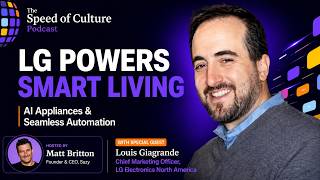
In a live CES 2025 interview, Adweek’s Matt Britton talks with Luis Villagrande, Chief Marketing Officer of LG Electronics North America, about the company’s strategic shift from a hardware‑focused business to a "smart life solutions" ecosystem. Villagrande explains how LG is redefining its brand identity around the mantra "Dive in, smile first," emphasizing human‑centric innovation, proactive AI‑driven care, and "affectionate intelligence" that makes voice interaction feel natural. The conversation covers the evolution of CES from a trade‑show to a ideas‑exchange, the need for cross‑brand smart‑home interoperability, and the challenges of commoditized TV markets. LG’s ThinQ platform, personalized experiences, and new content‑creation workflows (including micro‑influencers and AI‑generated assets) are highlighted as ways to stay relevant. Villagrande also details internal organizational changes—ownership‑experience teams, lifecycle marketing, and tighter integration with customer service—to move beyond transactional messaging toward long‑term solution‑based relationships. The interview ends with a reflection on the brand’s core values of uncompromising customer experience, human‑based innovation, and optimism for 2025.
Chapters
We're here live in Las Vegas at the CES Show 2025, and we're thrilled to chat with Luis Villagrande, the CMO of LG Electronics North America. From spearheading digital transformation to launching cutting-edge campaigns like Switch for Good and Live Beyond, Luis is at the forefront of innovation and marketing and consumer culture. So great to see you, Luis.
Pleasure to be here. Thank you.
Absolutely. So I imagine this is not your first CES.
No, I think it's, uh, in the 20s at this point. Yeah.
And how has it evolved over time?
Uh, well, the, the reason for coming out here is definitely evolved. Like, there was a, a point early on where this is where you'd showcase new products to retailers and— Sure. And media.
More of a trade show.
Yeah, it really was. And, uh, uh, nowadays it's, um, it's more of a, a place to, you know, bring ideas and people together. Most of our conversations, obviously, with our, our retail partners, even some media happened before you know, we're out here, but this is just a place, almost, you know, a celebration of what's coming on in the year ahead. And, you know, a lot of great meetings happen here because it's a place where we all converge. So, but you're also seeing, we were mentioning this on the way over here, just a difference in who's present, who has boots and who's, you know, demonstrating. I mean, automotive has become a really big part of CES, but media, it really has become you know, a much broader thing. It almost shouldn't be called Consumer Electronics Show.
Yeah, totally. And the timing of which, obviously kicking off the year and all the change and all the innovation kind of bubbles up in the fourth quarter and then everyone's ready to say, okay, we've turned the corner. Yeah, here's what's next. Yeah. What's next for, for LG Electronics? Where are you focused on heading into 2025?
Yeah. So, uh, you know, um, if you, if anyone had heard from a press conference, we've really been, uh, focusing on this, uh, evolution of LG moving from being, you know, a hardware company into what we're calling a smart life solutions company. That's something that was, you know, introduced, uh, a little over a year ago, and it's something that's going to be, you know, part of our future vision for the next, you know, 10 years. It's a, you know, it's a very ambitious endeavor, but, um, you know, we really have to— I mean, most companies have to start thinking beyond hardware. Sure. Anyway, if you're going to survive in this next—
just because of it, it kind of becomes commoditized, the margins get squeezed.
Yeah. And so But where we have a, you know, a really nice starting point is just our product portfolio is really broad, right? So if you make really good products and you're touching so many parts of the home and the office and now, you know, mobility, you really have that foundation to build off of to start introducing how does this all work together? How does it become more of a solution, right? So I think the simplest way to say it is We have to go from being, you know, a good purchase to a great experience for the consumer.
Right. And of course, that requires different muscles as an organization. Obviously, if you're just a component company, you just have to, you know, be good at manufacturing, supply chain, etc. This involves consumer experience design, leveraging data, software development, etc. So how has LG evolved in that realm? And within that regard, what is the ultimate vision of being a smart life solutions company?
Yeah, so, you know, it's really catering to a consumer. Well, one of our mantras is like innovation for a better life. So how does, how do we bring our innovation to make your life run smoother, be easier? You know, they talk about the kitchen being zero labor. How do we start reducing the, you know, the challenges or the work that has to happen in the home? But a lot of this is kind of 'Cause it's interesting, we're talking about catering to consumers' needs. A lot of this is also finding, proactively finding what they need before they know they need it. Yeah, so that's where we're ultimately headed. But right now it's being able to cater to the most immediate needs and tie these all together in a way that makes sense. I mean, we've been talking about smart home for a while. It's not something that's new and groundbreaking. AI helps a lot with just making it make sense. You know, where do, why do these products need to talk together? You know, how does it, and has it really benefited your life beyond, you know, you're just alerting you when the laundry's done, you know? Right.
So, so the set's been cumbersome. Yeah. And most people are not technically savvy. They're intimidated by it. And I think that we thought voice was gonna be the solve. I would argue voice was not outta the gate what we thought it would be. Yeah. But now with AI, you know, you talk to ChatGPT, even you talk to Alexa and Siri, it's much better experience now. Is voice at the center of how you see the consumer interacting with the smart home?
Yeah, definitely. I mean, I think just, you know, AI's at the center, like just making it, figuring out how they work together. So voice is a huge part of this. It's, you know, we're sort of trying to look at AI a bit different. We're calling it affectionate intelligence instead of artificial intelligence. Yeah. And because we want it to be, As natural as AI can be, you know? So you're saying is voice at the center of it? It is in the sense of we want the conversation to be a real conversation with LG's products and infrastructure. So in that sense, yes. But yeah, there's a lot that goes on behind the scenes. Voice is just the commands and getting the products to execute the commands is the tricky part.
Yeah, of course. So, and of course with the smart home interoperability, yeah, it's huge 'cause not everyone's just gonna own LG devices and appliances.
No.
Yeah.
We all have to really start thinking about how to work together and, you know, everyone's trying to, you know, to stake a, a claim in this moving forward.
But Amazon, Apple, Google, you guys, Samsung, there's a lot of players in the space.
Yeah. And, and we, you'd almost be remiss if, if there was one winner, right? We need multiple winners to make this all work. You know, people that work together. If it was just one, if it was just Google's platform that worked, that would be a mistake, right? Or if it was just Amazon. So making sure that there's that work and LG's been really good with partnering with companies to try to find ways to work together on that.
So when it comes to your role as CMO, obviously a big part of your job is packaging all of these initiatives up into a story that consumers understand and care about. What are your thoughts on how LG is going to be positioned to the consumer as it moves away from just a components company to more of an ecosystem or, you know, smart life solutions.
Yes. So, so a couple of years ago, we started looking forward to what is our future vision. And this idea of being a smart life solutions company came forward as our, our goal. There was a realization that we hadn't done a good enough job, speaking to what the brand stands for. Yeah. We, we, we're definitely guilty of here's the latest product, this is why the product's good.
This is why I talk about unique.
Get better.
Yes.
Yeah. And, and our brand was being communicated to consumers through our products. Thankfully, you know, we make very good products.
Yes.
Positive experiences. But the brand was meaning something different to if you're a gaming monitor owner or a $5,000 refrigerator owner or, you know, air purifier. So So we made a conscious effort, you know, in the trades it was LG launches a new brand identity. I'd constantly say it's, that would've been a mistake to do a new identity. What we did is make a commitment to tell the brand story because if you're gonna welcome LG into your home to be part of the solution, then you really need to know what the brand stands for and be closer to the brand than just a collection of products, right?
Sure.
So when we looked at it and sort of, you know, really said, what's our DNA? What do, you know, we stand for? Obviously we're the Life's Good Company and that's our slogan, but it's more of what we're seeing is like the DNA of that is this very sort of optimistic, positive approach to the challenges that the company was facing, but also, you know, in life in general. And that was a nice, organic, you know, platform to build off of. And so now that you're asking like, how do we sort of tell these stories and align it to a brand identity? 3 core values came out of this exercise of digging in and the sort of like rediscovering ourselves. One was, you know, an uncompromising customer experience, which, you know, 10 years ago meant if the product broke, we'd fix it, you know, quickly and get it to you. Now it's like, how do we make the experience, you know, positive on a day-to-day basis? The second one, which I think is probably where we shine the most, is I call human-based innovation, which is we could do a lot of things. LG is a very creative, innovative company, but where they shine is making innovations that really have direct, real consumer benefits, right? So yeah, could we make, you know, gadgets that you'd see in sci-fi movies? Of course, but I, appreciate things where it's, you know, I'd love to use our dishwasher example 'cause it's the least sexy example I could give, but I think it works well is, you know, we were hearing about what was the main pain points of dishwashers. It's loud when it's running and you can't be near it, you're raising the TV volume. It wasn't dry when you, at the end of it, it took too long to wash, you know? And that's what they, you know, that was the innovation they focused on dishwashers, 1-hour wash and dry and quiet operation. And, you know, so at the end of the day, Is it a groundbreaking innovation? You know, maybe, but it's what it really is, is answering what the consumers need. Right. You know, and so I think that's why what makes it good as a marketer is, you know, we do have engineers who are looking at what the consumer's needs are. Makes telling the story a lot easier.
Yeah, sure.
Later on.
Another thing that consumers I think are increasingly in demand of is personalization. Yeah. And I know that's a, that's a big cornerstone of some of your approaches. You have this ThinQ platform that really is about AI-driven features. And I know some of the features enable, you know, the consumer to understand what, how much food is left in the refrigerator, etc. Once we go to a world with, once we go to a world with AI agents, which we are quickly going towards, do you see a world where the appliances are actually doing the ordering? For consumers and, and the smart home then could be more of a smart home of agents that can make your life just more efficient in terms of how you spend your time.
Um, I think it's— that could be it, you know. Um, I think what we want to sort of make sure what we're doing is giving consumers the options, you know, like there should be a sliding scale on what do you want this smart home or this connected home to do, right? In some cases, people might want the most automation and hands-free thing as possible, and others might want really They might not lose control.
Yeah.
Right. Or like we, uh, part of when our, our smart appliances is, uh, now like one of the first things we did is proactive customer care. Like we want the, the products to inform the consumers if there's a, the filter's getting clogged, you know, like before it breaks, things like that. Yeah. So I think that's, you know, sort of your, your baseline and then it builds off of like, you know, improving experience.
Yeah. For sure. So in terms of the consumer and how they're finding about your products and the way that they're purchasing. What are some of the changes that you've seen in terms of their behaviors that are having you rethink the way that you try to capture their attention in 2025?
Yeah, you, you brought up, uh, commoditization before, right? And so in one of our categories, uh, TV, you're starting to see heavy commoditization. Yeah, TV. It's— and so behaviors have— shopping behaviors have changed so much because TVs used to be a very highly considered purchase, right? I'm going to get a new TV. I'm going to put it in the living room. I'm going to move the living room TV to the bedroom.
Yeah.
Crazy. Yeah. And now, you know, the antidote I often say is that, you know, you could go to Walmart to get some eggs and walk out with a 55-inch TV because it was $200. And you're like, oh, we got that third bedroom that I could just throw this in. And so not only is the cost dropping, but the dynamics that, that trickle down of get the latest TV for the main room and then, you know, the older TVs go to— now you're getting like these cheap TVs you just throw in, you know, into the various rooms.
And even the cheap ones are 4K and they look amazing.
Yeah. They, I, you know, like we do very well with, you know, our high-end OLEDs. We're the market leader in OLED TVs. And, but you know, the volume that you're seeing is, you know, in the mid to low. So the behaviors have changed. We see now, about 40% of consumers are spending less than a day researching a TV because of, you know, the price points. So, so we need to— again, this part of this shift is TV is hardware. We can't exist just by having the best hardware. So, you know, our webOS system, we have 300 free channels now within our TV. Like the FAST channels? Yeah, like LG channels. You can just, you know, get your TV connected to the internet and you have 300 channels, you're not paying for it. It's just part of the ad supported. Yeah. Ad supported. And it's, uh, I don't, so you're seeing like our message needs to change for the mid to low end. It's, uh, it's not just the picture quality. Of course that's always gonna be there, but it's like, what else are we providing you beyond, you know, the, the TV, the hardware?
Yeah. It's interesting. I mean, I've been thinking for a while that the TV is just such a missed opportunity because the same reason why Apple was so successful, because they had the last mile. They had their hardware in people's hands. And because of that, they were able to dictate the entire ecosystem. Having your TV in someone's home, you can really drive where their eyeballs go. You can drive the— but you, in order to do that and not have them switch to another input and deal with somebody else's interface, you have to be able to make great software that's easy to use and intuitive. Traditionally, companies that manufactured televisions have not done that.
Yeah. And you're also seeing now, um, I think last year is the first time more consumers are accessing, um, you know, connected television through the TVs, you know, that system as opposed to Fire Sticks. Yeah. You know, and so that, that is the trend that's going on. So we've had a, a head start in really focusing on— I think our, our webOS interface is, is very good and it's, it always, you know, test well with reviewers. Reviewers, especially high-tech reviewers, tend to be early adopters, so they might have been more familiar with some of the stick options. Exactly. Early on. Uh, but you, you know, we have a good interface.
But what you— and consumers are rather not have to plug in it. Yeah. Oh no, just turn it on. They don't want to spend more money switching inputs and all that.
Yeah, it's a little bit Wild West right now with all the different services. I think that'll also sort of converge a bit.
It confuses consumers too. They don't know where to find anything. Then especially you got now you have the NFL showing games on Peacock, Amazon Prime, and they used to just turn on and watch the game. Yeah. And now it's for a lot of Americans, they don't really understand how to sort it all out.
Yeah. I find it funny that there's actually services out there that people, you know, hired to tell them what subscriptions they have.
Yeah.
Because they might have 2 subscriptions without realizing.
Oh, there's so many.
That, that's the point we've gotten to where we're gonna outsource What am I spending my money on?
What's the paradox of choice? And I think the best brands are ones that make consumers' lives easier and they reduce choice. And I think especially in the world of home entertainment, there's just too much choice. There's too much fragmentation. No one remembers their passwords to anything. And you're starting to see a lot of these streaming services have growth deteriorate and they're getting a lot of churn because consumers just don't know how to access it and it's too much for them to think about.
You know?
Absolutely. So in terms of capturing consumers' attention based upon their new media consumption habits, where are you at relative to creating content, leveraging creators, you know, especially with Gen Z, making sure that you can make your brand top of mind?
Yeah. Well, so the content conversation is something we have all the time. I'm sure. Because just like what used to be your baseline asset kit has like tripled. Yeah, like if I'm selling a product now, Best Buy, what we would feel comfortable as our baseline asset kit for any product. And keep in mind, I got 1,400 product pages on my, on LG.com, a lot of accessories, but hundreds of real, like, you know, products. You used to be all right with a few images, a video, and just the content needs have, the expectations from consumers, what we want to communicate to consumers. So, you know, we're really, you know, forced to get into this content factory mentality of pumping out, you know, sort of a real robust robust baseline asset kit. And so we've of course explored, you know, AI options, uh, you know, bringing in, uh, you know, micro-influencers to do videos not for their audience but for their ability to do efficient, you know, uh, content, uh, you know, for us and things like that.
Storytelling.
Yes, right. And just get, you'll get a fresh perspective. I mean, it's, uh, you know, uh, we, we're very good at doing the, uh, professional product demo video. And then, yeah, you see somebody with a phone do a product video like, that's just good. And they did it probably like in 5 minutes.
Yeah. TikTok all day. They want to consume your product content the same way they're consuming all other content.
Yes. Yeah. So I think that you were still growing in that phase, but it's, again, it's a little overwhelming when you're thinking about all the content you gotta create and, and then it's all about differentiating, making sure you're clearly communicating. No one's reading anymore. No one has the patience for video. That's beyond, you know, 30 seconds. So it's really— you have to fine-tune your ability to communicate. I sure do.
Yeah. So shifting gears here, um, and just talking about you and your, you know, journey as CMO LG, how are you spending your time every day? Um, what's the pie chart of your day look like, and what does success look for you in 2025?
Yeah, you know, so again, it's the, um We launch hundreds and hundreds of products every year, right? So a lot of what we do in the marketing team is preparing for launch, working with our retail partners, we're getting ready, content creation's a huge part. We've introduced a lot more brand activity these days. So it's a lot of which what you would expect. I think there's always the organizational elements. We brought up before that it's going to be a big change to get to the point where we're moving from hardware to solution-based. There's a lot of conversations or thoughts about how do I restructure my org to cater to more, to be more solutions-oriented, right? A good example is when the older model, most of your communications are being done at a transactional point, like showing your product, selling your product. If we were going to be a solutions-based company, we have to learn how to talk and communicate at not only transactional phase, but in the mid to late ownership phase. Of course. What am I saying to somebody who's owned a product for 5 years? I don't want to be saying—
What's the customer journey?
Yeah, yeah. I don't want to be saying buy the next product. I mean, there'll be that hopefully at some point, but—
So that's— Lifecycle marketing. Yeah. And obviously the first-party data you're collecting on the consumer and how each consumer is different in terms of what they're looking for and the other portfolio products they have.
Yeah, and so, you know, most, uh, companies, most manufacturers in our industry are, you know, where there's a TV marketing guy and he's just focused on launching TV, you know. So we've started to introduce more like an ownership experience team, right? So team dedicated to not just onboarding somebody with a product but like helping them out, you know, through the lifecycle. That team has to be closely connected to customer service. The customer service integration into the, you know, with marketing is a huge, uh, topic right now for us. Like, how do we make sure we're speaking in— because that's what the experience that somebody has with a customer service agent is going to have more impact on their view of the brand than, you know, 2 years of advertising, right? So how do we make sure that message and communication and that experience is positive? So there's a lot of— the short answer is a lot of thinking beyond the the daily grind is how to evolve into being more a solutions company. What does that mean organizationally? What does that mean communication-wise?
Yeah, a lot of change management and understanding where the future's headed.
Yeah.
Awesome. Well, to wrap it up here, I'd love to know if there's a mantra that drives your professional journey that comes to mind.
Mantras. I mean, when we did a You know, we worked with TBWA on a brand manifesto. They had a line in one of their first videos that said, "Dive in, smile first." And I just thought that was such a simple 4-word articulation of really the brand essence. You know, it's like, I like to equate it to, you know, for sports fans out there, it's like, you know, being a relief pitcher with the game on the line and runners on base. And yeah, at that moment, you know, being able to sort of like embrace it with a smile and—
pressures and privileges, I think.
Yeah, exactly. And, and just, uh, you know, not that it takes away from the moment, but, you know, being able to sort of step into that moment with, with a smile, with optimism and positivity that, you know, things will work out. If, you know, if not, we'll figure it out. So, uh, solution-oriented is probably the, you know, the main mantra. Love that.
Wishing you nothing but optimism and positivity in 2025 for LG. Obviously you're at the part of a big transformation in the company, and I'll continue to watch from afar in terms of the work that you guys are doing. So really appreciate you taking the time.
Yeah, thanks for having me.
Absolutely. On behalf of Susan Adweekin, thanks again to Luis Villagrande, the Chief Marketing Officer of LG Electronics North America, for joining us today here live at CES in Las Vegas. Be sure to subscribe, rate, and review Speed of Culture podcast on your favorite podcast platform. Till next time, see you soon, everyone. Take care.
More from Matt




MikMak’s Rachel Tipograph on Consumer Spending, Retail Media & Holiday Shopping Trends



Jaguar Land Rover’s Charlotte Blank on Luxury, Purpose & Experiential Storytelling



