Liberty Mutual’s Jenna Lebel on AI, Gen Z & Data-Driven Creative
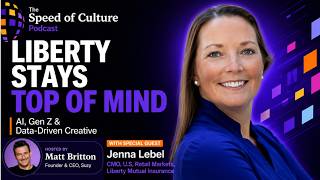
Jenna LaBelle, CMO of Liberty Mutual's U.S. Retail Markets, explains how the company uses data and AI to make insurance culturally relevant. The "Liberty, Liberty, Liberty" jingle tested through Ipsos and Veritonic studies proved highly effective. She's now experimenting with generative AI across creative development, media buying, and targeting, while reaching Gen Z through TikTok and creator partnerships.
Chapters
Up today on the Speed of Culture podcast, we are thrilled to welcome Jenna LaBelle, the Chief Marketing Officer of US Retail Markets at Liberty Mutual Insurance. Jenna's career spans over a decade of innovative marketing leadership where she has successfully shaped Liberty Mutual's brand strategy, driven cultural relevance through humor and creativity, and pioneered partnerships that align with the company values. Jenna, so great to see you today.
Great to see you. Thanks for having me, Matt.
Absolutely. So we've all heard Liberty's TV spots. You'd have to be under a rock to not have heard the "Liberty, Liberty, Liberty" tagline that comes on. But for those in the audience who don't know what Liberty Mutual does, would you mind just giving us an overview of the company?
Yeah, of course. So Liberty Mutual, Fortune 100, over 100-year personal lines insurance company, and I lead marketing for the US side of the business on personal lines.
Yeah. Awesome. And obviously, you know, insurance for the most part is seen as kind of a low engagement category. You know, people don't often brag about what insurance company they have. So how have you found the ability for Liberty Mutual to do such a good job at continuing to contemporize the brand and ultimately make people care and even talk about the brand?
Yeah. You know, as a marketer, I think insurance is one of the most unique categories out there. We do not have a tangible product. We are a need-based product. You're required to have it by law. So no one wants insurance. To your point, they're required to have it and it's something you pay for and you hope you never have to use it. And so in this category, that is, it's low touch. I would say it's low interest to some extent. You know, when we think of the insurance shopping and purchase behavior, consumers are shopping the brands that are top of mind. And so everyone in the category is fighting for that top of mind awareness. And so we as an insurance company, because we don't have that tangible product, we've relied on brand cues to sort of stand as the physical manifestation of our brand. We introduced our jingle, as you mentioned, in 2018. We introduced our spokescharacter duo, Limu-Imu and Doug, in 2019. And that really just unlocked our ability to connect with consumers in a different way, to make our brand, I would say, more approachable, more relatable, more relevant, and given us an opportunity to insert ourselves into conversations that we probably never had a place being in previously.
So I mean, it's so true that almost every insurance company who's been successful has an ad campaign they could point to that's attached to it. There's many great successful products in other categories that you probably can't easily point to an ad campaign to. And I think it's obviously some of the points you mentioned and the clear need for differentiation and the stand out and to be in a consideration set at those key moments. So given all that, it's incredibly important that you do land on the right advertising campaign. How did you know that the current jingle, for example, you had was right to the extent that you can lean into it and have that frequency over and over again?
Yeah, I, you know, it, a lot of people don't know this, but we do, uh, we're a very data-driven company as a, as an insurance company and as a marketing department, we rely heavily on analytics and testing. And so because we are trying to be top of mind with consumers, we want to make sure that we're breaking through and that people are taking away the Liberty brand. And so we actually test all of our ad campaigns, our individual advertising, as well as our jingle in front of consumers. And we're really getting at— for, for the jingle in particular, we're getting at, is it keeping Liberty Mutual top of mind? Is it play— can you play it back? So is it immediately sinking in? Is it becoming that earworm that you repeat back? And then of course, we're getting, you know, additional feedback in that testing environment as well to just make sure that it can stand the test of time. And it really has, you know, I think a jingle is so interesting because of all of the advertising, you know, tactics and tropes. I think it's the one that has been the most effective brand cue. It's It stood the test of time. You can probably think back to jingles you heard, you know, in the '80s and the '90s and play them back right, right on cue. And it's worked for us. You know, an Ipsos study found that advertising with audio branding cues sees an 8.5x uplift in branded attention. And it's been really effective for us. We launched ours in 2018, as I mentioned, and I think our jingle is currently ranked 3rd, according to Veritonic's latest Audio Logo Index. And it's been a really interesting thing to watch it appear in pop culture. And so the late night TV shows is my favorite where you have Jimmy Fallon or Kimmel or Stephen Colbert, you know, singing our jingle. And it's just, you know, it's been such an amazing thing to watch, especially because it only launched in 2018 and it's really just stock.
So what does the world look like in where you take a step back and you say, you know what, it's either time to evolve it or change it? What would have to happen?
We're, we're talking about it. Um, you know, we, we've seen other brands do that pretty effectively even within our category. And so it's something that's, that's always on the table. Um, one of the reasons we would do it is it frees up a little bit of space and breathing room in our advertising. Um, and you know, it's intentional that we have 4 Liberties in it. We're really keeping Liberty top of mind, but We think it could be as effective if it was just one. We've played with it a little bit in some of our advertising. So we did a partnership with the Minions movie franchise, and we had the Minions do the jingle. We've done a TV spot where we had our bad actor guy, the Liberty Liberty guy, play on the jingle. And so we're continuing to look for ways to keep it relevant.
It's interesting that we're talking about jingles. In 2025 at the same time when we've been hit with this huge AI era that is seeping into everything we do in work. And as much as jingles has been part of the history of advertising moving forward, I doubt 10 years from now we're gonna be talking about that, or maybe we will. Just curious to hear in, in a world of constant change, how much of what worked in the past will continue and how you at Liberty Mutual are diving into the future of, of advertising as that is indeed AI powered.
Yeah, it's a great question. I mean, I think a lot of the foundation, foundational elements, like the fundamentals are gonna remain, like the things that worked, the tactics that worked are gonna remain effective for the foreseeable future. I think the how you go about developing them, how you go about optimizing them is going to completely change. And when I think about AI and generative AI in particular and how it pertains to marketing, I think about it in 4 buckets: creative development. There's impact on media buying, of course. There's your standard operational efficiency, and then it's going to have an impact on consumer behavior and consumer trends and how they consume content, how they, how they shop for insurance, etc. And so if I go back to creative development, you know, we've been leveraging it for the creative development process by generating concepts, producing visual aids, rapid iteration, versioning, sizing of imagery. And that's just really accelerated the development process, which has been great. I think there's still a lot more room for us to push. And we're not at a place now where we're doing end-to-end content creation using AI. We will get there. And I think that we're going to take signals from consumers. When consumers are ready for it, we will be there. And so right now, we're doing a lot of testing and learning in the space. On the media buying side, you know, we've for a while now utilized AI-powered platforms both internally and through our external partners and, you know, platforms. And these systems have just allowed us to analyze real-time data to improve targeting, our bidding strategies, budget allocation, just ensuring that we're getting the most return on our advertising spend. And then probably like every organization, you know, there's an operational efficiency component here, just helping to streamline our workflows, automate repetitive tasks, etc. And then the last one is just like staying ahead of trends, making sure we're understanding how AI is changing consumer behavior. And so whether that be how consumers, you know, research, purchase, and shop for insurance, how they think about insurance, like what information they're gathering as they start that process. Like we're monitoring that 'cause that may prompt a change in our marketing strategy to address where consumers are.
Yeah, a lot to unpack there. I mean, when you talk about knowing when consumers are ready for AI-powered advertising, the question to me is when will AI be so good that consumers won't even know the difference, right? Yes. You know, there was one, there was one point where back in the Mad Men days everyone had to draw the graphics and then it became Photoshop. And now who knows if there's a human behind it. And it's the same with music where you don't know really what's electronic dance music generated drum beats or regular drum beats. And that, that's ultimately, and I think ultimately it's about value to the consumer, right? And your ability to speak to them, especially on a personalized basis.
Absolutely. Yeah. I think you're, you're spot on. It's like, One component is the consumer readiness, like the appetite for it. And then I think it's the quality, right? Like, can, can we match the same quality that we do today? And I think we're not there yet on both fronts. It'll take some time, but I know we will get there. And so we're sort of preparing for that eventual state.
Yeah, I think one thing AI unlocks, I would imagine for a company like yours, is you have a lot of data on your customers, right? You know what if they have a motorcycle or not, what type of insurance they have. And I would imagine personalization or hyper-personalization powered by the data you have combined with AI's ability to iteratively create creative and deliver to consumers on a one-to-one basis really does create a lot of potential for your brand moving forward. Where there could be a world where you can combine the two, where you can have your jingle in a music genre that the recipient loves, right?
Yes, absolutely. I, I think endless, endless opportunities for sure.
Yeah. And when it comes to your team, obviously, you know, greatness is in the agency of others and you would not be able to build the brand you're building without a great team, both internally and with agencies. How do you find it is for you as a leader to get them to adopt and move forward? Because obviously there's some people out there that are just freaked out about AI, don't want to move forward. You as a CMO of a major brand have to continue to look forward. How has that experience been for you?
Yeah, I think with any kind of transformation, and I would put this as a major transformation in our generation. And so with any transformation, I think you have different groups of people. Everybody's in a different place with that change curve. And so I think you have to meet people where they are. I think there's a lot of education that has to happen. There's a lot of learning and developing, spending time with it, using it. I've also made it a point to, for me, to make sure I'm highlighting all the ways I'm using it because I think that top-down is going to really help accelerate traction. And so that's something that we're doing. But, you know, I recognize not everybody is there yet. I know I've seen that the more people use it, the more they get familiar with it, the more they understand what it can and can't do, what its limitations are, where, where the opportunities are. I think you start to see adoption really accelerate and then those people kind of become advocates for it. And we've seen that even within the marketing department here is like you have your power users who are just like on their soapbox screaming, but like talking about all the ways they're using it. And that's been really, really helpful to sort of embed it in the way we work.
Yeah. One thing I found is that at a lot of large organizations, employees really can't get their hands on keyboard maybe the way that we'd like them to, because you have, you know, data privacy and security, IT, legal, all these sort of guardrails in place that while we say we want employees to be able to explore and, and test things out, the reality is they really can't. And one thing I've been starting to see is while you are, you know, kind of tied up in your ability to do so in work, at home, you're unencumbered. And I think you're gonna start to see consumers use AI to come up with recipes or manage their schedule or their finances and gain the skill sets at home where they don't have any of the restrictions and then bring that, those newfound skills into the workplace.
I think you're absolutely right. And like even the way I use it is like way different at home than I'm using it at work. And I think at home it's, it's been, you know, it's been really awesome to just uncover the different ways to use it. I was just, the other day looking for birthday gifts and described the person, generated some ideas, latched on to one of the ideas. It was sunglasses. I'm not going to say who it's for. And then I uploaded a picture of this person, asked them to show me an image of them wearing these different models. And that's how I made that purchase decision.
Really smart. So speaking of like moving ahead and looking forward, obviously you have a new audience that you're targeting, which is Gen Z, which is the iPhone generation. A lot of people still look at Gen Z as young kids, but this year actually in the US for the first time, the average first-time mom is Gen Z, right? So they're becoming the heads of the household and they're not people that have grown up, you know, watching TV. They grew up watching their phones and when they're watching their phones, they're looking at content, not really from traditional media, but from creators. It's a whole different world. So when you look at, I guess, continuing to evolve your go-to-market strategy for Gen Z, what does that look like?
Yeah, I love this question. You're, you're spot on. Like the, the way we reached people historically is not gonna be the way we reach people and the way we built our brand is gonna be different too. And, you know, mobile has fundamentally changed how people consume media. I think the stat is like people are on their mobile devices an average of like 3 hours and 50 minutes a day. And then my other favorite fact is that the average person now scrolls through 300 feet of content a day.
300 feet.
Interesting. How wild is that, right?
I'm the king of stats like that, and I've never heard that one.
I'm at the 300 feet. 300 feet. So in this environment where you have, you know, fleeting attention spans and everybody's scrolling through, you have to work harder to capture and keep attention. And so, you know, we've been obviously increasing spend, shifting spend to where consumers are spending time. But we don't want to just be on those platforms, you know, like TikTok or Instagram or Pinterest. We want to make sure that we're designing ads and experiences for those platforms. And so, for example, you know, on, on social media platforms where there's that heavy scrolling behavior, people are scrolling through content very quickly, spending less than a second on it. So we need to make sure we're heavily branded in the first couple of seconds, but also not too branded that they scroll even faster, like making it somehow break through in that environment or on TikTok, where we know the highest performing ads are those that look like user-generated content, right? They're not polished. They're a little bit low fidelity. So instead of us using the production of a TV shoot to shoot some of that, we're having Doug film on his iPhone, him participating in some of those TikTok trends just to make sure that it feels very native to the platform.
And I would imagine partnerships with creators themselves is a huge part of this moving forward just because of their audience and their ability to really sway opinion and consideration in ways that are different but equally as powerful as a jingle could.
Absolutely. Yeah. We, we've explored partnerships with content creators and influencers. We, one of my favorite ones is we worked with a TikTok influencer, Jo Steel, who's a makeup artist. This was around the Halloween timeframe, and Joe basically transformed Doug into Leemu, and it's, it's pretty remarkable. The transformation is unreal. We're continuing to look for ways to do that.
Cool. The other area I was going to get to, which is kind of part of the AI section, but it's really more about product, is how do you see the future of your product experience changing driven by some of these technologies? Because I would think areas like underwriting could be accelerated dramatically through the power of AI, just delivering a better customer experience, which makes your job ultimately a lot easier.
Yeah, I mean, I think the more, the more data, the more information that we get and the easier it is to turn that into better experiences for our customers, we will absolutely do and are starting to do. I think it is going to have a, you know, a huge impact on, on every business, frankly. But Certainly, certainly on ours. And I think the way that people purchase anything in the future, whether that is, you know, CPG, insurance, travel, is going to fundamentally change. And so we're making sure that we're in a place to embrace that change when it happens and be there and creating experiences that are personalized, that are, you know, better than today's experiences.
Absolutely. So I want to shift gears a little bit and just talk about you and your career because, you know, obviously you've been at Liberty Mutual and I know that you worked with my friends Dave and Carrie Kirpin at Likeable.
I knew the name when I saw it and I knew Mr. Youth very, very well.
And yeah, so we crossed paths and obviously what— so what I wanna hear about, and obviously you've been several other places, right, your career, but that was notable to me just based on my background. But like, what is the difference from being part of a scrappy startup where you're trying to be heard and you're coming in every day, and now where you are right now, sitting as a CMO of a Fortune 50 company, as you said, like, how does that change the way that you look at work every single day? And what are some skill sets that you used to lean into more that you don't as much now, and vice versa?
Yeah, I, it's funny, I, I always knew I wanted to be CMO. I wanted to hit it before 30. I didn't quite make it, uh, but I, but I always knew, uh, you know, I, I started in tech startup, agency startup. I knew I always wanted to get on the brand side because I wanted to be closer to decision-making. I wanted to make a greater impact. And what I loved about my experiences at startups and on the agency side is just that entrepreneurial spirit, the ability to come and build something, not have a blueprint. Here's— you don't get handed the playbook on day one and you just execute. And so the opportunity at Liberty has been amazing and completely delivered on that, been able to really make an impact across social media, digital marketing, a lot of the brand strategy and advertising before obviously taking the role as CMO. And I think now where I am, like, I definitely, you know, review creative marketing, think about things from a lot of much different lens. You know, I— we are a very data-driven company. I think I bring to the table both the data and analytics, but creativity. I think creativity is very important, especially in this fast-paced, constantly changing marketplace. Like, challenges are often complex and multifaceted, and I think that requires more, more than traditional approaches to problem solving. So I'm a big fan of creative problem solving. I think listening is the most important thing you can do, whether that's listening to your team, to your customers, to your partners, like to consumers, like, just as much as we can listen, gather those insights, and then I think it allows us to be better marketers in general. And so those are, those are two things right off the top of my head that I'm like, I rely on those every single day, creative problem solving and just the power of insights.
Absolutely. And obviously a lot of people want to get to the CMO seat one day regardless of age, but many people don't, especially not at the level that you're at right now at Liberty Mutual. When you look back on your career journey, what were some of the decisions that you think you made along the way that set yourself up for where you are right now, whether it's relationships or areas of learning that you lean into?
Yeah, I mean, I think to be CMO, you have to be a leader. That is table stakes. And when I think of what makes a good CMO is being able to take those leadership skills and the marketing fundamentals and being able to speak the language of the business. And so making the connections between the value that marketing is driving and how that impacts the business. I think it's important that you really understand deeply the business you're operating in. What are the KPIs and the priorities of the business? Use consistent language, make sure that goals are laddered up to business objectives. So I, when I came into this role, even before I came into this role, I've been on a learning journey. Insurance is a very complicated category, and so really trying to deeply understand it because I think that allows— and not just in insurance, in any category. I think if you really understand your business, it allows you to be a much better marketer. And then I think I've focused a lot of my time, my team's time on being the voice of the customer. There's no one else in the organization who can bring that voice into the organization. And so that's something that has helped me tremendously. I think it's benefited everybody. I think it makes our work better if we're bringing those rich insights in and leaning into what the customer says and wants.
I mean, I think the world is changing so fast right now. And I think, you know, I run a market research company, and I think one misperception that's out there right now is you don't need to talk to the consumer anymore. You can just ask AI. But the reality is actually AI is changing society and culture so fast then now you need to speak to the customer more than ever. Yeah. Because their life is gonna look nothing. Yeah. In 6 months like it does today. And you could make some assumptions based upon that and completely miss in terms of the product you're building or the brand that you're trying to storytell around.
Yes. I 100% agree with that. I think it'll be important more now than, than ever. To your point, just fa— things are moving so quickly. People are experiencing things in, in different, in unique ways. And I think Having that pulse on, on that customer is gonna be critical moving forward.
Absolutely. So Jenna, one more question as we wrap up here is we have a lot of younger listeners here at the podcast, and for those coming to the workforce for the first time, obviously there's so much anxiety. Also, I would argue a lot of opportunity, but it's certainly a world of unknowns. What are some of the skill sets that you think will stand the test of time for the new class of 2025 entering the workforce that you think they should really prioritize?
I'll touch on a couple skills and then I'll give like 3 things that I think would be sort of advice. The skills that I think will stand the test of time, creativity, 100%. That analytical thinking is going to be extremely important. Communication, and what I mean by that is like, yes, I can put into GPT to write me an email,. But I need to make sure that I'm, you know, the intention of that email is matching what that output is. And so crafting that to the right audience, making sure you're hitting on the right points, and getting that message across with clarity, I think is going to be very important. Relationships, I think, are going to continue to be, to be very important. The way we maintain and develop and foster those relationships might change, but I think that will still be critical. So probably those 4 things. And then advice, I would say 3 things. One is master the art of listening, like I said, to customers, to your team, to the market. It's rich with insights. So master that art of listening. Say yes to opportunities that scare you. I think that's where growth lies. I think growth hides in the places that we think are scary. And so just You know, say yes to, to the, the opportunity. And then kind of similar, just don't be afraid to take smart risks. I think if you, if you live in fear, you'll never do the things that make you stand out from the myriad of other awesome people who would want that role.
Uh, all great advice. And I think, you know, despite the fact that it could seem overwhelming, I think a lot of the things that you just mentioned are things that have been consistent since we started the podcast 2 years ago and, and think about how much change that's happened. So I think it's easy to get overwhelmed by all this change, but if you go back to kind of first principles on what makes somebody successful professional leader, a lot of those core tenets remain. Yeah. We often ask our guests at the, at the podcast, uh, if there's a mantra or saying that has guided their professional journey. And to wrap up here, I was wondering what might come to mind for you.
Yeah, I, I actually have it on my wall, but so you can't see it 'cause behind the camera, but it's—
we'll take your word for it.
It's there. I promise. Uh, it is go the extra mile. It's It's never crowded.
So true. You know, like I, I, I do a lot of hiking at national parks and it always is the same thing where you'll have 99% of people stop at the gift shop and go behind the gift shop and just take a selfie. And then 0.9% might go to the paved area and walk around the lake, but then 0.1% will go deep into the woods and capture the real beauty of it. Right. And that's where the extra mile lives. And to your point, not a lot of people do it. In both nature and in business and in life. And I think if you can do that, you're going to be able to stand apart.
100%.
Great. Absolutely. Well, thank you so much for taking the time today. Big fan of yours and big fan of the brand. And you did not disappoint. I can't wait for our audience to hear today's podcast.
Awesome. Thank you so much for having me.
On behalf of Suzy and I, we team— thanks again to Jenna LaBelle, Chief Marketing Officer of U.S. Retail Markets at Liberty Mutual Insurance, for joining us today. Be sure to subscribe right now to Speed to Culture podcast on your favorite podcast platform. Till next time, everyone. Cake time! Hey!
More from Matt




MikMak’s Rachel Tipograph on Consumer Spending, Retail Media & Holiday Shopping Trends



Jaguar Land Rover’s Charlotte Blank on Luxury, Purpose & Experiential Storytelling



