Lowe’s Jennifer Wilson on AI, Retail Media & Modern Home Marketing
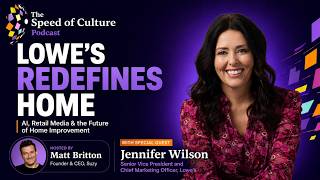
Jennifer Wilson, Lowe's CMO, explains how the company repositioned from construction-focused to a lifestyle brand embracing AI, décor, and aging-in-place solutions. Lowe's built a creator network of 26,000 influencers and uses first-party data to power its retail media network. The brand's NFL partnership and "Earn Your Sunday" campaign connect live sports to home-improvement moments.
Chapters
Up today on the Speed of Culture podcast, we're thrilled to be joined by Jennifer Wilson, the chief marketing officer at Lowe's. With over 2 decades of experience in marketing, Jennifer has led Lowe's to a major transformation, driving growth in retail media, loyalty programs, and cultural partnerships. Jennifer, so great to see you.
Great to see you, Matt. Thanks for having me today.
Absolutely. I've been looking forward to this one. I'm a huge fan of the brand and of your work. Lowe's sits at the intersection of home, aspiration, necessity. The brand kind of means so many different things, so many different people. How has the meaning of home evolved post-pandemic, and how are you sort of adapting the brand narrative to respond to that?
What a great question. So, you know, when you think about the pandemic, home was about safety. It was about, you know, really having this haven or respite that you could go to and and be able to, you know, help block out what was happening around you, I think. And, and while that's still true, right, we all have busy days or difficult and challenging times and we all love returning home. Today, home has really evolved into more of a hub for, particularly for many homeowners, as a hub for how they think about operating within their families. Because of the age of homes today, much of the housing stock rather is, is aging.
You have a big opportunity Jennifer Lowe's, as you know, sits at the intersection of home, aspiration, necessity. It means so many different things to so many different people. How has the meaning of home evolved post-pandemic, and how is the brand adapting its narrative to meet a consumer based upon all the changes we've seen?
Yeah, you know, I think the home played this significant role, as we know, during the pandemic, it became a respite, a place of safety. And while the home still plays that role for families, because everybody understands the concept of home and expects for it to be safe and expects for it to be rest, a place of rest and respite. What we see, particularly in light of the aging housing stock, is that home has become a place where consumers have desires to be able to grow within it. So they want to evolve their home in terms of the future vision. They're evolving their home in terms of who's in the home, whether it's children within the home and especially pets within the home. And so people kind of think of it as a lifestyle, home as a lifestyle. And so I would say it's— we were going from respite to lifestyle. And that's really how I want you to think, Matt, about where we're taking our brand, is that we play an integral, integral role in how people live their life and we want to be a part of that. And really our positioning is all around being the most helpful brand in home improvement because we want consumers, you know, we want to meet them with where they're at in terms of their lifestyle.
Yeah. And of course, when you think about post-pandemic, you know, look at us right now, we are talking on a Zoom-like interface and it's kind of commonplace in the corporate world. And while people certainly use the web to do video conferencing prior, it was just a fraction of what it is now. And now you have more and more people working from home. So when they look at their home layouts, home office is an important part. So I'd imagine those changes also impact the way they look at what their needs are in evolving what their home can do for them.
It's, it's true. I mean, we are, we are certainly and continue to see more and more consumers thinking about how they use their home beyond just their day-to-day lives. But I will also tell you that there's a big resurgence of coming back to in real life, particularly among younger homeowners, millennials and Gen Zers, as we think about even their children, Gen Alpha. You know, consumers want to be back in person. And so we have to think about the mobility and the way that a home can transition for consumers and really the role that our store, Matt, can even play in that experience because we want our store to really be kind of this playground for our customers and for their kids. And, and that's the type of experience that we're creating.
Yeah. So let's talk about that. I mean, you oversee your brand, one of the largest retail marketing engines in the country. What is one long-held assumption about home improvement shoppers that you think is now outdated?
What a great question. You know, I, I think that, you know, there is a notion that Lowe's has long stood for, you know, the construction side of the home, the sticks and bricks, for lack of a better way of saying it. And we are really trying to transform that image, the image of our brand, well beyond those things. Yes, we carry building products. Yes, we can create the exterior and the hard elements of your home, but we also are expanding into Marketplace, where we're, you know, going to have millions and millions of products to surround your home with decor and other aspects and elements. We have, you know, a bunch of breakthrough AI technology investments that we're making so that we can help you visualize your home no matter where you're at and where you want to take your home. And importantly, you know, I think about the fact that more and more consumers today have these big aspirations to make their home a place where they can see themselves aging in place even.
Right.
And so there's, there's just this sentiment, I think, about becoming a more modernized retailer, the investments that we're making certainly in our loyalty program as well. And I'll just parlay that into the fact that when you are an experiential brand, when you want to create these experiences, whether it's coming into our stores like right now during the Christmas timeframe or the holiday timeframe. And you can see larger-than-life displays and where your children can interact with those displays, where you can get free gifts as a loyalty member like this viral mug that's gone crazy on, on, on TikTok, or where your kids can take classes and they can get out from behind the screens and video gaming. They can come in and learn how to make an ornament. Those are the types of touchpoints that we're creating with our brand, and those are super meaningful. So from kind of, I'll call it cradle to grave, if you will, we're trying to make consumers understand that Lowe's plays a role in your, in your lifestyle. And it doesn't have to just be the traditional, I think of Lowe's for building materials.
Yeah, that's interesting. A lot to unpack there. I mean, obviously DIY has always been sort of like a cultural undercurrent. But with the new generation, you know, you look at Gen Alpha, who's going to be born into a world with nothing but AI, and Gen Z as well, put in this category, you know, the way they're going to be adopting AI and we're seeing really consumers of all ages do this is, and you mentioned this, they're going to be staging rooms, you know, through AI and say, oh no, I want to be more modern aesthetic. Oh, I want to be more shabby chic or whatever it may be. Whatever it is, have the vision. But then I think even more importantly, when it comes to DIY, AI can help them through how to fix or do anything on their own because one of the things holding them back in the past was just lack of knowledge. And that lack of knowledge gave them lack of confidence to dive in. But if you go step by step, you— AI can really say, okay, first go to Lowe's, buy this stuff, go home, then do this. And I think it's really— it could be really empowering. And I would imagine a really boon for your business.
Well, and Matt, let me just ask you to pause on the homeowner side and think about our associates. So if you think about an associate who we're hiring who perhaps was intimidated to get a job at Lowe's because they might have needed to know how to wire, how to plumb, or how to help somebody if they've got something, you know, if a toilet is clogged. Well, now all of that information is at their fingertips. And we're leveraging AI, of course, across our stores to really bolster the knowledge of our associates, all propelling or propping up this brand promise of being the most helpful brand in home improvement. And then you put the power of AI in the consumer's hands as well through what we call our My Lowe's companion app or our My Lowe's app on Lowe's and within our app. And now to your point, they are able to get answers faster. It can be anything from a challenge within the home to how quickly could we have a 5-star rated dishwasher delivered and installed, which the answer is next day, to, you know, to other things like help me envision something in my room or help me find the best gift for my dad for Father's Day. And so there's no question that AI is the future. But I think that one of the challenges and one of the things I'm also remarkably grateful for and look up to at Lowe's is that we also have made a considerable investment in the trades communities. And that really is connected to AI in the sense that AI can't be the one who does come and fix your clogged, you know, drain or toilet. You can, and we can empower you as a consumer, or the trade industry can. And so we are making a commitment and investing in our trade community as well so that we can continue to build and empower others across the country to go into the trades and not just think that the only answer is college.
Yeah, I think that's the trade community is gonna have a huge resurgence and a lot of others do as well.
Oh, 100%.
Because in the age of AI, I think a lot of traditional knowledge economy jobs, we're seeing disintermediation. There's certainly opportunity in the corporate world, but it's changing. But I think you're, you know, you still need people to come in and fix your air conditioner or install an HVAC into a building. I mean, there's just, you know, the physicality of that, I don't think is going away anytime soon.
Well, there's, there's one more thing, and I agree with you. There's one more thing that I wanted to add, especially relative to the younger homeowner. And that's just, you know, it's, it's, it's also thinking a little bit about how, where their, their mindset is, for lack of a better way of saying it. And when you think about the way that perhaps we or our parents shopped, it oftentimes revolved around a 3-day weekend. There's this whole notion of doing and wanting to be empowered to be a doer. And that is still absolutely a core customer of ours. And we hope that AI will continue to fuel the, you know, the energy behind those sort of doers or makers. But there's also this younger group of consumers who are like, I'm not really interested in that. I buy based off of impulse. I'm shopping across all of my social channels. I want you to put something in front of me that's just compelling and makes me say I have to have it. And so there's a whole different merchandise approach that we're going to market with as well there.
Things you want maybe versus things you need.
That's well said, Matt. Very well said. And so that is our job as a retailer, is to evolve our offering, not just our assortment, but also how we talk about it to consumers so that we can continue to be relevant, particularly in a marketplace where, you know, we've got a macro environment, at least in the housing market where it is today.
Yeah, I mean, I was going to ask you about that because obviously we have elevated interest rates. I wouldn't call— a lot of people call them high, but if you look at where the interest rates were in the late '70s, early '80s, it's, it's actually fairly low historically, but definitely high in modern times. And because of that, we are seeing less people put their homes on the market and they're staying for longer. How does that change the way that people buy in your category? Because on one hand, I would think that it gives them an opportunity to refurbish and, you know, maybe build that extra room in the house. But on the other hand, On the other hand, they're not moving into a new house as much. And I would imagine that creates some headwinds for the business.
You know, I'll answer it in two parts. One, I would say the one big opportunity for us from a marketing perspective is just thinking about these historical all-time highs of equity in the home and how do we help consumers tap into that equity in their home and really take on projects that perhaps they've been sitting on. A lot of folks haven't touched their kitchen or touched their paint job since COVID And, you know, that's that's been a considerable piece of time. I mean, your grill's perhaps worn out or your patio's worn out. So it is time to just start to refresh. And so we want consumers to think about home equity lines and, and really taking on those bigger projects. At the same time, what we also do see is just upgrades within repair and maintenance. And so an appliance is a great example of that, right? We see just unbelievable, you know, market share value across the competitive landscape in our appliances. We're the number one retailer in appliances, and that's because we see consumers not just come in to replace a standard refrigerator, but then also upgrade it. And you'll see new features and innovation like craft ice in a lot of our offerings or just, you know, every, every year, quarter by quarter, we're rolling out incredible innovation across this category and making the right investments in our supply chain so that we can deliver these appliances, you know, same day, next day to consumers across the country. So that's how I, we think about it is like let's tap into that, those, that home equity and take on projects. And we do see consumers doing that. We want to see them doing more of that. And then we think about upgrading them as they're, you know, going through repair and maintenance cycles.
Yeah, that makes sense. You mentioned Jennifer, social shopping and how you wanna reach the consumer where they are. And this year, for the first time ever, the average age of a first-time mom in the US is Gen Z, which means she grew up with the iPhone in the household, consuming content on the smaller screen. And of course, when you wanna reach people on the smaller screen, it's not through traditional advertising, it's through content. And content on the small screen often means, you know, living in the creator economy and storytelling and a completely different approach than brand building was 20 years ago. How is Lowe's tackling this new challenge of kind of being content first, mobile first to reach effectively the new consumer?
I think just to acknowledge this $250 billion creator economy is just like, you know, you, you have to be astonished at what this has become and, and what the, what the possibilities are. I don't know of many parents whose kids aren't saying they want to be a creator. It's just become, right, like the new career choice for younger generations. But we have recently, you know, earlier this summer launched our Creator Network. We have quickly scaled that Creator Network to over 26,000 creators in a very short period of time since launch. So we're super proud about that. You know, one of the things that we're seeing is just a great diversity between homeowner creators and professional creators so that we're able to balance our storytelling. And importantly, you know, I'll say that our creator network single-handedly helped us have, you know, a very strong holiday season or is helping us have a very strong holiday season. One of the big wins that we saw out of Black Friday was the viral bucket that went crazy across all social And we, within the bucket we gave away, our loyalty members got, the first 50 at the door who lined up got a free bucket. And within that, somebody had the chance to get a golden ticket, which was in exchange for an appliance worth $2,000. And we had Matt Lines, like you'll hear these stories, like the olden days of Black Friday. We sort of, our creator network helped us bring Black Friday back, that magic. Lines, 200, 100, you know, 300 people deep and waiting in line for these buckets. The human interest stories that have come out of the people who won the golden ticket, or even in one case in one of our stores, a gentleman who, who got the golden ticket and had heard of a couple who had hoped to win it, who had just bought their first home, and they tracked them down and gave them the golden ticket. And, and so I share some of this context, just to say that while we would have probably seen great reception to that Black Friday bucket with our own social channels and some of our own advertising, the swell that you can get, the over 200 million views that you can get in a very condensed period of time with a network is just unbelievable. And it really is a testament to where we want to take this, both in terms of being relevant to all of our creators as communities, but having the scale that, that a creator economy or a creator network can give you.
Yeah. And of course, you know, the more things change, the more they stay the same. And what hasn't changed is America's obsession with the NFL. It's still the most watched live show amongst both males and females consistently every year. You know, it, it has a, a power and, and gravitational pull unlike any other cultural property, I believe, in this country. And Lowe's just entered its 7th year as a partner. With the NFL, and you have this campaign called Earn Your Sunday, which you actually teamed up with EA Sports on. I'm a huge fan of Madden, so big fan of that campaign, but would love to talk about that campaign and why the NFL continues to be an area that you think is worthy of the big investment that it carries.
Well, yeah, I'll say first that the NFL is a cultural movement. I mean, what I think the league has been able to do with viewership over the years, what they've done with some of their marquee players, And what they continue to do with their brand is nothing short of just remarkable. And we admire them and really appreciate our partnership. You know, secondarily, it's no surprise that all of the viewership is in live sports today. And we know that there's just a power there to harness that live viewership. And so that's of high interest to us because otherwise you're chasing folks that with, you know, connected content or trying to find them in the right places where we know we have just their attention span for, you know, an hour and a half to 2 2 hours, which is really important to our brand. But importantly, you know, as we think strategically about what Earn Your Sunday means, and that's a campaign that we expect to sustain over the course of the next several years, it really is, you know, so endemic both to the sport but also to what we do as a brand. There's always that to-do list that you've got to get done around the house before you can sit down and have your snacks and watch your game. Chill, right? Chill, yeah. And so whether that's the honey-do list or whatever it is, The question is, have you done what you needed to do? And how can we, Lowe's, as the helpful brand in home improvement, help you earn that Sunday? And of course, our home team players come along for the ride. We have, to your point, expanded into EA Sports because gaming is just an incredible place to pick up additional engagement with the right level of customers. And we're integrating our loyalty program there so that you can earn points through our loyalty program and and engage just in different ways. And then we've also got our new Earn Your Sunday tour bus that's hitting all of the marquee games across the country. And we've, you know, driven just big-time engagement there on site. And so just becoming more immersed and experiential, which is important to us. I think the thing that, you know, that really for me strikes with, with NFL and just our sports strategy is that there's an unbelievable connection, I think, to— or maybe it's an unexpected connection to home and home improvement in the sense that, you know, when we're talking about Justin Jefferson doing a post where we created an oversized ice necklace, he posts this and literally half an hour later we're sold out of this oversized ice necklace in 1998. I mean, it's gone viral. It sold out less than an hour. And so they're just like cultural moments that are so a part of social conversation that the NFL creates. I mean, they create it hourly, if not every Sunday. And so to be a part of that for your brand, I think it's both incredibly powerful but also unexpected for a home improvement brand. And that's what I want. I want people to say, really, that's Lowe's? That's where we're going with our brand.
I mean, that's how you— that's how you etch your place in culture is by doing things unexpected. And obviously with that comes risk. I'm sure that you've taken no shortage of risk, you know, along your path to become the CMO. And how do you look at risk and how do you gain conviction on, on engaging in something that may be a little bit unconventional for a brand that has been around for so long? And I'm sure isn't necessarily one that has an unlimited appetite for risk, that you have to balance those things.
I think the first thing is just studying your customer base and understanding who your customer is, and not just your current customer, but the customer that you wanna appeal to. And as we think about brand preference, which is extremely important and a big priority for us, we have to understand what makes people prefer the brands that they love. And Matt, I'll give you a great example. We heard from millennial moms that they want us to be a brand their kids love. And if we're a brand their kids love, then they'll love us too. Well, how do I become a brand that their kids love when kids don't own homes? I can do that. They don't have to own a home for me to be relevant. The NFL is a great example. Our kids clinics are a great example. The soccer clinics that we offered, you know, that we had the 5 Moves Like Messi during the soccer season that we did in our parking lots where you could show up and learn 5, 5 of Messi's best moves and build soccer goals. You know, those are moments where parents are like, wow, okay, you're, you're a brand for my kids, so you're a brand for me. So that's one way that you just take risks is making sure you understand your consumer and that you're kind of listening to them and skating toward where they're skating. I think a second piece is understanding your brand. And I do have the luxury of probably knowing this brand more than other CMOs because I've grown up here. You know, April will be 20 years. And so I could tell you our brand tone, our brand voice, our brand colors, every single Pantone without even, you know, looking at a document because it's been 20 years. But I don't want to let that get in the way of also pushing the envelope. And what's so important to me is to not be a 20-year veteran as it relates to what we do with this brand. I, I wanna, I wanna be, um, I wanna take risks. They just need to be calculated. And what we need to do needs to be authentic to who we are.
I mean, it sounds like, and you wouldn't be able to be as successful as you are without this approach. You are passionate. About what you do. You're passionate about the brand. When you lose passion, you probably are okay with the status quo. You're probably like, I'll just go into work every day and we'll just do what's always worked. We'll sign up for the NFL again, see what happens. But you're clearly passionate about what you do. How have you been able to keep the spark alive, so to speak, being at the same company over 20 years? A lot of people who I interview on this podcast, they leave every 3 to 4 years and they bounce around, and there's nothing wrong with that, so to speak, but that hasn't been your path. How do you keep, you know, passion and I guess keep that mindset where you're continually reinventing within the same organization?
Well, I have to first give credit to our management team. The management team here at Lowe's, you know, led by our CEO, Marvin Ellison, is just, you know, an unbelievably, unbelievably talented but also motivated group of people who are just looking to be absolute best in class. I think the second thing is that when you're a challenger brand, you have no business working for a challenger brand if you're okay being number 2. And so we hire for people who want to be number 1 because that's what we're going after and that's what we're set on every day when we come in. So I want to hire people who are hungry to win and hungry to be number 1. And then third is, you know, really thinking about what can differentiate us in this marketplace. And again, you know, home, especially during COVID became an even more fragmented marketplace. You're getting some of mass retailers who are getting into home. You're getting a lot of pure plays who are getting into home. And so carving out our special place of what home means and the home marketplace means to us is important. And a part of that, a big part of that is being culturally relevant and trying new things and building strategies that make sense for our customer. So yeah, I agree, passion's a big part of it. But I think also if you are on this leadership team here at Lowe's, you are a, you're a sucker for transformation. And we, we won't rest until we're number one.
Yeah. The last area I want to touch on before we start to wrap up here is the work you're doing in the area of data. I know that retail marketing and your platform you built is a big priority. You have over 38 million loyalty members. Having first-party data in this age is, you know, the new, the new oil, so to speak. Data is the new oil because the ability to use that to drive hyper-personalization, understand your consumer, all those things. Is a huge unlock in the age of AI. So just love to talk a little bit about your retail media network, why it's important to you and the value that it offers to your partners.
Yeah, I mean, we think about sort of our loyalty ecosystem in two parts. One, how do we leverage that ecosystem to fuel a flywheel for the enterprise and make sure that we're getting repeat visits and incremental, you know, trips from our current membership base?. And then we think about how do we monetize those insights and audiences through our media network. We talk a little bit about what we call the 4 Cs. And, you know, consumer data is obviously one of them and how to think about, you know, making sure that we're offering the right level of consumer insights to our advertisers. A big part of that is helping them understand where their untapped audiences are and where their underserved share of wallet, what their underserved share of wallet is. Wall it looks like. So as one example, if I have a gardening vendor where customers are coming in in the spring and purchasing their gardening materials or products but not coming back in the fall when we know that that's a peak time for, for gardening, that's a big opportunity. And so I have a, a dedicated insights team looking into that type of audience insights, fueling pitches in my media network so that we're constantly serving up to our top 30 vendors or top 50 vendors or what we call advertisers these opportunities to go after. So that's one of the Cs. One of the other Cs is cultural relevance, and we've already talked about that today, but it's this notion that within my media network, you can come along for the ride with, with all of my sports investments or with my creator network or with other investments that I've made for a fraction of the cost. Don't pay for the NFL Shield, I've paid for it. Just come up, come be a part of the Earn Your Sunday campaign, and that's a great opportunity for you to have that exposure at a fraction of the cost. You know, another differentiating factor for us is our customer service. And we've just made an incredible investment in talent. We brought on a new leader over the media network, Mary Coco, who comes to us from Sam's and Walmart prior and eBay. So just a long run of ad sales that she's got behind her. And we're going to take this media network to a whole new level over the next couple of years. A part of that is investments in ad tech, to your point, but a part of it is also really harnessing the data that we already have. Matt, it's not just consumer data, it's actually home data too. And can you think about where we can take a media network if you start to also offer up the fact that I can tell you when a home is 10 years old and needs, you know, X, Y, Z replacements and repair?
Yeah, totally makes sense. I think, you know, the whole notion of retail media, obviously the brands, is so appealing because, you know, the way that they used to sell products and build their brands have changed and a lot of brands who sell to consumers don't have the luxury of first-party data. And the fact that you can do and you can leverage that in an omnichannel, you know, form really gives them a huge advantage in driving growth for the business.
Yeah. And I, you know, I think the last thing that I'll— maybe the point that I'll make there is that one of the biggest opportunities, I think, for all media networks, but especially ours too, is just connecting the experience in an omnichannel way. Matt, I think that a lot of the retail media networks who have grown up have become, you know, sort of programmatic performance media networks. And a lot of our advertisers now are saying, I want you to take it to the next level. I don't want to just experience this onsite or offsite. I also want to come into your store and experience it too. So I do think the next generation is connecting that data, of course, but then also making sure that that in-store experiences there. And part of the reason why I think our, our advertisers want to go there is because we are creating these really unique in-store moments, and, and they want to be a part of that. Uh, and so yeah, it feels kind of nostalgic in a way. It's a little bit of like what used to be shopper marketing and what now is retail media and bringing those together. And I think there could be a really big unlock for us there.
Yeah, it's an exciting time to be sure. Uh, so to wrap up here, you know, you've had such a fascinating career and have really done such a great job continuing to evolve the Lowe's brand. And as we've talked about, it can't happen without passion. It can't happen with you pushing yourself and your team to think differently. When you look back at your journey throughout your career, what are some of the things that you did right along the way? Some of the areas that you focused on that put you in the position that you're in today?
Well, I probably did more wrong than right, but that's a big lesson too. Because when you, yeah, when you make those missteps, you gotta take notes and make you don't do it again. But there's a couple of maybe marquee moments for me that I think about. One, I was asked at one point to go back into the business. I was on the marketing side. I was asked to go back into the business. And I had spent about 10 years running different business units at Lowe's, which, by the way, is probably the biggest takeaway is if you can— if you want to move in a fast track, especially in a retailer in marketing, make sure you have business unit experience too, because the fact that you can translate between both of them and not just be living over here in your marketing bubble, it's really critical. The second thing is take the assignment. When I was asked to, when I was in marketing feeling settled, asked to go back to a business unit and fix it, I mean, I, it wasn't what I wanted to do, but I took the assignment. And when you take the assignment, you know, oftentimes that just shows you're an enterprise player and you're thinking bigger than you. And that's a really big takeaway. And when I took that assignment, this is maybe a, a big third lesson., and it was sort of, I knew I wanted to be there for the shortest period of time. I wanted to turn the business around in a rapid way and go back to what, you know, back to the rest of the career path that I was kind of charting. And when I went back, took the assignment, I sort of just took all the badges off. Like, it didn't matter what level I was. And I remember pulling my team into a huddle and saying, all our stripes are off. Like, if you feel like you're above me or I'm below you or whatever the case is, all the stripes are off. And whatever it takes for the next year, whether it's me doing pivot tables or me coming into a store and moving steel and racking with you, whether— whatever it is, pick and shovel work, I'm here for it. And I need you all here for it too. And I think there was this, just this moment of like, we're all equal. We're all at the same— we're just one team. And I'll never forget what that did for my team and for my career because, you know, we just, we turned the business around in less than a year. And then I was right back to what I was, you know, back to the track that I, in my mind, had expected to take. So maybe those are 3 key takeaways.
I don't know. I think those are all fantastic takeaways, especially for people who are starting off on their career journey, for sure. Yeah. So, so the wrap up here, we always ask our guests if there's a saying or mantra that's helped sort of encapsulate their career journey to date. Would love to hear what comes to mind for you.
I do really subscribe to the idea that your career and what you do all day is about lifting up people and putting people first. And I think there are times as leaders where we can come in and have A+ days and where we'll have C- days and we gotta kind of own it. And so I really do, there's two kind of two big subscriptions. One is lift those around you up and don't look to be the smartest person in the room. But secondly, own it. Own every decision that you make, good, bad, indifferent. And I think that those two things have not only helped me in my career, but also they're the sort of guiding force in the decisions that I make, you know, for this brand.
Absolutely. Well, it's been fascinating to hear about your career journey and all the amazing things that you're working on at Lowe's. As I mentioned at the onset, I'm a huge fan of the Lowe's brand and your work, and you did not disappoint today. And I cannot wait for our audience to hear this conversation.
Thanks for having me, Matt. I really enjoyed it.
It's been a pleasure. On behalf of Suzie and I, we team. Thanks again to Jennifer Wilson, the Chief Marketing Officer at Lowe's, for joining us today. Be sure to subscribe, rate, and review the Speed of Culture podcast on your favorite podcast platform. Till next time, see you, everyone. Take care.
Bye-bye.
More from Matt




MikMak’s Rachel Tipograph on Consumer Spending, Retail Media & Holiday Shopping Trends



Jaguar Land Rover’s Charlotte Blank on Luxury, Purpose & Experiential Storytelling



