Lyft’s Brian Irving on AI, Human-First Branding & the Future of Mobility
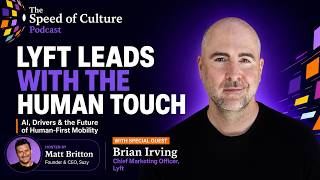
In this Speed of Culture podcast episode, host Matt Britton interviews Brian Irving, Lyft’s Chief Marketing Officer, about the evolution of Lyft’s brand, its two‑sided marketplace, and the broader mobility landscape. Irving explains how Lyft moved from its early “pink mustache” identity to a purpose‑driven, human‑first brand that prioritizes real connections between drivers and riders. He highlights Lyft’s focus on driver experience—citing a 29‑point higher driver preference score—and how the company serves both full‑time and supplemental drivers. The conversation shifts to macro‑consumer trends, noting Gen Z’s mobile‑first habits, lower car ownership, and urbanization, and how Lyft’s multimodal offerings (City Bike, Bay Wheels) complement rideshare. Irving describes autonomous vehicles as being in the “early stadium‑ticket” stage, emphasizing Lyft’s commitment to integrating AVs while still supporting human drivers. AI is framed as a “force multiplier” for marketers: the team creates safe spaces for experimentation, runs AI challenges, and re‑tools processes, focusing on upskilling and critical thinking rather than replacement. Marketing successes are discussed, including the launch of Lyft Silver for older, tech‑insecure users, data‑driven partnerships (e.g., Billie Jean King at the US Open), and a creator‑economy strategy that favors emerging influencers. Irving reflects on his career trajectory—from finance at GE to analytics at Apple, brand work at Google/Meta/Airbnb, and now Lyft—emphasizing curiosity, saying “yes,” and learning from both great and poor leaders. He concludes with a mantra about staying curious and embracing opportunities, encouraging listeners to adopt a similar mindset.
Chapters
Up today on the Speed of Culture podcast, we are thrilled to be joined by Brian Irving, the Chief Marketing Officer at Lyft. Brian's been at the forefront of Lyft's transformation, guiding the brand through an exciting evolution focused on human connection, innovation, and community. From launching Lyft Silver to leading the charge towards autonomous vehicles, Brian's vision is shaping the future of mobility. Brian, so great to see you, and thanks for joining today.
Likewise, my pleasure. And wow, what a setup. Okay.
Let's talk about the Lyft brand. You know, there are some people out there who travel and ridesharing, other ridesharing products, but have never used Lyft. What is different about Lyft that you'd like the audience to know in terms of the product and the brand?
Yeah, I mean, I think that it goes back to the genesis of it, and really the founders thought that there was a better way, like a friendlier way to get around. Um, and you know, to do that, some of the most iconic and probably most memorable parts of the, the origin story of the Lyft brand had to do with, you know, the pink mustache, moustache and that they really encouraged passengers to get in the front seat and, you know, kind of like fist bump with the driver. It really created this human connection between the rider and the driver. Um, and that, uh, it wasn't just about getting from point A to point B, but how you got there mattered. Um, and that the core of that, while, you know, we've matured past the pink moustache that, you know, wasn't relevant for, you know, if you're waking up at 6:00 AM to go to the airport for a business meeting, you know, like—
Didn't this look like leaving the club at 3:00 AM?
Exactly, yeah. So we've matured past, you know, a lot of the early things, but what we have remained true to is the belief that there's a better journey. And, you know, our purpose is rooted in that. It's rooted in getting real humans, enabling real drivers to make real money and to connect with the passengers and passengers to connect to what's most important to them. And, you know, that might be like something really mundane, like getting to a doctor's appointment but it might be something really sublime, like, you know, going to meet your college friends that you haven't seen in 5 years or something, you know? So we really believe that, you know, it comes down to who's on the journey and how we can help them get there better.
And of course, you run a two-sided marketplace. So I'd imagine part of your journey isn't just about getting more riders, but also getting more drivers to join and serve your customers.
You know, what's interesting is that I think, you know, getting more drivers was part of the journey, part of the challenge for quite some time. And now, while we still onboard new drivers at a regular pace, it's really about serving them. Like, you know, again, our purpose is to serve and connect. And so when we think about serving drivers, how do we help them maximize the time that they're spending driving? And whether that's because they're doing it as a full-time driver, right? And this is their primary source of income, or like a lot of folks who are doing it as a way of supplemental income for their family. And whether that's like mom who is maybe, you know, dropped kids off at school and is feeling like a 3-hour time block where she can bring in some additional income for the family or whatever. It's like, how do we help them serve not only their own needs, but serve the needs of the, of our riders? And like, frankly, like. Our driver preference, by the way, is like 29 points higher than other rideshare providers out there. Drivers prefer by far to drive with Lyft because we have a point of view to serve them and how can we help them, uh, get the most out of their time on the road.
Yeah. So let's talk about the consumer for a second because obviously the consumer trends that impact the way that people get from one place to the other obviously have a big impact on your business. And when you look at Gen Z, who is now for the, this year, for the first time ever, average age of a first-time mother in the US is Gen Z. So Gen Z grew up with the iPhone in the household. So they are mobile first, if you will. And you know, they're also less likely to own cars than previous generations, which I would— And also living in an increasingly urbanized culture where people are living in cities longer, there's much more two-income households, people getting married later in life. I would imagine all those things provide tailwinds for Lyft's business versus people who move out to the suburbs, two-car garage, white pickup fence, when maybe they're gonna be using your service a lot less.
Yeah, I mean, for sure. I think that, you know, you're hitting on something which is sort of like the macro trends of the expansion of the audience of like who actually is taking rideshare. I'll also point out that, you know, in major cities like New York and San Francisco, We actually run the bike share business as well. And so we own and run City Bike. We own and run Bay Wheels here in San Francisco, which is also an increasing part of how people get around in the city. And when they are connected to the bike service, they're also much more likely to be connected to us as their preferred rideshare option as well. So it really is like, how do we help people get around in the way that is both, you know, natural to them, but relevant for how they live. Yeah.
And in terms of changing how they're getting around, obviously autonomous vehicles is a massive topic, I'm sure for you and the automotive industry in general. Putting Lyft aside, where are we? What inning are we in, if you will, of the evolution of autonomous vehicles? Being that the 9th inning would be everyone, including your mother, is in an autonomous vehicle, where are we today and how far are we away from the 9th inning?
I think we're all just starting to buy tickets to go inside of a stadium. It's so early and yet super exciting, right? It's like, to play out your analogy there, like the anticipation, the enthusiasm is there, you know, as you're like ready to go into the stadium. Like, you know, something really great is about to happen. And you might be a spectator or you might be a participant, but It is really exciting. It's very early. And I think, you know, for us, it's really thinking about from a rideshare, from an AV partner, like where can we uniquely enable them? And we've had already a lot of really great announcements of things that we're into around like fleet management, stuff that people hadn't initially thought about of what it takes to have AVs on the road, as well as then onboarding all different types of, vehicles, and that might be sort of personal vehicles through to, you know, sort of, you know, sort of like shared ride type vehicles. And the big thing for us is like, we have differentiated ourselves and our brand by supporting our drivers, by supporting like this human-first approach, and we are going to continue to do that. So we're also investing in how do we help bring drivers along the journey not just by, you know, talking at them, but also bringing them into the discussion and helping to shape how we're thinking about our role in AV going forward.
Right, 'cause I would imagine in, there's no world in which you're never gonna want drivers. And you know, maybe it's when you're sending your kids somewhere, or maybe if it's for a longer journey versus a short haul journey in a city. And I think there's gonna be a role for humans obviously in transportation, But there's also gonna be an increasing— and I, the same analogy exists for business, you know, like I run a software company and we have people that are worried about their jobs. We have customers that are worried about their jobs. And the question is like, what does upskilling actually mean as technology, as AI takes a bigger role? And I'm sure AI's a big driver of autonomous vehicles. I'm also sure it's a big driver for your seat as a CMO in terms of how you're thinking about your business. So how has AI impacted your life on a day-to-day basis? And where do you see that same question being in 5 years?
Yeah, I think we're all kind of like going through this journey of like probably looking at, there was a lot of overhype early, you know, maybe like a year and a half, maybe 2 years ago, like a lot of hype with a lot of, now a lot of substance. And then to your point, like a lot of, well, I, I absolutely do not believe that this is a, should be a strategy that I will ever lead around marketing, which is like, you know, fear, uncertainty, and doubt. But it is absolutely has to be recognized to your point of team members who are wondering like, is AI coming to replace their job? And I think where we really are, and I just, you know, came out of a meeting with my whole team talking about this, where we're going is like, we really should think about what AI can do to unlock the multitudes of our own individual potential. And if you think about it from a—
A force multiplier on our, on our skillset.
100%. And if you think about it as like all of a sudden, maybe whether it's 100, whether it's 200, maybe it's 50, you have like 100 new employees working for you who work 24 hours a day and have a vast array of skillsets that are at your fingertips and you are prompting them to do their best work. And we And we have to think about that way. Like we have to think about like an employee from day one doesn't come in and do everything exactly like their best. You have to condition them, train them, talk to them to unlock that. And so I think, you know, we're now on that journey of what the possibility is. I don't even know if I can talk about 5 years now, 'cause I think even in 6 months and a year from now, all the things that we say, ah, there are limitations here, not quite there yet, I think they're gonna be solved. And so like, I think even like long-term planning is really like 6 months and a year when we're thinking about AI.
What are some of the challenges that you are finding? Just, you know, it is early days in AI.
Yeah.
With getting your team to embrace change, to, to, to accept the fact that what got us here won't get us there and, and how you're dealing with that as a leader.
Yeah, I think so. I think my job is to help provide a safe space, right? I think first and foremost that again, like this is not about someone coming to take a job, but I think that if you want to continue to have a job in marketing in the future, you should want to be AI native because whether it's here at Lyft or anywhere else, I think any CMO is going to be looking for people who already have experience, like hands-on. So I think really starting to, to, to create the safe space for this to be a learning journey. The second one is thinking about conditioning. So we've done things like like AI challenges for folks to just like go out and explore and experiment and see what happens and comes back. And then we're building out more of the roadmap of like, what are the tools that we should start with where we think we can unlock the greatest potential from our team members? And then how do we do the training, change management, and development with those tools to rethink how we think about processes, incentives, job descriptions, and all of that stuff. So I'd say we're in the messy middle of it right now. But mostly it's really about psychological safety and like thinking like, this is okay. And like jump in. And also like, don't— I think the other thing we discovered is that people kind of felt like they were cheating by using AI early on. Like they were almost like hiding the fact that they were using it and saying like, no, no, no. Like bring this to the forefront, share your learning, share your insights. It's not cheating. It's, you know, it's again, it's, it's enabling.
It's interesting 'cause students were cheating by using AI. My son actually got caught using AI very early days of the AI revolution writing a term paper. And part of me was like upset 'cause he didn't disclose it, but the other part of me was like, yeah, he's doing what we're telling the workforce to do on his own. So maybe he should be applauded for that.
Yeah. I mean, honestly, I do think that there is responsibility for us as leaders. And I have a 6-year-old son, so I'm both, I am really terrified, but also really excited for his potential in the world. But I do think it brings us back to hopefully spending a lot less time sort of like aggregating, pulling things together, organizing.
Yeah.
Yeah. To critical thinking. So like, okay, so a, your AI agent might help you develop a go-to-market strategy in 30 minutes, but you still have to do the critical thinking of, is this right for us? Is this right for us right now? Is this the right approach? Is it 80% right? Is it 70% right? So I hope it really brings us back to a place of like helping us do critical thinking as well.
Yeah, absolutely. Which is, I always talk about that being a huge skillset that needs to be developed. Sometimes things like critical thinking, creativity, and problem solving, they're areas that are really hard to upskill in if somebody is just sort of like an order taker, so to speak. So do you find that for certain roles you need to look outside of Lyft to find people? And if so, like, are those people, have you find those people easy to find?
Yeah. I mean, we've been evolving sort of the team here over the last year and a half since I joined already. And so we, we do have a lot of folks who have stayed and has embraced this new journey and they're either bringing their core skills and like, hey, this is stuff that we can't throw out. Like we have to keep these as core, core skill sets and bringing new people in. But I think that Do we have a— I don't think we have— we have a great employer brand. Lyft is an amazing place to work. It always has been. And I think part of it is because it's always been a caring culture, not just about our riders and drivers, but for the people as well that work here. And so, no, but I do think we're starting to look at, as we interview folks, is asking, what experience do you have already using AI to do your job? And even saying, what do you wish you could do? And really, again, like to that point, helping to unlock the critical thinking part of this of, well, you know, I've used Gemini or ChatGPT or Claude or whatever to get this far. I wish I could be able to do this. To me, that helps give a signal on that desire for the thinking and being a future, you know, building the future of what a modern marketer is versus, you know, being stayed in the, you know, what I used to do.
Right, makes sense. So talking about being a modern marketer, and obviously one big role you have as a marketer is getting new customers into the fold and driving more usage from existing customers. And that comes down to capturing their attention and getting them to take action. In that regard, like what has worked for Lyft from a marketing perspective, full funnel here in 2025?
Yeah, I think that it's sort of like both ends of the spectrum, right? Like we have to get the foundation right. Like we have to make sure that we are managing efficiently the customer through the funnel, right? Like, and just helping them, making sure that we are obsessed about every single point of the journey and that we are converting, you know, at a super optimal rate, I think. And what we've gone through over the last year and a half is, is sort of redefining what the future of the Lyft brand is. So pulling from the core of our identity, that's always been true, but also looking at like where we want to go, whether it's AV, whether it's our expansion internationally, whether it's are upleveling to help serve business travelers. It's really thinking like we have to like think about how the brand matures as well. Within that, we are always the challenger brand or we, you know, have been. And so this is the fun part for me, I think, as a marketer, like, you know, there are people that come and say like, oh, we don't have the same budgets, whatever. No, you get to think differently. Like you really get to. And for us, that means being like a purposeful rebel. You know, we are always inspired by our purpose, but we get to challenge the status quo of how to do things. And that comes to life in things like, you know, LiftSilver, which is a new, you know, a new product that is purely targeted towards, you know, my mom and my mom's generation who's like a little tech insecure, who's sort of at the, towards the end of her ability to drive all the time. She's, you know, after dark, she's just not comfortable at all. In Michigan, that's at 4 o'clock in the winter. So like, what, she's not gonna leave her house after 4 anymore? No. And so we're really serving by providing a truly unique service and custom service.
That transcends marketing, right? That's like consumer insight gets baked into the product that delivers value to the customer.
That's right. And then the marketing is something that we then get to unlock, right? And so like one of the things I love, like we launched a, a partnership with Billie Jean King yesterday. Like super timely. I mean, she is like the mother, the godmother of not only tennis, but probably sport as, as a whole. She's already a Lyft customer. So for her, she was like, when you approached her, she was like, this is a no-brainer for me because this is why I already use Lyft. And, you know, and of course, like the cultural timeliness of it being the US Open as well right now, it just is one of these things where I think, you know, driven by data, driven by insight, and then creativity is just like, how do we unleash it? And so I love that.
Has Lyft done a lot of work in the creator economy world given just the, you know, the new age of Gen Z and how they grew up with the phone? I would imagine getting in that newsfeed consistently is an important way to maintain, you know, top-of-line consideration.
Yes, 100%. I mean, I do think like we have one of the strongest social marketing teams out there, including how we work with creators and influencers. We tend not to go for the, you know, sort of like the mega creator, the mega influencer, because it doesn't really align to our brand generally. And so we really think of those who are on the cusp and like as their story arc is starting to rise, really try to work with them and help them break through as much as them helping us break through.
Yeah, for sure. So I wanna switch gears a little bit and talk about you and your career journey. You've worked at, some of the world's greatest companies, and I would put Lyft in that right now, but prior you've worked at places like Google and Meta and Airbnb. Along your Silicon Valley journey, which it seems like you've had, what are some of the takeaways that you've been able to gather from these companies that's made you a stronger leader and a stronger marketer to put you in the CMO seat that you're in today?
You know, I think one, you know, serendipity has got me here. I, you know, I talked about my mom being in Michigan. I grew up in Flint, Michigan, so like there's no chance that I should be sitting here talking to you about me being the CMO of Lyft today, you know? And so like, there's so much that, and so many people that have helped me get here, including, you know, just being lucky, I'll say. The, I think like I've been, I've had these different chapters and I wish I could say that they were really intentional and they weren't, but the first chapter was really rooted in data and performance. Like I started as in finance at GE, you know, going through the financial management training program and then moved into more marketing analytics and CRM and data. That chapter got me to then an opportunity at Apple where they needed those skill sets. But when I got to Apple, then what that unlocked for me was a whole new skill set and learning opportunity around brand and like that brand and product are— cannot be divorced from each other and that it is craft.
Yeah.
And attention to detail more than anything else that matters when, you know, thinking about the brand. And then sort of post that, it's been different versions of bringing those two things together and, you know, informing my sort of perspective on, you know, on marketing and that, you know, being really brand-driven, but outcomes are what matter and that we have to actually impact the brand and what we do and, and not just do things for the sake of creativity.
And when you're at a company like Apple or Google, I mean, these are the world's most powerful innovative companies and you decide to take a leap and do something different.
Yeah.
Like what gives you the conviction to do that when you are already working at a place that has so much potential?
Yeah. I mean, largely again, like it has been, my opportunities have come because someone who I have worked for, worked with before has gone somewhere else or introduced me to somewhere else where it became like a natural sort of opportunity for me to say, like, I've, you know, I could stay associated with this brand. I've had an amazing run and amazing experience here. And what's the opportunity for me to grow and learn more in the next role versus this one? And so it's really been about that. And the analogy I use is that you might be in a room with a door ahead of you and you think that that's the only door that's available to you. So you go through it and you think it's going to be this huge room that you're going to stay in for a very long time, and you find out it's a very small room, but it has 3 other doors that you would never have had access to had you not gone through it. And that one of those doors is the one that gets you to the next one. And so I just like, I'm a firm believer in being thoughtful, but saying yes to things that you think that are going to matter to you and matter to achieving like, you know, where you want to go in life.
Yeah. And, and, you know, obviously you've worked at so many great companies. I'm sure you've come in touch with so many incredible people, talented people that have gone on to do great things. When you think about the most talented people you've interacted with in business and the ones who made the biggest impact.
Yeah.
What are some of the attributes that you think are common across them?
They absolutely care about individuals. You know, they, they are, they know that their success comes from helping unlock the success of those around them first and foremost. And I think that they know that like teams and employees are, are human beings and not, you know, employees and teams, you know, at the, at the core of it. You know, and I've also had like a number of like not great leaders. Those experiences have been equally helpful for me because they've helped me understand what I hope to never represent in leadership of my teams. And then there have been some just incredible people who maybe were, you know, not people that I reported to or were peers. Maybe they were 2 or 3 levels below me, like reporting in, and they helped me unlock a whole new level of possibility, whether it was through a marketing capability that we're, you know, was emerging or whatever. So, you know, really trying to be inspired and learn from all of those that are around.
Yeah. And how are you keeping in touch with all the changes that are happening right now? Obviously, you have to care about people, you need to be inspiring, you need to be able to be inspired, but where do you get your information in terms of this is where I need to lean in, this is where that silver product, you know, I'm sure it came from an insight. Where are those insights coming from?
I will say, you know, we're very fortunate that we have a CEO who is passionate about, you know, customer obsession drives profitable growth. It's core to our brand. And so that is both a mantra strategy and someone who, you know, enables that and inspires that throughout the entire org is a gift. You know, that is absolutely true. I also think like we're super fortunate in the Bay Area. There is an incredibly strong CMO network here across various industries and we get together a lot. We, you know, sometimes it's because other people bring us together, sometimes it's because we bring ourselves together, but we spend a lot of time talking, learning open. There's not— there's no it's not about posturing and whatever, like it is just real authentic, like what's going on.
Great to have that.
It is incredible.
No matter what your role is, to have a group of peers that you can bounce things off of, I think is critically important to identify your blind spots and making sure that you're continuing to level your game up.
Without a doubt.
So Brian, we always end our podcast by asking our guests if there's a saying or mantra that has kind of encapsulated their professional journey to date. And just wondering what comes to mind for you and why.
Yeah, I think like, I'll come back to something I said earlier, which is like, be driven by curiosity and say yes. You know, say yes to learning something new, say yes to the lateral move, say yes to, you know, working with someone who is incredible and inspiring. But I think that it's really easy in a world where there is so much pressure, so much chaos, so much going on to just stay and try to be stable. But I think in hindsight, I always regret those moments when I do that. So I would just, I continue to encourage myself and would encourage others to say yes.
Yeah, and to your analogy earlier, sometimes you will open up a door and you'll find the room is smaller than you thought.
Yeah.
Maybe there's other doors, but sometimes you open up a room through a door that you thought was small and it's huge.
That's right.
And I think a lot of people, I was just telling my son who's just starting in college the same thing, which is don't assume that the thing that you're gonna go to is gonna play out exactly how you think. Cuz the reality is you think that this event or this thing you're gonna go to is gonna be something and it's gonna be something completely different.
Yeah.
And you're gonna have an experience that you never imagined you're gonna have. And I think that goes along to your mantra of just saying yes and putting yourself in those positions.
100%. You actually took mine and made it better.
Thank you. Well, that's what we're about here at the podcast is making each other better. So, well, you definitely have made me a better marketer and leader by just hearing about your journey at Lyft and all the great experience you have in your career. So thanks so much for joining today. I'm really excited for our audience to hear it themselves.
Thanks, Matt. I'm super appreciative.
Absolutely. On behalf of Suzy and every team, thanks again to Brian Irving, the Chief Marketing Officer at Lyft, for joining us today. Be sure to subscribe, rate, and review the Speed of Culture podcast on your favorite podcast platform. Till next time, see you soon, everyone. Take care.
Hey!
More from Matt




MikMak’s Rachel Tipograph on Consumer Spending, Retail Media & Holiday Shopping Trends



Jaguar Land Rover’s Charlotte Blank on Luxury, Purpose & Experiential Storytelling



