MAC’s André Branch on Inclusivity, Artistry & Beauty Marketing
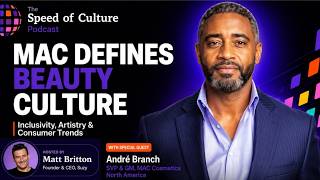
André Branch, SVP of MAC North America, explains how the brand stays relevant through inclusivity and purpose while balancing prestige positioning with social commerce. MAC innovates through product relaunches like Squirt Lip Gloss, QR-code eye palettes, and AR try-ons, while Viva Glam philanthropy now supports racial and environmental equity alongside LGBTQ+ causes.
Chapters
Up today, we're thrilled to welcome André Branch, the SVP and GM for MAC North America at Estée Lauder Companies. With over 30 years of experience leading iconic brands like L'Oréal, Nature's Bounty, and Diageo, André brings a unique experience on staying ahead in the fast-paced beauty industry. André, so great to see you today.
Pleasure to see you.
Thanks for having me. Absolutely. You know, the beauty industry is something that really kind of always intrigues me because it's part function, obviously part fashion.
Yeah.
What drives a successful beauty brand in today's world?
Well, I think first off, being connected to the consumer and understanding really what their needs are, their behaviors, their changes in lifestyle. It's a very dynamic industry, right? It changes very, very rapidly. I think consumers also have a very short attention span in terms of the subcategories that they're into, lip, face, eyes, things like that. So speed to market with product is important, but I also think you need to have strong brand purpose to really stand out. And that's where MAC shines as well. We've got high-performing, high-quality makeup products, but we also have a DNA and a brand purpose that really resonates with our consumers. Been there since it was founded 40 years ago. It's still there today. It's actually even more relevant today when you think about inclusivity, diversity, creativity, community. All these things really matter to our consumers. Mm-hmm. And I think that's what brands need to be successful today.
So in the fashion industry, we've seen a big boom in fast fashion and companies like Shein and Temu really take off. How do you look at sort of the utility and price and value, you know, and how that plays into the overall picture? Because obviously you want to be a certain prestige brand in the beauty category, in the fashion industry and especially apparel. We've seen it kind of go the other way. What are your thoughts on that?
Well, I mean, I think you still have different consumer segments, right? People will want value that may be more price-driven. Some people want value that's more experientially driven. And I think that's where MAC plays, right? We're a prestige beauty brand. We offer the best products on the market, but we also offer an experience. And again, we have that brand DNA that really connects with our consumers, right? We are all about all ages, all races, all genders. We were the first inclusive, diverse beauty brand on the market. We have a very strong purpose and mission, and I think that resonates with folks. And so we bring that value to the consumer. We also have incredible experiences in store. We have the best artists in the industry. We've got 13,000 artists globally. We are known for being the best artistry brand out there.
Yeah.
And so people are willing to pay for that. That's the value that they see in MAC. And so I think, Again, it's all about your positioning, how you're differentiating yourself relative to the market. There are other players out there that don't offer as much, and there's a value equation associated with that. But for us, all those things matter to our consumers.
Yeah. And you mentioned in-store, and you actually took the words right out of my mouth. I was gonna ask you about the channel strategy, 'cause obviously when you look at Gen Z, the first generation to grow up with a mobile device in the household, obviously very digitally savvy.
Exactly.
And is much more prone to wanna buy products from their phone, online, et cetera. So have you seen the channel strategy shifting over time and where's your consumer more so leaning into in terms of purchasing your product?
Yeah, but I would say first off, you know, Mack is a brand that really appeals to all different consumer segments. We've got Gen Alpha all the way up to what we call our ageless consumer, right? 45 plus, if you will. And so each one of those consumer demographics have a different shopping behavior, right? And our goal is to really service them wherever they want to be serviced. So we're in the traditional channels. We're also in some of the newer channels. If you look at Gen Z, if you look at Gen Alpha, they're shopping on TikTok, they're shopping on Instagram. We're there. They're in specialty multi, we're there. They're still going to department store, believe it or not, maybe not in the biggest proportions of some of the other consumer segments, we're there. And so I think the most important thing when you're a brand like MAC is just to make sure you keep a finger on the pulse of how consumers are consuming media, where they're, where they're shopping, what's their consumer journey. It's very, very, it's not linear is what I would say in terms of the consumer journey. So we have lots of insights and research around that. And then when we see things moving, we pivot towards that.
Yeah.
And I think that's what makes us very successful as a brand.
Absolutely. And obviously for you to be successful as a brand, you need to keep innovating with your customer, not only in terms of your distribution strategy, but also in terms of the product itself.
Absolutely.
So when you think about innovation in your category, Obviously you can innovate in a lot of different ways. What does innovation look like to MAC in 2024 and ahead to make sure that your brand is staying up with the times, so to speak, in terms of your consumer needs?
Yeah, there are many ways. I think it's a great question. If we talk about product innovation, again, different consumer segments have different products that they're into. As an example, we just relaunched a very iconic brand called Squirt Lip Gloss, which we had back in the day. We bought it back, we added 9 shades to it, but it's a, like a lip balm, it's a gloss. It's where the Gen Z and, and Gen Alpha consumer is playing today, much more so than the ageless consumer. You know, the ageless consumer's more into lipstick. So we drive product innovation based on where the consumers today are buying, right? We're always interested in recruiting new consumers to our business. We have our core consumer that we satisfy, but we also gotta get the new consumer in. So there's product innovation and that's based on what they're using, what their trends are. I would say there's also innovation in store and just how you experience the brand in the category. So if you go into our stores, we've got digital experiences that most folks don't have. We have augmented reality at shelf where you can try on new trends, new products.
Very cool.
You can customize your palette. You can get your own shades with your name printed on it. We have all sorts of things that allow you to really express your individuality in store. I would also say if you think about online, we've got order online, fulfilled in store, we've got live chat. So we're innovating in technology and how we connect with the consumer there as well. And then I would say also in some of our DNA of the brand, you know, we, we're all about sustainability. As I mentioned, we're all about community. We have been for over 30 years through our Viva Glam program, a supporter of sexual gender rights. We've supported very heavily HIV/AIDS. We've contributed over $525 million globally.
Wow.
Since this program was founded. But what we decided was that, you know, our consumers wanted more from us in terms of the communities that we were supporting, right? So we also added in things like racial equality. We wanted to support that. We wanted to support environmental equality, right? So now we have new partners that we've added into our, Viva Glam program. And our Viva Glam program is an incredible program. It's 30 years old. 100% of the proceeds from those sales of lipstick go straight to that program. We give it out to the organizations that matter to us in our mission. So we're constantly innovating there in terms of the people that we, that we bring on. We've been in partnership with an organization called God's Love We Deliver for many, many years since the beginning. Yeah, it's been a while.
Right?
Just recently we added the Trevor Project. As an example, another one. And so we are constantly keeping our ears to the ground and what's important to our consumers and adding innovation in all of these spaces.
Yeah. What about packaging? I saw a TikTok video, I wanna say a couple months ago where somebody had lip gloss that actually attached to their phone case. Yeah. Yeah. And I was thinking, well, that's really clever. Like when you think about packaging and form factor, has that evolved? And I'm sure that's something that also changes based upon the demographic you're going after.
Absolutely. Absolutely. I mean, first of all, you're gonna see, continued innovation there as well. We just launched not too long ago a Color Connect, which is an eye palette that has a QR code on it.
Right.
So you can buy this palette, you snap the QR code, it actually gives you pro tips and how to use that palette right there. And I think that's really a great innovation. But you're gonna see much, much more coming from us in terms of packaging innovation. A lot of exciting things happening on MAC.
And what about brand partnerships? Because obviously MAC's such a strong brand. I'm sure there's no shortage of brands in other categories that want to partner. And I'm sure there's certain brands that you look at as aspirational. How do you in your role look at partnering with other brands in the ecosystem?
Yeah, I would say that, you know, MAC has always been on the forefront of culture and pop culture.
Right.
Right, it's a big part of who we are. And one of the ways that we bring that to life is through our collaborations. We've partnered with properties like Disney, Stranger Things, Black Panther, We've had lots of celebrity partnerships. You know, we're in fashion, entertainment, art. So for us, that's just part of our DNA. And we're always looking for what's relevant to the consumer, who's driving the conversation, who is influencing.
Yeah.
Right. We just did a collaboration with Chappelle Rowan, for example, with her VMAs and red carpet just recently. So for us, that's a constant piece of, of the brand. That's what consumers come to expect. And I think we were the first to introduce that into beauty and we still do better than most.
Absolutely. And when you talk about celebrity partnerships, obviously the definition of celebrity has changed. The creator culture is obviously a huge category now, and many younger consumers are finding out about new products over TikTok through creators, much more so now than over traditional media. So when you look at your, your strategy going forward in terms of partnering with celebrities, do you believe that the core A-list celebrity is still as strong moving forward? Or are you looking at more of sort of a micro celebrity approach moving forward?
Yeah, no, it's a great question. I think I would tell you that there's a role for, for everyone in this space because they all serve different needs to different, for different consumers. Celebrities will always be part of our go-to-market approach, if you will. You just can't deny the influence and the power that they have with their— Like the A-list celebrities, right? Exactly. Yeah. But influencers have been a game changer for not only our industry, but many other industries.
Mm-hmm.
And the question is how you approach it, right? So what we decided on MAC is that obviously with this group, we wanted to make sure that it was, there were 3 things that, that really defined an influencer relationship for us. The first is that it was an authentic connection to the brand. They really have to like MAC. Right? We want them to really love the brand versus just trying to pay somebody to say something about the brand. That was important to us. The other piece is that we want people with great, great quality content, great creative ideas. That's important for us as well. We have a standard. We still give our influencers and our crew some flexibility there, but at the same time, they're representing MAC, which is an incredible prestige brand.
Mm-hmm.
I think the other thing for us is we wanted people who really embodied the values of MAC. So we talk about inclusivity, we talk about diversity, diversity. If you look at what we call our Matt Crew, which is a collection of influencers and folks that we work with, they are representing the spectrum.
Right.
They are supportive of rights across different many groups. They're advocates. And so I think everyone approaches it very differently. For us, that is what works for us. But they all have a role and we all, we use them very, very effectively across the mix.
Yeah. And speaking of influencers and creators, I was on stage last week with Sophia Hernandez of TikTok and she was telling me just about their vision at TikTok in terms of commerce and social commerce and TikTok Shop and how it's kind of like the new QVC and TikTok, you know, to your point in terms of multi-generational approach, TikTok is not just for young people anymore. It's, it's, you know, they think something like 140 million monthly active users in the US alone. Yeah, it's incredible. Yeah. So when you look at social commerce and I guess bringing, you know, the, the whole creator outreach all the way through the funnel, do you think that's a big part of of just commerce in general? And is that an area that, that you guys are looking at?
It's definitely an area that we're looking at. We're already there. We've been in social commerce for many years now. I think that as these platforms come online, you know, what TikTok has done is just absolutely incredible. You gotta be there innovating, you gotta be there testing and seeing what works with the consumer, right? The consumer wants to shop there, you gotta be there is what we talked about before. So it's important for us. I think, you know, the challenge always is how do you manage all these, these different channels? How do you put the resources against them? And that's something that we're constantly—
It's hard to do everything great, right?
Yeah, yeah, yeah, exactly. But I think for us it's just really around, you know, where do you, where do you, where's your center of gravity relative to your, your consumer target, right? And how do you, how do you allocate your resources there? But I think it has incredible potential. If you look at the growth of TikTok over the last, what, 4 years? I mean, it was almost nothing 5 years ago.
Yeah.
If you think about it, you gotta be in these places. You gotta be, you gotta be playing.
Absolutely. So when you look at just the media mix overall, obviously social's a huge part. TV, when I was growing up, used to be where everybody found out about everything. Is TV still important in a world where so much has time shifted and how much time do you spend thinking about the more traditional linear channels overall?
Yeah, I think, look, all the different platforms or mediums I would say serve a role. I mean, TV still has absolutely a role. I mean, the mass reach there is incredible when you're really spending money on, on big campaigns. I think also, you can be very, very targeted with TV. You can be targeted with any of these mediums now. Really is about who you're looking to—
Highly addressable these days.
Yeah, of course. Highly addressable, very connected. Who you going after? What's your reach frequency goals? Those things still matter, right? The metrics still matter. So I think that all of those mediums play a role. It's really about what are you looking to get done for your brand, right? I think some mediums are better than others at building the brand, at driving equity. Some are just awareness drivers, some are just conversion drivers. So you gotta really think, across the funnel, what is your campaign goal? What are you trying to accomplish?
Yeah. And of course content is huge. And we talked about the creators, we talked about channels. What types of content are areas that you think Mack has a right to play in, in terms of adding value to consumers? So obviously when you think about advertising, you're talking about your product and its attributes. When you think about content, you're obviously thinking about your consumer.
Yeah.
So what type of content does your consumer want and expect from Mack?
Yeah, I think a few things. They're all sorts of, they're all different types of content. What I would tell you is that from MAC, we want you to understand the product intimately, right? We do a lot of content on our own. We want you to know how to apply it. So artistry is a big part of who we are. As I mentioned, we've got 13,000 artists, we got the best in the business. People still need to know how to actually use it and apply it.
Yeah.
This is a big part of what we do. When we partner with our influencers like the MAC Crew, They want someone to credibly talk about the product and whether or not it's gonna work for them. So they're looking for that kind of endorsement.
It has to be believable too. It can't be just they're doing it like one night stand. They're, they're getting money to talk about something they're never gonna talk about as a fan. I think people see right through that.
They do see through it. And so that's why we're very selective in who we partner with.
Yeah.
I think the other piece is that you have to have still within this environment, you know, you, you work with influencers, you work with creators, you give them flexibility and freedom to express the brand the way they want. But I think also as a brand, you should still have a point of view on what this brand is for you.
Yeah.
And what you want people to take away from it. So there's a mixture of here's how we see the brand, here's what we're putting out there in the universe, but also we work with our influencers and they have their own spin on it. So different types of content, still very relevant.
All of it. It's so interesting because some brands you kind of wear after you buy it. Like if you buy a woman wears a, buys a Prada bag, that logo everyone's seeing. Yeah, yeah, yeah. Or Nike sneakers.
Yeah.
But your brand, people don't always know, right? More often than not, they don't know what type of makeup you're wearing.
Yeah.
You know, but the people who are around you don't. And I would imagine that kind of changes the way almost you market it. Everyone sees the Mercedes logo in your car, but your product really doesn't kind of carry over that way. Or does it? Like, do you expect the consumer to tell people that they're wearing MAC? Do other consumers just know? And how do you look at that overall? Yeah, yeah, yeah.
I think, well, word of mouth has always been the way MAC grew its business.
Yeah.
And that's still relevant today, right?
Sure.
People say, wow, that lip gloss on you looks amazing. Who is it?
Right?
That eyeshadow. Right. That's what you want. You know? Yeah. The pigment, look at the glimmer in that. Like, wow. Like this, you know, we, you can really see a difference in our products versus others. We have such high quality, such great pigment, such high performance. It stands out. And so, they're gonna ask the question. And you know, the word of mouth is still really, really strong with the consumer. And that's what you want. You gotta have, you know, we're, we're, we're a makeup brand, we are purpose-driven, but at the end of the day, you gotta have great— Yeah, you gotta walk the walk, right? Performance. Exactly. And that still works for us.
How involved are you in your role at making sure that that's the case? 'Cause obviously, you know, you're in charge of driving growth, but you know, you can't, you know, draw water from a stone, so to speak, right? So are you involved in the product development? Process at all before it actually comes to market?
Yeah.
Okay.
I would tell you that there's a huge team and I am one of many who weigh in on this. So it starts with, for example, first of all, our artists. Our artists are on the front lines across the world. They see the trends, they see other products.
Your artists in retail locations?
Across all of them in the stores. We have artists that we send to the fashion shows backstage. Everywhere where someone's working for Mac, they're developing a point of view.
Yeah.
So our product development actually starts with the input and the feedback from the artists. How does this work? Is it working for you as you apply it? No, we need to change this. We should look at that. So that's one piece of it.
Yeah.
We have an incredible product development team and our global team on Mac that does a lot of that. But as they come to us, us being the regional leads, they're sitting down saying, hey guys, here's the product. What do you think? Here's what we're trying to do with this. And we weigh in on that. So it really is a collective community. We've got the best research. The best scientists, the best insights people, the best manufacturers. Everybody is weighing in to make sure that the quality is top-notch.
Yeah.
And everybody has a point of view on it, right? So it's one thing to put it in, in a lab, but it's another thing to actually get it out in the market and see it applied in the real world. And so everybody's offering input and feedback from their perspective, and that works for us.
Absolutely. So let's shift gears a little bit to you and your career, 'cause just looking at your career background, I saw amongst other places you spent nearly a decade at Diageo, obviously amazingly powerful house of brands in a completely different category, spirits. What were some of your takeaways working at Diageo across brands like Smirnoff and José Cuervo and Captain Morgan? And what made you decide to make the leap from being, you know, in the spirits category to then moving over to L'Oréal, obviously, which, you know, started a path in, in the beauty space?
Yeah, I think For me with Diageo, which is an incredible company, by the way, love the company. The spirits industry is the industry that really taught me all about emotional marketing.
Yeah.
Right. No one talks about the liquid. There's no functionality in spirits. It's all emotion. And for me, that's where I discovered the power of brands, right? And connecting with the consumer on some emotional level. And there are different need states within that, on those emotional levels, right? So, That was really, really important to my growth and development as a brand builder. And I made the transition from spirits to beauty going to L'Oréal with fragrance. So it was a very easy transition.
Right.
Because fragrance is the same thing. It's all about the emotion and the, the power of the brand versus any liquid functionality benefit. Right. And so it was an easy transition and that's just continued. Same thing with, again, on a brand like MAC, it's really about the DNA of the brand, what we stand for, inclusivity, diversity, community, sustainability. All these things matter beyond the product.
Yeah.
And that's when you get real brand building. And so it's been very, I've been very fortunate to have worked at some of the world's best companies in these spaces.
And how do you get conviction to make a leap from a place like Diageo to L'Oréal after you've been there a decade and Obviously you keep moving up there. What makes you say one day, you know what, it's time for me to try something new?
Yeah, I think for me, I, I'm just naturally curious as an, as an individual, as a human. And after a while I want to just learn something different.
Yeah.
And when I left Diageo, I felt like I learned everything that I wanted to learn in that space at that time. But one of the things that's been consistent throughout my career is I've always aligned myself with what I would determine is the, you know, the best companies in the world within that space, right? So, and L'Oréal and Estée Lauder companies are incredible companies within beauty, top, top companies.
Sure.
Yep. And they appeal to me, right? So, and I thought as I go into a different space, I could learn a ton from these kinds of, these kinds of companies. Yeah.
So, and obviously in order for you to keep thriving at these world-class brands, you have to continue to develop and grow professionally.
Absolutely.
What are ways that you look to do that and continue to kind of broaden your horizons and your, and your talent?
Yeah, I think, I think it's conversations like this.
Yeah.
You know, staying connected to people who are in different spaces that are feeding you ideas, giving you things to think about. I always counsel my mentees, on taking development for your own career, right? So if there are things you're hearing about, AI, even e-commerce when it was a thing, social media when it came out, the companies sometimes are a little bit slow to kind of get to those things.
Absolutely.
You need to get out in front of it. Go get a book, go read, go sit in a seminar, go to a conference, learn more about it. And I think, you know, when you see these things come up, you gotta really get out in front of it because business is so dynamic. It's changing all the time.
Faster now than ever before. Absolutely.
And I think, I think the, I think, If an organization doesn't have learning agility embedded within it, it's just not gonna be a successful organization. You have to be the same way with your own career and your own development. So you have to take responsibility for that. I think also just, you know, in this world of branding, culture, trends, behavior, things change. You gotta be aware.
Mm-hmm.
Just gotta see what's going on around you.
Yeah, observe it.
Get plugged into all of that, right? You know, consume the media. What are people talking about? What's happening in politics? How are the moods shifting? These things are important. You just have to be a sponge. And I think if you do that, you can stay on top of it.
Yep. And I'm sure obviously in order for you to be successful, you need to be building a great team and developing that team. Absolutely. Yeah. So what have you seen as the hallmarks of great young professionals or newer professionals that come into your org? Like what makes them successful?
Yeah, I think first off, just a hunger to be successful.
You can't teach that though, can you?
No, you can't. But you can recruit for it, right? Self-starters, people who take the initiative, initiative. I think that's really important. They gotta want to learn. They have to be open to feedback. I think they have to be good as part of a high-performing team, right? Because there are no superstars in this space that we all work together and you get there as a team, not as an individual performer. So those are the things that I look for. I think, you know, anybody with that kind of mindset you can take and build into something. 100%.
Yeah. I totally agree. So when you look back on your career, obviously you're in a really exciting role at a world-class company. And I have the feeling that there's still a lot more that's gonna come outta you and your career, which is awesome. Thank you.
I hope so.
Yeah, absolutely. I would bet on it. What were some of the decisions, just looking back, that you think you made right along the way to put you in the position that you are today?
Without a doubt, I think one of the things is that I just took chances.
Right.
I took risks, you know, with my career as long as I felt like it was gonna benefit me in some way. So if I was going to, get an experience that I didn't have, although it may have upended my life in some way, I went after it and sometimes it was tough, but at the end of the day, it really did drive that benefit that I was looking for. I remember, you know, I spent, you know, almost 5 years overseas. You know, Americans typically don't go and do expat assignments overseas.
Yeah.
But it was incredible having international experience and living in different countries. So I think, you know, things like that, taking those gambles really, really paid off for me. And I think, you know, look, you have to bet on yourself. You have to know that things aren't always gonna be predictable. But if you chart your path and you are very clear about where you want to go and what you need to get there, you just take the risk.
Yeah. Yeah. And sometimes people just need to have faith that even if the risk doesn't work out well, they'll get learnings from it.
Yeah, I think that's right. And I think also, you know, with a spirit of resilience and just hard work and just you're gonna grind through and get through it. I think having that push is important too, right?
That's good.
When you get into those tough moments.
Yep. So wrapping up here, Andre, is there a quote or mantra that you like to live by and guide your professional journey?
For me, it is that every day is another opportunity. Like every day you wake up, you can be a better leader, you can be a better father, you can be a better runner, whatever the thing is that you want to do and do well, every day is another opportunity. So you just never give up on yourself. And I think that, level of resilience and determination is something that I live by.
Yeah, well, I'm super glad I got the opportunity to speak with you today. It's been awesome hearing about your journey.
It's mine.
And I've always been a fan from afar, so it's been great to finally meet you and hear from you firsthand. So thanks so much for joining us today.
Thanks so much for inviting me. I really appreciate it.
Absolutely. On behalf of Suzy and Adweek Keen, thanks again to the great André Branch, SVP and GM of Mack North America at the Estée Lauder Companies, for joining us today. Be sure to subscribe, rate, review the Speed of Culture podcast on your favorite podcast platform. Till next time, see you soon, everyone. Take care. Hey!
More from Matt




MikMak’s Rachel Tipograph on Consumer Spending, Retail Media & Holiday Shopping Trends



Jaguar Land Rover’s Charlotte Blank on Luxury, Purpose & Experiential Storytelling



