Mailchimp’s Michelle Taite on B2B Marketing, Content & Brand Growth
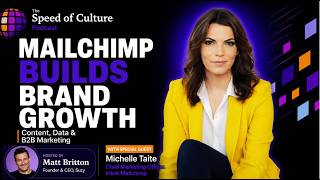
Michelle Taite, Mailchimp's CMO, came from footwear design and Israeli intelligence to build a hybrid B2B brand that uses consumer storytelling tactics. She's evolved Mailchimp from an email tool into a growth platform with AI-powered personalization, and created an in-house creative agency called Wink that produces everything from TikTok videos to documentaries for small-business owners and agencies.
Chapters
Up today, we're gonna be speaking with Michelle Tate, the CMO of Mailchimp. Michelle, thanks so much for joining us today.
Thanks for having me.
Absolutely. I'd love to start by getting to know a little bit more about you and your background. Apparently you started off as a footwear designer, not naturally the path that most people go into when they would end up one day as CMO. Talk to us about that, you know, original thesis of yours to be a footwear designer and how it led you to where you are today.
Yeah, so it's funny. If I take one step back, I'm actually originally from Israel. I spent 2 years in the intelligence force there also. Oh wow. Not super traditional. And so I think that experience at such a young age sort of got me interested in sort of understanding why people do what they do and sort of what makes them tick. And that coupled with coming from a modest/poor background got me interested in product design because in my mind it creatively exploited constraints. And it allowed you to create new experiences that weren't necessarily built off of more space or more money. And so, yeah, I, against all my parents' wishes, said no to law school and—
Me too.
There you go. And moved to London. My dad's British, so I hold a citizenship. I moved to London to study product design. I loved it. I interned for some high-end design firms, realized they were doing more art than design. I really wanted to work on products that touch people's everyday lives. And so Yeah, I was fortunate enough to go work for New Balance and learned a ton about just products, bringing them to market, commercialization, and P&Ls. And the closer I got to marketing, the more I realized that's sort of where I wanted to be and sort of made the move to marketing. And so I did an MBA at the time. I was told that's what you do in the US. I don't know if that's necessarily true anymore. And made my move into CPG. India, where I worked for Unilever for quite some time and spent the last 3 years working primarily on Dove and Dove Body Wash, leading the core body wash business in 135 countries, about $1 billion in sales. Loved everything about it, the mission, the people, the, the work, and then realized that I really wanted to go into tech because tech was moving so much quicker as it related to digital marketing. Um, and so made my way into it, still a company with a, a mission I believed in, serving small businesses and consumers, powering their prosperity. Yeah, and have been working here ever since. Uh, worked on the QuickBooks business, leading brand and product marketing and market research, and found my way into the marvelous, uh, world of Mailchimp.
First of all, amazing story. And obviously being at a company like Unilever for 7 years and being a brand manager there,— you know, it's one of the best places in the world you can work to understand how to manage a brand, everything from the P&L to supply chain to obviously the distribution of the products. And, you know, Unilever's done an amazing job, like, you know, brands like Dove, they've done such a great job at sort of reinvigorating it for the, you know, younger consumer. And I think plenty of case studies afoot there. So you were at QuickBooks for 4 years and that they're more core brands into it, and then you moved over to Mailchimp. As an entrepreneur in the software business, you know, Mailchimp is sort of like the dream company, right? In terms of success story. It was acquired for, I believe, $12 billion from Intuit. But more importantly, this company was basically bootstrapped from the beginning, meaning they didn't raise any venture capital. So in a world where so many companies right now are raising tens or hundreds of millions of dollars to build something of substance, here's a company that basically clawed their way over a nearly 20-year period to create a multi-billion dollar exit When you join a company like Mailchimp after being somewhere like Intuit and Unilever, do you feel the difference of sort of that culture? And how has that changed the way that you go about your work every day?
Yeah, the vision and the mission of Mailchimp is really about empowering the underdog, and serving small businesses is something that we at Intuit are very passionate about, and I was very familiar with working on QuickBooks, which is really a brand where we inspire those who dare to dream to just dream bigger, right? To that extent, it felt very familiar in terms of the DNA of the small business. I would also say the DNA of the two companies was also very familiar as it's, or very similar as it relates to customer obsession. And that is very true also of Unilever, right? Everything starts and ends with the customer, their customer needs, the customer's thoughts and emotions and really solving their biggest problems through innovation, through connection, through tools and services. So it felt very familiar to some extent, and in a way I think Mailchimp brings together the emotion and the soul that you see in CPG brands coupled with the high customer-backed performance that you see in tech.
I think what Mailchimp's done well, and I think it really fits well into your, you know, consumer background. We'll talk about the differences in B2B in a second, but I think Mailchimp really kind of embraced a lot of the consumer marketing principles in building their brand. I think a lot of companies that have B2B software platforms are very much performance marketing based, right? And they're all about cost per acquisition. And what they don't realize is that people buy business software tools the same way that they buy soda or cereal at Walmart, right? They buy from brands they've heard of and who they trust. So, but that being said, what are the distinctions in, in B2B marketing, right? Like, how has that changed, I guess, your approach to building a brand?
So I think that in B2B you're serving multiple customers. You're serving them in the same way. You want to make the right connections. You want to stay true to the benefits that you're providing them in terms of the innovation and the product that you're, that you're bringing to market. But at the end of the day, you might, and at the end of the day, you might be talking to a marketing agency and a small business. Or a marketing agency in, in service of a small business, but you're talking to them in a very human way that connects to their needs. It's just a compounding journey in terms of the value that you need to deliver.
Yeah. And I think before, let's just say in an advertising-driven world, obviously, especially in B2B marketing, it was all about unique selling proposition, right? And you would get into a feature battle and feature war and —now in this world where we're— people are staring at their phones 24 hours a day, it's about content. It's about the stories that you can tell and the consumer stories. I imagine a big piece of your go-to-market for Mailchimp is those customer stories in terms of how they're leveraging Mailchimp to basically drive their business and how you are empowering that underdog?
I think that customer stories serve a need across the customer journey. What we're trying to do is create a connected set of experiences that compound in value as our customers and our prospects get to know us. And retain with us. And essentially what that means is that first and foremost, you're providing the best value in terms of product functionality, whether it's predictive segmentation or email automations or whatever they're looking for, right, in that moment in time to grow their business. Because ultimately they will not speak to you unless you give them that initial benefit. And then it's really about encompassing or supporting them in their journey as it relates to growth of their business, as it relates to their emotional journey, where We know that being an entrepreneur, a larger business or a small business or a marketing agency is not easy. And so we provide content, everything from, we have a small business editorial called Courier out of the UK to, you know, short and long content that is delivered by Mailchimp Studios and Mailchimp Presents. Oh, very cool. As well as podcasts that we create. Yeah, we've invested a lot in content and we've invested a lot in ensuring that our brand continues to create across the board. Specifically, we have an in-house agency that we use called Wink, and it kind of reflects the wink that you see with our logo mascot Freddy, which is about the fun and I would say absurdist nature of our work. Our in-house creative agency creates anything from ads to web design, to the activations that we do in market. There are about 40 people, multidisciplinary, who really believe that creativity has the, has the force to change the world of work. So I think not just thinking about the work that you create, but also about what are the skill sets that you bring into your marketing team is really important as you think about that dynamic between performance and creativity.
And when you talk about the first-party data you have, how does that play a role in understanding what types of content this in-house agency focuses on? Are you using that sort of as a feedback loop to then spit back to your customers the things that are most important to them?
Constantly. And I would say we are most intrigued right now by the fact that people can consume and like consuming content that takes them less than a minute on TikTok. Yeah. And at the same time, they are watching documentaries for about an hour with us, uh, about the making of Walk in the Street. They— or a podcast like The Jump with Shirley Manson talks about different, different singers and musicians and their sort of their first big hit that sort of created the path for their journey. So it's really all about creativity, but in different bite-sized and sort of longer-form content. And we see that because they're on our platform, they're on Mailchimp Presents, our very own— I call it Netflix for entrepreneurs. But we see all that first-party data as well as our performance data and sort of create based off of what we see usage from.
Well, admittedly, I have not consumed nearly as much content from Mailchimp as maybe I should have to date, so I gotta dig into that. But I think that's the strategy, right? You talk about brands need to be publishers moving forward to drive deeper engagement in order to tell your story. Again, it's not about running ads that list all the functionality Mailchimp does. You have to win them over by, by telling those stories and content's how you do it. And the juxtaposition between short-form and long-form content makes a ton of sense. And it's sort of in line with how consumers act in the real world with entertainment-based content. They're on TikTok and then they're, they're bingeing on Netflix, right? They're doing one or the other. And it sounds like you're really trying to mirror that. It's interesting because many people who think about Mailchimp just obviously think of it as an email tool. And when I look at companies like yours, and obviously your competitive set has now broadened because you went from being an, an email tool to being a true platform, right? Moving from that point solution to being a platform where now you have this network of experts and you have domain services and you can build your website. And, you know, there are other companies out there like GoDaddy, which started as a domain tool and they're kind of moving towards the center. Squarespace started as a website tool and now they're doing Commerce, and they're, you know, they're doing domains. So a lot of companies are kind of moving to becoming a platform, and I guess, you know, ultimately there will probably be one winner or a couple winners that come out of it. What kind of drove that decision? Were you on board in 2017 when you were just an email tool, and have you kind of tried to drive that overall awareness as being more of a platform? Was that a big part of sort of your role coming on board?
So we just acquired the company last November, And so I can't say that we took that and molded it. However, we think of Mailchimp slightly differently. We think of Mailchimp as a handy and approachable toolbox, and our customers can sort of pick and choose which tools are the right ones for them and which tools work for them at the right time. And we want that platform to be super accessible to entrepreneurs and to those wearing many hats, but also to advanced and super strategic marketers. Who have really deep skills and need a very deep bench of tools. And we make sure that we, that we connect to our customers across their journey and are continuously learning from them so that we make those tools better. But we're the number one email marketing and automations platform globally, and as such, we have the most amount of data of all of our competitors. What that means for us is that we use AI and ML to make our platform smarter with every interaction that we have with a customer, but also for our customer with every interaction they have with us. It means that we give them predictive segmentation based off of other campaigns that are running at the same time. We— right— able to say, hey, this is the right subject line, or you should make your subject a little more pithy. And we can give them real-time recommendations that no other platform can. And so it's not just about being a platform, but it's about using the data in service of our customers' growth.
That, you know, I hadn't even thought about that, but being the number one email platform, you know, the amount of data, because everyone talks about first-party data and how important it is right now in an increasingly cookieless world, right? So you having that much data and being able to aggregate that metadata to understand these broader consumer trends and identifying audiences really puts you in a distinct competitive advantage against other competitors that are sort of moving towards the center. Now that you say it that way, it's really, it illuminates it for me, the real opportunity that you have, not to mention the first-party data you have across the whole Intuit family, whether it's consumer spending data, et cetera. It creates a, I think, a huge opportunity for sure.
I think that in a world where, in a cookieless world or a world that's going that in that direction, to sort of connect back to your point around content earlier, we're trying to also utilize that content to create first-party data that allows us to then connect to our prospects and our customers in a much more personal way. Where customers are coming to us, and we've been really lucky in terms of how this brand has evolved over the years, and its organic growth through brand, to be able to then now tie that back into performance and acquisition, and then also tie it back to the value we create for those customers.
Yeah, totally makes sense. And you know, just strikes me, you're a CMO of a multi-billion dollar brand, and you're sort of like, you are the customer or you are the prospect that so many different companies out there wanna serve, whether it's ad tech, advertising agencies, media companies, et cetera. And I think, you know, what I believe is that many of these companies that try to talk to or target a CMO to do business with them don't really understand what's important to a CMO. And as a result, they're trying to get to them with solutions that might not be important to them. So I'd love to hear from you, what's important to you? What does help look like for a CMO in terms of how you would work with vendors or agencies? What's keeping you up at night that would make you wanna talk and connect to new partners?
Yeah, you know, I think this kind of surprised me as I started working with Mailchimp from the get-go, because I don't think you realize it until you get closer to the brand. But Mailchimp marketers to market, right? And we're quite a skeptical bunch, I would say. Yeah. And so, I think as I look to market to marketers and I look at the brand to the business to really deliver meaningful tools and innovations, but also just breakthrough marketing as the brand that is setting the example in market for what best-in-class outperformance looks like. Right. I think breakthrough, I think about creativity and I specifically think about where culture meets conversion and where performance meets creativity. That's sort of where our brand and our teams are focused. We're also looking to expand globally, so we're thinking about how we take— we're in 190 countries— how we expand that even further with a product that truly unlocks growth for our customers, whether it's 4 times the orders or more revenue for them. How do we sort of bring that to more and more customers so that we power their prosperity?
Right. In many ways, if you're a marketer by trade and you wanna work with Mailchimp, you are their target customer. So it's pretty easy to get close to the customer because if you're in marketing, you are their target customer. So totally makes sense. So given all that, what's the pie chart of your day look like? What's a day in the life of Michelle Tate?
Ooh, good question. I think My job is interesting in that it brings together what Intuit sort of acquired Mailchimp for and what Intuit is really well known for. And so Mailchimp, known for its creativity, its brand, its immense offering across customer growth as a, as part of, or in service of their business. And then Intuit bringing sort of customer back performance. And my role is really about fusing those two. And so, I think, as I think of my day-to-day, it's anything from how do we drive web conversion to how do we make sure that we are front and center on New York Fashion Week, 'cause that's where creative agency—
Right, almost like the art and science, right? You know, we talk about conversion, you're looking at data, you're looking at things like conversion rates and how do you move that inch, but then if you're talking about Fashion Week or, I saw recently that you're doing something with Major League Baseball. So that's sort of like, you know, that's about art. What's the creative activation? It's a grand platform for you to tell your story.
Yeah. And thinking about new, to your point, new platforms, new mediums, new, new types of media across the world.
Yeah, absolutely. So let's talk about the consumer, cuz obviously when you talk about new platforms, you want to be where they are. How do you, I guess, understand your consumer? So if you're marketing to marketers, What steps do you take to understand what actual marketers want so you can actually deliver on that with your messaging?
Yeah, we're constantly talking to our customers. This is very much in the DNA of Intuit too. We're listening to them, building new tools and services to meet, meet their needs and enhance their experience. We just announced actually recently our Customer Advisory Board. It's an initiative that's focused on allowing our customers to truly, with their voice, guide what we develop for the rest of our customers.
We have one at Suzy as well, and it's incredibly helpful to be able to talk to your customers.
It's super impactful. The insights are just amazing. It's really composed of our highest interests and a lot of high-value partners, and they are across a bunch of industries and business sizes and locations. Like I said, we're global, so it's really important to us not to be US-centric in terms of how we develop those. And so we not only connect with them, but we connect with a bunch of our customers as we do the work. Right? So if we're working on an ad campaign, we are constantly talking to customers and trying to understand their attitudes, their thoughts, their requirements. We also just live the customer, so we have a bunch of employees who have side gigs and are bringing that to work every day. I love that. Yeah, I would say there is not a week that goes by without us speaking to a customer. And then on the other hand, because our platform is so big, we serve 12 million customers. Like I said, we're the number one email marketing automations platform globally. We're also able to take that data and harness it to understand like what are their needs, what are they telling us, but what are they actually doing, right? How do we get better in anticipating their needs and creating the innovation and the, and the feature sets that really answers their requirements without them necessarily saying, hey, this is what I'm thinking about, right?
Like if more of those 12 million customers are using long-form video or short-term video or doing more or less A/B testing or doing some type of promotional activity, you could see it on a macro basis and adjust your toolset accordingly. Exactly. Yeah. I mean, it's fascinating that, you know, to have that type of touchpoint. And again, when you look at other companies out there that also started with a point solution trying to move towards the center, the one thing they don't have, which is sort of marketing goal right now, is that first-party data. So I could see how that would be sort of incredibly impactful moving forward.
And I would say as we connect that with Intuit's data and our end-to-end growth platform, we connect QuickBooks and Mailchimp, we're able to start to think through what are the fintech insights, right? What are the marketing insights and how do they sort of fuel growth? So you could see us in a world where in future we would be looking at your P&L and telling you when would be the right time to, to run a campaign and what funds would you need for them.
And yeah, I mean, that's amazing, right? Or just understanding on a macro basis, I would imagine trends in terms of what people are buying. And I mean, I would imagine there's so many different things that you can unlock with that. Incredibly powerful as a B2B platform, but almost when you talk about 12 million people, it's really B2B for the masses. And it's interesting, you brought up side gigs. You know, conventional wisdom 10 to 15 years ago is that you wanted your employees just to focus on your business. And I wrote about this in my book, YouthNation. I was asked about it a lot, about side gigs. I love the notion of embracing employees' side gigs, because just to think that your dream as a CEO is the same dream as your employees, I think it's shortsighted. Everyone has something they do on the side. There's so much more access to business tools like Mailchimp and the ability to do your own thing. Why have people hide it? And it sounds like that you want your team to actually bring out the other things they're working on because it gives you deeper insight into the core customer.
Completely. And we do this in a few ways. I would say our culture is very, very creative. And so we have people, uh, bringing and sharing their unique skills in the office. And I invite you to come into our Atlanta office. It is exceptionally creative and fun. I'll take you up on that. Anytime. But you have knitting and people biking and cooking, and you start to see sort of the breadth of creativity across, and you create a space, a safe space for that experimentation. And that's core to our business, and we try and show it in our work. I would also say, um, we've brought in our marketing team, we use the hashtag #BeatOurBest And really that's about sort of building on our successes and getting better every day. And you can't do that without having an incredibly open culture that 100% bring their whole selves to work. Right.
So yeah, you can tell, I mean, everything from just like the monkey in the brand to the messaging, it's always been Mailchimp. I always look at as sort of like a very fun and relatable business brand. Compared to other B2B brands out there. I think they've done a great job. The founders have done an excellent job from the beginning. Again, seeing the, those crossovers between business and consumer brands, and it seems like, you know, under your leadership, that's only continued. And I have no doubt that as you expand globally, uh, the success will only continue to, uh, foster Mailchimp. So that's great. Just to kind of wind things down a little bit, I'd love to know in this fast-paced world that we all live in, what are some things that slow you down personally? And allow you to kind of take a step back from work and reflect?
I think just moments that matter, right? Our previous CEO, Brad Smith, at Intuit, used to talk about two types of moments: a crystal moment and a rubber moment, where rubber moments you could sort of like not necessarily make a baseball game or something with your kids and you could bounce back. And there were crystal moments where it would just like shatter. And, and you talk about the The importance of being there and understanding which ones are crystal moments. But I think for me it's just about being, you know, it goes without saying that you make the crystal moments, but making the rubber moments even more frequent is really what slows me down with my boys and my husband.
Oh, that's great. I think it's great advice to do. I think we're always kind of on to the next thing, but I think at the end of the day it is those moments that we have that matter more than anything else. And I think prioritizing them and You know, from hearing you make the most of the little things and understanding what the big things are is a great way of looking at it. So, well, this has been amazing just to hear. I mean, obviously your job encompasses a lot. The platform encompasses a lot. So I imagine that, um, you have quite a busy schedule and I'm super appreciative of you taking some time out and spending with us. So on behalf of Suzy and the Adweek team, I want to thank you for joining us. Be sure to subscribe, rate, and review the Speed of Culture podcast on your favorite podcast platform. Thanks again, everyone. Take care.
Hey!
More from Matt




MikMak’s Rachel Tipograph on Consumer Spending, Retail Media & Holiday Shopping Trends



Jaguar Land Rover’s Charlotte Blank on Luxury, Purpose & Experiential Storytelling



