Mailchimp’s Michelle Taite on B2C Strategies for B2B Brand Building
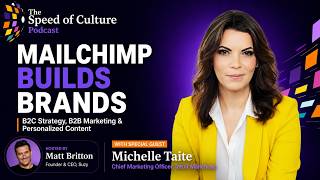
In a live CES interview, host Matt Britton talks with Michelle Tate, Global CMO of Intuit Mailchimp, about the company’s AI‑driven roadmap, data‑rich revenue intelligence, and how Mailchimp differentiates itself in a crowded B2B marketing‑tool landscape. Tate explains how Mailchimp leverages the broader Intuit ecosystem—65 billion daily machine‑learning predictions, half‑million business attributes, and 160 k consumer attributes—to deliver hyper‑personalized, trust‑based experiences. She shares findings from the "Science of Loyalty" study (47% of buyers cite brand trust, 30% repeat purchases stem from rituals) and outlines three pillars of meaningful connections: Soulful Subjectivity, Sincere Personalization, and Shared Courage, illustrated by the "Email Is Dead" London activation. The conversation moves to AI’s impact on email (built‑in vs add‑on, one‑to‑one scale, RevIntel), B2B segmentation strategies (e‑commerce as a torture test, SMB vs enterprise), and the cultural emphasis on experimentation (#BeatOurBest, AI‑generated campaign assets, Clusterable campaign). Tate reflects on her diverse background—from Israeli intelligence to product design, New Balance, Unilever, and QuickBooks—and how curiosity, humility, and a data‑first mindset shape her leadership. Finally, she discusses international expansion (190 countries, SMS, forms, pop‑ups) and upcoming AI capabilities for 2025.
Chapters
We're live here at CES in Las Vegas. I'm thrilled to welcome today Michelle Tate, the global CMO of Intuit Mailchimp. Michelle is a return guest on the show. So great to see you here.
Thanks for having me again.
Absolutely. So how's CES been for you this year?
It's kind of crazy every time around, right? Yes. You don't anticipate it and then it's still crazy.
And when you go to a show like this as CMO of Mailchimp, What are you hoping to accomplish?
Just learn something, right? We, I feel like we go from space to space, space to space, and oftentimes our schedules are so crowded. I just wanna stop and learn and hear a great nugget that I can take back.
And in that regard, obviously everyone's talking about AI here in 2025. We actually talked about AI when you were on our show back in 2022. You're kind of always looking around the corner. What do you, what do you have your eye on next year relative to the Mailchimp product and how you want to continue to bring the product to market?
Yeah, we've been working— AI, like you said, isn't new to us, right? So we've been working on AI for years and years. What's been really exciting in the last, I would call it, year or so and looking forward is how we've sort of connected back to the Intuit platform and then connected the AI capabilities on the Mailchimp platform. So let me take a step back. When we think about the Intuit platform, Intuit owns Credit Karma, TurboTax, QuickBooks, Mailchimp, and we power 65 billion machine learning predictions a day on that platform.
Wow.
That gives us about 500,000 attributes for every business, small or big, that we serve, about 160,000 attributes for every consumer that we serve. And so what that means for us is that we, as we think about powering marketers' success and their growth, we're able to proactively give them revenue predictions and opportunities, what we would call rev intel, right, about here are some of your targets, what they're ready to buy, how they're ready to engage, what you might want to send to them in a very hyper-personalized way.
Based upon their data or anonymized data across all your customers?
Everything. Right. Yeah. And, you know, pair with that, that we're the number one email and marketing automation platform in the world. And I say that not because it's a great claim, but mostly because AI sits on data and it's really important what data it sits on as to how useful it can be to you. Right. So powering or collecting that, connecting that to the Intuit platform has been really successful for us. For us, and that's how we expect to and are continuously innovating for our marketers.
Yeah, I mean, the world of, of B2B marketing tools, it, you know, could be overwhelming. As an entrepreneur myself and, and a customer of many tools, Mailchimp included, what is most important to you in terms of being able to have an effective strategy at communicating who Mailchimp is and what makes the company different amongst a sea of so many other tools out there?
Yeah, I think, you know, you're getting to a question around trust. Yeah. Around proposition. Brand. Right. Brand. You know, we did a study recently, the Science of Loyalty. You can find it on our website. And we talked to consumers and customers all over the world and asked them, what is it that gets you to buy a product? Right. And it was really interesting. And we looked at shopping behaviors. It was really interesting in multiple ways. The first, people are expecting not only sort of hyper-personalized experiences now, but they're actually expecting them to come to them. So if, you know, in the past you could go on a website, you would go to the high street, right, to like discover. Now they're expecting that discovery happens in their inbox. Discovery happens in SMS, right? Like it will come to me if it's relevant to me. I will, you know, they'll find me. It's an interesting approach, right? Especially as those types of relationships are repeat relationships, right? Especially in email. The second is when we ask customers, what makes you buy, right? About 47%, this is a global study, said brand trust. Like everything we like to hear as marketers, right? That they got our proposition, they love us, they trust us. The same amount of people said that it was promotions. So think about that. It's like, wow, free shipping equals trust, right? Right. And so for us, it's like, Well, how do you click down then to the secondary purchase and the loyalty that happens? And what— how do you create that? And what we found was that two things really stood out. One was frictionless purchases, right? And just availability. And the second was how do you get into rituals? Because when you have rituals, 30% of those customers buy you again.
Just right. Just like you order from Starbucks every single day once you get into that consumer behavior flow.
Exactly. And to get to those rituals, you need to think about the customer journey. It's like as a whole on and off platform. You need to think about them not only when they're ready to convert, but when they're thinking about educating themselves on the category, when they're trying to figure out what to do with your product, right? When they're stuck. And so we're thinking about it as a whole across the customer journey rather than just conversion. I think that's what's helped us unlock meaningful connection for our customers.
Gotcha. But in terms of your customer— Yeah, the B2B you know, audience that you serve, what have you found most impactful at getting them to choose Mailchimp for a marketing platform?
Yeah, just creating meaningful connections. And let me unpack that. We found over the last 3.5 years that I've been with the brand that there are 3 pillars to us creating meaningful connections with our customers. One is what we call soulful subjectivity. This idea that, you know, we are a very bright yellow in a sea of blues and greens in B2B. We are an expert of service and we don't take ourselves too seriously. But when it comes to delivering the goods, we do. And we're okay with people opting in and out of, you know, being part of our community. And so we bring our soul to the table and we're okay with people deciding whether they want to become— whether they want to choose us, become part of our— I don't want to call us a cult, right? But our community. And the second is— and that's important, right? Because we as customers have two choices. We can, in any interaction, it could be a transactional interaction or it can be something that's more aspirational. More values-based. Sure. And we want to be in that second bucket. The second pillar is sincere personalization. So communicating to customers where they're at, whether that's on platform and off or off platform in a way that is sincere to them, that is relevant to what they're doing.
It's not just copy, find and replace like you're going to talk to everyone the same, right?
Totally. And the last is what I would call shared courage. You know, lots of— there's lots of research around the fact that when when someone shares an act of courage, it is contagious. And we as a brand have found that when we do things that are a little bit out there, that we take the extra step that is certainly not comfortable, right, that that pays off and that creates meaningful connection. I'll give you sort of an example that ties it all together, because you think about Soulful Subjectivity as creating trust and Sincere Personalization in terms of utilizing data to give value, right, as creating value. And then that last piece on courage is creating a community. We launched a brand activation called Email Is Dead in the UK, and the insight there was that marketers, they care about one of two things: creativity or business results, right? And so business results, we got you covered with ROIs. But as it relates to creativity, we recognize that off-platform, what they were doing in their spare time was they were spending time in exhibits over the, over the weekend. And so we partnered with the London— Exhibits. Exhibits.
Right.
Yeah, it's London.
Right, right.
And so we partnered with the London Design Museum. All of the press keeps asking us every holiday season, is email dead?
Yeah.
And it is very far from being dead, right? Email is the highest ROI channel, $42 to the dollar. It's been around for over 50 years. It's outlasted generations and, you know, software, hardware, whatever you want to look at. And ultimately what we said is, hey, what if we created this exhibit? And the brief to the team was create ice cream museum meets the cultural power of email. Go, right? Would they, would they interact with us? And they did. And we showed them not only the power and the history of email, but also the personal power of email and the business power of email. And email is very personal, right? Businesses are born on email. Like Airbnb was created on email. Yeah. People find their birth parents on email. People find whether they're going to live or die on email. It's kind of crazy, right? We like to say if it happened and it mattered, it most likely happened on email. And then we looked at predictions for the future of email and showcased how it would outlast generations and allow people to write an email to themselves, which we sent back in a year. And this was all sort of a courageous act, right, that was built on sincere personalization based off of where they were at, at what point, and some trust that we had with them. And what we did was we, we truly designed for data. A lot of the brand activations, all of our brand activations are designed for first-party data. It was a free activation, a free exhibit. But if you wanted to interact with some of the quizzes, some of the photo booths, you had to give us your email. Right? Right. It became a nurture pool for us. And that, you know, That's the value exchange. Yeah, but that also creates meaningful connections.
Of course, you're basically not telling, you're showing. Yeah, through a campaign like that. Email definitely is very powerful. There is obviously an AI story around email that there are now all these tools that allow you to build, you know, AI-powered SDRs or, you know, sales development representatives that essentially that are AI-powered agents that write email. And I think that what I worry about as a B2B marketer is that the end customer who we serve is going to get flooded with emails that look personal, but they're really written by AI because the barrier to entry and the cost to create what seems like personalized emails is now so low. So I guess my question is, how do you think AI is going to impact the email channel moving forward? And what are you guys doing in terms of leveraging AI to allow people to do just that, create, you know, customized, personalized outreach at scale?
Yeah. So we urge And we're seeing this behavior, but we urge marketers not to work harder with these tools, but actually work smarter. And what we've seen in terms of the usage of our customers and also the research that we've run is that customers prefer AI that's built in versus added on. Yeah, right. And so that allows you to be hyper-personalized in a way that's more focused. I'm not so afraid of the proliferation of like crazy amounts of emails because there's, you know, one button where you can unsubscribe. So email is a repeat game and that's why the stakes are high, but also especially exciting, right? If— and to our conversation on RevIntel, if you allow— if you know exactly which customers are ready to buy or they're outside of their cycle, but you have an insight around what it is that they're looking to do and you can provide that specific message to them at the right time, at the right place, right? Then you continuously get that trust and compounding trust over time. Yeah, well, I think filter those pieces out.
Yeah. And I think the notion of personalization at scale is ultimately what every marketer is looking for. And I do think technology is such a point now where email marketing will no longer be one-to-many, but it should be one-to-one scale. And my, my email I get from a company should be completely different than yours based upon my history with that company, what that company knows about me. And I would imagine that's a big part of where Mailchimp is going to enable that one-on-one personalization. Exactly. So when you look at just different sectors that you serve, I know that you have a big SMB business and you're also working more enterprise companies. How do you look at B2B customer segmentation and how does your approach vary across different segments that you're trying to bring into the fold for Mailchimp?
Yeah, we work across a bunch of different segments. We look at e-commerce as a torture test for a lot of those segments just because great personalization relies on data and data in. And the more data in that you can provide, the more sophistication that you can create, the less work that you necessarily have to do, the more pointed the outcome is. Right. And so that's sort of what we look at as a torture test. And then we will personalize for different verticals within.
Yeah. And in terms of just the use of your product, you know, a lot of marketing tools that are out there targeting enterprise are trying to democratize the use, meaning instead of it just being used by people in the marketing department, maybe they want brand people to use it or other people. Is that a behavior that you're seeing? Do you see marketing tools like Mailchimp in the enterprise being used by more people just because it's more intuitive and easier to use? Or do you find, especially at larger companies, that they kind of try to control how it's deployed.
Yeah, I think that as you get bigger, you certainly have specific expertise. Right. Right. And those expertise for the longest time have been something that you grew up and sort of did over time. I think AI is becoming an equalizer in a sense.
Yeah, that's my point.
Yeah. Yeah. And, you know, if you take a step back and you think about what AI provides as the equalizer, it provides sort of predictive analytics and generative AI, right? But if you think about the marketer's biggest challenges right now, they're to stick with all the data and realize the insights from the data. Right. And what's been happening is marketing— we've talked about always-on marketing for the longest time, right? And we've talked about insights and data and data fluency. But the reality is that the data is changing consistently or constantly, right? And so utilizing AI to provide those insights based off of that data, that's where the differentiation is going to come in. And I think we've been thinking a lot as a team about— as, as a marketing team, you're looking across the customer journey. You have the privilege of really understanding, is the journey that we're crafting compounding in value for our customer, or are we shipping the, the org, right? And, and we have an opportunity to really connect those silos across the org. And I would say move from consumers of data. And, um, you know, we've talked about data fluency and data savviness and, uh, data-backed marketing for the longest time, to designers of data and being able to partner with the product teams to say, well, this is— well, this is how we, uh, need to instrument the product. These are the points by which we'll understand whether the person is stuck or there's an opportunity to engage, right? And that's where I think there's a, there's an opportunity both for AI to come in and crunch that data and help us personalize. But there's also, you know, the responsibility, I think, of marketers to take a step back and say, are we doing this properly?
Yeah. And I think, you know, you kind of touched on this point, but a lot of people don't have patience when it comes to reading reports and trying to decipher what's working, what isn't. I would imagine another thing that AI can do from an analytics standpoint is allow the marketer to actually see what's working, ask questions, and through some type of chat interface to really understand what's working, what email worked the best, what audience is growing the most in terms of conversions. Sometimes people have a hard time navigating these dashboards and figuring it out, but I think now it should probably become easier over time.
Yeah, yeah. And we ran a study called the Revenue Blueprint, and it looked at who are the marketers, what are the traits and the behaviors of marketers who were driving outsized revenue impact for their organizations? And it sort of came back to that, right, where there are 3 types of marketers that we found in the study. The first were sort of baseline marketers. They would amplify all the current or the basic strategies that you would assume. Everything we know as marketers. The second is performance marketers. They were more data savvy, they were more martech savvy. So they knew how to sort of marry the tools with the data and create more short-term growth. And then the third was a subset of those performance marketers were revenue leaders, and the revenue leaders had outsized impact in terms of the revenue because they actually had a higher usage, about above 85% for both predictive analytics and AI and generative AI and the use of and the combination of those together. So to your point, when you do that, that's when you see the outsized impact. And I think the more that we'll get marketers to do that, the more we'll see the outsized result. Yeah, but it's hard, right? You need to really lean in and do it. Yeah.
And it really is the barbell, as you mentioned, in terms of understanding the data and the analytics that drive business results while at the same time being creative, doing things like you did in terms of your activation and exhibits in London. Like, what is that key insight that's going to get somebody to care about what you're talking about? And I think sometimes you'll see marketers, you know, I guess go too much towards the brand side or the performance side, but you really need both, right? You can optimize all day long, but if if you're not adding value to the consumer, if you're not emotionally moving them, then you're not going to drive them to take any behavior that's going to help your business in any way. Yeah. Yeah. So moving on to you and, you know, your journey at Mailchimp, how has being a CMO changed over the last couple of years with all the evolution that we've seen in the marketplace?
There's a lot more learning, right? I'm a very curious person. If you ask my teams, they'll tell you that like I read way too much and that I ask a lot of questions, but I really believe in sort of curiosity and humility sort of turbocharging each other. This idea that you don't know everything. Sure. And if you ask and you're interested, then you'll learn more. But I think over the last 3, 3 and a half years, just technology has moved so quickly. I know. And being in that space, you need to keep trying and experimenting and understanding what's going on. And so, You know, it, it's just been about experimenting and learning with the team more so than, uh, I would say just coaching, right? Right.
Yeah. Right. And experimenting is like a key point, I think, because technology is moving so fast and there's so many tools out there. And sometimes there's nothing that really replaces just the value of trying stuff out. Right. And actually seeing how it works. I love trying out new tools, you know, the, does the promise meet what you know, the hope is of the product. And sometimes, like, especially now, you see some tools as a business marketer, like, what do you mean I can do that? That's incredible. And it is really moving so fast. You look at like the text-to-video tools that are coming out right now. Yeah, they're just unbelievable. Like Google's Veo in terms of coming up with any type of idea. If you can combine things like that, like video that's completely custom towards whoever you're going and a tool like yours, all of a sudden you can do things that are just mind-blowing in terms of delivering on what you know about the customer with creative that pops off the screen, that gets them to drive conversions. And I think once you can figure out how to synthesize it and put it all together, I think that makes— gives you a real superpower moving forward.
And also just like really being uncomfortable, being uncomfortable all the time, right? Like, which, which may be the case for, for all of these jobs. But I just think with the technology moving so much faster, you just need to lean into that and make sure that your teams know that it's okay to feel that way because that's when the learning happens and celebrate when there are small wins. You know, we have a corny but really useful hashtag on our team. It's #BeatOurBest and we use it with the work together. And the intent is really to just say like, let's do something today that was better than yesterday and tomorrow better than today. And it just instills this instinct to try to do something different and try to outperform in a different way. I was on a call yesterday with my team Zoom, we're onboarding someone new to the team and they said, well, you know, we have this idea that maybe we can teach funnel metrics in a way that's not, or maybe we can teach funnel metrics in a way that's not so boring. And so they created a song through an AI tool with all of the funnel metrics. And I was like, this is amazing. 'Cause they're thinking about multiple ways. I mean, it's just even that, right? And just experimenting with everything that's out there.
I would imagine also a big part of your role in terms of nurturing and growing a team is fostering a culture of experimentation, of learning, because it's moving so fast, much faster than when you are in— you or I entered the workforce. And it's just having people enter the workforce now when you're trying to get your bearings on a tool as sophisticated as Mailchimp, but at the same time trying to get your arms around the dizzying array of new tools and changes that are happening. In our industry right now, it's a lot. And I think, you know, allowing people to have the right type of approach, giving them space to learn is probably the only way to allow people to succeed in this day and age.
And I would say like learn and teach. Yeah, right. We had exceptional success with our campaign last year, the Clusterable campaign that was created with the help of AI. It was created by humans, but let me kind of back back out and explain. We had a meeting, our first sort of let me show you 5 concepts, right? As we get to a brand campaign type of meeting and the team had this idea for a customer campaign that was based off of an insight where we spoke to marketers. The marketers told us they had a customer growth problem and we were like, no, you don't really have a customer problem. You have a customer problem. You're treating all of your customers the same and therefore you're not seeing growth because you're not using hyper-personalization. Right. And so Team came into this meeting and they didn't tell me about it. They showed me it. Think about hearing that from a team. Like you're kind of wondering, well, what does the customer look like? Well, what does it feel like? Can we stretch it this way or that way? No, they use generative AI to sort of pull together what the visuals of this customer would be so that we could have a real conversation. It's like a show versus tell, right? Right. And, and within one meeting, we decided on that concept versus like the 5 meetings it would take us to, you know, narrow down to the final concept. Within one meeting, we decided we were going to launch this, but we needed to research it really well with different countries because customer in Spanish might be something different. And so we took it to groups in 4 different countries. And between the groups and between the focus groups and Quant, the team took the insights that they saw in the focus groups and prompted right, for the optimizations and optimize the research in between the groups. And then what we finally ended up creating with humans, right? And this was a human-led idea, right? But I always say like it's human ingenuity at machine speed. Yeah, right. And it's just allowed us to create a, create a campaign that, you know, has performed like top 5% at Ipsos ads and really, really successful for us. So it's a lot. And the team taught me that I didn't, you know, it's awesome. I didn't come in and say, well, why don't you prompt, you know, and and we'll see how it goes. So I think it's a dual sort of learning curve.
Yeah, the idea of the customer versus the customer too is so cool because you're right. I think when someone says I have a growth problem, that's the outcome, right? You know, that's the symptom. But what is the cause, right? And yeah, more than likely you don't understand your customer well enough or you're not speaking to them in a personalized and/or individualized way. And because of that, whatever message you have just isn't landing. Right. And that's the problem you need to solve, not the growth problem. That will solve the growth problem for you.
Yeah.
Which is interesting. So looking ahead to 2025, what are some of the new and exciting things that you have in your mind in terms of the continued growth and expansion of Mailchimp?
Yeah, the AI capabilities are certainly really, really exciting because they proactively sort of serve up growth opportunities for marketers. And as a marketer, I know I sort of wake up every morning, I'm like, how am I going to grow this business even faster? Yeah. So that I think is just is going to be, uh, a huge unlock, continues to be an unlock.
How much too fast, by the way, rolling out like new AI functionality? Because obviously you want to focus on what matters most to your customer. Yeah. If you push too much out too fast, I would imagine they get overwhelmed. Like, how do you deal with that balance in terms of a product roadmap?
I think it's the what versus the how. Yeah, right. And like, if the how is built in and easy to use and intuitive, or you have, uh, education on points of need, and, and you again, you instrument the product so that you understand where people are getting stuck and you also bring in humanized expertise, right, at the right time, then you can build that successfully. But we've seen, we've seen customers sort of take on and really love using AI because it delivers for them.
It does. Yeah. So what you were saying, sorry, so new AI functionality, anything else that you're focused on?
Yeah, we continue to expand our our offerings beyond email, SMS, and now, uh, forms and pop-ups. Um, we're in 190 countries and we're continuing to go really deep in our international markets. About half of our business is international. Um, and we've done a lot, uh, of sort of in-person experiences, uh, in Australia and London. We're continuing to do that in the spring, so I'm excited for that.
I was about to ask you, what is your most profitable channel at winning new customers?
We don't talk about the, our specific ROI.
Can't or dare ask.
But, but as an email marketer, I can tell you that I don't love email.
Right, right. Yeah. And I imagine it's kind of a mixture of everything you guys are doing. Yeah, for sure. So looking back at your professional journey as a CMO and now you've been at Mailchimp, I guess, 4 years and, you know, obviously you're accomplishing a lot and it's an exciting place to be. What are some of the learnings when you look back at your journey, both at Mailchimp and before that, and more specifically, some of the decisions you think you made right along the way to put you in the position you are today?
I don't know if they've been decisions along the way. I would say they're learnings that have positioned me well. I started my career in the Army.
I learned to—
Really? Yeah. I'm from Israel. I spent 2 years in the intelligence force. Wow. I learned how teams and specifically diverse teams just think differently and execute flawlessly because of the diversity of expertise.
Yeah.
Um, and really valued that and continue to bring that to every team I work on. Um, I studied product design in London. I think, um, one of my final projects there made a huge difference for me in terms of just understanding customers and how walking in the shoes of your customers is really important. I had designed some, uh, pediatric medical tools and, um, from the lens of a, of a toddler and their parents. And we all sort of know with kids, when you walk into that, to that office, the kids are like on alert. They know that this is business. Yeah. And so the design was really based off of if you looked at a toddler's world, they don't really connect form and function. What does it look like for them if you create a stethoscope that looks like a whale's tail or, you know, the earpiece that is kind of like half duck, half seal?
Just make it less intimidating.
Just think about the world that they like live and connect in, right?
It's a great learning lesson that applies really everything in terms of putting yourself in the shoes choose the customer.
Yeah, yeah. And so just bringing that to life, um, was— it was an unlock for me of like, you have to walk in your customer's shoes to really understand their world when you're designing for them. Um, New Balance taught me a ton about commercialization. But, um, in addition to that, I think, uh, when I worked at New Balance designing shoes, and I still look at everybody from the bottom up because It is what it is, right? As your designer, that's how you look at them. Yeah. I think it taught me a ton about crafts. Our design headquarters were based just above a manufacturing plant in Boston, and they required us to work in the plant 2 weeks a year. Really? Yeah. And you just like— I mean, the amount of ends that I messed up are insane, but the respect for craft is immense. Right. And then I think at Unilever, just the— when you marry an amazing product up with a really great proposition, how product just flies off the shelves. And my first rotation there was on Magnum ice cream and launching that into the North American market. And it took us like 18 months to get the caramel sauce right so that the bite was just right, that it created the right sort of perfect moment that we could then marry up with a proposition that was essentially— it was a premium proposition, a very price-driven market. So like Chanel on a stick is how I thought about it. And when we did that and we pulled it together, you know, within 10 days everything was gone. We were out of product. And so just the understanding that you need both, right, to, to make everything work. You can't just market, you can't just create a product. And then with QuickBooks, what a privilege to work with small businesses, right? And medium-sized businesses and just like help them grow.
It's a heartbeat of our economy.
Yeah. And the realization that even though it's hard and you need to be so thoughtful in because they have such complexity and you're really powering their prosperity, you can have fun. Like B2B should not be boring to boring. Totally breakthrough at a brilliant—
I love that. I couldn't agree more.
We worked with Danny DeVito at the time. It was my one of my most memorable experiences. And I think it was, you know, we had immense trust between us and our agency partners. The creative director, Kristen Rutherford, is one of my best friends up until this day because of that work, because we were able to like just have such trust and such insight and create something that was different even in a very serious category. And then, you know, the beginning of Mailchimp too was just a very good learning curve around whatever new job you're in and whatever you've been asked to do by the business. It really doesn't matter until you build trust.
Absolutely. And it sounds like the learnings from Mailchimp go so much more beyond that in terms of being data-driven and understanding the mixture of art and science and so many other things that you're learning every single day. Well, this has been amazing. I knew it would be based on our last discussion, and you did not disappoint. And such exciting stuff you're working on. Finally, before we wrap up, I asked of all of our guests, you may remember from last time, if there's a quote or mantra that you live by or guides your professional career. Does anything come to mind for you?
You know, Joni Mitchell's Both Sides Now has a line that says something's lost and something's gained in living every day. I think I live by that in that you learn, you, you know, sometimes things work for you, some things you learn, and some things don't work out. Yeah. But at the end of the day, if you live the day as if it's a day, it'll be meaningful. Fantastic.
Yeah. Well, thank you so much for taking your time. Thank you. During a busy week at CES, and I'm really appreciative. Can't wait for our audience to hear it. On behalf of Suzy and the Adweek team, thanks again to the great Michelle Tate, the global CMO of Intuit Mailchimp, for joining us today live from CES. Yes in Las Vegas. Be sure to subscribe, rate, and review Speed of Culture podcast on your favorite podcast platform. Till next time, see you soon.
Hey!
More from Matt




MikMak’s Rachel Tipograph on Consumer Spending, Retail Media & Holiday Shopping Trends



Jaguar Land Rover’s Charlotte Blank on Luxury, Purpose & Experiential Storytelling



