Marriott’s Peggy Roe on Loyalty, Personalization & Guest Experience
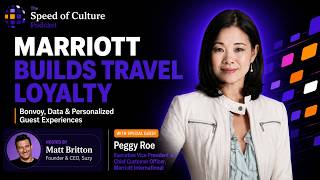
In this Speed of Culture podcast episode, host Matt Britton interviews Peggy Roe, Executive Vice President and Chief Customer Officer of Marriott International. The conversation spans Roe’s early career (including an Amazon internship), her 20‑year journey at Marriott, and the evolution of the company’s multi‑brand loyalty program, Marriott Bonvoy. Roe explains how Marriott leverages first‑party data, AI, and generational segmentation to personalize marketing, on‑property service, and owner‑side operations. She describes the expansion of the portfolio beyond hotels into homes, villas, yachts, and branded residences, and how open‑ended AI‑driven search is being tested on the Homes & Villas platform. The discussion also covers partnership strategies with non‑endemic brands (Uber, Starbucks, sports leagues), the “Moments” experiential redemption platform, and the shift from business‑travel dominance to passion‑driven leisure travel. Roe shares insights on employee longevity, the benefits of rotating roles within Marriott, and her involvement in the Women in Leadership Initiative, highlighting mentorship, visibility, and cultural change. The interview concludes with Roe’s career advice—pursue what you love and what you’re good at—and her mantra that Marriott’s business is “love and money,” linking customer affection to profitability.
Chapters
Up today, we're thrilled to welcome Peggy Rowe, Executive Vice President and Chief Customer Officer of Marriott International. As Marriott's first CCO, Peggy oversees the global strategy driving customer experience, loyalty, and brand innovation across 9,000 properties worldwide. Peggy, you must be a very busy person. Thanks so much for joining today.
Thanks for having me, Matt. It's great to be here.
Absolutely. So I've been really looking forward to this, and I was doing some deep research on your background before we start. And I just have to ask you, just as a side note, I saw that you were at Amazon in 1999. What was it like working at Amazon back then? That must have been in the very early days of the company's launch. So I'd love to hear that story.
Way back when. So I was at Amazon as an intern when there was only books, and we were launching toys and electronics that summer. So maybe that would expose my age, but I think I was actually an intern in Andy Jassy's team at the time. And it was very, very early on. I was first year in business school, and this was obviously a huge opportunity that summer to go and work at Amazon. And I think they were just really building up talent from different places. And I got to experience working in the marketing team and figuring out, like, what kind of loyalty reward should we send the most valuable customers who are spending the most with us at the end of the year? And It was a funny project, but it was great.
You obviously had no idea back then on what they would be. Was there any signs in your wildest dreams that they would become what they are today?
No. I mean, I had a sense at the time that it felt like something big. It was probably one of the most sought-after internships when I was in business school for the summer because it felt like really cool, outrageous, and different, of course, than banking or consulting. And you could feel the something was there. In fact, at the time, I recall that they had really asked a lot of people not to go back to business school, but to stay and work through the second year. And I remember my father saying, "I don't think so. You should not do that." So, kind of funny to think about where I'd be today if I'd stayed.
Yeah, I know. And I would imagine you were not paid in stock options for your internship.
No, not at all.
I had a similar experience working with Mark Zuckerberg and Eduardo Saverin right when Facebook started, not as an intern, but as a business partner selling in their first ads. And you look back on those moments and you have to ask yourself, like, could I have known that they were gonna be what they're gonna be? But that's just kind of how life is. But obviously you spent the majority of your career obviously at Marriott and in a completely different industry. What have been the most meaningful changes that you've seen over the last 20 years during your time at Marriott in terms of the business of hospitality?
I think what I've learned about this industry is that there's so many industries that are part of our industry and we ebb and flow, obviously, with the economy and so much of what's going on in the world. And so every year here feels like a new year and there's always something. Every year my husband says, "Is this gonna be the year where you settle down and you know your job and it's gonna be like a smooth year?" And in the first couple years I was like, "I think I know what I'm doing now." And Every year it's been something else, but it's a fantastic industry, super dynamic. I used to say that it's so many industries wrapped up in one. It's a playground for people who, like me, like to create experiences because it's really never-ending. And consumers obviously are always changing. So our brands are always evolving and what we do every day is always changing. So it's a lot of fun.
Yeah. And one thing I see, especially with the younger employees, is sort of like this itch to jump to a new role every 2 to 3 years. And it's more and more rare with the millennial generation to see them at the same company for 2 decades plus. What do you think some of the benefits have been for you to stay at one organization, obviously work your way up the ladder, that maybe other people don't see the value of when they're just ready to jump so quickly?
When I came here, I would look at people who've been here for 20 years and say, oh, that's never going to be me. You know, we have something called the Quarter Century Club. If you make it to 25 years, you get these great benefits for the rest of your life. In our hotels. And I am kind of amazed every time I think about the fact that it's been 21 years this year. But I think some of the— like, the reason it happens here at Marriott is because there is so much change and there is so much that you can learn and do here. You think about everything from being in customer service to food and beverage to real estate to design to data. I mean, again, name a discipline or an industry, and it's probably tied to us in some way. I think the benefit of being here for a long time is that it's actually a really complex business to learn because we have the customer side and the owner side. There's management companies and franchise companies, and every job that you have really gives you a different angle on the business. And I have moved around a lot here in my last 20 years, and having done so has really prepared me in this job. To do this role in a different way. And I think really look at the business holistically, not just from a marketing lens, and then to be able to really drive value for the business because I know what makes us profitable, what makes the owners tick, what makes customers love us. And to me, that's the fun part of being able to do the marketing job with that kind of knowledge being rooted in the business.
Right. And of course, when you talk about the marketing job, Marriott isn't just Marriott. You have many different brands, Sheraton to Westin, how do you look at building the different brands and giving them all their unique identity? Obviously, there's some overlap, but I'm just curious how you look at managing that.
Yeah, it's interesting. We were looking at the history of Marriott Bonvoy, right, which today is our loyalty program. And it's only been around for really 5 years. We launched it in 2019 when we brought Starwood and Marriott together and the Ritz-Carlton Rewards. We brought it all into one program. For maybe 14 years before we launched Marriott Rewards, and it was the industry's first multi-branded loyalty program. Now fast forward today, we're over 30 brands, we're in 10,000 locations worldwide, and we really think about Marriott Bonvoy as our consumer-facing master brand. And our positioning for Bonvoy is that it gives you access to people, places, and passions that you love. And inside of that is a portfolio of not just not hotel brands, but of experiences. Over COVID, we launched into leisure in a much deeper way, and we have over 34 all-inclusive hotels. We have over 160,000 homes and villas. We have 5 Ritz-Carlton Yachts, and we've got even over 100 branded residences that people could choose to live in one of our brands. And so we're really expanding as a company in so many different ways. Bonvoy is sort of that entry point into our portfolio and, and into our ecosystem. And then the more we know about you and what you love and where you are in your life stage, we get to then put the right products in front of you.
And where are you getting your insights? Because I know that you guys have also have partnerships with Uber and Starbucks and lots of different non-endemic categories as well that you're bringing into the fold. What gives you and Bonvoy, I guess, more broadly conviction to partner with these other brands? Like, and what type of research has to go into it based upon the fact that you have such a wide spectrum of customers that stay at your properties?
Yeah. And doing our customer research, we have members who've been in our program now for over 30 years. And so over the last year, I'd been talking to a lot of customers, but I started to think about them in generations because I like to understand why someone's traveling, and that has a lot to do with your life stage. And whatever life stage you're in, you're also sometimes traveling for business, for leisure, and your needs change depending on your state and also who you're with. So this is one of the most complex products if you think about it from a marketing perspective. It's not just a physical thing that you buy and you have, like, some sort of interest or affinity in it. Like, your preferences change all the time. So as we were studying different life stages, it occurred to me that understanding then what motivates somebody at that life stage and whether they're infrequent or frequent, high spender or low spender, you see all of those people in our ecosystem and we need all of them to be able to fill the over almost 9,000 hotels that we have. And so we started to expand our partnership. Like loyalty for us was always about reward the most frequent highest spenders. That's what most loyalty programs are based on. And we realize— that we actually should do more to get the infrequent population in, 'cause they're traveling. They're just maybe in masses, they're just not traveling as much.
So obviously the ability for you to be able to harness your first-party data is huge for the brand, for all your brands, 'cause it unlocks a level of personalization that I think will only be enhanced with all the capabilities that AI is going to present in, in the years ahead. So how is Marriott and its broader portfolio brands looking at the power of first-party data? Its ability to provide better customer experience and personalization moving forward?
This is really the vision that we aspire to. We believe that service in the future, great service, is driven by understanding who you are using what we know about you and what you give us permission to know and to activate that. But we are so lucky because customers tell us all the time. They actually— I get these emails where customers say, I really want to just tell you more. And we try to take great care of the data that we have with customers. We have been putting more of that— if you're in our app, you can go into preferences and see that we're allowing you to control what you tell us about your passions and preferences. But we also know that we want to set expectations on what we can deliver. And so we don't try to over-ask you too much yet until we know we can deliver. And that's really our challenge is people want to tell us more. We can't always ensure that we'll be able to deliver. So we're trying to make sure that what we promise we can actually deliver and hopefully surprise and delight you. But you'll see more of that.
Right. You saying deliver in terms of the rooms, like actually on-premise, or are you talking about the way that you communicate with them, or both?
Yeah, I mean, we think about using data in a couple ways. One is more targeted marketing. So we know who you are, we put the right products in front of you. The second is delivering more personalized service. If we know what your preferences are in advance, our hotel can prepare for that and then delight you, hopefully, and surprise you when you're there. And then the third area is really helping our owners and franchise management companies better understand their own operations so they can also drive better performance. And so we think about really organizing or structuring our data so that we can fuel the business in all three ways.
It's interesting 'cause we've been playing around a lot at Suzy with AI, and one of the big things I think you're gonna see more of in 2025 is really the end of the one-to-many newsletters that brands have done. So obviously you sign up for any company's newsletter and yes, you might be in some broader segment, either driven by psychographics or demographics, but you're probably getting the same message that tens of thousands of other people are. But I think over time, as a company like yours can mine more information about a user, whether if they have a family, they travel on business or pleasure, or the things that they like. There's no reason that you can't have one-to-one type communications with consumers at scale. And that unlocks a whole nother level of utility to them. And I actually don't think the technology— I actually think the technology's already here for that. It's just, can you pull all the pieces together and execute on something like that?
Exactly. I think you've got it. Knowing it is one thing. Being able to do something about it and activating all of our great associates around the world to be able to do that and have the bandwidth to do it is another. But I totally agree with you. I think it's really exciting to play in this space. And I think what we're seeing in AI in our industry, which I think will start to maybe rapidly show up more for consumers in the coming year, is more around releasing that search box. For so many years since I've been in this industry, we confine people to telling us about the city that they want to go in or the location and the dates. And I always wondered, like, why are we forcing you to tell us that? And why can't it be more of an open-ended question? And I think we've been experimenting with that in our Homes and Villas site, which is kind of our playground where we test a lot of new things. And if you go on to Marriott Homes and Villas, you can actually experiment with just asking a question about anything. Like, I want to go travel somewhere where I can ski, or I want to stay in a home where I can bring my dog.
Or where it's not raining this weekend. Or how about, like, I was planning on going to Florida, but there's a hurricane. Like, how can I go somewhere where there's not a hurricane? And they can tell you.
Exactly. And I think a lot of travel companies are experimenting with this. But what I find most fascinating, which is at the heart of what I love to do, is to really understand, like, what's in the minds of people when they're trying to think about going to travel? And what you'll see in the freeform text and conversations is, at first, people are really nervous. Like, they don't know what to ask because we've trained them to just put in a location and a date. And so we decided to try to prompt them more to help them. And then there's this little moment where people kind of figure it out and they go, oh, well, I guess I can ask anything. And then they start telling us everything and they're like, well, I need a room for my spouse and my kids and my dog. And by the way, I like my dog better than my spouse. And so, you know, and it's just like too much information, right? But imagine knowing all of that, to your point, at the customer level and then being able to mine that to— Yeah. Understand how we can deliver a better experience in the future. Now we know you have a dog and your family, so I'm excited about what's to come.
It reminds me a lot of like Netflix and Spotify, or like you go on Spotify and it allows you to discover things based upon what it knows about you, or Netflix. Imagine if you just went to Netflix and there's just a search box. People would probably watch a lot less on Netflix, right?
Exactly. Increasingly, as we have done our own customer research, what we are always surprised by is that consumers don't know the extent of what we have in our portfolio because it's very tough in what I will call like a static website to really learn about everything we have. And so to your point, we'll be able to really customize much more based on what we know. And we're actually already doing that. When we enroll somebody new into our program, in the first 100 days, we'll send you an email when you first come in. And based on what you're clicking on, we'll start to send you something more specific in response to what you've clicked on to get you to the next best action. So we're taking it one step at a time. It's a big— user base and there's a lot of complexity, as you know, and the data and technology have to come together, but it is a lot of fun.
So you mentioned earlier that your company offers now hotel rooms, but also homes as well, which is a new thing, obviously. And we saw the whole home sharing trend take off and it's still a big part of the way that people travel. How does the communication differ? Because for some consumers, it's probably jarring to them the same way it would be jarring for them not to have to enter a location and date, just to all of a sudden see homes as a potential destination when they're transacting with Marriott. So like, how was that, and is it still an ongoing thing in terms of customer education?
Yeah, because we're increasingly putting different products on our site, we also just launched a partnership with Sonder by Marriott Bonvoy, and it's putting their inventory into our ecosystem. And so we're doing a lot to make sure that consumers understand when it's a hotel, when it's a home, when it's a different type of product. And setting that expectation. But it is a bit of a challenge again, because the way that sites are built today, like you have to scroll to really learn, or you have to search, or you have to filter, and it's just begging for the technology to solve that. I should just be able to ask for what I'm looking for. But a lot of what we have been thinking about to try to get people to the right product is if you're looking for rooms or more rooms because you're traveling with a family, or you're looking for kitchens, Laundry, those are ways for us to show you different types of products. So again, it's sort of an industry that started with real estate and hotels, and we're shifting to better understand consumer needs that play against that and being able to really help connect those two together.
Totally makes sense. Are there any other trends that you have your eye on either from the consumer more broadly or more specifically in the travel and hospitality space? That you see as sort of like a booming trend heading into next year?
I think the biggest thing that we've seen, Marriott has been for a long time since I've been here, a really, a company very focused on business travelers, frequency and spend from a business travel standpoint. Through COVID, like everyone else, we saw leisure explode, and then that has sort of stayed in place. And then this aspiration for travel has been so strong, particularly at the premium and luxury higher ends. And then on top of that, because of that pent-up demand for travel, the interest in experiences, which was already there pre-COVID, shifting from material things to experiences, but that just blew up. And I think you're starting to see that research come out everywhere where people are traveling to the concert versus waiting for it to come home. Of course, Taylor Swift and others and even sports. I mean, you name it.
NFL, I was about to say. Yeah, of course.
Exactly. I mean, we've got so many partnerships with the F1, NFL, NCAA, all because of this. And it is actually the reason that we decided to position Bonvoy as the place to give you access to people, places, and passions, because we know that that is actually the insight around why people are traveling today. And it's not just, I'm looking for a hotel room. We're really working on understanding your passion and then getting you to the right place. We've been using our Moments platform, which is the place where we allow you to redeem your points. For a long time, you could redeem points and go to the Super Bowl with us, sleepover. Mm-hmm. In the Super Bowl suite. We've been doing that for years. We've been expanding on that over the last year, and we'll do that even more next year. This year with our partnership with MGM Collection, we just had somebody bid 2.4 million points to go choreograph the Bellagio fountain show. And it's the only customer that's ever had a chance to do that.
Because you create content from that as well, right?
Exactly. So we've had this fun experience where he not only got to choreograph it, he actually got to learn, go behind the scenes and understand the technical capabilities abilities of how to do that. Then he got to invite his family and friends to be able to come with him, stay at the Bellagio, watch the show, spend the weekend there. And these kind of bucket list experiences, once in a lifetime things, are the things that we can do for our most valuable members. At the same time, we've been doing one-point drops, which is the opportunity for just one point to play soccer with Trinity Rodman or to go to a mezcal tasting with Bryan Cranston. And so— Oh, wow. We also just signed Jason Kelce, right? He's our Courtyard fan ambassador and he's gonna be helping us with the Super Bowl this year. So we're having a lot of fun with these passion points and engaging consumers of all ages where before you may have only come to us after you decided to be a frequent business traveler. Today, the profile of our customer base is changing rapidly.
Again, there's a lot of kind of demographic shifts beyond that. I mean, the, average age of a first-time mother in the US is now nearly 3 years older than she was in the year 2000. So that's 3 more years that people can live the life that they can live only without kids, and they can decide last second to travel. And so people are definitely acting younger later in life. They're going to Coachella at age 40. They don't feel out of place. So I think all those things make this passion-based travel so much more of a reality. And it's just a great catalyst also to bring people together. There's so many people I know who have annual trips with their college friends or their girlfriends where they'll go to a concert or a game or whatever it may be. And it just makes the whole weekend so much more special. And for you to put your brand at the center of that, I think makes a ton of sense.
Absolutely. I was talking to this Gen Y couple recently. I spent a lot of time talking with customers. It's fun cuz you always get to hear the real stories and this couple. So they're both working remotely and their home base for their companies are in two different places, one in Canada and maybe one in Europe. I'm not sure, but they actually live in Texas. And so they said that, and they had a young couple, they have a 2-year-old. They said every week they decide whose trip or work is more interesting, and then they decide that they're going to travel to that location and sometimes bring their 2-year-old daughter, of course, 'cause their daughter's not in school yet. And so they're just like having a great time, like working and going around the world and taking their 2-year-old daughter. And sometimes they're staying in a Residence Inn 'cause they need more space, and sometimes they're staying at the St. Regis because they're on a splurge. But it shows you the spectrum. I can no longer say like this customer is a St. Regis customer because they're really staying across our brands based on the type of trip they're on and what they're doing. But it's really opened up the opportunities for us, which is great.
For sure. Shifting gears as we start to wrap up here, I know that you've also been very passionate on top of being clearly passionate about your customer to being passionate about women's leadership and what women's place in the workplace. We've done a lot of work at Suzy with the female quotient, driving gender equality. And they're a great organization. But I was really inspired reading some of the work that you've done co-founding Marriott's Women in Leadership Initiative. Would love to hear from you why that's so important to you and what's been some of the more rewarding parts of that initiative personally.
Yeah, well, thank you to you also for championing that work. It really is amazing to see all the support. And I think for me, I kind of fell into it a little bit. I went to this job in Asia, and I was the chief sales and marketing officer. And because I was a female in a senior job, it sort of fell into my lap to be the leader of this initiative. And so as I got into it and started meeting with women all across Asia and hearing their stories, I'd have these dinners kind of like I do with customers and just understand what's on their minds. I found that just having these conversations, bringing these women together, telling the stories was actually enough. It didn't take much to really create that spark and that desire and that— really, like, for people to see that women could lead in the position that I was in, and it wasn't that hard, actually. I think a lot of time women would look at roles like mine and say, how is that even possible? In fact, I sort of looked at that role before I went out to Asia and said, I have 2 kids that are 3 and 5. How is that even possible? For me, I had to rip off the Band-Aid. My husband and I had a conversation and said, does that make any sense for us? And he said— like neither one of us could actually on paper think about it making any sense for us to do that, but we just did it. And then for others, when they could see somebody in that role, right, that's the most powerful thing. And so just being able to demonstrate and to live it, I think, is what really resonates. And so I was grateful to have gone back to China, I think it was last year, and we had started this initiative when I was there 10 years ago that was— [SPEAKING CHINESE] How do we get more female leaders into the GM role, the general manager role? Because at the time, it was really seen as something that only men would do or would want to do and could do because of their experience. And going back last year, we had about 150 women show up to the breakfast who were all female general managers in Greater China. And that was really, really exciting. I think we've come a long way, but— Part of it is just breaking through a mindset either of thinking yourself you couldn't do it or not being able to see others doing it. And once we kind of broke the seal on that, it just came open. So hopefully that'll happen around the world.
Yeah. I mean, we still have a long way to go in here in the US. There still is a wage gap and there still are inequities that are happening. We were definitely making progress and people like you in important leadership positions, I think, helps pave the path for where you can go for sure.
Yeah.
Yeah, so to wrap up here, would love to hear from you. Obviously, you've been really successful in your career, and you have such an exciting role at Marriott, getting to work with Jason Kelce and Taylor Swift and all sorts of cool people. And I know it's not all fun and games as well. But when you look back on your career and your journey, what were some of the decisions do you think you made right along the way that put you in a position that you are today?
Yeah, you actually kind of touched on many of them, Matt. So I think that moving around a lot early was something that really benefited me. I have a slide that I always share when I do these career talks, which has a lot of zigzags on it, and it literally shows all the places that I've worked and experimented with over my career. And I think that I can almost see the learnings from every single one of my jobs inside of my role today. And so that piece. And then I mentioned this when I went to Asia, like it was one of those opportunities that— It didn't make sense personally necessarily, but I was so interested in it that I call it the rip the bandaid off moment where we just did it. And no risk, no reward. I've lived by that, I think, for a long time in my career, and that definitely opened up opportunities for me. And then last but not least, it's the advice I always tell people, like, do stuff you're really good at and do stuff that you love. And if you can find the intersection between those two things— It will serve you well no matter what.
Yeah, we often hear from our guests here on the podcast that having the ability to work internationally, especially earlier parts of your career, just give you this sort of worldview and different perspective that is applicable in so many different things that you end up doing later in your career.
Yeah, and the side benefit for that, which I don't think my husband and I talked about, but we definitely feel it now, was that I think we were more worried at the time about uprooting our lives and what that would be like for him or for me, and Actually, what it did for our children and actually us too, like what it exposed us to is really incredible. I don't think we could have ever imagined the world it opened them up to. So even at a very young age.
That's awesome. So finally here, is there a mantra or saying that you like to live by in terms of your professional career that comes to mind?
Well, I think it was the one that I shared with you, to do what you love and do what you're good at. But I use this a lot at work when I'm talking about loyalty that we've been talking a lot about. How loyalty is not just about the points and that for our business, loyalty is very much about the way we make people feel. And from a business objective, I try to keep things simple. Like, we are in the business of love and money. The more customers love us and our brands and our experiences, the more they will spend with us and the more profitable we will be as a company and how we will help our owners. So it's been a simple way to articulate our business strategy.
And really saying it's applicable to any service business when you look at your customer, right?
Very much so. It's just about figuring out what drives that love, right?
Exactly. Well, thanks so much for your time today, Peggy. It's been awesome hearing about your journey and all the great work you're doing at Marriott. I've been a fan for quite some time and can't wait to see what's next down the road for you and Marriott.
Thank you, Matt. Hopefully, I will see you as an ambassador in our program.
Yep, I already am a big Bonvoy person. So on behalf of Suzy and Adweek Keen, thanks again to Peggy Rhode, Executive Vice President and Chief Customer Professor at Marriott International for joining us today. Be sure to subscribe, rate, and review the Speed of Culture podcast on your favorite podcast platform. Till next time, see you soon, everyone. Stay at Marriott. Bye-bye. Hey!
More from Matt




MikMak’s Rachel Tipograph on Consumer Spending, Retail Media & Holiday Shopping Trends



Jaguar Land Rover’s Charlotte Blank on Luxury, Purpose & Experiential Storytelling



