Mastercard’s Raja Rajamannar on Experiential Marketing & Brand Innovation
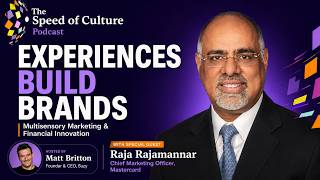
In a Speed of Culture interview recorded at CES 2026, Matt Britton talks with Raja Rajamannar, Mastercard’s Chief Marketing Officer, about his global career path, the dual B2B‑B2C nature of Mastercard’s business, and how the company has shifted from traditional advertising to experience‑led, multi‑sensory marketing. Rajamannar explains Mastercard’s three‑layer operating model (brand building, business growth, platform creation) and how marketing generates insights, crafts product value propositions, and produces sales assets for banks and merchants. He details the move away from ad‑heavy tactics toward "Priceless" experiences, citing large‑scale sponsorships, the "Priceless Tables" restaurant concept, and the acquisition of experience‑focused companies. The conversation covers Mastercard’s multi‑sensory strategy—expanding beyond sight and sound to taste (culinary experiences) and sound (a 10‑layer sonic branding architecture). Rajamannar also outlines Mastercard’s forays into fintech, open banking, crypto (partnership with Coinbase), NFTs, and collaborations with Apple Pay, positioning these as marketing‑as‑a‑service offerings. He shares brand performance metrics (rising to #12 in Interbrand’s top‑100, fastest‑growing brand), the challenges of fragmented media and short consumer attention spans, and the importance of authentic, person‑to‑person communication. Finally, he offers leadership advice—continuous learning, building strong teams, networking with CEOs and peers, and leveraging diverse talents—culminating in a personal mantra about maximizing one’s gifts.
Chapters
We are here in Las Vegas at CES for today's edition of Speed of Culture, and we have a very special guest. I'm so excited for our audience to get to know Raja Rajamannar, who is the Chief Marketing Officer of Mastercard. Thank you so much for joining us. So great to see you, Raja.
Thank you very much for having me here.
Absolutely. Before we get started and dive into Mastercard and all the very cool things you're doing, I'd love to hear a little bit about your background and the road that you took to get you to where you are today.
Got it. So it's been a long road and a very, what do you call, experience-filled kind of path that I have taken. Originally from India, trained a chemical engineer and specialized in environmental management. Did my MBA from the Indian Institute of Management Bangalore and started my career with a paints company, paint manufacturing company. I was there for 3 years and I got hired by Unilever. I was there in Unilever for about 7 years. Then I joined Citibank and Citibank moved me around the world. I was there with them for 15 years. I was there in Dubai, I was there in London, and I was there in New York. I was also the chairman and CEO of Diners Club, which was a fully owned company of Citibank in those days, and I was seconded to turn the business around, which I did. Then I came back to the mothership, which was Citibank, and I was heading up the core credit cards business for North America. And then I made a big change from there into the healthcare space with Humana, which was based in Louisville. And I also worked with a company now called Elevance, Elevance. At the time it was called WellPoint. And I joined Mastercard 10 years back.
And what has it been about the financial services space that you found so appealing that you sort of anchored your career?
Well, they pay well. Yeah. I'm kidding, I'm kidding. They don't pay as well as investment bank does.
Right, right.
But I think it's been a fantastic journey in terms of firstly, when you join a large company like Citibank in those days, you had an opportunity to have a global career. So as I said, I was in Dubai, I was in London, I was in New York, I was in Chicago, and Citibank moved me all around. And I like to believe myself to be a global citizen, and therefore getting this international exposure is something which I always cherished. Plus also I moved into different divisions of Citibank. I was managing mergers and acquisitions and operations and technology. And marketing, of course, and I was handling the P&Ls. So it was a very rich and diversified set of experiences that I had at the point in time. Sure. And that's why I have been there for 15 years. And when I moved to healthcare and then I had this opportunity with this, you know, the CEO of Mastercard, at that time he was my boss when I was at Citibank. So he asked me to come and join at Mastercard. And I absolutely enjoyed working with him before. So I said, this is a great opportunity. So I came here. He has retired since, but I'm still very much here.
Yeah. And being the CMO of Mastercard, I mean, that product that you have has many different constituents. You have your merchant partners, and you have the issuers, and you have obviously the consumers.
Correct.
So you have so many different stakeholders. Yes. How do you spend your time? What's the pie chart of a day of Raja look like?
See, firstly, you're absolutely right that we are a network and a technology platform. That connects these various constituents. You know, the consumers on the one hand, you got the banks or the non-banking financial institutions or the fintech companies on the other hand. And of course, you got the merchants where you use the cards. And the way we actually do our business, if you see, we have to impress upon the consumers that we are a great product. And where possible, we try to generate demand where a consumer would ask, a bank that I would like to have a MasterCard. Right. Now, that's a big journey because most of the times you don't even ask the bank for access.
You just take what they have.
You just— yeah, what they give, you just simply accept it. So our first order of business is to impress upon the bank that they have to issue cards on the MasterCard network as opposed to somebody else's network. And therefore, B2B marketing is actually our day-to-day reality.
So if there's a Delta SkyMiles card or an American Airlines card, You know, being done through Citibank, you want it to be a MasterCard.
Correct.
Versus another competitor.
Exactly right. So in this case, we have to manage multiple partners.
Yes.
We have to manage American Airlines in the example you had given. And we also have to convince Citibank. And both of them have to agree that it is my network, which is the right network to issue their cards on. So B2B is a significant amount of effort that goes in.
Sure.
But while we are doing that, We also have brand building. So one is in terms of day-to-day business, the other one is in terms of brand building. So we look at our business as 3 levels, right? One is building the brand and protecting it. The second one is fueling and driving the business. And the third is create platforms that will give the company a sustainable competitive advantage. So business part of it, driving the business, we are all over there. And that's the main part of what we do to win the business with the banks and with the businesses.
And what role do you as a CMO have in in that side of the business? Is it the storytelling about the network and unique attributes that you're talking about?
A lot more, a lot more. So we start with insights. So marketing comes up with the insights. Number 2, once we have got the insights, we help the product team come up with the right value propositions. And we also create ourselves wrappers for the various products. Like for example, we created a music card. We created the MLB card. We created a golf card. All that happens within marketing. So the products are more focused on the chassis. They build the chassis and we build the body. Sure. So that's how marketing and product, they sort of divide and conquer. So we do that. And once we have got the product value proposition and the whole package ready, then we create what we call as a foundational sales materials for the salespeople to go to the banks and to the merchants and pitch the products. And once that happens, so we are behind that whole thing. When the bank sends the RFP, The RFPs come to marketing and we use technology to give responses and make a draft zero of the RFP response. That's what we do in marketing. Then once all this is being done, we go to the consumers and we try to build the brand and create an attraction for that product that we have just created or for the older products that are already there. And that's a big one. And to create the value proposition, we have to develop assets like sponsorships, for example. So we manage all the sponsorships. And of course, we have our media stuff that keeps happening. So it's a pretty wide swath of areas that we play in. But what I would say is most importantly, from a brand development perspective and from a brand protection perspective, we handle both marketing and communications under the same, what you call, umbrella. So we call it integrated marketing and communications. So marketing part of it, we look at it as people-to-people marketing. When the advertising goes, Raja might be a father at home taking decisions on behalf of his family and with his family. Then Raja is the CMO who is also taking decisions for MasterCard on behalf of MasterCard for MasterCard. In both these cases, it is the same Raja.
I couldn't agree more. I think a lot of people make that distinction of B2B and B2C. You have to go after it differently.
You have to go person to person.
Even the same thing when you send people an email. If I'm sending somebody an email for business, what I've seen people try to do is they have their business language and their personal language. They're not being authentic. Authentic self. Be yourself. You don't have to put on some type of formal mask for business because they're just a person. You're not talking to MasterCard or Procter Gamble. You're talking to Raja, right?
You hit the nail on the head. That's exactly it. So what we do is from that perspective, when you are building a brand, you're building a brand for the people.
Yes.
Where people are impressed. So whether you're at home or you're in office, you are still making decisions in favor of my brand. Right. So that's how it works.
And those banking partners that you might get an RFP from are also people that could interact with some of your consumer-driven marketing. And that's— that all that feeds into their brain when they're making a decision of which direction am I going to go in.
That's absolutely right. And also in that, with what we do, you know, there are banks which are extremely capable of doing their own marketing, but there are smaller banks which might not have the infrastructure or the people to actually do it. So what we also do is to— we help the banks and the merchants to create marketing programs for themselves. So we do marketing as a service for them. So we do those kind of areas. So we keep ourselves pretty busy in a productive fashion.
Right. And as it relates to obviously building a consumer brand, which is obviously a gargantuan task, and you have some big competitors, and as you've said in many publications and interviews, you're just fighting for mindshare across billions of impressions from all other brands every single day. But Mastercard's done really a masterful job at building a differentiated brand. Has that gotten easier or harder over the years as there's been more fragmentation in messaging and media?
It has gone exponentially more difficult. Because on the one hand, the number of brands which are trying to reach consumers has exploded. The number of channels through which you can reach consumers and consumers' attention is fragmented across so many devices and so many channels that has exploded like crazy. And then the span of attention of consumers has actually gone down. And now they say it is less than that of a goldfish. I don't know how they measured it, but I would like to use that statistic, say it's less than 8 seconds and less than that of a goldfish. So you're talking about the intensity of clutter now is such that it's between 3,000 and 10,000 messages that a consumer, average consumer, is bombarded every single day. And that has to stand— your message has to stand out amongst those 10,000 messages. It has to go through that narrow window of span of attention of less than 8 seconds, communicate the message, get the right attribution, and convince the consumer to change their brand preference towards your brand or to retain the brand preference in favor of your brand. That's a humongous task. It's becoming more expensive. It's becoming more challenging. So we have to find alternate ways of reaching consumers' minds and hearts. To actually get their preference in favor of your brand.
Right. And it all starts with like your core brand equity pillars, right? The things that you want consumers to associate you with, whether you're widely accepted or easy to use or international coverage. Like, what are some of those things that Mastercard has leaned into consistently over time?
Yeah, see, one of the first things we did was a little bit radical. So we said that advertising as the way to connect with consumers, reach and connect with consumers and engage them, is becoming less effective and less efficient. And so what we said is, plus also, not only that, if you look at countries particularly outside of United States, mostly in Asia, it has become a big phenomenon of the introduction of ad blockers. So the estimate now is anywhere between 600 million to 1 billion people who have installed ad blockers on their mobile phones or mobile devices.
And I'll tell you, they're time shifting and they're fast forwarding through TV shows.
Exactly. They're doing so many. So therefore, that's one big issue. Second issue, consumers fundamentally dislike advertisements interfering with their experience. Like, I'm watching a beautiful movie or a beautiful song or whatever, suddenly this advertisement comes in between and it destroys my experience.
And there used to be nothing they could do about it, right? It used to be the cost of consuming content.
Exactly. That could be right from the platform perspective, but it's not right from the consumer's perspective, right? The second thing is now, literally when I'm watching as a human being, I'm watching a video, when the advertisement comes every 3 minutes, 4 minutes, or 5 minutes, I'm waiting for the Skip Now button. Not to make my life more difficult, they're serving me 2 ads at a time. They're saying, "Ad 1 of 2," which I cannot skip, then, "Ad 2 of 2," I can skip. That's torturing me. We, as marketers, talk about having delightful consumer experiences. Here, the consumer was having a delight on his own at this point in time till you came along, the marketer, and messed up my experience. That's not how it should be. What we said is, when we looked at this reality, we said, "Should we still be doing advertising-led marketing or should we do something else?" We opted for that something else, which is experience-led marketing. We became an experiential marketing company predominantly. Today, we spend a lot many more dollars on experiences than we do on advertisements. So what does it mean? So for example, we sponsor, we are one of the largest sponsors of MLB. We are one of the largest sponsors of PGA Tour and so on and so forth. So all these assets that we acquire through sponsorships, we have rights which we convert into accessible experiences for our consumers and customers. That is what they love. The challenge is, how do you do it in a consistent way where the quality is really priceless. The experience for the consumer is truly priceless. The fulfillment has to be flawless. And you also have to do it at scale because experiences tend to be limited in terms of the scale to which you can offer them. And third, how do you manage the economics? So we have been at it. And right now I say after about nearly 10 years of doing this, we are in a very good space. We acquired some companies which specialized in offering experiences to consumers. That really enhanced our capabilities and it has put us in a place where we have an infrastructure to curate and create experiences for consumers and do the fulfillment very effectively.
Right.
So we are doing it huge. So that's something which has really helped Mastercard quite a lot. And the proof of the pudding is that our brand, it used to be at number 85, 87 in the top, most of the top 100 brands. So I still inherited a top 100 brand. Today it is at number 12. So it is really moving fast. And Interbrands has rated us over the last 3 years as one of the top brands in terms of growth rate for actually 2 out of the 3 years with the fastest brand growing across all categories. And last year, we were one of the top 5. So that way, it's been really growing quite well overall. And so pretty pleased about it.
I think what you're alluding to is, I think, in a pre-digital era, you talk about advertising. And advertising is like, what's our unique selling proposition? You know, 360 horsepower, 20% more absorption, absorbent, whatever that may be. Let's shove it down the consumer's throat whether they like it or not. We're going to do it where they are, which is during content they're enjoying. And now we're in an age where the consumer has choice. And now instead of it starting with unique selling proposition, it's got to start with the consumer. Totally. What do they like? What are their passions? So that's why you're going towards baseball because that's what they care about.
Correct.
So you can give them more of what they want.
Exactly. And in the space that they would want to be in. Right? So when you talk of passions, like for example, what we did is When you want to create an experience, it has to be in an area of their passion. And which area do you focus on? So we did a global research and we came up with 10 passion points, like sports is one, music is one, shopping is one, travel, philanthropy, environment, et cetera. So we went into 10 passion points, health and wellbeing, and so on. And in each one of these, we are curating those experiences.
Right.
At scale.. And that's something which has been really, you know, very helpful for us to advance our own strategy.
And I would imagine also creates a great conduit for you to start creating content in social platforms and other places they may be.
Totally.
It kind of becomes a launching pad for content, correct?
Totally, totally. Right. Yeah, absolutely.
And so as we're looking ahead to 2023, we're here at CES and the great thing about CES, the beginning of the year, it's a fresh start. Everyone's looking forward, not backwards. What are some of the things that you're most excited about in terms of Mastercard's go-to-market strategy here in 2023?
See, 2023, firstly, what we are going to do is to continue advancing what we call as multi-sensory marketing. So what I mean by multi-sensory marketing is people are normally blessed with 5 senses, but as marketers, we focus only on 2 predominantly, the sense of sight and the sense of sound. Can we somehow tap into those other 3 senses? Because what is a sense at the end of the day? A sense is a mechanism or a device through which consumers are absorbing data or receiving information, which gets processed in the brain, which leads to feelings and emotions.
Right.
Very easy. Now, if there are 5 senses through which consumers are absorbing information, why are we focused only on 2? And how do we get through the other 3? So in fact, I remember jokingly, like, when I was telling this to one of our team members, we should look at how, for example, Mastercard can be associating itself with the sense of taste. So the question I got was, do you mean we have to create edible cards? No, no, we don't have to create edible cards. It's been literally too— it's being really literal. What we are talking about is being lateral. And for that, what we need to do is to get into culinary experiences. So we started organizing things like what we call as Priceless Tables, a table put in an unexpected place with extraordinary eating experience and food that's served, etc. Like our very first Priceless table was on top of a billboard in Times Square. And we had a 5-course meal served by a Michelin-starred chef. And we always had a celebrity there. And we had such a good amount of earned media on the one hand. It created a lot of positive buzz and Good Morning America and so on and so forth. But that gave us a phenomenal impetus. And now we got into the culinary space big time. We have got Michelin-starred chefs as our brand ambassadors. We have started curating these priceless tables. We have got like thousands of them around the world, we do them. And we started having our own restaurants. We launched 4 restaurants till now. And like, what is in Brazil recently, we had been recognized as Brazil's best restaurant that happens to be a MasterCard restaurant. We have one in Mexico City, we have one in Rome International Airport. So what happens is we are now getting into launching these restaurants as experience spaces where you get an extraordinary, you know, meal, but the surround systems beyond that meal is what makes it truly memorable. The meal itself is fantastic because it's curated by some of the top chefs, but beyond that, the entire experience is unexpected, unusual, unique, and therefore the memories you walk away with from there are truly priceless.
I imagine one of the other senses is hearing, and I know that you guys recently announced this Web3 Spotlight program, which looks really cool. So I'd love to hear a little bit more about that.
Yeah, see, when you look at the sense of sound, we have obviously been using sound as marketing community overall. You know, even when I was growing up as a child, we used to listen to jingles. But that's a very narrow interpretation of reaching consumers through sound. So we started understanding what is the effect of sound on the brain. Like, you know, the best example I had was I was sitting with somebody from Bose, the company which makes music systems and stereos. The best speakers, etc. They asked me to take a look at a horror film with volume zero. So I saw it. It doesn't feel like a horror film. It's almost like a joke. You know, you don't feel anything at all. But when they start increasing the volume, the fear factor keeps going up. Surprisingly, at some point it peaks and then it drops off after that, which means the mind has tuned itself out. So there is a science behind how how sound works on you. Fascinating. And there is also a science behind what kind of sounds, what kind of notes, what sequence of notes, the pace, the bass. Each one of these has got a different kind of an impact on people's feelings and emotions. Today, when people are using jingles or background music to videos and all this, this is something which is more seen to be intuitively, ah, this feels good, so let's put it in.
Right.
But there is a science behind it, so we started delving into that science.. And we came up with something what we call as our sonic branding identity, our sonic brand. So it is, how does MasterCard present itself as a sound? Right now, for example, if you see our logo, the red and yellow circles overlapping.
That's so cool.
Right. That is an identity of MasterCard. We call it the logo. What is the sound logo or the sonic logo of MasterCard? So we started looking into that. And we came up with a 10-layer architecture for our Sonic brand.
I imagine you had to bring in, um, outside experts to help you crack that because it's a very niche thing you're talking about.
Absolutely. So we worked with musicians, neurologists, record albums. We had musicologists who talk about whether a particular music is original or is there any element of plagiarization in it. Oh my God, we had to do so much amount of deep dive, and we got through the whole thing. So we created this 10-layer architecture. We have released launched so far 4 of these layers. 6 more are going to be in the pipeline. So I think back to your original question, which is, you know, next year one of our key areas is still going to be advancing of what you call multi-sensory marketing in a big way.
So the financial services space, you know, there was a lot of deregulation that happened over the last couple years and it opened up a path for a lot of fintech companies to come in. And we've had obviously cryptocurrencies and so much that's impacted this space. How has all this innovation disruption of financial services changed the way that you think about MasterCard's, I guess, key differentiations in the future, and are you guys dabbling in any of those areas?
Yes, in fact, you know, this is a situation where it opens the floodgates for innovation, which we pride ourselves in. Sure. So firstly, when the government said that you need to have open banking, We went and set up our whole infrastructure around open banking. When the government said fintech banks will be given licenses and they'll be getting into the country, we partnered with a number of fintech banks, fintech organizations. And then when the government talked about cryptocurrencies, we have gone into that space too. So for example, in cryptos, we have got announced a partnership with Coinbase. We have actually made— that Coinbase is more for buying and selling all the way from NFTs to cryptocurrencies and so on using your credit card or your debit card, a MasterCard product. Then we have issued cards in countries, or we have enabled the issuing of cards that use cryptocurrencies. So we have gone into that space. Then we have actually dabbled in NFTs quite a bit. And they're not exactly from financial services, but we are looking at from lifestyle services. So we got into that space. So each one of these new areas that are opening up. We have gone and done some significant amount of developmental work and going to the banks and to the non-banking financial institutions and to the merchants and offering them packaged solutions. So we almost look at it as a marketing as a service, as an example. Right. So we're doing those kind of things and getting fantastic mileage. So I feel very good about it, that suddenly the floodgates for creativity and innovation are now open. The folks, the companies which actually stay ahead on innovation are the ones which are going to win the space.
Absolutely.
And even before the government started opening all this, like when Apple was thinking in terms of their Apple Card and the wallet, etc., we were the company which actually partnered with Apple and we had done that. Many people even today ask me, "Oh, Apple Pay has come, so are you guys in trouble?" No, actually we are benefiting from the partnership. And it helps quite a lot because the consumer utilization goes up. And if you have a dominant share or a bigger share of it, you're in a great spot.
One of your biggest competitors, I would imagine, is cash.
Exactly right. You said it. That's exactly how we look at it. And this is as far as payments are concerned. Now, we go beyond payments. Like, you know, in my second hat at Mastercard, I'm also the president of Mastercard's healthcare business. Okay, not many people know that we are in healthcare space. We are into services, whether it is consulting services or it is fraud management services, loyalty services. These are services we offer to other organizations, whether they are our banking partners or they are merchants or whoever it is. So we are a very well-diversified company. And each time there is an opening of a new space that is available, we sort of try to get into that space to figure out how we can bring our core competencies into that space. And been in that space. Like, for example, in the healthcare. Before I joined Mastercard, I mentioned I was in the healthcare space for 4 years. So I could see a significant amount of similarities between the payments industry and the healthcare industry. Payments industry works seamlessly. Healthcare industry is completely broken. But the fundamental nature of these two businesses and the dynamics and the processes are very similar. We might not— it's not very intuitive, nor is it very obvious. But if you go just below the surface, that's exactly the reality. So we are now porting a lot of our payments expertise into the healthcare space, and that's how we are creating that entire new—
It's a huge market.
It's a gigantic market. So we're very excited about it. So that's how we are approaching this entire thing.
So let's shift gears a little bit and just talk a little bit about your leadership style, your career, and more importantly, maybe some wisdom you can impart to younger people, because we have a lot of younger listeners on our podcast. And, you know, you, in my opinion, sitting in one of the penultimate seats of marketing. You know, MasterCard is an iconic brand. You're the CMO. It's where almost anyone who gets into marketing wants to end up one day. So I guess my first question is, if you had to point to a couple of things that you think that you've done right in your career, I'm sure you've made mistakes just like everyone else has, but if you point to the things you think you've done right, what would they be that you think led to your success?
See, I first and foremost have been on a journey of learning throughout my career. I tried to see what was coming down the pike and try to learn it, try to figure out how it could be applied in the context of my company, and try to do something about it before the market wakes up. And that has really helped me quite a lot. So I think that learning is something which I would say is number one enabler. The second thing is to really build strong teams around yourself and enable them and empower them to their best. Because you are one individual, you can only do so much. But if you want the true multiplier effect, force multiplier, call it whatever, you need to have a team that's firing on all cylinders. So have the most competent people that you can lay your hands on and enable them, empower them, and let them really produce the magic. And that includes not only your internal team, but also the agencies, also the other partners. Like, you know, some of the most innovative solutions that we have launched have originated from small startups, for example. It's great for them, it's great for us, it's a win-win for both, and the consumers will eventually— so that's one kind of a thing. The third, I would say, is it's very critical to establish relationships with your CEO and with your peers, whether you're in C-suite or you're, you know, at the starting of your career. I think networking and relationship building is extremely critical. And when you do that, I think, you know, because many of the outstanding people who are there, they may not get the chance because they are in their own cocoon focused only on their own—
they don't have the visibility or whatever it may be.
So as a marketer, you need to know how to market yourself credibly. Yeah. And how— and when you are a marketing leader, you need to know how to market your marketing function very credibly to evangelize for it. So I think these, I would say, are some of the key things that stood me very good in my what do you call, practice over the last 36 years that I have been in marketing.
And you've also done a great job at just being visible in the industry. But I don't think you can do that without having your finger on the pulse of the consumer and where things are going. How are you able to be so in touch as time passes by with where things are headed? Because I often see a lot of CMOs, they lose touch and they're still marketing like it's 2015 right now., right? And Mastercard clearly isn't, and that's had a great impact on the business. How are you able to do that?
So, you know, one of the things is I try to read up quite a lot. I also call up people who I want to understand the latest and the greatest from because they are subject matter experts in those areas. I had taken lots of times mentoring sessions where I would go to somebody and say, hey, for example, you know, I was telling somebody today, I went to the head of artificial intelligence at Mastercard and I said, teach me artificial intelligence and I'll actually be a damn good student and understand. So when he's teaching me about AI, I'm listening, I'm learning, and I'm asking stupid questions and clarifying and getting the concept right and then ask for examples. Okay, show me applications. And though this gentleman is not from marketing, I would ask him, tell me, you tell me how you would deploy this in the area of marketing. And then that opens up and he does research and he shows me about what some of the companies might have been doing ahead of Mastercard. Then say, hey, here is something which I'll have to focus on and do something about and do better in my own company. So I think reaching out from a learning perspective, I think it helps quite a lot. Reading up a lot. And the other thing is, you know, we also do a lot of research. And, you know, the insights, they are not just simple surveys to say this ad is good or this ad is Bad, bad. but these are really powerful insights that actually originate in some of the studies that we do, which I find— and whether they are studies we do ourselves or whether studies they are published, and I, I find it very, very valuable. And finally, what I would also say is that when I come to forums like this, it really helps me to network.
CES.
At CES, yes, exactly. And it, it really helps us— helps me rather to learn from my peers and to— from the other marketers what they are up to, what are they hearing. There are these network dinners. They're not just going and eating and you're actually picking up nuggets that are truly valuable. That's how you stay in touch and that's how you stay very current.
Absolutely. Well, to wrap things up, Raja, is there one quote or mantra that you like to live by that you base the way you build your career on?
See, I wish I could take credit for it. For what I'm about to say, but I try to live by it because that was not mine, but it was my mom's. So what she would always say is that you are given a lot of gifts. Every one of us is blessed with lots of gifts. Try to realize every one of them to the maximum.
I love that.
That's something which really makes you a much more rounded person. And, you know, she used to tell me this was when I was a student, but that's one thing which I held all the while. So that's why, you know, Throughout my career, I've been focusing on areas which are quantitative, areas which are qualitative, area which are, you know, very scientific and technology and numbers driven. At the same time, into psychology, sociology, anthropology, and things like that. And even here in my role, I look after marketing communications and healthcare. So it helps to have that diversified approach to your own talent and to your own gifts, so to speak. And that's the mantra I have been living by.
Very cool. Well, thanks for sharing that. And thanks once again, Raja, for joining us today. I think the audience is going to get a tremendous amount of value from this. And given your busy schedule here at CES, I'm just incredibly thankful that you took the time.
Thank you very much. Much, much appreciated.
So on behalf of Suzy and the Adweek team, thanks again to Raja for joining us. Be sure to subscribe, rate, and review the Speed of Culture podcast on your favorite podcast platform. From here at CES in Las Vegas, thanks again. See you soon, everyone. Take care.
More from Matt




MikMak’s Rachel Tipograph on Consumer Spending, Retail Media & Holiday Shopping Trends



Jaguar Land Rover’s Charlotte Blank on Luxury, Purpose & Experiential Storytelling



