Matt Britton and Toby Daniels on Generation AI, Childhood & the Future of Work
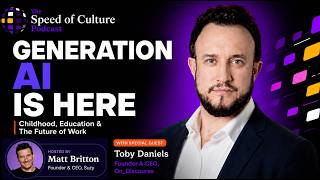
Matt Britton discusses his book Generation Alpha, arguing that education must shift from memorization to creativity and critical thinking while kids learn AI tools. He warns against treating AI chatbots as real relationships, citing a wrongful-death lawsuit against Character AI, and offers a practical framework for using LLMs to solve real problems.
Chapters
First of all, obviously, thank you so much for doing this. Thanks for taking the time.
Of course.
Obviously appreciate everyone else joining us here today. It's gonna be pretty fast-paced. We've got 30 minutes with Matt and we're gonna jump into his book, which I'm incredibly excited about, Generation Alpha. But here's where I wanna start. I wanna talk about The Goonies. I wanna go back to 1985. And talk about a movie that I think was like pretty seminal for you. It certainly was very important to me growing up. I am a kid of the '80s, as are you. And of course the movie's about a scrappy group of misfits who follow a treasure map. They dodge booby traps, they save their town. There are no phones, no filters, just bikes, backpacks, and, uh, lots of yelling. Fast forward to today, Generation Alpha is born into a world of location sharing, AI tutors, and pretty much algorithmic everything.
Yep.
And this cultural reference point, you talk about in a recent Newsweek interview and you sort of push this idea of Generation Goonie. So I wanna know, first of all, where were you when this movie dropped? What did it mean to you? What is Generation Goonie? And I think most importantly, to kind of kick us off, talk about why you think today's kids are potentially missing— what they're potentially missing without that kind of real-world adventure that that movie represented.
Yeah, and I actually, you know, the Goonies reference wasn't mine. It was actually the reporter from Newsweek. And I think it was a great insight. But to answer your question, in 1985, I was 10 years old. And you know, I think during that time period it was just a different world. In fact, like I just saw something on Instagram this morning where there was a game at the end of Michael Jordan's career where Kobe Bryant ran into him and he picked them, he picked them up and everyone in the crowd, no one has headphones. I would just think like those people witnessed a historic moment and they actually saw with their own two eyes. And that wasn't in the '80s, that was in the '90s or late '90s. And it just shows. How fast things have changed. You know, when I tell my kids that when I grew up there was no internet, it's kind of like if your parents told you when they grew up they had no electricity. It, it kind of feels that way. But to answer your question, in 1985, I was growing up in the suburbs of Philadelphia and we went outside every day and we played and we didn't have phones and our parents didn't have phones. And when they dropped us off at the shopping mall, we had to meet them at a specific time because if not, they would have no way to get in touch with us., right? And our parents didn't know where we were when we went to go hang out and play, right? We had this type of freedom, um, that I don't think kids have. I think most importantly, and you know, I have two older kids. One is a, um, my daughter's a sophomore in college and my son's going to be a freshman next year, is that they grew up in public and they had to fail in public. You know, when I didn't win class president in 1993, and I wrote about this in the book, like I lost, nobody cared. I didn't have to see people posting nasty comments about the fact that I lost on Instagram. It was just kind of over, right? And I was able to fail in private. Um, and I think that's a completely different world where obviously we are right now.
So, uh, the book opens in a really interesting way, kind of with a little bit of a haunting twist, because the foreword is written by AI, which I know is something that you were very kind of reticent about doing. Uh, and I know the intention was not for it to be a gimmick. In many ways, it's sort of part of the broader thesis of the book, right? Yeah. Um, but what is the point you were trying to make? Is it a point about kind of consciousness, and you have to read the foreword to know what I mean, or were you just handing the mic to kind of like, you know, the, the future?
Well, I think it, it's sort of like a, it's a sort of a forward-looking, almost like, um, you know, signal of where I think the future is headed. Where, you know, when I, when I told people that I know that I wrote a book, they're like, well, did you have AI write it? I'm like, no, I actually wrote 100% of this book besides the foreword. Where actually when I wrote Youth Nation 10 years ago, I had a ghostwriter. But this time I want, I don't know if I'll ever write another and I wanted it to be my words. So I was kind of sort of like really thinking about legacy and my children reading it. I wanted it to be my words, et cetera. But at the same time, I know that over time we are gonna be using AI for more and more and more.. And if this is gonna be looked at as a mark in history by anyone who cares, right? I think the fact that showing that I knew where it was headed, I knew about AI's capabilities today. And I did it in a way where AI was writing it. It was actually, I used Claude, Anthropic Claude to write it, wrote it in like the first person, like this is what it means to be AI. Don't have emotions. Matt asked me to write this forward. Here's what I meant. And I also think, so it's showing the reader what AI's capabilities are. Today, but also in the future when they look back, it'll show that I kind of knew where it was headed.
So let's talk about the alpha paradox, this idea of like agency. And I think the idea of like agency as we move into an increasingly like automated world. And you know, we talk a lot about the sort of the idea of AI tutors and personalized learning. Yeah. And the potential that these could be like silver bullet solutions in terms of how they can transform education. But like at the same time, I think a kid with an algorithm isn't the same as a kid with a teacher. And so do you think at this moment in time we're potentially over-indexing on teaching kids how to use AI before teaching them like how to be human and, and even how to just learn?
Well, I think it's both. I think that there's some things that are taught in school. And actually I think it's a big part of curriculum in K through 12, especially where it's this notion of memorization and regurgitation. Right? So it's like memorize all these facts and then regurgitate it on the test. And if you're able to do that, you're going to get a high score. And I kind of gamed the system. I wouldn't like pay attention at all in class. And the night before I would just chug Red Bull and I memorized as much as I could because I would be able to keep it in my mind and I would spit it out and I would probably also regurgitate the Red Bull I drank and then I would forget about it. Right? And I would never, and so I wouldn't, I passed the test, but I didn't really elevate myself. And I think in the past, facts were far more important, the retention of facts and knowledge. Now I would argue that's more commoditized. So the question is, what should it be replaced with? And I think to your point, it's skills like problem solving and creativity and critical thinking, right? Which are things that we're not spending enough time teaching kids how to figure out, um, you know, having empathy, how to negotiate, how to manage and grow people, how to deal with resilience. Um, are things that we never learn about. We learn about identifying different types of leaves so we can get to do well on tests. So I think at the same time, I do think understanding these tools is critical because, you know, I don't want to hire anybody right now who doesn't use AI. Why would I? So it's, and if we're, if the whole purpose of school is to prepare people and future-proof them for this coming world, it's only gonna become more and more important. So I do think it's a little bit of a barbell approach. On one side, you need to lean into the empathy and the critical thinking and the problem solving. Other side, you need to be very tactical with the tools. I think where education right now is in the middle, which is neither of those things.
Yeah, I mean, it's— I think it's going to be a challenge for the existing system to adapt. I mean, look, this book felt very personal to you. As you mentioned, you've got two older kids, you've also got two younger kids as well, who span— all of your kids span two different generations. And of course, your younger kids are very much part of Generation Alpha. Um, but what is your hope, uh, for this generation, particularly as you sort of think about the, the ways in which you can guide them through this, um, this sort of transformational and certainly transitional, like, moment that we're all experiencing. Like, everybody— I mean, that, that, that we've talked a lot on Discourse about this idea that, like, knowledge and, and even intelligence is becoming commoditized, so we have to kind of equip and give the skills to our kids. But it's not as straightforward as that. And it, you know, as a parent, it's hard to know what to do in this moment. So, like, How are you preparing and, and, and even providing kind of sort of, well, starting to think about how you're gonna provide guidance to kind of your younger kids?
Yeah. So I mean, you know, Toby, we, we both have been in business around the same time and we were both blessed to have been running companies through the dawn of the digital era, right? When the internet was first introduced and the big thing I talk about the book, remembering driving down Highway 101 from San Francisco to Silicon Valley to sell youth marketing services to companies like AltaVista and eBay and Yahoo, right? And that was a huge change that, you know, I wrote about during the book that Hershey's said they would never stoop down to advertising on computers, right? That's what, that's an executive from Hershey told me. So we saw that play out. Then of course we saw, you know, the social media era and the mobile era, which is largely Gen, you know, Gen Z driven. And we saw Facebook stock plummet when they, quote unquote trade it, you know, display advertising dollars for, um, you know, mobile dimes like that. You know, their stock dropped dramatically and they said, we're just focused on mobile, right? And people didn't understand how much will you be doing on mobile devices, whether it's watching TV or buying things, et cetera. And now it's happening all over again. And there's many correlations that I think I'm seeing kind of history repeating itself, if you will. Except I think it's gonna be with much broader and deeper implications because of the power of AI, because of the, you know, there's no learning curve to be able to adopt it. And the, the rate of change that it, it, you know, it's, it's in terms of its rate of improvement, which we just saw with OpenAI this week with its image creation. So we've never really seen anything like this. So you can compare the, the similarities between the dawn of the digital era or the dawn of the mobile and social media era in some ways, but in other ways it's completely different. To answer your question, you know, what I would tell my kids is that you have to either go deep into an art or deep into a science to be relevant in this future world. So either you have to lean heavily into the things that machines can't do, right? Because the machines have never ridden a roller coaster. The machines have never fallen in love. They've never broken their leg. You know, they've never gotten hurt by somebody, right? So there's, there's humanity that's still gonna matter, right? Or you need to go deep into a science and learn how to code and operate these machines and put the— help companies put them to work. I don't think anything in the middle is gonna make sense. So, you know, having a job, a job where, you know, you're master of all, a jack of all trades, master of none, I think is gonna put you in a really tough position. Or if you want to get a role in middle management, AI agents are gonna do the middle management, right? So figure out which side you're gonna go on and lean in and, and, and really own your domain on one side or the other.
All right, let's, let's talk about culture and, and commerce and that kind of like intersection. So, you know, I, I've known you and we've worked together for probably 15+ years at least, and, and you've always been someone that I look to in terms of providing, um, you know, bleeding edge kind of consumer behavior insights. Uh, and in many ways, as we think about this moment, right, AI is now starting to understand our behaviors perhaps even better than we do in some ways. In some ways. And when you think about this in the context of brands and, and what that represents as an opportunity, if brands start to know us better than we know ourselves, do, do we actually stop being consumers and then do we just ultimately become the product?
I don't think, I don't think AI's ever gonna know us better than we know ourselves. I think, you know, I run a market research company during my day job called Suzy and we have 300 employees and we're scaling and we work with most of the large major consumer brands that you think of. And I spent obviously a lot of time trying to figure out what the future of Suzy is in the world where when you talk about facts of being commoditized, so much types of research can be done using Perplexity. Like you don't need to conduct first-party market research to understand what are the 3 attributes people look at before picking a brand of toothpaste, right? You could ask Perplexity and get that. However, what you can ask AI for is, How do you feel the day after the election? Right? Because AI doesn't really care about that necessarily, right? Or how, how does it make you feel the moment that you decide to buy a Lexus? AI would never buy a Lexus because they would buy a Toyota because it's the same engine and a Lexus is more expensive. But AI doesn't have to worry what your neighbor is gonna think about you if you drive home in a Toyota versus Lexus. So brands are emotional, brands are not rational. And humans are more emotional. So I do think that there's a huge role in tapping into humanity and, you know, in market research specifically, there's this whole big movement on synthetic data, right? Like basically creating digital twins of real people that answer market research responses. I do think there's a role for that, but I think in this world, I think getting humans' voice and understanding consumers is gonna be even more valuable, right? And it's gonna be more precious. As things move forward.
Connect that to the idea of like personalization.
Yeah.
And this actually, again, it's been a hot, much debated topic, uh, within the On Discourse community. And actually one of our members recently on a call was sort of trying to make the argument that it's not about personalization, it's about being more personal. Those are two fundamentally different things. But like algorithmically enabled or driven personalization, like Sounds great. It's always been this kind of like huge promise, uh, in the world of kind of marketing, but it, it also kind of kills so much of what it means to be human, right? It, it sort of like flattens the kind of the, the surprise element. It kills spontaneity. Uh, it can reduce kind of discovery to like predictive loops. So like talk about what it means for you and, and your observations around, you know, what AI can potentially, uh, usher in or provide some support to in terms of how we can make our relationship with brands more more personal?
Well, I don't think personalization being personal are mutually exclusive. I mean, you never really talk to Coca-Cola and take it to dinner, right? So Coca-Cola is never really personal for you. Brands aren't supposed to be that, right? I think what, where personalization adds value, and, and I've actually spent probably 80 to 90% of my waking hours at work building an AI, which is, 'cause I'm not an engineer, but I've actually, that's a big turn I made about 18 months ago, as you know, Toby. And now there's very little things that you can tell me that, um, you know, that I wouldn't know how to build, which is crazy considering I, I don't really know how to write code. And one of the things I've built is sort of a hyper-personalized engine where based upon specific data points, you can get a string of emails or texts or Slacks or whatever that's completely custom to you and gets more custom over time. And you could do that at scale, send out a million emails, right? And a million different people get something completely different. That's something that we've never seen before, right? And yeah, you could say Amazon knows what you bought and it'll kind of, you know, try to show you something different. But I'm saying going really deep in terms of the individual data you're about to uncover. And I think that could unlock a lot for brands. And it means the more data a brand can get on somebody, the more that they can actually serve them things that, you know, that really interest them and really make sense to them. I think we're gonna start seeing that with TV shows and video games and all sorts of modalities because the, the ability to create infinite sorts of, um, content based upon specific data signals, you know, it continues to grow.
Let's go back to the book for a second. So, um, in it you write about the impact of AI on mental health.
Uh-huh.
Um, it's, it's sort of, it's one thing I think to, um, uh, have an AI coach. Uh, I think it's another to mistake that for like a real connection. And, and I think we can see the potential danger of that. I've seen my kids interact with AI under my supervision and it's wild. To see how quickly they start to sort of feel that there's a real connection there. So, you know, how do we, how do we navigate this, man?
It's really hard because Gen Alpha, you know, the, the distinguishing factor about Gen Alpha is they will never know a world without AI. So for them, they're going to just think, oh, this is how humans are supposed to interact with technology, like they're people, right? Because the reason that AI is so powerful is you don't have— there's no learning curve. You text it and talk to it just like you talk to a human. And as AI gets smarter and has more emotional resonance, it will kind of hook people. Perfect example. So for Suzy, we create these AI-powered moderators. So instead of having to schedule a real person to do focus groups or interviews, we have an AI moderator you talk to and people pour their heart out to this AI moderator. I was shocked that they actually do it because once you get into the framework of talking and it sounds like a human voice, sometimes people just forget that it's actually not a real human on the other line. And I think the danger in that is it isn't a real human. And I think if younger people start to create relationships with AI-powered chatbots or any other form factor, you know, it's just rife with danger, right? And because you don't know the company behind it, we've already seen somebody tragically commit suicide. And, you know, there's a lawsuit right now, a wrongful death lawsuit against this company, Character AI, because the family is basically saying, that this, this product, it would basically lead the, the, this teenager down the wrong direction. Mental health was a big issue obviously during COVID because kids felt disconnected. I think this could actually create more of that. You know, I'm an AI optimist. I think that there's a lot of positives gonna come out of this. And I think like every tech technological innovation, there will be negatives. And so this is one of them. I think parents just, I, I write a whole section on parenting in this book, even though I'm not necessarily like a psychologist or somebody who's a parenting expert, but I do have 4 kids. Right, that are all different ages. And so I know a little bit about parenting, and I, I really thought that was important because obviously kids need to know where to focus, but grown-ups and work— the workforce really needs to know how to focus, right? You're responsible for providing for a family, and you're worried every single day, is AI gonna take my job? You know, I have 300 employees, they're all worried about that, right? And, and trying to keep them productive and focused and tell them where to, you know, spend their time when the reality is that that is the case for every worker. You saw Meta laid off hundreds of engineers yesterday that makes billions of dollars a year. So if they're gonna do it, you know, obviously every company's gonna do it.
So I do wanna take a couple questions in a minute and Shamil, our head of discourse, will just feed me some of the questions that are coming through on the thread. But before I do, real quick, so we've been pushing this sort of idea of around sort of solving small in AI. And so the idea is basically, AI transformation isn't about like, like some, some great revolution. It's about solving small human-sized problems. And so if you were giving advice to either a founder or a parent in terms of where to start with AI, in particular in terms of starting small, what would be your recommendation?
So what I see a lot of people doing is it's almost like if you walk into an all-you-can-eat buffet and you circle around because you don't know what to eat because you can eat everything. And then you ended up wasting time and not even getting the right thing in the end. That's the problem a lot of people would have with AI is they play around with tools, but they really forget what they're trying to solve for. So for me, it's put all the tools away and just think about what are the biggest problems that you need to solve in your life or your business? That's step 1. 2, when you identify the problem, what data can help you solve that problem? And then 3, what does the solution look like? And then you could very simply go into ChatGPT and say, here's the data I have, here's a problem what I, what I wanna solve. Here's what a solution looks like. I want you to give me step-by-step instructions. Don't gimme step 2 until I've completed step 1. And you will get there. And you know, an example I have is I created my own health bot, which, you know, I aggregated 25 years of health history and it now creates dossiers for me when I go to a doctor's office. They don't have to ask me any questions, so they spend more time treating me and less time asking me questions because I've given him everything in advance, right? That was, that's something that every human should have cuz everybody who has the problem of wanting to stay alive as long as possible, right? So that's one example. For my business, I want to solve the problem of allowing my salespeople to be more efficient. So I took 25,000 hours of, um, Gong call transcripts and I fed them into a model. And now my, my sales team knows everything there is to know about what customers want in a particular category or vertical based upon those call transcripts. So they have more knowledge. So that's an example of taking a data and solving a different problem. That framework works for everything. What starts to happen is people just like, oh, I need to use all these tools. They forget what problem they need to solve. They, so they're not starting small and they don't actually move the needle at all.
All right, so, uh, a quick lightning round on, on this kind of solving small. So it's, it's a kind of a real or hype response. Um, so first question, AI tutors within, let's say the next 10 years, AI tutors will replace school as we know it. Real or hype?
Hype. I think that kids— people need mentors. They need people who they can interact with. I think AI might be great assistants in the education world, but not replace teachers.
All right. Generation Alpha will never learn to drive or even need to.
Uh, the younger Generation Alpha, I actually agree with that.
And in 5 years, we're gonna miss making bad decisions.
Um, I, I don't, I think in 5 years we'll still be making bad decisions.
Great. Awesome. Uh, all right, so, uh, we're gonna have one foot in the analog, one foot in AI. Uh, or you've obviously lived through this, but I want to ask you a personal question. What is the one thing that you envy about Generation Alpha? And then what is the one thing that you pity?
I envy that they just have this incredible technology because knowing what my personal skill sets are, if I had it at my disposal, because I'm more of a creative thinker and I think it really is a powerful tool for creative thinkers. I think I could have even accomplished more in my life if I had it at earlier stages in a disproportionate way. I pity, or not pity, but I feel bad for the fact that of everything we've talked about, that I think it's going to keep them away from those real experiences, from experiencing, you know, incredible things with other people because they're going to be spending so much more time with technology. Spending more time with technology is almost a, a definite thing I can say about this generation, and I don't think that's a good thing. All right.
Let's take a question from, well, she was one of the inventors of Alexa, so very excited that Joanna is here.
Hey.
Joanna Peña-Bickley, who also was one of our keynotes at our summit this week. She has a question. Applied to media, news, and personalization scale, this has created silos of truth. How do we create communal information centers in probabilistic models? Wow. What a good question.
Um, I'm not really quite sure what that means. Um, if, if you mean like bringing people together so they can, uh, you know, harness, uh, connectivity and have data come from that, I think after—
yeah, I think, I think we've got, we've got silos of truth, we've got mis— misinformation. How do we really address that? How can AI help us address that by creating kind of like, you know, new sort of opportunities to convene and connect but around more factually based information perhaps?
So I mean, let me tell you, I mean, I, I speak about AI all the time and depending upon where I am in the country, you have people concerned obviously on both sides of the aisle, so to speak, about AI. And you have a lot of people saying it's biased and it's pushing people in one direction or the other. I think avoiding bias in AI is nearly impossible because everybody's definition of unbiased is different. And I think ultimately people have to be the arbiter of their own truth. Yeah. And not re, you know, not require AI to be that, um, role of truth teller because then I think you're gonna be dependent upon whatever model that you use.
So this question from Sarah Hollerbeck is a phenomenal one, and, and I was sort of going to try and get to it, which is partly about taste, I think, and why, yeah, critical thinking is an important skill, but like, how do you teach taste? And her question specifically is, how do we teach discernment in schools?
Well, I don't know if discernment has ever been taught in schools. I think discernment happens in life. I mean, I don't think teachers are, are trained to teach discernment or to teach taste. I think that happens through your experience That happens from the minute that you're, um, you know, that you come out of the womb and your, your parents have certain values and that drives your worldview and the types of decisions you make. And it continues to evolve over time based upon the people you interact with and the experiences that you have. And I never think that, I never thought that was the role of schools and I certainly don't think it will be moving forward.
Amazing. All right. Question from Sol, uh, Solomon Rogers. Uh, how do you distinguish an AI character from a Tamagotchi?
Um, well, I mean, Tamagotchis, aren't they something that you get? I, I've never had a Tamagotchi, but isn't something that you can actually touch and feel a Tamagotchi? And AI characters you can't. So I guess that's how I distinguish it. Interesting question.
Very interesting question. Um, all right, let me see here. Any other questions coming in from you guys? All right, I don't think so. I'm gonna go back to, uh, to a couple additional questions I have. So I want to go back for a second, Matt, just a couple things that we sort of touched on, but I I think knowing who is sort of here and in the room, and as we sort of all wrestle with all our various different sort of anxieties around the future, we touched on and talked a little bit about kind of the future of jobs. And I think at the moment, the message, and it frustrates me sometimes that like we push these messages, particularly in media, around how to kind of make everybody feel comfortable about what's happening and where things are gonna be. At a time where I don't think anyone can really reliably predict what the future is going to look like. And in particular, I think young kids who are very concerned about jobs and their careers and what have you are being told, don't worry, if we look back in history, new jobs always emerge during these enormous transformational moments. And we certainly saw it during the Industrial Revolution. We saw it during the information revolution, and I think the same argument is being made today, but it's different, or at least it feels different. So what's your kind of way of being able to communicate to young people what the future is gonna potentially look like, particularly in terms of their careers?
Well, I mean, it's hard to really map it out. No one's really a, you know, a fortune teller in terms of where things are going, but it goes back to what I was saying earlier. I think to oversimplify it, you need to actually really go deep into being super right-brained or left-brained and being super technical or super on the emotive and human side and not be in the middle. I think, you know, we pretty much know the skill sets that are needed right now. Like for example, when OpenAI pushed out this incredible new tool where you can create all these new assets instantly, for some people they wouldn't even know how to use it, right? Like it's not intuitive to them how to create a cool image because they, they're not creative enough to understand the type of image they want to create. And for those people, no matter how great the tool is, they're never really gonna get the benefit of it because they don't think that way. And if you don't think that way, that's okay. Well then you have to go on the other side and really look, be super technical. But if you're not technical and you're not creative, I think that, you know, those in the middle are all the jobs where AI is, is taking things away. They're knowledge-based, they're process-based, and knowledge and process are two things that AI does. So I think it really is about focusing on one side or the other.
All right, last question from James Cooper. When will we stop talking about AI? Because it's just how everything is made and no longer interesting to highlight in the same way that no business calls themselves, in general, call themselves a dot-com anymore.
That's a great question. I would say probably in a couple years. I think it, it's probably when those legacy companies finally adopt it because it's gonna take so much longer than people think. I mean, there are still companies that I work with that are using Lotus Notes, right? So I think it's gonna take a while before we see this AI-based transformation. You know, we obviously are very biased. We generally live on the coast. We understand technology. We work for these digital companies. Most of corporate America is not nowhere near this. And there's gonna be lawyers and privacy and data security and so much is gonna get in the way. So it'll probably be longer than we think.
All right. So everyone here, we promised you a free book. Matt's been very generous. Uh, the book comes out in May, I believe, Matt.
That's right.
Yeah. So how do, um, the attendees joining us here today get an, a, a copy of your free book?
Yeah. So I created a tool talking about personalization, um, called the AI Readiness Report, uh, where basically you fill out your information and then it goes into your, um, LinkedIn, takes information from you and gives you an idea of the things you should focus on in AI. And it's at AIReadinessReport.com. So if you go there and you complete the report, I'll get your information and we'll ask you for your address and we'll send you a free book. It doesn't take long. You have to just fill out your name, your email address, and your LinkedIn profile, and that's it.
All right. Let me just drop the link into the chat here. There you go, everyone. AI Readiness Report. Matt, thank you so much.
Thanks, Jesse. Thank you, Matt.
Appreciate your time.
More from Matt




MikMak’s Rachel Tipograph on Consumer Spending, Retail Media & Holiday Shopping Trends



Jaguar Land Rover’s Charlotte Blank on Luxury, Purpose & Experiential Storytelling



