Matt Britton Keynote At Propelify Innovation Festival - Hoboken NJ: Gen Y Marketing Strategies
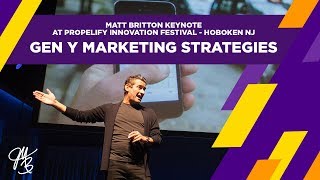
Matt Britton delivers an alphabet-structured keynote at Propelify about how millennials and Gen Z are reshaping business and marketing. Using letters G–Z he links cultural and technological trends (gentrification, hardware ecosystems, AI, programmatic/local advertising, influencer power, LinkedIn, delayed marriage, the decline of network TV, VR/AR, AR gaming, influencer metrics/Q scores, Snapchat, university reform, coworking, experiences, YouTube creators, and personalization) to implications for brands, retail, education, and careers. The talk mixes anecdotes (Best Buy, Pokemon Go), prescriptions (own ecosystems, spend small on targeted ads, consider alternatives to college), and skeptical takes (VR hype, Snapchat monetization).
And Della, thank you all so much for coming out today. You guys are all amazing. What's going, everybody? Once again, I'm your host, Corey Cambridge. Thank y' all so much for coming out to Propeller 5. Feels good to see so many beautiful faces. Hello. What's going on? We are out here. Also give a nice final applause for DJ Linda Lee on the ones and the twos.
There we go.
There we go. Don't be shy, y'.
All.
Don't be shy. All right, so I want to introduce my next guest, my main man, Matt Britton. He's the CEO of Crowdtap and the author of a book called Youth Nation. And if you're nice to him, he may spit a freestyle for you. It'd be nice to him, so give him a round of applause to my main man, Matt Bradley.
Yo, keep the beats going. My name is Ig and I dropped madpeas. Okay. I feel like I'm in the opening act for Lollapalooza 11am gig. How many millennials do we have in the audience? A lot of millennials in the house. So I spent my career helping big brands market to younger people. And what's abundantly clear right now is there's just a huge gap between the people that are making big business decisions in the business world and the people who are actually changing the future in the business world. I deal with a lot of CMOs, CEOs, et cetera, a lot of which are still Gen X and boomers, who in my mind are a different species than Gen Y and Gen Z. Everyone says, well, why is millennials such a big deal? The reason millennials are a big deal is that they were the first generation that grew up with skill and trade based, meaning you have to go deep into an art or deep into a science, because anything else is going to be offshore or outsourced to Costa Rica or China or you name it once it's going deeper than art need, being smart, being creative, coming up with ideas. You want a career in middle management, where you're going to work your way up the corporate ladder, you're going to find yourself in a really bad position very quickly. So that's why I tell parents of young people going to the world, go deep into an art, go beat your styles. What's the number one major in colleges? College of General Studies, Liberal arts. You're learning basically a whole lot of nothing that's not applicable coming out. Education needs to change. G stands for gentrification. Our major cities are getting pushed outward and outward bed stuy a place that's crime ridden a couple years ago now and Main street business owners get pushed out is when new businesses are built. One of three things are built. A chase, right? A Duane Reade or Starbucks. Why? Because those are things that people need within the hour, right? You need your money, you need your coffee or you need your pharmaceuticals, but anything else, you're just gonna have Amazon delivered the next day. And that's why there's not really a business model anymore. I was in Best Buy, I wrote a blog post about this because I didn't have my earphones and I had a conference call and I hate doing this. Some people say it gives you brain cancer. It's not short, that's not really the point. But I was waiting and there's one woman ahead of me and I waited for 14 minutes to buy this pair of Bose earphones because that's why I was struggling to get the rewards number into the system. And I got fed up and I went down the elevator of this massive three story complex that was ordered by the time I left the store. So sure, I didn't have the headphones for the next 24 hours, but in a couple of years I'll actually be able to have it delivered to me in five minutes. And that's why that Best Buy three story complex is going to be an apartment complex in three to five years. No doubt about it. It's just how it's going to happen. H stands for hardware. Hardware is becoming something that's more important not just to companies in technology, but to any company. Take the company that makes laundry detergent. Okay, what's happening now is any product's being commoditized. Retailers are building private label like Walmart and Target. And if you're going to buy a brand name laundry detergent, what's sold at private label is really just as good. And just how Apple said they need to own the whole ecosystem. If you sell laundry detergent, they then you should probably make laundry machines. Because if you can install the laundry machine and it has a sensor and it reorders the laundry detergent, then you've actually created an ecosystem where you can sell over time. That's the model that any company that sells packaged goods or consumable products need to go into. You need to own the whole ecosystem. Apple really paved the way for that. It's no longer about a point solution. Look like a company like Samsung, they make TVs, but they don't have an ecosystem, they don't lock in the user. Now they're just in a race to the bottom to try to make the cheapest possible tv. And as Vizio's technology gets better and better, is the consumer really going to spend 5x for what they can buy for Vizio? Maybe not. I stands for artificial intelligence. Machines are getting smarter and smarter. I saw a story the other day that Google, with its Translate tool, is trying to obviously translate one language to the other. But there's some languages that just don't translate. And through Google's artificial intelligence, they've actually created a whole new language, the language of Google, that can act as an intermediary between the two languages that can act compete with one another. To me, that's a great example of the power of artificial intelligence. For all we know, the whole world might be speaking the language of Google in 15 years. J stands for Joe's Pizza, and this stands for the democratization of opportunities. Okay, right now, if you're a small business, you have the same opportunity to advertise to the right person at the right time as a massive business. And as television moves into what I think will be a giant iPad hanging on your wall, you're going to see 8, 9, 10 year old kids going up to TVs and trying to swipe them all the time. Joe's Pizza will be able to programmatically buy an ad during the super bowl targeting people within one mile of their location. That's democratization. It makes it easy for opportunity. It's not just the big companies that could be on TV. As everything becomes programmatic, you can spend $5 and reach the right consumer at the right time. If there's one thing I tell you guys all to do, if you haven't done already, spend $5 and launch an ad on Facebook and target one small segment of consumers. You have no downside. See how it works? It's changing the world because you can actually make sure that every dollar goes to exactly who you want that dollar to go to. K stands for the Kardashians. The Kardashians. I made a statement Social Media Week a couple weeks ago that they're going to have and people leave exit stage. Ray, when you hear the Kardashians, that's cool, I get it. They are going to have a bigger impact on media when it's all said and done than the Beatles did. Not saying they're better musicians, but their scale and their reach and their model of selling shit is actually the true definition of what influence really is. That word influence is thrown around over and over and over again. But when a Kardashian posts makeup on an Instagram post, they actually sell things out and websites break down. Why? Because they spent their whole career first building an audience of people that really care about them. Okay? They watched them on Keeping up with the Kardashians, they got involved with their life and the Kardashians got into Snapchat and became more and more voyeuristic. And then they have an army of young women who care about what they do, what they feel, what they say and what they buy. And when people feel that way about people, that's when things sell. If you want to sell stuff, you call them. You don't call News Corp or Viacom or Big Media. People are the new brand. They now have the power, not the big publishers anymore. L stands for LinkedIn. I think LinkedIn is just getting started in terms of their power at connecting the business network. A lot of people write it off because it's not sort of in vogue or cool. But if you want to be seen in the business world, that is a new resume for a lot of you guys. You actually know that. But for some of you who didn't, I thought I'd throw that in there because I run into too many smart people who don't spend enough time on LinkedIn. And I think they should. And M stands for marriage. People are getting married later and later and later in life. The biggest reason is Tinder, obviously, but not just Tinder. People are staying in cities. Women are working later in life. Cities are more expensive. You need more of a dual income household. People who are 40, who are 40 are acting 30. There's 50 year old the birding man and that scene being socially accepted. So people have no interest in kind of settling down, moving out to the burbs. And since they're getting married later and later and later in life, the notion of the American family is going to be widely different. You know, we're not going to have as many kids that are being born to population. That I think is going to level off when you're selling to Mom. Mom is not younger anymore. The notion of a family is going to be much more of a wealthy thing. If you have a family in a barbell economy, especially in the cities, it's actually becoming more and more of a status symbol based upon the cost of raising a family in the city. N stands for network television. I do not think network TV will exist in five years. NBC, cbs, abc. Young people, Gen Y and Gen Z, they don't tune in to must see TV on Thursday night, right at 8 o' clock to watch Seinfeld. Those were the good old days. People are watching and time shifting every single program possible. The one thing holding up television, network television right now is the National Football League, the most watched live program amongst male and female viewers, which is why they command billion dollar deals with major networks. Besides that and the Grammys and Oscars, everything else is time shifted. Yet brands still spend a majority of money during upfronts, giving money to big TV providers. But in a world moving forward where the network TVs aren't there to get 100 million dollar checks during the upfront, where is the money going to go to? How are brands going to be able to work in a fragmented world? And what business opportunities does that produce for everyone who's at this conference? That's the question I have. Because that's the tipping point that's going to happen. One day there are CDs when you walked into Walmart. The next day they were gone. When itunes was invented, one day there were DVDs, then they were gone when itunes and Netflix started to stream. I think that same dramatic impact is going to happen at network television and I think it's going to be really fascinating. The city O stands for Oculus Rift or virtual reality, which I think frankly is very, very overplayed. I think this is a note. It reminds me when 3D TVs were coming out and everyone thought that was the next big thing. There's not been hardware that's been able to be spread out to the masses yet. There's not the applications that consumers really need. I do think it's going to come in niche areas like communications and gaming. Why travel to Taiwan when you enter business? Meeting with people in high def. But for the most people have no interest in kind of settling down, moving out to the burbs. And since they're getting married later and later and later in life, the notion of the American family is going to be widely different. You know, we're not going to have as many kids that are being bored of population. That I think is going to level off when you're selling to mom. Mom is not younger anymore. The notion of a family is going to be much more of a wealthy thing. If you have a family in a barbell economy, especially in the cities, it's actually becoming more and more of a status symbol based upon the cost of raising a family in the city. N stands for network television. I do not think network TV will exist in five years. NBC, cbs, abc. Young people Gen Y and Gen Z, they don't tune in to must see TV on Thursday night right at 8 o' clock to watch Seinfeld. Those were the good old days. People are watching and time shifting every single program possible. The one thing holding up television, network television right now is the National Football League, the most watched live program amongst male and female viewers, which is why they command billion dollar deals with major networks. Besides that and the Grammys and Oscars, everything else is time shifted. Yet brands still spend a majority of money during upfronts, giving money to big TV providers. But in the world moving forward, where the network TVs aren't there to get hundred million dollar checks during the upfront, where is the money going to go to? How are brands going to be able to work in a fragmented world? And what business opportunities does that produce for everyone who's at this conference? That's the question I have. Because that's the tipping point that's going to happen. One day there are CDs when you walked into Walmart, the next day they were gone. When itunes was invented, one day there were DVDs, then they were gone. When itunes and Netflix started to stream. I think that same dramatic impact is going to happen in network television and I think it's going to be really fascinating to see. O stands for Oculus Rift or virtual reality, which I think frankly is very, very overplayed. I think this is a note. It reminds me when 3D TVs were coming out and everyone thought that was the next big thing. There's not been hardware that's been able to be spread out to the masses yet. There's not the applications that consumers really need. I do think it's going to come in niche areas like communications and gaming. Why travel to Taiwan when you enter a business meeting with people in high def? But for the most part, I think virtual reality is very far away. Too many people are focused on that stuff, but they don't know how to actually do the blocking and tackling that's needed for today's world. P stands for Pokemon Go. Who played Pokemon Go and chased little creatures around Central Park. I know there's more of you guys out there. There was like Zombie Week in New York City when Pokemon Go first blew up, where everyone is chasing these little characters. For those of you who don't know what it is, you look through a phone and it overlays a game on top of a real world scenario and you actually earn points. That game went very high. It was like top 10 on the app store. And it flamed out just because people have better things to do in their lives. But what that showed you is the power of augmented reality. The power that one day I'll be able to put my camera over all of you and have overlays coming all of your faces. Okay, so those of you who are texting during it, I'd be able to come back and go after you afterwards. Right? Or if I'm in a store and I'm walking down the aisle, I could actually see how much things are and maybe I'll just buy it on Amazon, which is what people are going to do. Which is another reason why retailers are in bad shape. Because once augmented reality comes out, and Google just had a big announcement on it yesterday, why would anybody pay a dollar more than they need to? Why are retailers going to be able to mark anything up? If I actually go over every product and tell them the cheapest place I can get it, I can hit a button and have it sent to me, then retailers are just going to become giant showrooms. And the smart brands like Tesla understand that retailers are showrooms because you don't see them with massive complex, with massive parking lots in the suburbs. They have a 2,500 square foot footprint where they're selling Teslas, but they have two vehicles on display and they capture your information and they build relationships and they ship you your car. That's how car dealerships are going to work in the future. Not these massive Tri State Ford dealerships with huge parking lots. Because this generation isn't really going out there. But then again, I don't think people are going to be buying cars, which I spoke about earlier. Q stands for Q score. Q score is something that's used in the advertising industry in looking at celebrity sponsors or endorsers, which basically says how high of a Q score influence that they have. Obviously Michael Jordan, High Q score, LeBron on sports. What you saw with the Pepsi Kendall Jenner fiasco is actually leaning into too much of Q score. Just from a quantitative standpoint, but not a qualitative meaning. Sure, she has a ton of reach, sure she's hot, sure millennials know her, but she does not have influence over social responsibility. If it was a fashion ad by Maybelline or l', Oreal, putting her in something like that, like that would be great. But having her be somebody who's all of a sudden an authority on social responsibility is a miss. It's not just about people's reach or influence. It's what they're influential for. How do they build that influence and then the brands that can fit into them, that's who calls them. It's not just because somebody has a lot of reach. You should actually do a deal with them. And that's what you're seeing more and more of. S is for Snapchat. I did a ton of interviews last week about the future of Snapchat. Here's my take on Snapchat. It is right now. It's a one point solution. Why Snapchat blew up is that you had a lot of young people on Facebook using Facebook messenger and texting to share information, but they didn't want to see what they were saying to their bae at 2am so as a result they went to Snapchat because they knew it was a safe place and the 101 ephemeral text messaging took off. Then basically Snapchat went to a one to many stories approach which is basically kind of a newspaper. But you know what, that sounding is very duplicatable which is why Instagram duplicated. And then they also do discover which is sort of like you can see ESPN or BuzzFeed content, but young people don't want to go to Snapchat to see that type of content. So is Snapchat valuable? Yes. A lot of young people are moving from the four static icons at the bottom of your iPhone, the phone icon out and the Snapchat icon down as their de facto way of communicating. But the problem with that the business model is that there's nearly no native place for advertisements in one on one texting. You don't want to text somebody and actually have to see a spot in between. So that's problematic. So why I don't think Snapchat's going to go away anytime soon. I do not think it's the next Facebook. I think it's laughable that Wall Streeters who I was on a panel last week at CNBC with five other experts telling mainstream America why Snapchat's great. And at the end I said how many of you guys have ever used Snapchat? And no one raised their hand. And that's the crazy echo chamber we have when tech companies go public is these people don't understand the business. They look at fundamentals and they try to put it in these categories. But in reality we're in a world that nothing really fits into a category anymore with this innovation. U stands for universities. I spoke about education earlier. I think that the college debt college loan model needs to be reinvented. I think people should Think about skipping college if they think this is an opportunity to jump in and actually get their hold. Because learning is everywhere. There's so many opportunities where you can get information and be empowered. Information and the degree doesn't mean shit anymore to me, at least as an employer. I don't look at resumes. I've been burned by Harvard people. I've been wowed by community college people. And I just think that what happens is nobody wants to be the one kid that didn't go to college. And because of it, they rack up a ton of debt, and then they can't live the life that they want to live. And when it comes down to it, your best time to actually have financial freedom is between when you're in the age of 21 to 27. That's the future of your life. You go one of two ways. You go to work for corporate America and hope you're going to work your way up the corporate ladder. But what happens if that company gets bought or disrupted by a new technology? Or your boss sucks, or there's so many different things that can happen, and all of a sudden you're set back again and again you're putting your future into somebody else's hands because you want to live in a good apartment, right? And you want to be able to go to Coachella. Don't make that mistake. If you're 21 to 27, figure out what you love. Figure out where the path is to sell direct and be a freelancer. And by W, I don't even know where I am with the language. There's no screen here, but I'm just writing it out. W is for WeWork. WeWork really is about the freelancer world. It's got collaborative workspaces. For a couple hundred bucks, you can have a desk next to a bunch of other people in environment that rivals Google. And be empowered to be your own entrepreneur. That's where things are headed. X. I got to three letters left. X stands for experiences. Experiences basically is the new stuff. The status update is the new status symbol. And people are going to want to seek out experiences as a way to build their personal brand. Growing up, Gen Xers, boomers, if they want to show everybody that they actually hyped the Amazon river, they would have to take a photo app of it, hope that people would see it and stand on a shoebox, right? But now I can show it to people at scale. And that's why experiences are building personal brands. I did a panel with millennials a couple weeks ago. I asked them all. What is their favorite app? Every single one said a travel app is one of their favorite apps like get the flight out which is on Friday. You can actually search the furthest place you can travel for the cheapest amount of money. Oh, it's 300 hours round trip to Budapest. I guess we're going to Budapest. Pack up. Sounds crazy, but. But it's about the bucket list and traveling. Why is for YouTube? YouTube really is the closest thing we have towards a new model of tv. Because in the world that people are the new publishers, they are going to be the ones that build audiences and they're going to be extremely powerful. And there are so many 12, 13, 14, 15 year old kids that have bigger reach than Us Weekly and Newsweek and these magazines. It will blow your mind. And Z stands for zebra, which is Z is always the hardest one to do next to kind of cheat it experiences. Skip that over. Z is for zebra because they look all the same, these consumers from far away. But when you get closer and closer, like zebras, you see they all have different stripes which is why targetability, personalization matters. Have the greatest time today. Stay cool, ho book and love you all. Thank you very much.
I'm a round of applause for my band man, Matt Britton, everybody. Once again, I'm your host, Corey Cambridge.
More from Matt




MikMak’s Rachel Tipograph on Consumer Spending, Retail Media & Holiday Shopping Trends



Jaguar Land Rover’s Charlotte Blank on Luxury, Purpose & Experiential Storytelling



