Matt Britton Live At NatGeo HQ In Washington D.C.: "The Class Of 2025" : Reaching Gen Y
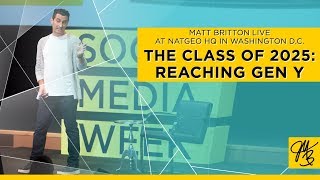
Matt Britton argues that the Class of 2025 will grow up entirely with screens and constant connectivity, amplifying millennial trends. They'll prefer renting over owning, skip traditional college for marketable skills, work as freelancers, and follow YouTube stars instead of TV networks. Legacy companies that don't adapt will be disrupted.
So are there any millennials in the audience? Okay, so normally when I ask that, over the last five to 10 years, I've been speaking all around the country. When I saw millennials, I'm like, wow, they're super young. They're millennials. But actually it's not really the case right now. The youngest millennials are actually 21 years old. They are aging out and they're being replaced by the Conners of the world, who are 18 and obviously coming in. It's just amazing what the access to information and technology does to somebody's upbringing. I talk about millennials all the time, and I still will, because to me, that was a defining generation. Because the gap between Gen X and Gen Y was the most severe gap in the history of humanity. Because the notion of growing up with the Internet in the household, in my opinion, makes those people who had the Internet a different species. Their brains are wired differently. They have an intuitive understanding of technology and communication. They grew up in a real time environment. I think the change from Gen Y to Gen Z is much less severe because I think it's just going to be much more Gen Y ness. But make no mistake, Gen Z is going to leave its mark of its own. And as I think about the millennials sort of aging out, it's time to look back at the legacy of the millennial generation and the things that they're actually going to leave. So when I'm 50, 60, 70 years old, I can look back and tell my children and grandchildren it's their version of I had to walk to school in freezing cold water with no shoes on. Right? It's like, well, I didn't have the Internet. I had to use Encyclopedia Britannica right until the millennials came along and changed everything. So what are those legacies? The legacies are really the hallmark of what Gen Z will become. And now I am starting to shift my focus towards a younger generation. And in doing so, I'm really fascinated with the notion of what is the world gonna look like in 2025. Why 2025? Well, I have an eight year old boy right now and I saw that he's gonna be graduating high school in the year 2025. And I know a lot of kids are gonna be graduating, coming college in the year 2025. And to me it's just really fascinating that that's going to be such a different world. Because one thing that's been brought on by the Internet is the rate of change have accelerated so quickly. So yes, when we grew up, TV was A big thing or telephone was a big thing. Maybe some people in the room. The car was invented, and that was a big thing. But the telephone took 30 years to get 100 million users and Instagram took two years. So what we think is going to happen in the future is actually going to happen faster and faster and faster. Not going to paint a picture of the Jetsons in 2025, although self driving cars might be a reality. I want to show you how all these millennial legacies are going to change the world for somebody who's coming out into the real world in 2025. Does anybody have kids in the room that Maybe age between 7 and 12? Okay, so good. A fair amount, maybe 30%. This is so important to know, not just for business, but also on how you raise your child, how you prepare them for a world that's going to look nothing like today. The things they need to be learning in a world where the education system is so slow to progress is super important as well as a parent. So I hope that you guys get value from this presentation, both from a professional level and from a personal level. Throughout the presentation, if you guys have questions or comments, you can tweet me atttyb. My Twitter handle's on each slide. In case you guys forget it. I'm gonna talk super quick, and sometimes I'll just take a breath of air and I'll drink through it, but I'm gonna be talking about the class of 2025, who it is. And sometimes people just especially early in the morning, they're like, just slow down, dude. You're too fast. So I'm okay with the sort of symbols, like, let's make it interactive if I go too fast for you guys. But super excited to be back at this conference. I've been here four or five times and always meet incredible people, and it's very well run. I love this venue. And now I'm a cover star of Nat Geo. So moving on, who are they? So who is the class of 2025? Well, these are kids that then when they were babies, the first thing they saw maybe wasn't their mother's smiling face, but actually a phone. So the second they came out of their mom's womb, they see their own faces. I work very closely with a charity called Pencils of Promise that builds schools in underprivileged areas around the world. And I went to Laos in Southeast Asia, and we all had phones. And we went to this remote village with no electricity, no running water, and I was showing kids their own face for the first time. They'd never seen their face. They didn't have mirrors before. It was a moment that literally brought me to tears because they didn't even know what they actually looked like. Here in America, we. We have kids that are looking the second they come out. So just think how that actually changes their brain. At age 3 or 4, they're learning how to be a hipster, right? Their parents are dressing them up like a hipster. More and more parents are living in cities, which I'll get into. They don't have to wait till they're 14 to be an emerging fashion blogger. They understand the value of fashion and style at a young age, and they're kind of into where they look. I wouldn't mind looking like this little dude at age 4. And. And then by age 10, they're already hosting group committees with all their devices. So they're getting together, they're using technology to work on class projects. Kids that are in school right now use Google Classroom. They should not be learning handwriting anymore, which is something I'm going to get into a little bit later in the presentation. But the group dynamics of using technology to collaborate with one another, to communicate, to share content, to share information, and obviously on a personal basis, texting, snapping at all hours of the night, constantly constant contact with other people. Their brains are wired differently than even the millennial generation, because these are people, again, that are learning from the second they're born how to collaborate with technology. And obviously, we talked about this a lot, but they are the most. They're going to be the most diverse generations. So the class of 2025, only half are going to be white, 25% are going to be Hispanic. Obviously, it doesn't come without notice to me that we're here in Washington, D.C. where there's so much, you know, controversy. And this is not going to be a political presentation, trust me. Not ever going to go there. But, you know, it's getting interesting. Just the confluence of factors with, you know, a political regime that's going one way, you have a generation with corporal lease going another way, not, you know, somewhat reminiscent of the 60s, you know, when you had all those clashes. The biggest difference is in the 60s, when people tried to fight and have counterculture to fight against big government, big institutions, they could only climb on soapboxes, where today they can reach millions of people at once. So I think the power of young people is so much more great, so much more accelerated. And the future of the world, the future of the business world, culture, society, the socioeconomic landscape is not going to be driven from the boardrooms anymore. It's going to be driven from the sidewalks. And what fascinates me right now is that the C Suite, I've worked with half the Fortune 500 over the last 20 years. And the one thing is always true, the board is full of old white men, right? For these legacy companies that are getting knocked out and they talk about this God, Mark Zuckerberg and all these incredible stars, yet the 30 somethings or 20 somethings in their company or seven floors buried beneath and they don't even know who they are, right? Why don't companies have shadow boards where they should be accountable to the young rising stars in their organization, the same way that the board itself is accountable to shareholders? Because that's how companies don't become the next Best Buy or Circuit City. Best Buy is not out of business yet. So if you work for Best Buy, I probably just Circuit City, Radio Shack, Polaroid, blah blah, blah, blah blah, Kodak, et cetera. You need to really disrupt yourselves. You need to disrupt yourself with the millennial thinking. Since the C suite is not filled with millennials yet and certainly not Gen Z's, these people don't have the ability to make decisions based upon the reality of today. They're making legacy decisions. They're spending 80% of their budget on TV. They're addressing a world where people are shopping in shopping carts offline versus shopping carts online. They're not ready for the next generation. And because of it, they're new innovations come up, nip them at the heels and they go out of business. So that's who they are. This is a very diverse generation again, a diverse generation in the world where corporate America is disconnected with it. Where would they be graduating from? Well, I think that higher education and just the education system in America, even at progressive private schools, is just so far behind the fact that we're teaching kids to understand algebra, where they could just ask theory any complex problem and they always will be able to and theories are going to get better. Or why are you teaching kids this type of thinking when our counterparts in Japan are learning algorithms? Who's going to win in a global economy moving forward? Why are kids being taught handwriting when they're typing? And why are they even being taught typing where in two to three years they're going to speak into their phone? So these are just two of. It's a presentation in terms of how far behind the education system is in America and how ill equipped it's making this generation Be. A lot of parents are still telling kids, go to college education, right? Get that four year degree, go work for a big company, work your way up the corporate ladder. But the reality is that unless you go deep into an art or deep into a science, your job is going to be offshored or outsourced. If you have to walk into work every day and wait for your boss to tell you what to do, your boss is going to tell somebody in Costa Rica or India, in China, to do that a lot more cheaply. In order for you to succeed, you have to go deep into an art or deep into a science. Deep into an art, understand aesthetics, the design, writing, creativity. Deep into a science, understand how to code, how to operate machinery. Because machinery, you know, Amazon just built 30,000 robots. How do you operate the machinery? Deep into art, deep into science. Who's not going to win College of Liberal Arts General Studies, which I went to. Those people that don't have those skill sets, the only thing you're going to be left at when they leave school is a mountain of debt. A mountain of debt which this new presidential, presidential group wants to essentially make stick with you. The debt, you can't get rid of it, it's going to be with you no matter what. So student debt is actually doing the exact opposite of what people go to college for. To follow their dreams. They're getting burdened with debt because they think that's kind of the way it should be done and that's how their parents taught them, and their parents, parents, etc. But because of it, they have no very marketable skill sets. There's a reason that trade schools are on the rise. Trade schools teach those marketable skill sets. When I was growing up and as many of you were growing up, trade schools were kind of looked down on, right? You need to get into a big university. But now, in a world where technology is disintermediating and if you're not in an art, you're not in the science, you're going to be disintermediated very quickly. You're going to be offshored or outsourced very quickly. Trade schools should be on the rise and people should not try to be straight A students. I don't want my kids to be a straight A student. I want them to be an A in something and an F in everything else. I really do. Because if LeBron James wasn't great at basketball, right, Would he be somebody who would he be an A in something else? Maybe, maybe not. He's gifted in one thing. Right. To have kids study every single thing so they could be gifted in everything. The fact that you're gonna be great at all things, that's why you see so many Ivy League kids come into the workforce and they get trampled on. I don't even look at resumes anymore because I hired so many kids from Penn, Harvard, Yale, and they did not perform nearly as successful as kids that went to middle of the road colleges because the pressure to do good in everything when the human mind can only do so much and being a specialist wins really kind of outweighs it. A friend of mine, Adam Braun, a brilliant person who started that charity, Pencils of Promise, went on to the private sector and started a venture fund that really redefined the whole college higher education system called Mission U. And the way Mission U works is you pay no tuition. Your tuition is paid by a portion of your future salary. Mission U partners with some of the leading employers in the world, like Google, like Apple, like Warby Parker, who have committed to give the people who graduate from Mission U jobs. You don't have to pay room and boarding, everything is remote. Except you do have cohorts from your city that you actually meet with. And it's a much faster way to get the education that you need, the marketable skill sets you need for, for a new world, and you don't get saddled with debt. To me, Mission U is onto something because it's really creating the blueprint for what is needed right now in this world, not what was needed back in 1954. Right. And that's about looking in the revenue and not changing quickly enough. Where will they live? So another thing we grew up thinking is that this is the version of the American dream, right? Big white house, picket fence, two car garage. Maybe you live on a cul de sac that you'd roll up to in your Lexus playing a little Shania Twain after a long day of work. Right? American dream for the Gen Xers, right? You moved out, you got a house. But the reality is that this generation has taken a U turn in terms of how they define the American dream. They want to stay in cities. Because in a 24 hour news cycle, cities is where the action is. And they are sacrificing the space and privacy of being in the suburbs for the proximity and connectivity of being in cities. And obviously when I say space, I mean space. This is a $2800 studio in Greenwich Village in Manhattan. But you know what? They'd rather be there. And sometimes they'll put two people in a studio because they'd rather be there at any cost. The space doesn't mean anything because they're out and they're redefining what their priorities are. And their priorities are experience and that connectivity. And what that's doing is it's kind of turning America inside out. Because the notion of the inner city blue collar worker is being flip flopped. The creative class that is deep in art and deep in the science and is now taking over the cities, this is Washington D.C. right now. The purple is people who are in the creative class, those are people who are obviously deep in them in art. The service class is people either in between the intermediaries, between a working class and the creative class or is deep in the science. And then you have the working class. Right, that's that blue collar worker. We're here in Washington D.C. i don't see much blue on here, do you? Right. So that's gentrification. It's being reflected in the real estate cost. In Brooklyn, real estate costs over the last 10 years are up 130%. Where in Long island is up 2 to 3%. Why? The millennials are staying in cities and the livable boundaries of cities get pushed further and further outwards. I was at a Jay Z concert last night, which was a risky move given I was speaking so early, but I hope I pull it off. And Jay Z's rapping about 560 State Street. It's an apartment building in downtown Brooklyn. In the context of him selling drugs and hustling just kind of just to get by. Well now you can buy apartment at 560 State street, but it's $2 million and it's across the street from the Barclays Center, a multibillion dollar entertainment complex which Jay Z is a part owner of. Right. So that's. Can I kind of bow the story any better? But it's not just in Brooklyn. It's Wynwood outside Miami, it's Oakland outside San Francisco. Every major city. People don't want to leave. Livable boundaries get pushed outward and outward people are staying in the cities. Real estate prices spike up, which has a whole trickle down effect on the way that this world will actually look. One way it will have a trickle down effect is in terms of where they work. Because companies are seeing that young people are staying in cities and what they're doing is they're abandoning their big suburban enclaves like Microsoft and Redmond, Washington or Pepsi and purchase New York. Right. And they're giving up the tax advantages of these huge corporate campuses and moving back into the cities because the millennials do not want to live in the suburbs. And they certainly don't want to commute to the suburbs. When companies are doing it, they're contracting their workforce because, let's face it, there's not enough space for massive workforces in the city. And a lot of companies are seeing that as they have more pressure from Wall street, they need to do addition to subtraction. And what that's driving is this whole boom of the freelancer or free agent economy. The free agent economy is not based upon the premise that you're going to work for a corporate company and work your way up the corporate ladder. In fact, the average age of a company on the Fortune 500 in the 70s was 40 to 50 years. And now the average age of a company is 8 to 10 years old. So companies are not around for much longer. So you can't work the way up the corporate ladder, keep your head down and make your way to the C suite. That's just a notion of the past. The reality is, if you want to succeed, you have to have those marketable skill sets. So talk about deep in and art deep into science. These are some of the most common words when associated with freelancers. There are people who understand that they have those marketable skill sets. They can work for many companies at the same time. Playing Xbox, easy, eating Doritos, drinking Mountain Dew, and making half a million dollars a year and working from wherever the hell they want. Right? That's the new version of the American dream. And this is the American dream that people can attain and our children should be striving to attain, not by being a generalist, but by being a specialist. And WeWork, which is now the fastest tenant of commercial real estate in the United States in many markets around the world, just valued at $20 billion, started by two guys in their late 20s within the D.C. area. Has a collaborative workspace model where I can rent that desk crushed from that spiffy guy in the blue shirt for about $200 a month. He might be an engineer. The person to my right might be a graphic designer. Person to the right of him might that we input information into a computing device. We will not even type anymore. We are going to speak. This is two to three years out. Okay? Think about the implications. Amazon's already taking advantage of it. They've gone hard with Alexa. If I could ask any of you guys, do one thing to prepare yourself for the Future. So spend $50 on an Amazon Alexa dot. $50. Buy it tonight, get it in your house tomorrow and play around with it. Because if not. And your ambition shocks me with a capital S. How many companies that are selling stuff do not have a mobile first or mobile centric outlook on the consumer? You go on a website, you go on your tablet, on your phone, it just doesn't work. You're hitting the back button, you're getting lost. Those companies are shooting themselves in the foot. They might as well just not even sell anything right now, right? And every industry is shifting, even people are buying cars, things that they never thought they would do on, on a mobile device about a year or two ago. And I'm pretty progressive digitally got scared about booking an expensive trip on a mobile device. Now it's kind of the de facto, right? So people are shopping for mobile devices. They're obviously shopping on Amazon. So instead of the SUV and filling up the back of the SUV with a lot of Target shopping bags, now you have doorman lobbies in New York City stacked up to the top with Amazon boxes where they're running out of space. But it doesn't necessarily mean they're buying more stuff because some of these boxes only have one to two things in it. You know, a two business, then you're hamstringing yourself. It's $50. You owe it to yourself. Buy it, play it, test it out. Because this is going to be the way that people buy everything. And Amazon knows it. And they're kind of really putting on their strength in terms of leveraging voice in the household. For example, if you try to buy batteries from Amazon Alexa, right? And you say, alexa, buy me batteries. Alexa will say, we will send you Amazon Basics batteries. And I say, no, Alexa, I want Dora cell batteries. Alexa says, well, we will send you Amazon Basics batteries, right? Why? Amazon is betting that the convenience and proximity of a device that's ubiquitous in the home to order via your voice is far more powerful in value to the consumer than the power of a multi billion dollar brand like Dorsal. So now they're going private label and taking out a huge P and G brand. What's next? Toothpaste, shampoo? Maybe your brand, right? Because in the world of voice, you're not looking at packaging, you're not looking at a logo anymore. Everybody's moving so quickly. Amazon is making that bet. And frankly, I think that bet is right. I think convenience is going to trump brand. I think the glory days of the American brand, meaning something that consumers and the world where experiences define them is really behind us. And I think voice is going to thing that kind of puts it over the top. I think the future of the phone is going to look something like this. I have a pair of AirPods. You use AirPods right now to talk into them. I was skeptical that they were going to fall out of my ear. They're actually amazing technology. I think it's going to be an entire phone in five to seven years. So. So you talk into it to send emails. Where's the nearest pizza place? What's interesting is if I ask where the nearest pizza place is, Apple can decide, is Google going to deliver those results? Yelp's going to deliver those results. So if they have the last mile and the hardware, they can really dictate the future of Google and big companies. What about if I want to view something like augmented reality? I think contact lenses are going to be the thing that you charge put in your eyes. So if I'm at Target, how much does this cost? They'll overlay the product I'm looking at with pricing. Or if I'm at a conference and I want to see who works for Coca Cola and that person opt in, I can see those things. Or if I want to see how much. The overpriced apartment is here in Washington D.C. and I walk by it, I can turn it on and it will show me through contact lenses. Obviously people have tablets and stuff to watch movies, but I think the phone itself is going to go away very quickly. Again, the rate of change is accelerating. Apple's already getting rid of the home button. They're already getting rid of the thumb to log in with the iPhone X. It's going to look at your face. It's all going in that direction. This is not Jetsons futuristic stuff. This is pretty close. And the way people buy is also gonna be very service driven. So this is a company called Glam Squad that has a fascinating kind of uber of everything model. Women actually want to get their hair done or makeup, et cetera, before a big night out. They no longer have to go to a salon. They push a button and a team of stylists comes to your house or you and your friends and gives you a blowout makeover. Whatever it may be. Glam Squad wins because they don't have to pay escalating Main street retail prices. Right? And the consumer doesn't even have to leave their house. So I think the uberfication of services hitting a button. There's a company called Handy, you hit a button. Cleaning service comes on. Zeel hit a button. Massage therapy comes to your house. Those sort of things are going to be what consumers want. Convenience, speed. And for the retailers, they don't have to pay overpriced real estate prices. That's going to be really interesting in terms of the service economy. What will they buy? Well, retail is going under, obviously. We know this. I know there's always stories about the mall still being around. You know, every data point shows that consumers that are living in cities aren't going to have cars, aren't going to basically be loading the back of their cars with stuff. They're going to be ordering over Amazon. Escalating real estate prices in major cities. It's going to put a lot of pressure on retailers are going to go out of business. Consumers are spending less on things that they traditionally spent the most amount of their discretionary expenditures on. Cars and housing. Cars. It's a no brainer. The cost of a car, when combined with gas, tolls, parking and insurance, now makes owning a car untenable. Why would you ever own a car where you can hit a button and have the ease and ubiquity of Uber to get wherever you want? When you're living in a city, you don't want to deal with a car. So major auto manufacturers, if I were them, I build for Uber because most young people that are staying in cities are simply not going to want to buy a car anymore, especially when they want to travel, especially if they're a freelancer and they're remote. Same with houses. Rite of passage, right? That's the classic bedrock of American savings. Own a house, take out a mortgage. Well, these people don't know if they want to be in the city two or three years from now. They're a freelancer. Maybe they won't be in the city a month from now. With Airbnb, they can rent out their apartment when they leave, which they're renting and rent another person's apartment when they go somewhere else. So they're accessing cars, they're accessing homes, over owning them, access over ownership. The big trend and a huge lasting millennial legacy that's still going to be around with the class of 2025. Even clothing is being rented. Over the next couple weeks, you're going to see a huge national ad campaign from a company called Rent the Runway. It allows Women to buy $1,500 dress for $75. You wear it for the night out. You can do a lot with $1,400 that you saved. Take the Instagram. No one's going to know that you don't actually own it, gladly return it the next day. This company is growing dramatically because people would rather access clothes over owning it, even music. The one thing Steve Jobs got wrong is he thought people were going to own music. So they went to a buy model with iTunes versus a subscription model like Spotify. But we all know there's only so many times that you can listen to Despacito. Okay? So now with Spotify and Beats, which Apple ended up buying, you can access to music over owning it. So it's really impacting almost every corner of the economy in terms of consumers kind of prioritizing not buying stuff. And they're going to with the fact they're not buying stuff. They obviously have a lot of savings and they're going to redeploy it, which impacts how they spend their time. One thing that they're definitely not spending their time doing is getting married early. People are getting married later and later and later in life. The number one reason is obviously Tinder. Okay? But there are more reasons why as millennials stay in the city, there's more two income households. It's more expensive to stay in cities. Schools are becoming better, parks are becoming nicer, they're overall becoming safer. People are staying in cities, they're pushing off getting married. You can see the data right now for women, the median age of the first birth was 22 years old back in the 70s. Now it's eclipsing 26 years old for the male. The average age of first time father is over 30 years old for the first time ever. People are acting younger later in life and getting married later in life. So culturally, the vision of success in 1987 when the famed movie Wall street came out and Gordon Gekko and a pre meltdown Charlie Sheen showed off what it meant to actually be successful, it was wearing a suit and tie, being super stressed, trying to get that next Ferrari or Maserati or the private jet to Aspen. That was a version of success. The modern day version of success looks a lot more like Eric Schmidt, who is now the chairman and former CEO of Google, arguably the most powerful company. Or at Burning man with a bunch of 20 something, 30 somethings, most of which are on some type of drug. Right? And the reason that Eric Schmidt got hired, according to Larry and Sergey, the founders of Google, is that they met him at Burning man and they saw he was right for the culture. Imagine Gordon Gekko hanging out at Burning Man. I don't think so. I don't think he would actually fit in there. So people are acting younger older in life, and they feel permission to do it. And since they're acting older, younger, older in life, they now understand what real success looks like. And it's not the accumulation of stuff anymore and is accumulation of experiences, which is bringing on a major trend that I talked about in my book Youth Nation called diffty, which stands for did it for the Instagram. And what did it for the Instagram means that experiences are so important, so critical in building one's personal brand and establishing social currency, that people pursue experiences not to actually enjoy them, but to prove that they were there. And it's not just kids, it's all of you guys watching your daughter's piano recital. Instead of watching it in high def with your two eyes, you're filming it through your phone, right? It goes to every single age group. Connor, hit it. Right. People are not enjoying things or doing things for the pure purpose of doing it for external validation. But the external validation isn't, check out my new Toyota Camry. It's check out where I was. Check out what I did. Case in point, Mission Peak in Fremont, California. Now, Mission Peak has been around for a very, very long time because it's a mountain, okay? But in the last three to four years, Mission Peak has been plagued by crowding complaints from local residents, pollution. Why? Well, Mission Peak is conveniently located off of two major highways. And while it looks like these people just climbed Mount Everest, it was only a 10 to 15 minute jaunt up, okay? These people barely broke a sweat. And on the top, of course, there's a pole that you can climb up to take the ultimate selfie. And there's not one person that's climbing up this without their phone to get the perfect selfie. It's not exactly like the people that struggle for their lives and climbing Mount Everest, right? But these people want to portray to everybody that they're adventurous. And adventure and experiences is the new redefining moment. Because before Instagram, if I had an incredible experience, if I traveled to a far off, remote place, the only people I could share it to were the people who could look at my photos in front of me. But now experiences can be shared at scale, so they're way more important. People are booking last minute travel just to go wherever they want to check it off the bucket list, there's an app called gtfo, which stands for get the flight out, which means that you can fly as far away on a Friday. It's $150 to go to Budapest. I guess we're going to Budapest. This weekend. Check it off the bucket list. Take a lot of pictures. It could portray what you wanted to portray. It's impacting every industry. Fitness. There's a company called Bowie's Great Gym, had great equipment. You had a membership, used it when you wanted to. It said, well, Bowie's is now out of business because having good fitness equipment is not good enough for a gym or a fitness related company anymore. This is Colorun. People pay $250 to go to one of these events that they have all around the world. When you show up, you wear a white shirt, and the second you get there, you're doused with colorful powder, creating a perfect Instagram moment. The race has no winners or losers, and at the end, you're treated to a free concert from a live dj. Now, when you see the Kenyans struggling to get to 26 miles in under two hours of the Boston Marathon, they are not taking selfies, okay? But these people are. And that's okay because experiences giving people methods for content, well, that's super important. What brands will they seek? Well, make no mistake about it, we're entering a barbell economy for the first time since the twenties. 0.1% of the population controls nearly 25% of the wealth. The wealth is getting pushed towards the coast and middle America with manufacturing jobs going away and being outsourced, Things getting offshored. They're really struggling. Right. When I go to St. Louis, Cincinnati, Pittsburgh, Detroit, you really actually see it. And what that's doing for business is really creating a world where you have to pick a lane. You have to be a value brand or a luxury brand. A value brand. Dollar tree, dollar store, Dollar General, Walmart, Everyday low prices, Right. These companies are winning by supply chain innovation. Vizio has a flat screen for $199. They know there's a big part of America that doesn't. They can't afford to care about a brand. They just need the best thing possible for the cheapest amount possible. Spirit, which basically calls itself the Bear Fair, where basically they'll charge you $49 for a flight. Yes. They'll charge you for a bucket of peanuts or any other thing that you want to upsell. But you know what? There's people who just pay the $49 and fly. On the other side of the equation, the luxury side, you have the iPhone x selling for $1,000 for a phone. Just think about that for a second. You have Blade, which shuttles execs back and forth between New York City and the Hamptons for $600 sparing them a two and a half hour ride. This company is now expanding dramatically. Luxury side, right? Value side. But don't be caught in the middle like the Gap, right? Because the Gap, they're selling jeans for $50. But the value side, they're going to buy Lee Jeans at Walmart, right, for $20. The luxury side's buying AG or Citizens jeans for $200. And the Gap finds itself in the middle. And that's why they just closed 40% of their stores. So companies need to pick a lane. If they don't pick a lane, they're going to find themselves on the wrong side or the inverse of the barbell economy. Brands are becoming less important to both sides of the equation. It's a company that fascinates me called Brandless. They sell everyday essentials for $3 each. There's no brand on them, right? But they will make a kick ass bottle of maple syrup with the best possible ingredients because they're not spending money on advertising. So they're making the bet that brands don't matter. They're making the bet that if they have simplicity and really focus on quality ingredients and not confusing brand extensions, they can win. And I actually believe in that model. There are other companies that are winning by going direct. There's a company called Away, they sell suitcases for $200 that have an iPhone charger in it, right? Super differentiated, but really speaks to a generation that cares about experiences and they go direct to consumer. So, so two types of retail companies, ones that go through Amazon, ones that go direct to consumer. It takes a lot more to go direct to consumer because you're not leveraging prime, one click shopping, et cetera. But if you can win and get the customer data which Amazon doesn't let you have, you can really drive growth. This company is over 30 million in revenue started by two women in their late 20s, which I absolutely love to hear. This is Warby Parker, one of the first kind of companies that's came into a big industry and really gotten close to taking down the 800 pound gorilla of Exotica and selling eyewear. They start online. Great brand cause related brand, direct to consumer. They're a retail establishment, they understand how consumers work. They have the same products on both sides of the aisle. They have a mirrored retail strategy. Think about the confusion when you go into Target or big box retailers. Warby understands that less is more and they actually have simplicity in their retail strategy, which is incredible. How would this generation watch for their couch? Because we talk about the future of TV and I have a whole nother presentation called Instagram Killed the Television Star about the future of tv. But the reality is that the TV is going to become a giant iPad hanging on your wall a lot quicker. I've been saying this now for 10 years, but Apple finally just announced a TV that they're coming out with during the holiday season as did Amazon and the computer and TV will become one because my 12 year old daughter has no idea what ABC, CBS, Fox or NBC even is. They do not know what TV networks are. So must see TV. Thursday night, 8 o', clock, you know, you tune into Cheers or Seinfeld. Remember those days? No longer. Everything is time shifted right now and basically the networks are going to go away. So this might be the interface of Apple TV lay, but very soon the interface is going to look like this. It's going to have shows. So there's a great show like Billions or this is Us that comes out. They can go direct to consumer. They no longer have to go to a network to distribute. They can sell their show to the wealthy side of the equation and they won't see commercials. Or the value side could see it for free and be watching commercials. But does that mean TV advertising will only hit the value sector? It's an interesting thing to think about. So shows will have their own network to go direct. Bloggers, influential people like the Kardashians and Logan Paul and everybody else down could have their own TV network. You could subscribe to and then live sports. And that's basically the game, that's the future of tv. And what this is going to do from an advertising standpoint is when you have this giant iPad in your wall, you're going to be in a logged in Facebook state. Which basically means TV advertising will be programmatic, which means Joe's Pizza will be able to advertise during the super bowl to everybody within one mile of their location. Think about that for a second because we're all going to be connected and the TV's going to know that they're speaking to somebody. The NFL is the most watched program on television amongst male and female viewers. But every single ad in the NFL is for gmc. Michelo Bud Light. Very masculine, right? Why he doesn't target females? Because there's no way to differentiate and there's more males, more buying power. It's a better way to get the male buyer. But now if there's a female watching it on her iPad, you can target her with a Victoria's Secret ad or something that is more targeted towards that gender, and not just gender, you can go with Facebook into household income and a variety of different things, some of which are quite unsavory, as we're hearing in the news right now. Who will influence these people? Well, I can tell you one thing. It's not the TV networks. If you had to get a message out right now, you wouldn't call Rupert Murdoch or Sumner Redstone to use their big network or Ted Turner. Right. Those people know you're going to call Justin Bieber and Kim Kardashian or their agent or their agent agents, depending upon how big time you are. And you're going to get them to push because they are the new networks. People are brands, brands are people, people are brands, brands are people. These people are now the new networks. They are the new brands. They take on the same look and form as NBC did. They craft programming. They have their own audience, except they can do it much quicker. And the advertising model is going to be much more direct, much more programmatic. This new generation doesn't care about Tom Hanks or Tom Cruise or people who were the Hollywood stars of yesterday. The new Hollywood stars, in their mind, aren't even Hollywood stars. They're YouTube stars. And they're people that you've never heard of, 12, 13, 14 year old kids out there with channels where they're engaging people on such a strong basis that these kids go right from home, from school, and they log in. They want to see what that makeup blogger who's 12 years old posted today, which is fascinating, no script turning on it. Because what we learned through reality TV and which became abundantly clear through social media, is that everyday people, real people, are so much more interesting than scripted characters. So while there's still a lot of scripted character stuff going on, Netflix and Amazon Video, et cetera, it's real people that ultimately win. It's a YouTube star that ultimately win. And nobody has showed this as much as the Kardashians, who I argue sometimes when I go on stage here that they have more of an impact in media and commerce than the Beatles did during their generation. I get hate tweets from that all the time from the Beatles fans. I absolutely love the Beatles. But what they've done in terms of transcending media, starting with tv, a traditional network to build an audience, to keeping up with the Kardashians, and each creating these massive individual audiences that are 100, 150 million people that hang on their every word, it's unlike anything we've ever seen. In fact, when they get Paid to post for Fitt weight loss tea. The website actually crashes and the products always sell out. That is true influence. To me, that's the definition of influence. If you can influence somebody to do something especially and buy something, to me, that's the definition of influence. If you can influence somebody to do something especially and buy something, then you're an influencer. And they are the ultimate influencers. And now with Live, where Instagram's being built, these people have the ability to really script their own live TV shows. When Justin Bieber wakes up in the morning and he turns on his phone and he hasn't even gotten out of bed yet and he just stands there and looks around, he gets 250, 300,000 people just looking at him going like this, just like that's it. And people, that's entertainment. And if he was holding a Starbucks cup or a Coca Cola can, et cetera, that company can get way more value in advertising on traditional 30 second TV, which is fascinating. And then lastly, what companies will shape their world? There's an incredible author named Scott Galloway who coming out with a book on these four companies, Google, Apple, Facebook and Amazon. And it's really interesting the way that he actually talks about these four companies. So this is Scott's thinking, which I believe in. This isn't my thinking. For Galloway is coming out with a book on these four companies. Google, Apple, Facebook and copyright standpoint. But he calls Google God. Meaning that people ask questions on Google that you would never ask another person. Am I gonna die? Do I have cancer? What's the meaning of life? Is it gonna rain tomorrow? How many points did LeBron James score last night? Up and down, right? And youth, Everybody wants that higher being that can answer their questions. For a lot of people in both the spiritual and everyday living sort of way, Google has kind of done that for them. It gives somebody something to rely on when you're looking for information that you need validation. Apple is sexual because it is a genetic indicator for people. That's a sign of wealth, right? And they are all about design. They are about that form over the function. And Apple knows that the further you move down your body in your decision making, the higher margins can become right. That's why people spend so much money on drinks at bars, right? And Apple is appealing to that gene in people. They're making them make irrational decisions like buying $1,000 phones and laughing all the way to the bank. With a balance sheet nearing $300 billion, Facebook is love. Facebook is what you need to connect with other people. We all need love, we all need validation. Instagram's obviously part of Facebook. That's where we get our love and affection from. We're getting it from posting pictures and hoping people will like it. We're sharing our heartfelt stories about somebody who is sick. Right? We're talking about things that we're passionate about in politics, et cetera. Other people are listening. That's the emotional side of love and Amazon's consumption. Right back to the old kings that were feeding themselves with grapes and had hoards of gold, right? These people wanted to feed on their ability to acquire and consume and Amazon was boom, boom, boom, boom, boom, boom, boom. They are winning consumption. It's my opinion that the companies that the people who are going to be on the luxury side of the equation versus the value side are going to be within this ecosystem. If you do not work for, for or understand how to work with at least one of these four companies. Google help people find things out. Apple help people access information in a cool way that's very culture driving. Facebook in a way that people actually seek emotional validation. Amazon, where they buy stuff. If you know how to work with any of these four companies, you're kind of shit out of luck. And it's fascinating. I wrote my book at the end. One of the predictions is that I think these companies are going to face regulatory issues. I actually think it's happening quicker than we thought with obviously the whole Russia issue with Facebook and now it's bleeding into Google. We'll see what the government does because it's largely unregulated. So while news has to be held to a set of standards. Is Facebook a social media company or are they just a traditional media company, you know, and do they have a responsibility to consumers to show what goes in the newsfeed or are they just a platform and do they just sort of say eschew responsibility and give it to consumer. Very interesting. But I think these companies all have kind of their work cut out for them. I think Google is most at risk because they get all their advertising, all their revenue from advertising and that comes from search. And in the world of voice, I think the end manufacturer like Apple could dictate who delivers the search results. Google sees that they just bought the company that manufactures the Pixel phone. I think Apple continues to win and the barbell economy, they're only going to push further down the luxury end. I think Facebook has built the most important communication tool in the history of humanity. And anybody who says that's going to go away like Msn or Yahoo went away, doesn't understand the power of the network effect and the fact they have trillions with a T post on consumer and they will be very soon serving every TV ad that we see and every billboard ad because we're going to be in a logged in Facebook state. It's going to be our universal identity. I personally think people should be able to vote using Facebook. Logging in threw that out because Again, we're in D.C. but I doubt that will ever happen. But I think that Facebook is here to stay and I think Amazon has really conquered the notion of convenience. I mean, being able to hit a button or now talk into something and buy something. The one thing that we can't create more of is time and Amazon's giving that back to consumers. So it's going to be interesting to think. So that's all I have for you guys today. If you have questions, atttyb if you think of something in the days ahead, feel free to use me as a resource. Thanks again to show like buy for having me and do we have time for questions? Is that okay? Cool. Thank you. Hi. So I work for a performing arts center and I'm wondering what you think about live experiences like concerts, Broadway shows. It's everything. Live experience is everything. Live experience plays into dfty. It's what people are spending their money in versus cars, houses, watches and sneakers.
More from Matt




MikMak’s Rachel Tipograph on Consumer Spending, Retail Media & Holiday Shopping Trends



Jaguar Land Rover’s Charlotte Blank on Luxury, Purpose & Experiential Storytelling



